
Mass defect: how missing mass becomes nuclear binding energy
Learn how mass defect explains the missing mass in atomic nuclei and how to calculate the binding energy released using Einstein’s equation.
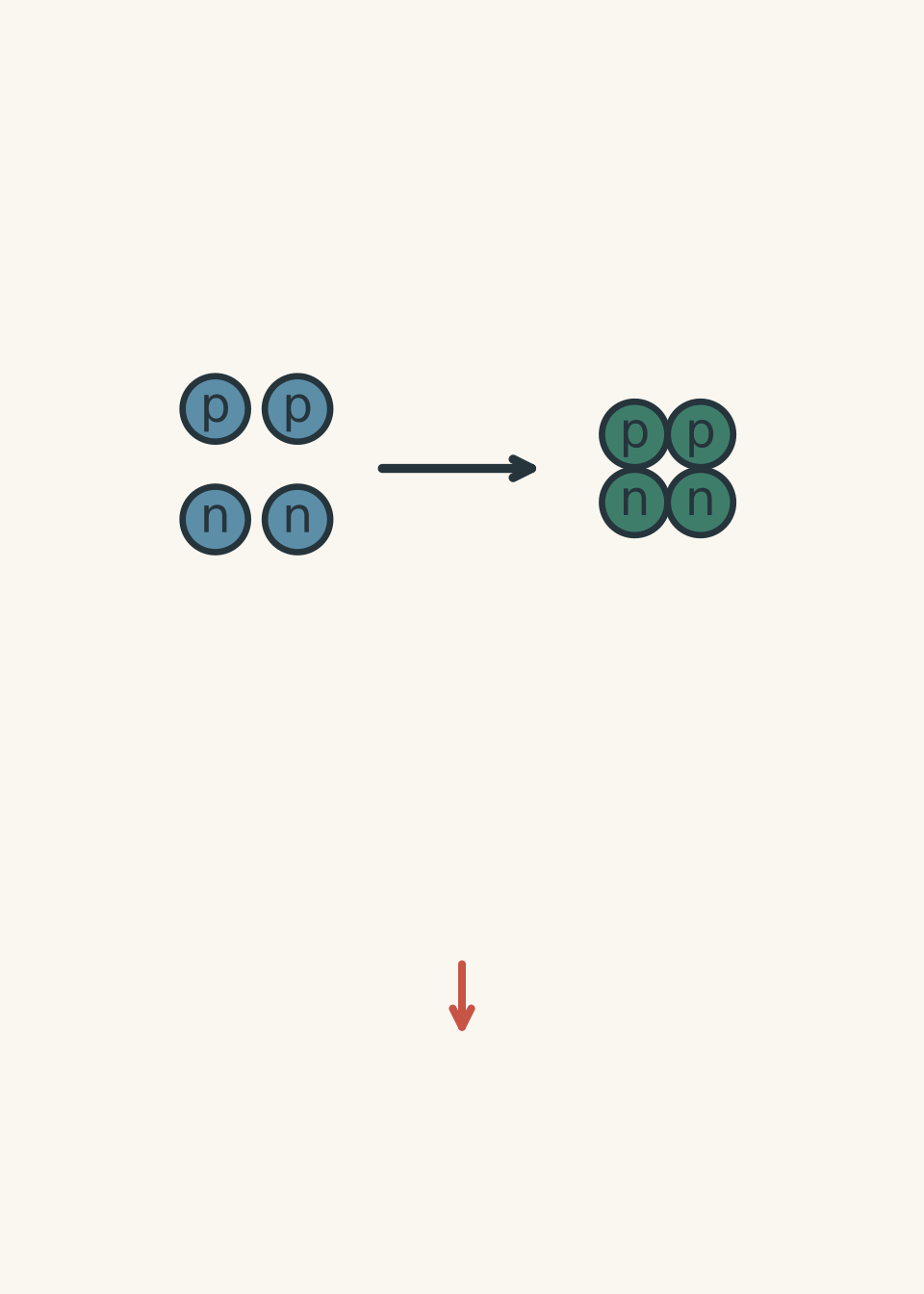
A nucleus can weigh less than the particles that built it. That sounds impossible at first. If you take a collection of protons and neutrons, join them together, and put them on a balance, you might predict the nucleus should have exactly the same mass as the separate particles.
It does not.
A helium nucleus contains two protons and two neutrons, but its mass is slightly smaller than the combined mass of those four particles. Where did the missing mass go?
Before reading on, predict this: if the mass disappears during nuclear formation, has something been destroyed, or has it changed into another form? The answer is the second one. The missing mass has been converted into energy that holds the nucleus together. This is the idea behind mass defect.
01The problem mass defect solves
Imagine building a house out of individual bricks. The finished house will have almost exactly the same mass as the pile of bricks. The energy involved in arranging the bricks is tiny compared with the mass of the bricks themselves.
Nuclei are different.
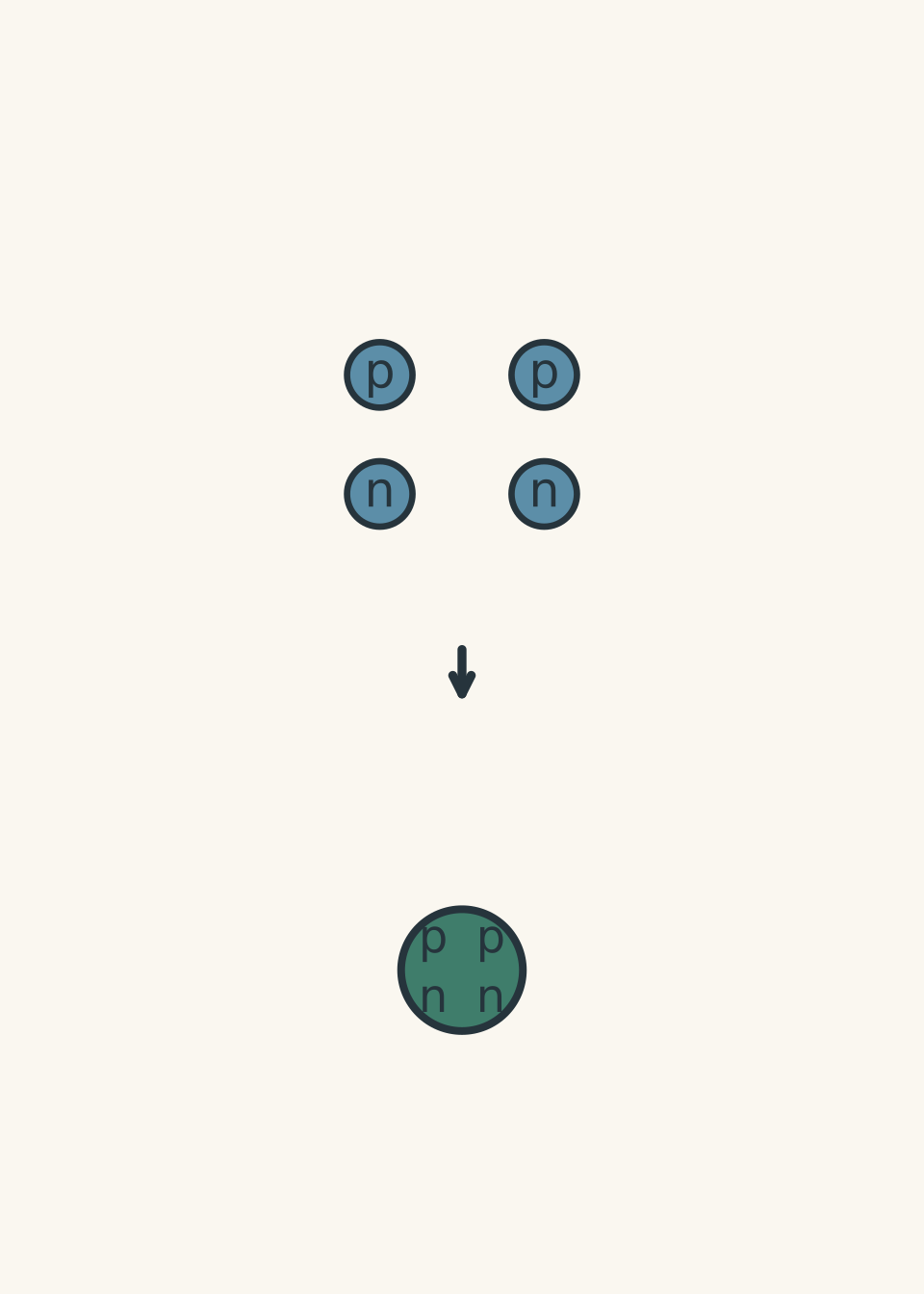
Inside a nucleus, protons and neutrons are held together by the strong nuclear force. When nucleons come together, energy is released. Because energy and mass are connected, the energy leaving the system reduces the mass of the final nucleus.
This is described by Einstein’s relationship:
\[ E = mc^2 \]
where:
- \(E\) is energy in joules (J),
- \(m\) is mass in kilograms (kg),
- \(c\) is the speed of light in metres per second (m/s).
The important idea is not that mass has vanished. The missing mass has become energy.
A useful way to picture this is like a group project where everyone starts with the same amount of “effort”. After the team works together, some effort is stored in the strong relationships that hold the group together. For a nucleus, the “relationship energy” is the binding energy. The analogy breaks down because people are not converted into energy, but nuclei really do have a measurable mass difference.
02Building the idea: from nucleons to nuclei
A proton has a certain mass. A neutron has a certain mass. If we know how many protons and neutrons are in a nucleus, we can calculate the expected mass of the separate nucleons.
Then we compare it with the actual measured mass of the nucleus.
The difference is the mass defect.
\[ \text{mass defect} = \text{mass of separate nucleons} - \text{mass of nucleus} \]
The mass defect is usually very small, often measured in atomic mass units (u).
One atomic mass unit is:
\[ 1\text{ u} = 1.66 \times 10^{-27}\text{ kg} \]
The mass defect becomes useful because it tells us the amount of energy stored in the nucleus as binding energy.
\[ E_b = \Delta m c^2 \]
where:
- \(E_b\) is the binding energy in joules (J),
- \(\Delta m\) is the mass defect in kilograms (kg),
- \(c\) is the speed of light (\(3.00 \times 10^8\text{ m/s}\)).
03The first simplification: what mass are we actually comparing?
A common mistake is to compare the wrong things.
For HSC calculations, you need to be careful about whether you are using:
- nuclear masses, which exclude electrons,
- atomic masses, which include electrons.
Most exam questions provide the information needed. If atomic masses are given, the electron masses usually cancel because the number of electrons matches the number of protons on both sides of the comparison.
The physics idea stays the same:
The mass defect comes from the difference between the mass before binding and the mass after binding.
04Worked example: calculating mass defect
Worked example: A helium nucleus
A helium-4 nucleus contains two protons and two neutrons.
The mass of a proton is \(1.0073\text{ u}\).
The mass of a neutron is \(1.0087\text{ u}\).
The measured mass of a helium-4 nucleus is \(4.0015\text{ u}\).
Calculate the mass defect.
Step 1
There are two protons and two neutrons:
\[ m_{\text{separate}} = 2(1.0073) + 2(1.0087) \]
\[ m_{\text{separate}} = 2.0146 + 2.0174 \]
\[ m_{\text{separate}} = 4.0320\text{ u} \]
Step 2
\[ \Delta m = 4.0320 - 4.0015 \]
\[ \Delta m = 0.0305\text{ u} \]
Step 3
The mass defect is:
\[ \boxed{0.0305\text{ u}} \]
This means \(0.0305\text{ u}\) of mass has been converted into binding energy when the helium nucleus formed.
05Worked example: converting mass defect into energy
Worked example: Binding energy of helium-4
The helium nucleus from the previous example has a mass defect of \(0.0305\text{ u}\). Calculate its binding energy.
Use:
\[ 1\text{ u}=1.66\times10^{-27}\text{ kg} \]
and:
\[ c=3.00\times10^8\text{ m/s} \]
Step 1
\[ \Delta m = 0.0305 \times 1.66\times10^{-27} \]
\[ \Delta m = 5.06\times10^{-29}\text{ kg} \]
Step 2
\[ E_b=\Delta mc^2 \]
Substitute the values:
\[ E_b=(5.06\times10^{-29})(3.00\times10^8)^2 \]
\[ E_b=(5.06\times10^{-29})(9.00\times10^{16}) \]
\[ E_b=4.55\times10^{-12}\text{ J} \]
Step 3
The binding energy is:
\[ \boxed{4.55\times10^{-12}\text{ J}} \]
This is the energy released when the helium nucleus forms from separate nucleons.
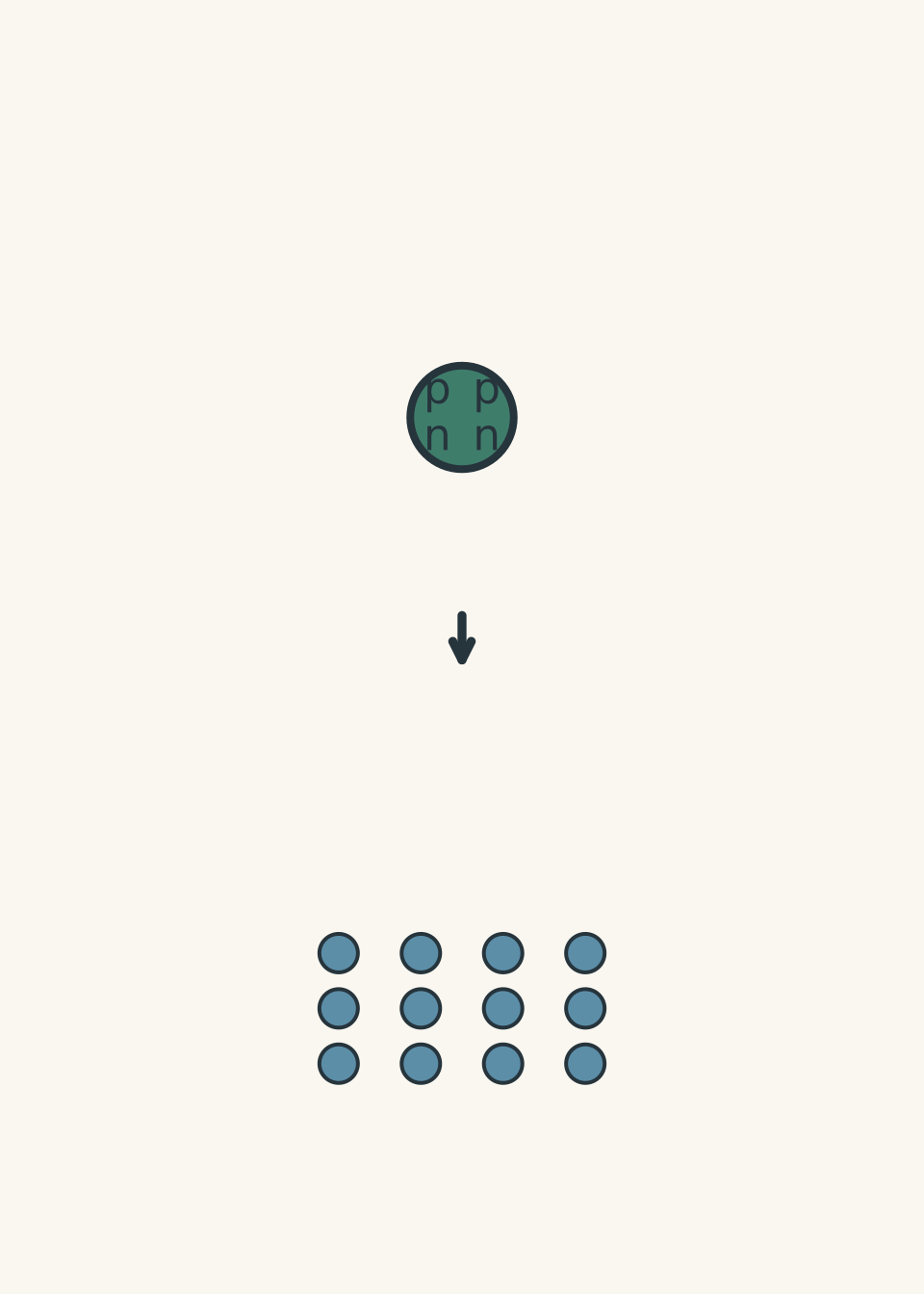
For a single nucleus this energy is tiny. For a sample containing trillions of nuclei, the total energy becomes enormous.
06The deeper idea: binding energy is not just “extra energy”
A stronger nucleus does not simply have a larger mass defect because it has more particles. Larger nuclei usually have larger total binding energies because they contain more nucleons.
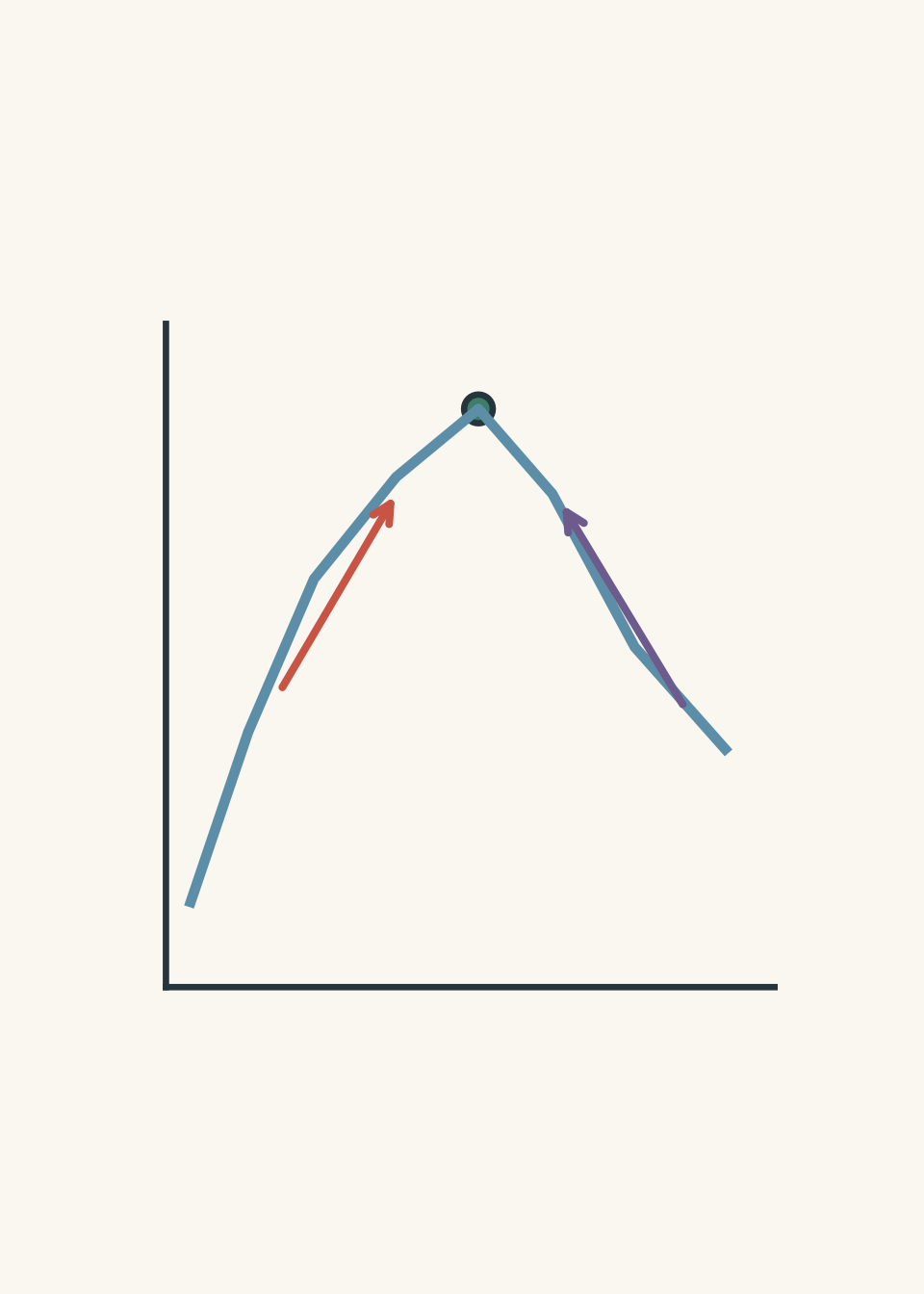
However, the useful comparison is binding energy per nucleon.
\[ \text{binding energy per nucleon}=\frac{\text{total binding energy}}{\text{number of nucleons}} \]
This tells us how strongly each nucleon is held on average.
Iron nuclei have one of the highest binding energies per nucleon. This helps explain why:
- very light nuclei can release energy through fusion,
- very heavy nuclei can release energy through fission.
Both processes move nuclei towards greater stability.
You can connect this idea with nuclear decay, where unstable nuclei change into more stable arrangements. For example, alpha decay involves a nucleus releasing a helium nucleus, as explained in Alpha decay: nuclear equations and radiation properties. The probability of these changes occurring over time links to ideas such as the decay constant and half-life.
07Common misconception: “The mass was destroyed”
It is tempting to say:
“The nucleus lost mass, so matter disappeared.”
That prediction feels reasonable because we see mass as a property of objects. But in nuclear physics, mass and energy are connected.
The better statement is:
The nucleus has less mass because energy has been released from the system.
Another common trap is thinking that a larger nucleus must have a larger binding energy per nucleon. More nucleons can mean more total binding energy, but the average binding energy per nucleon depends on how tightly those nucleons are arranged.
A huge nucleus can have more total binding energy but still be less stable per nucleon than a smaller nucleus.
08Questions and solutions
Question 1
A lithium-7 nucleus contains three protons and four neutrons.
The mass of a proton is \(1.0073\text{ u}\).
The mass of a neutron is \(1.0087\text{ u}\).
The measured mass of the lithium-7 nucleus is \(7.0144\text{ u}\).
Calculate the mass defect.
Solution 1
The mass defect is \(0.0408\text{ u}\).
Step 1: Calculate the mass of the separate nucleons.
\[ m_{\text{separate}}=3(1.0073)+4(1.0087) \]
\[ m_{\text{separate}}=3.0219+4.0348 \]
\[ m_{\text{separate}}=7.0567\text{ u} \]
Step 2: Subtract the nuclear mass.
\[ \Delta m=7.0567-7.0144 \]
\[ \Delta m=0.0423\text{ u} \]
Therefore:
\[ \boxed{\Delta m=0.0423\text{ u}} \]
The tempting mistake is to subtract the nuclear mass from the proton masses only, but neutrons also contribute to the original mass. Every nucleon must be included.
Question 2
A nucleus has a mass defect of \(0.0150\text{ u}\). Calculate its binding energy in joules.
Use:
\[ 1\text{ u}=1.66\times10^{-27}\text{ kg} \]
Solution 2
The binding energy is \(2.24\times10^{-12}\text{ J}\).
Step 1: Convert the mass defect.
\[ \Delta m=0.0150(1.66\times10^{-27}) \]
\[ \Delta m=2.49\times10^{-29}\text{ kg} \]
Step 2: Apply \(E_b=\Delta mc^2\).
\[ E_b=(2.49\times10^{-29})(3.00\times10^8)^2 \]
\[ E_b=(2.49\times10^{-29})(9.00\times10^{16}) \]
\[ E_b=2.24\times10^{-12}\text{ J} \]
The result is small for one nucleus, but nuclear reactions involve huge numbers of nuclei, so the total energy can become very large.
Question 3
Two nuclei are formed in different reactions.
- Nucleus A has a mass defect of \(0.20\text{ u}\) and contains 20 nucleons.
- Nucleus B has a mass defect of \(0.50\text{ u}\) and contains 80 nucleons.
Which nucleus has the greater binding energy per nucleon, and why?
Solution 3
Nucleus A has the greater binding energy per nucleon.
Step 1: Compare the binding energy per nucleon using the mass defect.
Because binding energy is proportional to mass defect:
For A:
\[ \frac{0.20}{20}=0.010\text{ u per nucleon} \]
For B:
\[ \frac{0.50}{80}=0.00625\text{ u per nucleon} \]
Nucleus B has more total binding energy, so it is tempting to think it is more tightly bound. However, it has that energy spread across many more nucleons.
The correct comparison is the energy per nucleon, so:
\[ \boxed{\text{Nucleus A is more tightly bound per nucleon}} \]
This is why total binding energy and stability are not the same measurement.
Question 4
A student says:
“A fusion reaction always releases energy because two nuclei join together, and joining things always creates more binding.”
Explain why this statement is incomplete.
Solution 4
The statement is incomplete because fusion only releases energy when the products have a greater binding energy per nucleon than the original nuclei.
Step 1: Identify the hidden assumption.
The student assumes that combining nuclei automatically makes them more stable. That is not always true.
Step 2: Apply the binding energy per nucleon idea.
Very light nuclei can release energy by fusing because they move towards the high binding-energy-per-nucleon region near iron.
However, nuclei heavier than iron would generally not gain stability through fusion. The resulting nucleus would not necessarily have a larger binding energy per nucleon.
The key constraint is the change in stability, not simply the fact that nuclei have joined.
Question 5
A researcher compares two possible nuclear reactions.
Reaction X changes a collection of light nuclei into a nucleus closer to iron. The total mass decreases by \(3.0\times10^{-12}\text{ kg}\).
Reaction Y changes a very heavy nucleus into two medium-sized nuclei. The total mass decreases by \(3.0\times10^{-12}\text{ kg}\).
A student argues that Reaction X must release more energy because fusion is “more powerful” than fission. Is the student correct?
Solution 5
The student is incorrect. Both reactions release the same energy if the mass defect is the same.
Step 1: Use the governing principle.
The energy released depends on the missing mass:
\[ E=\Delta mc^2 \]
Both reactions have:
\[ \Delta m=3.0\times10^{-12}\text{ kg} \]
So:
\[ E=(3.0\times10^{-12})(3.00\times10^8)^2 \]
\[ E=2.7\times10^5\text{ J} \]
Both reactions release:
\[ \boxed{2.7\times10^5\text{ J}} \]
Step 2: Explain the trap.
The student has confused the type of reaction with the amount of energy released. Fusion and fission are labels describing how the nucleus changes. The energy comes from the mass defect.
A more subtle point is that in real nuclear reactions, the mass defect depends on the exact nuclei involved. “Fusion” is not automatically larger than “fission”. The deciding factor is how far the system moves towards a more tightly bound arrangement.
Understanding mass defect gives you the tool needed to explain why nuclear reactions release energy, and it leads directly into predicting which nuclei are stable, why decay occurs, and why the binding energy curve has the shape it does.