
Gravitational Field Strength: HSC Physics Explained Clearly
Learn how gravitational field strength is calculated using g = GM/r² and understand the difference between a field and gravitational force. Includes worked examples and HSC-style questions.
A satellite is orbiting Earth. You might expect gravity to become “weak” because the satellite is hundreds of kilometres above the ground. But astronauts still experience Earth’s gravitational pull. So what is actually changing?
Here is the puzzle: if gravity is still acting, why do astronauts feel weightless?
The answer begins with separating two ideas that students often accidentally blend together: the strength of a gravitational field, and the force a particular object feels inside that field.
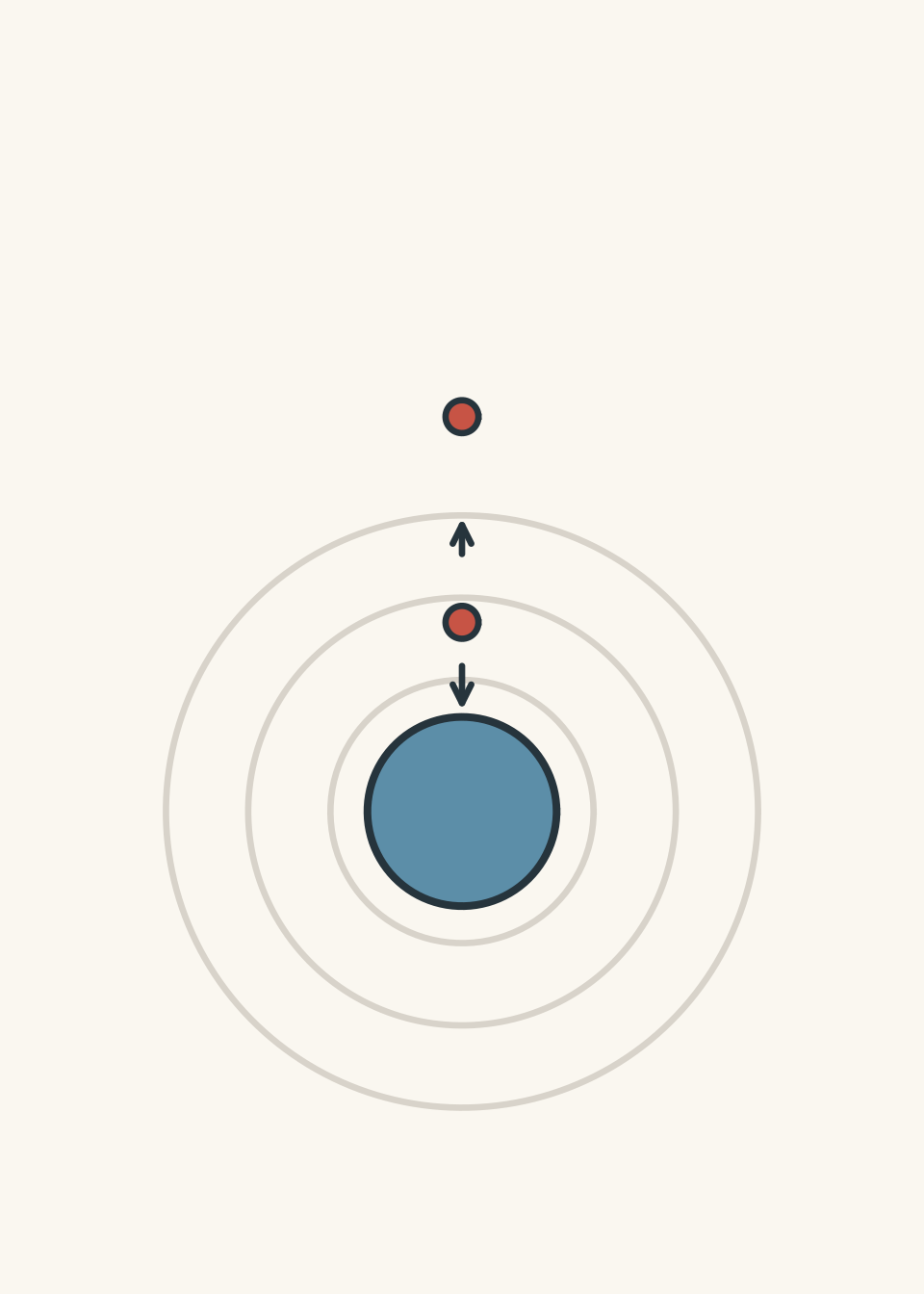
A gravitational field describes the space around a mass where another mass would experience a gravitational effect. The field exists even if there is nothing there to feel it.
A force is different. A force only appears when an object with mass is placed in the field.
Think about standing near a heater. The heater can produce warmth whether or not your hand is there. Your hand only experiences a temperature change because it interacts with that warmth. Gravity works in a similar way: the field is the “environment”, while the force is the effect on a specific object.
01Building the idea: what does gravitational field strength mean?
Imagine placing a 1 kg object at different locations around Earth.
Near Earth’s surface, the object is pulled strongly downward. Move the object further away, and the pull becomes weaker.
Predict this:
If two identical 1 kg objects are placed in different parts of Earth’s gravitational field, one on the ground and one high above Earth, which one experiences the larger gravitational force?
The one closer to Earth experiences the larger force because it is in a stronger gravitational field.
But the field strength itself does not depend on the object you place there. A 1 kg object and a 10 kg object at the same location experience the same gravitational field strength. The larger object simply feels a larger force because it has more mass.
The gravitational field strength is defined as the gravitational force per unit mass:
\[ g = \frac{F}{m} \]
where:
- \(g\) is gravitational field strength, measured in newtons per kilogram (\(\text{N kg}^{-1}\))
- \(F\) is gravitational force, measured in newtons (\(\text{N}\))
- \(m\) is the mass experiencing the force, measured in kilograms (\(\text{kg}\))
Near Earth’s surface, \(g\) is approximately:
\[ g = 9.8 \text{ N kg}^{-1} \]
This means every kilogram of mass experiences about 9.8 N of gravitational force.
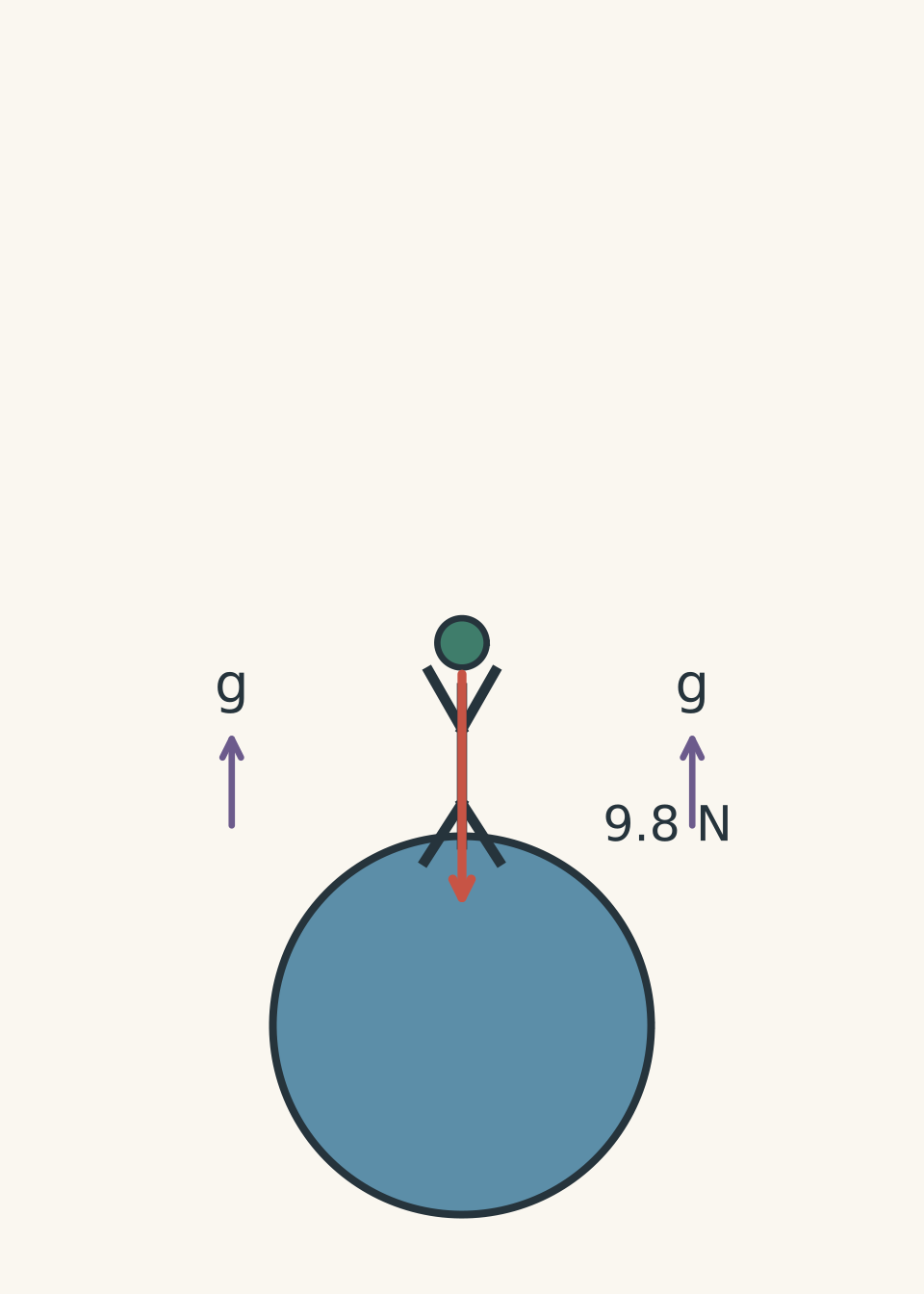
02The field around a planet: why does distance matter?
Newton’s law of universal gravitation gives the force between two masses:
\[ F = \frac{GMm}{r^2} \]
where:
- \(G\) is the universal gravitational constant, \(6.67 \times 10^{-11} \text{ N m}^2\text{/kg}^2\)
- \(M\) is the mass creating the gravitational field, such as Earth’s mass
- \(m\) is the mass placed in the field
- \(r\) is the distance from the centre of the mass \(M\)
Now combine this with the definition of field strength:
\[ g = \frac{F}{m} \]
Substitute Newton’s law:
\[ g = \frac{GMm}{r^2m} \]
The test mass \(m\) cancels:
\[ g = \frac{GM}{r^2} \]
This is the equation HSC Physics uses for gravitational field strength around a spherical mass.
The important idea is hidden in the cancellation: the field strength depends only on the object creating the field and the distance from its centre.
A heavier person does not create a stronger Earth field for themselves. A satellite does not “carry” its own smaller gravity. The field is determined by Earth’s mass and the satellite’s distance from Earth’s centre.
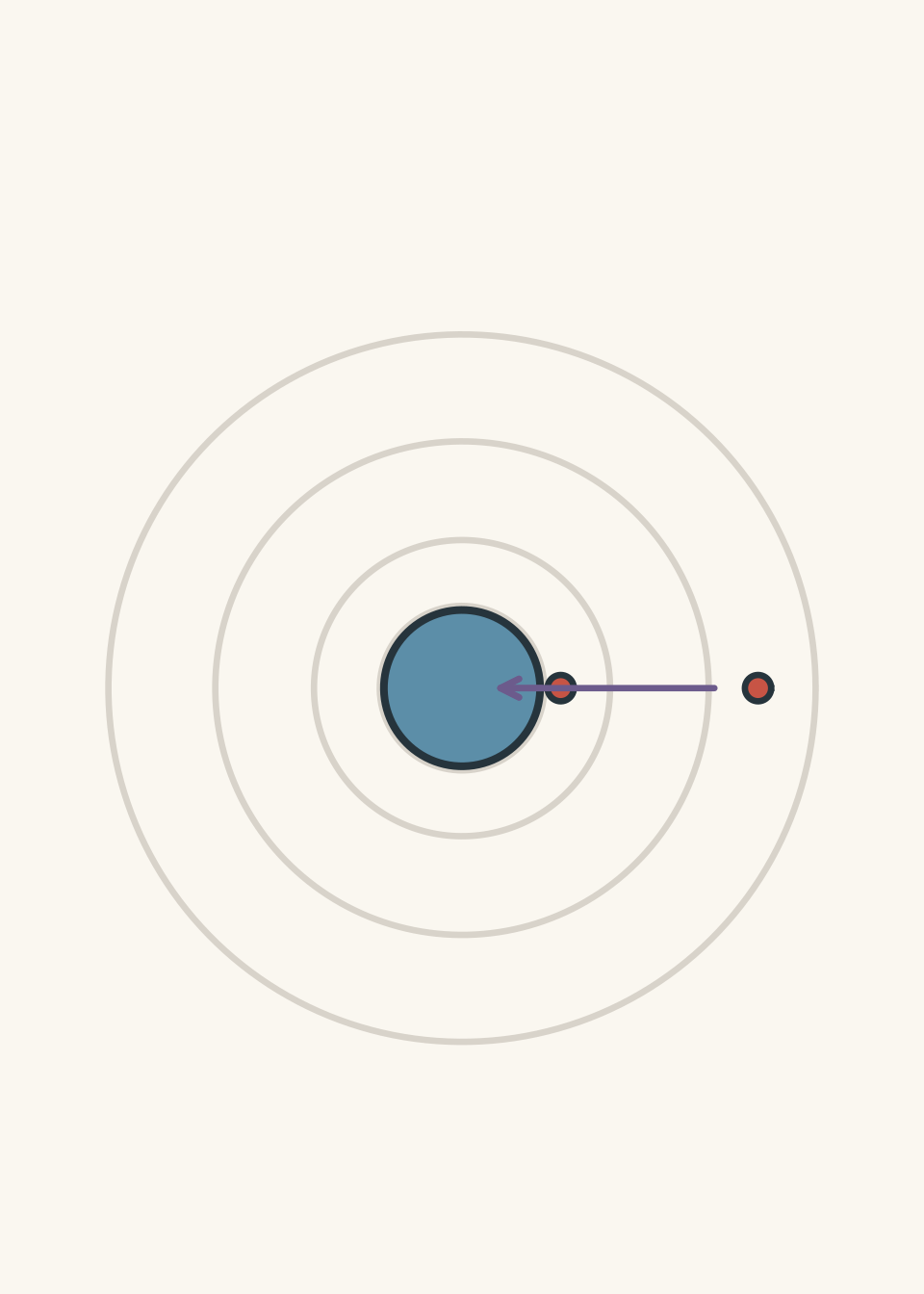
03The inverse square relationship
The \(r^2\) in the denominator creates an inverse square relationship.
This means:
- Double the distance from the centre of the planet → field strength becomes one quarter.
- Triple the distance → field strength becomes one ninth.
Students often predict that moving twice as far away makes gravity half as strong. That feels reasonable because distance has doubled, but gravity spreads out over the surface area of an expanding sphere.
The surface area of a sphere increases according to:
\[ A = 4\pi r^2 \]
As the distance increases, the same gravitational influence is spread across a larger area. That is why the field decreases with the square of the distance.
04Field strength versus gravitational force
This distinction causes many HSC mistakes.
Suppose an astronaut travels from Earth’s surface to a high orbit.
What changes?
The gravitational field strength decreases because \(r\) increases.
What about the gravitational force on the astronaut?
The force also decreases because:
\[ F = mg \]
The astronaut’s mass stays constant, so a smaller \(g\) means a smaller gravitational force.
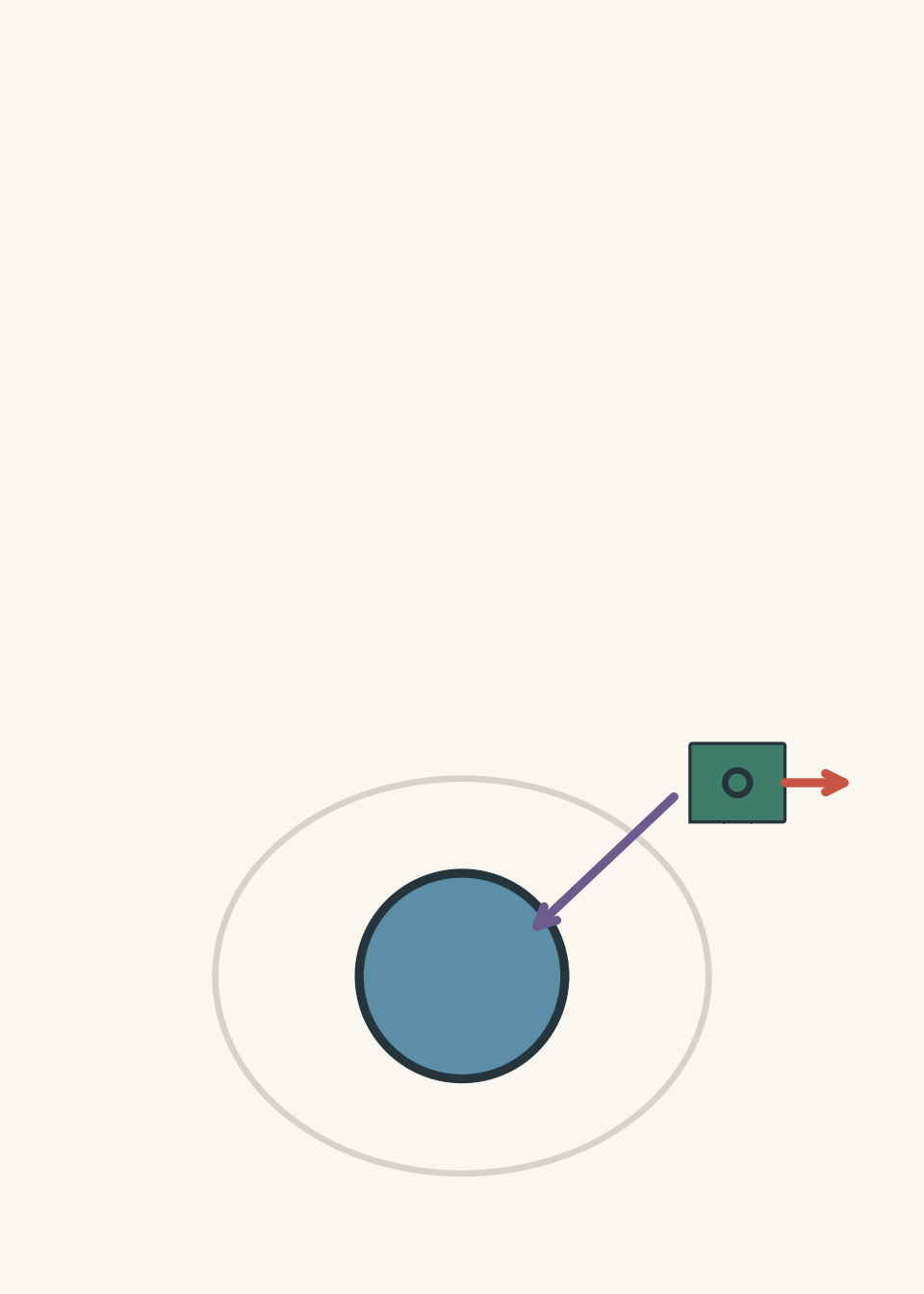
However, astronauts feel weightless in orbit mainly because they are continuously falling around Earth, not because gravity has disappeared. Their spacecraft and their bodies accelerate together under gravity.
A useful comparison:
| Quantity | Depends on | Changes if astronaut moves farther away? |
|---|---|---|
| Gravitational field strength \(g\) | Planet mass and distance from centre | Yes |
| Gravitational force \(F\) | Field strength and object mass | Yes |
| Object mass \(m\) | Amount of matter in object | No |
05Worked example: gravitational field strength above Earth
A satellite is \(7.0 \times 10^6\) m from Earth’s centre. Calculate the gravitational field strength at this distance.
Use:
\[ g = \frac{GM}{r^2} \]
For Earth:
\[ M = 5.97 \times 10^{24} \text{ kg} \]
and:
\[ G = 6.67 \times 10^{-11} \text{ N m}^2\text{/kg}^2 \]
Step 1
The distance is measured from Earth’s centre, so:
\[ r = 7.0 \times 10^6 \text{ m} \]
Step 2
\[ g = \frac{(6.67 \times 10^{-11})(5.97 \times 10^{24})}{(7.0 \times 10^6)^2} \]
Step 3
\[ g = \frac{3.98 \times 10^{14}}{4.9 \times 10^{13}} \]
\[ g = 8.1 \text{ N kg}^{-1} \]
Step 4
The gravitational field strength is about \(8.1 \text{ N kg}^{-1}\), slightly lower than the \(9.8 \text{ N kg}^{-1}\) near Earth’s surface because the satellite is further from Earth’s centre.
06Worked example: finding gravitational force from field strength
A satellite has a mass of \(1200\) kg and is located where the gravitational field strength is \(7.5 \text{ N kg}^{-1}\). Calculate the gravitational force acting on the satellite.
Step 1
The field strength is already given, so use:
\[ F = mg \]
Step 2
\[ F = (1200)(7.5) \]
Step 3
\[ F = 9000 \text{ N} \]
Step 4
The satellite experiences a gravitational force of \(9000\) N towards the object creating the field, in this case Earth.
Notice the difference: \(7.5 \text{ N kg}^{-1}\) describes the location. \(9000\) N describes what happens to this particular satellite.
07A common misconception: “zero gravity” in space
The phrase “zero gravity” is often used casually, but it is not accurate for most spacecraft near Earth.
A spacecraft in low Earth orbit still has a large gravitational field acting on it. The reason astronauts float is that both the spacecraft and astronaut are in free fall.
The spacecraft is moving sideways fast enough that as it falls toward Earth, it keeps missing the surface.
This idea connects directly to how gravity provides the centripetal force needed for circular orbits. You can explore that next in Gravity as Centripetal Force in Circular Orbits for HSC Physics.
08Questions and solutions
Question 1
A probe is located \(4.0 \times 10^6\) m from the centre of a planet with mass \(2.0 \times 10^{24}\) kg. Calculate the gravitational field strength at this location.
Use:
\[ G = 6.67 \times 10^{-11} \text{ N m}^2\text{/kg}^2 \]
Solution 1
The gravitational field strength is \(8.34 \text{ N kg}^{-1}\).
The governing equation is:
\[ g = \frac{GM}{r^2} \]
Substitute:
\[ g = \frac{(6.67 \times 10^{-11})(2.0 \times 10^{24})}{(4.0 \times 10^6)^2} \]
\[ g = \frac{1.334 \times 10^{14}}{1.6 \times 10^{13}} \]
\[ g = 8.34 \text{ N kg}^{-1} \]
The important idea is that the probe’s own mass was not needed. Field strength describes the planet’s gravitational environment, not the object placed inside it.
Question 2
A satellite is moved from an orbit where the gravitational field strength is \(12 \text{ N kg}^{-1}\) to an orbit twice as far from the centre of the planet. What is the new gravitational field strength?
Solution 2
The new gravitational field strength is \(3.0 \text{ N kg}^{-1}\).
The tempting mistake is to halve the value because the distance doubled. However, gravitational field strength follows an inverse square relationship:
\[ g \propto \frac{1}{r^2} \]
If the distance doubles:
\[ g_{\text{new}}=\frac{12}{2^2} \]
\[ g_{\text{new}}=\frac{12}{4} \]
\[ g_{\text{new}}=3.0 \text{ N kg}^{-1} \]
The square is the key feature. Doubling the distance spreads the field over four times the relevant spherical area.
Question 3
Two astronauts, with masses of 60 kg and 90 kg, are standing at the same point on a planet’s surface where the gravitational field strength is \(11 \text{ N kg}^{-1}\).
Explain why they experience different gravitational forces but the same gravitational field strength.
Solution 3
The astronauts experience different gravitational forces, but they are in the same gravitational field because field strength does not depend on the test object’s mass.
For the 60 kg astronaut:
\[ F = mg \]
\[ F = (60)(11) \]
\[ F = 660 \text{ N} \]
For the 90 kg astronaut:
\[ F = (90)(11) \]
\[ F = 990 \text{ N} \]
The heavier astronaut experiences a larger force because there is more mass for the field to act on. However, the location is the same, so the gravitational field strength remains \(11 \text{ N kg}^{-1}\).
Question 4
A student says:
“An astronaut orbiting Earth has a smaller gravitational force because they are weightless, so the gravitational field must be zero.”
Evaluate this statement.
Solution 4
The statement is incorrect because weightlessness does not mean the gravitational field is zero.
The astronaut is still inside Earth’s gravitational field. The field strength is smaller than at Earth’s surface because the astronaut is further from Earth’s centre, but it is not zero.
The mistake comes from confusing the sensation of weight with the existence of gravitational force. In orbit, the astronaut and spacecraft are both accelerating under gravity, so the astronaut does not feel a support force from the spacecraft floor.
A useful check is that if gravity were zero, the spacecraft could not remain in orbit around Earth.
Question 5
A planet has the same mass as Earth but twice Earth’s radius. A student claims that the gravitational field strength at the surface must be the same as Earth’s because the planet contains the same amount of mass.
Determine whether the student is correct and explain the reasoning.
Solution 5
The student is incorrect. The gravitational field strength at the surface would be one quarter of Earth’s surface field strength.
The tempting route is to focus only on the planet’s mass:
\[ g = \frac{GM}{r^2} \]
The student correctly notices that \(M\) is unchanged. However, the distance \(r\) from the centre of the planet has also changed.
For the larger planet:
\[ r_{\text{new}} = 2r_{\text{Earth}} \]
Substitute into the relationship:
\[ g_{\text{new}} = \frac{GM}{(2r)^2} \]
\[ g_{\text{new}} = \frac{GM}{4r^2} \]
\[ g_{\text{new}} = \frac{1}{4}g_{\text{Earth}} \]
The deeper idea is that surface gravity depends on both how much mass creates the field and how far away you are from that mass’s centre. A planet can have the same mass but a much weaker surface gravitational field if that mass is spread over a larger radius.
Understanding gravitational field strength gives you the tool needed for the next step in gravitational problems: using the field to explain orbital motion, escape velocity, and changes in satellite energy. These ideas are connected through the same question: how does gravity change as distance changes? You can continue with Energy Changes When Satellites Change Orbit: HSC Physics or Escape Velocity for HSC Physics: Derivation and Calculations.