
Electrical Energy in HSC Physics: Using E = Pt
Learn how to calculate electrical energy using E = Pt and connect energy transfer to voltage, current, resistance, and time in HSC Physics.
A 60 W lamp and a 1200 W heater can both run for 10 minutes. They run for the same time, so do they transfer the same amount of electrical energy?
No. The heater transfers energy 20 times faster. If both operate steadily for the same time, it also transfers 20 times as much energy. That simple idea is what \(E = Pt\) captures.
Before looking at the equation, predict this: if you leave the same lamp on for twice as long, what doubles, its power or the energy it transfers?
The energy doubles. The lamp is still transferring energy at the same rate, so its power stays the same. It just keeps doing that job for longer.
01Power tells you how quickly energy is transferred
Imagine filling a bucket from a tap. The flow rate tells you how quickly water enters. The amount of water in the bucket depends on both the flow rate and how long the tap runs.
Electrical power plays the role of the flow rate. Electrical energy is the accumulated amount.
The analogy is useful, but it has a limit. Energy isn’t a substance sloshing through wires like water. Power simply describes the rate at which energy is transferred or transformed.
Power is defined by
\[
P = \frac{E}{t}
\]
where:
- \(P\) is power in watts (\(\text{W}\))
- \(E\) is energy transferred in joules (\(\text{J}\))
- \(t\) is time in seconds (\(\text{s}\))
Rearranging gives the equation you will often need:
\[
E = Pt
\]
One watt means one joule per second:
\[
1\text{ W} = 1\text{ J s}^{-1}
\]
So a 60 W lamp transfers 60 J of energy every second while operating at that power.
After 1 second, it has transferred 60 J. After 10 seconds, 600 J. After 100 seconds, 6000 J.
That is why multiplying power by time gives energy.
02Worked example: How much energy does a lamp transfer?
A 75 W lamp operates for 4.0 minutes. Calculate the electrical energy transferred.
Step 1Convert the time to seconds.
The equation \(E = Pt\) uses SI units, so time should be in seconds.
\[
t = 4.0 \times 60 = 240\text{ s}
\]
Step 2Use \(E = Pt\).
\[
E = Pt = 75 \times 240 = 18\,000\text{ J}
\]
Step 3State what the result means.
\[
\boxed{E = 1.8 \times 10^4\text{ J}}
\]
The lamp transfers \(18\,000\text{ J}\), or \(18\text{ kJ}\), of electrical energy during the four minutes.
Notice that the 75 W rating is not an amount of energy. It is an energy transfer rate.
03Connecting energy to voltage and current
In a circuit, you often won’t be handed the power directly. Instead, you might know the current and potential difference.
Electrical power is
\[
P = VI
\]
where:
- \(V\) is potential difference in volts (\(\text{V}\))
- \(I\) is current in amperes (\(\text{A}\))
You can review this relationship in tutorgum’s guide to electrical power and \(P = VI\).
Substitute \(P = VI\) into \(E = Pt\):
\[
E = Pt
\]
\[
E = (VI)t
\]
so
\[
\boxed{E = VIt}
\]
This equation tells you that the electrical energy transferred depends on three things:
- the potential difference across the device
- the current through the device
- how long that transfer continues
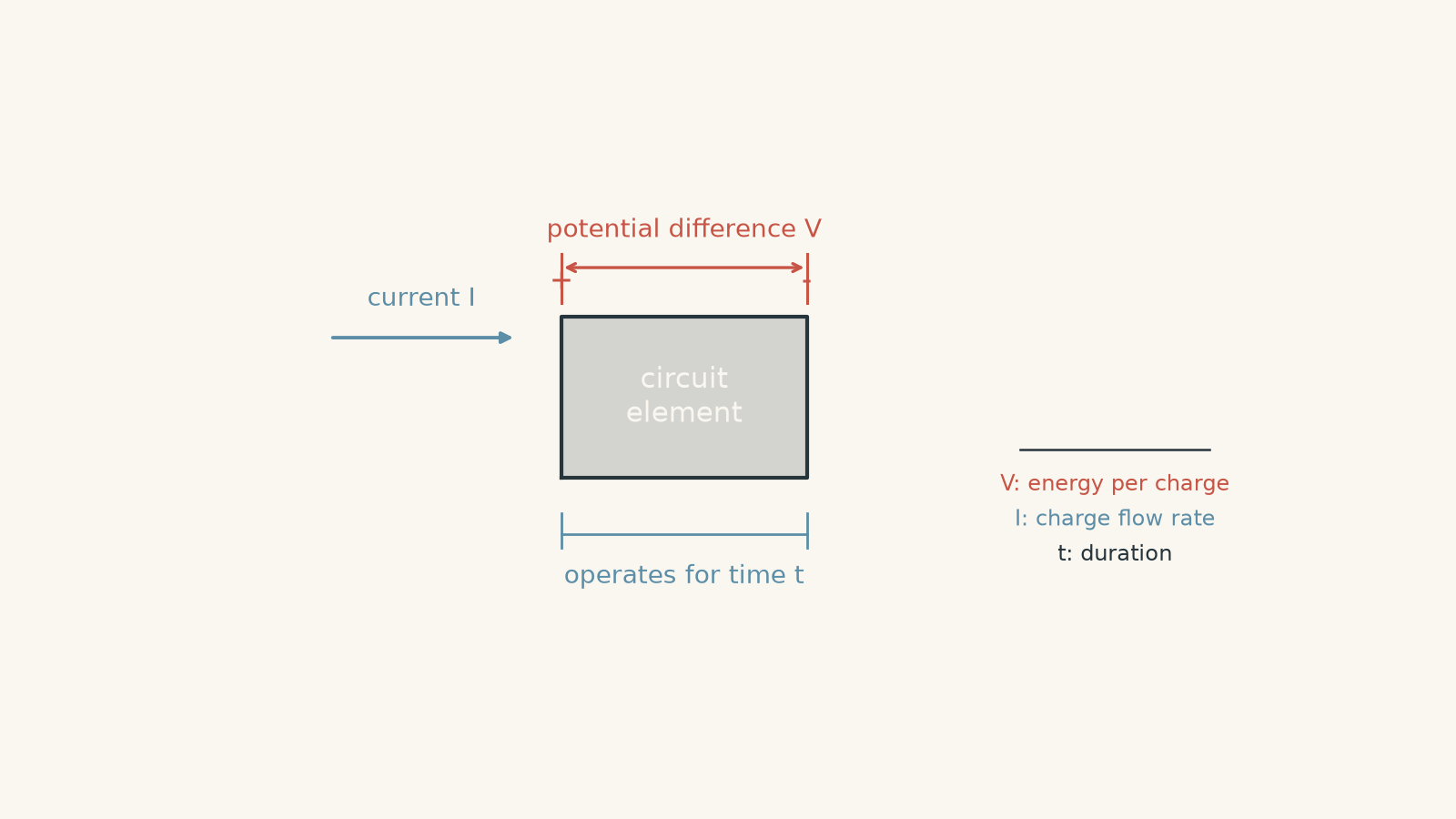
What is \(VIt\) actually saying?
Current tells you how much charge passes each second:
\[
I = \frac{q}{t}
\]
so
\[
q = It
\]
where \(q\) is charge in coulombs (\(\text{C}\)).
Potential difference tells you how much energy is transferred per coulomb of charge:
\[
V = \frac{E}{q}
\]
which rearranges to
\[
E = qV
\]
Now replace \(q\) with \(It\):
\[
E = (It)V = VIt
\]
So \(E = VIt\) isn’t a separate rule that appeared from nowhere. It combines two physical ideas:
- \(It\) tells you how much charge passes.
- \(V\) tells you how much energy is transferred per coulomb.
For example, if 20 C of charge passes through a device with a potential difference of 6 V, each coulomb transfers 6 J:
\[
E = qV = 20 \times 6 = 120\text{ J}
\]
The same result must come from \(E = VIt\) if the current and time give \(q = 20\text{ C}\).
For a closer look at why potential difference measures energy transferred per charge, see Potential Difference and Electrical Work: Using \(W = qV\).
04Worked example: Using voltage and current
A small motor operates with a potential difference of 12 V and draws a current of 2.5 A for 3.0 minutes. Calculate the electrical energy transferred to the motor.
Step 1Convert the time to seconds.
\[
t = 3.0 \times 60 = 180\text{ s}
\]
Step 2Find the power.
\[
P = VI
\]
\[
P = 12 \times 2.5 = 30\text{ W}
\]
The motor receives electrical energy at a rate of 30 J every second.
Step 3Find the energy transferred.
\[
E = Pt
\]
\[
E = 30 \times 180 = 5400\text{ J}
\]
Therefore,
\[
\boxed{E = 5.4 \times 10^3\text{ J}}
\]
The motor receives 5.4 kJ of electrical energy during the three minutes.
We could have gone directly to
\[
E = VIt = 12 \times 2.5 \times 180 = 5400\text{ J}
\]
The physics is identical. The two-step method is often easier to understand because you can first see the device’s power and then ask how long that power acts.
05The useful chain of equations
These relationships fit together rather than competing with each other.
| Relationship | What it tells you |
|---|---|
| \(P = \frac{E}{t}\) | Power is energy transferred per unit time |
| \(E = Pt\) | Energy equals power multiplied by time |
| \(P = VI\) | Circuit power depends on potential difference and current |
| \(E = VIt\) | Electrical energy transferred over a time interval |
| \(I = \frac{q}{t}\) | Current is charge flow rate |
| \(E = qV\) | Potential difference gives energy transferred per charge |
A useful decision rule is:
- Given \(P\) and \(t\)? Use \(E = Pt\).
- Given \(V\), \(I\), and \(t\)? Use \(E = VIt\).
- Given \(q\) and \(V\)? Use \(E = qV\).
- Given resistance instead of either \(V\) or \(I\)? First use a suitable power relationship, then use \(E = Pt\).
06Connecting energy to resistance
For a resistor under conditions where the relation \(V = IR\) is applicable, the power equation can be rewritten.
Starting with
\[
P = VI
\]
and substituting \(V = IR\):
\[
P = I(IR)
\]
so
\[
P = I^2R
\]
Alternatively, substitute \(I = \frac{V}{R}\):
\[
P = V\left(\frac{V}{R}\right)
\]
giving
\[
P = \frac{V^2}{R}
\]
Therefore, electrical energy can also be written as
\[
E = I^2Rt
\]
or
\[
E = \frac{V^2}{R}t
\]
These forms are useful, but don’t memorise them as unrelated equations. Start from the quantities you actually know.
There is also an important condition hiding here: you cannot blindly assume that \(R\) remains constant. For an ohmic conductor under constant physical conditions, that may be a good model. For a component whose temperature and resistance change substantially, using one resistance value for the entire time interval may give the wrong result.
07Worked example: Energy transferred by a resistor
A 24 \(\Omega\) resistor is connected across a constant 12 V potential difference for 90 s. Calculate the electrical energy transferred to the resistor.
Step 1Decide how to find the power.
We know \(V\) and \(R\), so
\[
P = \frac{V^2}{R}
\]
Step 2Calculate the power.
\[
P = \frac{12^2}{24}
= \frac{144}{24}
= 6.0\text{ W}
\]
The resistor is transferring electrical energy at 6.0 J per second.
Step 3Calculate the energy.
\[
E = Pt
\]
\[
E = 6.0 \times 90 = 540\text{ J}
\]
Therefore,
\[
\boxed{E = 540\text{ J}}
\]
In this resistor, that electrical energy is mainly transformed into thermal energy.
08The biggest misconception: power is not energy
Suppose two students compare a 20 W device and a 100 W device.
One says, “The 100 W device uses more energy.”
Is that always true?
No. It transfers energy faster, but total energy also depends on time.
Suppose the 100 W device runs for 10 s:
\[
E = 100 \times 10 = 1000\text{ J}
\]
Now suppose the 20 W device runs for 100 s:
\[
E = 20 \times 100 = 2000\text{ J}
\]
The lower-power device transfers twice as much total energy because it operates for much longer.
Think of power as the speed of spending money on a date. Spending $100 per hour sounds impressive or alarming, depending on the date. But someone spending $20 per hour for six hours still spends more overall. Power is the rate. Energy is the total.
The analogy breaks because joules aren’t dollars and a circuit isn’t checking its bank balance, but the distinction between rate and total amount is exactly the same.
09A second trap: \(E = Pt\) needs the right power
If a device operates at a constant power of 50 W for 20 s,
\[
E = 50 \times 20 = 1000\text{ J}
\]
Easy.
But suppose its power changes:
- 50 W for the first 10 s
- 80 W for the next 10 s
You cannot use \(E = 50 \times 20\), because the device isn’t at 50 W for the whole interval.
Calculate each section:
\[
E_1 = 50 \times 10 = 500\text{ J}
\]
\[
E_2 = 80 \times 10 = 800\text{ J}
\]
so
\[
E_{\text{total}} = 500 + 800 = 1300\text{ J}
\]
You could also use the average power for this particular interval:
\[
P_{\text{avg}} = \frac{50 + 80}{2} = 65\text{ W}
\]
because the two power values each apply for the same length of time.
Then
\[
E = P_{\text{avg}}t = 65 \times 20 = 1300\text{ J}
\]
The general idea is that electrical energy is the accumulated power over time. On a power-time graph, the energy transferred is the area under the graph.
So when you see \(E = Pt\), mentally read it as:
energy = constant power × time
or, when power varies,
energy = average power × time
where the average has been found correctly for that interval.
10Unit checks that catch a lot of mistakes
The equation can often tell you whether your units make sense.
Since
\[
E = Pt
\]
the units are
\[
\text{J} = \text{W} \times \text{s}
\]
because
\[
1\text{ W} = 1\text{ J s}^{-1}
\]
Similarly, from
\[
E = VIt
\]
the units are
\[
\text{V} \times \text{A} \times \text{s}
\]
and because \(\text{V}\times\text{A}=\text{W}\),
\[
\text{V}\times\text{A}\times\text{s}
=
\text{W}\times\text{s}
=
\text{J}
\]
Common conversions include:
- \(1\text{ min} = 60\text{ s}\)
- \(1\text{ kW} = 1000\text{ W}\)
- \(1\text{ kJ} = 1000\text{ J}\)
If a question gives 5 minutes and you substitute \(t=5\) into an equation using watts, you’ve mixed minutes with joules per second. That is usually a factor-of-60 error.
11Questions and solutions
Question 1
A 40 W study lamp operates for 15 minutes. Calculate the electrical energy transferred.
Solution 1
The lamp transfers \(\boxed{3.6\times10^4\text{ J}}\), or \(36\text{ kJ}\), of electrical energy.
Power is the rate of energy transfer, so use
\[
E = Pt
\]
First convert the time:
\[
t = 15\times60 = 900\text{ s}
\]
Then
\[
E = 40\times900
= 36\,000\text{ J}
\]
Therefore,
\[
\boxed{E = 3.6\times10^4\text{ J}}
\]
The main trap is using 15 directly as the time. Watts are joules per second, so the time must be converted from minutes to seconds.
Question 2
A device operates across a potential difference of 9.0 V. A current of 0.40 A passes through it for 5.0 minutes.
Calculate:
a. the power of the device
b. the electrical energy transferred
c. the charge that passes through the device
Then use \(E=qV\) to verify your energy answer.
Solution 2
The power is \(\boxed{3.6\text{ W}}\), the energy transferred is \(\boxed{1.08\times10^3\text{ J}}\), and the charge transferred is \(\boxed{120\text{ C}}\).
For part a, use
\[
P = VI
\]
\[
P = 9.0\times0.40
= 3.6\text{ W}
\]
For part b, convert the time:
\[
t = 5.0\times60 = 300\text{ s}
\]
Then
\[
E = Pt
\]
\[
E = 3.6\times300
= 1080\text{ J}
\]
so
\[
\boxed{E = 1.08\times10^3\text{ J}}
\]
For part c,
\[
I = \frac{q}{t}
\]
so
\[
q = It
\]
\[
q = 0.40\times300
= 120\text{ C}
\]
Now check the energy using
\[
E = qV
\]
\[
E = 120\times9.0
= 1080\text{ J}
\]
The two methods agree because \(q=It\). The equations \(E=qV\) and \(E=VIt\) describe the same energy transfer from two different starting points.
Question 3
Two heating elements are each connected across a constant 12 V supply for 60 s.
Element A has a resistance of \(6.0\,\Omega\). Element B has a resistance of \(24\,\Omega\).
A student argues that Element B should transfer more energy because its greater resistance “opposes the current more strongly and therefore makes more heat”.
Calculate the energy transferred by each element and assess the student’s claim.
Solution 3
Element A transfers \(\boxed{1440\text{ J}}\), while Element B transfers \(\boxed{360\text{ J}}\). Under the stated constant-voltage conditions, the student’s claim is incorrect.
With a fixed potential difference, use
\[
P = \frac{V^2}{R}
\]
For Element A:
\[
P_A = \frac{12^2}{6.0}
= \frac{144}{6.0}
= 24\text{ W}
\]
Therefore,
\[
E_A = P_At
= 24\times60
= 1440\text{ J}
\]
For Element B:
\[
P_B = \frac{12^2}{24}
= \frac{144}{24}
= 6.0\text{ W}
\]
Therefore,
\[
E_B = P_Bt
= 6.0\times60
= 360\text{ J}
\]
So
\[
\boxed{E_A = 1440\text{ J}}
\]
and
\[
\boxed{E_B = 360\text{ J}}
\]
The tempting misconception is that a greater resistance automatically means greater heating. That ignores what is being held constant.
At constant voltage,
\[
P = \frac{V^2}{R}
\]
so increasing \(R\) decreases the power.
If instead the same current were forced through both resistors, the relevant expression would be
\[
P = I^2R
\]
and the larger resistance would have the greater power. You must check the circuit conditions before deciding how resistance affects energy transfer.
Question 4
A laboratory device operates at 30 W for 20 s and then at 75 W for another 40 s.
A student calculates its total energy transfer using
\[
E = 30\times60
\]
because 30 W was the power at the start of the experiment.
Explain why this method fails and calculate the correct total energy transferred.
Solution 4
The device transfers \(\boxed{3600\text{ J}}\) in total. The student’s method fails because the power is not 30 W for the full 60 s.
For the first interval,
\[
E_1 = P_1t_1
\]
\[
E_1 = 30\times20
= 600\text{ J}
\]
For the second interval,
\[
E_2 = P_2t_2
\]
\[
E_2 = 75\times40
= 3000\text{ J}
\]
Therefore,
\[
E_{\text{total}} = E_1 + E_2
\]
\[
E_{\text{total}} = 600 + 3000
= 3600\text{ J}
\]
so
\[
\boxed{E_{\text{total}}=3.6\times10^3\text{ J}}
\]
The student’s calculation assumes a constant power of 30 W. That assumption is contradicted by the information in the question.
You could also find the average power over all 60 s:
\[
P_{\text{avg}}
=
\frac{E_{\text{total}}}{t_{\text{total}}}
=
\frac{3600}{60}
=
60\text{ W}
\]
Then \(E=P_{\text{avg}}t\) gives the same result.
Notice that simply averaging 30 W and 75 W would give 52.5 W, which is wrong here because the device spends different amounts of time at the two powers.
Question 5
A filament is connected to a constant potential difference. When it is first switched on, its resistance is \(10\,\Omega\). As the filament heats up, its resistance increases.
A student wants the exact electrical energy transferred during the first 30 s and calculates
\[
E = \frac{V^2}{10}(30)
\]
using the initial resistance for the entire interval.
No further information about how the resistance changes is available.
Can the exact energy transferred during the 30 s be determined from the given information? Explain whether the student’s calculation is likely to overestimate or underestimate the actual energy.
Solution 5
The exact energy cannot be determined from the information given, and the student’s calculation will overestimate the actual energy if the potential difference remains constant and the resistance rises above \(10\,\Omega\).
At a fixed potential difference,
\[
P = \frac{V^2}{R}
\]
The student’s calculation assumes that
\[
R=10\,\Omega
\]
for all 30 s. But the question explicitly states that the resistance increases as the filament heats.
As \(R\) increases while \(V\) remains constant,
\[
P = \frac{V^2}{R}
\]
decreases.
The initial power is therefore greater than the later power. Treating that larger initial power as though it continued for the whole 30 s gives too much energy.
To calculate the exact energy, we would need enough information to determine the power throughout the interval, such as the resistance, current, or power as a function of time, or suitable measurements over smaller time intervals.
This is the important hidden assumption behind many simple \(E=Pt\) calculations: the value of \(P\) must represent the relevant interval. If the circuit conditions change, one power value cannot automatically be used for the whole time.
12What this lets you understand next
The key idea is not just the formula \(E=Pt\). It is the distinction between a rate and a total.
Power tells you how quickly electrical energy is being transferred:
\[
P = \frac{E}{t}
\]
Circuit quantities determine that rate:
\[
P = VI
\]
and time determines how long the transfer continues:
\[
E = VIt
\]
Once that connection is clear, questions about heating, appliance energy use, resistance, and circuit efficiency become much easier to reason through. The next useful step is to ask where that transferred electrical energy goes, including how much becomes useful output and how much is dissipated as thermal energy.