
Wien’s Displacement Law: Finding Temperature from Peak Wavelength
Learn how to use Wien’s displacement law to calculate temperature from a black-body spectrum’s peak wavelength, with worked HSC Physics examples.
A hot piece of metal starts dull red. Heat it further and it becomes orange, then yellow-white. The material has not suddenly learnt how to make different colours. Its temperature has changed the pattern of electromagnetic radiation it emits.
Before doing any maths, predict this: if the object gets hotter, does the wavelength at which it emits most strongly move towards longer wavelengths or shorter wavelengths?
It moves towards shorter wavelengths. Wien’s displacement law puts a number on that shift, which means a measured spectrum can act like a thermometer even when the object is a star that you cannot touch.
01What does the peak of a thermal spectrum tell us?
A hot object emits electromagnetic radiation across a range of wavelengths. It does not emit one single wavelength.
Imagine lining up the emitted wavelengths from short to long and measuring how much radiation appears in each small wavelength interval. One part of the spectrum will be higher than the rest. The wavelength at that peak is called \(\lambda_{\max}\), read as “lambda max”.
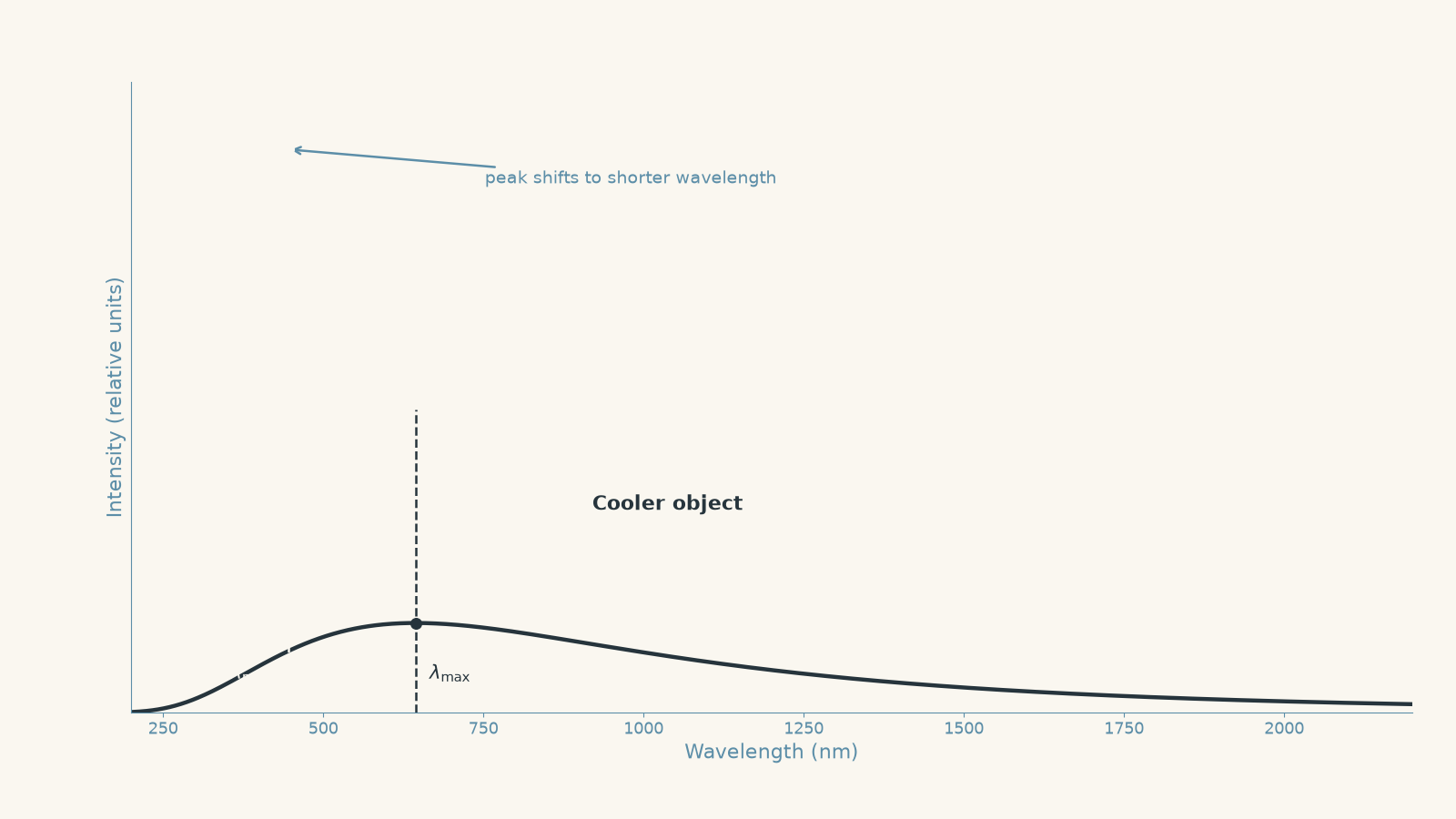
The useful pattern is:
- a cooler object has a longer \(\lambda_{\max}\),
- a hotter object has a shorter \(\lambda_{\max}\).
So a star peaking strongly in the blue part of the visible spectrum is hotter than one peaking in the red, provided their spectra are reasonably described by thermal black-body radiation.
This behaviour is part of the broader idea of black-body radiation. Wien’s displacement law focuses on one particularly useful feature of that spectrum: where the peak occurs.
02From the pattern to Wien’s displacement law
For an ideal black body,
\[ \lambda_{\max}T=b \]
or, rearranging for temperature,
\[ T=\frac{b}{\lambda_{\max}} \]
where:
- \(\lambda_{\max}\) is the wavelength of maximum spectral intensity, in metres \((\text{m})\),
- \(T\) is the absolute temperature, in kelvin \((\text{K})\),
- \(b\) is Wien’s displacement constant,
\[ b=2.898\times10^{-3}\ \text{m K} \]
For most HSC calculations, \(2.90\times10^{-3}\ \text{m K}\) is sufficiently precise unless the question supplies another value.
The inverse relationship is the important part. If \(\lambda_{\max}\) halves, \(T\) doubles.
That makes physical sense from the spectrum we just pictured: heating shifts the peak towards shorter wavelengths.
The unit conversion that causes most mistakes
Spectral wavelengths are often given in nanometres or micrometres, but the standard value of \(b\) above uses metres.
| Unit | Meaning | Conversion to metres |
|---|---|---|
| \(1\ \text{nm}\) | nanometre | \(1\times10^{-9}\ \text{m}\) |
| \(1\ \mu\text{m}\) | micrometre | \(1\times10^{-6}\ \text{m}\) |
| \(1\ \text{mm}\) | millimetre | \(1\times10^{-3}\ \text{m}\) |
For example,
\[ 520\ \text{nm}=520\times10^{-9}\ \text{m}=5.20\times10^{-7}\ \text{m} \]
If you put \(520\) directly into \(T=b/\lambda_{\max}\), your answer will be wrong by a factor of \(10^9\). That is not a small rounding issue.
03Why kelvin matters
Suppose someone tries to use degrees Celsius in Wien’s law. The problem is not just convention.
Wien’s law involves absolute temperature. A temperature of \(0^\circ\text{C}\) is not “no thermal energy”; it is \(273.15\ \text{K}\). The inverse relationship only has its physical meaning when temperature is measured from absolute zero.
Convert Celsius to kelvin using
\[ T(\text{K})=T({}^\circ\text{C})+273.15 \]
Usually, though, a Wien’s law question asks you to find \(T\) directly in kelvin.
04Worked example: Finding a star’s surface temperature
A star’s thermal spectrum has a maximum intensity at a wavelength of \(500\ \text{nm}\). Estimate its surface temperature using Wien’s displacement law.
Step 1
We know
\[ \lambda_{\max}=500\ \text{nm} \]
and need to calculate \(T\).
Step 2
\[ 500\ \text{nm}=500\times10^{-9}\ \text{m} =5.00\times10^{-7}\ \text{m} \]
Step 3
Starting from
\[ \lambda_{\max}T=b \]
we get
\[ T=\frac{b}{\lambda_{\max}} \]
Step 4
\[ T= \frac{2.898\times10^{-3}\ \text{m K}} {5.00\times10^{-7}\ \text{m}} =5.796\times10^3\ \text{K} \]
So,
\[ T\approx5.80\times10^3\ \text{K} \]
The star’s estimated surface temperature is about \(5800\ \text{K}\).
The metres cancel, leaving kelvin, which is exactly what we want.
05A useful mental shortcut
Because \(T\) and \(\lambda_{\max}\) are inversely proportional, you can often check an answer before touching your calculator.
Suppose Star A peaks at \(400\ \text{nm}\) and Star B at \(800\ \text{nm}\).
Which is hotter?
Star A. Its peak wavelength is half as large, so its temperature must be twice as large:
\[ \frac{T_A}{T_B} = \frac{\lambda_{\max,B}}{\lambda_{\max,A}} = \frac{800}{400} =2 \]
Notice that the wavelength units cancel in a ratio, so both wavelengths could remain in nanometres here.
This is a useful sanity check. If your calculator somehow tells you that the \(800\ \text{nm}\) object is hotter, something has gone wrong.
06The peak is not the only wavelength emitted
A common mistake is to read \(\lambda_{\max}=900\ \text{nm}\) and conclude, “The object emits infrared radiation, not visible light.”
That is not what Wien’s law says.
The peak is simply where the spectrum reaches its maximum. A thermal emitter produces a broad range of wavelengths on both sides of that peak.
Think of a party where one song gets the most people dancing. Calling it the most popular song does not mean every other song has suddenly vanished. \(\lambda_{\max}\) is the most intense part of the spectrum, not the only radiation present.
The analogy breaks because a radiation spectrum is continuous rather than a collection of separate songs, but the distinction between “largest” and “only” is the useful part.
This explains why a hot object can glow visibly even when its calculated \(\lambda_{\max}\) is still in the infrared.
Worked example: A hot object whose peak is invisible
A hot tungsten surface has a temperature of \(2900\ \text{K}\).
Calculate its peak wavelength and determine which part of the electromagnetic spectrum contains that peak.
Step 1
\[ \lambda_{\max}=\frac{b}{T} \]
Step 2
\[ \lambda_{\max} = \frac{2.898\times10^{-3}\ \text{m K}} {2900\ \text{K}} =9.99\times10^{-7}\ \text{m} \]
Step 3
\[ 9.99\times10^{-7}\ \text{m} = 0.999\ \mu\text{m} = 999\ \text{nm} \]
So,
\[ \lambda_{\max}\approx1.00\ \mu\text{m} \]
This lies just beyond the visible range, in the infrared.
Yet a tungsten object at this temperature can still appear very bright. There is plenty of radiation at visible wavelengths even though the maximum of the curve lies in the infrared.
That distinction is worth remembering: Wien’s law locates the peak. It does not mark the edges of the emitted spectrum.
07Using Wien’s law as a temperature measurement
The calculation itself is usually short. The harder part is deciding whether the wavelength you have been given really is \(\lambda_{\max}\).
A reliable process is:
- Identify the peak wavelength of the object’s thermal spectrum.
- Convert that wavelength to metres.
- Use \(T=b/\lambda_{\max}\).
- Give the temperature in kelvin.
- Check whether the result agrees with the inverse relationship: shorter peak wavelength should mean higher temperature.
There is also an important modelling condition hidden in step 1.
Wien’s law applies directly to black-body radiation. Real stars and hot objects are not perfect black bodies. Their spectra can contain absorption lines, emission lines, atmospheric effects, detector effects, and other complications.
For many HSC problems, the question tells you to treat the object as a black body, or gives a smooth thermal spectrum for which the approximation is intended. In that situation, using Wien’s law is appropriate.
08What Wien’s law cannot tell you
Suppose two stars have exactly the same \(\lambda_{\max}\).
Can you conclude that they emit the same total power?
No.
You can conclude, under the black-body model, that they have the same temperature. Wien’s law says nothing by itself about their size.
A huge star and a much smaller star can have the same surface temperature and therefore the same \(\lambda_{\max}\), while emitting very different total amounts of energy.
Similarly, the height of a measured spectrum and the position of its peak are different pieces of information. Wien’s law uses the position.
That separation becomes important when you later connect black-body spectra to the Stefan-Boltzmann law, where temperature and emitting surface area affect total radiated power.
09One precision that is easy to miss
The familiar form
\[ \lambda_{\max}=\frac{b}{T} \]
refers specifically to the peak of a spectrum expressed per unit wavelength.
That phrase sounds fussy, but it prevents a genuine mistake. If a spectrum is instead plotted against frequency, the highest point on that frequency graph is not simply converted into the wavelength peak by using \(\lambda=c/f\).
Changing from wavelength intervals to frequency intervals changes how the spectrum is divided up. So the location of the maximum changes too.
For normal HSC Wien’s law questions, you will generally be given a peak wavelength directly. Just do not turn an arbitrary “peak frequency” into \(\lambda_{\max}\) and assume nothing has changed.
10Questions and solutions
Question 1
A star is approximated as a black body and has a peak wavelength of \(725\ \text{nm}\).
Calculate its surface temperature.
Solution 1
The star’s surface temperature is approximately \(4.00\times10^3\ \text{K}\).
Wien’s displacement law gives
\[ T=\frac{b}{\lambda_{\max}} \]
First convert \(725\ \text{nm}\) to metres:
\[ 725\ \text{nm} = 725\times10^{-9}\ \text{m} = 7.25\times10^{-7}\ \text{m} \]
Then substitute:
\[ T= \frac{2.898\times10^{-3}\ \text{m K}} {7.25\times10^{-7}\ \text{m}} = 3.997\times10^3\ \text{K} \]
Therefore,
\[ T\approx4.00\times10^3\ \text{K} \]
The tempting mistake is to substitute \(725\) directly into the formula. The value of \(b\) is expressed in metre-kelvin, so the wavelength must first be expressed in metres.
Question 2
A furnace wall is approximately a black body at \(1450\ \text{K}\).
Calculate its peak wavelength. A student then says, “That means the wall cannot emit visible light because its peak is outside the visible spectrum.”
Assess the student’s statement.
Solution 2
The peak wavelength is approximately \(2.00\ \mu\text{m}\), in the infrared, but the student’s conclusion about visible light is incorrect.
Using
\[ \lambda_{\max}=\frac{b}{T} \]
gives
\[ \lambda_{\max} = \frac{2.898\times10^{-3}\ \text{m K}} {1450\ \text{K}} = 1.999\times10^{-6}\ \text{m} \]
Therefore,
\[ \lambda_{\max}\approx2.00\times10^{-6}\ \text{m} =2.00\ \mu\text{m} \]
The maximum is therefore in the infrared.
However, a black-body spectrum contains a continuous range of wavelengths. The peak identifies the wavelength at which the spectral intensity is greatest; it does not identify the only wavelength emitted.
The tempting route is to treat \(\lambda_{\max}\) like a single emission wavelength. Thermal radiation does not work that way. The furnace can emit some visible radiation even though its spectrum reaches its maximum in the infrared.
Question 3
Two stars, A and B, are each approximated as black bodies.
Star A has \(\lambda_{\max}=420\ \text{nm}\), while Star B has \(\lambda_{\max}=700\ \text{nm}\).
Determine the ratio \(T_A/T_B\). An observer also finds that the two stars have the same apparent brightness from Earth. Can the observer therefore conclude that the two stars have the same radius? Explain.
Solution 3
The temperature ratio is \(T_A/T_B=1.67\), but equal apparent brightness does not establish that the stars have the same radius.
Since
\[ T=\frac{b}{\lambda_{\max}}, \]
the ratio is
\[ \frac{T_A}{T_B} = \frac{b/\lambda_{\max,A}} {b/\lambda_{\max,B}} = \frac{\lambda_{\max,B}} {\lambda_{\max,A}} \]
Substituting,
\[ \frac{T_A}{T_B} = \frac{700\ \text{nm}}{420\ \text{nm}} = 1.67 \]
Star A is therefore about \(1.67\) times as hot as Star B.
The second conclusion does not follow from Wien’s law. Apparent brightness depends on more than temperature. In particular, the emitting area and the distance from the observer matter.
The tempting reasoning is: same observed brightness means same physical output, and therefore perhaps same size. But apparent brightness is not the same thing as total emitted power. Even knowing the temperatures from Wien’s law does not provide enough information to determine equal radii without additional information about factors such as distance and luminosity.
Question 4
An astronomer observes a thermal source through an ideal filter.
The filter blocks all wavelengths shorter than \(700\ \text{nm}\) and transmits all wavelengths of \(700\ \text{nm}\) or longer. In the transmitted spectrum, the greatest measured intensity occurs at \(700\ \text{nm}\), and the intensity decreases continuously at every longer wavelength.
A student calculates
\[ T=\frac{2.898\times10^{-3}}{700\times10^{-9}} \]
and claims that the source’s temperature must be \(4140\ \text{K}\).
Is that exact temperature justified? If not, determine what can be concluded about the source temperature. Assume the unfiltered source is an ideal black body.
Solution 4
The exact value \(4140\ \text{K}\) is not justified. The information implies that the source temperature is at least approximately \(4140\ \text{K}\).
The filter removes every wavelength below \(700\ \text{nm}\). Therefore, \(700\ \text{nm}\) is the left-hand boundary of the spectrum that the detector is allowed to see.
We are also told that the transmitted intensity decreases continuously for all wavelengths above \(700\ \text{nm}\). Therefore, the true black-body peak cannot lie at a wavelength greater than \(700\ \text{nm}\). If it did, the intensity would initially rise towards that longer-wavelength peak.
So the unfiltered spectrum must satisfy
\[ \lambda_{\max}\leq700\ \text{nm} \]
Wien’s law gives
\[ T=\frac{b}{\lambda_{\max}} \]
Because temperature is inversely proportional to \(\lambda_{\max}\), the largest possible peak wavelength gives the smallest possible temperature:
\[ T\geq \frac{2.898\times10^{-3}\ \text{m K}} {700\times10^{-9}\ \text{m}} \]
\[ T\geq4.14\times10^3\ \text{K} \]
Therefore,
\[ T\geq4140\ \text{K} \]
The student’s tempting mistake is to assume that the largest measured value must be the source’s true spectral peak. Here, the apparatus has removed the entire shorter-wavelength part of the spectrum. The maximum at \(700\ \text{nm}\) may simply occur because that is the shortest wavelength the detector is permitted to receive.
If the true \(\lambda_{\max}\) were exactly \(700\ \text{nm}\), the source would indeed have a temperature of about \(4140\ \text{K}\). If the true peak were \(600\ \text{nm}\), \(500\ \text{nm}\), or shorter, it would have been hidden by the filter and the source would be hotter.
Question 5
A detector records a black body’s spectrum using equal frequency intervals rather than equal wavelength intervals. Its frequency graph reaches a maximum at
\[ f_{\text{peak}}=5.88\times10^{14}\ \text{Hz} \]
A student calculates
\[ \lambda=\frac{c}{f_{\text{peak}}} = \frac{3.00\times10^8} {5.88\times10^{14}} \approx5.10\times10^{-7}\ \text{m} \]
and then uses \(T=b/\lambda\) to claim that the body’s temperature is approximately \(5680\ \text{K}\).
Is this use of Wien’s wavelength law valid? Explain what would need to be known before \(\lambda_{\max}=b/T\) could be used.
Solution 5
No. The calculation does not establish a temperature of \(5680\ \text{K}\) using the wavelength form of Wien’s law.
The student’s individual equation
\[ \lambda=\frac{c}{f} \]
is correct for converting one particular electromagnetic wave between its frequency and wavelength. The trap appears in the next step.
The frequency at which a spectrum plotted per unit frequency has its maximum is not, in general, the frequency corresponding to the wavelength at which the same radiation spectrum plotted per unit wavelength has its maximum.
That happens because equal wavelength intervals do not correspond to equal frequency intervals. Since
\[ c=f\lambda, \]
frequency and wavelength are inversely related. A fixed change in wavelength corresponds to a different-sized change in frequency depending on where you are in the spectrum. Re-expressing the radiation in equal frequency bins therefore changes the shape of the plotted distribution and shifts the location of its mathematical maximum.
The value
\[ \frac{c}{f_{\text{peak}}}=510\ \text{nm} \]
is the wavelength corresponding to the photons at that particular frequency. It has not been shown to be \(\lambda_{\max}\) for the wavelength-based spectrum.
To use
\[ \lambda_{\max}=\frac{b}{T}, \]
we would need the peak wavelength from the spectrum expressed per unit wavelength, or equivalent information that correctly determines that wavelength-domain peak.
This is a deeper version of the central rule in every Wien’s law problem: do not just grab a wavelength-looking number and substitute it. First establish that the quantity really is \(\lambda_{\max}\).
Once that is secure, Wien’s displacement law turns the position of a thermal spectrum’s peak into a temperature. The next useful step is to combine that temperature information with the rest of the black-body spectrum: Wien’s law tells you where the peak sits, while the Stefan-Boltzmann law tells you how strongly a black body radiates in total.