
Transverse and Longitudinal Waves: HSC Physics Guide
Learn how to distinguish transverse and longitudinal waves by comparing particle motion with wave propagation. Includes clear examples, misconceptions, and HSC-style practice.
Imagine flicking one end of a rope upwards. The pulse travels along the rope, but no piece of rope races from your hand to the other end. Each small section mainly moves up and down while the disturbance moves sideways.
Now push and pull the end of a slinky instead. The disturbance still travels away from you, but the coils move backwards and forwards along the same line.
That difference is the whole idea behind transverse and longitudinal waves. The question is not simply “Which way does the wave move?” It is:
How does the material oscillate compared with the direction in which the wave propagates?
01First, separate the wave from the particles
This is the part that causes most confusion.
Picture a long rope stretched across a room. You create a pulse at the left end and watch it travel to the right.
Predict what happens to a small piece of tape stuck halfway along the rope. Does the tape travel all the way to the right with the pulse?
It doesn’t. The tape moves away from its equilibrium position, then returns. The disturbance moves along the rope, while the material making up the rope only oscillates locally.
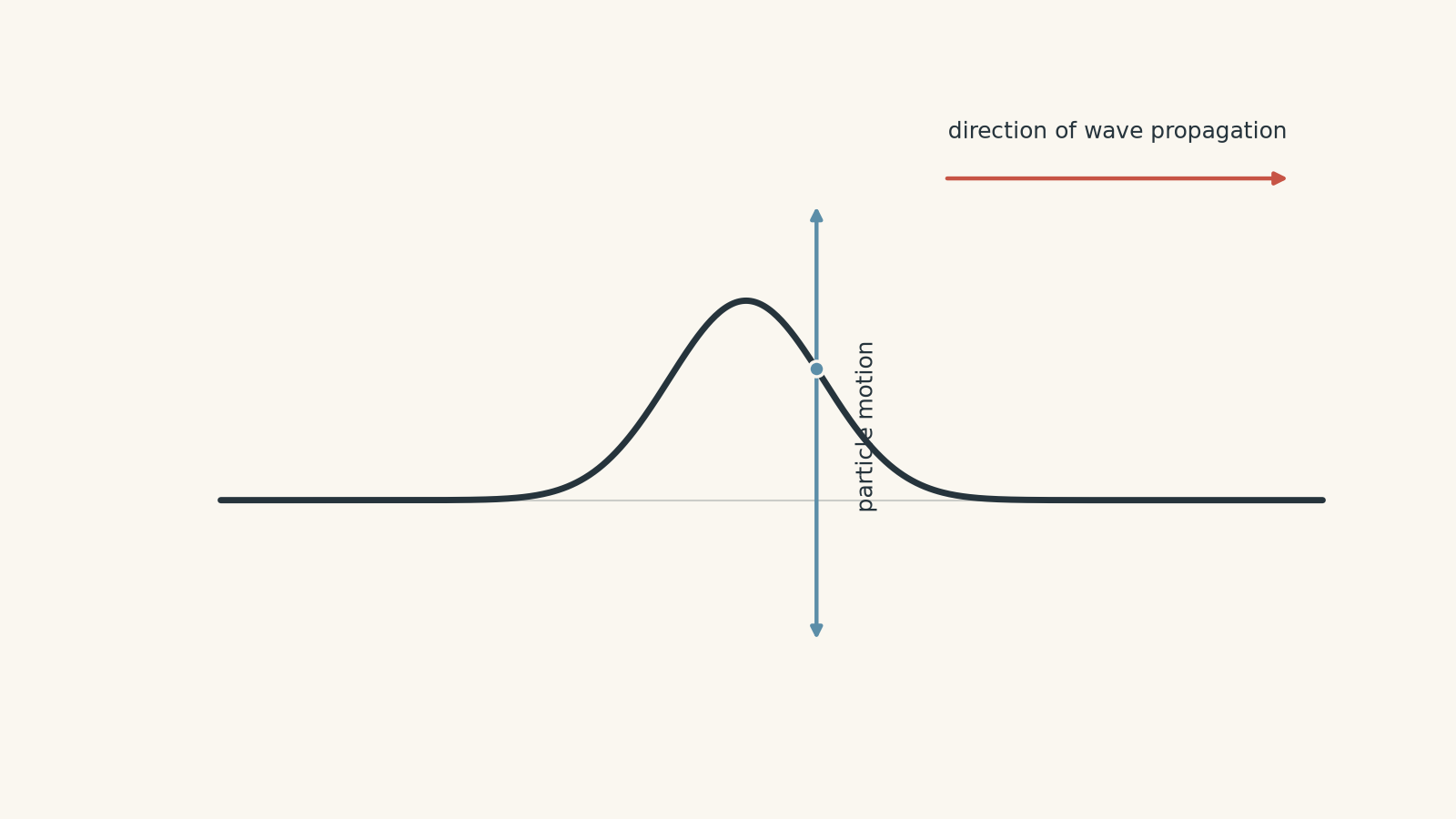
This gives us two directions to keep separate:
- Particle motion is the motion of particles of the medium around their equilibrium positions.
- Wave propagation is the direction in which the disturbance and its energy travel.
A useful mental model is a stadium wave. The pattern can travel around the stadium even though individual spectators stay near their seats. The spectators are like particles in a medium, while the travelling pattern is like the wave.
The analogy has limits. A stadium wave isn’t a continuous mechanical wave, and people make deliberate movements rather than responding to forces from neighbouring particles. But it captures the important point: a travelling pattern does not require the material itself to travel with it.
02Transverse waves: motion across the direction of travel
Return to the rope.
The pulse travels horizontally to the right. The rope sections move vertically.
Those directions are perpendicular.
A transverse wave is a wave in which the oscillation is perpendicular to the direction of propagation.
In symbols, if \(\vec{s}\) represents the particle displacement and \(\vec{v}_{\text{wave}}\) represents the direction of wave propagation, then for an ideal transverse wave:
\[ \vec{s} \perp \vec{v}_{\text{wave}} \]
The symbol \(\perp\) means “perpendicular to”.
Notice what the definition does not say. It doesn’t say transverse waves always move horizontally or that particles always move vertically. You could turn the entire rope by 90 degrees and it would still be a transverse wave.
The important feature is the relationship between the two directions.
Example: a pulse on a rope
Suppose a pulse travels east along a stretched rope. A marked section of rope moves north and south as the pulse passes.
The particle motion is north-south. The propagation is east.
These directions are perpendicular, so the pulse is transverse.
If the marked section is temporarily moving south, that does not mean the wave is travelling south. The particle’s instantaneous motion and the wave’s propagation are different things.
03Longitudinal waves: motion along the direction of travel
Now imagine a slinky lying horizontally.
Instead of flicking the end sideways, push several coils towards the rest of the slinky and release them.
A crowded region of coils moves along the slinky.
What will one marked coil do as the disturbance passes?
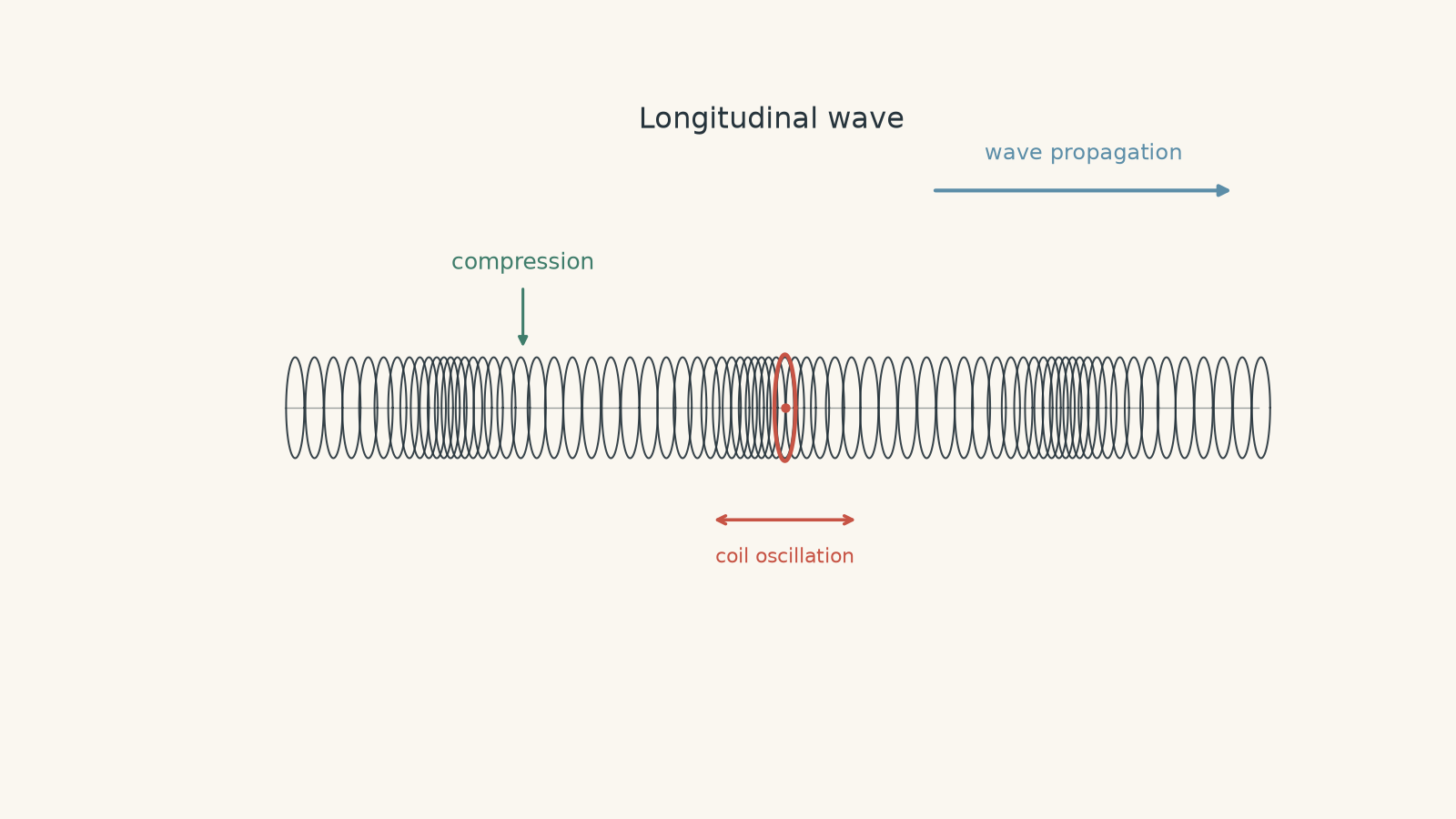
It moves forwards and backwards. It does not travel down the entire slinky.
This time the particle motion is parallel to the direction of propagation.
A longitudinal wave is a wave in which the particles oscillate parallel to the direction of propagation.
For an ideal longitudinal wave:
\[ \vec{s} \parallel \vec{v}_{\text{wave}} \]
The symbol \(\parallel\) means “parallel to”.
04Compressions and rarefactions
A longitudinal wave often looks less obviously “wave-like” because there may be no visible peaks and troughs.
Instead, particles become alternately crowded together and spread apart.
A region where particles are closer together than normal is called a compression.
A region where particles are farther apart than normal is called a rarefaction.
As the wave travels, the compressions and rarefactions propagate through the medium. Individual particles still only oscillate over a relatively small distance around their equilibrium positions.
Example: sound travelling through air
A loudspeaker cone vibrates forwards and backwards.
When the cone moves forwards, it pushes nearby air molecules closer together, producing a region of increased pressure. When it moves backwards, the molecules become more spread out.
Those pressure changes move through the air as a sound wave.
Suppose the sound travels from a speaker towards you along an east-west line. The air molecules also oscillate approximately east-west.
Particle motion and propagation are parallel, so sound in air is a longitudinal wave.
This is easy to mispicture. Air from the speaker does not need to fly across the room and enter your ear. Molecules push on neighbouring molecules, allowing the disturbance to propagate.
05The quickest way to classify a mechanical wave
Don’t begin by looking for peaks and troughs. Draw two arrows.
Ask:
- In what direction does the wave propagate?
- Along what line do the particles oscillate?
Then compare them.
| Particle oscillation compared with propagation | Wave type |
|---|---|
| Perpendicular | Transverse |
| Parallel | Longitudinal |
That rule is much safer than memorising examples.
For example, students sometimes learn “rope means transverse” and “slinky means longitudinal”. But a slinky can demonstrate either type. Move its end from side to side and you can create a transverse disturbance. Push and pull it along its length and you can create a longitudinal disturbance.
The object does not determine the classification. The relative directions do.
06A tempting misconception: particles travel with the wave
Suppose you watch a compression travel along a slinky from left to right. It is natural to think that a particular group of coils must also be travelling from left to right.
That prediction feels reasonable because we often associate motion of a pattern with motion of matter. A thrown ball, for example, moves because the ball itself changes position.
A wave behaves differently.
Consider three neighbouring coils called A, B, and C. Coil A moves and pushes on B. B responds and influences C. The disturbance therefore reaches C even though A never has to travel all the way there.
Energy can be transferred through interactions between neighbouring parts of a medium.
This is why a mechanical wave can transfer energy without a net transport of the medium from source to receiver.
Individual particles do move, but they oscillate around equilibrium positions rather than accompanying the wave over long distances.
07Don’t confuse particle displacement with wave shape
A transverse wave is often drawn as a wavy line like this:
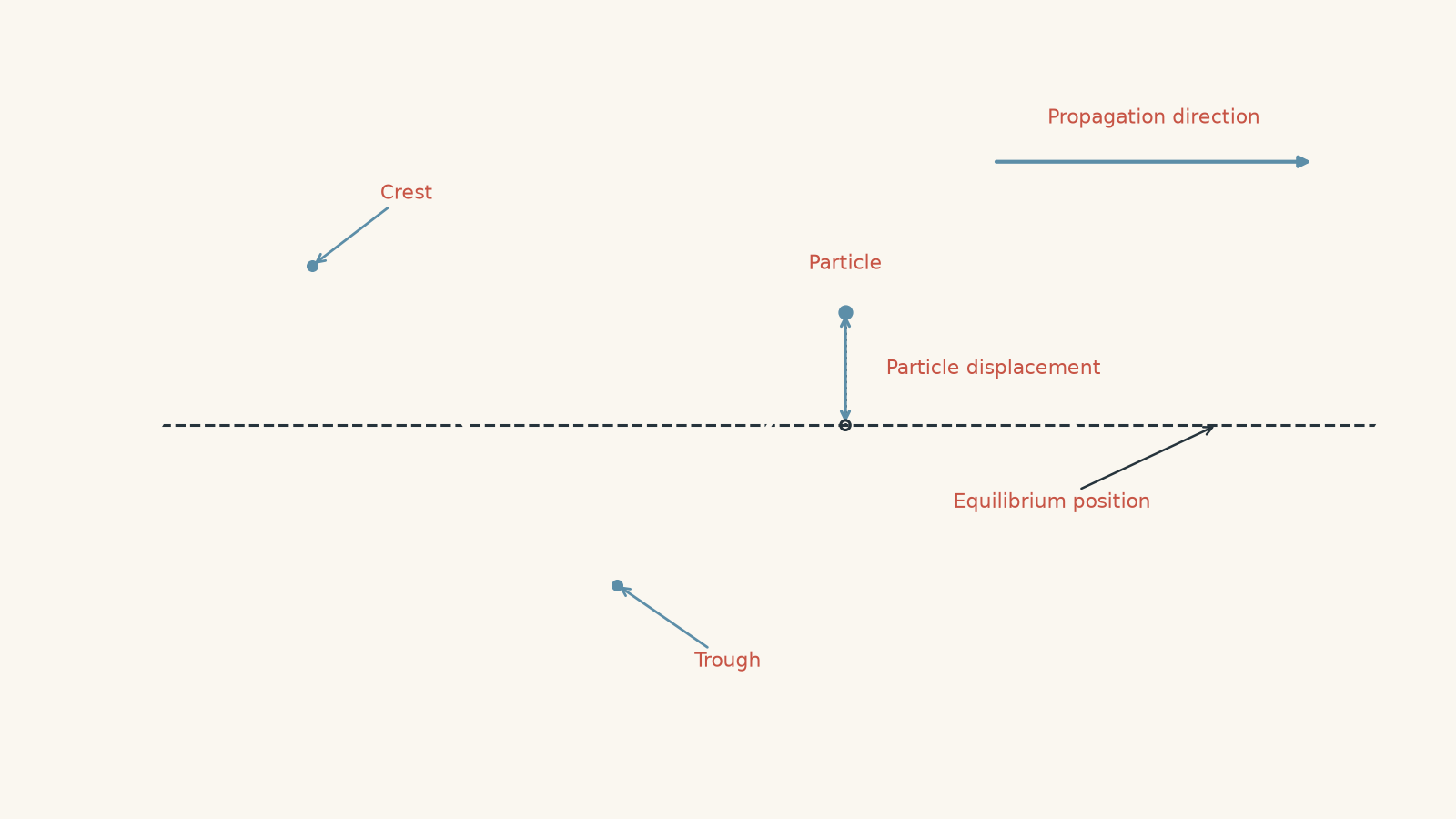
That graph can accidentally suggest that particles travel along the curved shape.
They do not.
For a simple transverse wave travelling horizontally, a particle stays at approximately the same horizontal position while moving up and down. The curved line shows the displacements of many different particles at one instant.
Think of taking a photograph of a rope. One section is high, another is near equilibrium, and another is low. Joining their positions gives the wave shape.
The shape is not a railway track followed by individual particles.
08What about wavelength?
The distinction between particle motion and propagation also prevents a common mistake when measuring wavelength.
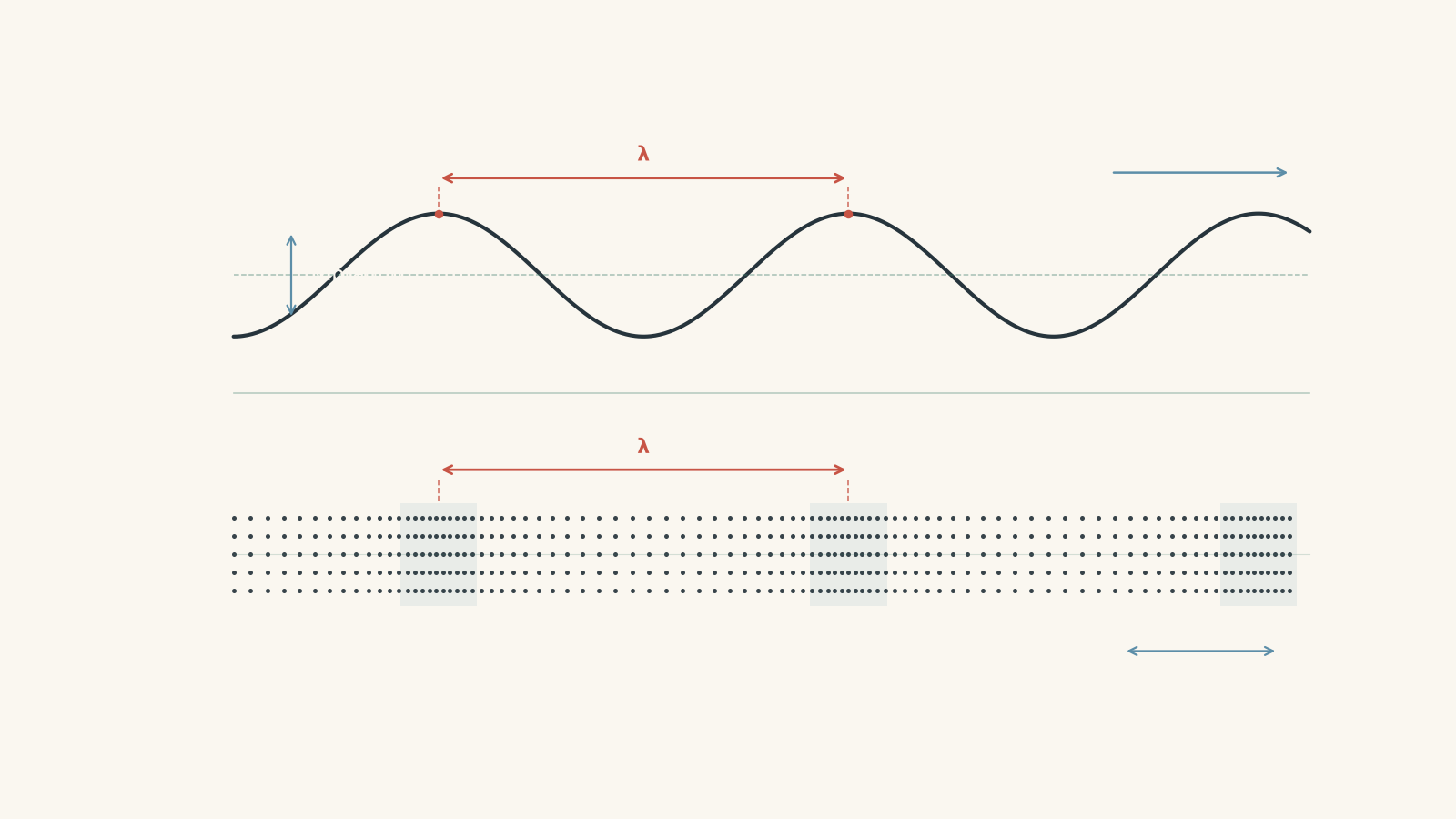
The wavelength, \(\lambda\), is the distance along the direction of propagation between two consecutive points in the same phase of oscillation.
For a transverse wave, that might be the distance from one crest to the next crest.
For a longitudinal wave, it can be the distance from the centre of one compression to the centre of the next compression.
So longitudinal waves still have wavelengths even though they do not have literal crests and troughs.
09Not every real wave fits the simple picture perfectly
The transverse-versus-longitudinal model is extremely useful, but it is worth knowing where the simplified picture ends.
Water surface waves
A wave travelling across the surface of water is often casually described as transverse because the surface moves up and down.
Real water particles near the surface can follow approximately circular or elliptical paths. Their motion therefore has both vertical and horizontal components.
So a surface water wave is not a perfect example of a purely transverse mechanical wave.
This is a good reason to classify waves from the actual particle motion rather than from what the surface happens to look like.
Electromagnetic waves
Visible light, radio waves, X-rays, and other electromagnetic waves are transverse, but there is an important difference from a rope.
There is no material medium whose particles are oscillating.
Instead, the electric field and magnetic field oscillate perpendicular to the direction in which the electromagnetic wave propagates. The electric and magnetic fields are also perpendicular to each other.
So when talking about mechanical waves, “transverse” describes particle displacement. For electromagnetic waves, it describes the directions of the oscillating fields.
10Seismic waves show why the distinction is useful
Earthquakes produce several kinds of seismic waves. Two important body waves are P waves and S waves.
P waves are longitudinal. Material in the Earth oscillates backwards and forwards approximately parallel to the direction in which the wave travels. This creates alternating compression and expansion.
S waves are transverse. Material oscillates perpendicular to the direction of propagation.
That difference has physical consequences. Longitudinal disturbances can travel through solids and fluids because the material can be alternately compressed and expanded.
Transverse mechanical waves require the medium to support shear deformation. Fluids do not sustain static shear stresses in the way solids do, so S waves do not propagate through the Earth’s liquid outer core.
This is much more useful than simply memorising “P means longitudinal, S means transverse”. The particle-motion model tells you why their behaviour differs.
11Questions and solutions
Question 1
A pulse travels from left to right along a rope. A small piece of tape attached to the rope moves upwards and downwards as the pulse passes.
Classify the wave and explain your reasoning.
Solution 1
The wave is transverse because the tape moves perpendicular to the direction in which the pulse propagates.
The propagation direction is horizontal, from left to right. The tape, which represents a small section of the rope, oscillates vertically.
Therefore,
\[ \text{particle motion} \perp \text{wave propagation} \]
which is the defining feature of a transverse wave.
The important point is that the tape does not need to travel to the right with the pulse. Its local up-and-down motion is enough to reveal the type of wave.
Question 2
A sound wave travels north through still air. Describe the approximate motion of an individual air molecule as the wave passes, and state whether the wave is transverse or longitudinal.
Solution 2
The molecule oscillates approximately north-south around its equilibrium position, so the sound wave is longitudinal.
The wave propagates north. In a longitudinal sound wave, air molecules oscillate parallel to that propagation direction.
The molecule might move slightly north, then south, then repeat. It does not travel continuously north from the sound source to the receiver.
The governing relationship is
\[ \text{particle motion} \parallel \text{wave propagation} \]
so the wave is longitudinal.
A common trap is to imagine that sound carries air from the source to the listener. Sound transfers energy through local pressure disturbances rather than transporting the same air molecules across the whole distance.
Question 3
A student observes a wave in a slinky and says:
“It’s a slinky, so the wave must be longitudinal.”
The disturbance is travelling east, while each coil moves north and south.
Is the student’s conclusion correct? Explain.
Solution 3
No. The wave is transverse, despite travelling through a slinky.
The material used does not determine whether a wave is transverse or longitudinal.
Here, the propagation direction is east-west, while the coils oscillate north-south. Those directions are perpendicular.
Therefore,
\[ \text{coil motion} \perp \text{wave propagation} \]
and the disturbance is transverse.
The misconception comes from remembering one common slinky demonstration in which coils are pushed and pulled along the slinky. That demonstration produces a longitudinal wave, but the same slinky can support other motions.
Classification must come from comparing the directions, not naming the object.
Question 4
A student sketches a transverse wave travelling to the right as a sinusoidal curve. They draw an arrow following the curve and claim that one particle travels forwards, upwards, forwards, downwards, and so on as the wave passes.
Explain what is wrong with this interpretation of the sketch.
Solution 4
The sinusoidal curve shows the positions of many particles at one instant, not the path travelled by one particle.
For an ideal transverse wave propagating horizontally, each particle oscillates perpendicular to the propagation direction. A particular particle therefore moves up and down around its equilibrium position rather than following the wave shape to the right.
The student’s mistake is to treat the wave profile as a trajectory.
Suppose the horizontal coordinate is \(x\) and the vertical displacement is \(y\). A snapshot \(y(x)\) tells us how the displacements of different particles vary with position at that instant. It does not mean that a single particle moves through every point on that curve.
The wave pattern can move to the right while the particles producing that pattern oscillate vertically.
Question 5
A mechanical wave travels to the right through a medium. Measurements show that each particle moves diagonally: during its oscillation it has both a horizontal displacement and a vertical displacement.
A student says, “The vertical component makes it transverse.”
Another student says, “The horizontal component makes it longitudinal.”
Can the wave be described as purely transverse or purely longitudinal from this information? Explain.
Solution 5
No. If the particle motion has both parallel and perpendicular components, the wave is not purely transverse or purely longitudinal.
The wave propagates horizontally.
The horizontal part of the particle displacement is parallel to propagation, which is a longitudinal component. The vertical part is perpendicular to propagation, which is a transverse component.
For a purely transverse wave, the oscillation would have to be entirely perpendicular:
\[ \vec{s} \perp \vec{v}_{\text{wave}} \]
For a purely longitudinal wave, it would have to be entirely parallel:
\[ \vec{s} \parallel \vec{v}_{\text{wave}} \]
Neither condition is satisfied here because the motion contains both components.
The trap is treating “has some transverse motion” as equivalent to “is a transverse wave”. Classification depends on the full direction of the oscillation, not just one component of it.
Question 6
A seismic wave travels vertically downwards through solid rock.
For wave A, rock particles oscillate vertically.
For wave B, rock particles oscillate horizontally.
A boundary below the rock leads into a liquid layer.
Classify waves A and B, then predict which type could continue through the liquid as the same basic kind of body wave. Explain the physical reason rather than relying on the names of seismic waves.
Solution 6
Wave A is longitudinal, wave B is transverse, and the longitudinal type can propagate through the liquid while the transverse body wave cannot.
Wave A propagates vertically and its particles also oscillate vertically. Its particle motion is parallel to propagation, so it is longitudinal.
Wave B also propagates vertically, but its particles oscillate horizontally. Its particle motion is perpendicular to propagation, so it is transverse.
A longitudinal mechanical wave can travel through a liquid because the liquid can undergo alternating compression and expansion. Neighbouring particles can push on one another and transfer the disturbance.
A transverse body wave requires the medium to provide a restoring response to shear deformation. A liquid does not support the required sustained shear behaviour, so this type of transverse seismic body wave cannot propagate through it.
The deeper point is that transverse and longitudinal are not just labels for different-looking diagrams. They describe how the medium must deform, which can determine whether a particular wave can exist in that medium.
12What this distinction lets you do next
Once you can separate particle motion from wave propagation, several later wave ideas become easier.
You can interpret wavelength without assuming particles travel one wavelength. You can understand compressions and rarefactions without trying to find imaginary crests in a sound wave. You can explain why some seismic waves cross liquids while others do not.
It also sets up an especially important result for transverse waves: polarisation. A transverse oscillation has a direction perpendicular to propagation that can be selected or restricted. That possibility gives physicists a powerful way to identify the transverse nature of electromagnetic waves.