
Hubble’s Law and Evidence for an Expanding Universe: HSC Physics Guide
Learn how galactic redshift, distance measurements, and Hubble's law provide evidence that the Universe is expanding. Includes explanations, worked examples, and practice questions.
A galaxy is moving away from Earth. Its light arrives stretched towards the red end of the spectrum. But here is the puzzle: how can we tell whether a distant galaxy is actually moving away, and how do we know the entire Universe is expanding rather than galaxies simply flying through a fixed empty space?
The key idea came from comparing two measurements:
- the redshift of a galaxy’s light, which tells us how quickly it is moving away, and
- the distance to that galaxy, which tells us how far away it is.
When these measurements are combined, a pattern appears: the more distant a galaxy is, the faster it is generally moving away from us.
01The observation that changed the question
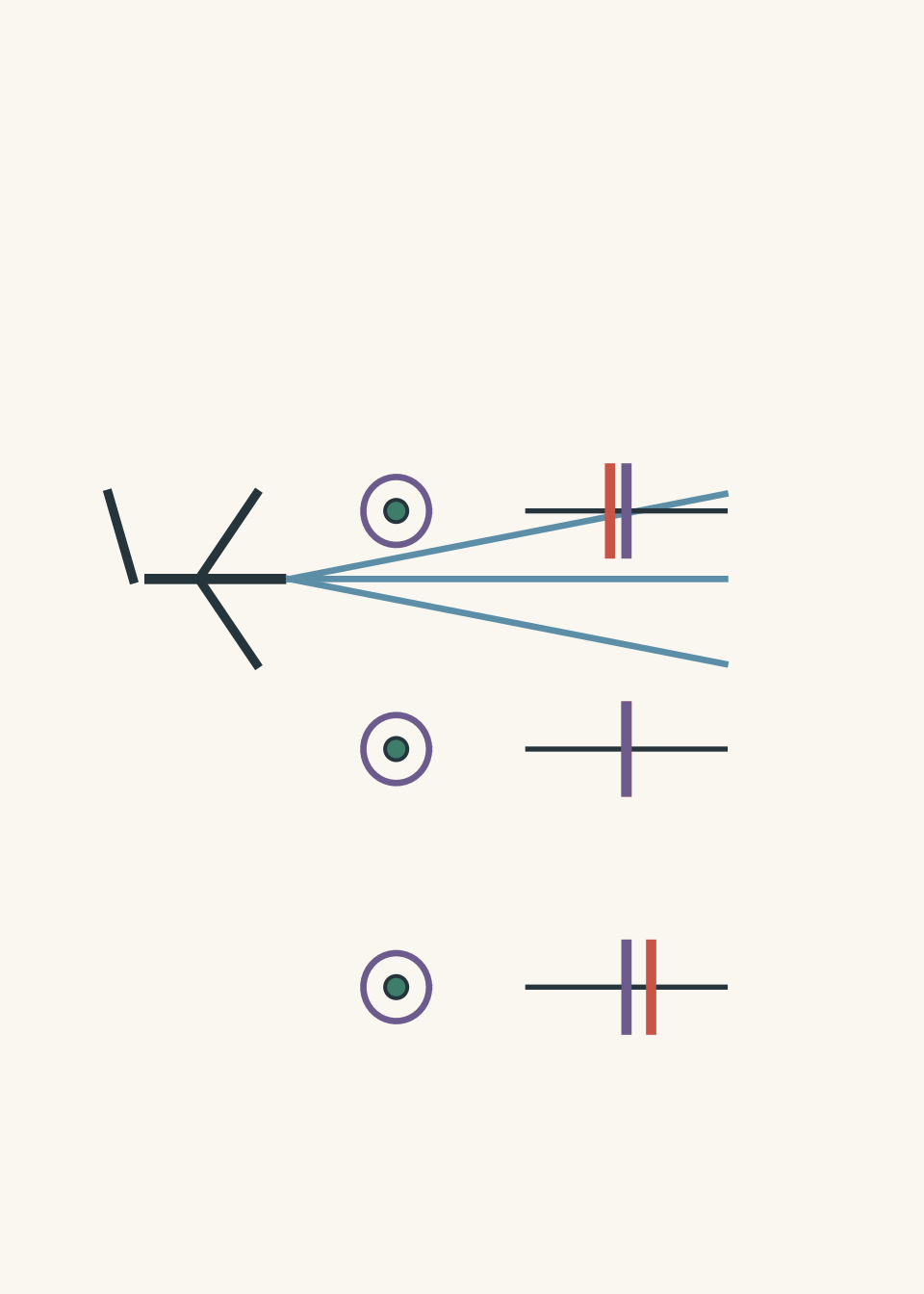
Imagine you are looking at a line of cyclists moving away from you. The cyclists closest to you are moving at the same speed as the cyclists far away.
Would you expect the furthest cyclists to appear to move away faster?
No. In that situation, distance and speed would not be connected. Every cyclist would have the same speed.
Astronomers found something different with galaxies. A galaxy twice as far away was, on average, moving away about twice as fast.
Before accepting that conclusion, predict what you would expect if the Universe were not expanding.
If the Universe were static, there would be no reason for distant galaxies to show a systematic relationship between distance and recession speed. Some galaxies might move towards us, some away from us, but there would not be a clear overall trend.
The evidence suggested something much bigger: space itself is expanding.
02Reading motion from starlight
To understand this evidence, we first need to understand how astronomers measure motion without travelling to the galaxy.
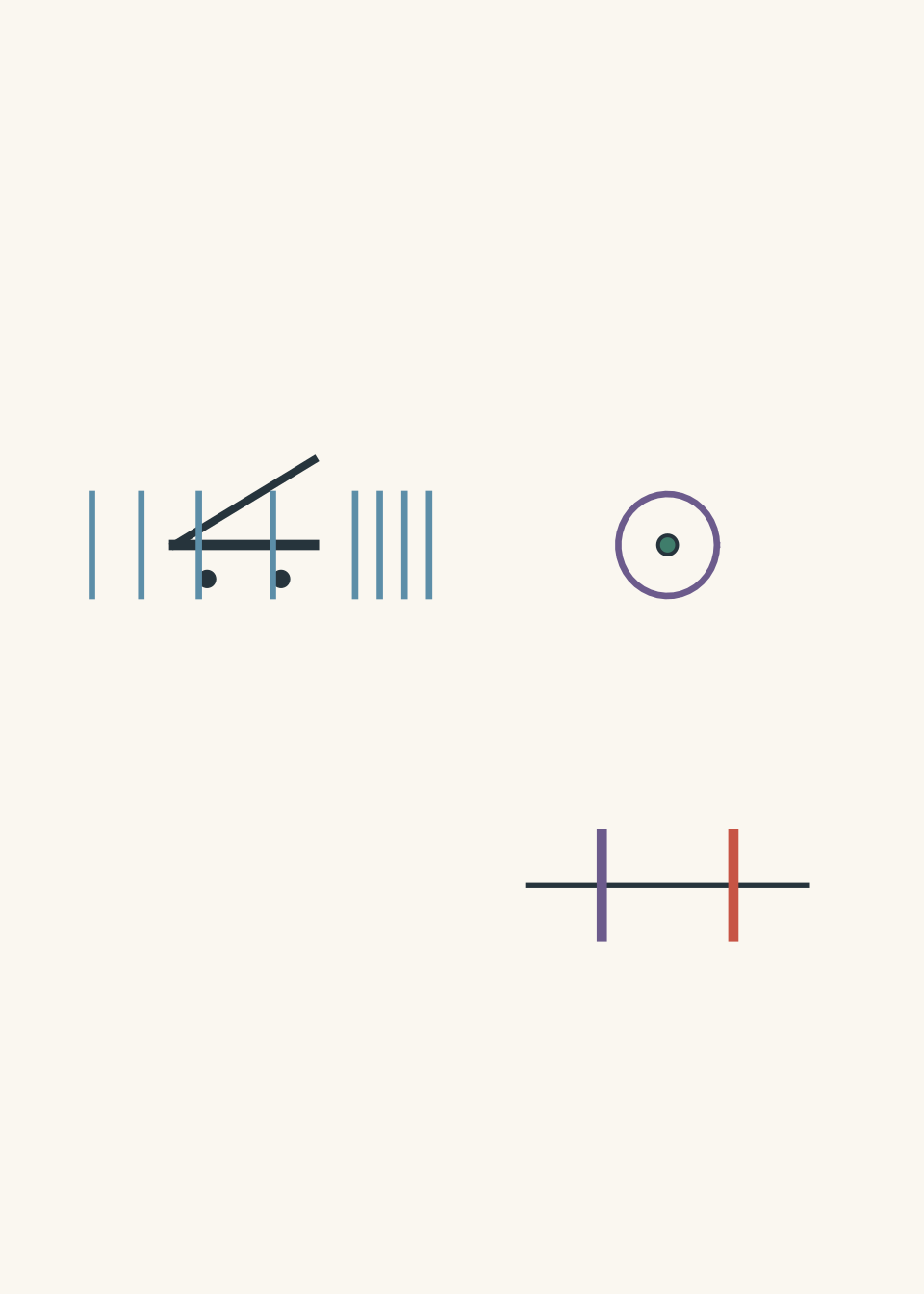
Stars and galaxies produce light with specific wavelengths. These wavelengths create patterns called spectral lines. Each element has its own pattern, almost like a barcode.
For example, hydrogen produces a known set of spectral lines. Astronomers can compare the wavelengths measured from a distant galaxy with the wavelengths measured from hydrogen on Earth.
If the spectral lines have shifted towards longer wavelengths, the light has been redshifted.
A redshift means the source of light is moving away relative to the observer.
This connects to the Doppler effect. You have probably noticed a similar effect with sound: a passing ambulance siren has a higher pitch as it approaches and a lower pitch as it moves away.
The light version is not exactly the same situation because light does not need a medium like air, but the idea of wavelength stretching is similar.
A useful first model is:
- galaxy moving towards Earth → wavelengths compressed → blueshift
- galaxy moving away from Earth → wavelengths stretched → redshift
This model is helpful, but it needs a refinement. For very distant galaxies, the redshift is not just a galaxy travelling through space. The expansion of space itself stretches the light waves as they travel.
03Measuring redshift
The amount of redshift can be described using the redshift value \(z\):
\[ z = \frac{\lambda_{\text{observed}}-\lambda_{\text{rest}}}{\lambda_{\text{rest}}} \]
where:
- \(z\) is the redshift,
- \(\lambda_{\text{observed}}\) is the wavelength measured from the distant galaxy,
- \(\lambda_{\text{rest}}\) is the known wavelength measured in a laboratory.
A larger value of \(z\) means a larger wavelength shift.
For small speeds compared with the speed of light, the recession speed can be estimated using:
\[ v = cz \]
where:
- \(v\) is the recession velocity of the galaxy in metres per second,
- \(c\) is the speed of light, \(3.00 \times 10^8 \text{ m s}^{-1}\),
- \(z\) is the redshift.
This equation is a useful HSC approximation. For extremely large distances, astronomers use more advanced models based on general relativity.
04Finding distance: the other half of the evidence
A redshift alone tells us how quickly a galaxy is moving away. It does not tell us how far away it is.
Astronomers need a distance measurement.
One method uses standard candles. These are objects with a known true brightness. By comparing their true brightness with their observed brightness, astronomers can estimate distance.
A simple analogy is looking at two identical torches at night.
The dimmer torch is probably further away.
The analogy breaks down because stars are not perfect identical torches. Astronomers need careful calibration to know the true brightness of the object.
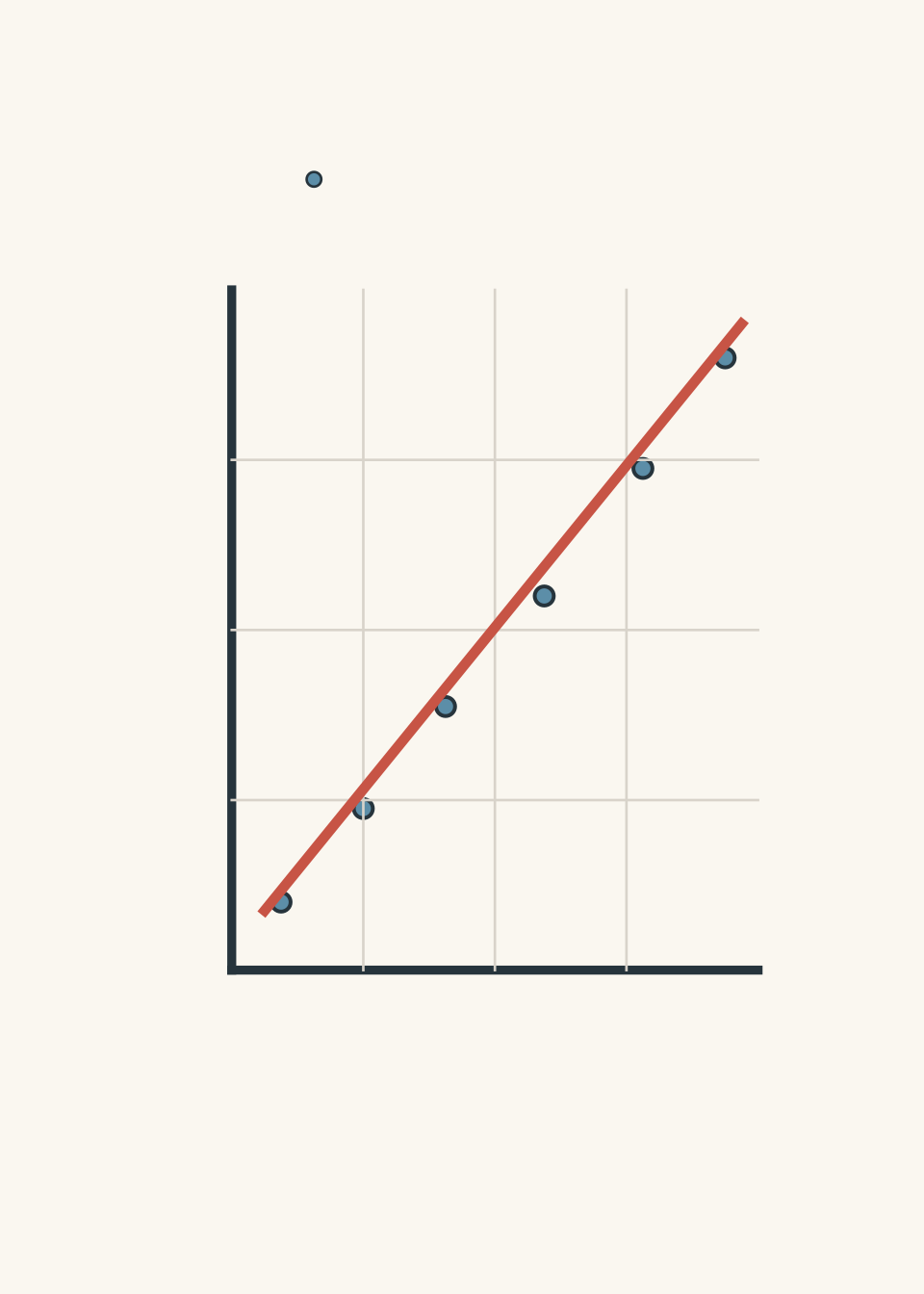
Distance measurements combined with redshift measurements allowed astronomers to build a graph of recession velocity against distance.
05Hubble’s law: the pattern in the data
The relationship is called Hubble’s law:
\[ v = H_0 d \]
where:
- \(v\) is the recession velocity,
- \(H_0\) is the Hubble constant,
- \(d\) is the distance to the galaxy.
The Hubble constant describes the current expansion rate of the Universe.
The important relationship is not just the equation. It is the meaning:
Distance increases, and recession velocity increases with it.
A common mistake is to think Earth is at the centre of the expansion because every galaxy appears to move away from us.
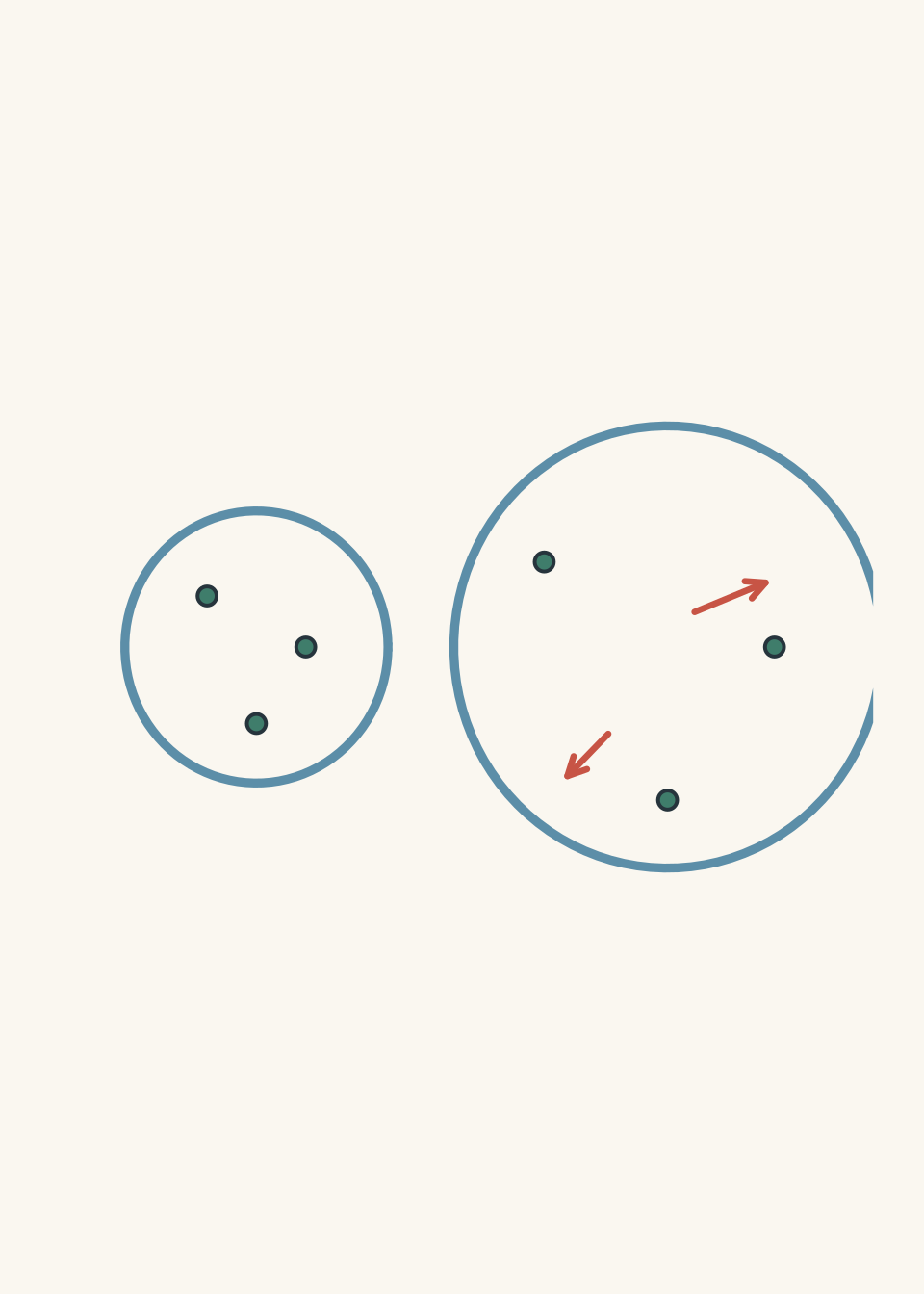
But imagine dots drawn on the surface of an inflating balloon. As the balloon expands, every dot sees other dots moving away. No single dot is the centre of the surface expansion.
The balloon analogy is useful for showing that every location can observe expansion. However, it is incomplete because the real Universe is not expanding into surrounding space like a balloon. Space itself is changing.
06Worked example: calculating recession velocity from redshift
Worked example: A galaxy has a redshift of \(z = 0.002\). Estimate its recession velocity.
Step 1
For small velocities:
\[ v = cz \]
The speed of light is:
\[ c = 3.00 \times 10^8 \text{ m s}^{-1} \]
Step 2
\[ v = (3.00 \times 10^8)(0.002) \]
\[ v = 6.00 \times 10^5 \text{ m s}^{-1} \]
Step 3
The galaxy is moving away at approximately:
\[ \boxed{6.00 \times 10^5 \text{ m s}^{-1}} \]
or \(600 \text{ km s}^{-1}\).
The redshift tells us the galaxy is receding. The size of the redshift gives an estimate of how quickly.
07Worked example: using Hubble’s law
Worked example: A galaxy is \(20\) Mpc away and has a recession velocity of \(1400 \text{ km s}^{-1}\). Calculate the value of \(H_0\).
Step 1
\[ v = H_0d \]
so:
\[ H_0=\frac{v}{d} \]
Step 2
\[ H_0=\frac{1400}{20} \]
\[ H_0=70 \text{ km s}^{-1}\text{Mpc}^{-1} \]
Step 3
The measured value suggests that for every additional megaparsec of distance, the recession velocity increases by about \(70 \text{ km s}^{-1}\).
This is the pattern expected from an expanding Universe.
08The most tempting misconception: “galaxies are moving through space”
It is natural to imagine galaxies as explosions from a central point, flying through a fixed space.
That prediction feels reasonable because many everyday objects move that way. A ball thrown across a field moves through the field.
However, the evidence from Hubble’s observations points to a different model. The large-scale expansion is caused by the stretching of space itself. Galaxies are carried apart as the space between them expands.
Local motions still exist. For example, galaxies can move towards each other because of gravity. The expansion effect becomes clearer at large distances where the overall pattern dominates.
This is why the Andromeda Galaxy can be moving towards the Milky Way even though the Universe is expanding.
09Connecting Hubble’s evidence to other stellar observations
Redshift measurements depend on identifying spectral lines correctly. This connects directly with how astronomers classify stars using their spectra.
You can review that connection here:
Classifying Stars with Stellar Spectra: HSC Physics Guide
Once astronomers know how to interpret light from stars and galaxies, they can also place stars on the Hertzsprung-Russell diagram to investigate stellar evolution:
Hertzsprung-Russell Diagram: How to Read Stellar Evolution
10Questions and solutions
Question 1
A galaxy has a redshift of \(0.0015\). Estimate its recession velocity.
Solution 1
The recession velocity is approximately \(4.50 \times 10^5 \text{ m s}^{-1}\).
For small redshifts, use:
\[ v = cz \]
where:
- \(c = 3.00 \times 10^8 \text{ m s}^{-1}\),
- \(z = 0.0015\).
Substitute:
\[ v=(3.00 \times 10^8)(0.0015) \]
\[ v=4.50 \times 10^5 \text{ m s}^{-1} \]
The galaxy is moving away from Earth at about \(450 \text{ km s}^{-1}\).
The common mistake is to treat the redshift value itself as a velocity. It is only a measure of the wavelength change.
Question 2
Two galaxies have the following observations:
- Galaxy A: distance \(50\) Mpc, recession velocity \(3500 \text{ km s}^{-1}\)
- Galaxy B: distance \(100\) Mpc, recession velocity \(7000 \text{ km s}^{-1}\)
Explain what this suggests about the expansion of the Universe.
Solution 2
The observations suggest that recession velocity is proportional to distance.
For Galaxy A:
\[ H_0=\frac{3500}{50}=70 \text{ km s}^{-1}\text{Mpc}^{-1} \]
For Galaxy B:
\[ H_0=\frac{7000}{100}=70 \text{ km s}^{-1}\text{Mpc}^{-1} \]
Both give the same value of \(H_0\).
This supports Hubble’s law:
\[ v=H_0d \]
A tempting conclusion is that Galaxy B is “moving faster because it has a bigger engine”. The better explanation is that the larger distance means there is more expanding space between Earth and Galaxy B.
Question 3
A student says:
“Because every galaxy appears to move away from Earth, Earth must be at the centre of the Universe.”
Explain why this reasoning is incorrect.
Solution 3
The conclusion is incorrect because expansion occurs throughout space, not from a single explosion point in empty space.
The balloon analogy helps: every dot on an expanding balloon surface sees other dots moving away. No dot is the centre of the surface expansion.
The tempting route is to use everyday motion, where objects moving away from us often indicate we are near the centre of the movement. The constraint that changes the result is that the expansion is the stretching of space itself, so every observer would measure distant galaxies moving away.
Question 4
A distant galaxy has a larger redshift than a nearby galaxy. A student concludes:
“The distant galaxy must have been travelling through space faster for its entire history.”
Assess this statement.
Solution 4
The statement is incomplete because the larger redshift mainly indicates that the light has experienced more expansion while travelling through space.
A distant galaxy generally has a larger recession velocity because it is farther away in the expanding Universe, following the pattern:
\[ v=H_0d \]
The tempting route is to imagine the galaxy as a rocket that has simply travelled faster. The missing constraint is that the observed redshift contains information about the expansion of space between the galaxy and Earth, not only the galaxy’s local motion.
A more accurate explanation is that greater distance means more expanding space contributes to the observed separation.
Question 5
Two astronomers measure the Universe.
Astronomer A observes a galaxy with a large redshift and concludes the galaxy is moving rapidly away.
Astronomer B argues that a large redshift alone cannot prove the galaxy has a large current velocity, because the light may have travelled for billions of years through an expanding Universe.
Who has the stronger argument, and what additional evidence is needed to support the conclusion?
Solution 5
Astronomer B has the stronger argument because redshift alone does not completely determine the present motion of a very distant galaxy.
The tempting route is to apply the simple Doppler model directly: larger wavelength shift means larger speed. This works well for nearby objects, but it becomes incomplete for cosmological distances.
For very distant galaxies, the observed redshift includes the effect of the expansion of space during the light’s journey.
To support a conclusion about universal expansion, astronomers need the combination of:
- reliable distance measurements,
- redshift measurements,
- the observed relationship between distance and recession velocity.
The key constraint is that a single galaxy’s redshift does not reveal the whole expansion history. The pattern across many galaxies is the evidence that supports Hubble’s law and an expanding Universe model.
This idea leads naturally into the next question astronomers ask: if the Universe is expanding now, what can that tell us about its past, its age, and the evidence for the Big Bang model?