
Work and Kinetic Energy of an Accelerated Charge | HSC Physics
Learn how electrical work, potential difference, electric field strength, and kinetic energy connect when a charged particle accelerates. Includes worked examples, common misconceptions, and challenging HSC-style questions.
Put a proton between two parallel plates connected to a 600 V supply. Now double the distance between the plates without changing the voltage. The electric field becomes weaker, so you might predict that the proton leaves with less kinetic energy.
It doesn’t, provided it still travels across the full 600 V potential difference.
That result is the reason you need to connect three equations rather than memorise them separately:
\[
W=qV,\qquad W=qEd,\qquad K=\frac12mv^2
\]
They are different views of the same energy transfer.
01Start with the thing that actually changes: kinetic energy
Imagine a positive charge released between two oppositely charged parallel plates. The electric field exerts a force on it. The charge accelerates, so its speed increases.
An increase in speed means an increase in kinetic energy.
The work-energy theorem says
\[
W_{\text{net}}=\Delta K
\]
where \(W_{\text{net}}\) is the net work done on the particle, measured in joules, and \(\Delta K=K_f-K_i\) is its change in kinetic energy.
If the electric force is the only force doing work, then
\[
W_E=\Delta K
\]
where \(W_E\) is the work done by the electric field.
Using
\[
K=\frac12mv^2
\]
gives
\[
W_E=\frac12m(v_f^2-v_i^2)
\]
where:
- \(m\) is the particle’s mass in kilograms,
- \(v_i\) is its initial speed in metres per second, and
- \(v_f\) is its final speed in metres per second.
So the main question becomes: how much work does the electric field do?
02Voltage tells you energy per unit charge
A potential difference of 1 volt means 1 joule of energy change per coulomb of charge:
\[
1\text{ V}=1\text{ J C}^{-1}
\]
That makes the familiar equation
\[
W=qV
\]
fairly natural. A larger charge experiences a larger energy transfer, and a larger potential difference provides more energy per coulomb.
There is one important catch: \(W=qV\) is usually being used as a magnitude equation in HSC questions.
If a particle with charge magnitude \(q\) is accelerated through a potential difference of magnitude \(V\), then the kinetic energy it gains is
\[
W=qV
\]
For example, a charge of magnitude \(2.0\times10^{-6}\text{ C}\) accelerated through 50 V gains
\[
W=(2.0\times10^{-6})(50)=1.0\times10^{-4}\text{ J}
\]
of kinetic energy.
That shortcut is excellent when the question clearly says the particle is accelerated through a stated voltage. It is less safe when positive and negative potentials are given explicitly.
The sign-safe version
Electric potential energy is
\[
U=qV
\]
so a change in potential gives
\[
\Delta U=q\Delta V
\]
where
\[
\Delta V=V_f-V_i
\]
The electric field does work by reducing electric potential energy:
\[
W_E=-\Delta U
\]
Therefore,
\[
\boxed{W_E=-q\Delta V}
\]
and, if the electric force is the only force doing work,
\[
\boxed{\Delta K=-q\Delta V}
\]
This equation handles the sign of the charge properly.
Suppose a proton moves from \(+500\text{ V}\) to \(+100\text{ V}\). Its charge is positive, so
\[
\Delta V=100-500=-400\text{ V}
\]
and
\[
W_E=-(+e)(-400)=+400e
\]
The work is positive, so the proton speeds up.
Now predict what an electron does while moving from \(+100\text{ V}\) to \(+500\text{ V}\). The potential is increasing, so does that mean it must lose kinetic energy?
No. An electron has negative charge. Here \(q<0\) and \(\Delta V>0\), so
\[
W_E=-q\Delta V>0
\]
The electron gains kinetic energy.
That gives a useful direction rule:
| Particle | Direction it naturally accelerates |
|---|---|
| Positive charge | Towards lower electric potential |
| Negative charge | Towards higher electric potential |
The electric field itself points from higher potential to lower potential. A positive charge accelerates with the field. A negative charge accelerates against it.
03Where \(W=qEd\) comes from
Now forget voltage for a moment and think about force.
A charge in an electric field experiences an electric force with magnitude
\[
F=qE
\]
when \(q\) is being treated as the magnitude of the charge.
Here:
- \(F\) is electric force in newtons,
- \(q\) is charge magnitude in coulombs, and
- \(E\) is electric field strength in newtons per coulomb.
For a constant force acting in the same direction as a particle’s displacement,
\[
W=Fd
\]
Substituting \(F=qE\),
\[
W=qEd
\]
where \(d\) is the distance travelled in the direction of the electric force.
So \(qEd\) is simply force times displacement:
\[
\boxed{W=qEd}
\]
There is nothing separate or mysterious about it.
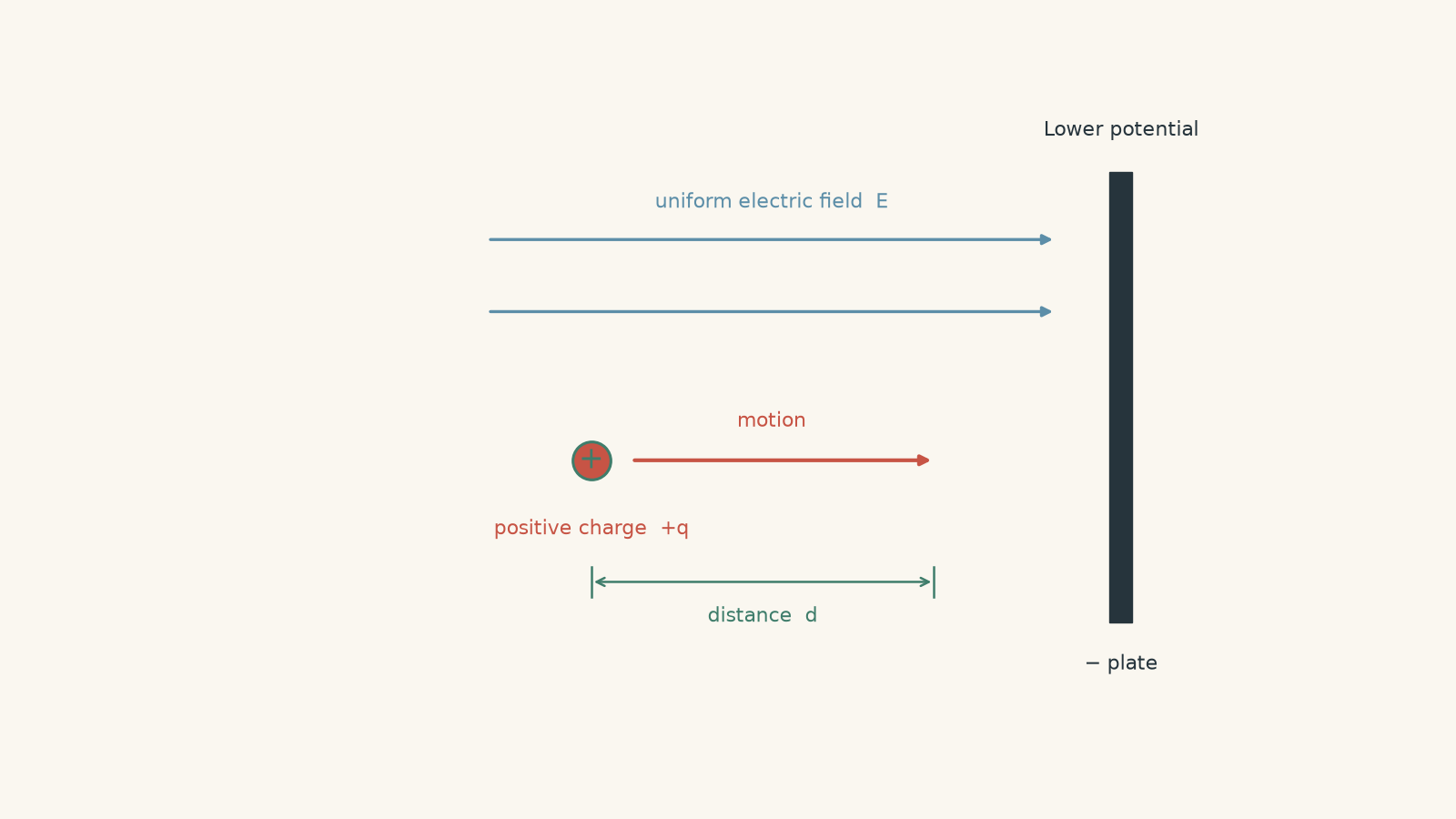
Why \(qEd\) and \(qV\) give the same answer
Between ideal parallel plates, the electric field is approximately uniform. Its magnitude is
\[
E=\frac{V}{d}
\]
where \(V\) is the magnitude of the potential difference across the plates and \(d\) is the plate separation.
If you need to refresh why this works, see Electric Fields Between Parallel Plates: Using \(E=V/d\).
Rearrange:
\[
V=Ed
\]
Now substitute that into \(W=qV\):
\[
W=qV=qEd
\]
So, for a particle accelerated all the way across a uniform parallel-plate field,
\[
\boxed{qV=qEd}
\]
They are not two different mechanisms. They calculate the same work using different information.
Think of it like paying for a taxi trip. \(qV\) is like being told the total fare directly. \(qEd\) is like knowing the fare per kilometre and the distance travelled. Either route should lead to the same bill.
The analogy breaks because electric potential difference is not literally accumulated according to road distance. In a general electric field, direction matters, and the field may change from point to point.
04Why a larger electric field does not always mean more final kinetic energy
Return to the original puzzle.
Accelerator A has:
- potential difference \(V=600\text{ V}\),
- plate separation \(d=0.020\text{ m}\).
Its field is
\[
E_A=\frac{600}{0.020}=3.0\times10^4\text{ N C}^{-1}
\]
Accelerator B uses the same 600 V but has a separation of \(0.040\text{ m}\):
\[
E_B=\frac{600}{0.040}=1.5\times10^4\text{ N C}^{-1}
\]
The second field is only half as strong.
A charge \(q\) crossing A gains
\[
W_A=qE_Ad_A
\]
so
\[
W_A=q(3.0\times10^4)(0.020)=600q
\]
Across B,
\[
W_B=qE_Bd_B
\]
so
\[
W_B=q(1.5\times10^4)(0.040)=600q
\]
The work is identical.
The weaker field acts through twice the distance.
This distinction is worth keeping sharp:
- \(E\) determines the force \(F=qE\), and therefore the acceleration at a particular point.
- \(V\) determines the total energy change per coulomb between two points.
- Two systems can have different field strengths but the same potential difference.
So a stronger field can produce a larger acceleration without producing a larger final speed across the complete gap.
05Connecting electrical work directly to speed
If a charged particle starts from rest and is accelerated through a potential difference of magnitude \(V\), then
\[
qV=\frac12mv^2
\]
where \(q\) is the magnitude of its charge.
Solving for speed,
\[
v=\sqrt{\frac{2qV}{m}}
\]
For a particle that already has an initial speed,
\[
qV=\frac12m(v_f^2-v_i^2)
\]
provided \(V\) represents the magnitude of the potential change that accelerates the particle.
For sign-sensitive problems, the safer equation is
\[
\frac12m(v_f^2-v_i^2)=-q\Delta V
\]
This version works whether the particle speeds up or slows down.
Worked example: A proton accelerated through 800 V
A proton starts from rest at a potential of \(+800\text{ V}\) and moves to a point at \(0\text{ V}\). Calculate the work done by the electric field and the proton’s final speed. Use proton charge \(q=+1.60\times10^{-19}\text{ C}\) and mass \(m=1.67\times10^{-27}\text{ kg}\).
Step 1
\[
\Delta V=V_f-V_i=0-800=-800\text{ V}
\]
Step 2
\[
\begin{aligned}
W_E&=-q\Delta V\\
&=-(1.60\times10^{-19})(-800)\\
&=1.28\times10^{-16}\text{ J}
\end{aligned}
\]
The work is positive, which makes sense because the proton is accelerating.
You could also use the magnitude shortcut \(W=qV\):
\[
W=(1.60\times10^{-19})(800)=1.28\times10^{-16}\text{ J}
\]
Step 3
The proton starts from rest, so \(v_i=0\):
\[
1.28\times10^{-16}=\frac12(1.67\times10^{-27})v_f^2
\]
Step 4
\[
\begin{aligned}
v_f&=\sqrt{\frac{2(1.28\times10^{-16})}{1.67\times10^{-27}}}\\
&=3.92\times10^5\text{ m s}^{-1}
\end{aligned}
\]
The proton leaves with a speed of approximately
\[
\boxed{3.9\times10^5\text{ m s}^{-1}}
\]
The important point is that its final kinetic energy came from the 800 V potential drop. You did not need to know the plate spacing.
06What if the particle moves only partway across the plates?
Suppose two plates are 4.0 cm apart with a potential difference of 1200 V.
The uniform field magnitude is
\[
E=\frac{1200}{0.040}=3.00\times10^4\text{ N C}^{-1}
\]
A particle that moves through only 1.5 cm has not crossed the full 1200 V.
The potential difference corresponding to that distance is
\[
V=Ed
\]
so
\[
V=(3.00\times10^4)(0.015)=450\text{ V}
\]
Only 450 V of potential difference has been crossed.
This is where blindly using the full plate voltage can give a very wrong answer.
Worked example: An electron accelerating partway between plates
Parallel plates are separated by \(4.0\text{ cm}\) and have a potential difference of \(1200\text{ V}\). An electron is travelling against the electric field at \(2.0\times10^6\text{ m s}^{-1}\). It moves another \(1.5\text{ cm}\) before its speed is measured. Calculate its new speed.
Use electron charge \(q=-1.60\times10^{-19}\text{ C}\) and mass \(m=9.11\times10^{-31}\text{ kg}\).
Step 1
Convert \(4.0\text{ cm}\) to metres:
\[
4.0\text{ cm}=0.040\text{ m}
\]
Then
\[
E=\frac{V}{d}
=\frac{1200}{0.040}
=3.00\times10^4\text{ N C}^{-1}
\]
Step 2
The electron moves against the electric field, towards higher electric potential.
\[
1.5\text{ cm}=0.015\text{ m}
\]
Therefore,
\[
\Delta V=E\Delta d
=(3.00\times10^4)(0.015)
=450\text{ V}
\]
The potential increases, so \(\Delta V=+450\text{ V}\).
Step 3
Use the signed equation:
\[
\begin{aligned}
W_E&=-q\Delta V\\
&=-(-1.60\times10^{-19})(450)\\
&=7.20\times10^{-17}\text{ J}
\end{aligned}
\]
The answer is positive. Although the potential increased, the electron has negative charge, so it gains kinetic energy.
Step 4
\[
\begin{aligned}
K_i&=\frac12mv_i^2\\
&=\frac12(9.11\times10^{-31})(2.0\times10^6)^2\\
&=1.82\times10^{-18}\text{ J}
\end{aligned}
\]
Step 5
\[
\begin{aligned}
K_f&=K_i+W_E\\
&=1.82\times10^{-18}+7.20\times10^{-17}\\
&=7.38\times10^{-17}\text{ J}
\end{aligned}
\]
Step 6
\[
\begin{aligned}
K_f&=\frac12mv_f^2\\
v_f&=\sqrt{\frac{2K_f}{m}}\\
&=\sqrt{\frac{2(7.38\times10^{-17})}{9.11\times10^{-31}}}\\
&=1.27\times10^7\text{ m s}^{-1}
\end{aligned}
\]
So the electron’s new speed is
\[
\boxed{1.27\times10^7\text{ m s}^{-1}}
\]
The full 1200 V was a tempting number to use, but the electron crossed only 1.5 cm of the 4.0 cm gap. The corresponding potential change was only 450 V.
07Choosing the right equation
You normally do not need all the equations at once.
| Information in the question | Useful starting point |
|---|---|
| Particle accelerated through a stated potential difference | \(W=qV\) using magnitudes |
| Initial and final electric potentials are given | \(W_E=-q\Delta V\) |
| Uniform field strength and distance along the force are given | \(W=qEd\) |
| Parallel-plate voltage and separation are given | \(E=V/d\) |
| Initial and final speeds are involved | \(W=\Delta K=\frac12m(v_f^2-v_i^2)\) |
| Particle starts from rest | \(qV=\frac12mv^2\) for an accelerating potential difference |
A useful exam habit is to ask: am I being given an energy-per-charge description, \(V\), or a force-per-charge description, \(E\)?
Then connect that electrical information to kinetic energy.
08The most tempting mistakes
Mistake 1: Assuming higher potential always means higher kinetic energy
That depends on the sign of the charge.
A positive particle gains kinetic energy by moving towards lower potential. A negative particle gains kinetic energy by moving towards higher potential.
Use
\[
\Delta K=-q\Delta V
\]
when signs matter.
Mistake 2: Thinking a stronger field must give a larger exit speed
A stronger field means a larger force and acceleration:
\[
F=qE
\]
But the final kinetic energy depends on the total work done.
Across an entire parallel-plate gap,
\[
W=qEd=qV
\]
So if the voltage stays the same while the plate gap changes, the exit kinetic energy stays the same.
Mistake 3: Using \(qEd\) with the total path length
The equation \(W=qEd\) works directly when \(d\) is displacement in the direction of the electric force in a uniform field.
If a charged particle follows a curved path, its total path length is not automatically the \(d\) you should insert.
In a uniform field, only the component of displacement parallel to the force contributes to electric work.
Mistake 4: Using the entire plate voltage for a particle that travels only part of the gap
In a uniform field,
\[
\Delta V=Ed
\]
If a particle crosses half the plate separation, it crosses half the potential difference.
The full voltage applies only when it moves from one plate potential all the way to the other.
09Questions and solutions
Question 1
A proton starts from rest and is accelerated through a potential difference of \(2.50\text{ kV}\).
Calculate:
a. the work done by the electric field, and
b. the proton’s final speed.
Use \(q_p=1.60\times10^{-19}\text{ C}\) and \(m_p=1.67\times10^{-27}\text{ kg}\).
Solution 1
The proton gains \(4.00\times10^{-16}\text{ J}\) of kinetic energy and reaches approximately \(6.92\times10^5\text{ m s}^{-1}\).
The proton is accelerated through a potential difference of magnitude
\[
2.50\text{ kV}=2.50\times10^3\text{ V}
\]
so the work done is
\[
\begin{aligned}
W&=qV\\
&=(1.60\times10^{-19})(2.50\times10^3)\\
&=4.00\times10^{-16}\text{ J}
\end{aligned}
\]
Because it starts from rest,
\[
W=\frac12mv^2
\]
Therefore,
\[
\begin{aligned}
v&=\sqrt{\frac{2W}{m}}\\
&=\sqrt{\frac{2(4.00\times10^{-16})}{1.67\times10^{-27}}}\\
&=6.92\times10^5\text{ m s}^{-1}
\end{aligned}
\]
The tempting mistake is to treat 2.50 kV as \(2.50\text{ V}\). The prefix kilo means \(10^3\), so the voltage must be converted before substitution.
Question 2
Two parallel plates are separated by \(5.0\text{ cm}\) and have a potential difference of \(900\text{ V}\).
An electron enters the region at \(1.50\times10^7\text{ m s}^{-1}\), travelling in the same direction as the electric field.
Determine whether the electron reaches the opposite plate. If it does not, calculate how far it travels before stopping.
Use \(q_e=-1.60\times10^{-19}\text{ C}\) and \(m_e=9.11\times10^{-31}\text{ kg}\).
Solution 2
The electron does not reach the opposite plate. It travels approximately \(3.56\text{ cm}\) before momentarily stopping.
Because the electron is travelling in the same direction as the electric field, its electric force acts in the opposite direction to its motion. It is therefore being decelerated.
First calculate its initial kinetic energy:
\[
\begin{aligned}
K_i&=\frac12mv_i^2\\
&=\frac12(9.11\times10^{-31})(1.50\times10^7)^2\\
&=1.02\times10^{-16}\text{ J}
\end{aligned}
\]
The energy required to move an electron through the entire 900 V in this retarding direction has magnitude
\[
\begin{aligned}
qV&=(1.60\times10^{-19})(900)\\
&=1.44\times10^{-16}\text{ J}
\end{aligned}
\]
The electron has only \(1.02\times10^{-16}\text{ J}\) initially, which is less than the \(1.44\times10^{-16}\text{ J}\) it would need to cross the full gap. It must turn before reaching the other plate.
Now find the field strength:
\[
\begin{aligned}
E&=\frac{V}{d}\\
&=\frac{900}{0.050}\\
&=1.80\times10^4\text{ N C}^{-1}
\end{aligned}
\]
At the turning point, all the initial kinetic energy has been removed:
\[
K_i=qEx
\]
where \(x\) is the distance travelled.
Therefore,
\[
\begin{aligned}
x&=\frac{K_i}{qE}\\
&=\frac{1.02\times10^{-16}}
{(1.60\times10^{-19})(1.80\times10^4)}\\
&=3.56\times10^{-2}\text{ m}\\
&=3.56\text{ cm}
\end{aligned}
\]
A tempting route is to use \(W=qV\) with the full 900 V and then obtain a negative final kinetic energy. That negative value is not a strange new type of energy. It tells you the assumption that the electron reaches the opposite plate is impossible.
Question 3
A proton and an alpha particle both start from rest and are accelerated through the same potential difference \(V\).
An alpha particle has charge \(+2e\) and mass approximately \(4m_p\), where \(e\) is the magnitude of the proton charge and \(m_p\) is the proton mass.
Compare:
a. the work done on the two particles,
b. their final kinetic energies,
c. their final speeds,
d. their accelerations if they are placed in the same electric field, and
e. the magnitude of the reverse potential difference required to stop each particle after acceleration.
Solution 3
The alpha particle gains twice the kinetic energy of the proton, but it finishes at only \(1/\sqrt2\) of the proton’s speed. Its acceleration in the same field is half the proton’s, and both particles require the same magnitude stopping potential.
For the proton,
\[
W_p=eV
\]
For the alpha particle,
\[
W_\alpha=(2e)V=2eV
\]
so
\[
W_\alpha=2W_p
\]
Since both start from rest, their final kinetic energies equal the work done:
\[
K_\alpha=2K_p
\]
It is tempting to conclude that the alpha particle must therefore be travelling faster. Its larger mass changes that conclusion.
For the proton,
\[
eV=\frac12m_pv_p^2
\]
so
\[
v_p^2=\frac{2eV}{m_p}
\]
For the alpha particle,
\[
2eV=\frac12(4m_p)v_\alpha^2
\]
which gives
\[
v_\alpha^2=\frac{eV}{m_p}
\]
Therefore,
\[
\frac{v_\alpha^2}{v_p^2}
=
\frac{1}{2}
\]
and
\[
\boxed{v_\alpha=\frac{v_p}{\sqrt2}}
\]
Now compare their accelerations in the same field.
For the proton,
\[
a_p=\frac{eE}{m_p}
\]
For the alpha particle,
\[
a_\alpha=\frac{2eE}{4m_p}
=\frac12a_p
\]
Finally, consider the stopping potential.
The proton has kinetic energy \(eV\). Reversing that gain requires an opposing potential change of magnitude \(V\).
The alpha particle has kinetic energy \(2eV\), but its charge is also twice as large:
\[
W=(2e)V
\]
so the same magnitude potential difference \(V\) removes its kinetic energy.
The key constraint is that voltage measures energy change per unit charge. Looking only at kinetic energy would suggest the alpha particle needs a larger stopping voltage, but its larger charge means each volt changes its energy twice as much.
Question 4
A proton starts from rest at point A, where the electric potential is \(+200\text{ V}\).
It travels through a uniform-field region to point B, where the potential is \(-600\text{ V}\). The distance from A to B is \(4.0\text{ cm}\).
Immediately after B it enters a second uniform-field region. Across this region, the potential rises linearly from \(-600\text{ V}\) at B to \(+500\text{ V}\) at C. B and C are \(5.5\text{ cm}\) apart.
Assume no other forces act.
a. Determine whether the proton reaches C.
b. If it turns around before C, find its turning point measured from B.
c. The second region is then rebuilt so that B and C are \(11.0\text{ cm}\) apart while their potentials remain \(-600\text{ V}\) and \(+500\text{ V}\). Find the new turning distance from B and explain why the potential at the turning point does or does not change.
Solution 4
The proton does not reach C. It turns \(4.0\text{ cm}\) beyond B in the original arrangement and \(8.0\text{ cm}\) beyond B after the second gap is doubled. In both cases, the turning point is at \(+200\text{ V}\).
From A to B,
\[
\Delta V=-600-(+200)=-800\text{ V}
\]
For a proton,
\[
\begin{aligned}
\Delta K&=-q\Delta V\\
&=-(1.60\times10^{-19})(-800)\\
&=1.28\times10^{-16}\text{ J}
\end{aligned}
\]
So at B the proton has kinetic energy equivalent to the energy gained through an 800 V accelerating potential difference.
From B to C, the potential rises by
\[
500-(-600)=1100\text{ V}
\]
A positive proton loses kinetic energy as it moves towards higher potential. Crossing the whole second region would require an energy decrease of
\[
q(1100\text{ V})
\]
but the proton has energy corresponding to only 800 V. It cannot reach C.
At the turning point, \(K=0\). The proton must therefore lose exactly the kinetic energy it gained earlier.
It can climb through a potential increase of 800 V from B:
\[
V_{\text{turn}}
=-600+800
=+200\text{ V}
\]
Because the potential rises linearly by 1100 V over 5.5 cm, the fraction of the gap reached is
\[
\frac{800}{1100}
\]
Hence,
\[
\begin{aligned}
x&=\frac{800}{1100}(5.5\text{ cm})\\
&=4.0\text{ cm}
\end{aligned}
\]
Now double the second gap to 11.0 cm while keeping the endpoint potentials unchanged.
The field becomes weaker because
\[
E=\frac{V}{d}
\]
but the total potential rise from B to C is still 1100 V.
The proton still turns after climbing through 800 V, so it reaches the same fraction of the gap:
\[
x=\frac{800}{1100}(11.0\text{ cm})=8.0\text{ cm}
\]
The tempting prediction is that the weaker field should let the proton travel to a different turning potential. It does let the proton travel a greater distance, but each metre now corresponds to a smaller potential change.
The deeper energy check is even simpler. The proton begins at A with zero kinetic energy at \(+200\text{ V}\). It also has zero kinetic energy at its turning point. With no other energy transfer, those two points must have the same electric potential energy and, for the same proton, the same electric potential: \(+200\text{ V}\).
Question 5
A uniform electric field of magnitude \(5.00\times10^3\text{ N C}^{-1}\) points in the positive \(x\)-direction. The field exists from \(x=-0.060\text{ m}\) to \(x=+0.100\text{ m}\).
Two protons begin at \(x=0\) with the same speed, \(2.00\times10^5\text{ m s}^{-1}\).
Proton A initially moves in the positive \(x\)-direction. Proton B initially moves in the negative \(x\)-direction.
Use \(q_p=1.60\times10^{-19}\text{ C}\) and \(m_p=1.67\times10^{-27}\text{ kg}\).
a. Show that proton B turns around before reaching the boundary at \(x=-0.060\text{ m}\).
b. Compare the work done by the electric field on A and B between \(x=0\) and their eventual arrival at \(x=+0.100\text{ m}\).
c. Calculate their speeds when they reach \(x=+0.100\text{ m}\).
d. Explain how proton B can travel farther and remain in the field for longer, yet arrive with the same speed as proton A.
Solution 5
Both protons eventually reach \(x=+0.100\text{ m}\) with the same speed, approximately \(3.68\times10^5\text{ m s}^{-1}\). Proton B first travels backwards to about \(x=-0.0418\text{ m}\), turns around, and then crosses the same final potential difference as A. The electric field therefore does the same net work on both.
First find the acceleration of a proton:
\[
\begin{aligned}
a&=\frac{qE}{m}\\
&=\frac{(1.60\times10^{-19})(5.00\times10^3)}
{1.67\times10^{-27}}\\
&=4.79\times10^{11}\text{ m s}^{-2}
\end{aligned}
\]
The acceleration points in the positive \(x\)-direction.
For proton B, the initial velocity is negative:
\[
u=-2.00\times10^5\text{ m s}^{-1}
\]
At its turning point,
\[
v=0
\]
Use
\[
v^2=u^2+2a\Delta x
\]
so
\[
\begin{aligned}
0&=(2.00\times10^5)^2
+2(4.79\times10^{11})\Delta x\\
\Delta x&=-4.18\times10^{-2}\text{ m}
\end{aligned}
\]
Therefore, B turns at
\[
x=-0.0418\text{ m}
\]
which is before the field boundary at \(-0.060\text{ m}\).
Now consider the work done between the common starting point \(x=0\) and common finishing point \(x=+0.100\text{ m}\).
For a proton in this uniform field,
\[
W=qE\Delta x
\]
The net displacement in the field direction is \(+0.100\text{ m}\) for both particles, regardless of the routes they take.
Therefore,
\[
\begin{aligned}
W_A=W_B
&=(1.60\times10^{-19})(5.00\times10^3)(0.100)\\
&=8.00\times10^{-17}\text{ J}
\end{aligned}
\]
Both particles also began with the same kinetic energy:
\[
\begin{aligned}
K_i&=\frac12mv_i^2\\
&=\frac12(1.67\times10^{-27})(2.00\times10^5)^2\\
&=3.34\times10^{-17}\text{ J}
\end{aligned}
\]
Their final kinetic energies are therefore identical:
\[
\begin{aligned}
K_f&=K_i+W\\
&=3.34\times10^{-17}+8.00\times10^{-17}\\
&=1.134\times10^{-16}\text{ J}
\end{aligned}
\]
Hence,
\[
\begin{aligned}
v_f&=\sqrt{\frac{2K_f}{m}}\\
&=\sqrt{\frac{2(1.134\times10^{-16})}{1.67\times10^{-27}}}\\
&=3.68\times10^5\text{ m s}^{-1}
\end{aligned}
\]
So
\[
\boxed{v_A=v_B\approx3.68\times10^5\text{ m s}^{-1}}
\]
The tempting route is to say proton B travels a greater total distance in the electric field, so \(W=qEd\) must give it more energy. That uses the wrong \(d\).
When B initially moves in the negative \(x\)-direction, the electric force points opposite its motion. The field does negative work, removing kinetic energy until B stops. As B then moves back in the positive \(x\)-direction, the field does positive work.
That initial backwards excursion contributes negative work on the way out and an equal amount of positive work when B returns through the same positions. Those contributions cancel.
What remains is the work associated with the net change from \(x=0\) to \(x=+0.100\text{ m}\).
This is why electric potential is so useful. In an electrostatic field, the energy transferred between two positions depends on their potential difference, not on how long the particle took or how complicated its route was.
10What to use next
These equations give you two complementary ways to analyse charged-particle motion.
Use energy when you care about the particle’s speed after moving between two potentials:
\[
\Delta K=-q\Delta V
\]
Use the field when you care about the force and acceleration at a particular place:
\[
F=qE,\qquad a=\frac{qE}{m}
\]
Between parallel plates, connect the two descriptions with
\[
E=\frac{V}{d}
\]
That gives the full chain:
\[
\boxed{qV=qEd=\Delta K}
\]
when the quantities are being used as positive magnitudes for a charge accelerating across a uniform potential difference.
The next useful decision is recognising when an energy method is enough and when you also need force and kinematics. A question asking for final speed often collapses quickly with \(qV=\Delta K\). A question asking where the particle turns, how long it takes, or how its trajectory bends usually needs \(qE=ma\) as well.