
Thermal Conductivity and Heat Transfer in HSC Physics
Learn how to use and interpret the thermal conductivity equation, including how material, area, temperature difference, and thickness affect heat transfer.
A metal spoon left in hot soup becomes uncomfortable to hold, while a wooden spoon usually does not. Both ends may be the same distance from the soup, so why does thermal energy reach your hand much faster through one material?
Before reading on, predict what would happen if you replaced the metal spoon with another metal spoon that was twice as thick. Would the handle heat more slowly because the thermal energy has “more metal to get through”, or faster because there is more material available to conduct energy?
The thicker spoon can transfer thermal energy faster. That sounds backwards until we separate two ideas: distance through a material and cross-sectional area available for conduction.
That distinction is exactly what the thermal conductivity equation helps us describe.
01Start with the physical picture
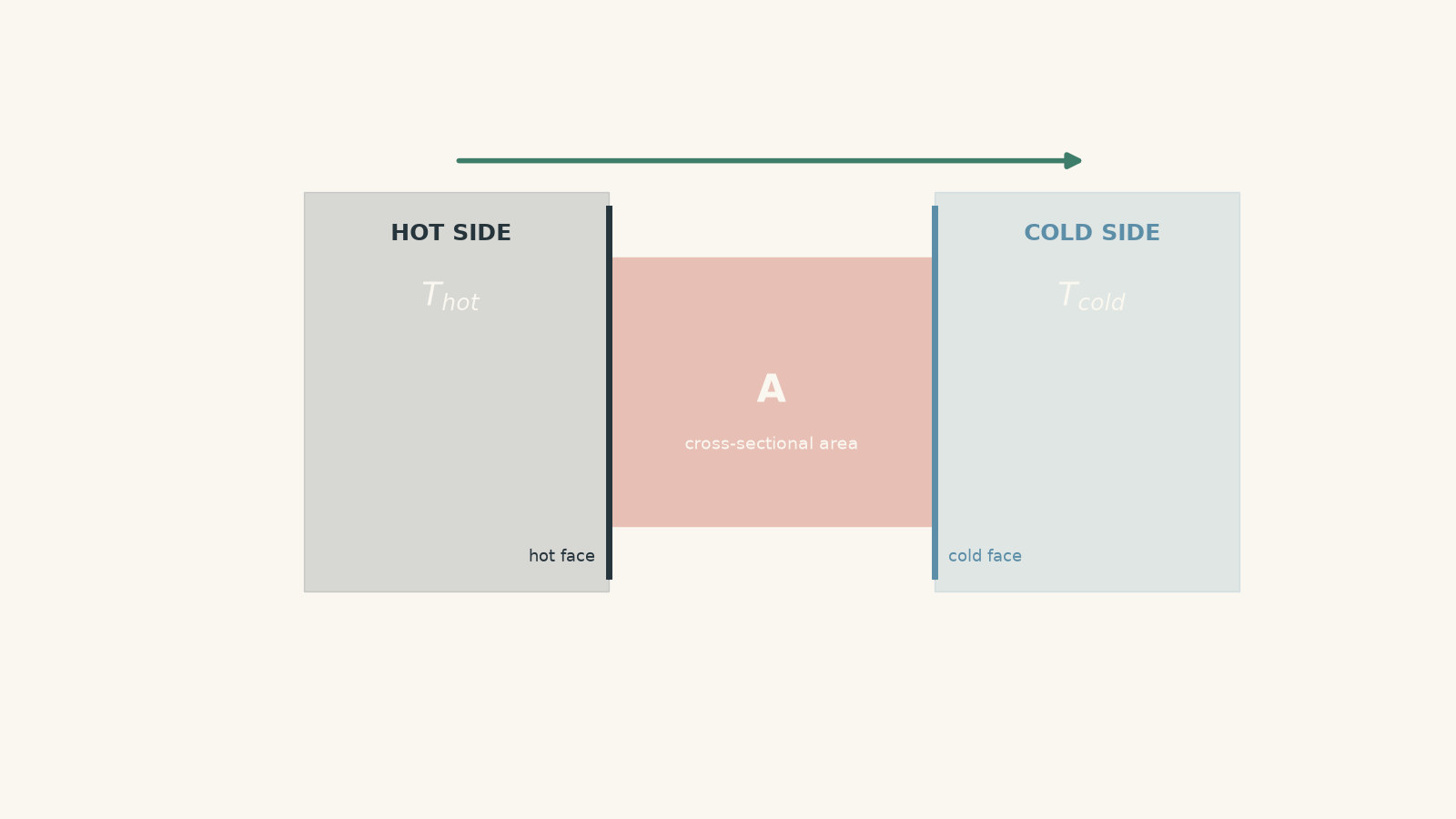
Suppose one side of a flat slab is hot and the other side is cold. The particles on the hot side have more internal energy. Through interactions between neighbouring particles, energy is transferred through the material towards the colder side.
For a solid slab, four things strongly affect how quickly that transfer occurs:
- the material
- the area through which energy can flow
- the temperature difference between the two sides
- the distance the energy has to travel
Picture people trying to leave a crowded concert through a corridor. A wider corridor allows more people through each second. A longer corridor makes the journey harder. A larger “push” from the crowd can also increase the flow.
For conduction, the area \(A\) is a bit like the corridor width, the thickness \(d\) is like the corridor length, and the temperature difference \(\Delta T\) provides the driving difference.
The analogy is useful for remembering the relationships, but it isn’t an exact physical model. Thermal energy is not a crowd of particles travelling all the way from the hot side to the cold side.
02The thermal conductivity equation
For steady conduction through a uniform flat layer, the magnitude of the rate of thermal energy transfer can be written as
\[ \frac{Q}{t} = \frac{kA\Delta T}{d} \]
where:
| Symbol | Meaning | SI unit |
|---|---|---|
| \(Q\) | thermal energy transferred | joules, J |
| \(t\) | time taken | seconds, s |
| \(Q/t\) | rate of thermal energy transfer | watts, W |
| \(k\) | thermal conductivity of the material | W m\(^{-1}\) K\(^{-1}\) |
| \(A\) | area perpendicular to the energy transfer | m\(^2\) |
| \(\Delta T\) | temperature difference between the two sides | K or °C |
| \(d\) | thickness of the material in the direction of energy transfer | m |
The left-hand side, \(Q/t\), deserves attention. It is not an amount of energy. It is an amount of energy transferred per second.
Because
\[ 1\text{ W} = 1\text{ J s}^{-1}, \]
a result of \(40\text{ W}\) means \(40\text{ J}\) of thermal energy is being transferred each second.
03What each variable actually does
Rather than memorising the equation as a block of symbols, read its structure:
\[ \frac{Q}{t} \propto k,\qquad \frac{Q}{t} \propto A,\qquad \frac{Q}{t} \propto \Delta T,\qquad \frac{Q}{t} \propto \frac{1}{d} \]
That tells us how changing one variable affects the transfer rate when the others stay constant.
Thermal conductivity \(k\): what is the material like?
The thermal conductivity \(k\) describes how effectively a material conducts thermal energy.
A larger \(k\) means a greater rate of energy transfer for the same geometry and temperature difference.
Metals generally have relatively high thermal conductivities. Materials used for insulation, such as foams and trapped air, have much lower thermal conductivities.
The important point is that \(k\) is a property of the material, not a measurement of how hot the material is.
A steel object does not have a high thermal conductivity because it happens to be hot. It has a high thermal conductivity because steel transfers thermal energy relatively effectively.
Area \(A\): how much pathway is available?
If you double \(A\), you double the rate of thermal energy transfer, provided everything else stays unchanged.
This is why the thick-spoon prediction from the opening needs care. A larger cross-sectional area gives thermal energy more parallel pathways through the material.
For a wall or window, \(A\) is the face area through which energy is being transferred.
For a rod, \(A\) is its cross-sectional area, not its surface area along the sides.
Temperature difference \(\Delta T\): how strong is the driving difference?
The equation uses
\[ \Delta T = T_\text{hot} - T_\text{cold} \]
when we are interested in the positive magnitude of the difference.
If the temperature difference doubles, the transfer rate doubles under this model.
A common mistake is to use the hot-side temperature by itself. A wall with one side at \(30^\circ\text{C}\) and the other at \(29^\circ\text{C}\) does not experience the same conduction rate as a wall with one side at \(30^\circ\text{C}\) and the other at \(0^\circ\text{C}\).
The first has \(\Delta T = 1^\circ\text{C}\). The second has \(\Delta T = 30^\circ\text{C}\).
For a temperature difference, a change of \(1^\circ\text{C}\) has the same size as a change of \(1\text{ K}\). You do not need to convert a temperature difference from Celsius to kelvin before using this equation.
Thickness \(d\): how far must energy be conducted?
The thickness appears in the denominator:
\[ \frac{Q}{t} \propto \frac{1}{d} \]
So increasing the thickness reduces the transfer rate.
If the thickness doubles,
\[ \frac{Q}{t} \]
is halved, assuming \(k\), \(A\), and \(\Delta T\) remain unchanged.
This is one reason thicker insulating layers reduce heat transfer.
Notice the difference between thicker in the direction of transfer, which increases \(d\), and wider across the direction of transfer, which increases \(A\). Those changes have opposite effects.
04Worked example: heat loss through insulation
A section of insulation has thermal conductivity \(0.040\text{ W m}^{-1}\text{ K}^{-1}\), area \(2.5\text{ m}^2\), and thickness \(0.080\text{ m}\). The temperature difference across it is \(16^\circ\text{C}\). Calculate the rate of thermal energy transfer through the insulation.
Step 1
We want the rate of thermal energy transfer, \(Q/t\).
Step 2
\[ \frac{Q}{t} = \frac{kA\Delta T}{d} \]
Step 3
\[ \frac{Q}{t} = \frac{(0.040)(2.5)(16)}{0.080} = 20\text{ W} \]
Step 4
The insulation transfers thermal energy at a rate of \(20\text{ J}\) each second under these conditions.
The value is a rate, not the total energy transferred.
05From transfer rate to energy transferred
Sometimes the equation gives you \(Q/t\), but the question asks for \(Q\).
Once the transfer rate is known,
\[ Q = \frac{Q}{t}\,t \]
For example, if thermal energy is transferred at \(20\text{ W}\) for \(300\text{ s}\),
\[ Q = (20)(300) = 6000\text{ J} \]
So \(6000\text{ J}\) is transferred during those five minutes.
Do not put the elapsed time \(t\) into the denominator on the right-hand side of the conductivity equation. The \(t\) is already contained in the quantity \(Q/t\).
06Worked example: finding the required thickness
A flat panel has an area of \(1.8\text{ m}^2\) and thermal conductivity \(0.025\text{ W m}^{-1}\text{ K}^{-1}\). The temperature difference across it is \(24^\circ\text{C}\). The energy transfer rate must not exceed \(18\text{ W}\). What minimum thickness is required?
Step 1
\[ \frac{Q}{t} = \frac{kA\Delta T}{d} \]
We know the maximum allowed value of \(Q/t\) and need to find \(d\).
Step 2
Multiplying both sides by \(d\), then dividing by \(Q/t\), gives
\[ d = \frac{kA\Delta T}{Q/t} \]
Step 3
\[ d = \frac{(0.025)(1.8)(24)}{18} = 0.060\text{ m} \]
Step 4
The panel must be at least
\[ 0.060\text{ m} = 6.0\text{ cm} \]
thick to keep the conduction rate at or below \(18\text{ W}\), assuming the model applies.
Notice the logic here. We are not just finding a number. Because increasing \(d\) decreases the transfer rate, any thickness greater than \(0.060\text{ m}\) would reduce the rate further.
07The most tempting misconception: “more material means more insulation”
That statement is only partly useful.
Suppose you take the same material and make a slab twice as thick in the direction of energy transfer. Then \(d\) doubles, so the conduction rate halves.
But suppose instead that you place two identical slabs side by side. The thickness \(d\) stays the same while the total area \(A\) doubles. Now the conduction rate doubles.
So “more material” by itself tells you almost nothing. You must ask how the geometry changed.
This is a common HSC trap because \(A\) and \(d\) can both become larger when an object is described as “bigger”, yet they affect the equation differently.
08Why temperature difference matters, not temperature alone
Imagine two identical panels.
For panel A:
\[ T_\text{hot}=40^\circ\text{C},\qquad T_\text{cold}=30^\circ\text{C} \]
so
\[ \Delta T=10^\circ\text{C}. \]
For panel B:
\[ T_\text{hot}=20^\circ\text{C},\qquad T_\text{cold}=10^\circ\text{C} \]
so its temperature difference is also
\[ \Delta T=10^\circ\text{C}. \]
If \(k\), \(A\), and \(d\) are the same, the simplified equation predicts the same rate of conduction through both panels.
That can feel strange because panel A is hotter overall. But conduction in this model depends on the difference across the material, not simply the absolute temperature at one side.
There is a limit to this simplification. In real materials, \(k\) can change with temperature. If that variation is significant, treating \(k\) as constant is no longer exact.
09What assumptions are hiding inside the equation?
The equation
\[ \frac{Q}{t} = \frac{kA\Delta T}{d} \]
is not a universal rule for every thermal situation.
It works as a useful model when we can treat the situation as:
- steady, so temperatures are not changing significantly with time
- one-dimensional, so energy mainly flows through the material in one direction
- uniform in cross-section
- made from a material whose \(k\) can be treated as constant
- approximately flat, with thickness \(d\)
- free from major complications such as internal heat generation
“Steady” is particularly important.
Suppose you suddenly place one side of a cold metal block against a heater. At first, different parts of the block are still changing temperature. The system is in a transient state. The simple slab equation may not describe the whole process accurately at each instant.
After enough time, the temperature pattern may become approximately stable even though energy continues flowing. That is the type of steady conduction situation this equation handles best.
10The simplified equation comes from a more general idea
For a flat material with a roughly linear temperature change across its thickness, the temperature changes by \(\Delta T\) over distance \(d\).
The ratio
\[ \frac{\Delta T}{d} \]
therefore describes how rapidly temperature changes with position.
A larger temperature change over a shorter distance means a steeper temperature gradient, and hence a larger conduction rate.
The more general form of Fourier’s law includes a negative sign to show direction:
\[ \frac{Q}{t} = -kA\frac{dT}{dx} \]
Here, \(dT/dx\) is the temperature gradient.
The negative sign tells us that thermal energy flows towards lower temperature.
For many HSC calculations, we are interested only in the magnitude of the transfer rate. For a uniform slab with a linear temperature gradient, the magnitude becomes
\[ \frac{Q}{t} = \frac{kA\Delta T}{d}. \]
So the familiar equation is not a separate law. It is a useful special case of the temperature-gradient description.
11A quick way to check whether your answer makes physical sense
Before trusting the calculator, test the direction of your result.
If \(k\) increases, \(Q/t\) should increase.
If \(A\) increases, \(Q/t\) should increase.
If \(\Delta T\) increases, \(Q/t\) should increase.
If \(d\) increases, \(Q/t\) should decrease.
This catches many algebra mistakes.
For example, if your calculation says making insulation thicker increases heat transfer, you have probably rearranged the equation incorrectly or confused \(A\) with \(d\).
Units give you another useful check:
\[ \frac{ (\text{W m}^{-1}\text{ K}^{-1}) (\text{m}^2) (\text{K}) }{ \text{m} } = \text{W}. \]
Everything cancels to watts, which is the correct unit for \(Q/t\).
12Questions and solutions
Question 1
A glass pane has thermal conductivity \(0.80\text{ W m}^{-1}\text{ K}^{-1}\), area \(1.5\text{ m}^2\), and thickness \(0.010\text{ m}\). The temperature difference across the pane is \(12^\circ\text{C}\).
Calculate the rate of thermal energy transfer through the glass.
Solution 1
The rate of thermal energy transfer is \(1440\text{ W}\).
Use
\[ \frac{Q}{t} = \frac{kA\Delta T}{d}. \]
Substituting,
\[ \frac{Q}{t} = \frac{(0.80)(1.5)(12)}{0.010} = 1440\text{ W}. \]
This means \(1440\text{ J}\) of thermal energy is transferred each second under the assumptions of the model.
The large value is reasonable compared with an insulating material because glass has a much larger \(k\) than typical thermal insulation, and the pane is only \(0.010\text{ m}\) thick.
Question 2
A material transfers thermal energy at a rate of \(45\text{ W}\). Its area is doubled while its thickness and temperature difference stay unchanged.
What is the new transfer rate? Explain without substituting into the full equation.
Solution 2
The new transfer rate is \(90\text{ W}\).
From
\[ \frac{Q}{t} \propto A, \]
the rate of conduction is directly proportional to area when \(k\), \(\Delta T\), and \(d\) are constant.
Doubling \(A\) therefore doubles \(Q/t\):
\[ 45\text{ W}\times 2=90\text{ W}. \]
A tempting mistake is to think that more material must always provide more insulation. In this case, the extra material increases the area available for conduction rather than increasing the distance through which energy must travel.
Question 3
A \(0.050\text{ m}\)-thick insulating panel has thermal conductivity \(0.030\text{ W m}^{-1}\text{ K}^{-1}\) and area \(3.0\text{ m}^2\). The two faces are maintained \(20^\circ\text{C}\) apart.
Calculate:
a. the rate of thermal energy transfer through the panel
b. the energy transferred in \(10\) minutes.
Solution 3
The transfer rate is \(36\text{ W}\), and the energy transferred in \(10\) minutes is \(2.16\times10^4\text{ J}\).
For part a,
\[ \frac{Q}{t} = \frac{kA\Delta T}{d} = \frac{(0.030)(3.0)(20)}{0.050} = 36\text{ W}. \]
For part b, first convert \(10\) minutes to seconds:
\[ t=10\times60=600\text{ s}. \]
Then
\[ Q = \left(\frac{Q}{t}\right)t = (36)(600) = 21600\text{ J} = 2.16\times10^4\text{ J}. \]
The distinction between the two answers matters. \(36\text{ W}\) describes how quickly energy is transferred, while \(2.16\times10^4\text{ J}\) is the accumulated energy transferred over the \(600\text{ s}\) interval.
Question 4
Two panels are made from the same material and have the same temperature difference across them.
Panel X has area \(A\) and thickness \(d\).
Panel Y has area \(3A\) and thickness \(2d\).
Determine the ratio of the conduction rate through Y to the conduction rate through X.
Solution 4
Panel Y conducts thermal energy at \(3/2\), or \(1.5\), times the rate of panel X.
For panel X,
\[ \left(\frac{Q}{t}\right)_X=\frac{kA\Delta T}{d}. \]
For panel Y,
\[ \left(\frac{Q}{t}\right)_Y = \frac{k(3A)\Delta T}{2d}. \]
Therefore,
\[ \frac{ (Q/t)_Y }{ (Q/t)_X } = \frac{ k(3A)\Delta T/(2d) }{ kA\Delta T/d } = \frac{3}{2}. \]
The larger thickness tries to reduce conduction, but the threefold increase in area has a stronger effect. Looking only at the fact that panel Y is “thicker” would therefore give the wrong prediction.
Question 5
A student compares two slabs.
- Slab P has thermal conductivity \(k\), thickness \(d\), area \(A\), and temperature difference \(\Delta T\).
- Slab R is made from a material with thermal conductivity \(2k\). Its thickness is also doubled to \(2d\), while \(A\) and \(\Delta T\) remain unchanged.
The student says, “The higher thermal conductivity means slab R must transfer energy faster.”
Is the student correct? Determine the transfer-rate ratio and explain the misconception.
Solution 5
The student is not correct. The two slabs have the same conduction rate.
For slab P,
\[ \left(\frac{Q}{t}\right)_P = \frac{kA\Delta T}{d}. \]
For slab R,
\[ \left(\frac{Q}{t}\right)_R = \frac{(2k)A\Delta T}{2d} = \frac{kA\Delta T}{d}. \]
Therefore,
\[ \frac{(Q/t)_R}{(Q/t)_P}=1. \]
Doubling \(k\) tends to double the rate, but doubling \(d\) tends to halve it. The two effects exactly cancel.
The misconception is focusing on one variable while ignoring the others. Thermal conductivity matters, but the transfer rate depends on the whole combination \(kA\Delta T/d\).
Question 6
A flat slab initially has a steady temperature difference of \(18^\circ\text{C}\) across it and conducts energy at \(60\text{ W}\).
The hot-side temperature is then suddenly increased so that the temperature difference becomes \(36^\circ\text{C}\). A student immediately states that the conduction rate must now be exactly \(120\text{ W}\).
Explain why \(120\text{ W}\) is a reasonable prediction for the new steady state but is not necessarily the exact conduction rate immediately after the temperature is changed.
Solution 6
The new steady-state conduction rate is predicted to be \(120\text{ W}\), but the simple slab equation does not necessarily describe the system immediately after the temperature change.
Once a new steady temperature pattern is established,
\[ \frac{Q}{t}\propto\Delta T. \]
The temperature difference has doubled from \(18^\circ\text{C}\) to \(36^\circ\text{C}\), so the steady-state prediction is
\[ 60\text{ W}\times\frac{36}{18} = 120\text{ W}. \]
However, immediately after the hot-side temperature changes, temperatures within the slab have not yet adjusted to their new values. The material is undergoing transient conduction, so the internal temperature gradient is changing with time.
The tempting mistake is treating the simplified equation as though it applies perfectly at every instant. It is most directly applicable when the temperature distribution through the slab can be treated as steady.
13What this equation prepares you for next
Thermal conductivity is really a first encounter with a broader idea: a flow is driven by a gradient and limited by resistance.
Here, the temperature difference provides the driving effect, while the material and geometry control how strongly the system resists thermal energy transfer.
That idea leads naturally to thermal resistance, conduction through several layers, and the more general temperature-gradient form of Fourier’s law. It also gives you a useful decision rule now: when a conduction problem changes, do not ask only whether there is “more insulation” or a “better conductor”. Check separately what happened to \(k\), \(A\), \(\Delta T\), and \(d\), then predict the direction of the change before touching the calculator.