
Projectile Time of Flight for Level and Uneven Landings
Learn how to calculate projectile flight time for same-height, higher, lower, and sloping landing conditions using HSC Physics methods.
Kick two projectiles from the same point with the same upward velocity, but give one of them a much larger horizontal velocity. Which one stays in the air longer?
For a level landing, the answer is neither. They land at the same time. Horizontal speed changes where the projectile lands, but not when it returns to the original height.
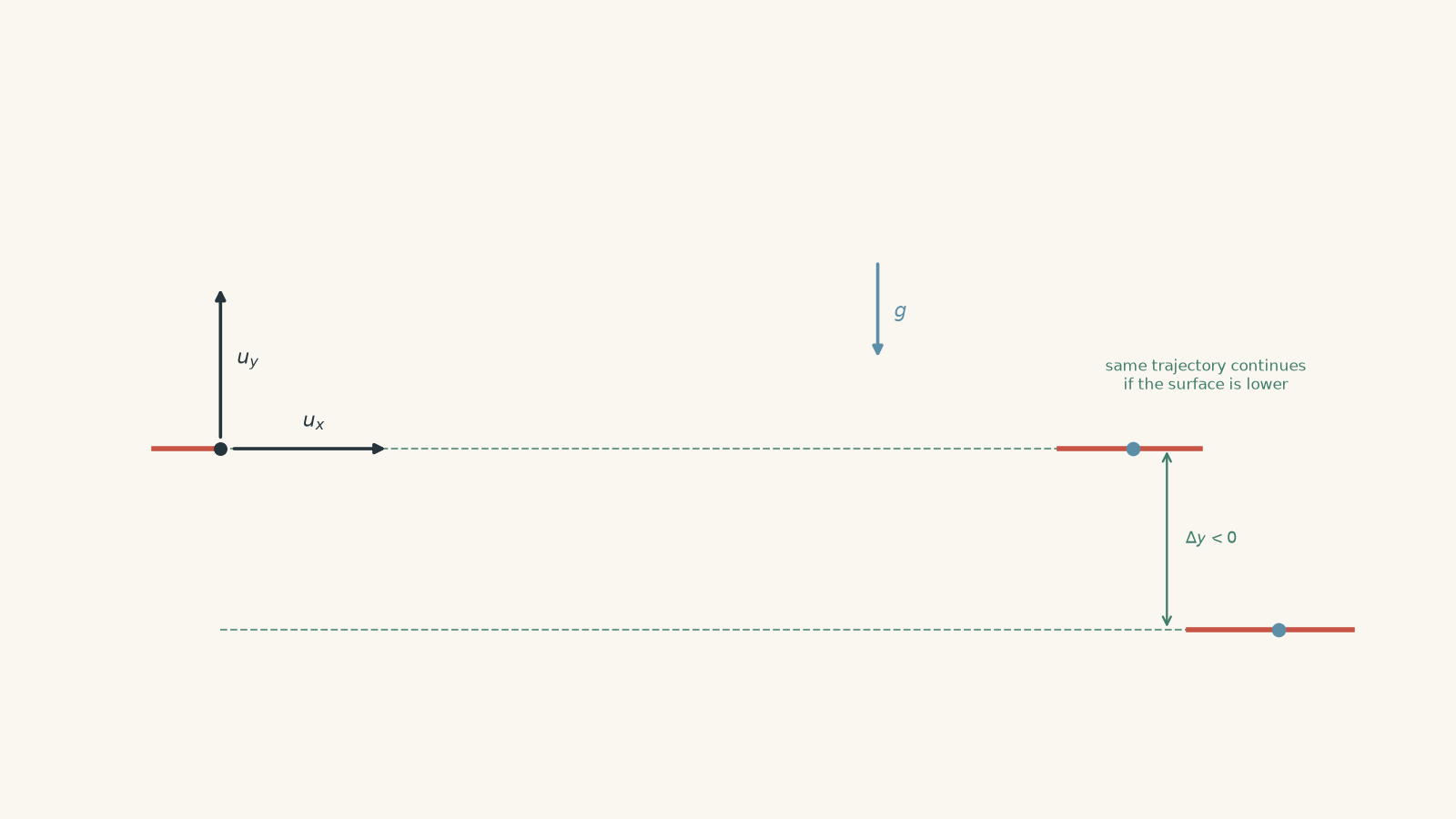
That result is useful because it turns a two-dimensional projectile problem into a much simpler question: what is happening vertically? The catch is that the shortcut only works when the projectile lands at the same height from which it was launched. Put the landing point on a cliff, in a valley, or on an elevated platform, and we need to be more careful.
01Flight time is mainly a vertical-motion problem
A projectile has horizontal and vertical motion happening at the same time.
Think of those two motions as two people on the same date who barely talk. They share one clock, but gravity only bothers the vertical one. Horizontal motion determines where the projectile is, while vertical motion determines how high it is.
That picture is useful, but it has a limit. If the landing height itself depends on horizontal position, such as on a slope, the two motions become connected through the landing condition. We will come back to that.
For ordinary HSC projectile questions, unless the question says otherwise, we assume:
- air resistance is negligible
- gravitational acceleration is constant
- \(g = 9.8\ \mathrm{m\,s^{-2}}\), directed downwards
- horizontal acceleration is zero.
If the projectile is launched at speed \(u\) and angle \(\theta\) above the horizontal, its initial vertical velocity is
\[
u_y=u\sin\theta
\]
and its initial horizontal velocity is
\[
u_x=u\cos\theta.
\]
If resolving the launch velocity into components still feels slippery, revise Projectile Initial Velocity Components for HSC Physics before pushing further.
02The equation that controls flight time
Take upwards as positive. Let
- \(u_y\) be the initial vertical velocity in \(\mathrm{m\,s^{-1}}\)
- \(t\) be the time after launch in seconds
- \(g\) be the magnitude of gravitational acceleration in \(\mathrm{m\,s^{-2}}\)
- \(\Delta y=y_f-y_i\) be the final height minus the initial height, in metres.
The vertical displacement equation is
\[
\Delta y=u_yt-\frac{1}{2}gt^2.
\]
This is the main equation for finding flight time.
Notice what is missing: horizontal velocity. For a landing surface at a fixed height, flight time comes from the vertical motion.
03Same launch and landing height
Suppose the projectile lands at exactly the height from which it was launched.
Then
\[
\Delta y=0.
\]
Substitute that into the vertical displacement equation:
\[
0=u_yt-\frac{1}{2}gt^2.
\]
Factor out \(t\):
\[
0=t\left(u_y-\frac{1}{2}gt\right).
\]
There are two solutions:
\[
t=0
\]
or
\[
t=\frac{2u_y}{g}.
\]
The first solution is not a mysterious extra flight. It is simply the instant of launch. The second solution is when the projectile returns to its original height.
So, for a projectile that launches upwards and lands at the same height,
\[
\boxed{T=\frac{2u_y}{g}}
\]
where \(T\) is the total time of flight.
Since \(u_y=u\sin\theta\),
\[
T=\frac{2u\sin\theta}{g}.
\]
Why is the flight time twice the time to maximum height?
At maximum height, the vertical velocity is zero.
Using
\[
v_y=u_y-gt,
\]
we get
\[
0=u_y-gt_{\text{up}},
\]
so
\[
t_{\text{up}}=\frac{u_y}{g}.
\]
For a same-height landing, the downward part is vertically symmetric with the upward part. Therefore,
\[
T=2t_{\text{up}}=\frac{2u_y}{g}.
\]
The symmetry comes from constant gravitational acceleration and the equal starting and finishing heights. It is not a rule that every projectile spends equal time going up and coming down.
Worked example: Same-level flight time
A projectile is launched from level ground at \(18.0\ \mathrm{m\,s^{-1}}\), at \(35.0^\circ\) above the horizontal. It lands back at its launch height. Find its time of flight.
Step 1
\[
u_y=u\sin\theta=(18.0)\sin35.0^\circ=10.3\ \mathrm{m\,s^{-1}}.
\]
Step 2
\[
T=\frac{2u_y}{g}
=\frac{2(10.3)}{9.8}
=2.11\ \mathrm{s}.
\]
Step 3
The projectile is in the air for about \(2.11\ \mathrm{s}\). It reaches maximum height after about half of this time, or \(1.05\ \mathrm{s}\).
Its horizontal velocity never entered the time calculation. It would matter if we were asked how far the projectile travelled horizontally.
04What changes when the landing height is different?
Now launch the same projectile from a cliff.
Would you still use
\[
T=\frac{2u_y}{g}?
\]
No. That equation gives the time required to return to the launch height. The projectile then continues falling to the ground below.
This is one of the most common projectile-motion mistakes: noticing that the object goes up and comes down, then automatically doubling the time to maximum height.
The correct approach is to use the actual vertical displacement.
For example:
- landing \(12\ \mathrm{m}\) below launch means \(\Delta y=-12\ \mathrm{m}\)
- landing \(5\ \mathrm{m}\) above launch means \(\Delta y=+5\ \mathrm{m}\).
Keep the sign. Do not turn every displacement into a positive distance.
Starting with
\[
\Delta y=u_yt-\frac{1}{2}gt^2,
\]
rearrange:
\[
\frac{1}{2}gt^2-u_yt+\Delta y=0.
\]
This is a quadratic equation in \(t\). Applying the quadratic formula gives
\[
t=\frac{u_y\pm\sqrt{u_y^2-2g\Delta y}}{g}.
\]
Do not memorise the \(+\) sign as “the flight-time sign”. Examine the roots and choose the time that matches the physical situation.
Worked example: Landing below the launch point
A ball is launched from the edge of a \(12.0\ \mathrm{m}\) cliff at \(14.0\ \mathrm{m\,s^{-1}}\), \(25.0^\circ\) above the horizontal. Find the time until it reaches the ground below.
Step 1
The ground is \(12.0\ \mathrm{m}\) lower, so
\[
\Delta y=-12.0\ \mathrm{m}.
\]
The initial vertical velocity is
\[
u_y=(14.0)\sin25.0^\circ=5.92\ \mathrm{m\,s^{-1}}.
\]
Step 2
\[
-12.0=(5.92)t-\frac{1}{2}(9.8)t^2.
\]
Rearranging,
\[
4.90t^2-5.92t-12.0=0.
\]
Step 3
\[
t=
\frac{5.92\pm\sqrt{(-5.92)^2-4(4.90)(-12.0)}}{2(4.90)}.
\]
This gives approximately
\[
t=2.28\ \mathrm{s}
\]
or
\[
t=-1.07\ \mathrm{s}.
\]
Step 4
Time after launch must be positive, so
\[
T=2.28\ \mathrm{s}.
\]
The negative solution belongs to the mathematical parabola extended backwards before the chosen launch instant. It is not part of the actual flight.
Notice that the same-height formula would have given
\[
\frac{2u_y}{g}
=\frac{2(5.92)}{9.8}
=1.21\ \mathrm{s}.
\]
That is only the time at which the ball passes back through the height of the cliff edge. It still has another \(12.0\ \mathrm{m}\) to fall.
05Landing above the launch point is more subtle
Suppose instead that you ask when a projectile is \(8\ \mathrm{m}\) above its launch point.
You might get two positive times.
Why?
The projectile can pass the same elevated height once while travelling upwards and again while travelling downwards.
For
\[
t=\frac{u_y\pm\sqrt{u_y^2-2g\Delta y}}{g},
\]
the expression under the square root,
\[
u_y^2-2g\Delta y,
\]
tells us something useful.
If it is:
- positive, there can be two crossings of that height
- zero, the target height is exactly the maximum height
- negative, the projectile never reaches that height.
This is the same physics used when calculating the Maximum Height of a Projectile.
There is another catch. Two vertical crossing times do not automatically mean two possible landing times.
Suppose a narrow balcony exists only between \(x=40\ \mathrm{m}\) and \(x=50\ \mathrm{m}\). The projectile might pass the balcony’s height once at \(x=5\ \mathrm{m}\) and again at \(x=45\ \mathrm{m}\). Only the second crossing can produce a collision with that balcony.
So for a finite platform:
- use vertical motion to find when the projectile is at the platform’s height
- use \(x=u_xt\) to find where it is at each of those times
- identify the first actual intersection with the platform.
That is more precise than simply choosing the larger quadratic root.
06A compact decision rule
| Landing condition | Best starting point | Main trap |
|---|---|---|
| Same height as launch | \(T=\frac{2u_y}{g}\) | Using the formula when the landing height is different |
| Fixed level below launch | Solve \(\Delta y=u_yt-\frac12gt^2\) with \(\Delta y<0\) | Forgetting that downward displacement is negative |
| Fixed level above launch | Solve the quadratic and examine both roots | Assuming there must be only one positive time |
| Horizontal launch from height \(h\) | Set \(u_y=0\) and \(\Delta y=-h\) | Adding horizontal speed to the vertical equation |
| Finite elevated platform | Find vertical crossing times, then calculate \(x=u_xt\) | Choosing a root without checking horizontal position |
| Sloping landing surface | Combine the equation of the surface with \(x(t)\) and \(y(t)\) | Treating landing height as a fixed \(\Delta y\) |
For a horizontal launch from height \(h\), the vertical equation becomes
\[
-h=-\frac{1}{2}gt^2,
\]
so
\[
T=\sqrt{\frac{2h}{g}}.
\]
Again, horizontal speed does not affect the time taken to fall through a fixed vertical distance.
07The tempting shortcuts that fail
A useful shortcut is only useful if you know its conditions.
“Time down equals time up” is true when the projectile finishes at its launch height. If it lands below the launch point, the downward journey continues for longer.
“Horizontal velocity never affects flight time” is also incomplete. For a fixed horizontal landing level, horizontal velocity does not affect flight time. But if the landing height depends on horizontal position, as it does on sloping ground, horizontal motion can change when the projectile meets the surface.
“Always take the positive sign in the quadratic formula” is not a reliable rule either. Landing below the launch point normally gives one positive and one negative root, but an elevated target can give two positive roots. The geometry of the actual landing surface decides which crossing matters.
Finally, do not change a signed vertical velocity into a speed halfway through a calculation. If a projectile is moving downwards and upwards is positive, then its vertical velocity is negative. That sign tells the equation which way the projectile is moving.
08Questions and solutions
Question 1
A projectile is launched from level ground at \(20.0\ \mathrm{m\,s^{-1}}\), \(30.0^\circ\) above the horizontal. It lands at the same height.
Calculate its time of flight. Take \(g=9.8\ \mathrm{m\,s^{-2}}\).
Solution 1
The projectile is in flight for \(2.04\ \mathrm{s}\).
First find its initial vertical velocity:
\[
u_y=u\sin\theta
=(20.0)\sin30.0^\circ
=10.0\ \mathrm{m\,s^{-1}}.
\]
Because the projectile lands at its launch height,
\[
T=\frac{2u_y}{g}.
\]
Therefore,
\[
T=\frac{2(10.0)}{9.8}
=2.04\ \mathrm{s}.
\]
The tempting mistake is to use the full launch speed of \(20.0\ \mathrm{m\,s^{-1}}\) in the flight-time formula. Only the vertical component controls the time required to return to the same height.
Question 2
A projectile is launched from ground level at \(24.0\ \mathrm{m\,s^{-1}}\), \(55.0^\circ\) above the horizontal.
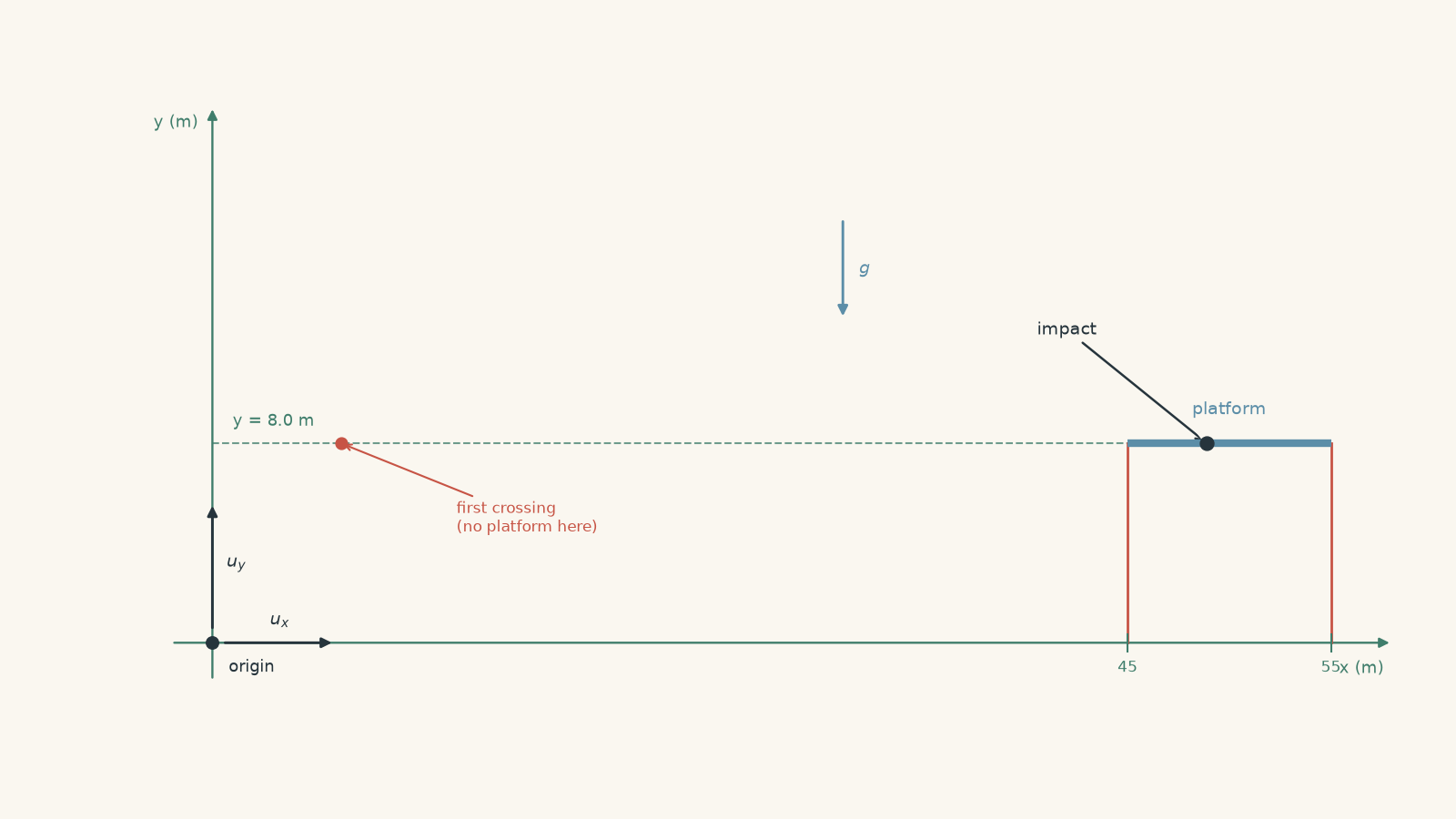
A horizontal platform is \(8.0\ \mathrm{m}\) above the launch point and extends from \(x=45.0\ \mathrm{m}\) to \(x=55.0\ \mathrm{m}\).
Ignore air resistance and the thickness of the platform.
Does the projectile hit the platform? If it does, find the time of flight until first contact. If it does not, find the time until it returns to ground level.
Solution 2
The projectile hits the platform on its downward journey, \(3.55\ \mathrm{s}\) after launch.
Resolve the initial velocity:
\[
u_x=(24.0)\cos55.0^\circ
=13.8\ \mathrm{m\,s^{-1}},
\]
\[
u_y=(24.0)\sin55.0^\circ
=19.7\ \mathrm{m\,s^{-1}}.
\]
At platform height,
\[
\Delta y=8.0\ \mathrm{m}.
\]
Use the vertical equation:
\[
8.0=(19.7)t-4.90t^2.
\]
Rearranging,
\[
4.90t^2-19.7t+8.0=0.
\]
The two roots are approximately
\[
t=0.460\ \mathrm{s}
\]
and
\[
t=3.55\ \mathrm{s}.
\]
Both are physically meaningful vertical crossings. The first is on the way up, and the second is on the way down.
But the platform does not exist everywhere at \(y=8.0\ \mathrm{m}\), so we must check the horizontal positions.
At \(t=0.460\ \mathrm{s}\),
\[
x=u_xt=(13.8)(0.460)=6.33\ \mathrm{m}.
\]
There is no platform there.
At \(t=3.55\ \mathrm{s}\),
\[
x=(13.8)(3.55)=48.9\ \mathrm{m}.
\]
This is inside the platform’s range from \(45.0\ \mathrm{m}\) to \(55.0\ \mathrm{m}\). Therefore the projectile contacts the platform at
\[
T=3.55\ \mathrm{s}.
\]
A tempting route is simply to choose the larger positive quadratic root because it “looks like the landing time”. That happens to give the correct contact here, but it is not a valid general method. The decisive constraint is the platform’s horizontal position.
Question 3
A projectile is launched from ground level.
It passes through a height of \(15.0\ \mathrm{m}\) while rising, then passes through the same height exactly \(1.00\ \mathrm{s}\) later while falling.
No launch speed or angle is given.
Find:
- the projectile’s maximum height
- its initial vertical velocity
- its total flight time back to ground level
- its total flight time if the actual landing surface is instead \(5.0\ \mathrm{m}\) below the launch point.
Take \(g=9.8\ \mathrm{m\,s^{-2}}\).
Solution 3
The maximum height is \(16.2\ \mathrm{m}\), the initial vertical velocity is \(17.8\ \mathrm{m\,s^{-1}}\), the same-level flight time is \(3.64\ \mathrm{s}\), and the time to a surface \(5.0\ \mathrm{m}\) below launch is \(3.90\ \mathrm{s}\).
The key is that the projectile passes the same height twice, with the maximum point halfway between those crossings in time.
The crossings are \(1.00\ \mathrm{s}\) apart, so each crossing occurs
\[
0.500\ \mathrm{s}
\]
from the instant of maximum height.
At maximum height, \(v_y=0\). Therefore the magnitude of the vertical velocity at either \(15.0\ \mathrm{m}\) crossing is
\[
|v_y|=g(0.500)
=(9.8)(0.500)
=4.90\ \mathrm{m\,s^{-1}}.
\]
Now consider the upward crossing. From \(15.0\ \mathrm{m}\) to maximum height, use
\[
v_y^2=u_y^2+2a\Delta y,
\]
where the initial vertical velocity for this short section is \(4.90\ \mathrm{m\,s^{-1}}\), the final vertical velocity is zero, and \(a=-9.8\ \mathrm{m\,s^{-2}}\).
Thus,
\[
0=(4.90)^2+2(-9.8)\Delta y,
\]
so
\[
\Delta y=1.225\ \mathrm{m}.
\]
The maximum height is therefore
\[
H=15.0+1.225=16.225\ \mathrm{m}
\approx16.2\ \mathrm{m}.
\]
Now work backwards from launch level to maximum height:
\[
0=u_y^2+2(-9.8)(16.225).
\]
Hence,
\[
u_y=\sqrt{2(9.8)(16.225)}
=17.8\ \mathrm{m\,s^{-1}}.
\]
For a return to launch height,
\[
T=\frac{2u_y}{g}
=\frac{2(17.8)}{9.8}
=3.64\ \mathrm{s}.
\]
If the landing surface is \(5.0\ \mathrm{m}\) below launch, however,
\[
\Delta y=-5.0\ \mathrm{m}.
\]
Therefore,
\[
-5.0=(17.8)t-4.90t^2,
\]
or
\[
4.90t^2-17.8t-5.0=0.
\]
Solving gives the positive root
\[
t=3.90\ \mathrm{s}.
\]
The tempting mistake is to treat the \(1.00\ \mathrm{s}\) between the two \(15.0\ \mathrm{m}\) crossings as either the time to maximum height or half the whole flight. It is neither. What matters is the symmetry about the maximum point: the top occurs halfway in time between two crossings of the same height.
Question 4
A projectile leaves the edge of a cliff. Exactly \(2.00\ \mathrm{s}\) later, it passes through the launch height again while travelling downwards.
The sea is \(9.80\ \mathrm{m}\) below the launch point. The projectile’s horizontal velocity is constant at \(12.0\ \mathrm{m\,s^{-1}}\).
A student argues:
It takes \(2.00\ \mathrm{s}\) to get back to the cliff height. Then it simply falls another \(9.80\ \mathrm{m}\), so I can add the free-fall time from rest.
Determine:
- the actual total flight time
- the horizontal distance from the cliff to the impact point
- the vertical velocity just before impact
- exactly why the student’s method fails.
Solution 4
The actual flight time is \(2.73\ \mathrm{s}\), the projectile lands \(32.8\ \mathrm{m}\) horizontally from the cliff, and its vertical impact velocity is approximately \(17.0\ \mathrm{m\,s^{-1}}\) downwards.
The \(2.00\ \mathrm{s}\) return to the launch height tells us the initial vertical velocity.
For a same-height return,
\[
2.00=\frac{2u_y}{9.8}.
\]
Therefore,
\[
u_y=9.80\ \mathrm{m\,s^{-1}}.
\]
At any later time,
\[
\Delta y=u_yt-\frac12gt^2.
\]
At the sea,
\[
\Delta y=-9.80\ \mathrm{m},
\]
so
\[
-9.80=(9.80)t-4.90t^2.
\]
Divide by \(4.90\):
\[
-2=2t-t^2.
\]
Therefore,
\[
t^2-2t-2=0.
\]
The positive root is
\[
t=1+\sqrt3
=2.73\ \mathrm{s}.
\]
The horizontal distance is
\[
x=u_xt
=(12.0)(2.73)
=32.8\ \mathrm{m}.
\]
The vertical velocity at impact is
\[
v_y=u_y-gt.
\]
Thus,
\[
v_y
=9.80-(9.8)(2.73)
=-17.0\ \mathrm{m\,s^{-1}}.
\]
The negative sign means downwards.
The student’s split-motion idea is not automatically wrong. The problem is the initial condition used for the second section.
When the projectile returns to the cliff height after \(2.00\ \mathrm{s}\), it is not momentarily at rest. Its vertical velocity is
\[
v_y=9.80-(9.8)(2.00)
=-9.80\ \mathrm{m\,s^{-1}}.
\]
It is already moving downwards at \(9.80\ \mathrm{m\,s^{-1}}\). Treating the final \(9.80\ \mathrm{m}\) as free fall from rest throws away that velocity, so it predicts too much extra time.
This is a useful warning about splitting motion into stages: when one stage ends, its final velocity becomes the next stage’s initial velocity.
Question 5
Two projectiles are launched from the same point on a straight hillside that rises at \(20.0^\circ\) above the horizontal.
Both projectiles have the same initial vertical velocity:
\[
u_y=15.0\ \mathrm{m\,s^{-1}}.
\]
Projectile A has
\[
u_{x,A}=5.0\ \mathrm{m\,s^{-1}},
\]
while projectile B has
\[
u_{x,B}=10.0\ \mathrm{m\,s^{-1}}.
\]
The hillside extends indefinitely.
A student argues that both projectiles must have the same flight time because their initial vertical velocities are identical.
Determine the flight time of each projectile until it next meets the hillside.
Then suppose the hillside instead slopes downwards at \(20.0^\circ\). Find the new flight times and explain why their order reverses.
Finally, show what happens in the flat-ground limit.
Solution 5
On the rising hillside, projectile A stays airborne for \(2.69\ \mathrm{s}\) and projectile B for \(2.32\ \mathrm{s}\); on the falling hillside, A stays airborne for \(3.43\ \mathrm{s}\) and B for \(3.80\ \mathrm{s}\). The student’s same-\(u_y\) argument fails because the landing height is no longer fixed.
Put the launch point at the origin.
For a hillside rising at angle \(20.0^\circ\),
\[
y=x\tan20.0^\circ.
\]
The vertical position of either projectile is
\[
y=15.0t-4.90t^2.
\]
Its horizontal position is
\[
x=u_xt.
\]
At impact, the projectile and hillside must have the same \(x\) and \(y\), so
\[
15.0t-4.90t^2=u_xt\tan20.0^\circ.
\]
Factor out \(t\):
\[
t\left(15.0-u_x\tan20.0^\circ-4.90t\right)=0.
\]
The root \(t=0\) is the launch instant. The next intersection occurs at
\[
t=\frac{15.0-u_x\tan20.0^\circ}{4.90}.
\]
For projectile A,
\[
t_A
=\frac{15.0-(5.0)\tan20.0^\circ}{4.90}
=2.69\ \mathrm{s}.
\]
For projectile B,
\[
t_B
=\frac{15.0-(10.0)\tan20.0^\circ}{4.90}
=2.32\ \mathrm{s}.
\]
So the faster horizontal projectile lands sooner.
Why? As B moves horizontally faster, the rising hillside beneath it also reaches greater heights more quickly. B does not have to fall as far vertically before meeting the ground.
Now reverse the slope. For a hillside falling at \(20.0^\circ\),
\[
y=-x\tan20.0^\circ.
\]
The impact condition becomes
\[
15.0t-4.90t^2=-u_xt\tan20.0^\circ.
\]
For the non-zero root,
\[
t=\frac{15.0+u_x\tan20.0^\circ}{4.90}.
\]
Projectile A therefore has
\[
t_A
=\frac{15.0+(5.0)\tan20.0^\circ}{4.90}
=3.43\ \mathrm{s},
\]
while projectile B has
\[
t_B
=\frac{15.0+(10.0)\tan20.0^\circ}{4.90}
=3.80\ \mathrm{s}.
\]
Now the faster horizontal projectile stays airborne longer. By travelling farther horizontally, it reaches a part of the downhill surface that is lower, so it must fall farther before impact.
The flat-ground limit makes the hidden assumption clear. Set the slope angle to \(0^\circ\):
\[
\tan0^\circ=0.
\]
Both expressions reduce to
\[
t=\frac{15.0}{4.90}
=3.06\ \mathrm{s}.
\]
This is exactly
\[
T=\frac{2u_y}{g}
=\frac{2(15.0)}{9.8}
=3.06\ \mathrm{s}.
\]
So the statement “same vertical velocity means same flight time” is not fundamentally about projectiles. It is about projectiles with the same vertical motion and the same fixed landing height.
Once the surface slopes, horizontal position determines the height of the ground, so horizontal and vertical motion can no longer be separated when deciding the collision time.
09What flight time lets you calculate next
Once the correct flight time is known, several other projectile quantities become straightforward.
For constant horizontal velocity,
\[
x=u_xt,
\]
so flight time gives the horizontal position of the projectile at landing. Its vertical impact velocity follows from
\[
v_y=u_y-gt.
\]
Those two velocity components can then be combined to find the impact speed and direction.
The next important step is understanding what happens when the launch angle changes. Increasing the angle usually increases \(u_y\), which tends to increase flight time, but it simultaneously decreases \(u_x\). Those competing effects are what produce the familiar relationship between Projectile Launch Angle, Height, Flight Time and Range.