
The Standard Model of Particle Physics: HSC Physics Guide
Learn how the Standard Model organises quarks, leptons, force carriers, and the Higgs boson, and where the model is incomplete.
A free neutron has zero electric charge, yet it is made from three charged quarks. A free neutron can also change into a proton, an electron, and an antineutrino. If you only memorise a list of particles, those facts look like separate tricks. The Standard Model connects them: quarks and leptons are the matter particles, photons, gluons, and W and Z bosons describe three fundamental interactions, and the Higgs boson has a different role again. :chatgpt-content-reference{index=”0″}
Zooming in: from atom to fundamental particles
- Atom — composite
Electrons surround a nucleus.
The nucleus contains protons and neutrons.
- Nucleus — composite
Contains protons and neutrons.
- Proton and neutron — composite
p = uud; n = udd
Each has three valence quarks.
Proton: +e; neutron: 0.
- Up and down quarks — fundamental
u, d
Treated as fundamental matter particles.
No internal substructure has been observed.
A useful NSW Physics inquiry question is:
“What is the Standard Model? What evidence suggests that protons and neutrons are not fundamental particles?” :chatgpt-content-reference{index=”1″}
That question gives you the right way to approach the topic. You need to know what the particles are, how they interact, and where the model stops working.
01Matter particles: quarks and leptons
Start with the familiar picture of an atom. An atom contains electrons around a nucleus. The nucleus contains protons and neutrons.
But the chain does not stop there.
Protons and neutrons are composite particles. They are made from quarks. Electrons, by contrast, are fundamental particles in the Standard Model: no internal structure has been observed.
“Fundamental” does not mean physicists have proved that absolutely nothing smaller could ever exist. It means that, with current evidence, the particle behaves as though it has no smaller constituents.
The Standard Model puts the fundamental matter particles into two families: quarks and leptons. There are three generations of each. :chatgpt-content-reference{index=”2″}
| Generation | Quarks | Leptons |
|---|---|---|
| 1st | up \(u\), down \(d\) | electron \(e^-\), electron neutrino \(\nu_e\) |
| 2nd | charm \(c\), strange \(s\) | muon \(\mu^-\), muon neutrino \(\nu_\mu\) |
| 3rd | top \(t\), bottom \(b\) | tau \(\tau^-\), tau neutrino \(\nu_\tau\) |
The generations repeat the same basic charge pattern, but the particles in the second and third generations are heavier and generally less stable. Ordinary stable matter is made from first-generation particles. :chatgpt-content-reference{index=”3″}
Three generations of matter particles
| 1st generation — ordinary stable matter | Quarks: up (u), down (d) Leptons: electron (e⁻), electron neutrino (νₑ) |
|---|---|
| 2nd generation | Quarks: charm (c), strange (s) Leptons: muon (μ⁻), muon neutrino (νμ) |
| 3rd generation | Quarks: top (t), bottom (b) Leptons: tau (τ⁻), tau neutrino (ντ) |
Quark charges
Let \(e\) represent the magnitude of the elementary electric charge.
The charge pattern is worth memorising because it lets you solve many questions rather than simply recall answers.
| Particle type | Examples | Electric charge |
|---|---|---|
| Up-type quark | \(u,c,t\) | \(+\frac{2}{3}e\) |
| Down-type quark | \(d,s,b\) | \(-\frac{1}{3}e\) |
| Charged lepton | \(e^-,\mu^-,\tau^-\) | \(-e\) |
| Neutrino | \(\nu_e,\nu_\mu,\nu_\tau\) | \(0\) |
The corresponding antiparticles have opposite charges. So an anti-up quark has charge \(-\frac{2}{3}e\), while a positron \(e^+\) has charge \(+e\). Neutrinos and antineutrinos are electrically neutral.
Quarks also have a quantum property called colour charge. The names red, green, and blue are labels, not actual colours. Colour charge is what matters for the strong interaction.
Quarks do not normally appear by themselves. They combine into composite particles called hadrons. Baryons contain three quarks, while mesons contain a quark and an antiquark. Protons and neutrons are baryons. :chatgpt-content-reference{index=”4″}
For a closer look at how quarks combine into protons, neutrons, and mesons, see Quarks and Hadrons: How Protons, Neutrons and Mesons Form.
Quark charge bookkeeping
| Proton | u (+⅔e) + u (+⅔e) + d (−⅓e) = p (+e) Valence quark content: uud. Total charge: +e. |
|---|---|
| Neutron | u (+⅔e) + d (−⅓e) + d (−⅓e) = n (0) Valence quark content: udd. Total charge: 0. |
Worked example: find the charge of a baryon
A baryon has the quark content \(u d s\). Determine its electric charge and state whether it is fundamental or composite.
Step 1
\[ q = +\frac{2}{3}e -\frac{1}{3}e -\frac{1}{3}e \]
Step 2
\[ q = 0e \]
So the baryon is electrically neutral.
Step 3
It is made from three quarks, so it is a composite hadron, not a fundamental particle.
The useful habit here is to calculate the charge from the constituents. Don’t assume that a neutral particle contains only neutral constituents. A neutron is the classic example: its charged quarks add to zero.
02What makes the particles interact?
Now consider two electrons. They electrically repel each other even though neither electron is touching the other.
In the Standard Model, interactions are described using fields and, in the familiar HSC picture, force-carrier particles. You can think of a force carrier as a messenger between interacting particles.
That messenger analogy is useful, but it has a limit. A force carrier is not literally a tiny classical ball being thrown back and forth. The precise description comes from quantum field theory. For HSC questions, the exchange-particle picture is a useful way to identify which interaction is occurring.
The three Standard Model interactions have these carriers:
| Interaction | Carrier | What it acts on | Useful clue |
|---|---|---|---|
| Electromagnetic | photon \(\gamma\) | electrically charged particles | charge matters |
| Strong | gluons \(g\) | colour-charged particles | acts on quarks and gluons |
| Weak | \(W^+\), \(W^-\), \(Z^0\) | quarks and leptons | can change particle flavour |
| Gravitational | no confirmed Standard Model carrier | mass-energy | not included in the Standard Model |
The photon is the carrier of the electromagnetic interaction. Gluons carry the strong interaction. The W and Z bosons carry the weak interaction. Gravity is not part of the Standard Model; a hypothetical graviton is sometimes proposed as its quantum carrier, but it has not been established as a Standard Model particle. :chatgpt-content-reference{index=”5″}
There is an important distinction between the two weak carriers:
- \(W^+\) and \(W^-\) are charged weak carriers and can change the electric charge and flavour of a matter particle.
- \(Z^0\) is electrically neutral and mediates neutral-current weak interactions.
This gives you a powerful prediction rule.
A neutrino has no electric charge and no colour charge. So can the electromagnetic or strong interaction act directly on it?
No. But the neutrino does participate in the weak interaction. Being electrically neutral does not mean “does not interact”.
Likewise, an up quark has electric charge and colour charge, so it can participate in electromagnetic, strong, and weak interactions.
Which interactions apply?
| Electron (e⁻) | Electromagnetic: ✓ Strong: ✗ Weak: ✓ |
|---|---|
| Electron neutrino (νₑ) | Electromagnetic: ✗ Strong: ✗ Weak: ✓ |
| Up quark (u) | Electromagnetic: ✓ Strong: ✓ Weak: ✓ |
| Gluon (g) | Electromagnetic: ✗ Strong: ✓ Weak: ✗ |
A common trap: “boson” does not mean “force carrier”
A boson is a broad category of particle. The photon, gluons, W bosons, Z boson, and Higgs boson are all bosons, but they do not all have the same role.
The Higgs boson is the important exception students often misfile.
The Higgs boson has spin 0, whereas the familiar force-carrying gauge bosons have spin 1. The Higgs boson is associated with the Higgs field and the mechanism through which elementary particles such as quarks and charged leptons acquire mass. The W and Z bosons also acquire mass through their interaction with the Higgs field. :chatgpt-content-reference{index=”6″}
So in an HSC answer:
Matter particles: quarks and leptons
Force carriers: photon, gluons, \(W^\pm\), \(Z^0\)
Higgs: a boson with a different role
Gravity: outside the Standard Model
Roles in and beyond the Standard Model
| Matter particles — inside | Quarks and leptons. Fundamental matter particles. |
|---|---|
| Force carriers — inside | Photon, gluons, W⁺, W⁻, and Z⁰. Carry electromagnetic, strong, and weak interactions. |
| Higgs boson — inside | Excitation of the Higgs field. Not a force carrier. |
| Gravity — outside | Not included in the Standard Model. No confirmed Standard Model gravity carrier. |
Worked example: follow a neutron through beta decay
A free neutron undergoes beta-minus decay:
\[ n \rightarrow p + e^- + \bar{\nu}_e \]
Explain what happens at the quark level and identify the force carrier.
Step 1
A neutron is
\[ udd \]
and a proton is
\[ uud \]
Only one quark needs to change: a down quark becomes an up quark.
Step 2
The down quark has charge \(-\frac{1}{3}e\), while the up quark has charge \(+\frac{2}{3}e\).
Charge conservation requires
\[ -\frac{1}{3}e = +\frac{2}{3}e + q_X \]
Therefore,
\[ q_X=-e \]
The exchanged particle must have charge \(-e\).
Step 3
The Standard Model particle with charge \(-e\) that carries the charged weak interaction is the \(W^-\) boson.
So the quark-level process is
\[ d \rightarrow u + W^- \]
Step 4
The \(W^-\) produces
\[ W^- \rightarrow e^- + \bar{\nu}_e \]
Combining the two stages gives
\[ n(udd) \rightarrow p(uud)+e^-+\bar{\nu}_e \]
Step 5
The total charge starts at \(0\). The final charges are
\[ (+e)+(-e)+(0)=0 \]
so charge is conserved.
The tempting mistake is to choose the photon because the process involves electric charge. But a photon does not change a down quark into an up quark. That change of quark flavour is the clue that points to the weak interaction and the \(W^-\) carrier. The W boson is an internal exchange particle in this decay, rather than a real W particle flying out of the neutron and being detected.
Beta-minus decay at the quark level
- Initial neutron
n(udd): 0e
u = +⅔e; d = −⅓e.
Composite baryon.
- Quark flavour change
d(−⅓e) → u(+⅔e) + W⁻(−e)
−⅓e = +⅔e − e.
Weak interaction; virtual W⁻ is exchanged.
- Lepton production
W⁻(−e) → e⁻(−e) + ν̄ₑ(0)
−e = −e + 0.
Electron antineutrino has zero charge.
- Final state
p(uud, +e) + e⁻(−e) + ν̄ₑ(0)
Final charge: +e − e + 0 = 0.
Overall: n → p + e⁻ + ν̄ₑ.
03One interaction can involve several kinds of particles
A useful mistake to avoid is thinking that each particle has one assigned force.
An electron can interact electromagnetically and weakly. An up quark can interact through all three Standard Model interactions. A neutrino interacts through the weak interaction despite having zero electric charge.
The reason is that different interactions respond to different properties.
- Electromagnetism responds to electric charge.
- The strong interaction responds to colour charge.
- The weak interaction acts on quarks and leptons, including electrically neutral neutrinos.
This is why a neutron can participate in the strong interaction even though its total electric charge is zero. Its constituent quarks carry colour charge.
There is another subtlety. A neutral particle can itself be a force carrier. The \(Z^0\) is neutral, but it carries the weak interaction. So “neutral” and “non-interacting” are completely different ideas.
Charge does not determine every interaction
| Electron + neutrino | e⁻ • ν e⁻: −1e → electromagnetic; weak: yes ν: 0, colourless; weak: yes |
|---|---|
| Up quark | u +2/3e → electromagnetic; colour-charged → strong Weak interaction: yes |
| Neutron | n = udd Net electric charge: 0 Quarks carry colour → strong; weak: d → u in β⁻ decay |
| Photon | γ Electric charge: 0; colourless Carries the electromagnetic interaction |
| Gluon | g Electric charge: 0; carries colour charge Carries the strong interaction |
| Z boson | Z⁰ Electric charge: 0; colourless Carries the weak interaction via neutral currents |
Strong force versus the nuclear force
At HSC level, you will often see the strong force described as the force that binds quarks into protons and neutrons.
There is a useful extra layer of precision.
The fundamental strong interaction is described by quantum chromodynamics and involves quarks and gluons. The force that binds protons and neutrons together inside a nucleus is a residual effect of the strong interaction.
So if a question asks for the Standard Model carrier of the strong force, the answer is gluons.
Do not answer “mesons” just because meson exchange can be used in some descriptions of the nuclear force between nucleons.
Quarks and gluons are also subject to confinement: isolated quarks are not observed in ordinary conditions. At extremely high energies and densities, however, quarks and gluons can form a quark-gluon plasma. :chatgpt-content-reference{index=”7″}
04How do we know protons and neutrons are composite?
Suppose you wanted to find out whether a proton was truly fundamental.
You cannot simply open one up and look inside.
Instead, you use a high-energy particle as a probe. A higher-energy probe can investigate smaller distance scales. By measuring how the probe scatters, you can infer the structure of the object it hit.
High-energy scattering experiments showed patterns consistent with small, point-like constituents inside protons and neutrons. This is evidence for quarks. It is not a photograph of three little balls sitting inside a proton. It is evidence from the way particles interact. :chatgpt-content-reference{index=”8″}
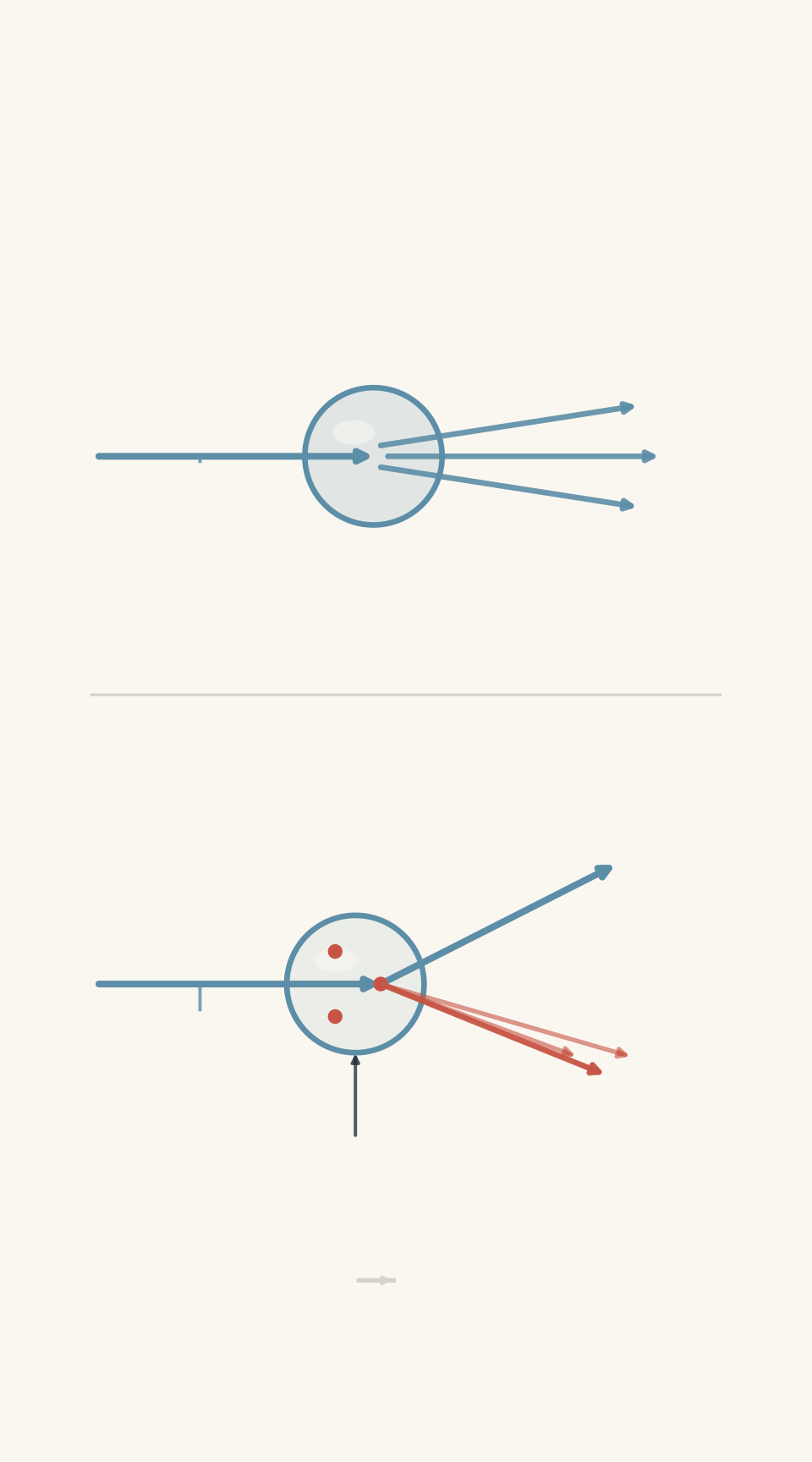
Particle accelerators extend this idea further. They provide enough energy to produce particles that would otherwise be impossible to observe directly, while detectors measure the products of their interactions and decays.
The W and Z bosons were discovered through accelerator experiments, and the Higgs boson was discovered at the Large Hadron Collider in 2012. The properties of these particles can then be compared with Standard Model predictions. :chatgpt-content-reference{index=”9″}
This gives you the basic scientific cycle:
model → prediction → experiment → comparison → stronger model or revision
A theory becomes more convincing when different experiments repeatedly agree with its predictions. It also becomes more interesting when a careful experiment finds a reproducible disagreement.
05The Higgs boson is part of the model, but it does not complete the model
The Higgs boson is often described as “the particle that gives everything mass”. That is a useful shortcut, but it needs refining.
The Higgs field interacts with elementary particles. Those interactions contribute to the masses of elementary particles, including quarks, charged leptons, and the W and Z bosons. The Higgs boson is an excitation of this field. :chatgpt-content-reference{index=”10″}
But most of the mass of an ordinary proton does not come directly from the Higgs field. Most of it comes from the energy associated with the strong interaction inside the proton.
So:
- Higgs field → gives elementary particles their mass through their interactions with the field.
- Strong interaction → accounts for most of the mass-energy of composite protons and neutrons.
- Higgs boson → evidence for the Higgs field and its mechanism.
That distinction prevents a common exam mistake: Higgs boson is not another name for the strong, electromagnetic, or weak force carrier.
06Where the Standard Model stops
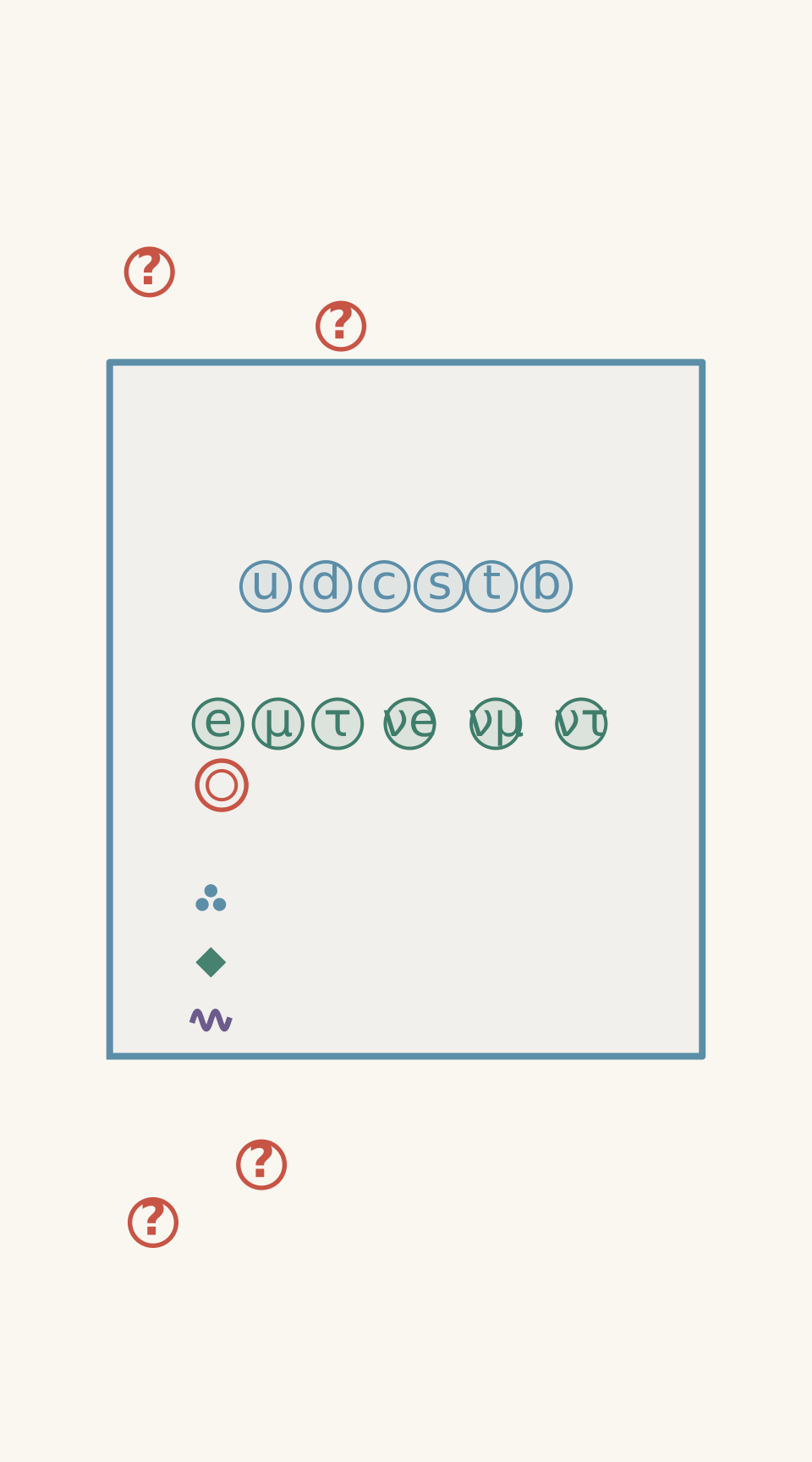
Here is the surprising part: the Standard Model is extremely successful and still incomplete.
Those statements are not contradictory.
A map can be extremely accurate within the area it covers while leaving half the continent blank.
Gravity is outside the Standard Model
The Standard Model describes the electromagnetic, strong, and weak interactions. It does not provide a quantum description of gravity.
A hypothetical quantum carrier of gravity is called the graviton, but the graviton is not part of the Standard Model. The difficulty is that quantum field theory and general relativity have not been combined into a complete, experimentally established framework. :chatgpt-content-reference{index=”11″}
This does not make the Standard Model useless for particle physics. At the scale of individual particles, gravitational effects are normally tiny compared with the other interactions.
Dark matter is not explained
Astronomical observations provide strong evidence for additional matter that does not behave like ordinary luminous matter. The Standard Model contains no established particle that accounts for dark matter.
So if an experiment definitively identified a new particle as the constituent of dark matter, that would be evidence for physics beyond the Standard Model. :chatgpt-content-reference{index=”12″}
Neutrinos have mass
The minimal Standard Model treated neutrinos as massless. Experiments studying neutrino oscillations established that neutrinos have tiny, non-zero masses.
That means the minimal model needs to be extended. The rest of the Standard Model does not suddenly stop predicting electromagnetic, strong, and weak phenomena correctly. This is a good example of how scientific theories are often extended, rather than simply thrown away. :chatgpt-content-reference{index=”13″}
The model does not explain why there are three generations
The Standard Model describes the three generations very successfully, but it does not explain why nature has exactly three, or why their masses are so different.
Experiments have also provided strong evidence for three light neutrino families. The question of why there are three generations remains open. :chatgpt-content-reference{index=”14″}
Matter dominates over antimatter
The Standard Model contains mechanisms that distinguish matter from antimatter, including CP violation. However, the amount of CP violation in the Standard Model is not enough to explain why the observable universe contains vastly more matter than antimatter.
Again, this is not a reason to stop using the model. It is a clue that the model is not the whole story. :chatgpt-content-reference{index=”15″}
07The exam-ready way to organise it
When a particle-physics question looks messy, reduce it to five decisions.
| If the question asks… | Start by thinking… |
|---|---|
| What is matter made from? | Quarks and leptons |
| Is this particle fundamental? | Quarks and leptons are fundamental; protons, neutrons, and mesons are composite |
| Which interaction is involved? | Check electric charge, colour, and whether a quark or lepton changes |
| Which carrier is involved? | Photon → electromagnetic; gluon → strong; \(W^\pm/Z^0\) → weak |
| Is this beyond the Standard Model? | Think gravity, dark matter, neutrino mass, unexplained generations, or unexplained matter-antimatter asymmetry |
The strongest clue in a reaction is often what changes.
If a down quark becomes an up quark, the weak interaction is the obvious candidate.
If electrically charged particles interact without changing their identity, electromagnetic interaction is a strong candidate.
If colour-charged quarks interact, think strong interaction.
If a question gives you a neutral particle, do not immediately say “no interaction”. Ask which charge or property the interaction responds to.
That is the real structure of the Standard Model: not a table to memorise, but a system for predicting what can happen.
08Questions and solutions
Question 1
A particle has the quark content \(u d d\).
Calculate its electric charge in units of \(e\), and identify the particle. Is it fundamental or composite?
Solution 1
It is a neutron with zero electric charge, and it is a composite particle.
The quark charges are
\[ q_u=+\frac{2}{3}e \]
and
\[ q_d=-\frac{1}{3}e \]
Therefore,
\[ \begin{aligned} q &= +\frac{2}{3}e -\frac{1}{3}e -\frac{1}{3}e\\ &=0e \end{aligned} \]
So the particle is electrically neutral.
The combination \(udd\) is the quark content of a neutron. Because it contains three quarks, it is a baryon and therefore a composite particle.
The tempting route is to treat “neutron” and “fundamental particle” as interchangeable labels. They are not. The neutron is made from more fundamental constituents, whereas the quarks themselves are treated as fundamental in the Standard Model.
Question 2
A neutral baryon has quark content \(u d s\). It decays according to
\[ uds \rightarrow p+\pi^- \]
Use \(p=uud\) and \(\pi^-=d\bar u\).
- Show that electric charge is conserved.
- Determine which quark changes during the decay.
- Identify the interaction and the force carrier.
- Explain why the strong interaction cannot produce this decay by itself.
Solution 2
The decay is a weak interaction in which the strange quark changes into an up quark through \(W^-\) exchange.
First, the initial baryon has charge
\[ +\frac{2}{3}e -\frac{1}{3}e -\frac{1}{3}e =0e \]
The final particles have charges
\[ q_p=+e \]
and
\[ q_{\pi^-}=-e \]
so
\[ q_{\text{final}} =+e-e =0e \]
Electric charge is conserved.
Now compare the quark content:
\[ uds \rightarrow uud+d\bar u \]
The original \(u\) and \(d\) can remain. The \(s\) quark must become a \(u\) quark.
At the quark level,
\[ s\rightarrow u+W^- \]
and then
\[ W^-\rightarrow d+\bar u \]
The interaction is therefore weak, and the carrier is the \(W^-\) boson.
The tempting route is to say “both products are hadrons, so this must be a strong decay”. The exact constraint that defeats that argument is quark flavour. Strong interactions mediated by gluons do not change a quark from one flavour to another. The strange quark cannot simply turn into an up quark through gluon exchange.
The weak interaction can change quark flavour, which is why it provides the correct mechanism.
Question 3
Consider four particles: an electron \(e^-\), an electron neutrino \(\nu_e\), an up quark \(u\), and a gluon \(g\).
For each particle, state whether it can participate directly in:
- the electromagnetic interaction,
- the strong interaction,
- the weak interaction.
Then assess these two claims:
Student A: “The electron neutrino cannot interact because it has no electric charge.”
Student B: “The gluon can participate directly in electromagnetic interactions because it is a boson.”
Solution 3
Student A is wrong because neutrinos participate in the weak interaction, and Student B is wrong because being a boson does not automatically give a particle an electromagnetic interaction.
The interaction table is:
| Particle | Electromagnetic | Strong | Weak |
|---|---|---|---|
| Electron \(e^-\) | Yes | No | Yes |
| Electron neutrino \(\nu_e\) | No | No | Yes |
| Up quark \(u\) | Yes | Yes | Yes |
| Gluon \(g\) | No direct electromagnetic interaction | Yes | No |
The electron has electric charge, so it participates in electromagnetism. It does not carry colour charge, so it does not participate in the strong interaction. It can also participate in the weak interaction.
The electron neutrino has zero electric charge and no colour charge, so it does not participate directly in electromagnetic or strong interactions. It does, however, participate in the weak interaction.
The up quark has both electric charge and colour charge, so it can participate in all three Standard Model interactions.
The gluon is itself a carrier of the strong interaction and carries colour charge, so gluons can interact with other gluons through the strong interaction. But a gluon does not have electric charge, so it does not directly participate in the electromagnetic interaction in the basic Standard Model classification.
Student A’s trap is confusing electric neutrality with no interaction. Student B’s trap is confusing the broad category boson with the narrower role force carrier for a particular interaction.
Question 4
At the quark level, an interaction is observed in which
\[ d\rightarrow u+X \]
where \(X\) is a boson.
- Calculate the electric charge of \(X\).
- Identify \(X\) within the Standard Model.
- Explain why \(X\) cannot be a photon, \(Z^0\), gluon, or Higgs boson.
- Explain why the large mass of the W and Z bosons is related to the short range of the weak interaction.
Solution 4
\(X\) must be a \(W^-\) boson, so the process is a charged weak interaction.
Charge conservation gives
\[ -\frac{1}{3}e = +\frac{2}{3}e + q_X \]
Therefore,
\[ q_X = -\frac{1}{3}e -\frac{2}{3}e \]
\[ q_X=-e \]
So \(X\) must have charge \(-e\).
The Standard Model boson with this charge that carries the weak interaction is \(W^-\). Therefore,
\[ d\rightarrow u+W^- \]
The photon is ruled out because it is electrically neutral and mediates the electromagnetic interaction. The \(Z^0\) is also neutral and therefore cannot supply the required charge change. Gluons are neutral electrically and carry the strong interaction rather than changing a down quark into an up quark. The Higgs boson is electrically neutral, has spin 0, and has a different role associated with the Higgs field.
The exact clue is not simply that the process involves a charged particle. The clue is that the quark’s flavour changes and its electric charge changes by one elementary charge. That points directly to a charged weak interaction.
The W and Z bosons are very massive compared with the photon. Their large masses limit the distance over which the weak interaction can operate, giving it its extremely short range. The photon is massless, which is associated with the long range of electromagnetism. :chatgpt-content-reference{index=”16″}
Question 5
A new neutral boson \(X\) is observed.
Early experiments establish that:
- \(X\) has spin 1.
- \(X\) has non-zero mass.
- Its interactions are very short range.
- Its mass and interactions with charged leptons and quarks match the known \(Z^0\) boson within experimental uncertainty.
A student concludes:
“\(X\) is definitely the \(Z^0\).”
A later, much more sensitive experiment finds that \(X\) has no interaction with neutrinos at all, even though the experiment is sensitive enough that a Standard Model-strength neutrino interaction would have been detected.
- Explain why the original identification of \(X\) as \(Z^0\) was reasonable.
- Explain why the later neutrino result rules out \(X=Z^0\), assuming the measurement is reliable.
- Explain why \(X\) cannot instead be the photon, a gluon, or the Higgs boson.
- If the result is independently confirmed, what does it tell us about the Standard Model?
- Why is “neutrinos are difficult to detect” not an adequate explanation for the missing interaction?
Solution 5
If the neutrino result is confirmed, \(X\) cannot be the Standard Model \(Z^0\), and its discovery would provide evidence for physics beyond the Standard Model.
The original identification was reasonable because several independent properties pointed towards the \(Z^0\):
- \(Z^0\) is electrically neutral.
- It has spin 1.
- It is massive.
- It mediates a short-range weak interaction.
- It interacts with charged leptons and quarks.
So the student was not making a silly guess. The available evidence genuinely supported the identification.
The problem appears when the experiment tests another predicted property.
The \(Z^0\) is the neutral carrier of the weak interaction, and neutrinos participate in weak neutral-current interactions. Therefore, a genuine \(Z^0\) must have a coupling to neutrinos. :chatgpt-content-reference{index=”17″}
The crucial condition is that the experiment is sensitive enough to detect a Standard Model-strength coupling. That means “we didn’t see neutrinos” cannot simply be blamed on the detector being unable to see them. The experiment has tested whether the predicted interaction leaves a measurable signal and found that it does not.
So the new observation conflicts with a required property of the \(Z^0\).
Could \(X\) be the photon? No. A photon is massless and mediates the long-range electromagnetic interaction. It also couples to electric charge, whereas neutrinos are electrically neutral.
Could \(X\) be a gluon? No. Gluons carry the strong interaction and colour charge. They do not directly couple to charged leptons in the way described here.
Could \(X\) be the Higgs boson? No. The Higgs boson has spin 0, whereas \(X\) has spin 1. The Higgs also has a different role from the gauge bosons that carry the electromagnetic, strong, and weak interactions. :chatgpt-content-reference{index=”18″}
The tempting route is to focus on the first four observations and ignore the fifth because \(X\) “looks like” a Z boson. But a scientific model makes multiple linked predictions. Matching some properties is not enough if another measured property contradicts a necessary prediction.
If the missing neutrino interaction is independently confirmed, \(X\) would not fit any of the known Standard Model bosons described above. The appropriate conclusion would be that a new particle or interaction has been observed and the Standard Model is incomplete.
That does not mean every Standard Model prediction has failed. It means the model needs an extension that can account for the new observation.
This is the deeper lesson behind particle physics: classification is not just about matching a particle’s name to a picture. You use charge, spin, interactions, decay products, and conservation laws together. Once those constraints stop agreeing with the model, the disagreement itself becomes evidence for what lies beyond it.
The next useful step is to apply the same reasoning to particle reactions: start with the particles present, track what changes, check conservation laws, and then identify the interaction and carrier.