
Forces Between Magnets: Attraction, Repulsion and Fields
Learn how magnetic poles and fields explain attraction, repulsion, and the turning effect on nearby magnets. Includes worked examples and HSC-style practice questions.
Put two bar magnets on low-friction carts. Point the north end of one towards the south end of the other, then release them. They roll together. Turn one magnet around so that north faces north, and they roll apart.
That sounds simple: opposite poles attract, like poles repel. But that rule is only the shortcut. The useful HSC explanation is why those forces appear. To get there, you need to think about the magnetic field produced by each magnet, and how the other magnet responds to that field.
Before reading on, predict this: if the north pole of one magnet is facing the south pole of another, is the attraction only happening between those two nearest poles?
Not quite. Every part of one magnet is interacting with the magnetic field produced by the other. The nearby poles usually dominate the result because the field is stronger closer to a magnet.
01Start with the poles
A bar magnet has two ends called the north pole and south pole.
If two poles are brought near each other:
| Facing poles | Interaction |
|---|---|
| North and south | Attraction |
| South and north | Attraction |
| North and north | Repulsion |
| South and south | Repulsion |
This gives the familiar rule:
Unlike poles attract. Like poles repel.
That rule predicts the direction of the force correctly, but it doesn’t yet explain the mechanism. For that, we need the magnetic field.
02A magnet changes the space around it
A magnet doesn’t need to touch another magnet to affect it. It creates a magnetic field in the surrounding space.
You can picture the field using magnetic field lines. Outside a bar magnet, the arrows point from the north pole towards the south pole.
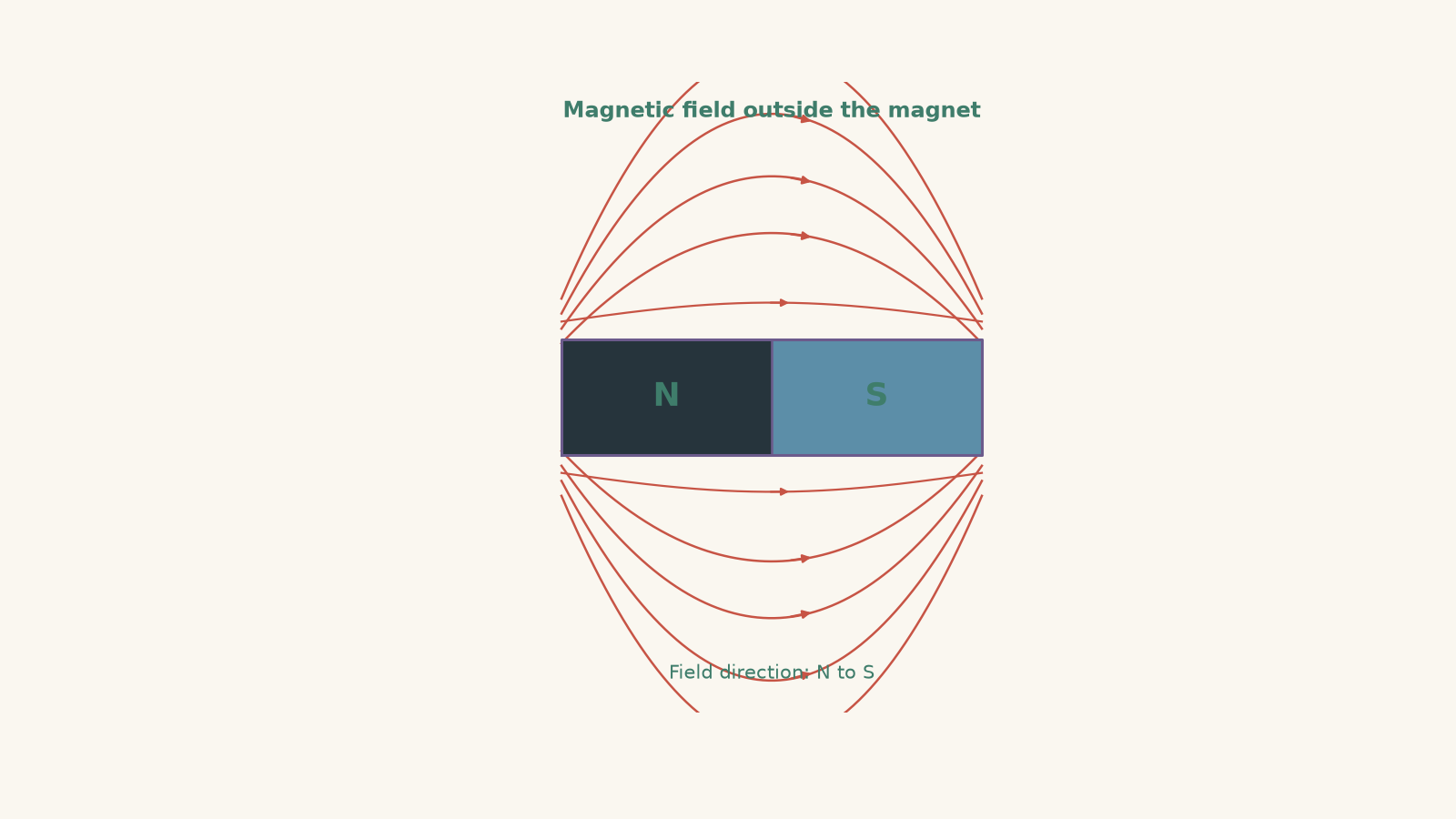
The field lines tell us two useful things:
- the arrow shows the direction of the magnetic field at that point
- lines drawn closer together represent a stronger magnetic field
The lines themselves aren’t physical threads sitting in space. They are a diagram for representing the field.
That’s worth remembering. A common explanation says that field lines “pull” magnets together like stretched rubber bands. It can help you picture the shape, but it isn’t literally what happens. There are no magnetic strings joining the magnets.
03How one magnet feels another magnet’s field
Imagine magnet A sitting on the table. It produces a magnetic field around itself.
Now bring magnet B nearby.
Magnet B is sitting inside magnet A’s field. The poles of magnet B respond to that external field. Magnet A is doing the same thing because it is sitting inside magnet B’s field.
A useful first model is:
- a north pole tends to be pushed in the direction of the magnetic field
- a south pole tends to be pushed opposite the direction of the magnetic field
Real bar magnets always contain both poles, so this “individual pole” picture is a model rather than a claim that isolated magnetic poles are sitting inside the magnet. Its job is to help us track the forces on the two ends.
Now we can explain attraction and repulsion rather than just memorising them.
04Why opposite poles attract
Suppose the north pole of magnet A faces the south pole of magnet B.
The field from A near its north end points away from A’s north pole. Magnet B’s nearby south pole responds in the opposite direction to that field, so it is pulled towards A.
At the same time, B’s magnetic field produces a corresponding force on A.
The result is that the magnets accelerate towards one another.
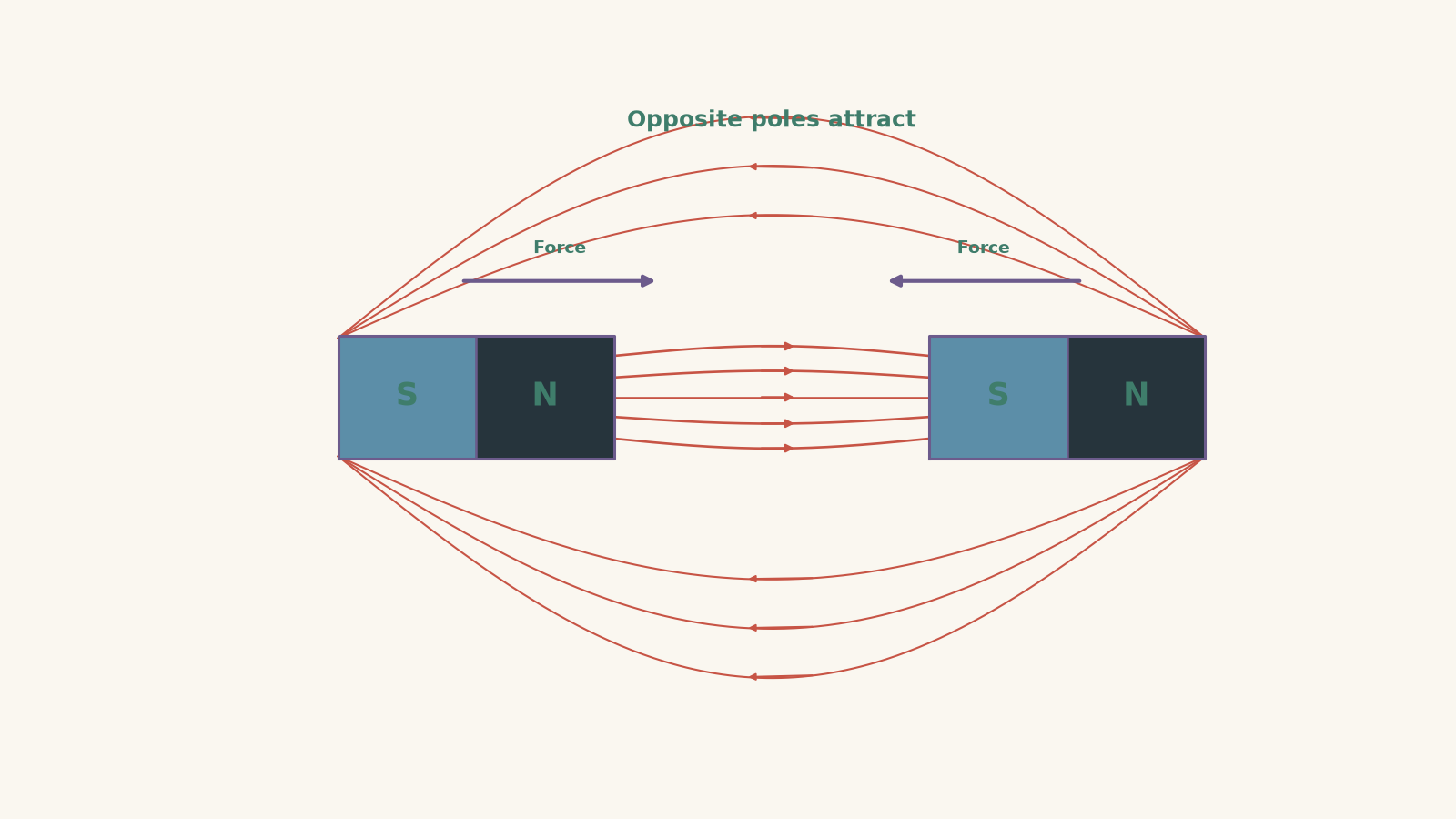
There are other interactions too. A’s north pole interacts with both poles of B, and its south pole does as well.
So why doesn’t everything cancel?
Distance matters. The field is much stronger near a pole than far away from it. When opposite poles are facing, the attractive interaction between the two nearby poles dominates the interactions involving the more distant poles.
The result is a net attractive force.
Worked example: What happens when opposite poles face?
Two identical bar magnets are placed horizontally on separate low-friction carts. The north pole of the left magnet faces the south pole of the right magnet.
Predict what happens when both carts are released, and explain the result using magnetic fields.
Step 1
The closest poles are north and south, so the simple pole rule predicts attraction.
Step 2
Each magnet produces a magnetic field. The right-hand magnet is inside the field created by the left-hand magnet, and vice versa.
Step 3
The field interaction produces forces that draw the nearby north and south poles towards one another. Because these poles are close together, their interaction is stronger than the interactions between the more distant poles.
Step 4
There is a net force on each magnet towards the other magnet, so the carts accelerate towards each other.
The important point is that “opposites attract” describes the result. The magnetic fields explain how one magnet can exert a force on another without contact.
05Why like poles repel
Now turn the right-hand magnet around so that north faces north.
Near the gap, the magnetic fields produced by the two north poles point away from their respective poles. The field pattern cannot continue straight from one north pole into the other in the way it can between north and south.
Instead, the field bends away from the region between them.
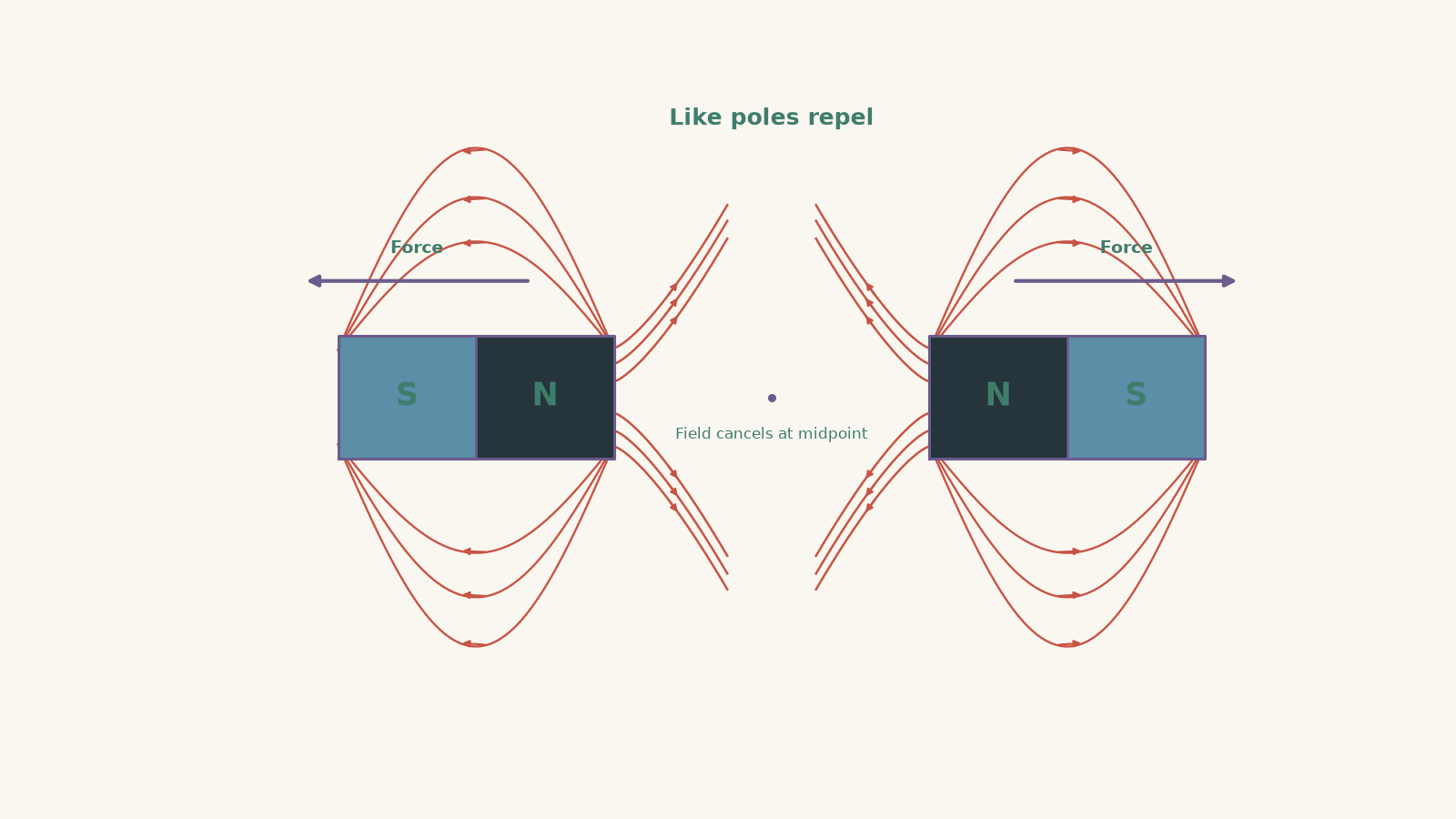
Each nearby north pole experiences a force away from the other magnet.
Again, all four poles contribute to the total interaction. The far south poles still matter. But the repulsion between the two nearby north poles is stronger than the attractions involving the more distant poles.
So the overall result is a net repulsive force.
The same reasoning applies when south faces south.
06The field diagram is evidence about direction, not a picture of the force
Students often blur together two different things:
- the magnetic field, which exists around a magnet
- the magnetic force, which acts on another suitable object placed in that field
A field can exist even when there is nothing nearby to experience a force.
Think of it like someone creating a truly awkward atmosphere at a party. The atmosphere can already be there before anyone else walks into the room. The analogy breaks because a magnetic field is a measurable physical field, not a mood, but the distinction is useful: the field is the condition of the space, while the force is what another object experiences because it is in that field.
This also means you should avoid saying, “The magnetic field is the force.” It isn’t.
The field helps determine the force.
07Magnets can rotate as well as move
So far, we’ve lined the magnets up neatly. Real questions aren’t always that generous.
Place a small bar magnet sideways near the north pole of a larger magnet.
What do you predict happens first?
The small magnet doesn’t simply slide directly towards or away from the large magnet. Its two poles experience forces in different directions, which can produce a turning effect. The magnet tends to rotate until its orientation better aligns with the surrounding magnetic field.
This is exactly what a compass needle does.
The north-seeking end of a compass points approximately in the direction of the local magnetic field.
Worked example: A magnet placed sideways
A small bar magnet is placed to the right of the north pole of a larger bar magnet. The small magnet initially lies vertically, so its north pole points upwards and its south pole points downwards.
Explain why the small magnet begins to rotate.
Step 1
Immediately to the right of the large magnet’s north pole, its magnetic field points roughly away from the north pole, towards the right.
Step 2
Its north pole tends to respond in the direction of the external field, so the force on that end has a rightward component.
Step 3
The south pole responds in the opposite direction, producing an oppositely directed force on the other end.
Step 4
Because the forces act at different positions along the small magnet, they create a turning effect.
The small magnet rotates towards an orientation in which its north pole points more nearly along the external magnetic field.
This is an important upgrade to the simple “attract or repel” story. Magnetic interactions can change an object’s orientation, not just its position.
08A magnetic field doesn’t always give a magnet a net push
Here’s a more subtle prediction.
Suppose a small bar magnet sits in an approximately uniform magnetic field, meaning the field has essentially the same strength and direction across the whole magnet. The bar magnet is initially sideways to the field.
Will the magnet move across the table?
Not necessarily.
Its north and south ends can experience forces that create a turning effect while largely cancelling as a net translational force. The magnet can therefore rotate without its centre of mass accelerating significantly.
In an ideal perfectly uniform magnetic field, a magnetic dipole can experience a torque that aligns it with the field while having no net force.
This exposes a common misconception:
“If an object is in a magnetic field, the field must push it somewhere.”
A magnetic field does not automatically produce a net translational force. The result depends on the object, its orientation, and whether the field changes from one position to another.
Near a real bar magnet, the field is strongly non-uniform, particularly near the poles. That variation helps produce the net attraction or repulsion we observe between nearby magnets.
09Why the simple pole rule works so well
For two ordinary bar magnets, you can usually begin with the facing poles:
- unlike facing poles suggest attraction
- like facing poles suggest repulsion
But a stronger explanation follows this chain:
Each magnet produces a magnetic field -> the other magnet is placed in that field -> forces act on different parts of the magnet -> those forces combine to produce a net force and sometimes a turning effect.
This lets you reason through unfamiliar arrangements instead of depending on a memorised slogan.
One more warning: north and south magnetic poles aren’t the same thing as positive and negative electric charge. The words “attract” and “repel” appear in both topics, but electric charge and magnetic poles are different physical ideas. In an ordinary bar magnet, you don’t obtain an isolated north pole simply by cutting the magnet in half. You obtain smaller magnets, each with north and south poles.
10Reading magnetic field diagrams
When an exam question gives you a field diagram, use it systematically.
First, find the direction of the arrows. Outside an ordinary bar magnet, they run from north towards south.
Next, look at the spacing. A region with more closely packed lines represents a stronger field.
Then ask what object has been placed in the field. A compass, another magnet, a moving charged particle, and a current-carrying wire don’t all respond in the same way.
For another bar magnet, remember that both poles matter. One pole may be attracted while the other is repelled, and the final motion depends on the combined effect.
That last step is often what separates a good explanation from “north and south attract”.
11Questions and solutions
Question 1
Two bar magnets lie on a smooth horizontal surface. The south pole of magnet A faces the north pole of magnet B.
State the initial motion of the magnets when released, and explain it in terms of fields.
Solution 1
The magnets initially accelerate towards each other.
Each magnet produces a magnetic field, and each magnet is therefore located inside the field produced by the other. The nearest poles are unlike poles, south and north, so the forces on the nearby ends act towards one another.
Because those poles are closer together than the other pairings of poles, their attractive interaction is stronger. The combined interactions therefore produce a net attractive force.
The trap is to stop at “opposites attract”. That predicts the correct motion, but a complete physical explanation identifies the magnetic fields that allow the magnets to interact without contact.
Question 2
Two identical bar magnets are aligned along the same straight line with their north poles facing each other.
A student says, “There should be no net force because each north pole is also attracted to the south pole at the far end of the other magnet.”
Explain why the student is incorrect.
Solution 2
The magnets experience a net repulsive force because the repulsion between the nearby north poles is stronger than the attractions involving the more distant south poles.
Every pole participates in the interaction, so the student’s idea that the far poles matter is reasonable. The mistake is assuming that all of those interactions are equally strong.
The magnetic field is stronger closer to a magnet. The two facing north poles are separated by the smallest distance, so their repulsive interaction dominates. Attractions involving poles at the far ends act over larger separations and are weaker.
The combined effect is therefore repulsion, not zero force.
Question 3
A bar magnet lies horizontally with its north pole on the right. A tiny compass is placed directly to the right of that north pole.
Which way will the north-seeking end of the compass initially point? Explain your reasoning.
Solution 3
The north-seeking end of the compass points approximately to the right, away from the bar magnet’s north pole.
Outside a bar magnet, the magnetic field points away from the north pole and towards the south pole. At a point directly to the right of the north pole, the local field therefore points roughly rightwards.
A compass needle is itself a small magnet. Its north-seeking end rotates towards the local magnetic field direction, so it points right.
The useful rule here is not simply “north repels north”. A compass is free mainly to rotate, so reading the local field direction gives the clearest prediction.
Question 4
A small bar magnet is placed near a much larger bar magnet. The small magnet is initially at right angles to the local magnetic field.
A student predicts that it must immediately move either towards or away from the large magnet because “magnets either attract or repel”.
Explain what else can happen.
Solution 4
The small magnet can rotate as well as translate because the magnetic forces on its two ends can produce a turning effect.
The north and south poles of the small magnet respond differently to the external magnetic field. Since these forces act at different points on the magnet, they can produce a torque that turns the magnet.
As it rotates, the magnet tends towards an orientation aligned with the local field.
Because the large magnet’s field is also non-uniform, the small magnet may experience a net force and move as well. The exact motion can therefore involve both rotation and translation.
The misconception is treating a magnet as a single point that can only be “attracted” or “repelled”. A bar magnet has spatial extent, so forces acting on its two ends can also turn it.
Question 5
A small bar magnet is placed in the middle of an ideal uniform magnetic field. Its axis initially makes an angle with the field.
A student argues:
“There’s a magnetic field, so the magnet must accelerate across the region.”
Assess this claim.
Solution 5
The claim is incorrect. In an ideal uniform magnetic field, the magnet can rotate without experiencing a net translational force.
The field has the same strength and direction across the whole magnet. Forces associated with the magnet’s two poles can therefore combine to produce a turning effect while cancelling as a net force on the magnet’s centre of mass.
The magnet tends to rotate until its magnetic orientation aligns with the external field, but its centre does not have to accelerate across the region.
This is different from the situation near a bar magnet, where the external field is non-uniform. There, one part of the second magnet can be in a stronger field than another, allowing a net force to occur.
The key idea is that the existence of a magnetic field does not by itself guarantee a net force.
Question 6
Two identical bar magnets have their north poles facing each other. Someone sketches field lines passing directly from one north pole across the gap into the other north pole, with arrows pointing from left to right.
Explain what is wrong with the sketch and describe the expected field pattern.
Solution 6
The sketch is incorrect because magnetic field lines do not run from one north pole directly into another north pole.
Outside an ordinary bar magnet, magnetic field lines emerge from north poles and enter south poles. Both facing north poles therefore have field directions pointing outward from their surfaces.
In the region between the magnets, the contributions from the two magnets oppose one another. The field lines bend away from the central region rather than connecting one north pole directly to the other.
At the exact midpoint between two perfectly identical, symmetrically positioned north poles, the magnetic field contributions can cancel. That does not mean the magnets experience no repulsion overall. Each whole magnet occupies an extended region where the other’s field is non-uniform, and the combined forces still produce a net repulsive interaction.
This is why a field diagram should be read as a map of the field at many positions, not as physical strands tying one pole to another.
12Where this idea leads next
Once you separate magnetic field from magnetic force, several later ideas become much easier.
A magnetic field can turn a compass because the compass is a tiny magnetic dipole. It can exert forces on moving charged particles and current-carrying conductors because moving charge responds to magnetic fields. Changing magnetic fields can then be connected to electromagnetic induction.
So the useful idea isn’t merely “opposites attract”.
It is that a magnet creates a field throughout the space around it, and another magnetic system responds to the field at its location. Attraction, repulsion, and rotation are different observable results of that same interaction.