
Photon energy and atomic transitions: HSC Physics guide
Learn how photon energy connects to atomic energy levels, spectral lines, and electron transitions. This guide explains E = hf and E = hc/lambda with worked examples.
A scientist points a telescope at a distant star and sees thin coloured lines instead of a smooth rainbow. A hot object, like a filament globe, can produce a broad range of colours, but a gas like hydrogen produces only specific wavelengths. Why does hydrogen “choose” certain colours?
A reasonable prediction is that atoms should be able to absorb or emit any amount of energy. After all, you can give a skateboarder almost any push and they can speed up by a small amount. Why would an atom be different?
The answer is that atoms do not have continuous energy options. Their electrons can only exist in certain allowed energy states. When an electron moves between these states, the atom must absorb or emit a photon with exactly the right energy.

Understanding this link between energy changes and photons is the key to explaining atomic spectra, lasers, and the evidence that helped scientists develop quantum models of matter.
01From a colour to an energy change
Imagine a staircase.
You can stand on the first step, the second step, or the third step, but you cannot stand halfway between steps. The height changes happen in fixed jumps.
Electrons in atoms behave in a similar way. Their allowed energies are called energy levels. The electron is not slowly sliding through every possible energy value. Instead, it can jump between specific levels.
A simplified picture is:

Suppose an electron starts in a lower energy level. If it absorbs exactly the right amount of energy, it can jump to a higher level.
If it later falls back down, the atom releases that energy as a photon.
The energy of the photon is equal to the difference between the two energy levels:
\[ E_{\text{photon}} = \Delta E \]
where:
- \(E_{\text{photon}}\) is the energy of the emitted or absorbed photon in joules (J)
- \(\Delta E\) is the difference between the two atomic energy levels in joules (J)
This explains the strange observation from hydrogen spectra. Hydrogen can only produce photons with energies that match the gaps between its energy levels.
A photon is not a tiny coloured ball. It is a packet of electromagnetic energy. The colour we observe depends on the photon’s wavelength.
02Connecting photon energy to frequency
Before looking at wavelengths, think about waves in the electromagnetic spectrum.
Radio waves, microwaves, visible light, and X-rays are all electromagnetic waves. They differ because they have different frequencies and wavelengths.
Frequency tells us how many wave cycles pass a point each second.
A photon’s energy depends on its frequency:
\[ E = hf \]
where:
- \(E\) is photon energy in joules (J)
- \(h\) is Planck’s constant, \(6.626 \times 10^{-34}\ \text{J s}\)
- \(f\) is frequency in hertz (Hz)
The important relationship is:
- higher frequency → higher energy photon
- lower frequency → lower energy photon
So an ultraviolet photon has more energy than a visible red photon because ultraviolet light has a higher frequency.

Try predicting this:
A hydrogen atom emits a red photon and another hydrogen atom emits a violet photon. Which electron transition involved the larger energy change?
The violet photon has the larger energy. Violet light has a higher frequency, so \(E = hf\) tells us its photon energy is greater. Therefore, the electron moved between energy levels with a larger energy difference.
03Connecting photon energy to wavelength
Light also has a wavelength. The speed of electromagnetic waves is:
\[ c = f\lambda \]
where:
- \(c\) is the speed of light, \(3.00 \times 10^8\ \text{m s}^{-1}\)
- \(f\) is frequency in hertz (Hz)
- \(\lambda\) is wavelength in metres (m)
Because \(f = \frac{c}{\lambda}\), we can substitute into the photon energy equation:
\[ E = hf \]
to get:
\[ E = \frac{hc}{\lambda} \]
This gives another useful way to calculate photon energy.
The equation tells us:
- shorter wavelength → larger photon energy
- longer wavelength → smaller photon energy
This often feels backwards at first. Students sometimes think a longer wave must “contain more” because it stretches further. The problem is that photon energy depends on how rapidly the electromagnetic field oscillates, not how long the wave looks in space.
04The first model is useful, but incomplete
The staircase analogy helps us picture quantised energy levels, but it is not the exact reality.
An electron is not a tiny marble sitting on a physical step. Quantum mechanics describes electrons using probability distributions called orbitals. The allowed energy values are real, but the picture of neat circular tracks is only a simplified model.
The historical development of these ideas is covered further in the explanation of the Bohr Model of Hydrogen: Quantised Orbits Explained.
For HSC Physics problems, the key idea remains:
A photon is emitted or absorbed when an atom changes between quantised energy states, and the photon energy equals the energy difference.
05Absorption and emission: the two directions
There are two possible electron transitions.
Absorption
An electron moves to a higher energy level.
The atom gains energy, so:
\[ E_{\text{absorbed photon}} = \Delta E \]
The incoming photon must have exactly the correct energy. If it does not, the atom cannot use it for that transition.

Emission
An electron moves to a lower energy level.
The atom loses energy by releasing a photon.
\[ E_{\text{emitted photon}} = \Delta E \]
The emitted photon’s wavelength tells us the size of the energy jump.

This is why spectral lines are useful. They are like fingerprints for atoms. The pattern of wavelengths reveals which energy differences exist inside the atom.
06Worked example: Finding the energy of a photon from its frequency
A blue light photon has a frequency of \(6.50 \times 10^{14}\ \text{Hz}\). Calculate its energy.
Step 1
Photon energy is related to frequency by:
\[ E = hf \]
Step 2
\[ E = (6.626 \times 10^{-34})(6.50 \times 10^{14}) \]
Step 3
\[ E = 4.31 \times 10^{-19}\ \text{J} \]
Step 4
The photon has an energy of:
\[ \boxed{4.31 \times 10^{-19}\ \text{J}} \]
This is the energy carried by one blue photon. A beam of light contains many photons, so the total energy of the beam depends on both the energy per photon and the number of photons.
07Worked example: Finding photon energy from wavelength
A hydrogen atom emits visible light with a wavelength of \(656\ \text{nm}\). Calculate the photon energy.
Step 1
The equation \(E = \frac{hc}{\lambda}\) requires metres.
\[ 656\ \text{nm} = 656 \times 10^{-9}\ \text{m} \]
Step 2
\[ E = \frac{(6.626 \times 10^{-34})(3.00 \times 10^8)} {656 \times 10^{-9}} \]
Step 3
\[ E = 3.03 \times 10^{-19}\ \text{J} \]
Step 4
The emitted photon has energy:
\[ \boxed{3.03 \times 10^{-19}\ \text{J}} \]
This wavelength is part of the hydrogen Balmer series. The connection between these wavelengths and electron transitions is explained in more detail in The Balmer Series: How Hydrogen Produces Spectral Lines.
08A common mistake: confusing wavelength with energy
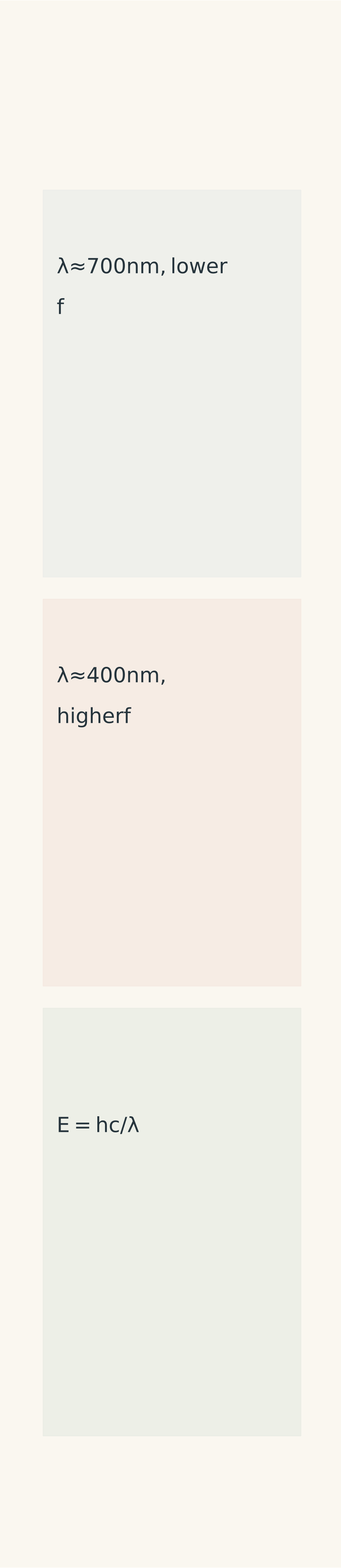
A student might see a wavelength of \(700\ \text{nm}\) and a wavelength of \(400\ \text{nm}\) and think the larger number must represent more energy.
The opposite is true.
Because:
\[ E = \frac{hc}{\lambda} \]
energy is inversely proportional to wavelength.
A \(400\ \text{nm}\) photon has more energy than a \(700\ \text{nm}\) photon because its wavelength is shorter.
A quick decision rule:
| If the photon has… | Then it has… |
|---|---|
| higher frequency | more energy |
| shorter wavelength | more energy |
| lower frequency | less energy |
| longer wavelength | less energy |
09Why this matters beyond spectra
The idea that energy comes in discrete packets changed physics. It helped explain why classical wave theories could not describe atoms properly.
Photon energy calculations also connect to other quantum ideas. For example, the wave behaviour of particles such as electrons is explored in de Broglie Matter Waves: HSC Physics Explained Clearly.
The next step is to use these ideas to calculate the wavelengths produced by specific atomic transitions and explain why each element has its own spectral pattern.
10Questions and solutions
Question 1
A photon of red light has a frequency of \(4.60 \times 10^{14}\ \text{Hz}\). Calculate its energy.
Solution 1
The photon energy is \(3.05 \times 10^{-19}\ \text{J}\). This is found using the relationship between photon energy and frequency.
Step 1: Use the equation:
\[ E = hf \]
where \(E\) is photon energy, \(h\) is Planck’s constant, and \(f\) is frequency.
Step 2: Substitute:
\[ E = (6.626 \times 10^{-34})(4.60 \times 10^{14}) \]
Step 3: Calculate:
\[ E = 3.05 \times 10^{-19}\ \text{J} \]
The tempting mistake is to think the visible colour alone determines the energy without calculation. The actual energy depends on the frequency of the photon.
Question 2
A hydrogen atom emits a photon with wavelength \(486\ \text{nm}\). Calculate the photon energy.
Solution 2
The photon energy is \(4.09 \times 10^{-19}\ \text{J}\). The shorter wavelength means this photon has more energy than the red \(656\ \text{nm}\) photon from the earlier example.
Step 1: Convert the wavelength.
\[ 486\ \text{nm}=486 \times 10^{-9}\ \text{m} \]
Step 2: Use:
\[ E=\frac{hc}{\lambda} \]
Step 3: Substitute:
\[ E= \frac{(6.626 \times 10^{-34})(3.00 \times 10^8)} {486 \times 10^{-9}} \]
Step 4: Calculate:
\[ E=4.09 \times 10^{-19}\ \text{J} \]
The important reasoning is that a smaller wavelength means a larger energy gap between atomic states.
Question 3
An electron in a hydrogen atom moves from a higher energy level to a lower energy level and emits a photon. A student claims the photon could have any wavelength because the electron is “losing energy continuously”. Explain why this is incorrect.
Solution 3
The photon cannot have any wavelength; it must have a wavelength corresponding to one allowed energy difference between atomic states.
Step 1: Identify the assumption causing the mistake.
The student is treating atomic energy like a ramp, where any energy value is possible.
Step 2: Apply the quantum model.
Hydrogen electrons can only occupy specific energy levels. The energy released is:
\[ E_{\text{photon}}=\Delta E \]
where \(\Delta E\) must match the difference between two allowed states.
Step 3: Connect energy to wavelength.
Since:
\[ E=\frac{hc}{\lambda} \]
only specific photon energies produce specific wavelengths.
The trap is that ordinary objects, like moving cars, can usually change energy continuously. Atomic electrons do not behave like macroscopic objects.
Question 4
Two photons are emitted by an atom. Photon A has a wavelength of \(300\ \text{nm}\), and photon B has a wavelength of \(600\ \text{nm}\).
A student says photon B must transfer twice as much energy because its wavelength is twice as large. Determine whether the student is correct.
Solution 4
The student is incorrect. Photon A has twice the energy of photon B.
Step 1: Compare the relationship.
Photon energy follows:
\[ E=\frac{hc}{\lambda} \]
Energy is inversely proportional to wavelength.
Step 2: Compare the wavelengths.
Photon B has:
\[ \lambda_B=600\ \text{nm} \]
Photon A has:
\[ \lambda_A=300\ \text{nm} \]
Photon A has half the wavelength, so:
\[ E_A = 2E_B \]
Step 3: Explain the misconception.
The student has treated wavelength like a direct measure of energy. In electromagnetic radiation, the opposite relationship applies because frequency increases as wavelength decreases.
Question 5
A hydrogen atom is initially in a high energy state. It can return to the ground state in either one jump or by making two smaller jumps through an intermediate energy level.
A student argues that the final photon produced must have the same energy in both cases because the electron starts and ends at the same places.
Explain what happens and determine whether the student’s reasoning is correct.
Solution 5
The student’s reasoning is only partly correct. The total energy released is the same, but the number and wavelengths of photons can be different.
Step 1: Consider the one-jump case.
If the electron moves directly from the high state to the ground state, one photon is emitted:
\[ E_{\text{photon}}=E_{\text{high}}-E_{\text{ground}} \]
This photon carries the full energy difference.
Step 2: Consider the two-jump case.
The electron releases energy in two stages:
\[ E_1=E_{\text{high}}-E_{\text{middle}} \]
and:
\[ E_2=E_{\text{middle}}-E_{\text{ground}} \]
The two photons satisfy:
\[ E_1+E_2=E_{\text{high}}-E_{\text{ground}} \]
Step 3: Explain the hidden constraint.
The starting and ending states determine the total energy change, but the available intermediate states determine how that energy is divided.
The student has correctly noticed that total energy is conserved. The mistake is assuming conservation means the same photon must be produced.
The final conclusion is:
- one direct jump → one photon with the full energy difference
- two jumps → two photons whose energies add to the same total
This is why atomic spectra contain many different lines. Each possible transition creates a different photon energy, and therefore a different wavelength.