
Why Ammonia Is Pyramidal: Lone Pairs and Experimental Evidence
Discover why ammonia (NH3) has a trigonal pyramidal shape rather than a flat structure. Learn how nitrogen's lone pair affects bond angles, how VSEPR theory predicts its geometry, and how experimental evidence confirms the model.
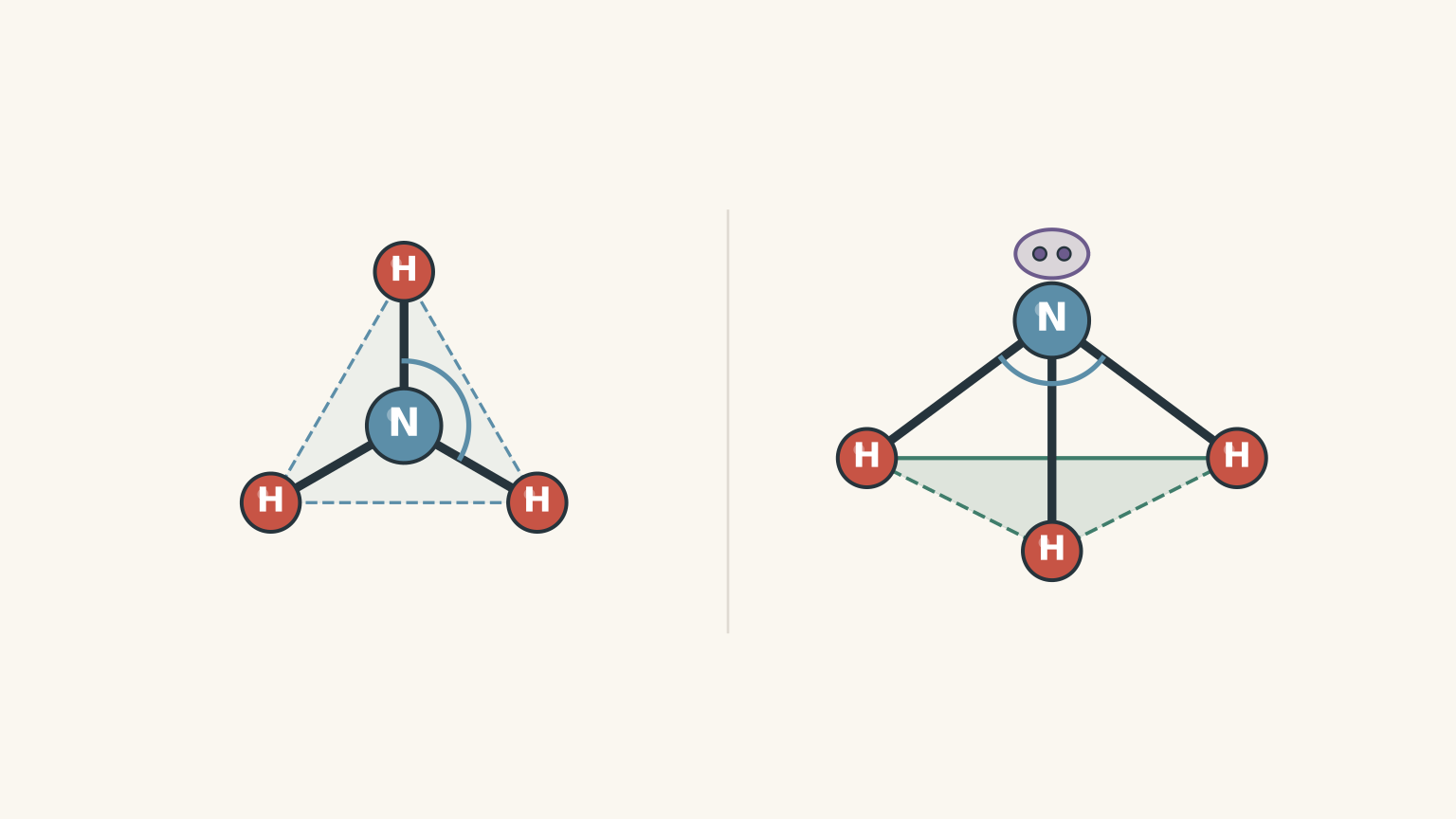
A flat drawing of ammonia, \(\ce{NH3}\), can make it look as though nitrogen and its three hydrogen atoms sit in the same plane. But ammonia is not flat. Its three hydrogen atoms form a triangular base, with the nitrogen atom sitting above them, giving the molecule a trigonal pyramidal shape.
The reason is one pair of electrons that you cannot see in the molecular formula: nitrogen has a lone pair. This fourth region of electron density changes the arrangement of the three N-H bonds.
There is also experimental evidence. The measured H-N-H bond angle in ammonia is approximately \(106.7^\circ\), rather than the \(120^\circ\) expected for a flat trigonal planar molecule.
Let’s work out why the lone pair changes the shape, how we know the molecule is pyramidal, and what happens when we change the charge on ammonia.
01Why three bonds do not make ammonia flat
Start by considering a molecule with three atoms bonded to a central atom.
If the three bonding regions were the only regions of electron density around the central atom, they would spread out as far as possible in a plane. This gives a trigonal planar arrangement, with bond angles of \(120^\circ\).
That sounds reasonable for ammonia. Nitrogen has three hydrogen atoms attached to it.
But there is something missing from that prediction.
Nitrogen has five valence electrons. Three are involved in forming N-H bonds, but the remaining two stay together as a non-bonding pair.
This is called a lone pair.
The lone pair occupies a fourth region of electron density around nitrogen. It cannot be ignored when predicting molecular shape.
Due to technical limitations, this figure may display incorrectly or contain inaccuracies. Please check key details against your course materials.
The short answer is that four electron regions arrange themselves approximately towards the corners of a tetrahedron. Three are N-H bonding pairs, and the fourth is the lone pair.
Only three of these regions contain bonded atoms. When we describe the molecular shape, we consider the positions of the atoms, not the lone pair.
That produces a trigonal pyramid rather than a tetrahedron or a flat triangle.
02Start with nitrogen’s valence electrons
To understand the shape properly, begin with the Lewis structure.
Nitrogen is in Group 15 of the periodic table, so it has five valence electrons. Hydrogen is in Group 1, so each hydrogen contributes one valence electron.
The total number of valence electrons in neutral ammonia is:
\[ N_{\text{total}}=5+3(1)=8 \]
These eight electrons must be distributed around the atoms.
Nitrogen forms three single covalent bonds with the three hydrogen atoms.
Each covalent bond contains two shared electrons, so the three bonds account for:
\[ 3\times 2=6\text{ electrons} \]
That leaves:
\[ 8-6=2\text{ electrons} \]
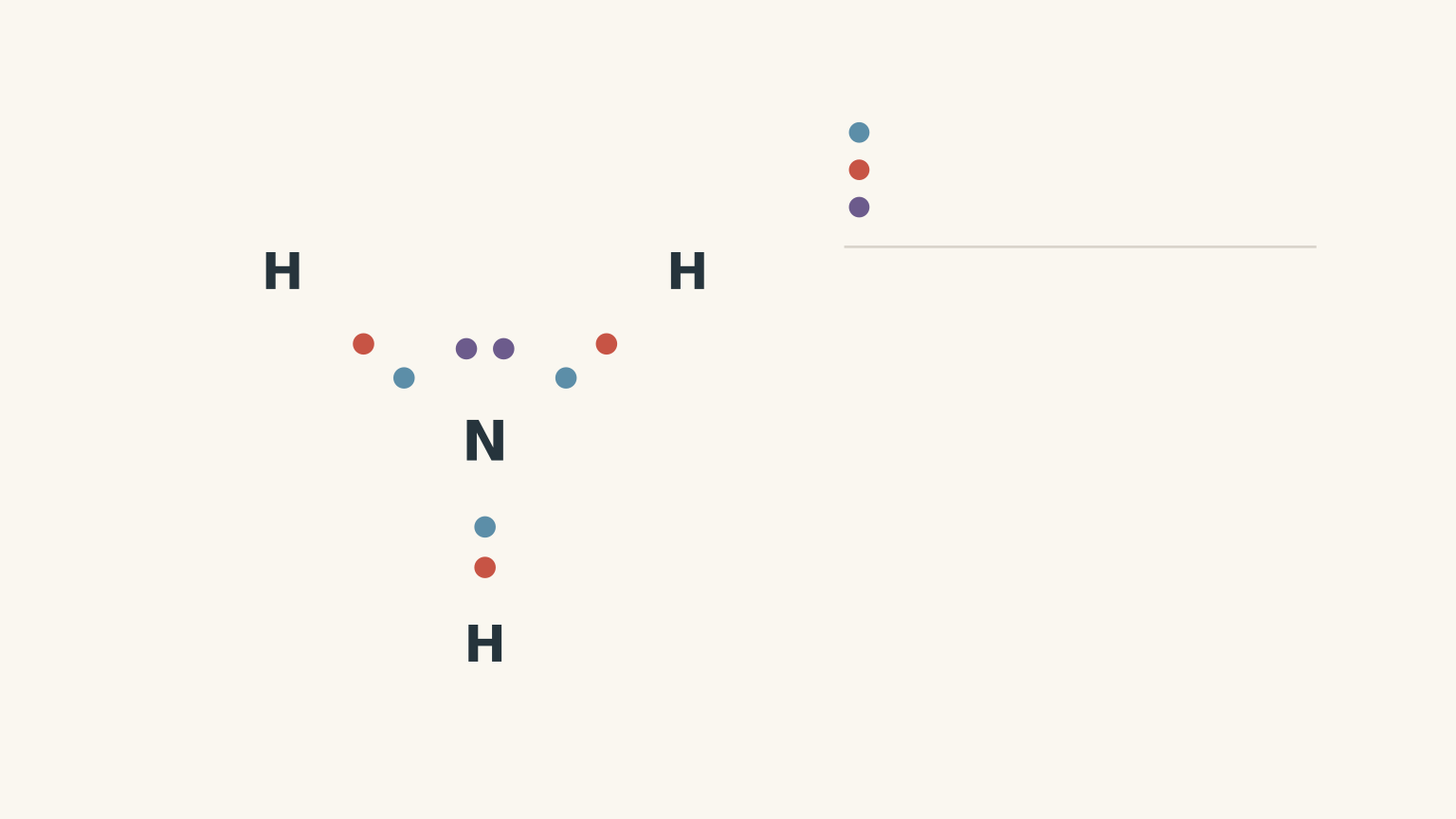
The remaining two electrons form one lone pair on nitrogen.
We can summarise the Lewis structure as follows:
| Feature | Number |
|---|---|
| Total valence electrons | 8 |
| N-H single bonds | 3 |
| Bonding electron pairs | 3 |
| Lone pairs on nitrogen | 1 |
| Overall molecular charge | 0 |
Due to technical limitations, this figure may display incorrectly or contain inaccuracies. Please check key details against your course materials.
Notice something important: the lone pair is part of the Lewis structure, even though it does not appear as another atom in the molecular formula.
This is why the formula \(\ce{NH3}\) cannot tell you the molecular shape on its own. You need to consider the distribution of the valence electrons as well.
Does the lone pair give nitrogen a negative charge?
Not in neutral ammonia.
A lone pair does not automatically mean that an atom has a negative formal charge. We need to account for both the bonding and non-bonding electrons.
Formal charge is calculated using:
\[ \mathrm{FC}=V-N-\frac{B}{2} \]
Where:
- \(V\) = valence electrons in the isolated atom
- \(N\) = non-bonding electrons assigned to the atom
- \(B\) = bonding electrons shared in bonds
For nitrogen in ammonia:
\[ \begin{aligned} \mathrm{FC}(N)&=5-2-\frac{6}{2}\\ &=5-2-3\\ &=0 \end{aligned} \]
Each hydrogen also has a formal charge of zero.
Therefore, the overall formal charge is zero, as expected for neutral \(\ce{NH3}\).
The lone pair affects the molecule’s geometry, but it does not make the molecule negatively charged.
Worked example: Check the electron count in ammonia
Question: A student draws three N-H single bonds around nitrogen in ammonia. They claim that nitrogen has no remaining valence electrons because all three bonds are complete. Explain why this is incorrect and determine the formal charge on nitrogen.
Step 1
Nitrogen contributes five, and the three hydrogen atoms contribute one each.
\[ 5+3(1)=8\text{ electrons} \]
Step 2
Three single bonds contain six electrons altogether.
\[ 3(2)=6\text{ bonding electrons} \]
Step 3
\[ 8-6=2\text{ electrons} \]
These form one lone pair on nitrogen.
Step 4
\[ \mathrm{FC}(N)=5-2-\frac{6}{2}=0 \]
Nitrogen has one lone pair and a formal charge of zero.
The student’s mistake was treating the completion of three covalent bonds as though it used all five of nitrogen’s valence electrons. It does not. The remaining two electrons are essential to understanding ammonia’s three-dimensional structure.
03Four electron regions produce a pyramidal shape
Now we can use VSEPR theory to predict the geometry.
VSEPR stands for Valence Shell Electron Pair Repulsion. The model assumes that regions of electron density around a central atom arrange themselves to minimise repulsion.
Think about the four regions around nitrogen in ammonia:
- Three bonding pairs from the N-H bonds.
- One non-bonding pair from the lone pair.
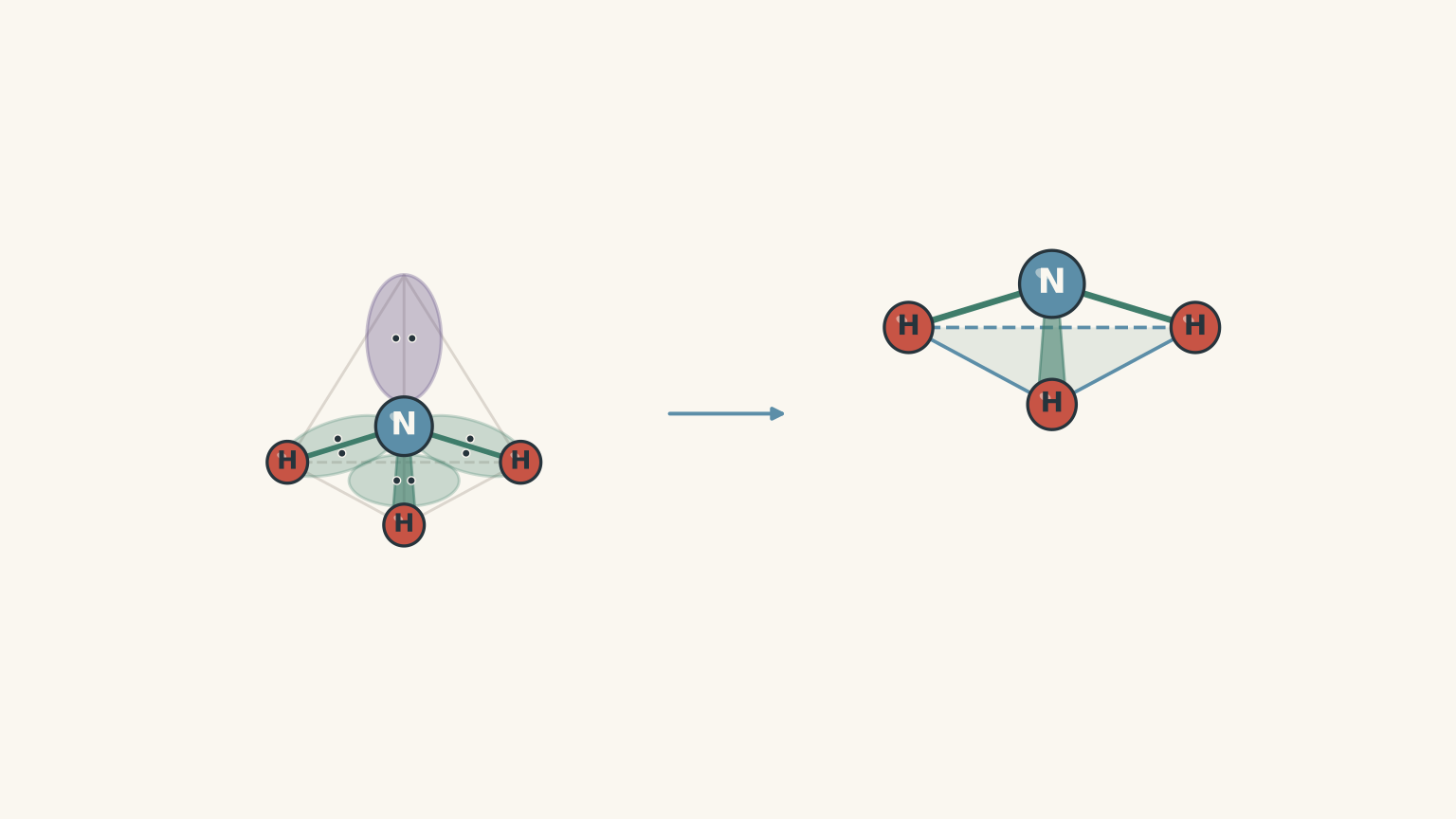
These four regions arrange approximately tetrahedrally.
The ideal angle between two directions in a regular tetrahedral arrangement is:
\[ 109.5^\circ \]
However, ammonia’s actual H-N-H angle is smaller, at approximately \(106.7^\circ\).
Why?
The lone pair occupies a larger region of space around nitrogen than a bonding pair does. It is not shared between two nuclei, so its electron density is distributed differently.
As a result, the repulsion between the lone pair and the bonding pairs is stronger than the repulsion between two bonding pairs.
The lone pair pushes the three N-H bonding regions closer together, compressing their bond angles.
The general order of repulsion in the VSEPR model is:
\[ \text{LP-LP}>\text{LP-BP}>\text{BP-BP} \]
Here, LP means lone pair and BP means bonding pair.
Due to technical limitations, this figure may display incorrectly or contain inaccuracies. Please check key details against your course materials.
Electron-pair geometry versus molecular shape
These two terms are easy to confuse.
For ammonia, they describe different things:
| Description | What is considered? | Ammonia |
|---|---|---|
| Electron-pair geometry | All four electron regions | Tetrahedral |
| Molecular shape | Positions of nitrogen and hydrogen atoms only | Trigonal pyramidal |
The electron-pair geometry is tetrahedral because there are four regions of electron density.
The molecular shape is trigonal pyramidal because one of those regions is a lone pair, not an atom.
This distinction is particularly important in HSC Chemistry questions. If an exam asks for the molecular shape, writing only “tetrahedral” is incorrect.
For a more detailed explanation of this distinction, see Electron-Pair Geometry vs Molecular Shape: HSC Chemistry.
Worked example: Why does water have a smaller bond angle?
Question: Ammonia has one lone pair on its central atom and a bond angle of approximately \(106.7^\circ\). Water has two lone pairs on its central oxygen atom and an H-O-H angle of approximately \(104.5^\circ\). Explain why the water molecule has a smaller bond angle.
Step 1
Ammonia has three bonding pairs and one lone pair.
Its electron-pair geometry is tetrahedral, and its molecular shape is trigonal pyramidal.
Step 2
Oxygen has six valence electrons. It forms two O-H bonds, leaving two lone pairs.
Water therefore has two bonding pairs and two lone pairs.
Its electron-pair geometry is tetrahedral, but its molecular shape is bent.
Step 3
Water has two lone pairs, whereas ammonia has only one.
The additional lone pair increases the influence of lone-pair repulsion on the bonding regions. This compresses the angle between the two O-H bonds more strongly.
Step 4
- Ammonia: approximately \(106.7^\circ\).
- Water: approximately \(104.5^\circ\).
Water has the smaller bond angle because it has two lone pairs rather than one.
The important idea is that the number of lone pairs influences the bond angles, even though lone pairs are not included when naming the molecular shape.
04How do we know ammonia is actually pyramidal?
So far, we have used Lewis structures and VSEPR theory to predict the shape.
But a prediction is not the same thing as experimental evidence.
How could scientists determine whether ammonia is actually pyramidal rather than flat?
One important approach came from microwave spectroscopy.
The ammonia inversion experiment
In 1934, physicists Cleeton and Williams carried out an early experiment using microwave radiation to investigate the inversion motion of ammonia.
Their work was an important step in the development of molecular microwave spectroscopy. A historical review published in Philosophical Transactions of the Royal Society A describes this experiment and the later development of microwave spectroscopy.
The underlying problem was interesting: could the energy transitions of a molecule reveal information about its structure and movement?
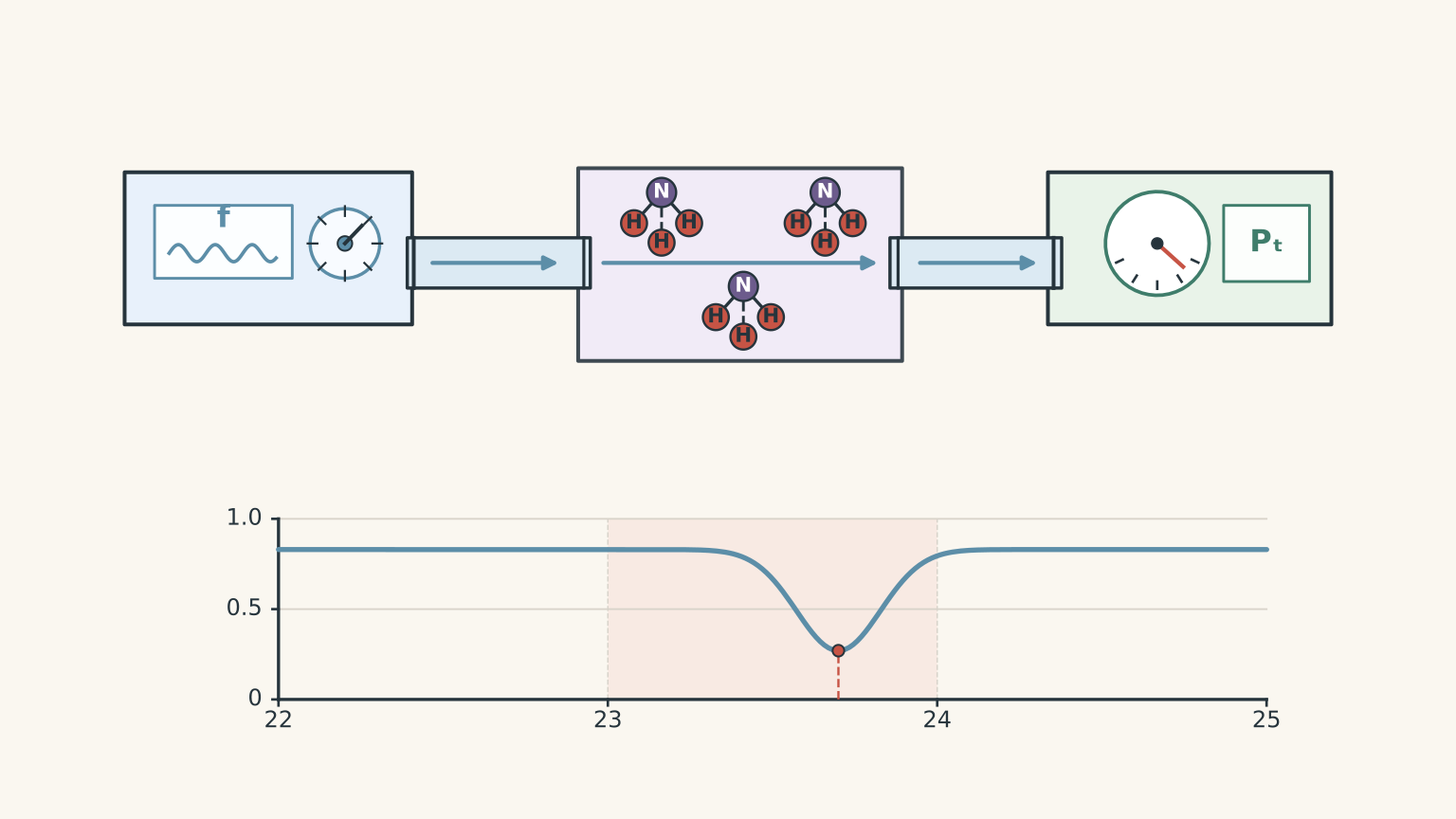
To understand the experiment, picture the apparatus in a simple arrangement.
A microwave source produces electromagnetic radiation. This radiation travels through a waveguide into a chamber containing ammonia gas. On the other side, a detector measures how much microwave radiation passes through the chamber.
The experimenters vary the microwave frequency and monitor the transmitted signal.
Due to technical limitations, this figure may display incorrectly or contain inaccuracies. Please check key details against your course materials.
What should happen if ammonia absorbs the radiation?
At certain frequencies, the microwave photon has exactly the energy required to move a molecule between two allowed energy states.
The molecule absorbs the radiation, so the detector records a decrease in transmitted microwave power.
This produces an absorption line.
For ammonia, an important feature of the microwave spectrum is associated with its inversion motion.
The umbrella motion of ammonia
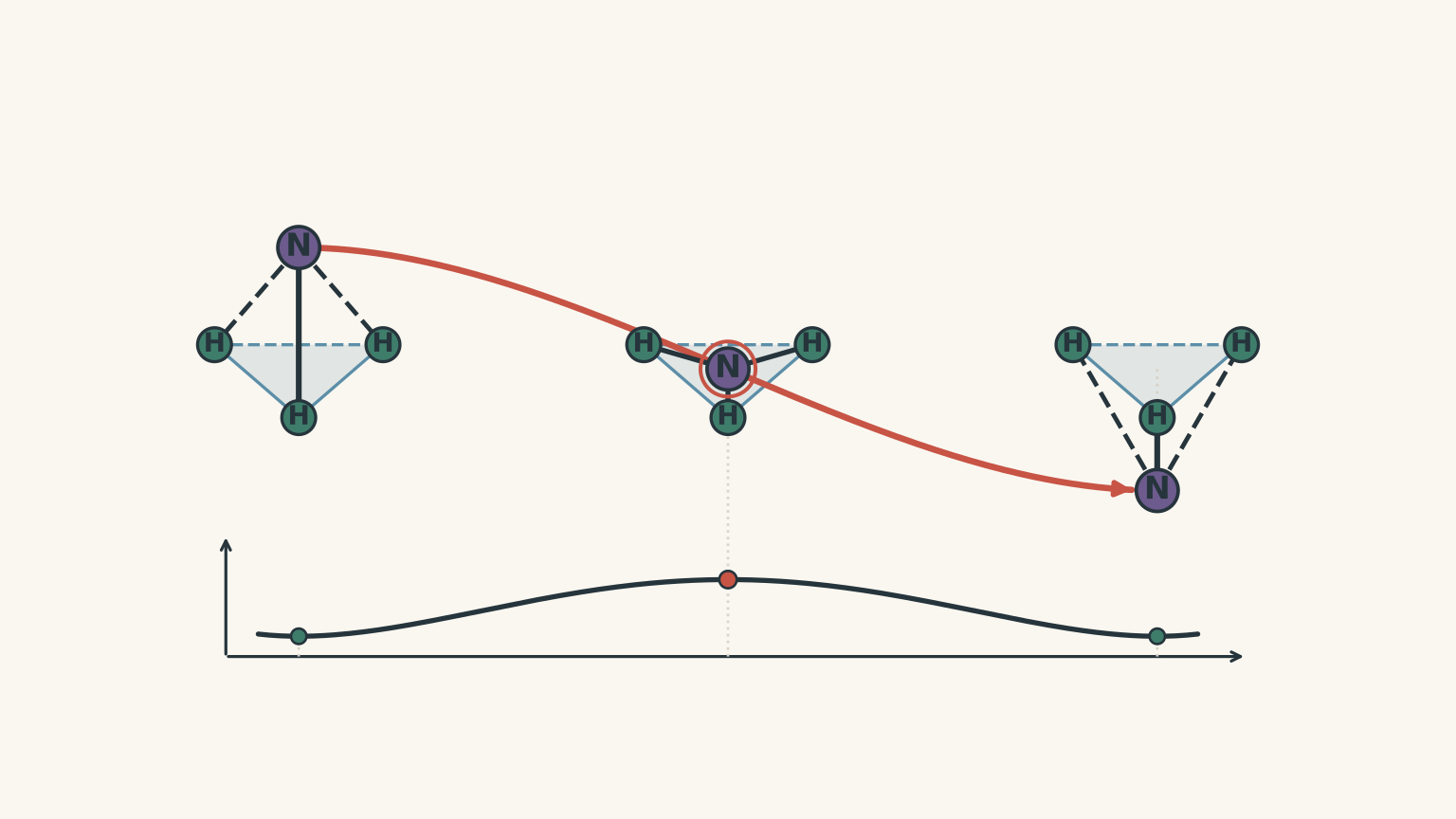
Imagine the three hydrogen atoms forming the rim of an umbrella, with nitrogen at the central tip.
The nitrogen atom can move from one side of the plane containing the three hydrogen atoms to the other.
As it moves, the molecule changes between two equivalent pyramidal arrangements.
This is called inversion.
Due to technical limitations, this figure may display incorrectly or contain inaccuracies. Please check key details against your course materials.
The umbrella analogy is useful because it shows how the molecule can turn inside out.
However, atoms are not rigid umbrella spokes. The actual motion is governed by the molecule’s potential energy and quantum mechanics.
There are two equivalent low-energy pyramidal configurations, separated by an energy barrier at the planar arrangement.
In quantum mechanics, the nitrogen atom can tunnel through this barrier. This produces two closely spaced inversion energy states.
A microwave photon can supply the energy difference between these states.
The observed inversion spectrum therefore provides evidence for the double-well energy arrangement associated with ammonia’s pyramidal structure.
What did the experiment actually measure?
The detector did not photograph nitrogen moving through the hydrogen plane.
It measured microwave absorption at particular frequencies.
A prominent ammonia inversion transition lies in the region around 23-24 GHz. The exact frequency depends on the rotational state of the molecule.
This is an important distinction:
- The experimental observation is an absorption line.
- The interpretation is that ammonia has inversion states associated with two equivalent pyramidal configurations.
- The molecular geometry is inferred using a physical model of the molecule and its energy levels.
The early experiments also had limitations. The available microwave sources were less sophisticated than later instruments, and an absorption measurement alone did not directly give the exact bond angle.
After the development of improved microwave technology, including klystron sources and waveguides, researchers could obtain more detailed spectra. Rotational and other fine spectral features could be investigated, allowing more precise structural information to be extracted.
For further historical detail, see the Royal Society review, New opportunities and emerging themes of research in microwave spectroscopy.
Worked calculation: What is the wavelength of the microwave radiation?
Suppose a microwave spectrometer detects an ammonia inversion transition at a representative frequency of \(23.7\text{ GHz}\).
Calculate the wavelength of the radiation.
Step 1
\[ \lambda=\frac{c}{f} \]
Where:
- \(\lambda\) = wavelength in metres.
- \(c\) = speed of light, \(3.00\times10^8\text{ m s}^{-1}\).
- \(f\) = frequency in hertz.
Step 2
\[ 23.7\text{ GHz}=23.7\times10^9\text{ Hz} \]
Step 3
\[ \begin{aligned} \lambda&=\frac{3.00\times10^8}{23.7\times10^9}\\ &=1.27\times10^{-2}\text{ m} \end{aligned} \]
Step 4
\[ \lambda=1.27\text{ cm} \]
The microwave radiation has a wavelength of approximately \(1.27\text{ cm}\).
This is consistent with the centimetre-scale wavelengths used in microwave spectroscopy. The calculation gives the wavelength of the radiation, not the size of the ammonia molecule.
Experimental evidence for the actual bond angle
Microwave spectroscopy is not the only way to investigate molecular structure.
Experimental molecular geometry data compiled in the National Institute of Standards and Technology’s Computational Chemistry Comparison and Benchmark DataBase (CCCBDB) gives an H-N-H angle of approximately \(106.67^\circ\) for ammonia.
The experimental N-H bond length is approximately \(1.012\) Å, where one ångström is \(10^{-10}\) metres.
These measurements are consistent with the trigonal pyramidal model.
Compare the three relevant angles:
| Model or measurement | H-N-H angle |
|---|---|
| Trigonal planar arrangement | \(120^\circ\) |
| Ideal tetrahedral arrangement | \(109.5^\circ\) |
| Experimental ammonia geometry | \(106.67^\circ\) |
The measured angle is neither \(120^\circ\) nor exactly \(109.5^\circ\).
It is smaller than the ideal tetrahedral angle because the lone pair compresses the N-H bonding regions.
You can explore the experimental geometry data through the NIST CCCBDB ammonia geometry record.
05What happens when we change ammonia’s charge?
The role of the lone pair becomes even clearer when we compare ammonia with other molecules and ions.
A useful starting point is boron trifluoride, \(\ce{BF3}\).
Why is \(\ce{BF3}\) flat but \(\ce{NH3}\) pyramidal?
Both molecules have three atoms bonded to a central atom.
However, their central atoms have different numbers of electron regions.
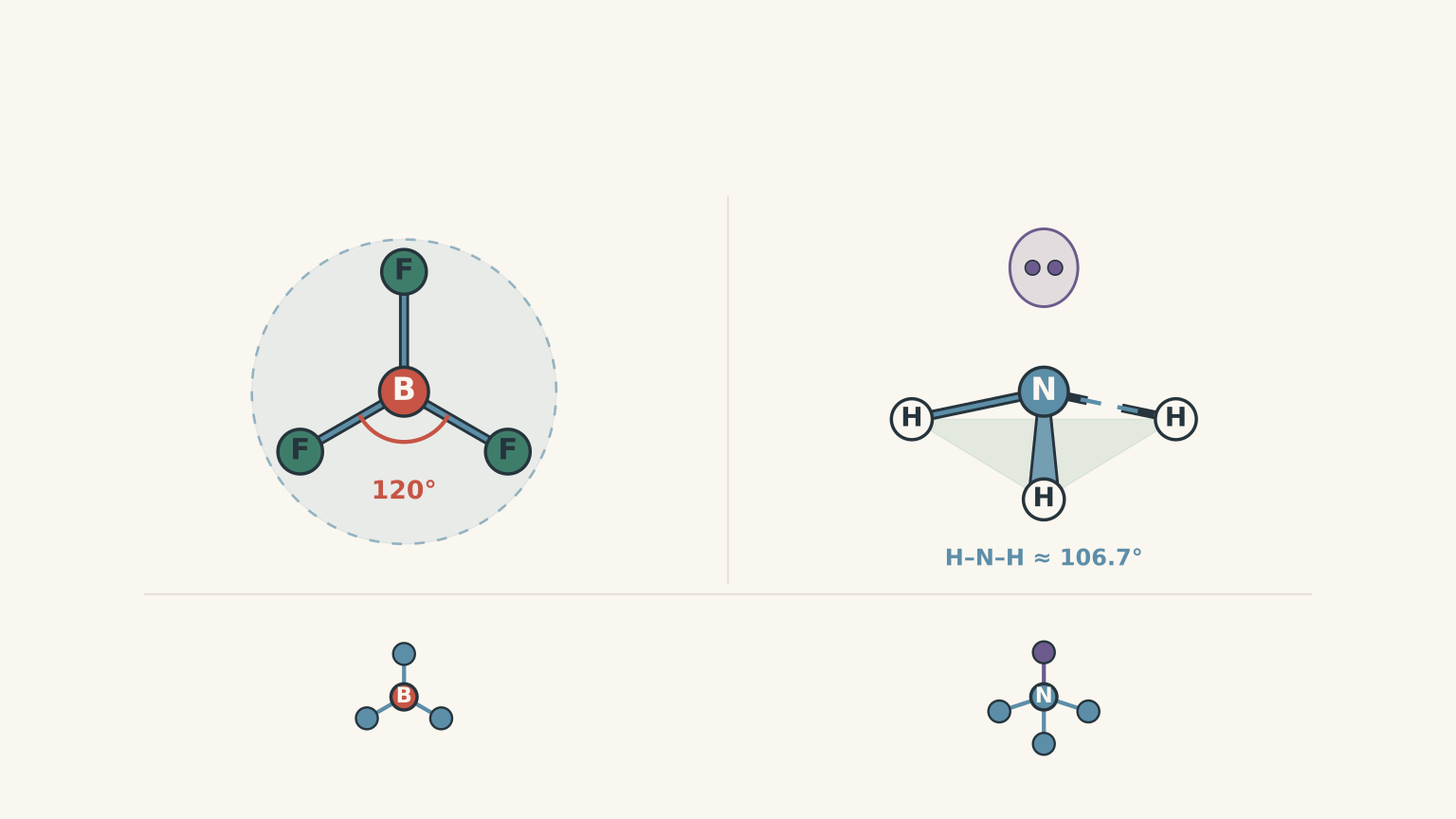
In \(\ce{BF3}\), boron forms three B-F bonds and has no lone pairs on the central atom.
There are three electron regions, so the arrangement is trigonal planar, with bond angles of approximately \(120^\circ\).
In \(\ce{NH3}\), nitrogen has three N-H bonds and one lone pair.
There are four electron regions, giving a tetrahedral electron-pair geometry and a trigonal pyramidal molecular shape.
| Property | \(\ce{BF3}\) | \(\ce{NH3}\) |
|---|---|---|
| Central atom | Boron | Nitrogen |
| Bonding pairs | 3 | 3 |
| Lone pairs | 0 | 1 |
| Electron regions | 3 | 4 |
| Electron-pair geometry | Trigonal planar | Tetrahedral |
| Molecular shape | Trigonal planar | Trigonal pyramidal |
| Bond angle | Approximately \(120^\circ\) | Approximately \(106.7^\circ\) |
Due to technical limitations, this figure may display incorrectly or contain inaccuracies. Please check key details against your course materials.
The tempting mistake is to count only the atoms attached to the central atom.
Three bonded atoms do not automatically mean trigonal planar geometry. You must count the lone pairs as well.
There is another important difference between the molecules. Boron in \(\ce{BF3}\) has only six electrons around it, rather than a complete octet. This is a known exception to the octet rule.
You should not force a Lewis structure to satisfy an octet if doing so gives the wrong electron count or formal charges.
What if ammonia accepts a proton?
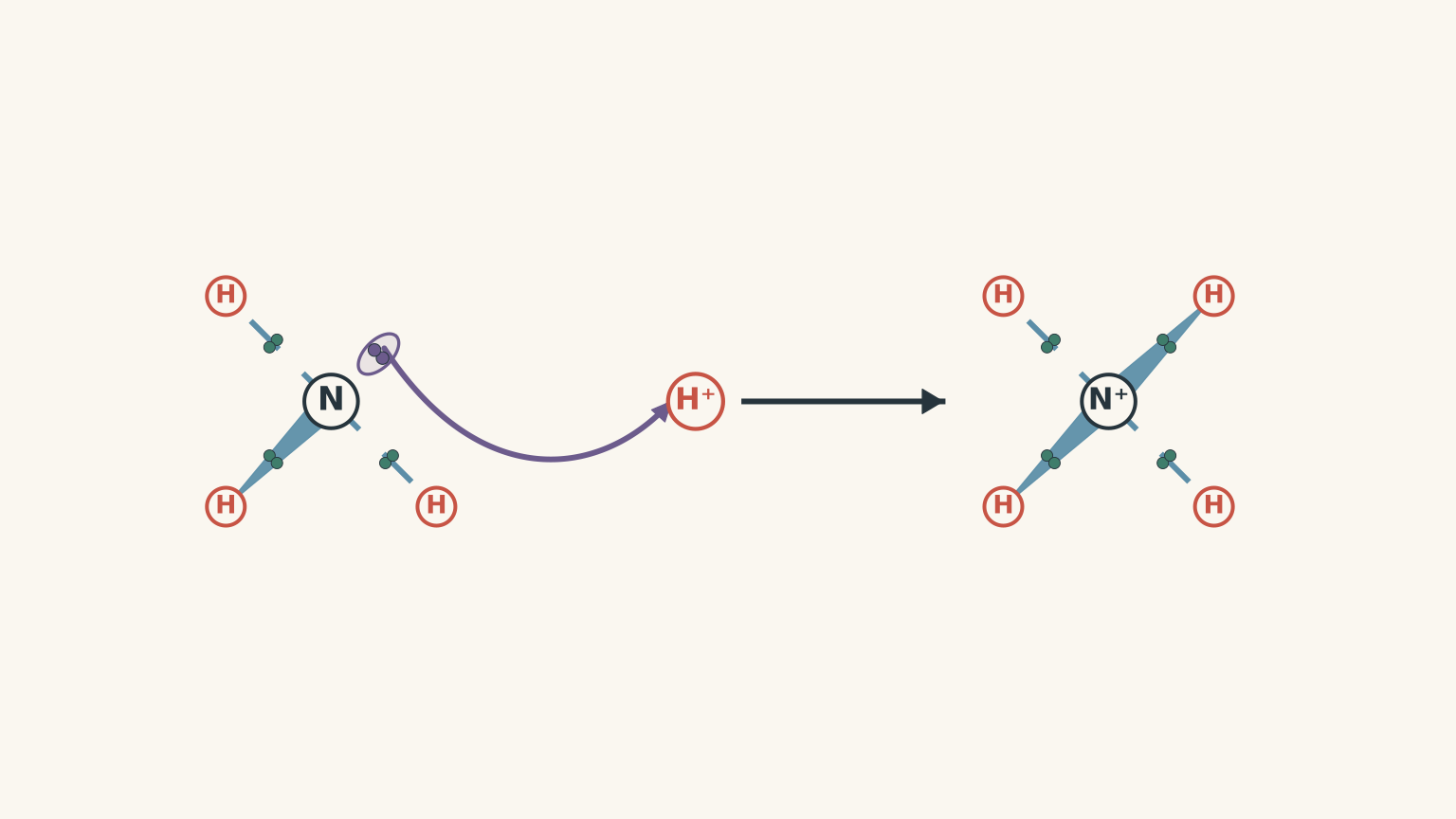
Now consider the reaction between ammonia and a hydrogen ion:
\[ \ce{NH3 + H+ -> NH4+} \]
The hydrogen ion, \(\mathrm{H}^{+}\), has no electrons of its own.
Ammonia uses its nitrogen lone pair to form a bond with the incoming proton.
This produces the ammonium ion, \(\ce{NH4+}\).
What happens to the molecular shape?
In ammonia, nitrogen has:
- Three bonding pairs.
- One lone pair.
In ammonium, nitrogen has:
- Four bonding pairs.
- No lone pairs.
All four electron regions are now bonding regions.
The electron-pair geometry and molecular shape are therefore both tetrahedral.
Due to technical limitations, this figure may display incorrectly or contain inaccuracies. Please check key details against your course materials.
Notice something interesting about the electron count.
For ammonia:
\[ 5+3(1)=8 \]
For ammonium:
\[ 5+4(1)-1=8 \]
Both species have eight valence electrons.
Yet their molecular shapes are different.
The reason is that the electrons are distributed differently. Ammonia has six bonding electrons and two non-bonding electrons. Ammonium has eight bonding electrons and no lone pair.
The nitrogen formal charge also changes.
For ammonium:
\[ \begin{aligned} \mathrm{FC}(N)&=5-0-\frac{8}{2}\\ &=+1 \end{aligned} \]
The ammonium ion has an overall charge of \(+1\), and nitrogen has a formal charge of \(+1\).
The four N-H bonds in the finished ammonium ion are equivalent. The fact that one bond was initially formed using a lone pair does not make it permanently different from the other three.
This is a useful reminder that molecular geometry depends on the arrangement of electron regions, not simply the total number of electrons or the overall charge.
An extension: Removing an electron can also change the shape
There is an interesting contrast between adding a proton and removing an electron.
When ammonia accepts a proton, it forms \(\ce{NH4+}\), which is tetrahedral.
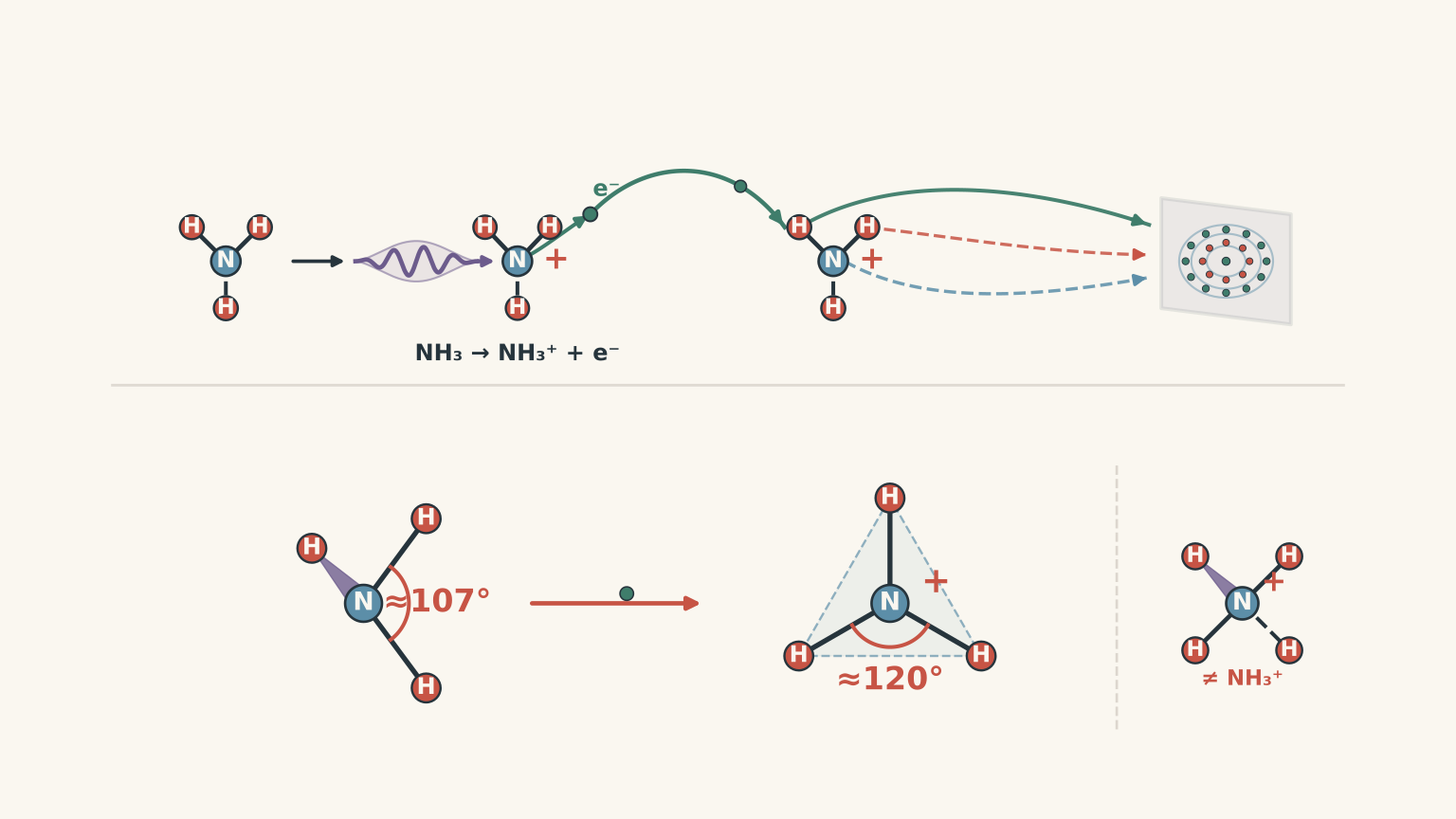
But when ammonia loses an electron, it forms the ammonia radical cation, \(\ce{NH3+}\).
These are different processes:
\[ \ce{NH3 + H+ -> NH4+} \]
\[ \ce{NH3 -> NH3+ + e-} \]
The first reaction adds a proton. The second removes an electron.
That difference matters because removing an electron changes the occupation of the molecule’s electronic states, including the non-bonding electron distribution responsible for the neutral molecule’s pyramidal geometry.
In fact, the ground-state ammonia cation has a planar equilibrium geometry, rather than the pyramidal geometry of neutral ammonia.
This has been investigated experimentally using laser-induced electron diffraction.
In a 2021 study, researchers used an intense laser pulse to ionise isolated ammonia molecules. Electrons released during ionisation scattered from the molecular nuclei. The resulting diffraction patterns were used to infer the changing positions of the atoms.
The neutral molecule began with a pyramidal geometry and an H-N-H angle of approximately \(107^\circ\). Following ionisation, the cation underwent an ultrafast change towards a planar structure with an angle of \(120^\circ\).
The experiment retrieved a near-planar, field-affected cation geometry of \(117\pm5^\circ\), approximately 8-10 femtoseconds after ionisation.
Due to technical limitations, this figure may display incorrectly or contain inaccuracies. Please check key details against your course materials.
This is an advanced experimental example rather than a required HSC technique. Its importance here is the distinction between protonation and ionisation.
Both \(\ce{NH4+}\) and \(\ce{NH3+}\) have a positive overall charge, but they have different electron arrangements and different molecular geometries.
You can read the original study, Laser-induced electron diffraction of the ultrafast umbrella motion in ammonia.
06A reliable way to explain ammonia’s shape in an HSC response
When asked why ammonia is pyramidal rather than flat, build your explanation in a logical sequence.
- Nitrogen has five valence electrons.
- Ammonia has three N-H single bonds and one lone pair on nitrogen.
- These create four regions of electron density around nitrogen.
- Four electron regions arrange approximately tetrahedrally according to VSEPR theory.
- The lone pair is not an atom, so the molecular shape is trigonal pyramidal.
- Stronger lone-pair-bonding-pair repulsion compresses the H-N-H angle below \(109.5^\circ\), giving an experimental angle of approximately \(106.7^\circ\).
The distinction between electron-pair geometry and molecular shape is essential. So is recognising that a Lewis structure is an electron-bookkeeping representation, not a literal picture of the molecule in three dimensions.
If you need to revise the electron-counting step, see How to Count Lone Pairs in Lewis Structures for HSC Chemistry.
07Questions and solutions
Question 1
A student draws ammonia with nitrogen in the centre and three hydrogen atoms arranged at \(120^\circ\) to one another in the same plane.
Explain why this representation does not correctly describe the three-dimensional molecular shape of ammonia. State the correct molecular shape and approximate H-N-H bond angle.
Solution 1
Ammonia is trigonal pyramidal, with an H-N-H bond angle of approximately \(106.7^\circ\).
The student’s drawing incorrectly assumes that the three N-H bonds are the only electron regions around nitrogen.
Nitrogen has five valence electrons. Three form N-H single bonds, while the remaining two form one lone pair.
This gives four electron regions around nitrogen, which arrange approximately tetrahedrally.
The lone pair repels the bonding pairs more strongly than the bonding pairs repel one another. This compresses the H-N-H angle below the ideal tetrahedral angle of \(109.5^\circ\).
The correct molecular shape is therefore trigonal pyramidal, not trigonal planar.
Question 2
Boron trifluoride, \(\ce{BF3}\), and ammonia, \(\ce{NH3}\), both have three atoms bonded to a central atom.
A student argues that both molecules should therefore have trigonal planar shapes.
Evaluate this claim using VSEPR theory. Include the number of bonding pairs, lone pairs, electron regions, and the molecular shape of each molecule.
Solution 2
The claim is incorrect. \(\ce{BF3}\) is trigonal planar, whereas \(\ce{NH3}\) is trigonal pyramidal.
The difference comes from the number of electron regions around the central atom.
For \(\ce{BF3}\):
- Boron forms three B-F single bonds.
- There are no lone pairs on boron.
- There are three electron regions.
- The electron-pair geometry is trigonal planar.
- The molecular shape is trigonal planar, with bond angles of approximately \(120^\circ\).
For \(\ce{NH3}\):
- Nitrogen forms three N-H single bonds.
- There is one lone pair on nitrogen.
- There are four electron regions.
- The electron-pair geometry is tetrahedral.
- The molecular shape is trigonal pyramidal, with bond angles of approximately \(106.7^\circ\).
The tempting approach is to count only the three bonded atoms. However, VSEPR theory considers all regions of electron density, including lone pairs.
This is why the two molecules have different shapes despite having three terminal atoms each.
Question 3
Ammonia reacts with a proton to form ammonium:
\[ \ce{NH3 + H+ -> NH4+} \]
Both species have eight valence electrons when the charge is included in the electron count.
(a) Calculate the total number of valence electrons in each species.
(b) Determine the number of bonding pairs and lone pairs around nitrogen in each species.
(c) Calculate the formal charge on nitrogen in \(\ce{NH4+}\).
(d) Explain why the molecular geometry changes even though the total number of valence electrons remains eight.
Solution 3
The geometry changes from trigonal pyramidal in \(\ce{NH3}\) to tetrahedral in \(\ce{NH4+}\), because the lone pair becomes a fourth bonding pair.
(a) Calculate the valence electron totals.
For ammonia:
\[ N_{\text{total}}=5+3(1)=8 \]
For ammonium, the positive charge means one electron is subtracted from the total:
\[ N_{\text{total}}=5+4(1)-1=8 \]
Both species have eight valence electrons.
(b) Determine the electron pairs.
In ammonia, three N-H bonds use six electrons. The remaining two form one lone pair.
Therefore, nitrogen has:
- Three bonding pairs.
- One lone pair.
In ammonium, all eight electrons are involved in four N-H bonds.
Therefore, nitrogen has:
- Four bonding pairs.
- No lone pairs.
(c) Calculate the formal charge on nitrogen in ammonium.
Using:
\[ \mathrm{FC}=V-N-\frac{B}{2} \]
For nitrogen:
\[ \begin{aligned} \mathrm{FC}(N)&=5-0-\frac{8}{2}\\ &=+1 \end{aligned} \]
Nitrogen has a formal charge of \(+1\).
Each hydrogen has a formal charge of zero, so the overall ion charge is \(+1\).
(d) Explain the change in geometry.
In ammonia, the lone pair occupies one of the four tetrahedral electron regions. Since it is not an atom, the molecular shape is trigonal pyramidal.
When ammonia accepts a proton, the lone pair forms an additional N-H bond.
The resulting ammonium ion has four bonding pairs and no lone pairs. All four regions are bonding regions, giving both a tetrahedral electron-pair geometry and a tetrahedral molecular shape.
The key point is that the total electron count alone does not determine molecular geometry. The distribution of those electrons between bonding and non-bonding regions also matters.
Question 4
A microwave spectroscopy experiment investigates the inversion motion of ammonia.
A prominent inversion transition is observed at a representative frequency of \(23.7\text{ GHz}\).
Use the speed of light, \(c=3.00\times10^8\text{ m s}^{-1}\), to answer the following.
(a) Calculate the wavelength of the microwave radiation.
(b) Explain why an absorption line at the inversion transition supports the model of ammonia having two equivalent pyramidal configurations.
(c) Explain why the microwave absorption measurement does not directly give the H-N-H bond angle.
Solution 4
The microwave wavelength is approximately \(1.27\text{ cm}\), and the absorption line provides evidence for ammonia’s inversion motion between two equivalent pyramidal configurations.
(a) Calculate the wavelength.
Use:
\[ \lambda=\frac{c}{f} \]
Convert the frequency:
\[ f=23.7\times10^9\text{ Hz} \]
Substitute:
\[ \begin{aligned} \lambda&=\frac{3.00\times10^8}{23.7\times10^9}\\ &=1.27\times10^{-2}\text{ m}\\ &=1.27\text{ cm} \end{aligned} \]
The wavelength is approximately \(1.27\text{ cm}\).
(b) Interpret the absorption line.
Ammonia has two equivalent pyramidal configurations, with nitrogen on opposite sides of the plane containing the three hydrogen atoms.
The nitrogen atom can tunnel through the energy barrier between these configurations.
This produces two closely spaced inversion energy states.
When the microwave radiation has the correct frequency, ammonia absorbs energy and transitions between the states.
The absorption line therefore supports the existence of the inversion motion associated with the double-well potential.
(c) Explain the limitation of the measurement.
The detector measures the absorption of microwave radiation, not the positions of individual atoms.
The absorption frequency gives information about the energy difference between molecular states.
The molecular geometry must be inferred by analysing the spectrum using a physical model. Additional structural measurements can then help determine bond lengths and bond angles.
The microwave spectrum is evidence for molecular behaviour, not a direct photograph of the molecule.
Question 5
A research group compares three nitrogen-containing species under different experimental conditions.
They obtain the following information:
| Species | Experimental or established geometry |
|---|---|
| Neutral \(\ce{NH3}\) | Trigonal pyramidal, H-N-H angle approximately \(106.7^\circ\) |
| Ammonium, \(\ce{NH4+}\) | Tetrahedral |
| Ammonia radical cation, \(\ce{NH3+}\) | Near-planar; a laser-induced electron diffraction experiment measures \(117\pm5^\circ\) approximately 8-10 femtoseconds after ionisation |
A student makes two claims:
- Both \(\ce{NH4+}\) and \(\ce{NH3+}\) have a positive charge, so they should have the same molecular geometry.
- The near-planar measurement of \(\ce{NH3+}\) proves that neutral ammonia must also be capable of adopting a stable planar structure.
Evaluate both claims.
Your response must:
- Distinguish protonation from ionisation.
- Compare the valence electron arrangements of all three species.
- Explain why the positive charge does not determine the molecular geometry.
- Interpret the experimental uncertainty and explain what the diffraction result establishes.
Solution 5
Both claims are incorrect. The two positive ions are produced by different processes, which change the electron arrangement in different ways. The near-planar cation measurement does not overturn the pyramidal geometry of neutral ammonia.
The crucial distinction is between adding a proton and removing an electron.
First, consider neutral ammonia, \(\ce{NH3}\).
Nitrogen contributes five valence electrons, and the three hydrogen atoms contribute three more.
\[ 5+3=8\text{ valence electrons} \]
These electrons form three bonding pairs and one lone pair.
The four electron regions give a tetrahedral electron-pair geometry, while the three bonded hydrogen atoms produce a trigonal pyramidal molecular shape.
Its experimental H-N-H angle is approximately \(106.7^\circ\).
Next, consider ammonium, \(\ce{NH4+}\).
Ammonium forms when ammonia accepts a proton:
\[ \ce{NH3 + H+ -> NH4+} \]
The proton has no electrons to contribute. Instead, ammonia uses its existing lone pair to form another N-H bond.
The total valence electron count is:
\[ 5+4-1=8 \]
All eight electrons are now involved in four bonding pairs.
Nitrogen has no lone pairs, so the electron-pair geometry and molecular shape are both tetrahedral.
The positive charge does not make the molecule planar. It is the change from one lone pair and three bonds to four bonds that changes the geometry.
Finally, consider the ammonia radical cation, \(\ce{NH3+}\).
This species forms through ionisation:
\[ \ce{NH3 -> NH3+ + e-} \]
Unlike protonation, ionisation removes an electron rather than adding a proton.
The total valence electron count becomes:
\[ 5+3-1=7 \]
The electronic arrangement is therefore different from both neutral ammonia and ammonium.
Removing an electron changes the occupation of the molecular electronic states and changes the potential energy surface. The neutral pyramidal arrangement is no longer the preferred equilibrium geometry of the cation.
The ammonia cation has a near-planar ground-state geometry.
Now interpret the diffraction measurement.
The reported angle is:
\[ 117\pm5^\circ \]
This gives an interval of:
\[ 112^\circ\text{ to }122^\circ \]
A perfectly planar arrangement would have an angle of \(120^\circ\).
Since \(120^\circ\) falls within the measured interval, the experimental result is consistent with a near-planar cation.
However, the measurement was made shortly after strong-field ionisation and describes a field-affected molecular structure. It should not be treated as a direct measurement of neutral ammonia or of ammonium.
The experiment establishes that removing an electron can produce a rapid change in ammonia’s molecular geometry.
It does not establish that neutral ammonia is planar, nor does it show that all positively charged nitrogen species have the same shape.
The student’s underlying mistake is assuming that overall charge uniquely determines molecular geometry. It does not. Molecular geometry depends on the full electronic arrangement, including the number and distribution of bonding and non-bonding electrons.
This is why you must distinguish \(\ce{NH3}\), \(\ce{NH4+}\), and \(\ce{NH3+}\), rather than treating them as variations of the same structure.
The next useful comparison is between ammonia, water, and ammonium. Together, they show how changing the number of lone pairs and bonding regions changes both molecular shape and bond angles. Once you can explain those three structures using valence electrons, formal charge, and VSEPR theory, you have a much stronger foundation for predicting the shapes of unfamiliar molecules and polyatomic ions.