
Why Gas-Collection Practicals Measure Less Gas Than Predicted
Stoichiometry predicts how much gas a reaction should produce, but laboratory measurements often fall short. Learn how to calculate the expected gas volume, correct for temperature, pressure, and water vapour, and identify plausible causes of experimental discrepancies.
A student reacts 0.100 g of magnesium with excess hydrochloric acid. Stoichiometry predicts about 104 mL of gas collected over water at 25°C and 101.3 kPa, but the measuring cylinder reads only 87 mL. Has the reaction produced too little hydrogen, or has some hydrogen formed but failed to reach the collector?
The volume reading alone cannot distinguish those explanations. To diagnose the problem, follow the gas from the reaction itself to the final measurement, checking what can happen at each stage.
Predicted gas versus measured gas
| Theoretical pathway | Limiting reagent → theoretical moles of H₂. Use stated temperature and pressure to predict volume; for collection over water, use P(H₂) = P(total) − p(H₂O). |
|---|---|
| Experimental pathway | Reaction → gas transfer → collection → volume reading. Reaction: incomplete reaction means less H₂ forms. Transfer and collection: leaks, trapped gas, or dissolution can reduce collected gas. Reading: actual temperature, pressure, water levels, and meniscus affect the comparison. |
01Follow the gas through the practical
Consider a typical school experiment in which magnesium reacts with hydrochloric acid and the hydrogen is collected over water.
The gas follows a specific path:
- A measured mass of magnesium is placed in a reaction flask.
- Hydrochloric acid is added. Hydrogen begins forming as the reaction proceeds.
- A bung and delivery tube direct the gas away from the flask.
- The tube carries the gas into an inverted, water-filled measuring cylinder in a water trough.
- Hydrogen entering the cylinder displaces water, and the graduated scale gives the collected gas volume.
The apparatus is supposed to transfer the gas from the reaction vessel into the measuring cylinder without losing any of it.
What should the experiment show if everything works perfectly?
If the acid is in excess, the magnesium is pure, the reaction goes to completion, and no gas escapes, the amount of hydrogen produced should agree with the stoichiometric prediction. The volume reading should then agree with the predicted volume once temperature, pressure, and water vapour are accounted for.
But notice how many things must go right for that agreement to occur.
A leak can let hydrogen escape. An incomplete reaction can produce fewer moles than predicted. Gas can remain in the apparatus rather than reach the collector. Even if the correct amount is produced and collected, the final volume can differ from the prediction if the gas temperature or pressure is different from the assumed conditions.
The first experiment gives you a discrepancy. The next task is to identify which part of the process could explain it.
02Stoichiometry predicts moles, not a cylinder reading
Start with the chemical equation:
\[ \ce{Mg + 2HCl -> MgCl2 + H2} \]
The equation tells us that one mole of magnesium produces one mole of hydrogen, provided sufficient hydrochloric acid is available and the reaction proceeds completely.
For pure magnesium reacting with excess acid,
\[ n(\ce{H2})_{\text{theoretical}}=n(\ce{Mg}) \]
The amount of magnesium can be calculated from its mass:
\[ n=\frac{m}{M} \]
Here, \(n\) is the amount in moles, \(m\) is the mass in grams, and \(M\) is the molar mass in grams per mole.
For magnesium, \(M=24.3\ \text{g mol}^{-1}\).

- Mg
- HCl
- MgCl₂
- H₂
That calculation gives the theoretical amount of hydrogen. It does not yet tell us its volume.
For a gas, volume depends on the amount of gas, its temperature, and its pressure. The ideal gas equation connects these quantities:
\[ PV=nRT \]
Rearranging to calculate volume gives
\[ V=\frac{nRT}{P} \]
In this equation:
- \(V\) is the gas volume in litres.
- \(n\) is the amount of gas in moles.
- \(R\) is the gas constant, \(8.31\ \text{kPa L mol}^{-1}\text{K}^{-1}\).
- \(T\) is the absolute temperature in kelvin.
- \(P\) is the gas pressure in kilopascals.
Always convert temperature to kelvin using \(T(\text{K})=T(°\text{C})+273\), and keep the pressure units consistent with the value of \(R\).
Worked example: Predict the hydrogen volume
A 0.100 g sample of pure magnesium reacts completely with excess hydrochloric acid. Calculate the theoretical amount of hydrogen and its volume at 25°C and 101.3 kPa. Then calculate the expected volume if the hydrogen is collected over water at the same temperature, with equal water levels inside and outside the measuring cylinder. The water vapour pressure at 25°C is 3.17 kPa.
Step 1
\[ \begin{aligned} n(\ce{Mg})&=\frac{m}{M}\\ &=\frac{0.100\ \text{g}}{24.3\ \text{g mol}^{-1}}\\ &=4.12\times10^{-3}\ \text{mol} \end{aligned} \]
Step 2
The equation gives a 1:1 mole ratio between magnesium and hydrogen. Therefore,
\[ n(\ce{H2})=4.12\times10^{-3}\ \text{mol} \]
Step 3
Convert the temperature to kelvin:
\[ T=25+273=298\ \text{K} \]
Substitute into the ideal gas equation:
\[ \begin{aligned} V&=\frac{nRT}{P}\\ &=\frac{(4.12\times10^{-3})(8.31)(298)} {101.3}\\ &=0.1007\ \text{L}\\ &\approx101\ \text{mL} \end{aligned} \]
So the theoretical volume of dry hydrogen is approximately 101 mL.
Step 4
The gas in the measuring cylinder contains water vapour as well as hydrogen. The total gas pressure is atmospheric pressure when the water levels are equal, but some of that pressure comes from the water vapour.
Therefore, the hydrogen pressure is
\[ \begin{aligned} P_{\ce{H2}}&=P_{\text{atm}}-p_{\ce{H2O}}\\ &=101.3-3.17\\ &=98.13\ \text{kPa} \end{aligned} \]
Use this pressure to calculate the expected wet-gas volume:
\[ \begin{aligned} V&=\frac{(4.12\times10^{-3})(8.31)(298)} {98.13}\\ &=0.1040\ \text{L}\\ &\approx104\ \text{mL} \end{aligned} \]
The expected volume is approximately 104 mL, not 101 mL, when the hydrogen is collected over water under these conditions.
The difference comes from the water vapour correction. At the same temperature and total pressure, hydrogen in a mixture with water vapour has a lower partial pressure than dry hydrogen. A larger volume is therefore needed to accommodate the same amount of hydrogen.
This resolves an important prediction: water vapour makes the expected wet-gas volume larger, not smaller, than the corresponding dry-gas volume at the same total pressure. Ignoring this correction cannot explain why a measured volume is below the dry-gas prediction.
For calculations involving a mixture of hydrogen and water vapour, the correction assumes that the non-water gas can be treated as hydrogen. If initial air is present, its contribution must also be considered when interpreting the gas composition.
Water vapour increases the collected gas volume
| Dry hydrogen | P_total = P_H₂ Hydrogen pressure equals total pressure; the same amount occupies a smaller volume. |
|---|---|
| Hydrogen over water | P_total = P_H₂ + p_H₂O Water vapour lowers hydrogen’s partial pressure; the same amount occupies a larger volume. |
03Diagnose the discrepancy from the experimental setup
Suppose the predicted volume is 104 mL but only 87 mL is collected. The shortfall is 17 mL.
It is tempting to label this a 16% loss of hydrogen and move on. However, the difference between the theoretical and measured volumes does not automatically identify what went wrong.
Start with the possible causes and ask what evidence each one would leave.
| Possible cause | Why the reading may be low | What evidence would help |
|---|---|---|
| Gas leak | Hydrogen escapes through a loose bung, a poor connection, or damaged tubing instead of entering the collector. | A faulty seal is found, or a repeat with properly secured connections collects more gas. |
| Incomplete reaction | Some of the expected hydrogen is never produced because the reaction stops early. | Unreacted magnesium remains, the acid was insufficient, or the reaction conditions prevented complete reaction. |
| Impure magnesium | The weighed sample contains material that does not produce hydrogen, so the calculation overestimates the reactive magnesium. | The sample’s purity or condition indicates that not all its mass was metallic magnesium. |
| Gas lost during transfer | Hydrogen escapes before collection begins, bubbles bypass the collector, or gas remains in the apparatus. | The procedure includes a delay before sealing or a stage where gas can escape rather than being collected. |
| Gas dissolves in water | Some hydrogen enters the collection water rather than remaining in the gas phase. | A controlled comparison with a method that avoids direct contact with bulk collection water gives a different result. |
| Temperature or pressure mismatch | The actual gas volume differs from the predicted volume because the calculation uses incorrect conditions. | The measured temperature, pressure, or water levels differ from the assumed values. |
| Reading error | The gas volume is read incorrectly or the scale is too coarse to resolve a small difference. | Repeated readings disagree, or the meniscus was not read consistently. |
These causes do not all affect the experiment in the same way. Some reduce the amount of hydrogen collected, while others make the theoretical comparison inaccurate.
A leak and an incomplete reaction are different problems
A leak means hydrogen may have been produced but escaped before it could be measured.
An incomplete reaction means some of the expected hydrogen was never produced in the first place.
The distinction matters because the evidence and the fix are different.
If magnesium remains at the end of the reaction, investigate whether the acid was limiting or the reaction had not finished. Calculate the available amounts of both reactants instead of assuming that the acid was in excess.
If no visible magnesium remains, that supports the idea that the reaction went to completion, but it does not prove that every gram originally weighed was pure magnesium. An impure sample can disappear without producing the amount of hydrogen predicted from its total mass.
If the apparatus is not sealed before the reaction begins, hydrogen can escape immediately. Magnesium reacts with hydrochloric acid as soon as they come into contact, so even a short delay can matter. A better design starts the reaction only after the collection system is properly connected and closed, using the laboratory’s approved method.
Hydrogen is flammable. Never use a flame to check for leaks.
Could the hydrogen dissolve in the water?
Yes, some hydrogen can dissolve in the collection water. Gas collection is not always a perfect separation between gas and liquid.
However, hydrogen is only slightly soluble in water. Dissolution is possible, but it should not automatically be blamed for a large discrepancy in an ordinary school practical.
The identity of the gas matters. Dissolution is much more significant for gases such as ammonia and carbon dioxide than for hydrogen under comparable conditions.
A gas syringe can help investigate whether direct contact with bulk collection water contributes to the discrepancy. But changing from a measuring cylinder to a syringe may also change the transfer path, dead volume, and other experimental details. A higher reading from the syringe supports further investigation; it does not, by itself, prove that dissolution was the sole cause.
Could the gas volume simply be different because of its conditions?
Yes. This is why the gas temperature and pressure must be measured or otherwise established, rather than assumed.
From the ideal gas equation,
\[ V=\frac{nRT}{P} \]
for a fixed amount of gas, volume increases with absolute temperature and decreases with pressure.
If the gas is cooler than the temperature used in the prediction, its measured volume will be smaller. If its pressure is higher than assumed, its volume will also be smaller.
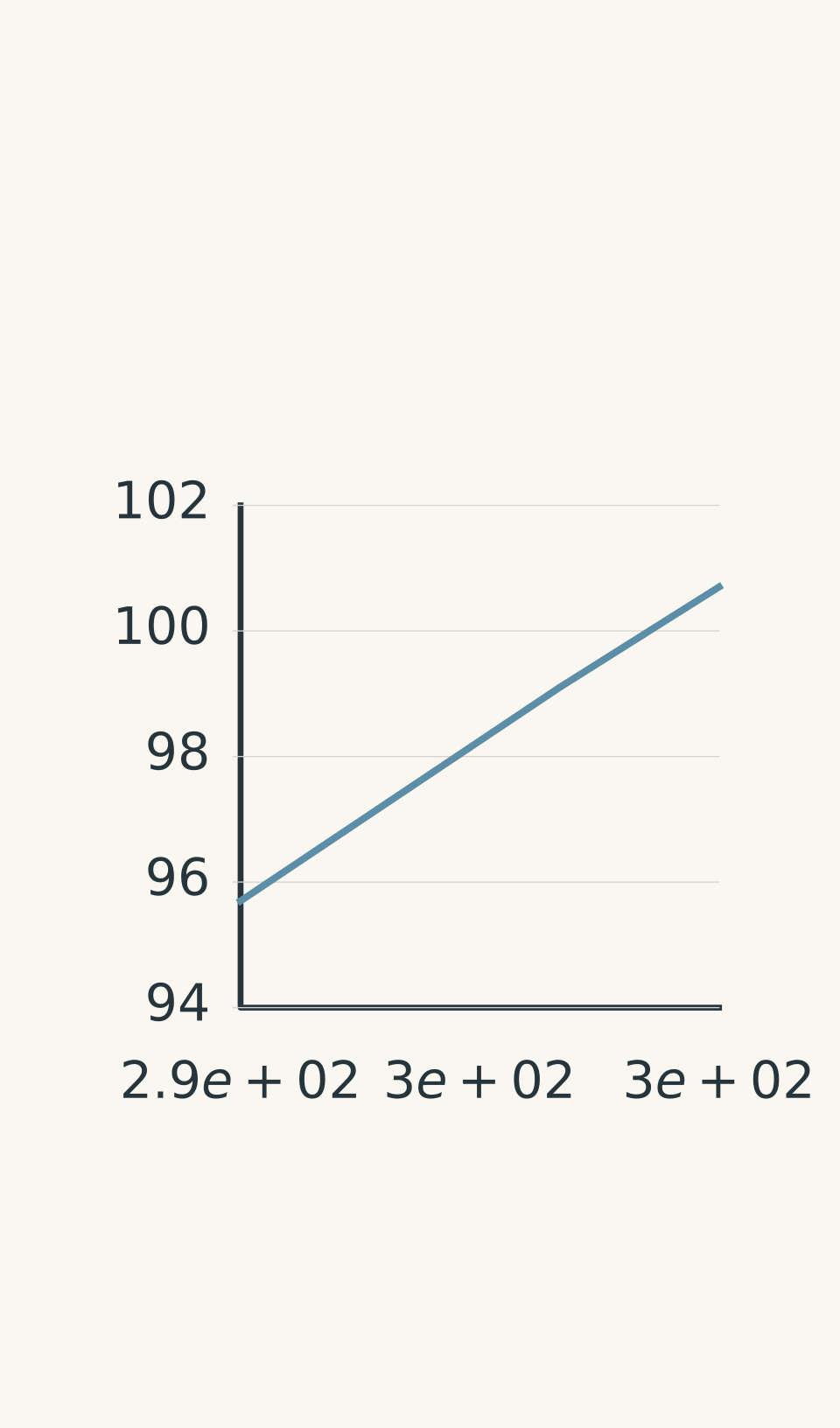
- Dry gas at 100 kPa
The water levels in a gas-collection cylinder matter too. When the water levels inside and outside the cylinder are equal, the gas pressure inside is approximately atmospheric pressure. If the levels differ, the trapped gas pressure also differs from atmospheric pressure.
For example, if the water level inside the inverted cylinder is lower than the level outside, the gas pressure inside is higher than atmospheric pressure. Using atmospheric pressure alone would then overestimate the volume expected for a fixed amount of gas.
Finally, allow the gas to reach the temperature at which you intend to measure it. Reading the volume while the gas is still warmer than its surroundings can give a different result from reading it after it has cooled.
04Water vapour and other effects can push the result in opposite directions
A useful diagnosis considers not only what can make a reading too low, but also what can make it too high.
| Effect | Likely direction of its influence |
|---|---|
| Hydrogen escapes through a leak | Lower collected volume |
| Reaction stops before completion | Lower gas production |
| Hydrogen dissolves in collection water | Lower gas-phase amount collected |
| Gas is cooler than assumed | Lower volume |
| Gas pressure is higher than assumed | Lower volume |
| Water vapour is ignored in the theoretical calculation | The predicted wet-gas volume is too small |
| Gas is warmer than assumed | Higher volume |
| Unaccounted gas is displaced into the collector | Can distort the reading or its interpretation, depending on the setup |
The last point needs care. Air is initially present in many reaction vessels and delivery tubes. Early gas entering the collector may therefore contain air rather than being pure hydrogen.
In a displacement setup, the initial air does not automatically create an extra volume error: under suitable constant-temperature and constant-pressure conditions, the displaced gas volume can still track the amount of gas formed. However, the collected mixture must not automatically be treated as chemically pure hydrogen when interpreting its composition. If the procedure deliberately discards the initial gas, some hydrogen may be lost as well.
This is a good example of why an experimental result should be interpreted from the actual setup rather than from a generic list of possible errors.
05Worked example: Estimate the amount of hydrogen represented by a reading
A student reacts 0.100 g of pure magnesium with excess hydrochloric acid. The gas is collected over water at 24°C and atmospheric pressure of 100.8 kPa. The water levels are equal, and the water vapour pressure is 2.98 kPa.
The measured gas volume is 94.0 mL. Assuming the setup has accounted for initial-air and dead-volume effects, estimate the fraction of the theoretical hydrogen amount represented by the measurement.
Step 1
Assuming the gas is hydrogen plus water vapour,
\[ \begin{aligned} P_{\ce{H2}}&=P_{\text{atm}}-p_{\ce{H2O}}\\ &=100.8-2.98\\ &=97.82\ \text{kPa} \end{aligned} \]
Step 2
Convert the volume to litres:
\[ V=94.0\ \text{mL}=0.0940\ \text{L} \]
The temperature in kelvin is
\[ T=24+273=297\ \text{K} \]
Rearrange the ideal gas equation to calculate the amount:
\[ n=\frac{PV}{RT} \]
Substitute the measured values:
\[ \begin{aligned} n_{\text{collected}} &=\frac{(97.82)(0.0940)}{(8.31)(297)}\\ &=3.73\times10^{-3}\ \text{mol} \end{aligned} \]
Step 3
The magnesium should produce one mole of hydrogen per mole of magnesium.
\[ \begin{aligned} n_{\text{theoretical}} &=\frac{0.100}{24.3}\\ &=4.12\times10^{-3}\ \text{mol} \end{aligned} \]
Step 4
\[ \begin{aligned} \text{Apparent collection fraction} &=\frac{n_{\text{collected}}}{n_{\text{theoretical}}} \times100\%\\ &=\frac{3.73\times10^{-3}}{4.12\times10^{-3}} \times100\%\\ &\approx90.5\% \end{aligned} \]
The reading represents approximately 90.5% of the theoretical hydrogen amount under the stated assumptions.
The corresponding theoretical wet-gas volume at these conditions is about 104 mL, compared with the measured 94.0 mL.
This is an apparent collection fraction. It does not prove that the chemical reaction achieved a 90.5% yield. The shortfall could reflect gas loss, incomplete reaction, an incorrect assumption about the sample, or a measurement problem.
The distinction is important: the amount produced by the reaction and the amount successfully collected are not necessarily the same.
06How to revise the experiment without guessing
A good experimenter does not see a low reading and immediately choose a favourite explanation. Instead, they revise the investigation so that competing explanations can be tested.
Diagnose a low gas-volume result
- Calculate the limiting reagent
Use mole ratios to calculate theoretical H₂.
- Check reaction completion and purity
Look for unreacted Mg and verify sample purity.
- Inspect gas transfer
Check seals, tubing, trapped gas, and start-up losses.
- Correct measurement conditions
Account for temperature, gas pressure, water levels, and water vapour.
- Repeat or compare collection methods
Change one factor at a time; repeat trials to test the suspected cause.
Use the following sequence.
First, check the theoretical calculation.
Calculate the amount of each reactant and identify the limiting reagent. For magnesium reacting with hydrochloric acid, two moles of HCl are required for every mole of Mg. If the acid is limiting, the theoretical hydrogen amount must be calculated from the acid, not from the magnesium mass alone.
Check the assumed purity of the magnesium and whether the reaction could reasonably have gone to completion.
Second, check whether the gas could have escaped.
Inspect the bung, tubing, and connections. Check whether the collection system was ready before the reaction began, and whether gas could escape during assembly or transfer.
If a revised setup collects more gas, that supports the idea that the original setup lost gas. It does not automatically quantify the amount lost at each stage.
Third, correct the measurement conditions.
Record the gas temperature, atmospheric pressure, and water levels. If gas is collected over water, account for water vapour. If the water levels differ, account for the difference in gas pressure rather than assuming it equals atmospheric pressure.
Use the conditions that actually apply to the measurement, not convenient values from a textbook example.
Fourth, compare collection methods carefully.
A gas syringe may help investigate losses associated with water collection. However, keep the reaction conditions and other parts of the procedure as consistent as possible.
If you change the seal, the reaction conditions, and the collection method simultaneously, you cannot tell which change caused the improvement.
Finally, repeat the experiment and consider measurement uncertainty.
A small discrepancy may be consistent with the precision of the measuring cylinder or the variation between trials. A consistent, larger shortfall deserves further investigation.
The important question is not simply whether the measured volume differs from the prediction. It is whether the difference is larger than the uncertainty expected from the method, and whether the available evidence identifies a plausible cause.
07Questions and solutions
Question 1
A 0.0486 g sample of pure magnesium reacts completely with excess hydrochloric acid. Hydrogen is collected over water at 25°C and atmospheric pressure of 100.0 kPa. The water levels are equal, and the water vapour pressure is 3.17 kPa.
Calculate the theoretical volume of wet gas collected. Use \(M(\ce{Mg})=24.3\ \text{g mol}^{-1}\) and \(R=8.31\ \text{kPa L mol}^{-1}\text{K}^{-1}\).
Solution 1
The theoretical wet-gas volume is approximately 51.2 mL.
First, calculate the amount of magnesium:
\[ \begin{aligned} n(\ce{Mg})&=\frac{0.0486}{24.3}\\ &=0.00200\ \text{mol} \end{aligned} \]
The reaction has a 1:1 mole ratio between magnesium and hydrogen. Therefore,
\[ n(\ce{H2})=0.00200\ \text{mol} \]
Because the gas is collected over water, its hydrogen pressure is
\[ P_{\ce{H2}}=100.0-3.17=96.83\ \text{kPa} \]
The temperature is
\[ T=25+273=298\ \text{K} \]
Use the ideal gas equation:
\[ \begin{aligned} V&=\frac{nRT}{P_{\ce{H2}}}\\ &=\frac{(0.00200)(8.31)(298)}{96.83}\\ &=0.0512\ \text{L}\\ &=51.2\ \text{mL} \end{aligned} \]
The expected volume is about 51.2 mL. Using atmospheric pressure directly as the hydrogen pressure would underestimate the expected wet-gas volume because some of the total pressure comes from water vapour.
Question 2
A student reacts 0.120 g of magnesium with 10.0 mL of 0.200 mol L⁻¹ hydrochloric acid. Assume the magnesium is pure, the reaction proceeds as far as the available acid allows, and the hydrogen is collected over water at 25°C and atmospheric pressure of 100.0 kPa. The water vapour pressure is 3.17 kPa, and the water levels are equal.
Calculate the maximum theoretical volume of wet gas. Explain why calculating the hydrogen amount from the magnesium alone gives an incorrect prediction.
Solution 2
The maximum theoretical wet-gas volume is 25.6 mL, because hydrochloric acid is the limiting reagent.
First, calculate the amount of magnesium:
\[ \begin{aligned} n(\ce{Mg})&=\frac{0.120}{24.3}\\ &=4.94\times10^{-3}\ \text{mol} \end{aligned} \]
Now calculate the amount of hydrochloric acid:
\[ \begin{aligned} n(\ce{HCl})&=cV\\ &=(0.200\ \text{mol L}^{-1})(0.0100\ \text{L})\\ &=2.00\times10^{-3}\ \text{mol} \end{aligned} \]
The equation requires two moles of HCl per mole of hydrogen. Therefore, the maximum amount of hydrogen is
\[ \begin{aligned} n(\ce{H2})_{\max} &=\frac{n(\ce{HCl})}{2}\\ &=\frac{2.00\times10^{-3}}{2}\\ &=1.00\times10^{-3}\ \text{mol} \end{aligned} \]
The hydrogen pressure is
\[ P_{\ce{H2}}=100.0-3.17=96.83\ \text{kPa} \]
At 298 K,
\[ \begin{aligned} V&=\frac{nRT}{P_{\ce{H2}}}\\ &=\frac{(1.00\times10^{-3})(8.31)(298)}{96.83}\\ &=0.0256\ \text{L}\\ &=25.6\ \text{mL} \end{aligned} \]
Calculating from the magnesium alone would predict about 126 mL of wet gas. That prediction assumes enough acid is available to react with all the magnesium, which is not true here.
A small collected volume does not necessarily indicate a leak or a failed practical. The limiting reagent must be checked before investigating collection losses.
Question 3
Three repeat trials use the same mass of magnesium, excess hydrochloric acid, and the same collection conditions. The theoretical wet-gas volume is 104 mL.
- In the first procedure, the acid contacts the magnesium before the flask is sealed. The mean collected volume is 86 mL.
- In the revised procedure, the system is closed before the acid contacts the magnesium. The mean collected volume is 101 mL.
In both procedures, no visible magnesium remains at the end. The other planned conditions are unchanged.
What is the strongest conclusion supported by these results? What can you not conclude from the results alone?
Solution 3
The results strongly support the conclusion that starting the reaction before closing the system causes a substantial loss of gas during start-up. They do not prove that every missing millilitre has the same cause.
The revised procedure increases the mean collected volume by
\[ 101-86=15\ \text{mL} \]
The main planned change was whether the collection system was closed before the reaction started. Hydrogen can form as soon as the acid contacts the magnesium, so the original procedure gives some gas an opportunity to escape before collection is ready.
The increase from 86 mL to 101 mL is consistent with that explanation.
However, the revised reading is still 3 mL below the theoretical prediction:
\[ 104-101=3\ \text{mL} \]
The remaining difference cannot be assigned to dissolution, a leak, or measurement uncertainty from these results alone. Additional checks would be needed to distinguish those possibilities.
The lesson is to use a controlled change to identify a likely cause, then investigate any remaining discrepancy separately.
Question 4
A reaction should produce 0.00400 mol of gas. The gas is collected over water at 20°C and atmospheric pressure of 100.0 kPa. The water levels are equal, and the water vapour pressure is 2.34 kPa.
A student predicts 97.4 mL using atmospheric pressure directly, then measures 96.0 mL. They claim that water vapour explains the difference.
Calculate the correct theoretical wet-gas volume and assess the student’s claim.
Solution 4
The correct theoretical wet-gas volume is approximately 99.7 mL, so water vapour does not explain the low reading. Ignoring water vapour makes the predicted volume too small.
The temperature is
\[ T=20+273=293\ \text{K} \]
The pressure of the non-water gas is
\[ P_{\text{dry gas}}=100.0-2.34=97.66\ \text{kPa} \]
Use the ideal gas equation:
\[ \begin{aligned} V&=\frac{nRT}{P_{\text{dry gas}}}\\ &=\frac{(0.00400)(8.31)(293)}{97.66}\\ &=0.0997\ \text{L}\\ &=99.7\ \text{mL} \end{aligned} \]
The dry-gas prediction using 100.0 kPa is approximately 97.4 mL. Subtracting the water vapour pressure lowers the pressure used in the calculation, increasing the predicted volume to 99.7 mL.
The measured volume is therefore about
\[ 99.7-96.0=3.7\ \text{mL} \]
below the correct prediction, a shortfall of approximately 3.7%.
The student’s reasoning has the direction backwards. Water vapour occupies part of the total pressure; correcting for it increases the expected volume of the collected gas.
Question 5
A student reacts 0.100 g of pure magnesium completely with excess hydrochloric acid. The hydrogen is collected over water at 25°C and atmospheric pressure of 101.3 kPa. The water vapour pressure is 3.17 kPa.
The water level inside the inverted measuring cylinder is 20 cm lower than the level outside. The pressure difference due to this height difference is given as 2.0 kPa, making the trapped gas pressure 2.0 kPa above atmospheric pressure.
The student measures 96.0 mL of wet gas.
Another student claims that the low reading must be explained by an incorrect theoretical calculation because water levels differ. A third student argues that water vapour should be ignored because the gas pressure is already higher than atmospheric pressure.
Calculate the corrected theoretical wet-gas volume. Then explain what the measured volume establishes, and what it cannot establish, assuming the gas contains hydrogen and water vapour only.
Solution 5
The corrected theoretical wet-gas volume is approximately 101.8 mL. The measured volume of 96.0 mL remains about 5.8 mL below that prediction, so the pressure and water vapour corrections do not eliminate the discrepancy.
The key is that the two corrections act in opposite directions.
Step 1: Calculate the theoretical amount of hydrogen.
\[ \begin{aligned} n(\ce{Mg})&=\frac{0.100}{24.3}\\ &=4.12\times10^{-3}\ \text{mol} \end{aligned} \]
The mole ratio between magnesium and hydrogen is 1:1, so
\[ n(\ce{H2})=4.12\times10^{-3}\ \text{mol} \]
Step 2: Correct the total gas pressure for the water-level difference.
Because the water level inside the cylinder is lower than the level outside, the trapped gas pressure is higher than atmospheric pressure.
\[ \begin{aligned} P_{\text{gas}}&=P_{\text{atm}}+2.0\\ &=101.3+2.0\\ &=103.3\ \text{kPa} \end{aligned} \]
Step 3: Correct for water vapour.
The gas contains water vapour, so the pressure attributable to the non-water gas is
\[ \begin{aligned} P_{\text{dry gas}} &=P_{\text{gas}}-p_{\ce{H2O}}\\ &=103.3-3.17\\ &=100.13\ \text{kPa} \end{aligned} \]
The higher total pressure reduces the expected volume. Subtracting the water vapour pressure then increases it relative to a calculation that incorrectly treats the entire pressure as dry gas pressure.
Neither correction can be ignored.
Step 4: Calculate the corrected theoretical volume.
At 25°C,
\[ T=25+273=298\ \text{K} \]
Therefore,
\[ \begin{aligned} V&=\frac{nRT}{P_{\text{dry gas}}}\\ &=\frac{(4.12\times10^{-3})(8.31)(298)} {100.13}\\ &=0.1018\ \text{L}\\ &=101.8\ \text{mL} \end{aligned} \]
Step 5: Compare the corrected prediction with the measured volume.
\[ \begin{aligned} \text{Shortfall}&=101.8-96.0\\ &=5.8\ \text{mL} \end{aligned} \]
As a percentage of the corrected theoretical volume,
\[ \begin{aligned} \text{Shortfall percentage} &=\frac{5.8}{101.8}\times100\%\\ &\approx5.7\% \end{aligned} \]
The corrected prediction is still approximately 5.7% above the measured volume.
The result shows that the unequal water levels and water vapour explain part of the difference between the original prediction and the actual reading, but not all of it. Under the stated assumptions that the magnesium reacts completely and the gas is hydrogen plus water vapour, the remaining discrepancy points to collection, transfer, or measurement effects, or to an assumption that has not been accounted for.
It does not prove that 5.7% of the hydrogen dissolved in the water, nor does it identify a leak by itself. Those explanations require further evidence.
That is the next useful decision in a gas-collection practical: once the limiting reagent, gas conditions, and pressure corrections are established, use repeat trials and controlled changes to investigate the remaining shortfall. Only then can you make a defensible judgement about the collection efficiency and whether a calculated yield reflects the chemistry or the limitations of the experiment.