
Gas Collection Over Water: Correcting for Water Vapour
Learn how to correct the pressure of gas collected over water by accounting for water vapour. This extension guide explains Dalton's law, applies the ideal gas equation, and builds confidence through worked examples and challenging practice questions.
A student collects 0.250 L of hydrogen gas over water at 25.0°C. The atmospheric pressure is 101.3 kPa. They substitute 101.3 kPa directly into the ideal gas equation, \(PV=nRT\), and calculate the amount of hydrogen.
There is a problem with that calculation. The collected gas is not pure hydrogen. Some water has evaporated, so the space above the water contains both hydrogen and water vapour. The atmospheric pressure therefore includes the pressure contributed by both gases.
Before calculating the amount of hydrogen, you need to remove the contribution from water vapour.
This guide develops an extension beyond the required Year 11 syllabus content. The prerequisite is the gas-law foundation in Year 11 Quantitative chemistry, including ideal gas behaviour, \(PV=nRT\), and the relationship between pressure and volume at constant temperature. The specific correction for gas collected over water is extension material, not a stated assessment requirement.
The NSW Chemistry 11-12 Syllabus (2025) is scheduled for implementation for Year 11 from 2028. Here, Year 11 identifies the prerequisite knowledge, not an expectation that this extension will be assessed. See the NESA syllabus.
01Why gas collected over water contains two gases
Imagine collecting a gas in an inverted measuring cylinder filled with water.
As the gas enters the cylinder, it pushes the water down and occupies the space above it. The volume of displaced water gives you the volume of gas collected.
However, the gas is in contact with liquid water throughout the collection process. Some water molecules escape from the liquid surface and enter the gas phase.
The resulting mixture contains:
- The gas produced by the chemical reaction.
- Water vapour from the surrounding liquid.
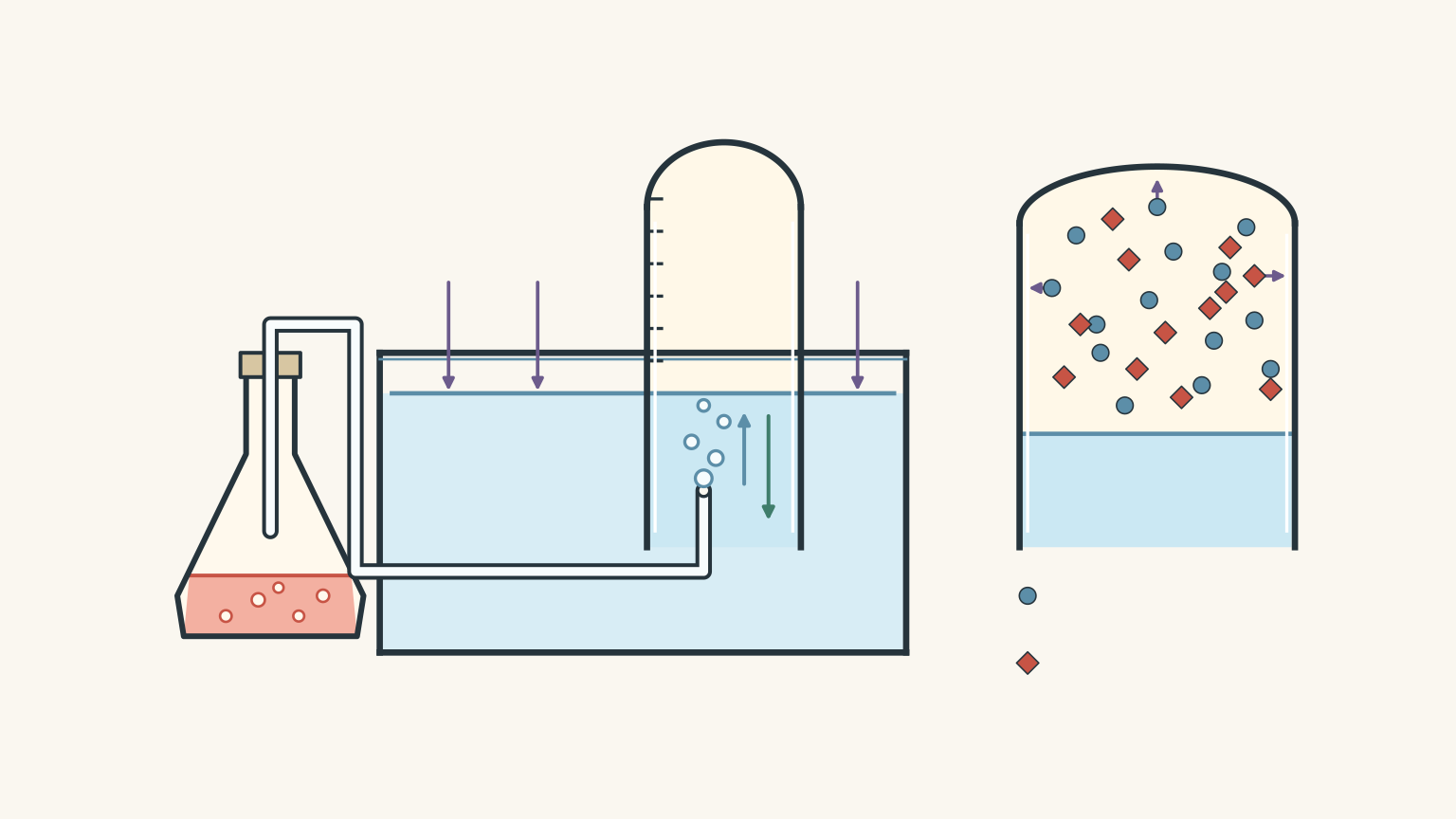
Due to technical limitations, this figure may display incorrectly or contain inaccuracies. Please check key details against your course materials.
Why does water evaporate?
Water does not need to boil before its molecules can enter the gas phase.
Even at room temperature, some water molecules have enough energy to escape the liquid surface. They become water vapour and move freely through the available space.
As more water evaporates, the water vapour contributes to the pressure inside the collection cylinder.
Eventually, if the gas has enough time to equilibrate with the liquid water, the water vapour reaches its saturated pressure at that temperature. This is called the vapour pressure of water.
The important point is that the water vapour occupies the same gas volume as the collected gas. It is not sitting in a separate layer that can simply be ignored.
Both types of particles contribute to the measured pressure.
02Dalton’s law: separating the pressure contributions
How can we distinguish the pressure produced by hydrogen from the pressure produced by water vapour?
We use Dalton’s law of partial pressures.
Dalton’s law states that the total pressure of a mixture of ideal gases equals the sum of the partial pressures of its individual gases.
For a gas collected over water:
\[ P_{\mathrm{total}}=P_{\mathrm{gas}}+P_{\ce{H2O}} \]
Where:
- \(P_{\mathrm{total}}\) is the total pressure of the gas mixture, measured in kPa.
- \(P_{\mathrm{gas}}\) is the partial pressure of the gas being collected, measured in kPa.
- \(P_{\ce{H2O}}\) is the partial pressure of water vapour, measured in kPa.
We want the pressure of the collected gas, not the pressure of the entire mixture.
Rearranging:
\[ \boxed{P_{\mathrm{gas}}=P_{\mathrm{total}}-P_{\ce{H2O}}} \]
This is the pressure correction required before calculating the amount of collected gas.
Why can we use atmospheric pressure?
There is one experimental detail to check.
When the water level inside the collection cylinder is equal to the water level outside it, the pressure of the gas mixture inside the cylinder equals atmospheric pressure.
Therefore:
\[ P_{\mathrm{total}}=P_{\mathrm{atm}} \]
Substituting this into Dalton’s law gives:
\[ \boxed{P_{\mathrm{gas}}=P_{\mathrm{atm}}-P_{\ce{H2O}}} \]
This is the equation you will use in most introductory gas-collection calculations.
However, equal water levels are an assumption, not an automatic feature of every experiment.
If the water level inside the cylinder is lower than the external water level, the gas pressure is greater than atmospheric pressure. If the internal water level is higher, the gas pressure is lower than atmospheric pressure.
In either case, you must first account for the pressure difference caused by the water column. Only then should you subtract the water vapour pressure.
The University of Calgary’s Chemistry textbook explanation of gas collection over water also discusses this pressure relationship.
03Finding the vapour pressure of water
You now know that you need to subtract water vapour pressure.
But where does that value come from?
Water vapour pressure depends on temperature. As water gets warmer, more molecules have enough energy to escape the liquid surface, increasing the pressure exerted by the vapour.
This means you cannot use one fixed water vapour pressure for every experiment.
The following approximate values are useful:
| Temperature (°C) | Water vapour pressure (kPa) |
|---|---|
| 20 | 2.34 |
| 25 | 3.17 |
| 30 | 4.24 |
| 35 | 5.63 |
These values are rounded. The 25°C value agrees with the International Association for the Properties of Water and Steam (IAPWS), which gives a vapour pressure of 0.00317 MPa. The other values are consistent with the temperature-dependent data in the University of Calgary chemistry reference.
Sources: IAPWS water and steam properties and University of Calgary vapour pressure table.
Notice how quickly the pressure increases with temperature.
At 20°C, water vapour contributes approximately 2.34 kPa. At 35°C, it contributes approximately 5.63 kPa.
That difference matters when calculating the amount of gas collected.
Always use the vapour pressure corresponding to the actual temperature of the collected gas.
If the question supplies a water vapour pressure, use that value. If it supplies a temperature instead, obtain the corresponding vapour pressure from the appropriate table.
04Using the corrected pressure in the ideal gas equation
Now connect the pressure correction to the gas equation you already know.
The ideal gas equation is:
\[ PV=nRT \]
For a gas collected over water, we use the partial pressure of the collected gas:
\[ P_{\mathrm{gas}}V=n_{\mathrm{gas}}RT \]
Rearranging:
\[ \boxed{n_{\mathrm{gas}}=\frac{P_{\mathrm{gas}}V}{RT}} \]
Since:
\[ P_{\mathrm{gas}}=P_{\mathrm{total}}-P_{\ce{H2O}} \]
We can combine the equations:
\[ \boxed{ n_{\mathrm{gas}}= \frac{(P_{\mathrm{total}}-P_{\ce{H2O}})V}{RT} } \]
The symbols represent:
| Symbol | Meaning | Unit |
|---|---|---|
| \(n_{\mathrm{gas}}\) | Amount of collected gas | mol |
| \(P_{\mathrm{total}}\) | Total pressure of the mixture | kPa |
| \(P_{\ce{H2O}}\) | Water vapour pressure | kPa |
| \(V\) | Measured gas volume | L |
| \(R\) | Ideal gas constant | kPa L mol⁻¹ K⁻¹ |
| \(T\) | Absolute temperature | K |
For pressure in kPa and volume in L, use:
\[ R=8.314\ \mathrm{kPa\,L\,mol^{-1}\,K^{-1}} \]
Remember that temperature must be converted into kelvin:
\[ T=t+273.15 \]
Here, \(t\) is the temperature in degrees Celsius.
One detail is particularly important: you still use the entire measured gas volume. Both gases occupy the same space. It is the pressure contribution, not the volume, that needs correcting.
Worked example: Finding moles of oxygen collected over water
An oxygen sample occupies 0.350 L at 25.0°C. It is collected over water, with the water levels inside and outside the collection cylinder equal.
The atmospheric pressure is 100.0 kPa. The vapour pressure of water at 25.0°C is 3.17 kPa.
Calculate the amount, in moles, of oxygen collected.
Step 1
Because the water levels are equal, the total pressure inside the collection cylinder equals atmospheric pressure.
\[ P_{\mathrm{total}}=100.0\ \mathrm{kPa} \]
Step 2
\[ \begin{aligned} P_{\ce{O2}} &=P_{\mathrm{total}}-P_{\ce{H2O}}\\ &=100.0-3.17\\ &=96.83\ \mathrm{kPa} \end{aligned} \]
The pressure of oxygen alone is 96.83 kPa.
Step 3
\[ T=25.0+273.15=298.15\ \mathrm{K} \]
Step 4
\[ n=\frac{PV}{RT} \]
\[ n= \frac{96.83\times0.350} {8.314\times298.15} \]
\[ n=0.01367\ \mathrm{mol} \]
Final answer
\[ \boxed{n_{\ce{O2}}=0.0137\ \mathrm{mol}} \]
The sample contains approximately 0.0137 mol of oxygen.
Notice that we used 96.83 kPa rather than 100.0 kPa. Using atmospheric pressure directly would have incorrectly counted the pressure contribution from water vapour as though it came from oxygen.
Worked example: Using gas collection to calculate a reacting mass
Magnesium reacts with excess hydrochloric acid according to the equation:
\[ \ce{Mg + 2HCl -> MgCl2 + H2} \]
Hydrogen produced by the reaction is collected over water. The collected gas occupies 0.480 L at 27.0°C.
The atmospheric pressure is 100.2 kPa, the water levels are equal, and the vapour pressure of water at 27.0°C is 3.57 kPa.
Calculate the mass of magnesium that reacted.
Step 1
The total pressure equals atmospheric pressure because the water levels are equal.
\[ P_{\mathrm{total}}=100.2\ \mathrm{kPa} \]
Subtract the water vapour pressure:
\[ \begin{aligned} P_{\ce{H2}} &=100.2-3.57\\ &=96.63\ \mathrm{kPa} \end{aligned} \]
Step 2
\[ T=27.0+273.15=300.15\ \mathrm{K} \]
Step 3
\[ n_{\ce{H2}}=\frac{PV}{RT} \]
\[ n_{\ce{H2}}= \frac{96.63\times0.480} {8.314\times300.15} \]
\[ n_{\ce{H2}}=0.01859\ \mathrm{mol} \]
Step 4
The equation shows a 1:1 mole ratio between magnesium and hydrogen.
Therefore:
\[ n_{\ce{Mg}}=n_{\ce{H2}} \]
\[ n_{\ce{Mg}}=0.01859\ \mathrm{mol} \]
Step 5
Using:
\[ m=nM \]
where \(m\) is mass in grams and \(M\) is molar mass in g mol⁻¹:
\[ m(\ce{Mg})=0.01859\times24.305 \]
\[ m(\ce{Mg})=0.4518\ \mathrm{g} \]
Final answer
\[ \boxed{m(\ce{Mg})=0.452\ \mathrm{g}} \]
Approximately 0.452 g of magnesium reacted.
The important sequence is to correct the gas pressure first, calculate the moles of hydrogen second, and then use the balanced equation to determine the amount of magnesium.
Reversing that sequence can introduce an error into every subsequent stoichiometric calculation.
05Common mistakes and limitations
1. Using atmospheric pressure without correcting it
This is the most common mistake.
If the atmospheric pressure is 101.3 kPa and the temperature is 25°C, the pressure of the dry collected gas is:
\[ P_{\mathrm{gas}}=101.3-3.17 \]
\[ P_{\mathrm{gas}}=98.13\ \mathrm{kPa} \]
Using 101.3 kPa instead would overestimate the amount of collected gas by approximately 3.2%.
The difference might look small, but it carries through into subsequent calculations.
2. Using the wrong temperature for water vapour pressure
Water vapour pressure changes with temperature.
For example, using 3.17 kPa at 35°C would underestimate the amount of water vapour present because the correct value is approximately 5.63 kPa.
Always match the vapour pressure to the gas temperature.
3. Assuming the gas pressure always equals atmospheric pressure
This is only true when the water levels inside and outside the collection vessel are equal.
If they differ, the pressure of the gas mixture must first be corrected for the water column.
Do not automatically substitute atmospheric pressure just because a question mentions gas collection over water.
4. Assuming the correction accounts for every experimental error
The water vapour correction fixes one specific problem: the collected gas mixture contains water vapour.
It does not correct for:
- Gas escaping through leaks.
- Gas dissolving in the collection water.
- An incomplete chemical reaction.
- Errors in reading the gas volume.
- Incorrect temperature measurements.
The method also assumes that the collected gas is sufficiently insoluble in water and does not react with it. Gases such as ammonia and hydrogen chloride are unsuitable for ordinary collection over water because they dissolve readily.
For a related explanation of why experimentally collected gas can be lower than the amount predicted by stoichiometry, see Why Gas-Collection Practicals Measure Less Gas Than Predicted.
5. Subtracting water vapour pressure from the volume
The correction applies to pressure, not volume.
The collected gas and water vapour are mixed throughout the same space. You do not calculate a separate volume for each gas.
Use the measured gas volume with the corrected partial pressure.
06Connecting the correction to Boyle’s law
There is another interesting consequence of this model.
You have already studied the relationship between pressure and volume at constant temperature.
For a fixed amount of ideal gas:
\[ PV=\text{constant} \]
This is Boyle’s law.
But what happens if a gas mixture contains water vapour and is in contact with liquid water?
At a constant temperature, the saturated vapour pressure of water remains constant, provided liquid water is still present and equilibrium is maintained.
However, the amount of water vapour in the gas phase can change as the volume changes.
If the volume increases, more water can evaporate to maintain the saturated vapour pressure. If the volume decreases, some water vapour can condense.
The amount of the dry collected gas remains fixed, but the amount of water vapour in the gas phase does not necessarily remain fixed.
Consequently, Boyle’s law can apply to the dry gas while the total gas mixture does not follow the same simple pressure-volume relationship.
This distinction becomes particularly important when interpreting experimental data or considering what happens when a collected gas is cooled.
07Questions and solutions
The following questions progress from a straightforward pressure correction to more demanding problems involving stoichiometry, gas mixtures, and changes in temperature.
Question 1
A sample of nitrogen gas is collected over water. The measured volume is 0.275 L at 25.0°C.
The atmospheric pressure is 99.6 kPa, and the water levels inside and outside the collection cylinder are equal.
The vapour pressure of water at 25.0°C is 3.17 kPa.
Calculate the amount of nitrogen collected, in moles.
Solution 1
The sample contains \(1.07\times10^{-2}\) mol of nitrogen.
The measured atmospheric pressure includes the contribution from water vapour, so we must correct it before applying the ideal gas equation.
Step 1: Calculate the partial pressure of nitrogen.
\[ \begin{aligned} P_{\ce{N2}} &=99.6-3.17\\ &=96.43\ \mathrm{kPa} \end{aligned} \]
Step 2: Convert the temperature.
\[ T=25.0+273.15=298.15\ \mathrm{K} \]
Step 3: Apply the ideal gas equation.
\[ n=\frac{PV}{RT} \]
\[ n= \frac{96.43\times0.275} {8.314\times298.15} \]
\[ n=0.01070\ \mathrm{mol} \]
Therefore:
\[ \boxed{n_{\ce{N2}}=1.07\times10^{-2}\ \mathrm{mol}} \]
The result represents the amount of nitrogen only, excluding the water vapour in the collection cylinder.
Question 2
Two samples of nitrogen are collected over water under different temperature conditions.
Both collections occur at an atmospheric pressure of 101.3 kPa, with equal water levels inside and outside their collection vessels.
The measurements are:
| Measurement | Sample A | Sample B |
|---|---|---|
| Volume (L) | 0.300 | 0.315 |
| Temperature (°C) | 20.0 | 30.0 |
| Atmospheric pressure (kPa) | 101.3 | 101.3 |
| Water vapour pressure (kPa) | 2.34 | 4.24 |
Determine which sample contains more nitrogen.
A student argues that Sample B must contain more nitrogen because it has the larger volume.
Evaluate this argument using calculations.
Solution 2
Sample A contains slightly more nitrogen:
\[ n_A=0.01218\ \mathrm{mol} \]
\[ n_B=0.01213\ \mathrm{mol} \]
Therefore, the student’s argument is incorrect. A larger volume does not automatically mean a larger amount of gas when temperature and pressure conditions differ.
Step 1: Calculate the nitrogen pressure in Sample A.
\[ P_A=101.3-2.34 \]
\[ P_A=98.96\ \mathrm{kPa} \]
Convert its temperature:
\[ T_A=20.0+273.15=293.15\ \mathrm{K} \]
Calculate the amount:
\[ n_A=\frac{98.96\times0.300} {8.314\times293.15} \]
\[ n_A=0.01218\ \mathrm{mol} \]
Step 2: Calculate the nitrogen pressure in Sample B.
\[ P_B=101.3-4.24 \]
\[ P_B=97.06\ \mathrm{kPa} \]
Convert its temperature:
\[ T_B=30.0+273.15=303.15\ \mathrm{K} \]
Calculate the amount:
\[ n_B=\frac{97.06\times0.315} {8.314\times303.15} \]
\[ n_B=0.01213\ \mathrm{mol} \]
Step 3: Compare the results.
\[ 0.01218>0.01213 \]
Sample A contains approximately 0.4% more nitrogen than Sample B.
The student’s mistake was considering volume in isolation.
Sample B has a larger volume, but it also has a higher temperature and a higher water vapour pressure. Both factors affect the amount of nitrogen calculated.
There is another useful observation here.
If you had ignored the water vapour correction, you would have calculated approximately 0.01247 mol for A and 0.01266 mol for B.
You would have selected Sample B instead.
The pressure correction actually changes the conclusion, not just the number of decimal places.
Question 3
A 0.500 g sample of pure magnesium reacts completely with excess hydrochloric acid according to:
\[ \ce{Mg + 2HCl -> MgCl2 + H2} \]
The hydrogen produced is collected over water at 25.0°C.
The following measurements are recorded:
- Gas volume: 0.420 L
- Atmospheric pressure: 100.5 kPa
- Water vapour pressure: 3.17 kPa
- Water levels: equal inside and outside the collection vessel.
Calculate the percentage of the theoretical amount of hydrogen represented by the collected sample.
Assume all the magnesium reacts, and that the collected gas contains only hydrogen and water vapour. Do not assume that all the hydrogen produced was necessarily recovered.
Solution 3
The collected sample contains \(1.65\times10^{-2}\) mol of hydrogen, representing approximately 80.2% of the theoretical amount.
We first determine the amount of hydrogen actually collected, then compare it with the theoretical amount from the original magnesium.
Step 1: Correct the pressure.
Since the water levels are equal:
\[ P_{\mathrm{total}}=100.5\ \mathrm{kPa} \]
Subtract the water vapour pressure:
\[ P_{\ce{H2}}=100.5-3.17 \]
\[ P_{\ce{H2}}=97.33\ \mathrm{kPa} \]
Step 2: Convert the temperature.
\[ T=25.0+273.15=298.15\ \mathrm{K} \]
Step 3: Calculate the actual amount of hydrogen collected.
\[ n_{\ce{H2}}=\frac{PV}{RT} \]
\[ n_{\ce{H2}}= \frac{97.33\times0.420} {8.314\times298.15} \]
\[ n_{\ce{H2}}=0.01649\ \mathrm{mol} \]
Step 4: Calculate the theoretical amount of hydrogen.
First, determine the initial amount of magnesium.
\[ n_{\ce{Mg}}=\frac{m}{M} \]
Using a magnesium molar mass of 24.305 g mol⁻¹:
\[ n_{\ce{Mg}}=\frac{0.500}{24.305} \]
\[ n_{\ce{Mg}}=0.02057\ \mathrm{mol} \]
The balanced equation gives a 1:1 mole ratio between magnesium and hydrogen.
Therefore, the theoretical amount of hydrogen is:
\[ n_{\ce{H2,theoretical}}=0.02057\ \mathrm{mol} \]
Step 5: Calculate the percentage recovered.
\[ \%\text{ recovered} = \frac{n_{\mathrm{actual}}} {n_{\mathrm{theoretical}}} \times100 \]
\[ = \frac{0.01649}{0.02057}\times100 \]
\[ =80.2\% \]
Therefore:
\[ \boxed{\%\text{ recovered}=80.2\%} \]
Only 80.2% of the theoretical hydrogen amount is represented by the measured gas sample.
This does not prove that the chemical reaction itself had an 80.2% yield. Hydrogen may have escaped, dissolved in the water, or otherwise failed to be collected.
The calculation tells us how much hydrogen was recovered relative to the theoretical amount, not necessarily how much was chemically produced.
Question 4
A sealed piston-cylinder contains nitrogen gas in contact with a reservoir of liquid water.
The system is maintained at 25.0°C. The amount of nitrogen is fixed, and sufficient liquid water remains present throughout the experiment to keep the gas saturated with water vapour.
The piston is moved slowly to produce two different gas volumes.
The total pressure of the gas mixture is measured at each volume:
| State | Gas volume (L) | Total pressure (kPa) |
|---|---|---|
| A | 0.200 | 103.17 |
| B | 0.400 | 53.17 |
The water vapour pressure at 25.0°C is 3.17 kPa.
Answer the following:
(a) Calculate the partial pressure of nitrogen at each state.
(b) Determine whether the nitrogen data is consistent with Boyle’s law.
(c) Determine whether the total gas mixture satisfies \(P_{\mathrm{total}}V=\text{constant}\).
(d) Explain how the amount of gas in the cylinder can change even though the system is closed.
Solution 4
The nitrogen obeys Boyle’s law, but the total gas mixture does not satisfy the same constant pressure-volume product.
The reason is that the amount of water vapour in the gas phase changes as the volume changes.
Step 1: Calculate the nitrogen pressure in State A.
\[ P_{\ce{N2},A}=103.17-3.17 \]
\[ P_{\ce{N2},A}=100.00\ \mathrm{kPa} \]
Step 2: Calculate the nitrogen pressure in State B.
\[ P_{\ce{N2},B}=53.17-3.17 \]
\[ P_{\ce{N2},B}=50.00\ \mathrm{kPa} \]
Step 3: Test Boyle’s law for nitrogen.
For a fixed amount of gas at constant temperature:
\[ PV=\text{constant} \]
For State A:
\[ P_AV_A=100.00\times0.200 \]
\[ P_AV_A=20.0\ \mathrm{kPa\,L} \]
For State B:
\[ P_BV_B=50.00\times0.400 \]
\[ P_BV_B=20.0\ \mathrm{kPa\,L} \]
The products are equal.
Therefore, the nitrogen data is consistent with Boyle’s law.
Step 4: Test the total gas mixture.
For State A:
\[ P_{\mathrm{total},A}V_A =103.17\times0.200 \]
\[ =20.634\ \mathrm{kPa\,L} \]
For State B:
\[ P_{\mathrm{total},B}V_B =53.17\times0.400 \]
\[ =21.268\ \mathrm{kPa\,L} \]
These values are not equal.
Therefore, the total mixture does not obey the same simple Boyle’s law relationship.
Step 5: Explain the change in the amount of gas.
The nitrogen amount is fixed, but the amount of water vapour in the gas phase is not.
At 25.0°C, the water vapour pressure remains at approximately 3.17 kPa while liquid water is present and equilibrium is maintained.
When the volume increases, more liquid water evaporates to maintain this partial pressure. The number of water molecules in the gas phase therefore increases.
The system is still closed because no matter enters or leaves the cylinder. Water simply changes from liquid to gas.
This is the subtle distinction: a closed system does not necessarily contain a fixed number of gas-phase particles when a substance can change between liquid and gaseous states.
Question 5
A rigid, sealed vessel contains nitrogen gas above liquid water.
The volume of the gas space remains constant at 0.500 L throughout the experiment. The nitrogen is assumed to be insoluble and non-reactive, and sufficient liquid water remains in the vessel.
Initially, the vessel is at 35.0°C. The gas mixture is saturated with water vapour, and its total pressure is 100.0 kPa.
The vessel is then cooled to 20.0°C and allowed to reach equilibrium again.
The relevant water vapour pressures are:
| Temperature | Water vapour pressure |
|---|---|
| 35.0°C | 5.63 kPa |
| 20.0°C | 2.34 kPa |
A student uses the combined gas law:
\[ \frac{P_1}{T_1}=\frac{P_2}{T_2} \]
They substitute the initial total pressure and calculate the final total pressure as approximately 95.1 kPa.
(a) Determine the correct final total pressure.
(b) Explain why the student’s application of the combined gas law gives an incorrect result.
(c) Explain what happens to the water vapour during cooling, and distinguish between the amount of nitrogen and the total amount of gas in the gas phase.
Solution 5
The correct final total pressure is approximately:
\[ \boxed{92.1\ \mathrm{kPa}} \]
The student’s prediction of 95.1 kPa is incorrect because the combined gas law cannot be applied directly to the total mixture as though the amount of gas-phase particles remained constant.
Some water vapour condenses as the vessel cools.
Step 1: Find the initial partial pressure of nitrogen.
Initially:
\[ P_{\mathrm{total},1}=100.0\ \mathrm{kPa} \]
The water vapour pressure is 5.63 kPa.
Therefore:
\[ P_{\ce{N2},1}=100.0-5.63 \]
\[ P_{\ce{N2},1}=94.37\ \mathrm{kPa} \]
Step 2: Convert both temperatures into kelvin.
Initially:
\[ T_1=35.0+273.15=308.15\ \mathrm{K} \]
Finally:
\[ T_2=20.0+273.15=293.15\ \mathrm{K} \]
Step 3: Calculate the final partial pressure of nitrogen.
The nitrogen amount and vessel volume remain constant.
Therefore, the ideal gas equation gives:
\[ \frac{P_{\ce{N2},1}}{T_1} = \frac{P_{\ce{N2},2}}{T_2} \]
Rearranging:
\[ P_{\ce{N2},2} = P_{\ce{N2},1} \frac{T_2}{T_1} \]
Substitute:
\[ P_{\ce{N2},2} = 94.37\times \frac{293.15}{308.15} \]
\[ P_{\ce{N2},2}=89.78\ \mathrm{kPa} \]
This is the final partial pressure of nitrogen.
Step 4: Add the final water vapour pressure.
At 20.0°C, the water vapour pressure is 2.34 kPa.
Therefore:
\[ P_{\mathrm{total},2} = P_{\ce{N2},2}+P_{\ce{H2O},2} \]
\[ P_{\mathrm{total},2}=89.78+2.34 \]
\[ P_{\mathrm{total},2}=92.12\ \mathrm{kPa} \]
Thus:
\[ \boxed{P_{\mathrm{total},2}=92.1\ \mathrm{kPa}} \]
Step 5: Explain why the student’s prediction is wrong.
The student applies the combined gas law directly to the total pressure:
\[ P_{\mathrm{total},2} = 100.0\times \frac{293.15}{308.15} \]
\[ P_{\mathrm{total},2}=95.13\ \mathrm{kPa} \]
This calculation assumes that the total amount of gas-phase substance remains constant.
That assumption is incorrect.
The amount of nitrogen remains constant, but the amount of water vapour does not.
As the vessel cools, the saturated vapour pressure of water decreases from 5.63 kPa to 2.34 kPa. Some water vapour therefore condenses into liquid water.
The total amount of water in the vessel is conserved, but a smaller amount remains in the gas phase.
This is the key constraint that changes the answer.
The combined gas law works for a fixed amount of gas under the relevant conditions. Here, the gas mixture does not have a fixed amount of gas-phase substance because water vapour changes phase.
The correct approach is to treat nitrogen and water vapour separately, calculate their final partial pressures, and then add them.
08Where this leads next
Gas collection over water combines three ideas:
- Dalton’s law separates the pressure contributions of different gases.
- Water vapour pressure accounts for the contribution from evaporated water.
- The ideal gas equation converts the corrected gas pressure, volume, and temperature into moles.
Once you can make this correction, you can use experimental gas volumes reliably in stoichiometric calculations and compare collected amounts with theoretical predictions.
The next important decision is whether the gas-collection method itself is suitable for the substance being produced. Even a perfectly calculated vapour-pressure correction cannot recover gas that has dissolved in water or escaped from the apparatus.
For that experimental question, continue with Why Gas-Collection Practicals Measure Less Gas Than Predicted.
If you want another calculation-focused treatment of the same method, see How to Find Moles of Gas Collected Over Water Using Vapour Pressure.