
Radical Chain Reactions: How the Three Stages Work
Explore how radical chain reactions work through initiation, propagation, and termination. Using methane chlorination and radical polymerisation, learn how radicals sustain a reaction, how chains stop, and how energy changes relate to each stage.
One flash of light can start a chemical reaction that produces thousands of product molecules without requiring another flash for every molecule formed. How does that work?
Consider methane reacting with chlorine to produce chloromethane and hydrogen chloride. The overall reaction is exothermic, yet it needs an initial energy input to get started. Once it begins, a repeating sequence of reactions can keep the process going.
The explanation is a radical chain reaction. Its three essential stages are initiation, propagation, and termination.
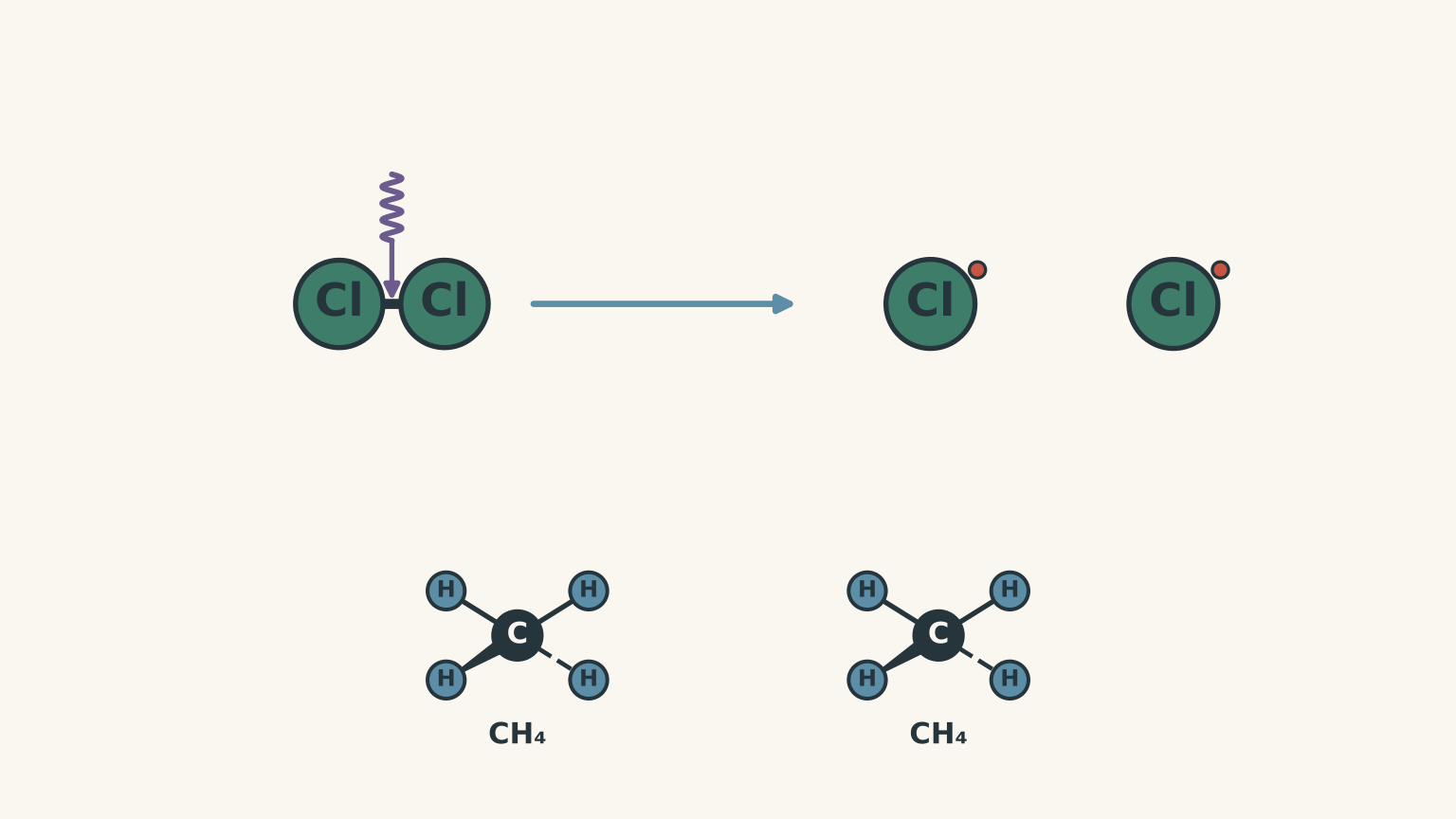
Due to technical limitations, this figure may display incorrectly or contain inaccuracies. Please check key details against your course materials.
01The Year 11 chemistry behind the mechanism
This article assumes you have studied the Year 11 Chemical reactions foundation, particularly the energy changes involved in chemical reactions.
A syllabus clarification: the NSW Chemistry 11-12 Syllabus (2025) is scheduled to begin Year 11 implementation in 2028. This article uses Year 11 knowledge as its starting point, then explores radical chain reactions as an extension beyond the required syllabus content. Understanding this mechanism is not an HSC assessment requirement. You do not need to have studied it to meet the Year 11 course requirements.
The relevant starting point is the difference between endothermic and exothermic reactions.
Breaking bonds and forming bonds
Every chemical reaction involves changes to chemical bonds.
- Breaking a chemical bond requires energy to be absorbed.
- Forming a chemical bond releases energy.
The overall energy change depends on which effect is greater.
An endothermic reaction absorbs more energy than it releases. Its enthalpy change, represented by \(\Delta H\), is positive.
An exothermic reaction releases more energy than it absorbs. Its enthalpy change is negative.
There is another important energy concept: activation energy, \(E_a\).
Activation energy is the minimum energy barrier that reacting particles must overcome for a reaction to proceed along a particular pathway.
This explains an apparent contradiction. A reaction can release energy overall but still need an initial energy input to overcome its activation energy barrier.
Keep these two ideas separate:
| Concept | What it tells you |
|---|---|
| Enthalpy change, \(\Delta H\) | Whether the overall reaction absorbs or releases heat |
| Activation energy, \(E_a\) | The energy barrier that must be overcome for a particular reaction step |
This distinction becomes particularly important when we examine radical chain reactions. Different stages of the same reaction mechanism can have different energy changes.
02What is a radical?
A radical is an atom or group of atoms containing at least one unpaired electron.
For example, a chlorine radical is represented as \(\ce{Cl^.}\). The dot represents its unpaired electron.
A chlorine molecule, \(\ce{Cl2}\), contains two chlorine atoms joined by a covalent bond. Both electrons in that bond are shared.
If the bond breaks evenly, each chlorine atom receives one electron from the original bond. This produces two chlorine radicals.
This type of bond breaking is called homolytic fission.
\[ \ce{Cl2 -> 2Cl^.} \]
The two electrons in the original bond have been divided equally between the atoms.
Radicals are particularly useful in chain reactions because their unpaired electrons allow them to react with other molecules and form new bonds.
Importantly, a radical is not necessarily an ion. The chlorine and methyl radicals used in our example are electrically neutral.
Why can radicals keep a reaction going?
Think of a relay race.
A runner receives a baton, carries it forward, and passes it to the next runner. The baton continues through the race even though the individual runners change.
In a radical chain reaction, the radical character is passed between different chemical species.
A chlorine radical can react to form a methyl radical. The methyl radical can then react to regenerate a chlorine radical.
The radical species changes, but the chain continues.
The analogy is about tracking the reactive species, not a literal electron travelling between molecules.
03The three stages of a radical chain reaction
We will use the chlorination of methane as our main example.
The overall chemical equation is:
\[ \ce{CH4 + Cl2 -> CH3Cl + HCl} \]
Methane, \(\ce{CH4}\), reacts with chlorine, \(\ce{Cl2}\), to produce chloromethane, \(\ce{CH3Cl}\), and hydrogen chloride, \(\ce{HCl}\).
One hydrogen atom in methane is replaced by a chlorine atom.
This example uses an idealised mechanism for the first substitution. In reality, further chlorination can occur, producing compounds such as dichloromethane and trichloromethane.
The reaction is discussed here as a theoretical mechanism, not as an experimental procedure. Chlorine gas is acutely toxic, methane is flammable, and hydrogen chloride is corrosive.
1. Initiation
Initiation is the stage where radicals are first produced.
For methane chlorination, light energy can break the chlorine-chlorine bond.
\[ \ce{Cl2 ->[h\nu] 2Cl^.} \]
The symbol \(h\nu\) represents the energy supplied by light.
The chlorine molecule absorbs sufficient energy for its covalent bond to break homolytically. Two chlorine radicals are formed.
This is an endothermic step because energy must be supplied to break the bond.
The important outcome is that the reaction now contains radicals capable of starting the propagation process.
Initiation does not have to involve light in every radical chain reaction. Heat or chemical initiators can also generate radicals in other systems.
2. Propagation
Propagation is where the actual chain reaction takes place.
This stage involves two repeating reactions.
Propagation step 1: A chlorine radical reacts with methane.
\[ \ce{Cl^. + CH4 -> HCl + ^.CH3} \]
The chlorine radical removes a hydrogen atom from methane.
Two things happen:
- Hydrogen chloride, \(\ce{HCl}\), is formed.
- A methyl radical, \(\ce{^.CH3}\), is produced.
The chlorine radical has been consumed, but another radical has appeared.
Notice that the radical has not disappeared from the reaction. Its identity has changed from chlorine to methyl.
Propagation step 2: The methyl radical reacts with chlorine.
\[ \ce{^.CH3 + Cl2 -> CH3Cl + Cl^.} \]
The methyl radical reacts with another chlorine molecule.
The products are:
- Chloromethane, \(\ce{CH3Cl}\).
- A new chlorine radical, \(\ce{Cl^.}\).
The chlorine radical is regenerated.
That is the key feature of propagation. A radical is consumed in one reaction and another radical is produced, allowing the sequence to repeat.
The newly formed chlorine radical can react with another methane molecule, restarting propagation step 1.
Why is propagation called a chain reaction?
Consider what happens when we combine the two propagation equations.
\[ \ce{Cl^. + CH4 -> HCl + ^.CH3} \]
\[ \ce{^.CH3 + Cl2 -> CH3Cl + Cl^.} \]
The chlorine and methyl radicals appear on both sides of the combined equations.
They cancel when we calculate the overall reaction.
We are left with:
\[ \ce{CH4 + Cl2 -> HCl + CH3Cl} \]
This is the original balanced chemical equation.
The radicals are intermediates. They participate in the mechanism but do not appear in the overall reaction because they are regenerated or consumed within the sequence.
One radical chain carrier can therefore help convert many reactant molecules into products before the chain eventually stops.
3. Termination
Propagation cannot continue indefinitely.
Eventually, two radicals can collide and combine to form a stable product. This removes the radicals needed to continue the chain.
These reactions are called termination steps.
In methane chlorination, three possible termination reactions are:
Termination pathway 1: Two chlorine radicals combine.
\[ \ce{Cl^. + Cl^. -> Cl2} \]
A chlorine molecule is regenerated.
Termination pathway 2: A chlorine radical and a methyl radical combine.
\[ \ce{Cl^. + ^.CH3 -> CH3Cl} \]
Chloromethane is produced, but neither reactant radical is regenerated.
Termination pathway 3: Two methyl radicals combine.
\[ \ce{^.CH3 + ^.CH3 -> C2H6} \]
Ethane, \(\ce{C2H6}\), is produced.
All three reactions remove radicals from the system.
Once enough radicals have been removed, propagation becomes less frequent and the chain reaction slows or stops.
Comparing the three stages
The easiest way to identify each stage is to track the radicals.
| Stage | What happens to radicals? | Main purpose |
|---|---|---|
| Initiation | Radicals are created | Starts the chain |
| Propagation | One radical is consumed and another is produced | Continues the chain |
| Termination | Radicals are consumed without producing new radicals | Ends the chain |
This gives you a useful decision rule when examining an unfamiliar mechanism:
- Does the step create radicals from non-radical reactants? It is initiation.
- Does it consume a radical and produce another radical? It is propagation.
- Does it consume radicals without producing another radical? It is termination.
Do not classify a step based only on whether it produces a stable molecule. Termination can produce stable products too.
04Worked example: Is methane chlorination exothermic overall?
Methane reacts with chlorine to produce chloromethane and hydrogen chloride.
The following approximate bond dissociation enthalpies are provided:
| Bond | Bond dissociation enthalpy (kJ mol⁻¹) |
|---|---|
| C-H in methane | 439 |
| Cl-Cl | 240 |
| C-Cl in chloromethane | 350 |
| H-Cl | 432 |
Calculate the approximate enthalpy change for the overall reaction and explain why the reaction still requires initiation.
Step 1
One C-H bond in methane and one Cl-Cl bond in chlorine must be broken.
The total energy absorbed is:
\[ E_{\text{broken}}=439+240 \]
\[ E_{\text{broken}}=679\text{ kJ mol}^{-1} \]
Step 2
One C-Cl bond and one H-Cl bond are formed.
The total energy released is:
\[ E_{\text{formed}}=350+432 \]
\[ E_{\text{formed}}=782\text{ kJ mol}^{-1} \]
Step 3
Use:
\[ \Delta H= E_{\text{broken}}-E_{\text{formed}} \]
Substitute:
\[ \Delta H=679-782 \]
\[ \boxed{\Delta H=-103\text{ kJ mol}^{-1}} \]
Step 4
The negative enthalpy change means the overall reaction is exothermic.
Approximately 103 kJ of energy is released per mole of reaction.
However, this does not mean the reaction starts without an energy input. The initiation step still requires sufficient energy to break the chlorine-chlorine bond and produce radicals.
The overall enthalpy change and the activation energy describe different things.
05The energy changes within the propagation cycle
We can take the energy analysis one step further.
Instead of considering only the overall reaction, examine the two propagation steps separately.
Using the bond dissociation enthalpies above:
First propagation step
\[ \ce{Cl^. + CH4 -> HCl + ^.CH3} \]
One C-H bond breaks and one H-Cl bond forms.
\[ \Delta H_1=439-432 \]
\[ \Delta H_1=+7\text{ kJ mol}^{-1} \]
This propagation step is slightly endothermic.
Second propagation step
\[ \ce{^.CH3 + Cl2 -> CH3Cl + Cl^.} \]
One Cl-Cl bond breaks and one C-Cl bond forms.
\[ \Delta H_2=240-350 \]
\[ \Delta H_2=-110\text{ kJ mol}^{-1} \]
This step is strongly exothermic.
Adding the two propagation steps gives:
\[ \Delta H_{\text{cycle}}=7-110 \]
\[ \boxed{\Delta H_{\text{cycle}}=-103\text{ kJ mol}^{-1}} \]
The complete propagation cycle is exothermic, even though its first step is slightly endothermic.
This is an important distinction. Individual steps within a reaction mechanism do not have to share the same enthalpy change.
The bond dissociation enthalpies used here are rounded values, so the calculated result is an estimate rather than an exact experimental measurement. The calculation also does not determine the activation energy of either step.
06Why doesn’t the reaction stop when the light is switched off?
This is one of the most interesting features of radical chain reactions.
Suppose light initiates methane chlorination and is then removed.
You might predict that the reaction immediately stops because no more energy is being supplied.
That prediction overlooks the radicals already present.
Existing radicals can continue reacting through the propagation steps without requiring a new photon for every reaction cycle.
However, the reaction is not energy-free. The propagation steps still have activation energy barriers, and ordinary thermal collisions must provide sufficient energy for reactions to occur.
Eventually, radicals undergo termination reactions. The number of available chain carriers decreases, and the reaction rate falls.
This introduces another useful concept: chain length.
Chain length describes the average number of propagation cycles completed before a chain is terminated.
A long chain means that relatively few initiation events can lead to many product-forming propagation cycles.
A short chain means that termination occurs relatively quickly.
Radical concentration, temperature, and the competing reaction pathways all influence how long chains survive.
07A radical chain reaction does not necessarily branch
There is a tempting misconception that a chain reaction must produce more and more radicals at every step.
That is not what happens in the methane chlorination mechanism.
In each propagation step:
- One radical reacts.
- One new radical forms.
The number of radical chain carriers is maintained rather than multiplied.
This is called a non-branching chain mechanism.
A branching chain reaction is different. In a branching step, one radical can generate two or more radicals, increasing the radical population.
That distinction is important because branching can cause a rapid increase in reaction rate under suitable conditions. Ordinary propagation in methane chlorination does not automatically produce this behaviour.
The word chain describes the repeated transfer of radical activity, not necessarily an uncontrolled or explosive reaction.
08Another application: Radical polymerisation
Radical chain reactions are not limited to reactions between alkanes and halogens.
They are also important in the formation of polymers.
Consider ethene, \(\ce{CH2=CH2}\).
Ethene molecules can join together to form long chains of carbon atoms. In radical polymerisation, a radical at the end of a growing chain reacts with another ethene molecule.
A simplified mechanism has the same three stages.
Initiation: A suitable initiator produces radicals.
\[ \ce{I-I -> 2I^.} \]
Here, \(\ce{I-I}\) represents a generic bond in an initiator molecule. The symbol \(I\) is not a particular chemical element.
Propagation: A growing polymer radical adds another ethene molecule.
\[ \mathrm{P}_n^\bullet+\ce{CH2=CH2} \rightarrow \mathrm{P}_{n+1}^\bullet \]
Here, \(\mathrm{P}_n^\bullet\) represents a growing polymer chain containing \(n\) repeat units and an unpaired electron at its reactive end.
After adding ethene, the chain becomes longer and the radical moves to its new end.
It can then react with another ethene molecule.
Termination: Two growing polymer radicals combine.
\[ \mathrm{P}_n^\bullet+\mathrm{P}_m^\bullet \rightarrow \mathrm{P}_{n+m} \]
The two growing chains join together, and the radical centres disappear.
The result is a non-radical polymer chain.
This example demonstrates that radical chain mechanisms share a common structure even when the reactants and products are very different.
The exact chemistry depends on the substances involved. Real polymerisation mechanisms can also include chain transfer, inhibitors, and different termination pathways. The model above focuses on the basic chain-growth process.
09Worked example: Classifying a radical polymerisation mechanism
A simplified polymerisation mechanism contains the following three reactions:
\[ \ce{I-I -> 2I^.} \]
\[ \mathrm{P}_n^\bullet+\ce{CH2=CH2} \rightarrow \mathrm{P}_{n+1}^\bullet \]
\[ \mathrm{P}_n^\bullet+\mathrm{P}_m^\bullet \rightarrow \mathrm{P}_{n+m} \]
The first reaction produces two initiator radicals, the second adds an ethene molecule to a growing polymer chain, and the third joins two growing polymer chains.
Classify each reaction and explain how the radical population changes.
Step 1
\[ \ce{I-I -> 2I^.} \]
This is initiation.
A non-radical molecule breaks apart to produce two radicals. The radical population increases.
Step 2
\[ \mathrm{P}_n^\bullet+\ce{CH2=CH2} \rightarrow \mathrm{P}_{n+1}^\bullet \]
This is propagation.
One radical reacts, but another radical remains at the end of the longer polymer chain.
The number of radical chain carriers is unchanged.
Step 3
\[ \mathrm{P}_n^\bullet+\mathrm{P}_m^\bullet \rightarrow \mathrm{P}_{n+m} \]
This is termination.
Two radicals combine to form a non-radical product. The radical population decreases by two.
The key is to follow the unpaired electrons rather than simply counting how many products appear.
10Questions and solutions
Question 1
Consider the following four reactions in the chlorination of methane.
A. \(\ce{Cl2 ->[h\nu] 2Cl^.}\)
B. \(\ce{Cl^. + CH4 -> HCl + ^.CH3}\)
C. \(\ce{^.CH3 + Cl2 -> CH3Cl + Cl^.}\)
D. \(\ce{Cl^. + Cl^. -> Cl2}\)
Identify which reaction represents initiation, which reactions represent propagation, and which represents termination.
Explain why reactions B and C together allow the reaction to continue.
Solution 1
A is initiation, B and C are propagation, and D is termination.
The distinction comes from tracking the radicals.
- A creates two chlorine radicals by breaking the chlorine-chlorine bond.
- B consumes a chlorine radical and produces a methyl radical.
- C consumes the methyl radical and regenerates a chlorine radical.
- D combines two chlorine radicals, removing them from the chain.
Reactions B and C form one complete propagation cycle.
The chlorine radical is regenerated, allowing it to react with another methane molecule. This is why propagation can repeat rather than requiring a fresh initiation event for every product molecule.
Question 2
The propagation mechanism for methane chlorination consists of:
\[ \ce{Cl^. + CH4 -> HCl + ^.CH3} \]
\[ \ce{^.CH3 + Cl2 -> CH3Cl + Cl^.} \]
Use the following bond dissociation enthalpies:
| Bond | Energy (kJ mol⁻¹) |
|---|---|
| C-H | 439 |
| Cl-Cl | 240 |
| H-Cl | 432 |
| C-Cl | 350 |
Calculate the enthalpy change for each propagation step and for the complete propagation cycle.
Explain why the first propagation step can be endothermic while the complete cycle is exothermic.
Solution 2
The first propagation step has an enthalpy change of \(+7\text{ kJ mol}^{-1}\), the second has an enthalpy change of \(-110\text{ kJ mol}^{-1}\), and the complete cycle has an enthalpy change of \(-103\text{ kJ mol}^{-1}\).
First propagation step
The C-H bond breaks, and an H-Cl bond forms.
\[ \Delta H_1=439-432 \]
\[ \boxed{\Delta H_1=+7\text{ kJ mol}^{-1}} \]
This step is endothermic because slightly more energy is required to break the C-H bond than is released when H-Cl forms.
Second propagation step
The Cl-Cl bond breaks, and a C-Cl bond forms.
\[ \Delta H_2=240-350 \]
\[ \boxed{\Delta H_2=-110\text{ kJ mol}^{-1}} \]
This step is strongly exothermic because forming the C-Cl bond releases more energy than is required to break the Cl-Cl bond.
Complete propagation cycle
Add the enthalpy changes of the two steps.
\[ \Delta H_{\text{cycle}}=7+(-110) \]
\[ \boxed{\Delta H_{\text{cycle}}=-103\text{ kJ mol}^{-1}} \]
The complete cycle is exothermic because the energy released during the second propagation step exceeds the energy absorbed during the first.
The tempting mistake is to assume every step must have the same energy classification as the overall reaction. This is incorrect. Enthalpy changes are calculated for individual reactions as well as for the complete process.
Question 3
A mixture of methane and chlorine undergoes radical chlorination after exposure to suitable light.
The light source is then switched off. Assume there are still plenty of methane and chlorine molecules present, but no other source of new radicals.
Product formation continues briefly before the reaction rate falls substantially.
Explain this observation using the three stages of a radical chain reaction.
Solution 3
The reaction continues briefly because radicals produced during initiation can keep reacting through propagation even after the light source is removed.
The light source is responsible for generating the initial chlorine radicals.
Once these radicals exist, they can react with methane to produce methyl radicals. The methyl radicals then react with chlorine molecules, regenerating chlorine radicals.
The propagation cycle can therefore continue without a new photon being absorbed for every cycle.
However, termination reactions gradually remove radicals from the system.
For example:
\[ \ce{Cl^. + Cl^. -> Cl2} \]
As the radical population decreases, fewer propagation reactions can occur. Eventually, the chain reaction slows substantially.
The important distinction is that switching off the light prevents further photochemical initiation, but it does not instantly destroy radicals that have already formed.
The remaining stable reactants do not necessarily react at an appreciable rate under the stated conditions because the initiation barrier is no longer being overcome effectively.
Question 4
Consider an alternative pathway in methane chlorination.
One initiation event produces two chlorine radicals.
Each chlorine radical reacts with a methane molecule:
\[ \ce{Cl^. + CH4 -> HCl + ^.CH3} \]
The two methyl radicals then combine:
\[ \ce{^.CH3 + ^.CH3 -> C2H6} \]
(a) Classify each of the three stages, including initiation.
(b) Derive the overall balanced chemical equation for this pathway.
(c) Explain why the formation of ethane is a termination reaction, even though a stable product is formed.
Solution 4
The first reaction is initiation, the two hydrogen-abstraction reactions are propagation, and the methyl radical combination is termination.
The overall equation is:
\[ \ce{Cl2 + 2CH4 -> 2HCl + C2H6} \]
Step 1: Write the initiation reaction.
\[ \ce{Cl2 -> 2Cl^.} \]
One chlorine molecule produces two chlorine radicals.
Step 2: Include both propagation reactions.
Two chlorine radicals each react with one methane molecule.
\[ \ce{2Cl^. + 2CH4 -> 2HCl + 2^.CH3} \]
Two hydrogen chloride molecules and two methyl radicals are produced.
Step 3: Write the termination reaction.
\[ \ce{2^.CH3 -> C2H6} \]
The two methyl radicals combine to form ethane.
Step 4: Add the reactions and cancel the radicals.
The chlorine radicals and methyl radicals are intermediates, so they cancel from the combined equation.
The remaining equation is:
\[ \boxed{\ce{Cl2 + 2CH4 -> 2HCl + C2H6}} \]
Step 5: Explain why the final reaction is termination.
The tempting argument is that the reaction must be propagation because it forms a stable product.
However, classification depends on what happens to the radicals.
Two methyl radicals are consumed, and no new radical is produced. Therefore, the radical population decreases by two.
The reaction ends the chain rather than continuing it.
This example also shows why termination reactions can influence the final product mixture. Not every methane molecule that reacts through a radical pathway necessarily produces chloromethane.
Question 5
A simplified methane chlorination system undergoes one initiation event:
\[ \ce{Cl2 ->[h\nu] 2Cl^.} \]
Assume the following conditions:
- The initiation event produces exactly two chlorine radicals.
- Each radical completes exactly 50 full propagation cycles.
- After completing its cycles, each chain carrier is a chlorine radical.
- The two remaining chlorine radicals then combine through termination.
- No other termination pathways or secondary chlorination reactions occur.
Determine:
(a) The total number of complete propagation cycles.
(b) The number of methane and chlorine molecules consumed during propagation.
(c) The number of chloromethane and hydrogen chloride molecules produced.
(d) The total number of radical chain carriers during propagation and after termination.
(e) The overall balanced chemical equation, taking initiation and termination into account.
Solution 5
There are 100 complete propagation cycles in total. They consume 100 methane molecules and 100 chlorine molecules during propagation, producing 100 chloromethane molecules and 100 hydrogen chloride molecules. Two radical chain carriers exist during propagation, and none remain after termination.
The important challenge is distinguishing the number of propagation cycles from the number of radicals.
Step 1: Calculate the total number of propagation cycles.
There are two initial chlorine radicals.
Each completes 50 cycles.
\[ N_{\text{cycles}}=2\times50 \]
\[ \boxed{N_{\text{cycles}}=100} \]
Step 2: Determine the reactants consumed.
Each complete propagation cycle consumes:
- One methane molecule.
- One chlorine molecule.
This follows directly from the two propagation reactions:
\[ \ce{Cl^. + CH4 -> HCl + ^.CH3} \]
\[ \ce{^.CH3 + Cl2 -> CH3Cl + Cl^.} \]
Therefore, 100 cycles consume:
\[ \boxed{100\text{ CH4 molecules}} \]
and
\[ \boxed{100\text{ Cl2 molecules}} \]
Step 3: Determine the products formed.
Each complete cycle produces one molecule of chloromethane and one molecule of hydrogen chloride.
Therefore:
\[ \boxed{100\text{ CH3Cl molecules}} \]
and
\[ \boxed{100\text{ HCl molecules}} \]
Step 4: Track the radical population.
This is the conceptual part of the question.
There are initially two chlorine radicals.
During propagation, each radical changes identity:
\[ \ce{Cl^. -> ^.CH3 -> Cl^.} \]
The chlorine radical is consumed in the first propagation step, but a methyl radical replaces it.
The methyl radical is then consumed in the second propagation step, regenerating a chlorine radical.
Therefore, each complete cycle returns the chain carrier to its original form.
The total radical population remains two throughout propagation.
At termination:
\[ \ce{2Cl^. -> Cl2} \]
Both radicals are consumed.
The final radical population is zero.
Step 5: Account for initiation and termination in the overall equation.
The initiation reaction consumes one chlorine molecule:
\[ \ce{Cl2 -> 2Cl^.} \]
The final termination reaction regenerates one chlorine molecule:
\[ \ce{2Cl^. -> Cl2} \]
These two reactions cancel when the entire process is added together.
The 100 propagation cycles therefore determine the net stoichiometry:
\[ \boxed{\ce{100CH4 + 100Cl2 -> 100CH3Cl + 100HCl}} \]
Dividing by 100 gives the simplest overall equation:
\[ \boxed{\ce{CH4 + Cl2 -> CH3Cl + HCl}} \]
The tempting mistake is to assume that 100 propagation cycles must produce 100 new radicals. That would confuse radical regeneration with radical multiplication.
The exact constraint is that each propagation step consumes one radical and produces one replacement radical. The number of chain carriers is maintained, not increased.
A second tempting mistake is to count the chlorine molecule used in initiation as an additional net reactant. In this particular scenario, the termination reaction regenerates that chlorine molecule, so it cancels from the overall balance.
Light supplies the energy required for initiation. It is not a matter-based reactant in the balanced chemical equation.
This is the central idea behind radical chain reactions: a small number of initiating events can support a much larger number of propagation reactions without continuously increasing the number of radicals.
11Where to take this idea next
You can now distinguish a radical chain reaction from a simple sequence of reactions by looking for the regeneration of radical chain carriers.
The next useful question is how temperature and radical concentration affect the competition between propagation and termination. That leads into reaction kinetics, where the mechanism explains not just which products form, but also how quickly they form.
For a useful comparison, see tutorgum’s guide to Consecutive Reactions: How Intermediates Form and Disappear. The key difference is that a radical chain mechanism regenerates a reactive chain carrier during propagation.
The mechanism and approximate bond-energy values discussed here are consistent with established university chemistry teaching materials, including OpenStax’s treatment of radical halogenation and Kenyon College’s explanation of methane chlorination. The syllabus implementation timeline is available from NESA’s Chemistry 11-12 Syllabus (2025).