
Thomson’s Charge-to-Mass Experiment: HSC Physics Explained
Understand how crossed electric and magnetic fields were used to determine particle speed and charge-to-mass ratio. Includes worked examples, experimental reasoning, and exam-style questions.
A narrow cathode-ray beam enters a region containing an electric field and a magnetic field. The electric field tries to push the beam one way. The magnetic field tries to bend it the other way. Now adjust the fields until the beam goes straight.
What have you learned?
It might look like “nothing happened”, but that straight beam is the useful measurement. If two known forces exactly cancel, their equality tells you the speed of the particles without knowing either their charge or their mass. Then a second magnetic deflection can reveal the ratio of charge to mass.
That is the key idea behind the crossed-field treatment of J. J. Thomson’s work: use one experiment to find the particle’s speed, then use its curvature to find how strongly its charge responds compared with its inertia.
The result was much stranger than simply finding another charged atom. Cathode rays behaved as if they contained negatively charged particles with an enormous charge-to-mass ratio. They were far lighter, relative to their charge, than any known ion. Thomson argued that these particles were constituents of atoms themselves. Nobel Prize
01The measurement problem Thomson had to solve
By the late nineteenth century, cathode-ray tubes produced a beam travelling from the negative electrode, the cathode, through a low-pressure gas.
The difficult question was: what actually travelled through the tube?
One possibility was that cathode rays were some kind of wave-like disturbance. Another was that they were streams of charged particles. Thomson’s 1897 paper explicitly addressed this disagreement. Wikisource
There was an awkward piece of evidence against the particle idea. Magnetic fields could bend cathode rays, but earlier attempts to deflect them using ordinary electric fields had failed.
If the rays really carried electric charge, shouldn’t an electric field push them?
Yes. That failed prediction needed explaining.
Thomson found that the remaining gas inside the tube was part of the problem. Cathode rays ionised that gas, making it conductive enough to weaken the electric field around the beam. At sufficiently low pressure, the screening became much smaller, and an electric field did deflect the rays. The direction of deflection was consistent with negative charge. LeMoyne College
That result established something important. But it still did not answer a harder question:
How massive were these particles?
You cannot simply place one on a laboratory balance. Thomson needed to infer mass from motion.
02Picture the apparatus before doing the maths
The essential arrangement can be pictured from left to right.
A cathode produces the cathode rays. The beam is narrowed by openings so that its path is easy to track. It then passes through a region containing electric and magnetic fields. Finally, it reaches a fluorescent surface, where the impact produces a visible spot.
Thomson’s apparatus used a highly evacuated tube, narrow beam-forming openings, electric deflection plates, magnetic fields, and a fluorescent region where the beam position could be measured. His published work compared electric and magnetic deflections to determine the particles’ speed and their mass-to-charge ratio. LeMoyne College
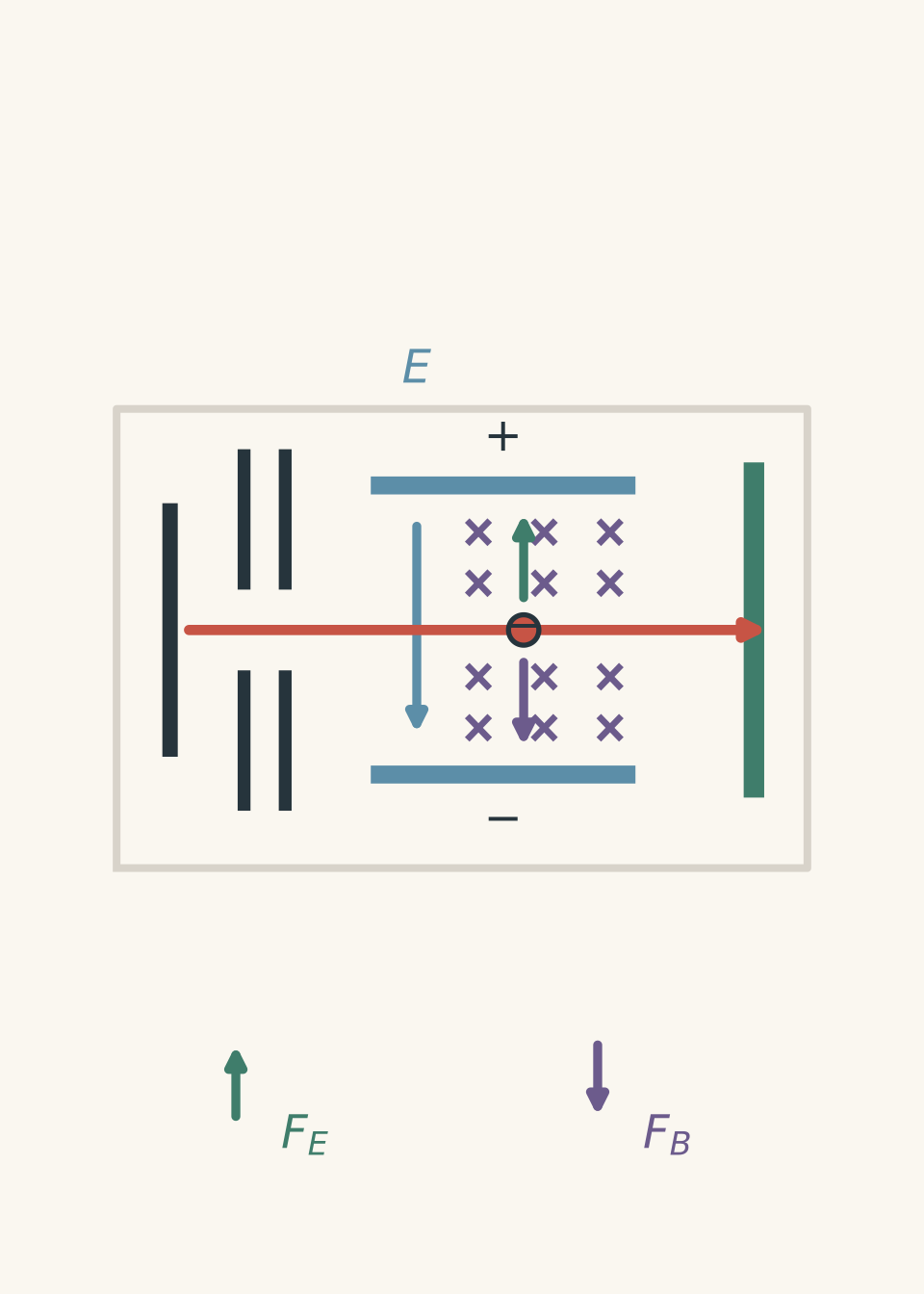
For HSC Physics, it is useful to organise this reasoning as a crossed-field method. The electric and magnetic fields act at the same time and are perpendicular to each other and to the beam.
Before reading on, predict this: if the electric force points upwards and the magnetic force points downwards, what happens when the two forces have exactly the same magnitude?
The particle travels straight through at constant velocity. Its vertical forces cancel.
That straight path tells us its speed.
03Why crossed fields can measure speed
Consider a charged particle of charge \(q\) travelling at speed \(v\).
In a uniform electric field of magnitude \(E\), the magnitude of the electric force is
\[ F_E = |q|E \]
where:
- \(F_E\) is electric force in newtons, N,
- \(|q|\) is the magnitude of the particle’s charge in coulombs, C, and
- \(E\) is electric field strength in newtons per coulomb, N C\(^{-1}\).
Now suppose the particle moves perpendicular to a magnetic field of magnitude \(B\).
The magnetic force has magnitude
\[ F_B = |q|vB \]
where:
- \(F_B\) is magnetic force in newtons, N,
- \(v\) is particle speed in metres per second, m s\(^{-1}\), and
- \(B\) is magnetic field strength in tesla, T.
The fields are arranged so that these forces act in opposite directions.
For an undeflected particle,
\[ F_E = F_B \]
so
\[ |q|E = |q|vB. \]
The charge cancels:
\[ v = \frac{E}{B}. \]
This is the clever part.
You do not need to know \(q\). You do not need to know \(m\). Any charged particle moving at the correct speed experiences equal-magnitude electric and magnetic forces.
The crossed fields therefore act as a velocity selector.
A slightly silly way to picture it is two friends pulling you in opposite directions with exactly equal force. Your ability to resist being accelerated – your mass – does not matter once the pulls themselves are equal. But the analogy breaks once you ask why one of the forces depends on speed: unlike your two friends, the magnetic force becomes stronger as the charged particle moves faster.
A detail students often miss: the charge sign cancels too
Suppose you replace an electron with a positively charged particle moving in exactly the same direction.
Both forces reverse.
The electric force reverses because \(q\) changes sign. The magnetic force also reverses because the magnetic force depends on \(q\mathbf{v}\times\mathbf{B}\).
So if the two forces cancelled for one sign of charge, they also cancel for the opposite sign, provided the speed is still \(E/B\).
That means an undeflected path by itself does not tell you whether the particle is positive or negative.
The sign must come from the direction of deflection when one field acts without the other.
04Worked example: finding the speed of an undeflected beam
An electron beam travels perpendicular to an electric field of magnitude \(3.60\times10^4\ \text{N C}^{-1}\) and a magnetic field of magnitude \(2.00\times10^{-3}\ \text{T}\). The fields produce forces in opposite directions, and the beam passes through undeflected. Determine the speed of the electrons.
Step 1
The electric and magnetic forces must have equal magnitudes:
\[ F_E=F_B. \]
Therefore,
\[ |q|E=|q|vB. \]
Step 2
\[ v=\frac{E}{B}. \]
Step 3
\[ v=\frac{3.60\times10^4}{2.00\times10^{-3}} =1.80\times10^7\ \text{m s}^{-1}. \]
The electrons are travelling at
\[ v=1.80\times10^7\ \text{m s}^{-1}. \]
The important point is not just the number. We obtained the speed without knowing the electron’s charge or mass.
05Speed is only half the problem
Now imagine switching off the electric field while keeping a magnetic field perpendicular to the beam.
Predict the path.
The magnetic force is always perpendicular to the particle’s instantaneous velocity. It changes the direction of the velocity rather than its speed.
A force that continually points towards the centre of a circle is a centripetal force, so the beam follows a circular arc.
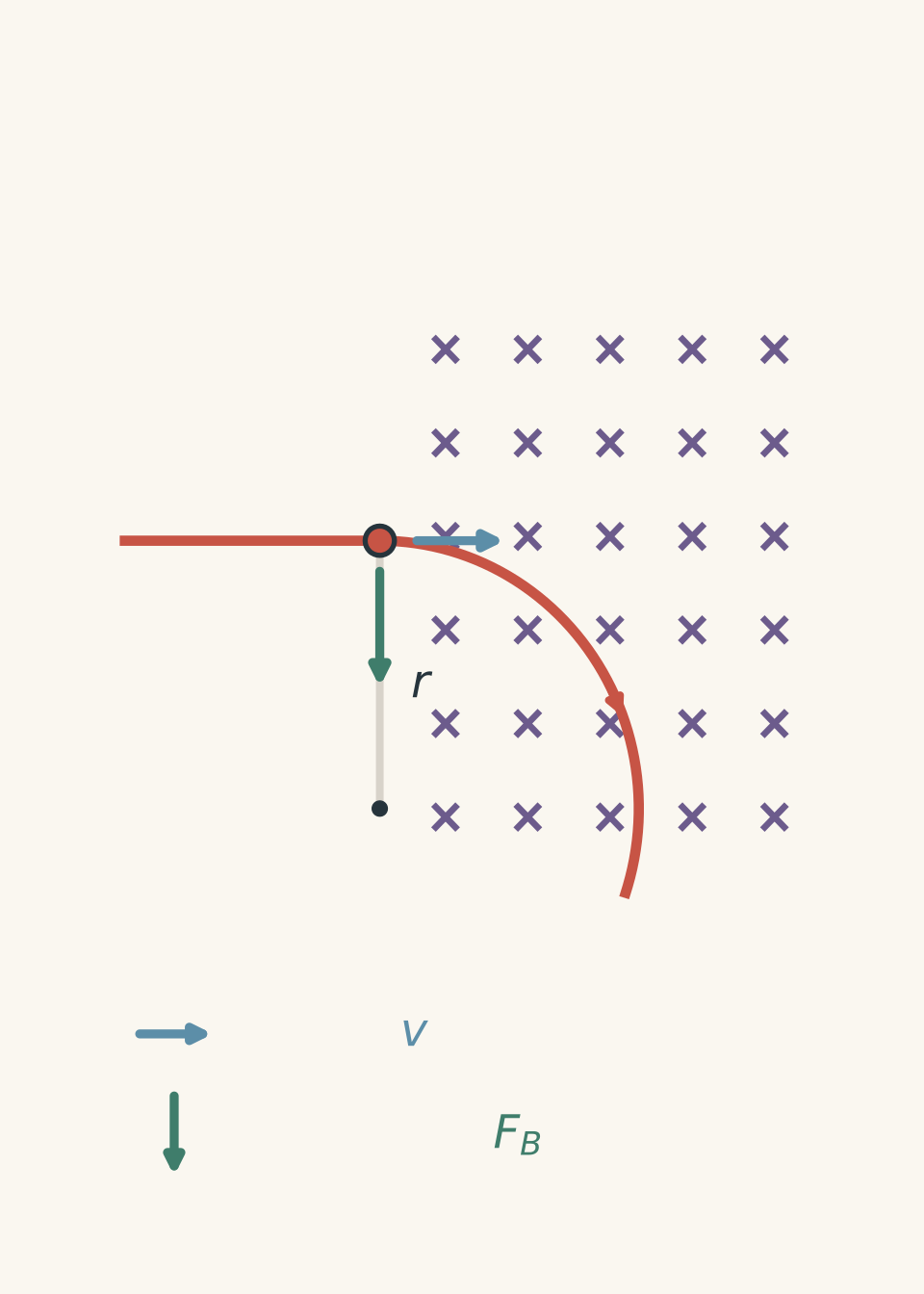
For perpendicular motion,
\[ F_B=|q|vB. \]
The required centripetal force is
\[ F_c=\frac{mv^2}{r}, \]
where \(m\) is the particle’s mass in kilograms and \(r\) is the radius of the circular path in metres.
The magnetic force supplies this centripetal force:
\[ |q|vB=\frac{mv^2}{r}. \]
Cancel one factor of \(v\):
\[ |q|B=\frac{mv}{r}. \]
Rearranging gives
\[ \frac{|q|}{m}=\frac{v}{Br}. \]
Now insert the speed already obtained from the crossed fields:
\[ v=\frac{E}{B}. \]
If the same magnetic-field magnitude \(B\) is used, then
\[ \frac{|q|}{m} = \frac{E}{B^2r}. \]
More generally, if the selector uses magnetic field \(B_s\) and the circular analyser uses a different field \(B_a\),
\[ v=\frac{E}{B_s} \]
and
\[ \frac{|q|}{m} = \frac{v}{B_a r} = \frac{E}{B_sB_a r}. \]
That more general form is worth remembering conceptually rather than memorising blindly. First find the velocity. Then use circular motion to find charge-to-mass ratio.
06Worked example: finding the electron charge-to-mass ratio
A cathode-ray beam passes undeflected through crossed fields of \(E=4.20\times10^4\ \text{N C}^{-1}\) and \(B_s=2.40\times10^{-3}\ \text{T}\). The electric field is then removed. In a perpendicular magnetic field of \(B_a=1.00\times10^{-3}\ \text{T}\), the beam follows a circular path of radius \(0.100\ \text{m}\).
Determine the magnitude of the particles’ charge-to-mass ratio.
Step 1
For zero deflection,
\[ v=\frac{E}{B_s}. \]
Substituting,
\[ v = \frac{4.20\times10^4}{2.40\times10^{-3}} = 1.75\times10^7\ \text{m s}^{-1}. \]
Step 2
\[ |q|vB_a=\frac{mv^2}{r}. \]
Therefore,
\[ \frac{|q|}{m}=\frac{v}{B_a r}. \]
Step 3
\[ \frac{|q|}{m} = \frac{1.75\times10^7} {(1.00\times10^{-3})(0.100)} = 1.75\times10^{11}\ \text{C kg}^{-1}. \]
So
\[ \frac{|q|}{m}=1.75\times10^{11}\ \text{C kg}^{-1}. \]
That is close to the modern electron value of about \(1.76\times10^{11}\ \text{C kg}^{-1}\).
Notice what the experiment has not measured. It has not separately found \(q\) and \(m\). Many possible combinations of charge and mass could give the same ratio.
That limitation becomes important when interpreting Thomson’s result.
07Why the electric-field experiment had initially failed
This part of the history is useful because it shows how an experimental failure can be evidence about the apparatus rather than evidence against the theory.
Earlier work, including experiments by Heinrich Hertz, had failed to show ordinary electrostatic deflection of cathode rays. Thomson initially obtained the same result. LeMoyne College
A reasonable conclusion might have been:
No electric deflection means the cathode rays are uncharged.
But that conclusion assumes the intended electric field actually exists where the beam travels.
The remaining gas inside the tube was being ionised by the cathode rays. Positive and negative ions could move around and reduce the effective electric field near the beam. Thomson found that increasing the degree of evacuation reduced this conductivity. With sufficiently little gas remaining, the rays were measurably deflected by the electric field. LeMoyne College
This is a useful experimental lesson:
“I saw no effect” is not automatically the same as “the effect does not exist.”
You have to ask whether the apparatus was capable of producing and detecting the effect predicted by the model.
In Thomson’s case, improving the vacuum changed the result.
08What the experiment actually established
There are several conclusions here, and they should not be blurred together.
| Observation or measurement | What it supports |
|---|---|
| Cathode rays are deflected by an electric field | The rays behave as charged particles |
| Deflection is towards the positive plate | Their charge is negative |
| Electric and magnetic effects can be balanced | Their speed can be determined |
| Magnetic curvature can then be measured | \(|q|/m\) can be determined |
| Similar \(q/m\) behaviour occurs for cathode rays produced under different conditions | The particles are not peculiar to one particular cathode material or gas |
Thomson found a charge-to-mass behaviour dramatically different from ordinary atomic ions. The particles had much less mass per unit charge than known atoms or ions. He concluded that cathode rays were streams of extremely small negatively charged particles, later called electrons, and that these particles were constituents of matter. Nobel Prize
There is an important piece of scientific honesty here.
The measurement of \(q/m\) alone does not tell you whether:
- \(q\) is enormous,
- \(m\) is tiny, or
- both differ from the values expected for an ion.
Thomson’s wider evidence supported the small-particle interpretation, but \(q/m\) is still a ratio. A separate measurement of the elementary charge was required before electron mass could be obtained independently.
That is where later measurements such as Millikan’s oil-drop experiment become important.
09Historical experiment versus the neat HSC model
The textbook crossed-field derivation is beautifully clean:
\[ |q|E=|q|vB \]
followed by
\[ |q|vB=\frac{mv^2}{r}. \]
Real historical experiments were less tidy.
Thomson’s 1897 investigation involved a series of measurements and apparatus arrangements, including electric deflection, magnetic deflection, and methods for determining velocity and \(m/e\). His original paper describes comparing deflections rather than simply presenting the compact modern “velocity selector, then circular analyser” exercise you may see in an HSC question. LeMoyne College
That does not make the HSC model wrong. It makes it a simplified reconstruction of the governing physics.
The distinction is useful:
- Historical fact: Thomson investigated cathode rays using electric and magnetic effects and determined their charge-to-mass behaviour.
- Physical model: electric and magnetic forces can be balanced to determine \(v\), and magnetic curvature can then determine \(|q|/m\).
- Modern hindsight: we know the particles were electrons and can compare Thomson’s measurements with precise modern values.
For the evidence that established the rays’ negative charge before the \(q/m\) measurement, see Cathode-Ray Evidence for Electrons: HSC Physics Explained.
10Three decisions that prevent most exam mistakes
When you meet a Thomson-style problem, do not immediately hunt for an equation. Decide what the apparatus is doing.
1. Is the beam straight in crossed fields?
If yes, the net transverse force is zero:
\[ |q|E=|q|vB. \]
Use this to find velocity:
\[ v=\frac{E}{B}. \]
Do not introduce centripetal force here. A straight beam is not undergoing circular motion.
2. Is the beam curving in a magnetic field?
If the velocity is perpendicular to the field, magnetic force supplies centripetal force:
\[ |q|vB=\frac{mv^2}{r}. \]
Use this to obtain
\[ \frac{|q|}{m}=\frac{v}{Br}. \]
3. Are you being asked for the sign of the charge?
The magnitude equations above cannot give it.
Use the observed direction of bending together with
\[ \mathbf{F}=q\mathbf{v}\times\mathbf{B}. \]
Find the force direction predicted for a positive charge using the right-hand rule. If the actual particle bends the opposite way, its charge is negative.
11Questions and solutions
Question 1
A beam of charged particles passes undeflected through perpendicular electric and magnetic fields. The electric field strength is \(6.0\times10^4\ \text{N C}^{-1}\), and the magnetic field strength is \(3.0\times10^{-3}\ \text{T}\).
Calculate the speed of the particles.
Solution 1
The particle speed is \(2.0\times10^7\ \text{m s}^{-1}\).
Because the beam is undeflected, the electric and magnetic forces must have equal magnitudes:
\[ |q|E=|q|vB. \]
Cancelling \(|q|\),
\[ v=\frac{E}{B}. \]
Substitute the given field strengths:
\[ v = \frac{6.0\times10^4} {3.0\times10^{-3}} = 2.0\times10^7\ \text{m s}^{-1}. \]
So
\[ v=2.0\times10^7\ \text{m s}^{-1}. \]
A tempting mistake is to search for the particle’s charge before calculating \(v\). It is unnecessary. The charge appears in both forces and cancels.
Question 2
A cathode-ray beam passes undeflected through a velocity selector containing an electric field of \(5.40\times10^4\ \text{N C}^{-1}\) and a magnetic field of \(3.00\times10^{-3}\ \text{T}\).
It then enters a second magnetic field of \(1.20\times10^{-3}\ \text{T}\), perpendicular to its velocity. The beam follows a circular path of radius \(8.50\ \text{cm}\).
Calculate:
a. the speed of the particles, and
b. the magnitude of their charge-to-mass ratio.
Solution 2
The particles travel at \(1.80\times10^7\ \text{m s}^{-1}\), and their charge-to-mass ratio is \(1.76\times10^{11}\ \text{C kg}^{-1}\).
For part a, an undeflected beam means
\[ |q|E=|q|vB_s, \]
where \(B_s\) is the selector magnetic field.
Therefore,
\[ v=\frac{E}{B_s}. \]
Substituting,
\[ v = \frac{5.40\times10^4} {3.00\times10^{-3}} = 1.80\times10^7\ \text{m s}^{-1}. \]
For part b, convert the radius first:
\[ 8.50\ \text{cm}=0.0850\ \text{m}. \]
In the second magnetic field,
\[ |q|vB_a=\frac{mv^2}{r}. \]
Hence
\[ \frac{|q|}{m} = \frac{v}{B_a r}. \]
Substitute:
\[ \frac{|q|}{m} = \frac{1.80\times10^7} {(1.20\times10^{-3})(0.0850)} = 1.76\times10^{11}\ \text{C kg}^{-1}. \]
Therefore,
\[ \frac{|q|}{m}=1.76\times10^{11}\ \text{C kg}^{-1}. \]
The likely trap is using the selector field \(3.00\times10^{-3}\ \text{T}\) in the circular-motion calculation. The beam curves in the second magnetic field, so \(B_a=1.20\times10^{-3}\ \text{T}\) belongs in that equation.
Question 3
An electron beam travels horizontally to the right through crossed electric and magnetic fields. The magnetic field points into the page.
The electric field is adjusted so that the electrons pass straight through.
a. Determine the direction of the electric field.
b. A beam of positively charged particles with exactly the same speed is then sent through the apparatus without changing either field. Will it initially deflect? Explain.
c. Explain why the undeflected motion alone cannot determine the sign of the particles’ charge.
Solution 3
The electric field points downwards, and the positive particles also pass through initially undeflected.
For part a, first find the magnetic-force direction.
For a positive charge moving to the right with \(\mathbf{B}\) into the page, the right-hand rule gives
\[ \mathbf{v}\times\mathbf{B} \]
upwards.
An electron has negative charge, so its magnetic force is in the opposite direction: downwards.
For the electron to remain undeflected, the electric force must therefore act upwards.
Because an electron is negatively charged, its electric force is opposite to the electric-field direction. The electric field must point downwards.
For part b, consider a positive particle at the same speed. Its magnetic force is now upwards. Because it is positive, its electric force is in the direction of the electric field, which is downwards.
The magnitudes are
\[ F_E=qE \]
and
\[ F_B=qvB. \]
The fields were chosen so that \(E=vB\), so these forces remain equal and opposite. The positive particle also passes through undeflected.
For part c, the cancellation condition is
\[ qE=qvB \]
in magnitude, so \(q\) cancels. Changing the sign of \(q\) reverses both forces, leaving them opposed to one another.
The tempting conclusion is that the direction of the electric field must reveal the sign of an undeflected particle. It does not. You need to observe the direction of deflection with one field acting separately, or obtain equivalent directional evidence.
Question 4
A source accelerates negatively charged particles from rest through a potential difference \(V\). They then enter a crossed-field velocity selector and pass through undeflected. After the selector, they enter a perpendicular magnetic analyser and follow a circular path of radius \(r\).
The accelerating potential is then increased from \(V\) to \(4V\). The source still emits the same particle species.
A student argues:
“The particles have four times as much electrical energy, so their speed becomes four times as large. We should multiply both selector fields by four to keep the beam straight.”
Assess the argument. Determine:
a. the new particle speed compared with the original speed, assuming non-relativistic motion,
b. how the ratio \(E/B_s\) of the selector fields must change to transmit the new beam, and
c. how the analyser radius changes if its magnetic field is left unchanged.
Solution 4
The new speed is twice the original speed, the selector ratio \(E/B_s\) must double, and the analyser radius also doubles.
The student’s error is treating kinetic energy as proportional to speed. Kinetic energy is proportional to \(v^2\).
Initially, a particle accelerated from rest through potential difference \(V\) gains kinetic energy
\[ \frac{1}{2}mv^2=|q|V. \]
After the potential difference becomes \(4V\),
\[ \frac{1}{2}mv'^2=|q|(4V). \]
Divide the second equation by the first:
\[ \frac{v'^2}{v^2}=4. \]
Therefore,
\[ v'=2v. \]
For part b, the selector transmits particles satisfying
\[ v=\frac{E}{B_s}. \]
The required selected speed has doubled, so
\[ \left(\frac{E}{B_s}\right)'=2\frac{E}{B_s}. \]
There are many ways to achieve this. For example, \(E\) could double while \(B_s\) remains unchanged. Multiplying both \(E\) and \(B_s\) by four would leave \(E/B_s\) unchanged, so it would still select the original speed and would reject the newly accelerated particles.
For part c, in the analyser,
\[ |q|vB_a=\frac{mv^2}{r}. \]
Therefore,
\[ r=\frac{mv}{|q|B_a}. \]
For the same particle species and unchanged analyser field, \(m\), \(|q|\), and \(B_a\) are constant. Thus
\[ r\propto v. \]
Since \(v'=2v\),
\[ r'=2r. \]
The deeper point is that three different relationships are operating:
\[ K\propto v^2,\qquad v=\frac{E}{B_s},\qquad r\propto v. \]
Confusing any two of them gives a plausible-looking but incorrect prediction.
Question 5
A laboratory produces a mixed beam containing two unknown negatively charged particle species, A and B.
Both species pass straight through the same crossed-field selector, so each has speed \(v=E/B_s\). They then enter the same perpendicular magnetic analyser.
Species A follows a circular path of radius \(r\). Species B follows a path of radius \(2r\).
A student concludes:
“B must have twice the mass of A because its circular path has twice the radius.”
Another student says:
“No. B could instead have half the charge.”
The source is then changed so that, before the selector, both species are accelerated from rest through the same potential difference \(V\). Once the selector fields are reset appropriately, both species are again observed to pass through it together at one common speed.
Using all of this information, determine the relationship between the masses and charge magnitudes of A and B. Explain why the extra accelerating-potential observation changes what can be concluded.
Solution 5
Species B has four times the mass and twice the charge magnitude of species A:
\[ m_B=4m_A \]
and
\[ |q_B|=2|q_A|. \]
From the first experiment alone, neither student has enough information.
Both particles leave the selector at the same speed \(v\). In the analyser,
\[ r=\frac{mv}{|q|B_a}. \]
Since \(v\) and \(B_a\) are the same for both species,
\[ r\propto\frac{m}{|q|}. \]
Given
\[ r_B=2r_A, \]
we therefore know
\[ \frac{m_B/|q_B|}{m_A/|q_A|}=2. \]
So
\[ \frac{m_B}{|q_B|} = 2\frac{m_A}{|q_A|}. \]
This does not uniquely mean \(m_B=2m_A\). A different charge could produce the same radius ratio.
Now use the second observation.
Both species are accelerated from rest through the same potential difference \(V\), and afterwards they can both be selected at the same speed \(v\).
For either species,
\[ |q|V=\frac{1}{2}mv^2. \]
Rearrange:
\[ \frac{|q|}{m} = \frac{v^2}{2V}. \]
Because both species have the same \(V\) and the same \(v\), this equation says
\[ \frac{|q_A|}{m_A} = \frac{|q_B|}{m_B}. \]
At first, that appears to contradict the analyser result, which said their \(m/|q|\) ratios differ by a factor of two.
And that is the hinge in the problem: the stated observations cannot all describe the same two species under the stated assumptions.
The analyser observation requires
\[ \frac{m_B}{|q_B|} = 2\frac{m_A}{|q_A|}, \]
while equal acceleration potential followed by equal speed requires
\[ \frac{m_B}{|q_B|} = \frac{m_A}{|q_A|}. \]
These cannot both be true.
Therefore the proposed conclusion
\[ m_B=4m_A,\qquad |q_B|=2|q_A| \]
cannot actually satisfy the full experiment. The correct conclusion is that the complete set of observations is physically inconsistent under the stated assumptions.
At least one assumption must fail. For example, the particles might not both start from rest, they might not pass through the same accelerating potential, the two observed analyser traces might not correspond to the same species seen in the second run, or an unaccounted field could be affecting the motion.
This is the conceptual point Thomson-style measurements are good at exposing. A crossed-field selector measures speed. Magnetic curvature measures \(m/|q|\). Acceleration through a known potential connects speed to \(|q|/m\). These are not three independent stories about the beam. They are constraints on the same particles, and they must agree.
That consistency is what turns beam deflection from a visual observation into a quantitative test of a particle model.
The next useful step is therefore not another rearrangement of Thomson’s equations. It is to ask how \(q\) can be measured independently. Once the elementary charge is known, a measured \(q/m\) ratio can finally be separated into an actual particle charge and an actual particle mass.