
The Geiger-Marsden Experiment: HSC Physics Explained
Understand how alpha-particle scattering challenged Thomson’s atomic model and provided evidence for a tiny, dense, positively charged nucleus.
Imagine firing a fast, heavy, positively charged particle at a sheet of gold only a few hundred atoms thick. If the atom’s positive charge is spread smoothly through its whole volume, what should happen?
You’d expect the particle to pass through with, at most, a small wobble. That was roughly the prediction available to Hans Geiger and Ernest Marsden in 1909. Instead, a tiny fraction of their alpha particles turned through enormous angles. Some came almost straight back.
That strange result forced a new picture of the atom: most of an atom’s volume is relatively empty, while nearly all of its positive charge, and most of its mass, are concentrated in a tiny central nucleus.
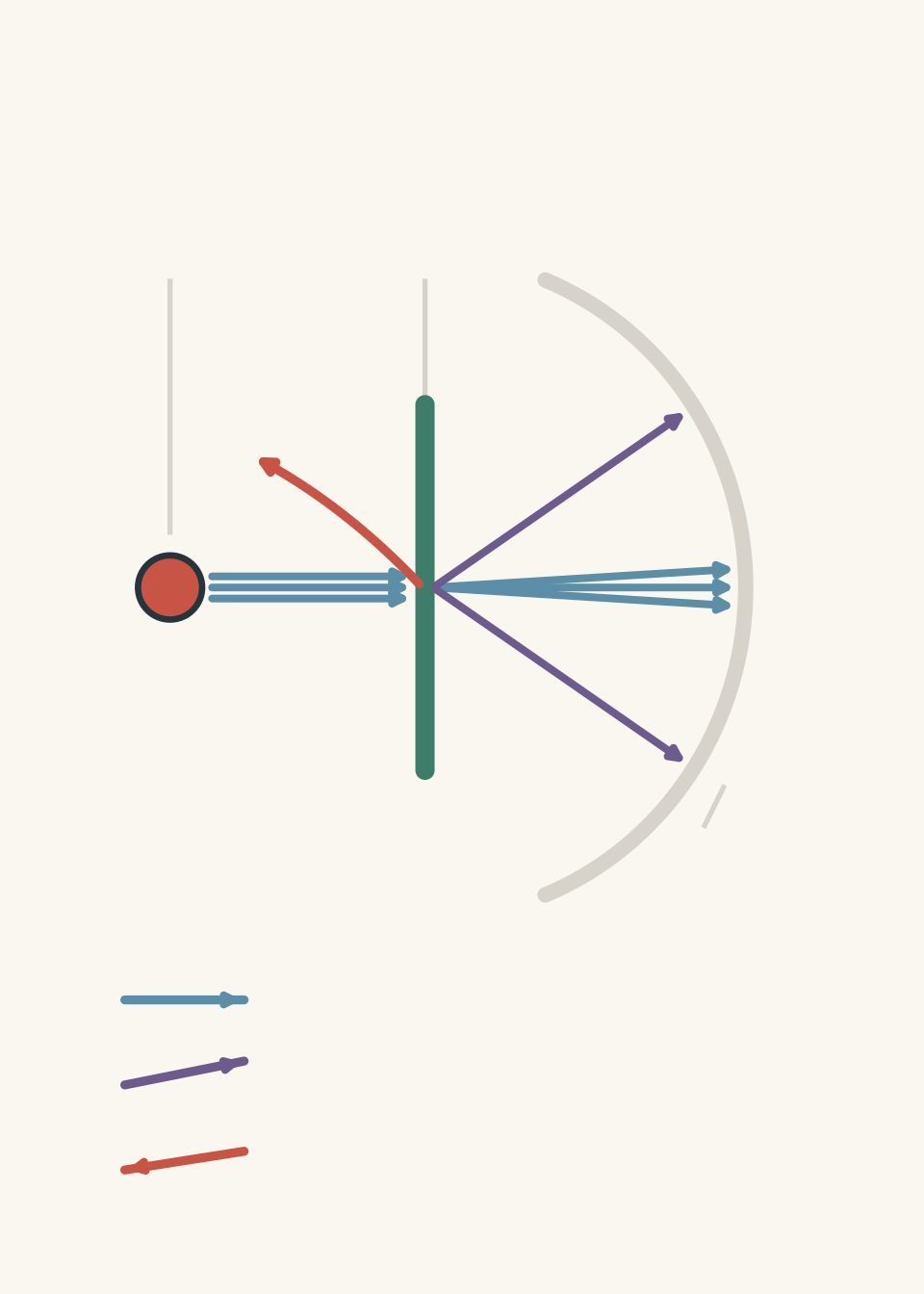
01The problem with the old atomic model
By 1909, the electron was already known from experiments involving cathode rays. If you need that part of the story refreshed, see Cathode-Ray Evidence for Electrons.
The discovery of negative electrons immediately created another problem. Ordinary atoms are electrically neutral, so where was the positive charge?
J. J. Thomson’s model placed the electrons inside a much larger region of diffuse positive charge. It is often called the plum pudding model.
The important feature is not the pudding. It is this:
- negative electrons are tiny particles inside the atom,
- positive charge is spread through a much larger volume,
- there is no tiny, highly concentrated positive centre.
For an incoming alpha particle, that makes a definite prediction.
An alpha particle is positively charged. If it travels through a diffuse positive atom, it should feel electrostatic repulsion. But because the positive charge is spread out, there is no single location producing an extremely strong repulsive force.
So predict the result: should one alpha particle suddenly reverse direction after approaching one atom?
Under the diffuse-charge model, that would be extraordinarily difficult to explain. Small deflections make sense. A near reversal does not.
That is exactly why the Geiger-Marsden result mattered.
02How the experiment worked
The experiment was carried out by Hans Geiger and Ernest Marsden while working with Ernest Rutherford at the University of Manchester. Their important large-angle scattering results were reported in 1909. Rutherford’s nuclear interpretation followed in 1911.
It helps to mentally follow one alpha particle through the apparatus.
From source to foil to detector
First, a radioactive source emitted alpha particles. Alpha particles are helium nuclei: each contains two protons and two neutrons, although the modern proton-neutron description came later.
The source was arranged so that a narrow beam of alpha particles travelled towards a very thin metal foil. Gold became the famous example because gold can be made into extremely thin sheets.
The foil needed to be thin for an important reason. If an alpha particle passed through hundreds of thousands of atoms before being detected, it would be hard to tell whether a large change in direction came from one strong interaction or many smaller ones.
After passing through, or scattering from, the foil, an alpha particle could strike a screen coated with zinc sulfide.
The screen produced a tiny flash, called a scintillation, when struck by an alpha particle. Geiger and Marsden could therefore count particles arriving at different angles.
The detector was effectively asking:
After the alpha particle reaches the foil, which direction does it leave?
That turns atomic structure into something measurable.
03What should the plum pudding model have produced?
Suppose an alpha particle enters an atom.
It has positive charge, so the atom’s positive charge repels it. The electrons attract it, but an electron is much less massive than an alpha particle and cannot easily reverse the alpha particle’s large momentum.
If the positive charge is spread throughout the whole atom, the alpha particle experiences relatively weak forces from different parts of that distribution as it travels through.
Its path might bend a little.
That prediction is similar to rolling a heavy bowling ball through a loose crowd of ping-pong balls. The details of the analogy aren’t exact, but the basic idea is useful: lots of weak interactions can disturb the path without easily sending the bowling ball straight back towards you.
The analogy breaks because alpha scattering is caused by electric forces acting at a distance, not mechanical collisions.
The key prediction remains: very large single deflections should be extremely rare if positive charge is diffuse.
04What Geiger and Marsden actually observed
Most alpha particles behaved quite normally.
They passed through the thin foil with little or no deflection.
Some were deflected through small angles.
But a very small fraction were scattered through large angles, including angles greater than \(90^\circ\). Some therefore travelled back towards the side from which they had arrived.
This combination of observations is more important than any one observation by itself.
| Observation | What it suggests |
|---|---|
| Most alpha particles pass almost straight through | Most of the atom’s volume does not contain enough concentrated matter or charge to strongly disturb an alpha particle |
| Some particles undergo small deflections | Alpha particles do interact electrically with atoms |
| A tiny fraction undergo very large deflections | Positive charge must sometimes exert an extremely strong repulsive force over a very small distance |
| Some particles scatter backwards | The alpha particle can occasionally approach a very small, massive, positively charged region almost head-on |
Notice the logic. Rutherford did not look directly at a nucleus.
He inferred it from what happened to particles that passed near it.
That style of reasoning is still central to particle and nuclear physics: fire something with known properties at a target, measure what comes out, then infer what must have happened inside.
05Why “most went straight through” matters
Students often focus entirely on the dramatic particles that bounced backwards.
Don’t miss the boring ones.
If atoms were mostly filled with a dense, strongly interacting substance, a large fraction of alpha particles should have been seriously disturbed. Instead, most travelled almost straight through.
So the atom cannot be a solid little ball.
Its radius is mostly occupied by space in which there is no concentrated positive charge or mass capable of strongly deflecting an alpha particle.
Calling the atom “mostly empty space” is useful, but needs one qualification. Modern quantum physics does not describe electrons as tiny planets leaving literally blank regions between them. Electron probability distributions occupy the atom.
For interpreting the Geiger-Marsden experiment, however, “mostly empty space” captures the crucial contrast: the nucleus occupies an extremely small fraction of the atom’s volume.
06Why the rare large deflections matter even more
Now consider an alpha particle that comes very close to the centre of a gold atom.
An alpha particle has charge \(+2e\). In modern terms, a gold nucleus has charge \(+79e\), where \(e\) is the elementary charge.
Like charges repel.
The electrostatic force between two point charges has magnitude
\[ F=\frac{kq_1q_2}{r^2} \]
where:
- \(F\) is electrostatic force in newtons,
- \(k=8.99\times10^9\ \mathrm{N\,m^2\,C^{-2}}\) is Coulomb’s constant,
- \(q_1\) and \(q_2\) are the charges in coulombs,
- \(r\) is their separation in metres.
The important part is the \(1/r^2\).
Halve the separation and the force becomes four times as large.
Make the separation one tenth as large and the force becomes one hundred times as large.
A highly concentrated positive charge can therefore produce an enormous force on an alpha particle that passes extremely close to it.
That gives a natural explanation for both parts of the evidence:
- most alpha particles never come sufficiently close to a nucleus, so they barely deflect,
- a tiny fraction pass very close to a nucleus, so they experience a strong repulsive force and turn sharply.
The rarity of large-angle scattering is therefore part of the evidence that the nucleus is tiny.
07Worked example: How much stronger is the repulsion when an alpha particle gets closer?
An alpha particle approaches a gold nucleus. Compare the electrostatic force at a separation of \(2.0\times10^{-13}\ \mathrm{m}\) with the force at \(1.0\times10^{-13}\ \mathrm{m}\).
Step 1
The charges are unchanged. Only the separation changes, so
\[ F\propto\frac{1}{r^2}. \]
Step 2
Let \(F_1\) be the force at \(2.0\times10^{-13}\ \mathrm{m}\), and \(F_2\) the force at \(1.0\times10^{-13}\ \mathrm{m}\).
\[ \frac{F_2}{F_1} = \left(\frac{r_1}{r_2}\right)^2 = \left(\frac{2.0\times10^{-13}}{1.0\times10^{-13}}\right)^2 =4 \]
Step 3
The electrostatic repulsion is four times stronger when the separation is halved.
This is why a very close approach can produce a dramatically different trajectory from an ordinary passage through the atom.
08Why the electrons cannot explain backward scattering
There is an easy misconception here.
An alpha particle is positively charged and an electron is negatively charged, so couldn’t an alpha particle interact strongly with an electron and be thrown backwards?
The signs of the charges tell us there is attraction, but they do not tell us what happens to the motion.
An alpha particle is thousands of times more massive than an electron. A light electron is much easier to accelerate than the alpha particle. An encounter with an electron cannot conveniently provide the massive alpha particle with the large backwards change in momentum seen in the experiment.
A useful comparison is a moving ute hitting a ping-pong ball. The ping-pong ball might have an exciting afternoon. The ute is unlikely to reverse down the street.
Again, the analogy is only about the mass difference. Atomic interactions are electromagnetic, not little mechanical crashes.
Large-angle alpha scattering instead points towards interaction with something both strongly positively charged and capable of taking substantial momentum: the nucleus.
09Rutherford’s revised model
Rutherford proposed that the atom’s positive charge was not spread throughout its entire volume.
It was concentrated in a very small central region.
We now call that region the nucleus.
The model explained the observations in one picture:
- The nucleus is extremely small compared with the atom, so most incoming alpha particles miss it by a large distance.
- The atom’s positive charge is concentrated in the nucleus, so an alpha particle passing close to it feels strong electrostatic repulsion.
- Most atomic mass is concentrated there, allowing the alpha particle’s momentum to change greatly without simply throwing the target backwards like a lightweight electron.
- Electrons occupy the much larger region surrounding the nucleus.
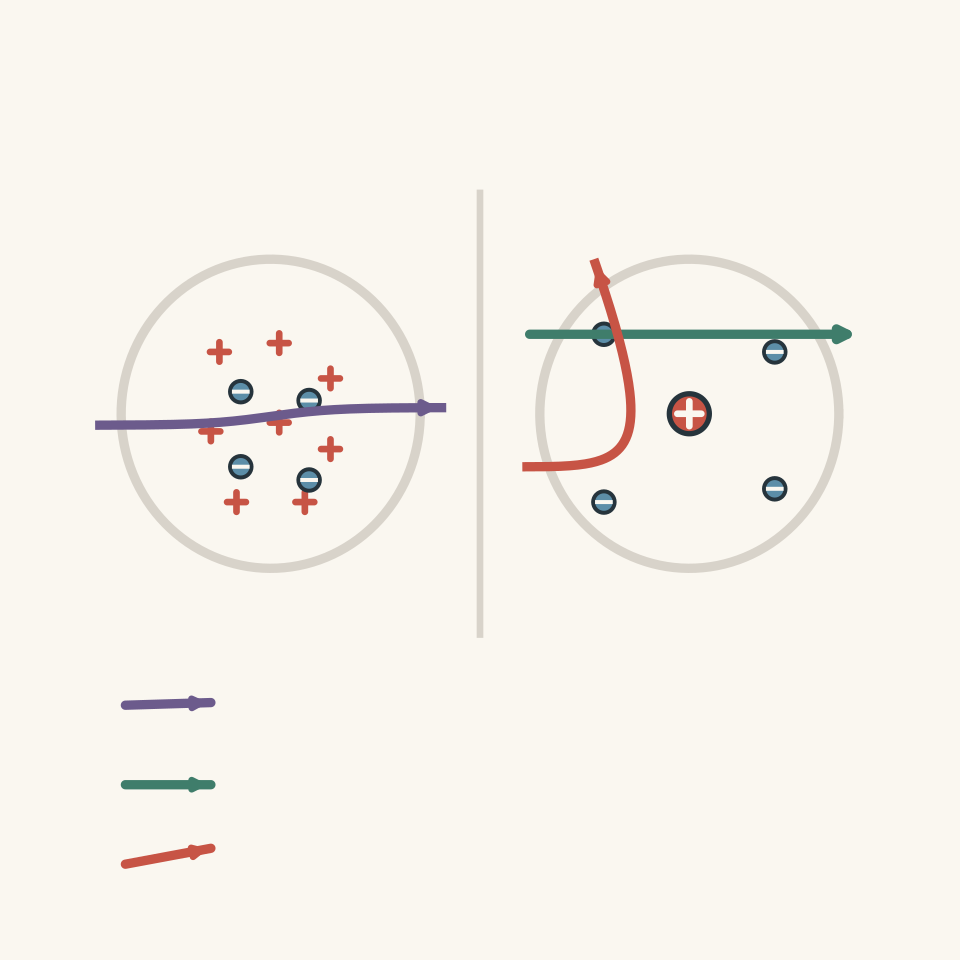
Be careful with the historical sequence. The 1909 experiment produced the surprising scattering evidence. Rutherford’s nuclear model, published in 1911, was the interpretation that made sense of it.
The experiment did not instantly provide the complete modern atomic model.
10Worked example: Estimate the closest approach of an alpha particle
Suppose an alpha particle with kinetic energy \(5.0\ \mathrm{MeV}\) heads directly towards a gold nucleus. Estimate its closest approach by assuming all of its kinetic energy is converted into electrostatic potential energy before it turns around.
Use:
- alpha-particle charge \(q_\alpha=+2e\),
- gold nuclear charge \(q_{\mathrm{Au}}=+79e\),
- \(e=1.60\times10^{-19}\ \mathrm C\),
- \(k=8.99\times10^9\ \mathrm{N\,m^2\,C^{-2}}\),
- \(1\ \mathrm{eV}=1.60\times10^{-19}\ \mathrm J\).
Ignore nuclear forces and treat both charges as point charges.
Step 1
Far from the nucleus, the alpha particle has kinetic energy.
As it approaches the positive nucleus, electrostatic repulsion slows it down. For a perfectly head-on approach, the closest point occurs when its speed momentarily reaches zero.
So
\[ E_k=E_{\mathrm{electric}}. \]
For two point charges,
\[ E_{\mathrm{electric}}=\frac{kq_\alpha q_{\mathrm{Au}}}{r}. \]
Step 2
\[ \begin{aligned} E_k &=5.0\times10^6\ \mathrm{eV} \times1.60\times10^{-19}\ \mathrm{J/eV}\\ &=8.0\times10^{-13}\ \mathrm J \end{aligned} \]
Step 3
\[ q_\alpha=2(1.60\times10^{-19})=3.20\times10^{-19}\ \mathrm C \]
and
\[ q_{\mathrm{Au}}=79(1.60\times10^{-19}) =1.264\times10^{-17}\ \mathrm C. \]
Now solve
\[ \begin{aligned} r &=\frac{kq_\alpha q_{\mathrm{Au}}}{E_k}\\ &=\frac{(8.99\times10^9)(3.20\times10^{-19})(1.264\times10^{-17})} {8.0\times10^{-13}}\\ &\approx4.5\times10^{-14}\ \mathrm m. \end{aligned} \]
Step 4
The alpha particle turns around at roughly \(4.5\times10^{-14}\ \mathrm m\), or \(45\ \mathrm{fm}\), under these assumptions.
That is vastly smaller than a typical atomic radius of order \(10^{-10}\ \mathrm m\). The alpha particle can therefore penetrate deep into the atom before the concentrated positive charge produces enough repulsion to reverse it.
This calculation does not tell us that the gold nucleus has a radius of \(45\ \mathrm{fm}\). It gives the alpha particle’s distance of closest approach in this simplified head-on Coulomb model. That distinction is important.
11Evidence, interpretation, and modern hindsight
These are easy to mix together in an exam response.
What was directly observed
Geiger and Marsden observed the directions in which alpha particles emerged after interacting with thin metal foils.
The crucial pattern was:
- most suffered little deflection,
- fewer suffered moderate deflection,
- very few suffered large-angle or backward scattering.
What Rutherford inferred
Rutherford interpreted the distribution as evidence that:
- positive charge is concentrated in a tiny central region,
- this central region contains most of the atom’s mass,
- the rest of the atomic volume contains relatively little concentrated matter.
What we know with later physics
Modern physics adds details that the original experiment did not establish on its own:
- the nucleus contains protons and neutrons,
- gold has atomic number \(79\), so a neutral gold atom has 79 protons,
- electrons are described using quantum mechanics, rather than simple planetary orbits,
- nuclei themselves have internal structure.
This separation is useful in HSC responses. Don’t credit one experiment with discovering every fact that later became part of the model.
12Why repeated small deflections are not enough
Could a particle undergo many tiny deflections inside the foil and, by bad luck, end up travelling backwards?
That is a reasonable alternative explanation, and it is worth testing.
If deflections occur randomly, lots of small changes can produce a net change in direction. But a very large deflection from a thin foil would require an implausibly extreme accumulation of small kicks if no strong concentrated scattering centre existed.
More importantly, the angular pattern of scattering could be described by a model in which a positively charged alpha particle is repelled by concentrated positive charge.
The rare large-angle events therefore weren’t just “weird particles”. Their frequency as a function of angle contained information about the charge distribution inside the atom.
Later scattering measurements provided stronger quantitative tests of Rutherford’s model.
13A useful exam decision rule
When an HSC question gives you a Geiger-Marsden observation, connect that exact observation to the feature of the model it supports.
| If the question mentions… | Connect it to… |
|---|---|
| Most alpha particles pass straight through | The nucleus occupies a tiny fraction of atomic volume |
| Small deflections | Electrostatic interaction with positive nuclear charge |
| Rare large deflections | Positive charge is highly concentrated |
| Backward scattering | A close approach can produce a very strong repulsive force |
| Alpha particles remain largely unaffected overall | The atom is not filled uniformly with dense matter |
| Failure of Thomson’s model | Diffuse positive charge cannot naturally account for the observed large-angle scattering |
Avoid writing only, “The experiment proved atoms have nuclei.”
That gives the conclusion but skips the physics. A stronger response connects observation → force → structure.
14Questions and solutions
Question 1
In the Geiger-Marsden experiment, most alpha particles passed through a thin gold foil with little or no change in direction.
What conclusion about atomic structure is supported by this observation?
Solution 1
Most of the atom’s volume contains no highly concentrated matter or positive charge capable of strongly deflecting an alpha particle, so the nucleus must occupy only a very small fraction of the atom.
An alpha particle is relatively massive and positively charged. If dense matter or strong positive charge were distributed throughout the whole atom, large disturbances would occur much more frequently.
The tempting answer is simply “atoms are empty space”. That is useful shorthand, but it is less precise. The experiment specifically shows that the concentrated positive charge and mass occupy a tiny region compared with the atom’s total size.
Question 2
A student writes:
“The rare alpha particles that travelled backwards show that electrons must sometimes strongly attract an alpha particle and pull it around.”
Evaluate this statement.
Solution 2
The statement is incorrect. The backward scattering is evidence for strong electrostatic repulsion from a small, positively charged nucleus, not attraction by electrons.
An alpha particle is positively charged, so an electron does attract it. However, electrons have very small mass compared with an alpha particle. They cannot readily account for the large change in momentum needed to send a fast alpha particle backwards.
A nucleus provides both features needed by the evidence: concentrated positive charge gives a strong repulsive force during a close approach, and its comparatively large mass allows substantial momentum transfer without the scattering centre simply being flung away.
The tempting route is to notice the opposite charges and conclude that electron attraction must be strong. The missing constraint is momentum: charge determines the interaction, but the masses help determine how the objects respond to that interaction.
Question 3
An alpha particle passes a gold nucleus. At one point its distance from the nucleus is \(3.0\times10^{-13}\ \mathrm m\). Later, during the same approach, its distance has fallen to \(1.0\times10^{-13}\ \mathrm m\).
Assuming Coulomb’s law applies, by what factor has the magnitude of the electrostatic force increased? Explain how this behaviour helps account for large-angle scattering.
Solution 3
The electrostatic force has increased by a factor of \(9\).
Coulomb’s law is
\[ F=\frac{kq_1q_2}{r^2}. \]
Because the charges do not change,
\[ F\propto\frac{1}{r^2}. \]
Therefore,
\[ \begin{aligned} \frac{F_2}{F_1} &=\left(\frac{r_1}{r_2}\right)^2\\ &=\left(\frac{3.0\times10^{-13}} {1.0\times10^{-13}}\right)^2\\ &=9. \end{aligned} \]
So reducing the separation to one third makes the force nine times as large.
This helps explain why most alpha particles are only weakly affected while a tiny fraction are deflected dramatically. An alpha particle that stays far from a nucleus experiences a much weaker force. One that passes unusually close experiences rapidly increasing repulsion and can undergo a large change in momentum and direction.
A tempting mistake is to say the force becomes three times larger because the distance becomes three times smaller. The inverse-square relationship is the constraint that changes the answer.
Question 4
Consider two hypothetical atomic models.
Model A: the atom contains positive charge spread uniformly through a sphere of atomic size.
Model B: the same total positive charge is concentrated in a tiny central nucleus.
An experiment finds all three of the following:
- \(99.9\%\) of alpha particles leave within a small angle of their original direction.
- A small minority scatter through moderate angles.
- A reproducible but extremely small fraction scatter through angles greater than \(90^\circ\).
A student argues that observation 1 strongly supports Model A because nearly every alpha particle passes through as expected for diffuse positive charge.
Is the student’s conclusion justified? Explain how all three observations must be used together.
Solution 4
No. Taken together, the observations strongly favour Model B: a tiny concentration of positive charge surrounded by a much larger region in which alpha particles usually experience only weak net deflection.
Observation 1 by itself is compatible with both models. Diffuse positive charge could allow mostly small deflections, but a tiny nucleus also predicts that behaviour because most alpha particles simply pass nowhere near the nucleus.
Observation 2 shows that alpha particles experience electromagnetic interactions while crossing the foil. Again, this alone does not clearly separate the models.
Observation 3 is the decisive constraint. A particle scattered beyond \(90^\circ\) has undergone a very large change in momentum. Producing that change over a short encounter requires a very strong force. Concentrating positive charge into a tiny region provides such a force during rare close approaches.
The crucial point is that Model B explains the apparently contradictory combination: strong interactions are possible, yet they are rare. The nucleus can be extremely powerful at short range and still affect only a tiny fraction of trajectories because its geometrical size is so small.
The tempting route is to count observations like votes: since most particles go straight, choose the diffuse model. But experimental models are constrained by the complete pattern of evidence. A rare observation can be more discriminating than a common one when one model cannot account for it.
Question 5
Imagine a modified Geiger-Marsden experiment using two different hypothetical atoms, X and Y.
Their atoms have the same overall atomic radius. Their nuclei have the same positive charge. The alpha particles enter with the same kinetic energy.
For atom X, the nucleus is extremely massive compared with an alpha particle.
For atom Y, suppose the positive nuclear charge is still concentrated in the same tiny region, but the central object has a mass comparable with the alpha particle.
A student predicts that X and Y must produce identical alpha-scattering patterns because Coulomb’s law depends on charge and separation, not nuclear mass.
Is the student correct? Explain what would stay similar, what would change, and why this matters when interpreting the original experiment.
Solution 5
The student is not fully correct. The electrostatic force at a given separation would be the same in X and Y, but the final motion need not be the same because both interacting objects must obey conservation of momentum and energy.
For a given separation,
\[ F=\frac{kq_\alpha q_N}{r^2}, \]
so if the charges and geometry are identical, the instantaneous electrostatic force on the alpha particle is indeed the same. By Newton’s third law, the nucleus experiences an equal and opposite force.
The difference appears in how much the target nucleus accelerates.
For atom X, the nucleus is extremely massive. Its acceleration,
\[ a=\frac{F}{m}, \]
is very small. During the encounter it behaves approximately like a fixed scattering centre. The alpha particle can therefore undergo a large change in direction while the nucleus recoils only slightly.
For atom Y, the central object has a mass comparable with the alpha particle. It recoils substantially. Some of the system’s kinetic energy and momentum appears as motion of that central object, so the alpha particle’s trajectory cannot generally be treated as scattering from an immovable centre. The distribution of outgoing alpha-particle angles would therefore differ from X’s even though the electrostatic interaction has the same charge dependence.
The tempting argument uses Coulomb’s law correctly but treats it as the whole mechanics problem. Coulomb’s law determines the force. Conservation of momentum, conservation of energy, and the masses determine how that force changes the motions of both objects.
This sharpens the interpretation of the original experiment. Large backward deflections did not merely indicate concentrated positive charge. Their mechanics were also consistent with the alpha particle encountering a centre containing substantial mass.
That leads directly to the next stage of the atomic model. Rutherford’s nucleus solved the scattering problem, but it immediately created another one: if negatively charged electrons surround a positive nucleus, why doesn’t classical physics make the atom unstable? That failure of the Rutherford model is what pushes the story towards Bohr’s quantised atom and, eventually, the quantum model of electron states.