
The Rydberg equation: calculating hydrogen wavelengths
Learn how the Rydberg equation predicts hydrogen spectral wavelengths from electron transitions. Includes worked examples and HSC Physics practice questions.
A hydrogen gas discharge tube can glow red, blue-green, or violet depending on the energy levels involved. But if you look closely, the light is not a smooth rainbow. It appears as separate bright lines.
Why doesn’t hydrogen produce every colour in between?
A reasonable prediction is that the electron inside a hydrogen atom should be able to absorb or release any amount of energy, like turning a dimmer switch through any brightness level. If that were true, hydrogen’s light would contain a continuous spread of colours.
Instead, hydrogen behaves more like a staircase. Electrons can only sit on certain energy levels, so they can only release certain amounts of energy when they move down. The Rydberg equation lets us predict the wavelength of those emitted photons.

01From electron jumps to spectral lines
Imagine an electron as someone standing on a staircase. They can stand on the first step, the second step, or the third step, but not halfway between steps.
An electron in a hydrogen atom behaves similarly. It can only occupy specific energy levels. These levels are labelled by the principal quantum number \(n\):
- \(n = 1\): the lowest energy level, closest to the nucleus
- \(n = 2\): a higher energy level
- \(n = 3\), \(n = 4\), and so on: progressively higher energy levels
When an electron falls from a higher level to a lower level, the atom releases a photon.
The energy of that photon is:
\[ E_{\text{photon}} = E_i - E_f \]
where:
- \(E_{\text{photon}}\) is the photon energy in joules,
- \(E_i\) is the initial electron energy,
- \(E_f\) is the final electron energy.
The photon energy is linked to wavelength:
\[ E_{\text{photon}} = \frac{hc}{\lambda} \]
where:
- \(h\) is Planck’s constant,
- \(c\) is the speed of light,
- \(\lambda\) is the wavelength of the photon.
A larger energy drop creates a higher-energy photon, which means a shorter wavelength.
So the key prediction is:
If an electron falls a long distance between energy levels, should the emitted light have a longer or shorter wavelength?
The answer is shorter wavelength. A bigger energy release means a more energetic photon, and energetic photons have smaller wavelengths.
02The simplified hydrogen model
Before using the Rydberg equation, it helps to see the idea behind it.
For hydrogen, the energy of an electron at level \(n\) is:
\[ E_n = \frac{-13.6}{n^2} \text{ eV} \]
The negative sign means the electron is bound to the nucleus. A free electron would have \(0\text{ eV}\), so hydrogen’s energy levels sit below that reference point.
The equation shows two important patterns:
- The energy levels get closer together as \(n\) increases.
- The jump from \(n=3\) to \(n=2\) releases less energy than the jump from \(n=6\) to \(n=2\).
This first model is useful, but it is not the easiest way to calculate wavelengths. For hydrogen spectra, we usually use the Rydberg equation.
03The Rydberg equation
The Rydberg equation directly links the starting and finishing energy levels to the wavelength of emitted light:
\[ \frac{1}{\lambda}=R_H\left(\frac{1}{n_f^2}-\frac{1}{n_i^2}\right) \]
where:
- \(\lambda\) is the wavelength of the emitted photon in metres,
- \(R_H\) is the Rydberg constant for hydrogen, \(1.097 \times 10^7\text{ m}^{-1}\),
- \(n_f\) is the final energy level,
- \(n_i\) is the initial energy level.
For emission:
\[ n_i > n_f \]
because the electron moves down to a lower energy level.
A common mistake is reversing the levels. Students often put the lower level into \(n_i\) because it appears first in the sentence. The equation does not care about the wording. It cares about the physics:
- initial = where the electron starts,
- final = where the electron ends.
04Hydrogen’s spectral series
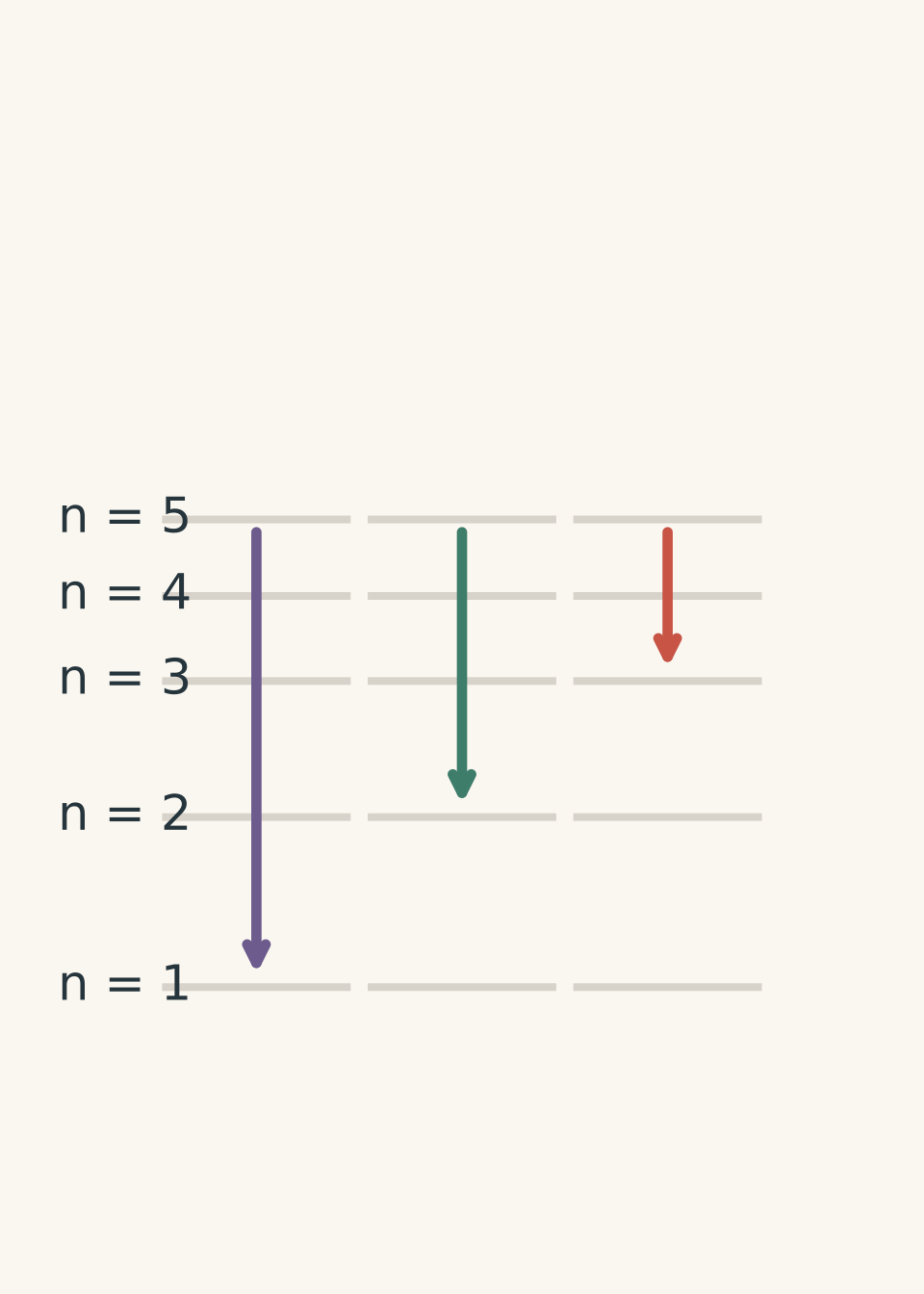
The final energy level determines the spectral series.
| Final level \(n_f\) | Series | Region of electromagnetic spectrum |
|---|---|---|
| \(n_f=1\) | Lyman series | Ultraviolet |
| \(n_f=2\) | Balmer series | Visible |
| \(n_f=3\) | Paschen series | Infrared |
The visible hydrogen lines that students usually study are the Balmer series because electrons falling to \(n=2\) release photons with wavelengths in the visible range.
05Why the Rydberg equation works
The Rydberg equation is not magic. It is a shortcut built from the energy-level model.
The energy released is:
\[ \Delta E = E_i-E_f \]
and that energy becomes a photon:
\[ \Delta E=\frac{hc}{\lambda} \]
The equation combines the hydrogen energy levels and the photon relationship into one calculation.
The deeper idea is that the wavelength of light is evidence of the size of an energy change inside an atom.
A silly analogy can help here. Think of an electron transition like two people deciding whether to move from “just friends” to a relationship. A tiny change in the situation gives a small emotional shift; a huge change gives a much bigger one. The photon energy is like the size of that shift.
The analogy breaks down because electrons do not choose, feel, or move continuously between levels. Quantum energy levels are fixed.
06Worked example: Hydrogen electron falls from \(n=3\) to \(n=2\)
A hydrogen electron falls from energy level \(n=3\) to \(n=2\). Calculate the wavelength of the emitted photon.
Step 1
The electron starts at:
\[ n_i=3 \]
and finishes at:
\[ n_f=2 \]
This is an emission process because the electron moves to a lower energy level.
Step 2
\[ \frac{1}{\lambda}=1.097\times10^7 \left(\frac{1}{2^2}-\frac{1}{3^2}\right) \]
\[ \frac{1}{\lambda}=1.097\times10^7 \left(\frac{1}{4}-\frac{1}{9}\right) \]
\[ \frac{1}{\lambda}=1.097\times10^7(0.1389) \]
\[ \frac{1}{\lambda}=1.52\times10^6 \]
Step 3
\[ \lambda=\frac{1}{1.52\times10^6} \]
\[ \lambda=6.56\times10^{-7}\text{ m} \]
Step 4
\[ \lambda=656\text{ nm} \]
The emitted photon has a wavelength of approximately 656 nm, which is red visible light.
This is the famous hydrogen-alpha line.
07Worked example: A larger energy jump
A hydrogen electron falls from \(n=6\) to \(n=2\). Calculate the wavelength of the emitted photon.
Step 1
\[ n_i=6,\qquad n_f=2 \]
Step 2
\[ \frac{1}{\lambda}=1.097\times10^7 \left(\frac{1}{2^2}-\frac{1}{6^2}\right) \]
\[ \frac{1}{\lambda}=1.097\times10^7 \left(\frac14-\frac1{36}\right) \]
\[ \frac{1}{\lambda}=1.097\times10^7(0.2222) \]
\[ \frac{1}{\lambda}=2.44\times10^6 \]
Step 3
\[ \lambda=\frac{1}{2.44\times10^6} \]
\[ \lambda=4.10\times10^{-7}\text{ m} \]
\[ \lambda=410\text{ nm} \]
The wavelength is approximately 410 nm, which appears violet.
Notice the pattern. The electron still ends at \(n=2\), so it is still a Balmer line. However, it starts higher, so it releases more energy and produces a shorter wavelength.
08Common mistakes with the Rydberg equation
Mistake 1: Thinking any wavelength is possible
Students often expect hydrogen to behave like a tiny glowing object that can produce every colour.
The problem is that atoms do not have continuous energy levels. Only specific energy differences are possible, so only specific wavelengths appear.
Mistake 2: Using the wrong direction
For emission:
\[ n_i>n_f \]
The electron falls downward.
For absorption, the electron moves upward:
\[ n_f>n_i \]
The same equation can be used, but the physical situation has changed.
Mistake 3: Forgetting units
The Rydberg constant has units of \(\text{m}^{-1}\), so the wavelength you calculate is in metres.
A result such as \(656\) without units is incomplete.
09Questions and solutions
Question 1
A hydrogen electron falls from \(n=4\) to \(n=2\). Calculate the wavelength of the emitted photon.
Solution 1
The wavelength is approximately \(486\text{ nm}\), because the electron undergoes a Balmer transition.
The electron starts at:
\[ n_i=4 \]
and ends at:
\[ n_f=2 \]
Using:
\[ \frac{1}{\lambda}=R_H\left(\frac{1}{n_f^2}-\frac{1}{n_i^2}\right) \]
\[ \frac{1}{\lambda}=1.097\times10^7 \left(\frac14-\frac1{16}\right) \]
\[ \frac{1}{\lambda}=1.097\times10^7(0.1875) \]
\[ \frac{1}{\lambda}=2.06\times10^6 \]
Therefore:
\[ \lambda=\frac{1}{2.06\times10^6} \]
\[ \lambda=4.86\times10^{-7}\text{ m} \]
\[ \lambda=486\text{ nm} \]
The trap is assuming the biggest \(n\) value always belongs in the final position. The final level is determined by where the electron ends, not by which number is larger.
Question 2
A student says: “The transition from \(n=5\) to \(n=4\) should produce a shorter wavelength than the transition from \(n=3\) to \(n=2\), because 5 and 4 are bigger numbers.”
Is the student correct? Explain.
Solution 2
The student is incorrect. The \(n=3\) to \(n=2\) transition produces the shorter wavelength because it releases more energy.
The tempting idea is that larger energy levels should mean larger energy changes. However, hydrogen energy levels are not evenly spaced.
The gap between \(n=5\) and \(n=4\) is very small because high energy levels are close together. The gap between \(n=3\) and \(n=2\) is much larger.
Since:
\[ E=\frac{hc}{\lambda} \]
a larger energy release gives a shorter wavelength.
The important constraint is the spacing between the levels, not the size of the level numbers themselves.
Question 3
A hydrogen atom absorbs a photon and its electron moves from \(n=2\) to \(n=5\).
Calculate the wavelength of the absorbed photon.
Solution 3
The absorbed photon has a wavelength of approximately \(434\text{ nm}\).
For absorption, the electron moves upward:
\[ n_i=2,\qquad n_f=5 \]
The energy difference is the same size as the reverse emission transition from \(n=5\) to \(n=2\).
Using the Rydberg equation with the lower level first:
\[ \frac{1}{\lambda}=1.097\times10^7 \left(\frac14-\frac1{25}\right) \]
\[ \frac{1}{\lambda}=1.097\times10^7(0.21) \]
\[ \frac{1}{\lambda}=2.30\times10^6 \]
\[ \lambda=4.34\times10^{-7}\text{ m} \]
\[ \lambda=434\text{ nm} \]
The common trap is thinking absorption requires a different wavelength calculation. The wavelength is determined by the energy gap. The direction of the transition changes, but the energy difference is the same.
Question 4
A scientist observes a hydrogen spectrum containing visible lines at several wavelengths. One line is measured at \(656\text{ nm}\). Another line is measured at \(410\text{ nm}\).
A student claims the \(410\text{ nm}\) photon must come from an electron ending at a lower energy level than the \(656\text{ nm}\) photon because violet light has more energy.
Explain whether this claim is correct.
Solution 4
The claim is incorrect. Both photons can come from electrons ending at \(n=2\); the difference is that the starting levels are different.
The \(656\text{ nm}\) line corresponds to the transition:
\[ n=3\rightarrow n=2 \]
The \(410\text{ nm}\) line corresponds to:
\[ n=6\rightarrow n=2 \]
The tempting reasoning is that a more energetic photon must involve a lower final state. However, the photon energy depends on the difference between the two energy levels:
\[ \Delta E=E_i-E_f \]
A larger starting level creates a larger energy drop even if the final level is unchanged.
The constraint that decides the answer is the final level. Since both lines are Balmer series lines, they both finish at \(n=2\).
Question 5
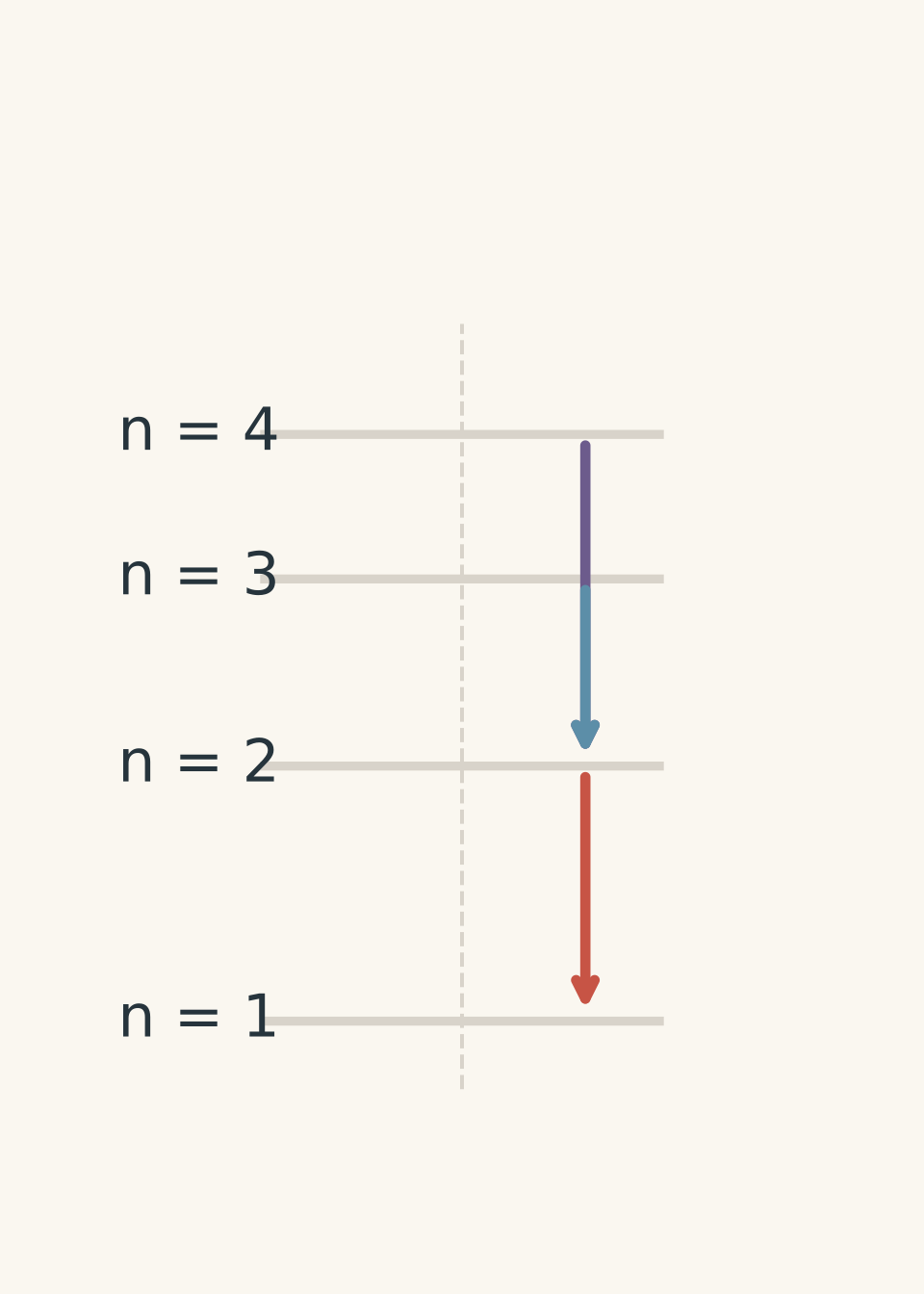
A hydrogen atom is in the excited state \(n=4\). It can return to \(n=1\) in one jump, or it can pass through \(n=3\) and \(n=2\) before reaching the ground state.
A student argues that the final energy released must always be the same because the atom starts at \(n=4\) and ends at \(n=1\).
Determine whether the student is correct. Explain what happens to the emitted wavelengths.
Solution 5
The student is correct about the total energy released, but incorrect about the wavelengths produced.
The atom begins with the same energy and ends with the same energy, so the total energy released is fixed:
\[ \Delta E=E_4-E_1 \]
However, the path changes the number of photons emitted.
If the atom drops directly:
\[ n=4\rightarrow n=1 \]
it releases one photon with a large energy and therefore a short wavelength.
If it drops in steps:
\[ n=4\rightarrow n=3\rightarrow n=2\rightarrow n=1 \]
it releases three photons. Each photon corresponds to a smaller energy difference, so each has a different, longer wavelength than the single direct transition.
The tempting route is to focus only on the starting and ending states. That works for total energy, but spectroscopy measures individual photons, and individual photons depend on the actual transitions taken.
This is why hydrogen spectra contain many lines: the same atom can release photons from many possible allowed transitions.
10Where this leads next
The Rydberg equation is a powerful shortcut, but it is built on a bigger idea: atoms have quantised energy levels. Once you understand why hydrogen produces specific wavelengths, the next step is connecting those wavelengths to the electromagnetic spectrum, photon energy, and the evidence that led scientists away from the classical model of the atom.