
Electron diffraction evidence for de Broglie’s matter waves
Learn how the Davisson-Germer experiment provided evidence for de Broglie's hypothesis that particles can have wave properties. This guide explains the apparatus, observations, and physics behind the result.
An electron should behave like a tiny particle. It has mass, it can be fired through a vacuum, and it can hit a detector at a specific location. So why did experiments show electrons creating the same kind of patterns that waves make?
This was a problem hidden inside a bigger question: if light can behave like both a wave and a particle, could matter do the same thing?
In 1924, Louis de Broglie proposed that moving particles have a wavelength. The idea was strange because nobody had directly seen an electron wave. It needed evidence.
The key experiment was electron diffraction. It forced physicists to ask a simple prediction:
If electrons are only particles, what pattern should they make when they strike a solid surface? And if de Broglie was right, what would change?
The answer came from experiments where electrons produced diffraction patterns, something strongly associated with waves.
01The problem: particles or waves?
Before electron diffraction, scientists already knew that light had a confusing identity.
The photoelectric effect showed that light transfers energy in packets called photons. This supported a particle model.
However, experiments such as interference and diffraction showed that light also behaves like a wave. A wave model could explain patterns where waves combine and cancel.
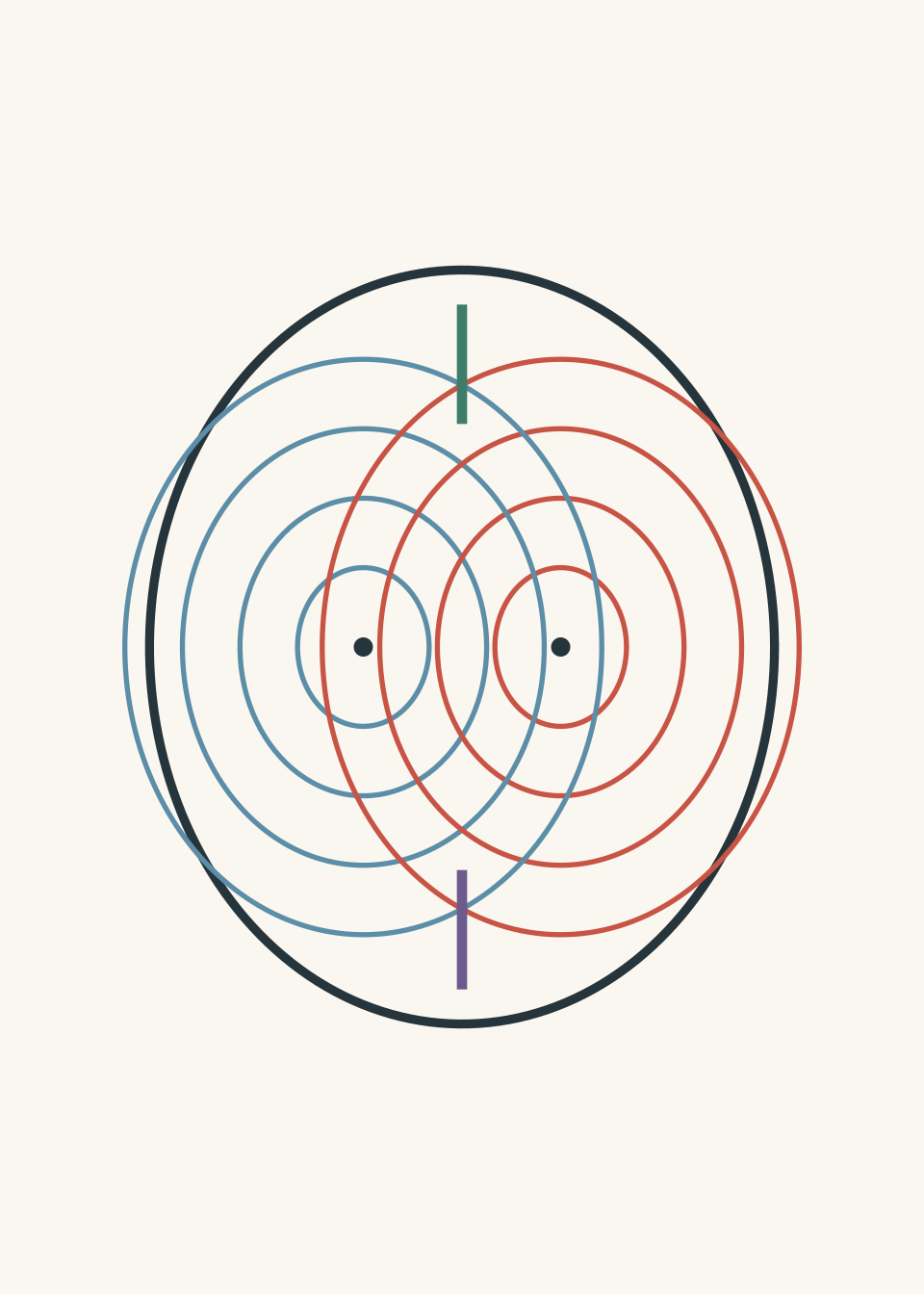
You can picture this using water waves. Two waves meeting in a pool can make a larger wave or almost no wave depending on how their peaks and troughs line up.
The surprising question was whether the reverse could also happen:
Could things we normally think of as particles have wave behaviour?
De Broglie’s reasoning was based on symmetry. If waves can act like particles, perhaps particles can have wave properties.
He proposed that every moving particle has a wavelength:
\[ \lambda = \frac{h}{p} \]
where:
- \( \lambda \) is the wavelength of the particle in metres (m)
- \( h \) is Planck’s constant, \(6.63 \times 10^{-34}\ \text{J s}\)
- \( p \) is momentum in kilogram metres per second (kg m s\(^{-1}\))
For a particle moving much slower than the speed of light:
\[ p = mv \]
where:
- \(m\) is the particle mass in kilograms (kg)
- \(v\) is its velocity in metres per second (m s\(^{-1}\))
So the equation becomes:
\[ \lambda = \frac{h}{mv} \]
The equation is not saying an electron is a tiny water ripple. The wavelength is a property of the electron’s behaviour, especially when it interacts with objects of a similar size.
02Why diffraction was the test
A wave can bend and spread when it passes through an opening or around objects with a size close to its wavelength. This is diffraction.
For visible light, the wavelength is around \(10^{-7}\) m. Ordinary objects are much larger, so we do not notice visible light bending around them in daily life.
For electrons, the situation is different.
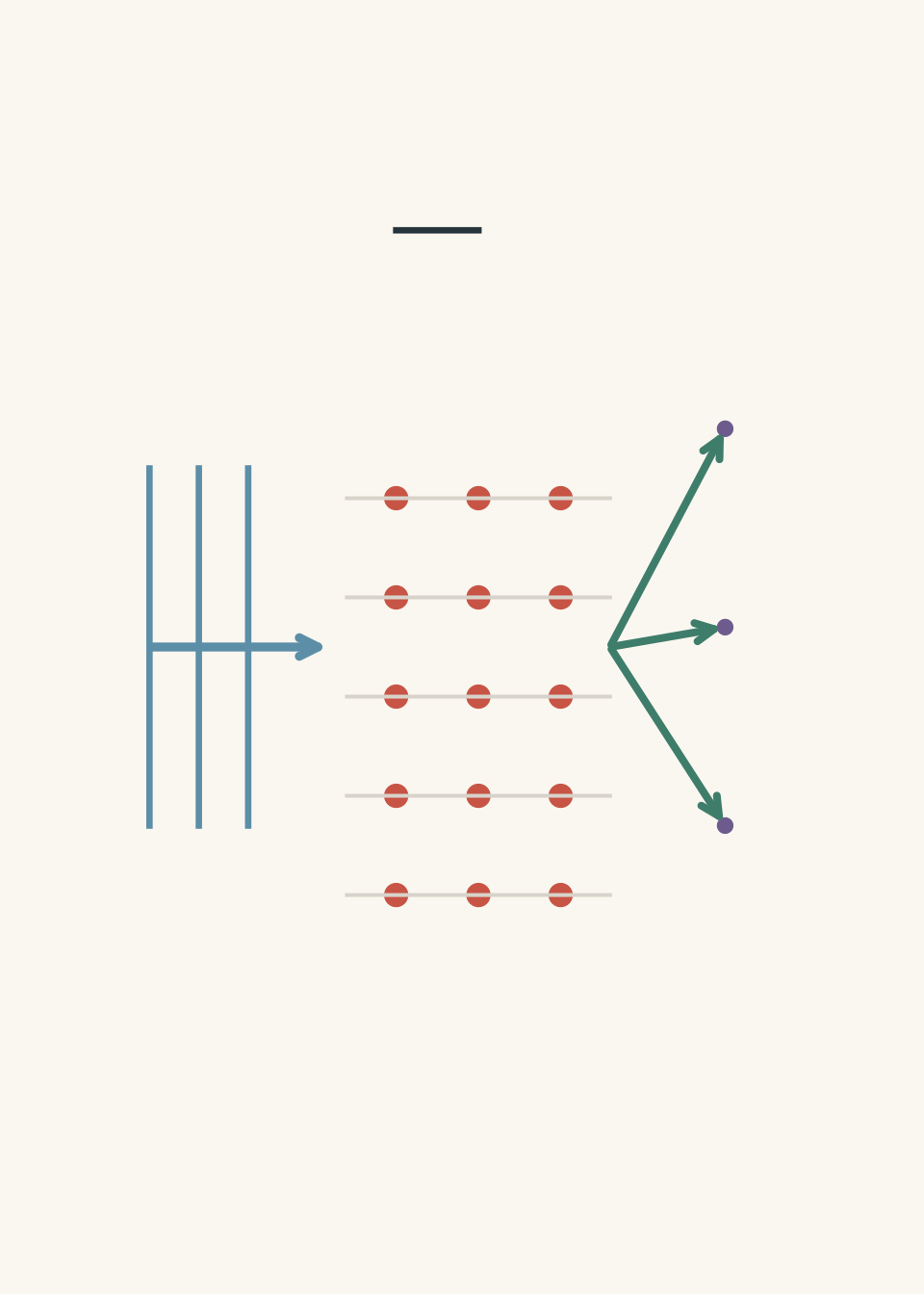
An electron accelerated through a large voltage can have a wavelength around \(10^{-10}\) m. This is similar to the spacing between atoms in a crystal.
That makes crystals useful because the regularly spaced atoms act like a repeating structure that can scatter waves in a predictable way.
The crystal is not a normal flat wall. It is more like a three-dimensional grid of atoms.
03The Davisson-Germer experiment
In 1927, Clinton Davisson and Lester Germer observed electron diffraction using a nickel crystal.
The original goal was not to prove de Broglie’s idea. They were investigating how electrons scattered from metal surfaces.
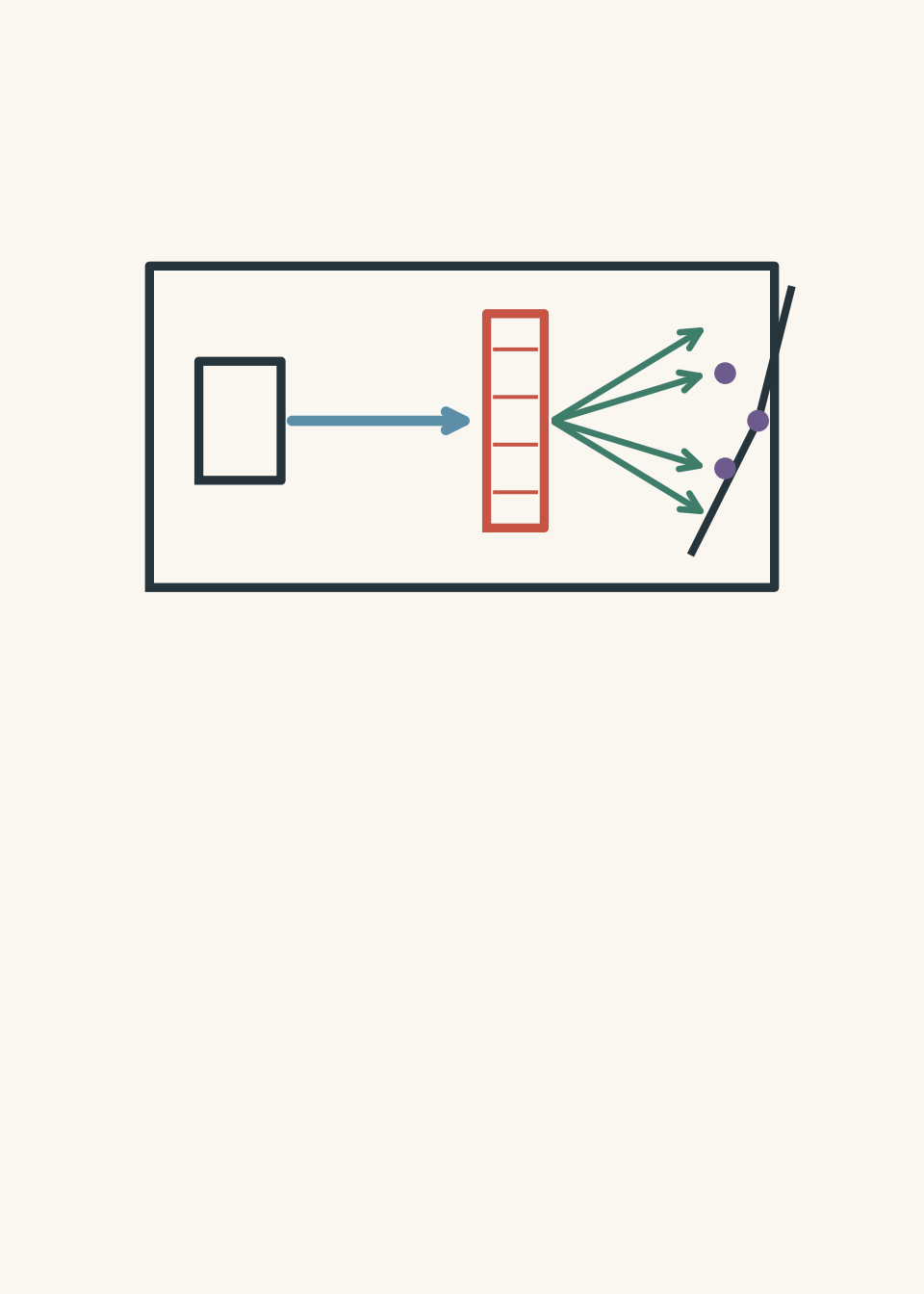
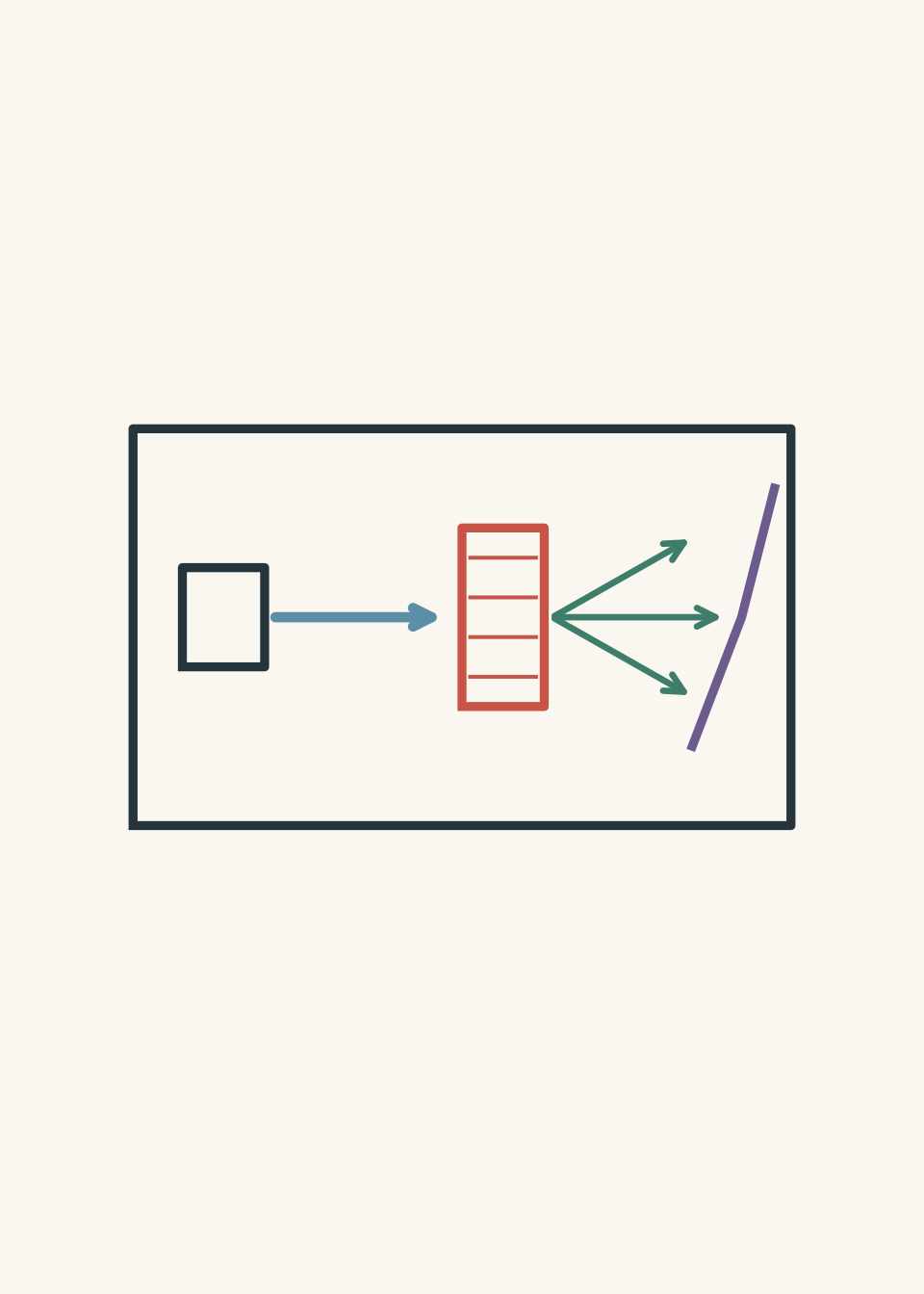
Their apparatus can be pictured as a chain of connected parts:
- An electron gun produced electrons.
- The electrons travelled through a vacuum so they would not collide with air molecules.
- An accelerating voltage increased the electrons’ speed.
- The electron beam struck a nickel crystal.
- A movable detector measured how many electrons scattered at different angles.
The important measurement was not simply “how many electrons arrived”.
The researchers measured how the number of scattered electrons changed as the detector angle changed.
What should have happened?
Imagine the electrons were just tiny balls bouncing off atoms.
You would expect a smooth scattering pattern. The number of detected electrons should gradually change as the detector moved.
But the actual result had strong peaks at particular angles.
This was the clue.
A strong peak meant that electrons were arriving in preferred directions. That is exactly the type of pattern expected when waves interfere.
The electrons were behaving like waves.
04The first design problem: how do you know it is diffraction?
A careful scientist has to ask: could something else create the pattern?
A pattern alone does not automatically prove a theory. The measurement has to match the prediction.
The crystal spacing and electron wavelength needed to produce the observed angles.
For a crystal, the condition for strong diffraction is described by Bragg’s law:
\[ n\lambda = 2d\sin\theta \]
where:
- \(n\) is an integer representing the diffraction order
- \(d\) is the spacing between crystal planes in metres
- \(\theta\) is the angle involved in diffraction
- \(\lambda\) is the electron wavelength
The measured diffraction angles gave a wavelength that matched de Broglie’s predicted wavelength.
That agreement was the important evidence.
The experiment did not show that electrons are literally waves in the same way as water. It showed that electrons produce wave-like interference effects.
This distinction matters. Quantum objects do not fit neatly into our everyday categories.
05Worked example: finding an electron wavelength
An electron moves at \(2.0 \times 10^6\ \text{m s}^{-1}\). Calculate its de Broglie wavelength.
Step 1
The electron is moving much slower than the speed of light, so:
\[ \lambda = \frac{h}{mv} \]
The electron mass is:
\[ m = 9.11 \times 10^{-31}\ \text{kg} \]
Step 2
\[ \lambda = \frac{6.63 \times 10^{-34}}{(9.11 \times 10^{-31})(2.0 \times 10^6)} \]
Step 3
\[ mv = (9.11 \times 10^{-31})(2.0 \times 10^6) \]
\[ mv = 1.82 \times 10^{-24}\ \text{kg m s}^{-1} \]
Step 4
\[ \lambda = \frac{6.63 \times 10^{-34}}{1.82 \times 10^{-24}} \]
\[ \lambda = 3.64 \times 10^{-10}\ \text{m} \]
The electron wavelength is:
\[ \boxed{\lambda = 3.6 \times 10^{-10}\ \text{m}} \]
This is about the same scale as the spacing between atoms in many crystals, which explains why diffraction is possible.
06Worked example: checking a diffraction result
Electrons produce a first-order diffraction peak from a crystal with atomic plane spacing \(d = 0.20\ \text{nm}\). The diffraction angle is \(45^\circ\). Find the electron wavelength.
Step 1
\[ n\lambda = 2d\sin\theta \]
For first-order diffraction:
\[ n = 1 \]
so:
\[ \lambda = 2d\sin\theta \]
Step 2
\[ d = 0.20\ \text{nm} \]
\[ d = 0.20 \times 10^{-9}\ \text{m} \]
Step 3
\[ \lambda = 2(0.20 \times 10^{-9})\sin45^\circ \]
Since:
\[ \sin45^\circ = 0.707 \]
\[ \lambda = 2(0.20 \times 10^{-9})(0.707) \]
Step 4
\[ \lambda = 2.83 \times 10^{-10}\ \text{m} \]
The wavelength is:
\[ \boxed{\lambda = 2.8 \times 10^{-10}\ \text{m}} \]
This is close to the wavelength expected for electrons in the experiment, supporting the matter-wave model.
07What the experiment changed
The electron diffraction results did not replace the particle model with a wave model.
Instead, physics moved towards a quantum model.
An electron can:
- have mass and momentum like a particle,
- produce diffraction like a wave,
- create a localised detection event when measured.
A useful way to think about it is like a person whose behaviour changes depending on the situation. A person might act differently at a job interview compared with at home. The person has not become a different object; the situation reveals different properties.
The analogy breaks down because electrons are not choosing how to behave. Quantum behaviour is not a personality change. It is a fundamental property of nature.
The next major step was understanding how quantum objects are described mathematically, leading to ideas such as wave functions and electron energy levels. This connects naturally to atomic spectra, including the way the Rydberg equation predicts hydrogen wavelengths: The Rydberg equation: calculating hydrogen wavelengths.
08Questions and solutions
Question 1
Electrons in an experiment have a velocity of \(3.0 \times 10^6\ \text{m s}^{-1}\). Calculate their de Broglie wavelength.
Solution 1
The de Broglie wavelength is \(2.4 \times 10^{-10}\ \text{m}\), because wavelength is found from the particle momentum.
Step 1: Use:
\[ \lambda = \frac{h}{mv} \]
For an electron:
\[ m = 9.11 \times 10^{-31}\ \text{kg} \]
and:
\[ v = 3.0 \times 10^6\ \text{m s}^{-1} \]
Step 2: Substitute:
\[ \lambda = \frac{6.63 \times 10^{-34}}{(9.11 \times 10^{-31})(3.0 \times 10^6)} \]
Step 3: Calculate:
\[ mv = 2.73 \times 10^{-24}\ \text{kg m s}^{-1} \]
\[ \lambda = \frac{6.63 \times 10^{-34}}{2.73 \times 10^{-24}} \]
\[ \lambda = 2.43 \times 10^{-10}\ \text{m} \]
Therefore:
\[ \boxed{\lambda = 2.4 \times 10^{-10}\ \text{m}} \]
The small wavelength explains why a crystal lattice, rather than an everyday object, is needed to observe diffraction.
Question 2
A student says, “The Davisson-Germer experiment proves electrons are waves, so electrons cannot be particles.”
Explain why this statement is incorrect.
Solution 2
The statement is incorrect because the experiment shows electrons have wave-like properties, not that they stop being particles.
The tempting idea is that “wave” and “particle” are opposites. This works for everyday objects, such as a tennis ball or a water wave, but quantum objects do not follow that simple classification.
The electrons in the Davisson-Germer experiment still arrived at the detector as individual impacts. However, when many electrons were measured together, the overall pattern showed diffraction peaks.
The important evidence was the combination of:
- individual detection events,
- a statistical pattern matching wave interference.
The result supports the quantum model, where particles can have wave properties.
Question 3
An electron beam is accelerated so its speed increases. A student predicts that the diffraction pattern should become larger because the electrons have more energy.
Assess this prediction.
Solution 3
The prediction is incorrect because increasing electron speed decreases the electron wavelength, making the diffraction angles generally smaller.
The tempting reasoning is that more energy should create a “bigger” effect. However, the relevant quantity for diffraction is wavelength.
The relationship is:
\[ \lambda = \frac{h}{mv} \]
As \(v\) increases, the denominator increases, so \( \lambda \) decreases.
A smaller wavelength means the electron wave is less affected by the spacing between crystal planes, so the diffraction pattern changes.
This is why changing the accelerating voltage changes the observed diffraction angles.
Question 4
A researcher repeats an electron diffraction experiment. The electron speed is unchanged, but the crystal is replaced with another crystal that has atoms arranged with twice the spacing between crystal planes.
Predict how the diffraction pattern changes and explain why.
Solution 4
The diffraction angles become larger because the larger crystal spacing requires a larger angle for the same wavelength.
A common mistake is to focus only on the electrons. Since the electron beam has not changed, it is tempting to predict no change.
However, diffraction depends on the relationship between wavelength and structure.
Bragg’s law is:
\[ n\lambda = 2d\sin\theta \]
The wavelength \( \lambda \) stays constant, but \(d\) doubles.
For the equation to remain balanced, \( \sin\theta \) must decrease or increase depending on the geometry convention used for the measured angle. In the standard Bragg setup where \(\theta\) is measured from the crystal plane, a larger spacing allows the same wavelength to satisfy the diffraction condition at a smaller angle.
The key conclusion is that the diffraction pattern changes because the crystal structure is part of the measurement. The electron wavelength alone does not determine the pattern.
Question 5
A physicist claims: “If electrons have wavelengths, then a larger object like a cricket ball must also have a measurable wavelength. Therefore, we should be able to observe cricket ball diffraction.”
Evaluate this claim.
Assume a cricket ball has a mass of \(0.16\ \text{kg}\) and moves at \(40\ \text{m s}^{-1}\).
Solution 5
The claim is technically correct but physically misleading because the cricket ball’s wavelength is far too small to observe.
The first step is to calculate the wavelength.
Step 1: Find the momentum.
\[ p = mv \]
\[ p = (0.16)(40) \]
\[ p = 6.4\ \text{kg m s}^{-1} \]
Step 2: Use the de Broglie equation.
\[ \lambda = \frac{h}{p} \]
\[ \lambda = \frac{6.63 \times 10^{-34}}{6.4} \]
Step 3: Calculate.
\[ \lambda = 1.04 \times 10^{-34}\ \text{m} \]
The cricket ball wavelength is:
\[ \boxed{\lambda \approx 1.0 \times 10^{-34}\ \text{m}} \]
The surprising part is that the equation does apply to the cricket ball. The trap is assuming that “having a wavelength” automatically means we can observe diffraction.
For diffraction to be noticeable, the wavelength must be similar to the size of the structure causing the diffraction. A cricket ball’s wavelength is many orders of magnitude smaller than atomic spacings, so ordinary diffraction effects are impossible to detect.
This is why matter waves are obvious for electrons but hidden for large everyday objects. The next step in quantum physics is to ask how these wave properties connect to the allowed energies and structures inside atoms.