
de Broglie Matter Waves: HSC Physics Explained Clearly
Learn how moving particles have wavelengths using the de Broglie equation, and understand the evidence for wave-particle duality in HSC Physics.
A football and an electron are both moving objects. So why do we happily talk about a football having a clear path, but an electron having a wavelength?
This sounds strange at first. If you throw a tennis ball across a room, you do not expect it to spread out, interfere, or create a diffraction pattern. But when electrons pass through tiny gaps, they can produce patterns that look like waves.
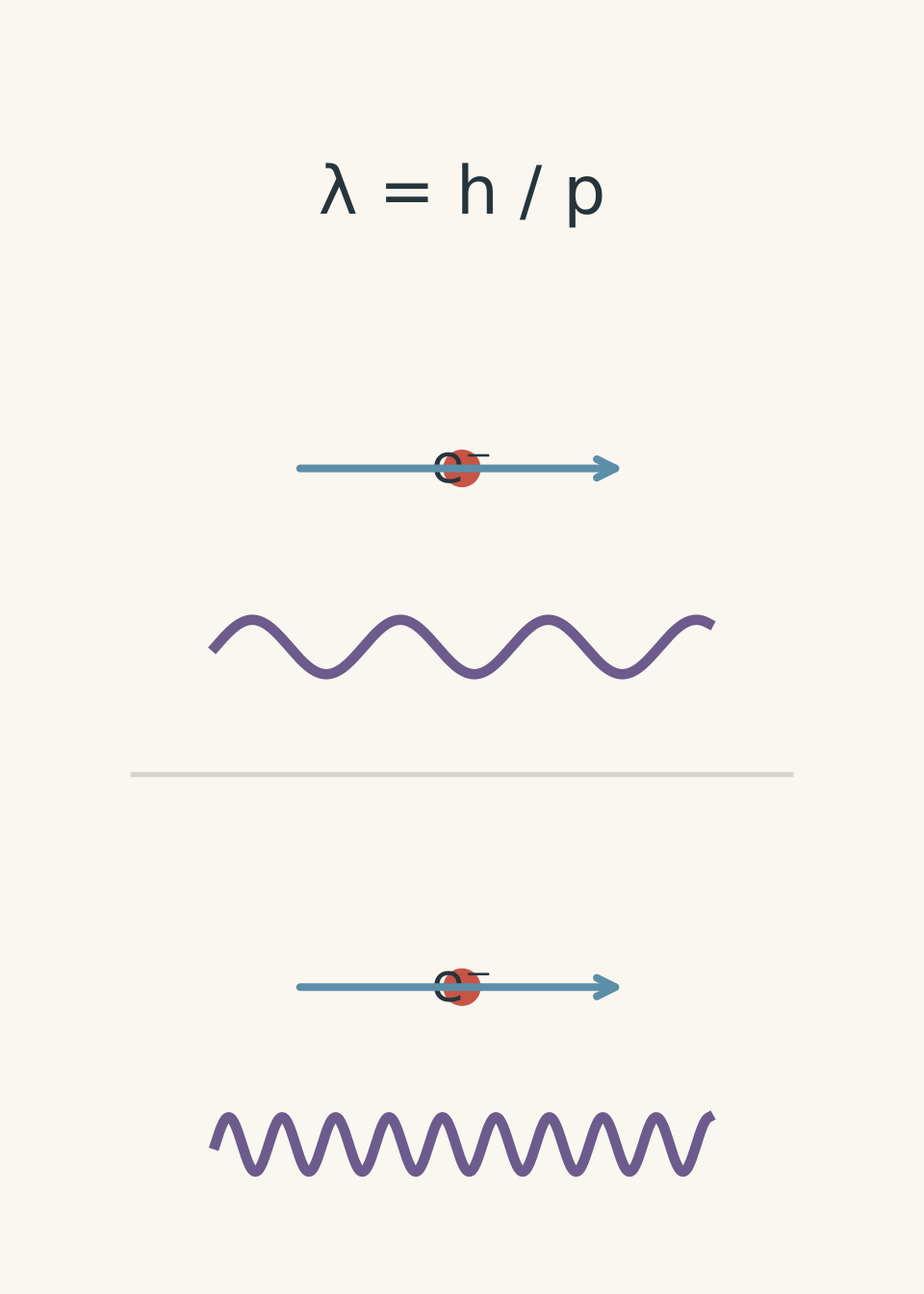
Before learning the equation, predict this: if you keep increasing the speed of an electron, should its wavelength get bigger or smaller?
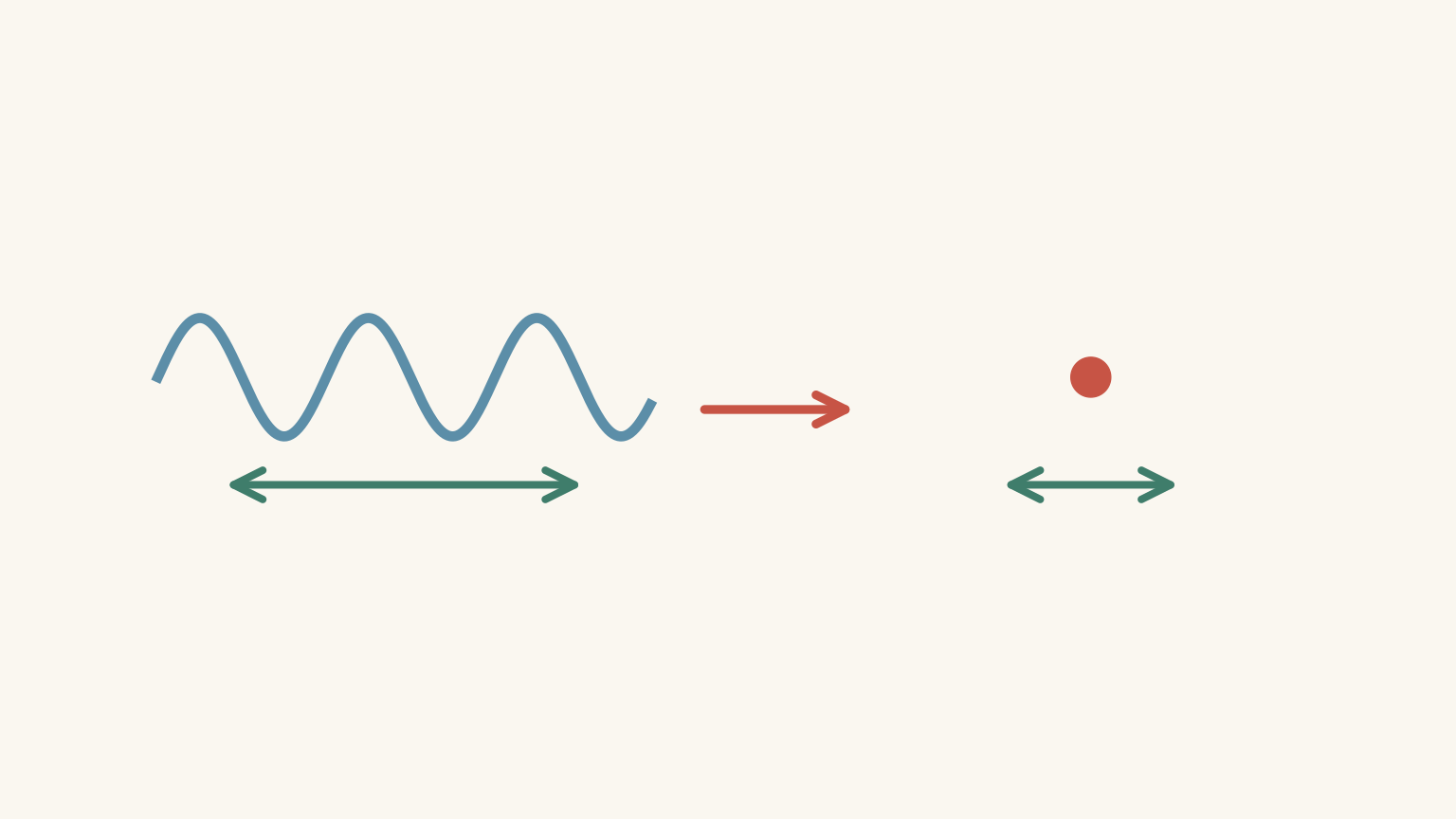
The answer is smaller. A faster electron behaves less like a spread-out wave and more like a concentrated particle. This is the key idea behind de Broglie matter waves.
01Why did physicists need matter waves?
For a long time, physics separated things into two groups:
- waves, like light and sound
- particles, like electrons and atoms
Waves spread out, interfere, and diffract. Particles have a position and momentum.
Light caused the first major problem. Experiments showed that light could behave like a wave, but it could also behave like particles called photons. This is called wave-particle duality.
Then physicists asked a bigger question:
If light, which we usually think of as a wave, can act like a particle, could matter, which we usually think of as particles, act like a wave?
In 1924, Louis de Broglie proposed that moving particles should have an associated wavelength.
The idea was simple:
- every moving particle has wave-like behaviour
- the wavelength depends on the particle’s momentum
- larger momentum means a smaller wavelength
This was not just a mathematical trick. It made a prediction that could be tested.
02Building the intuition: what does a matter wave mean?
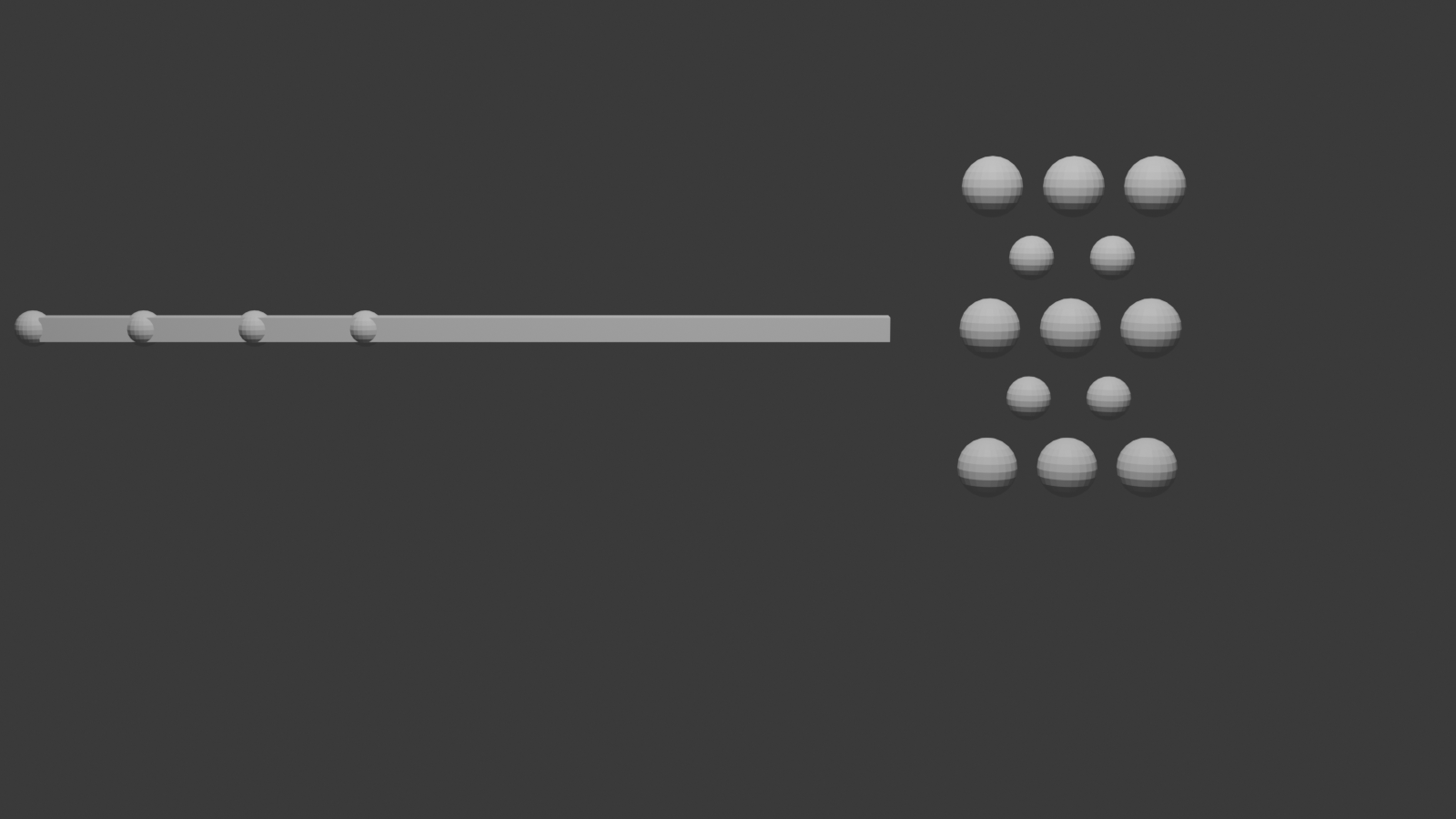
Imagine a crowded school hallway.
A person walking slowly can weave around others and take many possible paths. Their movement feels spread out. A person sprinting through the hallway has much more momentum and is easier to predict as a straight-moving object.
This is not exactly what happens with particles, but it gives a useful first picture:
- low momentum → larger wavelength
- high momentum → smaller wavelength
The analogy breaks down because an electron is not literally a tiny water ripple or a person spreading through space. The wavelength describes the behaviour of the quantum object, not a physical wave made from electron material.
The more accurate idea is that particles have a wave property connected to their momentum.
03The de Broglie equation
De Broglie related wavelength to momentum:
\[ \lambda = \frac{h}{p} \]
where:
- \(\lambda\) is the de Broglie wavelength in metres (m)
- \(h\) is Planck’s constant, \(6.626 \times 10^{-34}\ \text{J s}\)
- \(p\) is momentum in kilogram metres per second (\(\text{kg m s}^{-1}\))
For many HSC problems, momentum is found using:
\[ p = mv \]
where:
- \(m\) is mass in kilograms (kg)
- \(v\) is velocity in metres per second (\(\text{m s}^{-1}\))
Combining these gives the commonly used form:
\[ \lambda = \frac{h}{mv} \]
This equation contains the whole physical idea:
- increasing mass decreases wavelength
- increasing velocity decreases wavelength
- small particles moving quickly can still have measurable wavelengths
04Why do we not notice matter waves in everyday life?
A student might predict that if electrons have wavelengths, then cricket balls, cars, and people should also show wave behaviour.
That prediction is actually correct.
Everything with momentum has a de Broglie wavelength.
The issue is scale.
Consider a cricket ball. Its mass is enormous compared with an electron. Even if it moves quickly, its momentum is so large that its wavelength becomes incredibly tiny.
For example, a 0.15 kg cricket ball moving at 40 m/s has:
\[ \lambda = \frac{6.626 \times 10^{-34}}{(0.15)(40)} \]
\[ \lambda \approx 1.1 \times 10^{-34}\ \text{m} \]
That wavelength is far too small to observe with ordinary experiments.
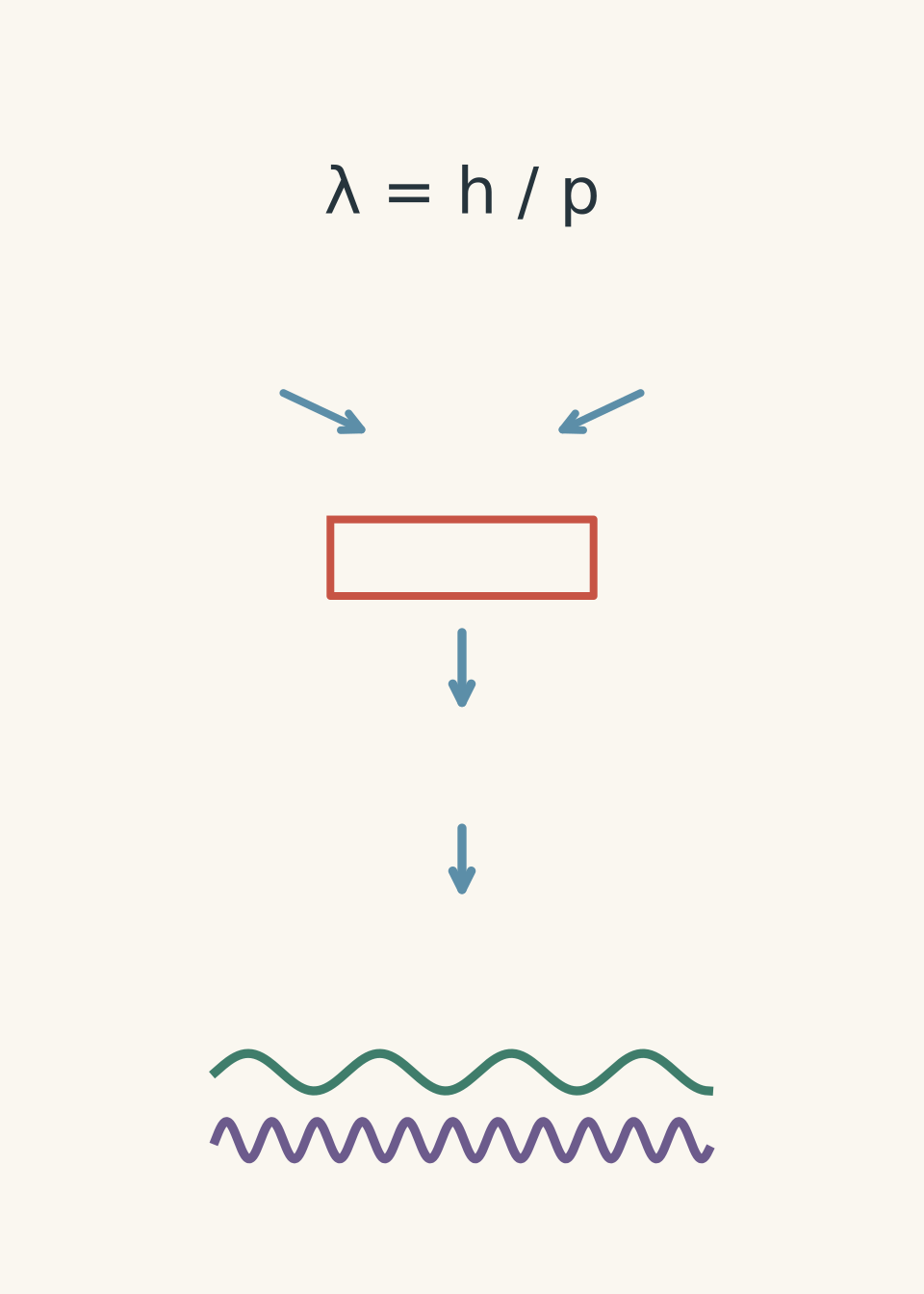
An electron, however, has a much smaller mass. Its wavelength can be similar in size to distances between atoms in a crystal, which allows diffraction to occur.
This is why electron diffraction became important evidence for de Broglie’s idea. You can read more about that evidence here: Electron diffraction evidence for de Broglie’s matter waves.
05Worked example: Finding the wavelength of an electron
An electron travels at \(2.0 \times 10^6\ \text{m s}^{-1}\). Calculate its de Broglie wavelength.
Step 1
The particle is moving, so use:
\[ \lambda = \frac{h}{mv} \]
The electron mass is:
\[ m = 9.11 \times 10^{-31}\ \text{kg} \]
and Planck’s constant is:
\[ h = 6.626 \times 10^{-34}\ \text{J s} \]
Step 2
\[ \lambda = \frac{6.626 \times 10^{-34}}{(9.11 \times 10^{-31})(2.0 \times 10^6)} \]
Step 3
\[ (9.11 \times 10^{-31})(2.0 \times 10^6) =1.822 \times 10^{-24} \]
Step 4
\[ \lambda = \frac{6.626 \times 10^{-34}}{1.822 \times 10^{-24}} \]
\[ \lambda = 3.64 \times 10^{-10}\ \text{m} \]
The electron has a de Broglie wavelength of:
\[ \boxed{3.64 \times 10^{-10}\ \text{m}} \]
This is around the size of distances between atoms in solids, which explains why crystals can be used to observe electron diffraction.
06Worked example: Comparing two particles
An electron and a proton both travel at \(1.0 \times 10^6\ \text{m s}^{-1}\). Which particle has the larger de Broglie wavelength?
Step 1
\[ \lambda = \frac{h}{mv} \]
Both particles have the same velocity and the same value of \(h\). The only difference is mass.
Step 2
A smaller mass gives a larger wavelength.
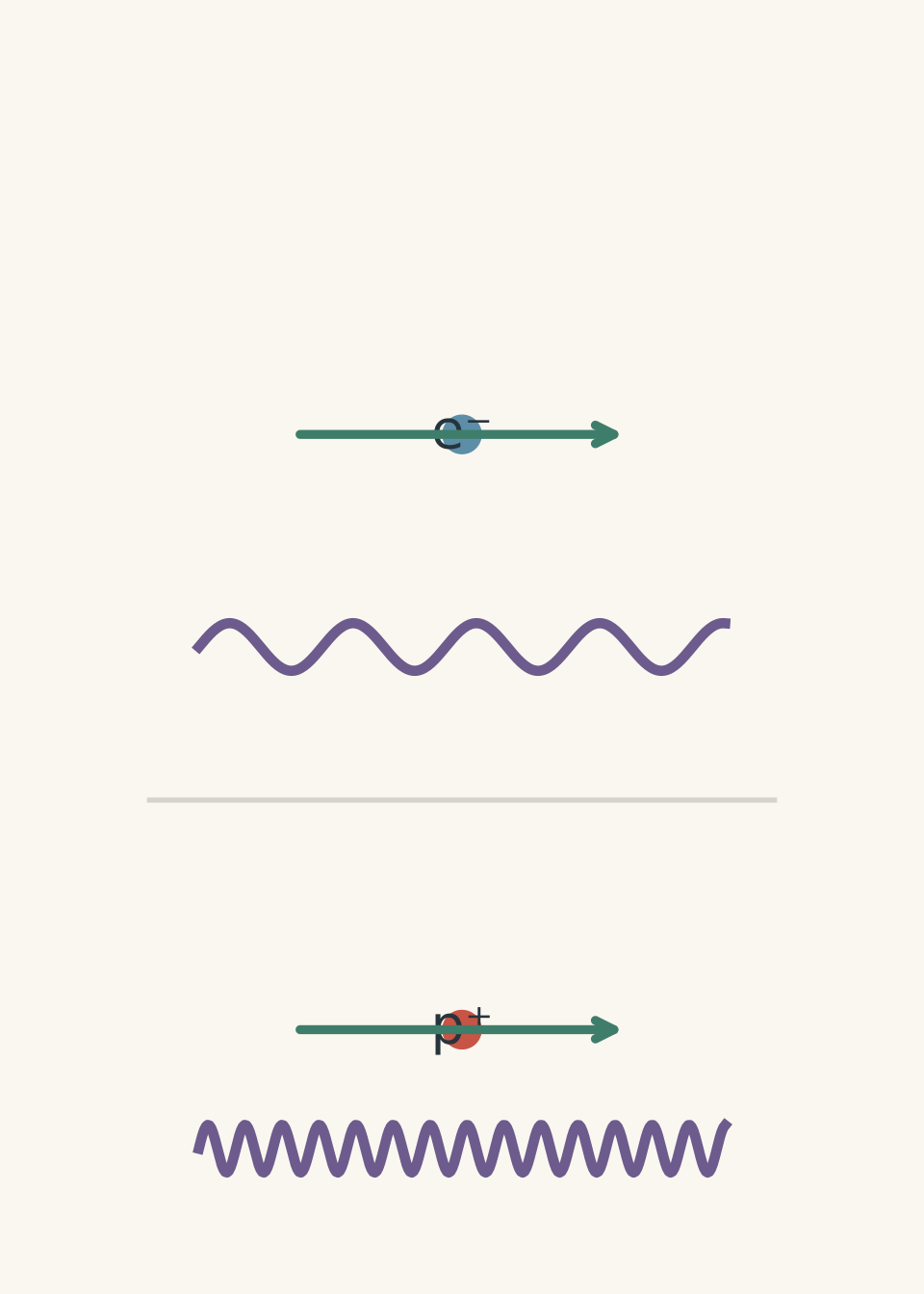
An electron has much less mass than a proton, so:
\[ \lambda_{\text{electron}} > \lambda_{\text{proton}} \]
Step 3
The electron’s wave behaviour is much easier to observe because its wavelength is much larger.
The important reasoning is not the calculation. It is recognising that wavelength depends on momentum, not just speed.
07Matter waves and wave-particle duality
A common mistake is to think that a particle is either a wave or a particle at a given moment.
Quantum physics is more subtle.
A particle such as an electron can show particle-like behaviour in some experiments and wave-like behaviour in others.
For example:
- detecting an electron at a screen shows a particle-like event
- producing an interference pattern shows wave-like behaviour
The experiment determines which behaviour becomes visible.
A useful comparison is a person who behaves differently depending on the situation. Someone might be quiet while studying and loud at a party. The person has not changed into a different thing; the situation reveals a different behaviour.
The analogy has limits. People have different moods and choices, while quantum objects follow mathematical rules that do not match everyday experience.
08The link between wavelength and uncertainty
Matter waves also connect to the idea that tiny particles cannot always have perfectly known properties.
If a particle behaves like a wave spread over space, it becomes difficult to describe its exact position at the same time as its exact momentum.
This connects to Heisenberg’s uncertainty principle, which is another consequence of quantum physics.
The de Broglie wavelength is the starting point: it tells us that particles are not simply tiny versions of everyday objects.
09Questions and solutions
Question 1
An electron moves at \(3.0 \times 10^6\ \text{m s}^{-1}\). Calculate its de Broglie wavelength.
Use:
\[ m_e = 9.11 \times 10^{-31}\ \text{kg} \]
and:
\[ h = 6.626 \times 10^{-34}\ \text{J s} \]
Solution 1
The de Broglie wavelength is approximately:
\[ \boxed{2.43 \times 10^{-10}\ \text{m}} \]
The governing relationship is:
\[ \lambda = \frac{h}{mv} \]
Substitute the values:
\[ \lambda = \frac{6.626 \times 10^{-34}}{(9.11 \times 10^{-31})(3.0 \times 10^6)} \]
The denominator is:
\[ (9.11 \times 10^{-31})(3.0 \times 10^6) =2.733 \times 10^{-24} \]
Therefore:
\[ \lambda=\frac{6.626 \times 10^{-34}}{2.733 \times 10^{-24}} \]
\[ \lambda=2.43 \times 10^{-10}\ \text{m} \]
The result is on an atomic scale, which is why electron waves can interact with crystal structures.
Question 2
Two electrons have the same mass. Electron A travels at \(1.0 \times 10^6\ \text{m s}^{-1}\), and electron B travels at \(4.0 \times 10^6\ \text{m s}^{-1}\).
Determine the ratio of their wavelengths, \(\frac{\lambda_A}{\lambda_B}\), and explain why.
Solution 2
The ratio of wavelengths is:
\[ \boxed{\frac{\lambda_A}{\lambda_B}=4} \]
The tempting mistake is to think the faster electron should have a larger wavelength because it is “moving more”. However, de Broglie wavelength depends on momentum:
\[ \lambda = \frac{h}{mv} \]
The mass and \(h\) are constant, so wavelength is inversely proportional to velocity:
\[ \lambda \propto \frac{1}{v} \]
Therefore:
\[ \frac{\lambda_A}{\lambda_B} = \frac{v_B}{v_A} \]
\[ = \frac{4.0 \times 10^6}{1.0 \times 10^6} \]
\[ =4 \]
The slower electron has four times the wavelength.
Question 3
A student says:
“Electrons have wave properties, so an electron moving through a double slit must split into two half-electrons.”
Explain why this statement is incorrect.
Solution 3
The statement is incorrect because the electron remains a single quantum object, but its wave behaviour affects the probability of where it is detected.
The tempting reasoning is based on everyday waves. A water wave can split into two smaller waves, so it seems reasonable that an electron wave should do the same.
However, the de Broglie wavelength does not mean the electron is physically divided into pieces. When electrons pass through a double slit, the wave-like description predicts interference patterns in many detections.
Each individual detection still appears as a localised event, showing particle-like behaviour.
Question 4
An electron beam is accelerated so that the electrons have twice their original speed. A student predicts:
“The wavelength is doubled because the electrons have twice as much movement.”
Is this prediction correct? Explain the change and identify the assumption that causes the mistake.
Solution 4
The prediction is incorrect. The wavelength becomes half its original value.
The mistake is assuming that more motion means a bigger wave. The equation shows the opposite relationship:
\[ \lambda=\frac{h}{mv} \]
If the speed doubles:
\[ v_2=2v_1 \]
then:
\[ \lambda_2=\frac{h}{m(2v_1)} \]
\[ \lambda_2=\frac{1}{2}\lambda_1 \]
The electron’s momentum has increased, so its associated wavelength decreases.
The deeper idea is that a particle with greater momentum behaves in a way that is less spread out in wavelength terms.
Question 5
An experiment compares electron diffraction from two crystal samples.
Sample A produces a strong diffraction pattern using electrons travelling at a certain speed.
Sample B has identical crystal spacing, but the electrons are accelerated to a much higher speed before entering the crystal.
A student claims:
“Sample B should show a stronger diffraction pattern because faster electrons have more energy.”
Evaluate this claim.
Solution 5
The claim is not necessarily correct. Faster electrons may produce a weaker diffraction effect because their wavelength becomes smaller and may no longer match the crystal spacing.
The tempting route is to focus only on energy. Faster electrons do have greater kinetic energy, but diffraction depends on the relationship between wavelength and the spacing of the crystal structure.
The de Broglie equation gives:
\[ \lambda=\frac{h}{mv} \]
Increasing speed increases momentum, which reduces wavelength.
Strong diffraction occurs when the wavelength is comparable to the spacing between crystal planes. If the wavelength becomes too small compared with that spacing, the interference pattern changes and may become less obvious.
The assumption that “more energy means more wave behaviour” is the trap. Wave behaviour is not controlled simply by energy; it depends on the wavelength and the arrangement used to observe it.
Understanding de Broglie wavelengths gives you the tool needed for the next step: explaining the experimental evidence that confirmed matter waves through electron diffraction. It also connects naturally to quantum models of electrons, including how electrons occupy allowed energy states in atoms.