
Alpha decay: nuclear equations and radiation properties
Learn how alpha emission changes atomic nuclei and how to write alpha decay equations. This HSC Physics guide explains radiation properties, energy, and common misconceptions.
A radioactive sample sits on a bench. You measure the radiation coming from it and find that it is slowly changing over time. Then you place a sheet of paper between the sample and a detector, and the radiation almost disappears.
What happened? Did the nucleus stop being radioactive? Did the paper block every kind of radiation?
Predict what you think: if a nucleus emits a particle from inside itself, what should happen to the atom afterwards? Should it become the same element, a different element, or simply a smaller version of itself?
The answer is that some unstable nuclei can transform into different nuclei. In alpha decay, the nucleus ejects a small, tightly bound piece of itself called an alpha particle. This changes the identity of the atom because the number of protons changes.
01Why do some nuclei emit alpha particles?
Inside an atom, the nucleus contains protons and neutrons. The protons are positively charged, so they repel each other. The strong nuclear force holds the nucleus together, but this force only acts over extremely small distances.
For small nuclei, the strong nuclear force can usually balance the electrical repulsion between protons. For very large nuclei, such as uranium and radium, there are many protons pushing against each other. The nucleus becomes less stable.
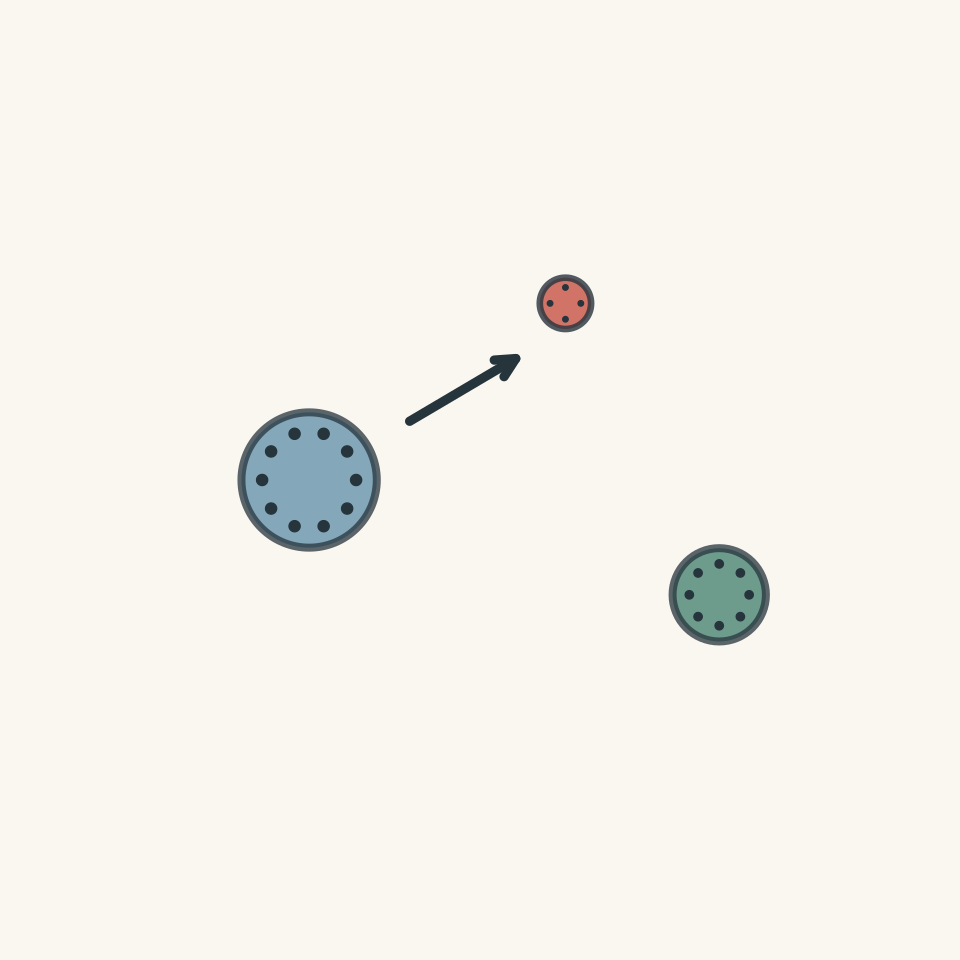
Imagine a crowded group photo where everyone is squeezing together. At first, everyone can fit. Add more and more people, and eventually someone has to step out of the group. An alpha particle is like a small, organised group of two protons and two neutrons leaving the crowded nucleus.
The analogy is useful because it shows why a large nucleus might change. However, the nucleus is not actually a collection of little balls loosely packed together. The strong nuclear force, quantum effects, and energy changes determine whether a decay can occur.
An alpha particle contains:
- 2 protons
- 2 neutrons
- no electrons
Because it has two protons, it has a charge of \(+2e\), where \(e\) is the elementary charge. It is the same as the nucleus of a helium-4 atom.
02Building the nuclear equation
Students often remember that “something leaves the nucleus” and then get stuck writing the equation. The key is conservation.
In any nuclear equation:
- the total number of nucleons (protons + neutrons) is conserved
- the total charge is conserved
The mass number \(A\) tells us the total number of protons and neutrons.
The atomic number \(Z\) tells us the number of protons.
An alpha particle has:
\[ A = 4 \]
\[ Z = 2 \]
So when a nucleus emits an alpha particle:
- the mass number decreases by 4
- the atomic number decreases by 2
The general form is:
\[ {}^{A}_{Z}X \rightarrow {}^{A-4}_{Z-2}Y + {}^{4}_{2}\text{He} \]
where:
- \(X\) is the original parent nucleus
- \(Y\) is the daughter nucleus
- \(A\) is the mass number
- \(Z\) is the atomic number
The daughter nucleus is a different element because the number of protons has changed.
03A prediction: does alpha decay make a lighter atom of the same element?
It feels reasonable to think this. After all, the atom has simply lost some material.
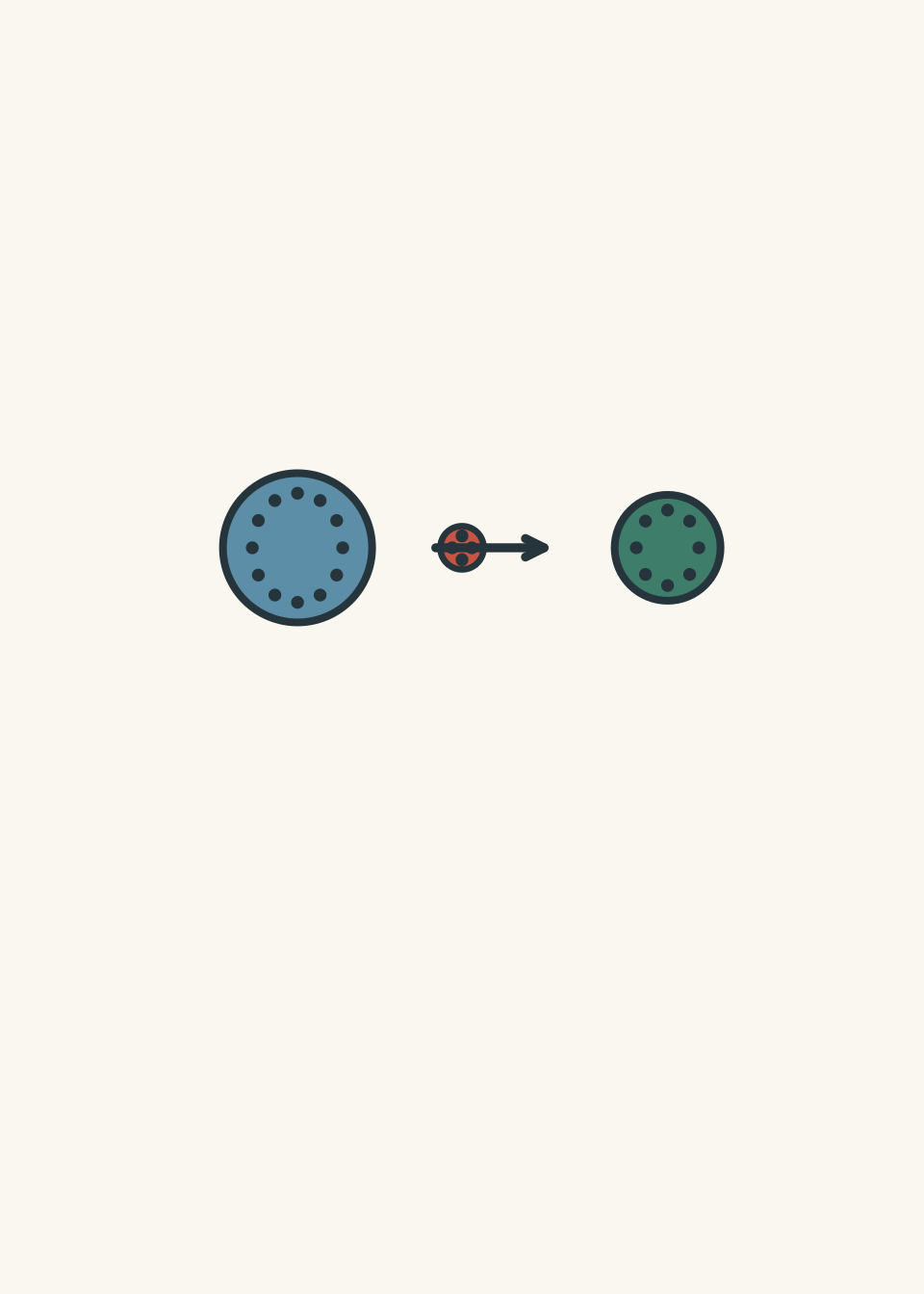
But the element is defined by its number of protons. Losing two protons means the atom is no longer the same element.
For example, uranium has 92 protons. After alpha decay, the daughter nucleus has:
\[ 92 - 2 = 90 \]
protons.
Element 90 is thorium, not uranium.
The atom has changed identity.
04Radiation properties of alpha particles
Alpha radiation has several important properties.
1. Alpha particles are highly ionising
An alpha particle has a relatively large mass and a \(+2\) charge. As it travels through matter, it strongly interacts with nearby atoms and can remove electrons.
This creates ions, which is why alpha radiation is called highly ionising.
2. Alpha particles have low penetration
Because alpha particles interact so strongly, they lose energy quickly.
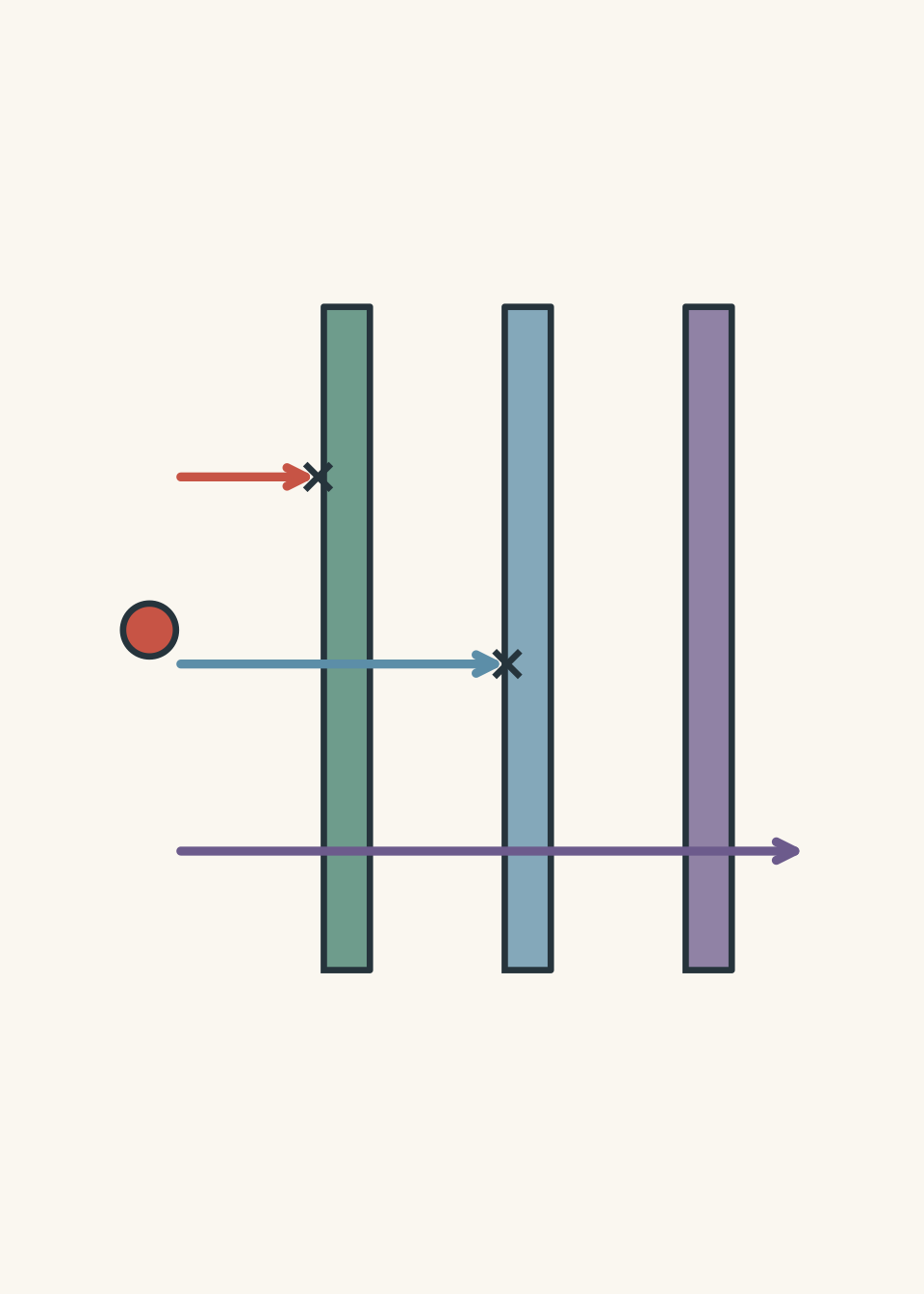
A sheet of paper or the outer layer of human skin can stop alpha radiation.
This leads to an important exam distinction:
- Outside the body: alpha radiation is usually not very dangerous because it cannot travel far.
- Inside the body: alpha radiation can be very damaging because it deposits energy into nearby cells.
3. Alpha particles are affected by electric and magnetic fields
An alpha particle is positively charged, so it is deflected by electric and magnetic fields.
However, because it is relatively massive, its path bends less than a lighter charged particle such as a beta particle.
A useful rule:
| Radiation | Charge | Mass | Ionising ability | Penetration |
|---|---|---|---|---|
| Alpha | \(+2\) | Large | High | Low |
| Beta | \(-1\) or \(+1\) | Small | Medium | Medium |
| Gamma | 0 | None | Low | High |
05Energy released during alpha decay
Alpha decay is not just a particle leaving. The products have slightly less mass than the original nucleus.
That missing mass becomes energy:
\[ E = mc^2 \]
where:
- \(E\) is energy released in joules
- \(m\) is the mass converted into energy in kilograms
- \(c\) is the speed of light in metres per second
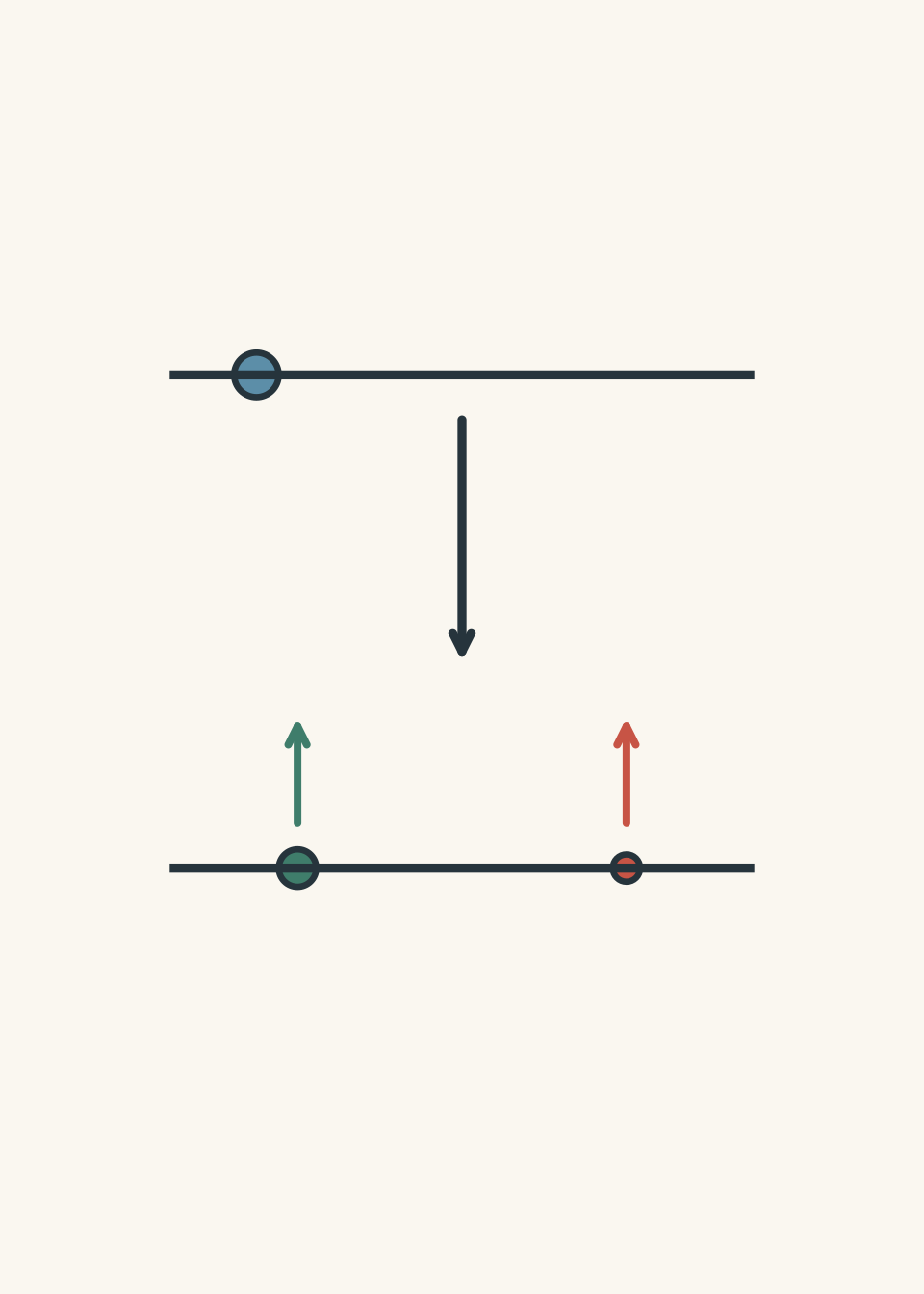
The energy usually appears as kinetic energy of the alpha particle and the daughter nucleus.
The alpha particle often receives most of the energy because the daughter nucleus is much heavier and recoils more slowly.
06Worked example: Identify the daughter nucleus
A radium-226 nucleus undergoes alpha decay. Determine the daughter nucleus.
Step 1
An alpha particle removes 4 from the mass number and 2 from the atomic number.
\[ A_{\text{daughter}} = 226 - 4 = 222 \]
\[ Z_{\text{daughter}} = 88 - 2 = 86 \]
Step 2
Atomic number 86 is radon.
Step 3
\[ {}^{226}_{88}\text{Ra} \rightarrow {}^{222}_{86}\text{Rn} + {}^{4}_{2}\text{He} \]
The daughter nucleus is radon-222. The important idea is that the element changed because the proton number changed.
07Worked example: Calculate the energy released
A nuclear reaction converts \(5.0 \times 10^{-13}\,\text{kg}\) of mass into energy during alpha decay. Calculate the energy released.
Step 1
\[ E = mc^2 \]
where \(m = 5.0 \times 10^{-13}\,\text{kg}\) and \(c = 3.0 \times 10^8\,\text{m s}^{-1}\).
Step 2
\[ E = (5.0 \times 10^{-13})(3.0 \times 10^8)^2 \]
\[ E = (5.0 \times 10^{-13})(9.0 \times 10^{16}) \]
\[ E = 4.5 \times 10^4\,\text{J} \]
Step 3
The energy released is:
\[ \boxed{4.5 \times 10^4\,\text{J}} \]
A very small amount of mass has produced a large amount of energy because the conversion factor \(c^2\) is extremely large.
08The common alpha decay traps
Trap 1: Changing the mass number but forgetting the atomic number
A student may write:
\[ {}^{226}_{88}\text{Ra} \rightarrow {}^{222}_{88}Y + {}^{4}_{2}\text{He} \]
The mass is conserved, but the charge is not. The daughter cannot still have 88 protons.
Trap 2: Thinking alpha radiation is always harmless
The low penetration of alpha particles does not mean low energy transfer. Alpha particles are dangerous when the radioactive material enters the body because the energy is deposited over a very short distance.
Trap 3: Thinking radioactive decay can be stopped
You can shield yourself from alpha radiation, but shielding does not stop the nucleus from undergoing decay. The decay process is a change inside the nucleus.
09Questions and solutions
Question 1
A polonium-210 nucleus undergoes alpha decay. Determine the daughter nucleus.
Solution 1
The daughter nucleus is lead-206 because alpha decay reduces the mass number by 4 and the atomic number by 2.
For polonium-210:
\[ A = 210,\quad Z = 84 \]
After alpha emission:
\[ A = 210 - 4 = 206 \]
\[ Z = 84 - 2 = 82 \]
Atomic number 82 is lead, so:
\[ {}^{210}_{84}\text{Po} \rightarrow {}^{206}_{82}\text{Pb} + {}^{4}_{2}\text{He} \]
The tempting mistake is to only remove four nucleons and ignore the element change. The proton number determines the element, so the atomic number must decrease.
Question 2
A student says: “Alpha radiation cannot be dangerous because it is stopped by paper.” Explain whether this statement is correct.
Solution 2
The statement is incomplete because alpha radiation has low penetration but high ionising ability.
A sheet of paper stops alpha particles because they interact strongly with matter and lose their energy quickly. However, if an alpha-emitting substance enters the body, those same strong interactions cause a large amount of energy to be deposited in a small region of tissue.
The important distinction is between penetration and ionisation. Alpha radiation travels only a short distance, but it can cause significant damage along that distance.
Question 3
A nucleus undergoes alpha decay. The emitted alpha particle has kinetic energy, and the daughter nucleus also moves. Explain why the alpha particle receives most of the kinetic energy.
Solution 3
The alpha particle receives most of the kinetic energy because the daughter nucleus has a much larger mass and therefore accelerates less.
Momentum must be conserved. Before decay, the nucleus is approximately stationary, so after decay:
\[ p_{\alpha} = p_{\text{daughter}} \]
Both objects have equal and opposite momentum, but kinetic energy depends on mass:
\[ E_k = \frac{p^2}{2m} \]
For the same momentum, the smaller mass has the larger kinetic energy. Since the alpha particle is much lighter than the daughter nucleus, it carries most of the energy.
The tempting route is to think the larger object should carry more energy because it contains more matter. The conservation rule that decides the outcome is momentum, not size.
Question 4
A scientist measures an unknown radioactive nucleus and finds that after alpha decay the daughter nucleus has atomic number 90 and mass number 234. The scientist claims the original nucleus was thorium-234. Determine whether this claim is correct.
Solution 4
The claim is incorrect because the original nucleus must have had atomic number 92 and mass number 238.
Alpha decay reverses the changes:
\[ A_{\text{parent}} = 234 + 4 = 238 \]
\[ Z_{\text{parent}} = 90 + 2 = 92 \]
Atomic number 92 is uranium, so the original nucleus was uranium-238:
\[ {}^{238}_{92}\text{U} \rightarrow {}^{234}_{90}\text{Th} + {}^{4}_{2}\text{He} \]
The tempting mistake is to identify the daughter element as the original radioactive material. The decay product is not the starting nucleus; it is what remains after the alpha particle leaves.
Question 5
A detector is placed near an alpha source. A sheet of paper is placed between the source and detector, and the count rate drops to almost zero. A student concludes that the source has stopped decaying. Explain why this conclusion is wrong and describe what evidence would better test the conclusion.
Solution 5
The source has not necessarily stopped decaying; the paper has most likely blocked the alpha particles before they reach the detector.
Alpha decay is a random nuclear process. The nuclei continue to decay according to the radioactive decay law, but the emitted particles may no longer reach the detector.
A better test would be to remove the paper and compare measurements over time, or use a detector setup designed to measure the radiation from the source without blocking it.
The subtle trap is confusing “radiation detected” with “radiation produced”. A detector only measures particles that reach it. It does not directly measure every decay occurring inside the source.
Alpha decay is the first example of how unstable nuclei transform into more stable arrangements. Once you understand how the nucleus changes during alpha emission, the next step is understanding other decay processes, such as beta decay, where the nucleus changes in a different way.