
Simple Ester Production: HSC Chemistry Lab Explained
Learn how simple esters are produced in the laboratory through esterification. This guide explains the reaction, practical method, safety considerations, and identification of ester products.
A student mixes ethanol and ethanoic acid in a test tube, warms the mixture, and expects a new substance to appear. But what evidence would prove that a chemical reaction has actually happened? The liquids were already clear. They do not suddenly change colour, explode, or form a solid.
A better prediction is to focus on properties. The mixture may start smelling sharp like vinegar and alcohol, but after heating, a sweet, fruity smell appears. Something new has formed: an ester.
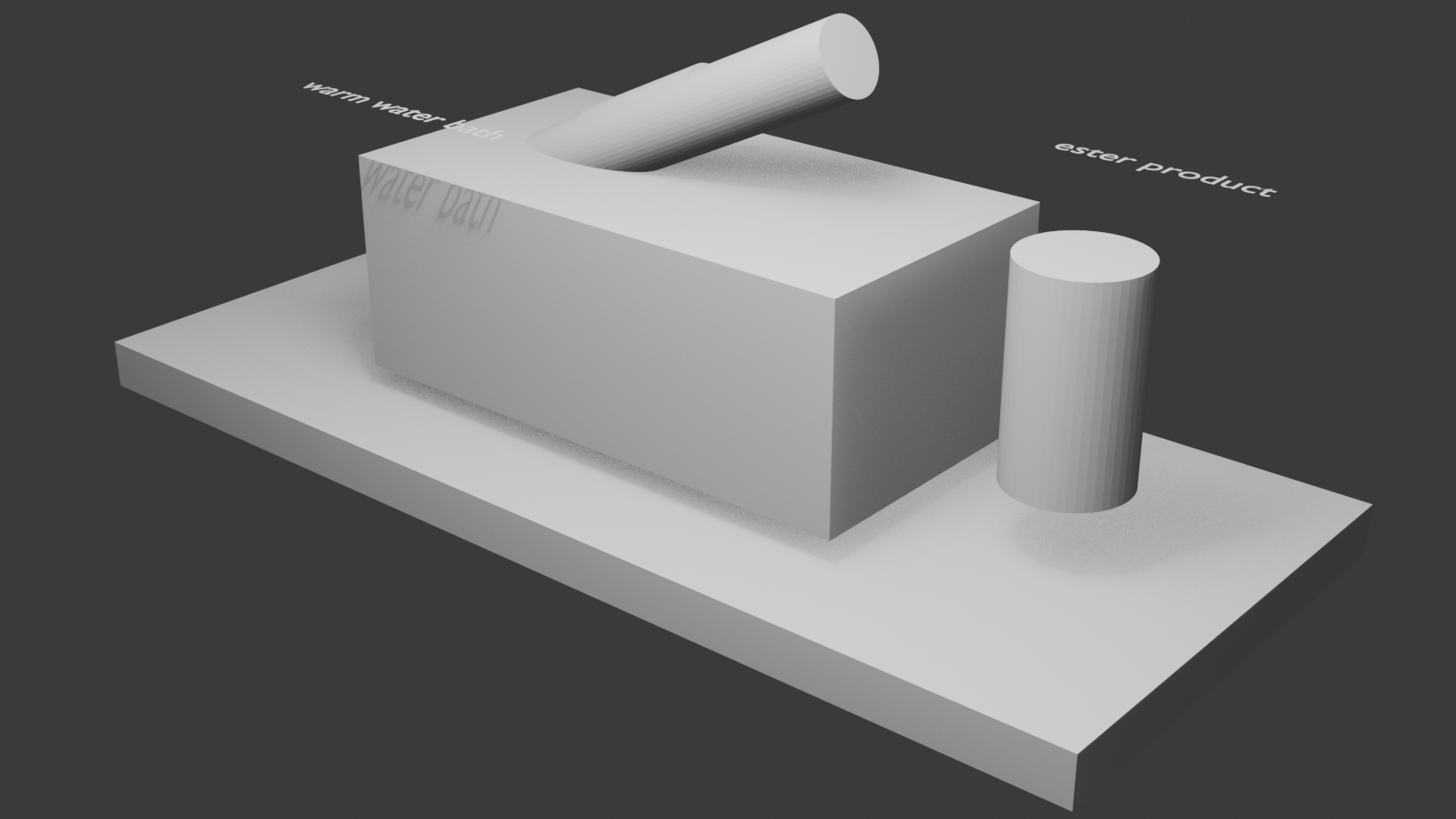
The challenge is that making an ester is not just “mix two chemicals and wait”. You need to understand which molecules react, why heating helps, why an acid catalyst is added, and how chemists separate a product from a reaction mixture.
01The idea behind ester production
Imagine two molecules meeting at a crowded party.
The alcohol molecule has a useful part called a hydroxyl group, \( -OH \). The carboxylic acid molecule has a carboxyl group, \( -COOH \). These groups are the parts that interact during ester formation.
A simple way to picture it is:
- the alcohol brings a carbon chain and an \( -OH \) group
- the carboxylic acid brings a carbon chain and a \( -COOH \) group
- the molecules rearrange, joining the carbon chains together
- water is removed as a small by-product
It is a bit like two people linking arms while one person leaves the group chat. The analogy helps you picture a joining process, but it is not a literal description. Molecules do not “decide” to react, and the atoms are not choosing partners. The reaction occurs because the new arrangement has a different energy balance.
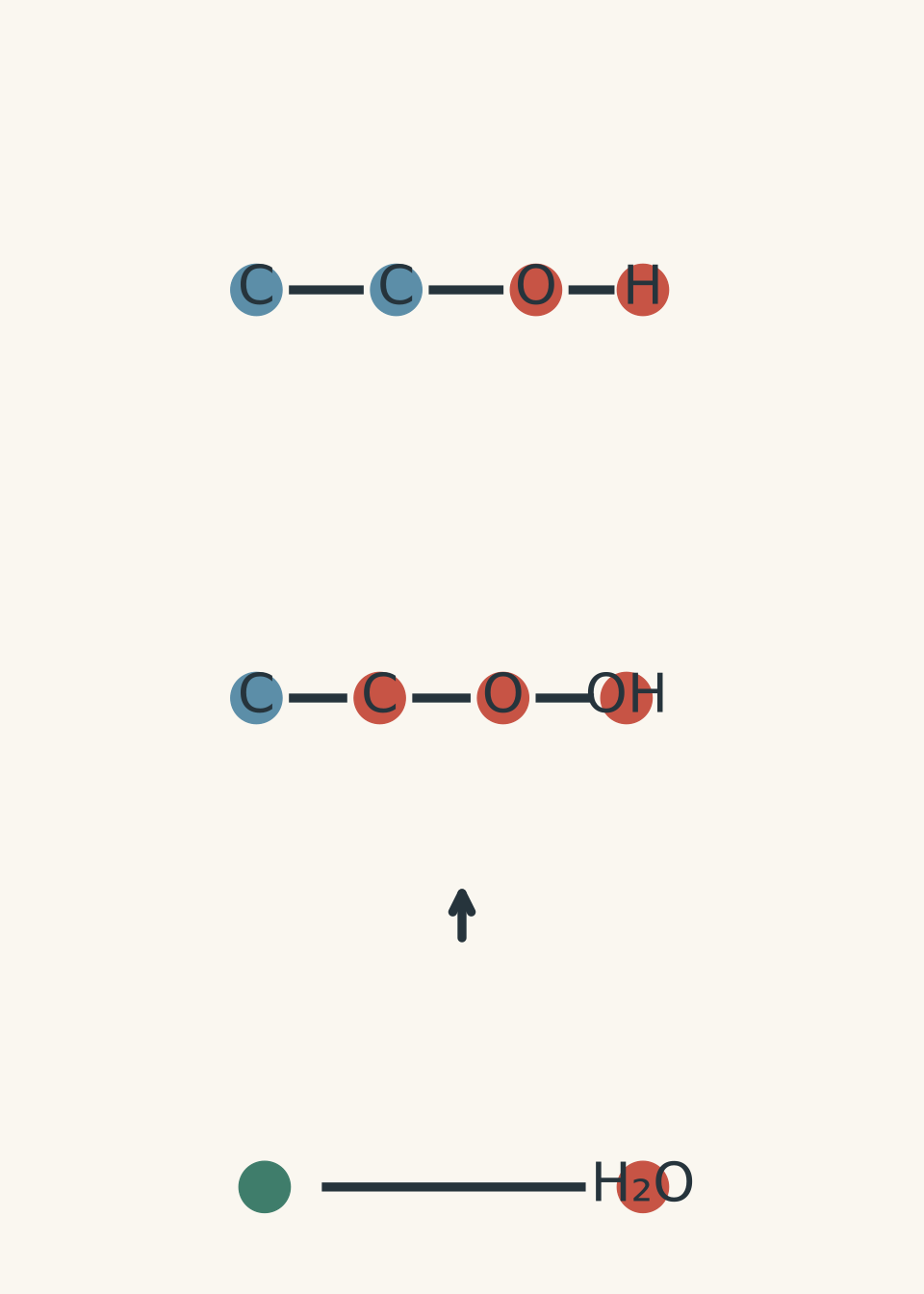
The general reaction is called esterification.
For an alcohol reacting with a carboxylic acid:
\[ \ce{alcohol + carboxylic acid <=> ester + water} \]
For example, ethanol reacts with ethanoic acid to form ethyl ethanoate:
\[ \ce{CH3CH2OH + CH3COOH <=> CH3COOCH2CH3 + H2O} \]
Ethanol + ethanoic acid ⇌ ethyl ethanoate + water
The reaction is reversible. This means the ester and water can also react to reform the acid and alcohol.
That raises an important question:
If the reaction can go backwards, why does the ester form at all?
The answer is that conditions influence the balance between reactants and products. Removing water, using suitable reactant amounts, or separating the ester product can encourage more ester formation. In a school laboratory, the aim is usually not to make 100% pure ester, but to produce enough ester to identify its properties.
02What happens in the laboratory?
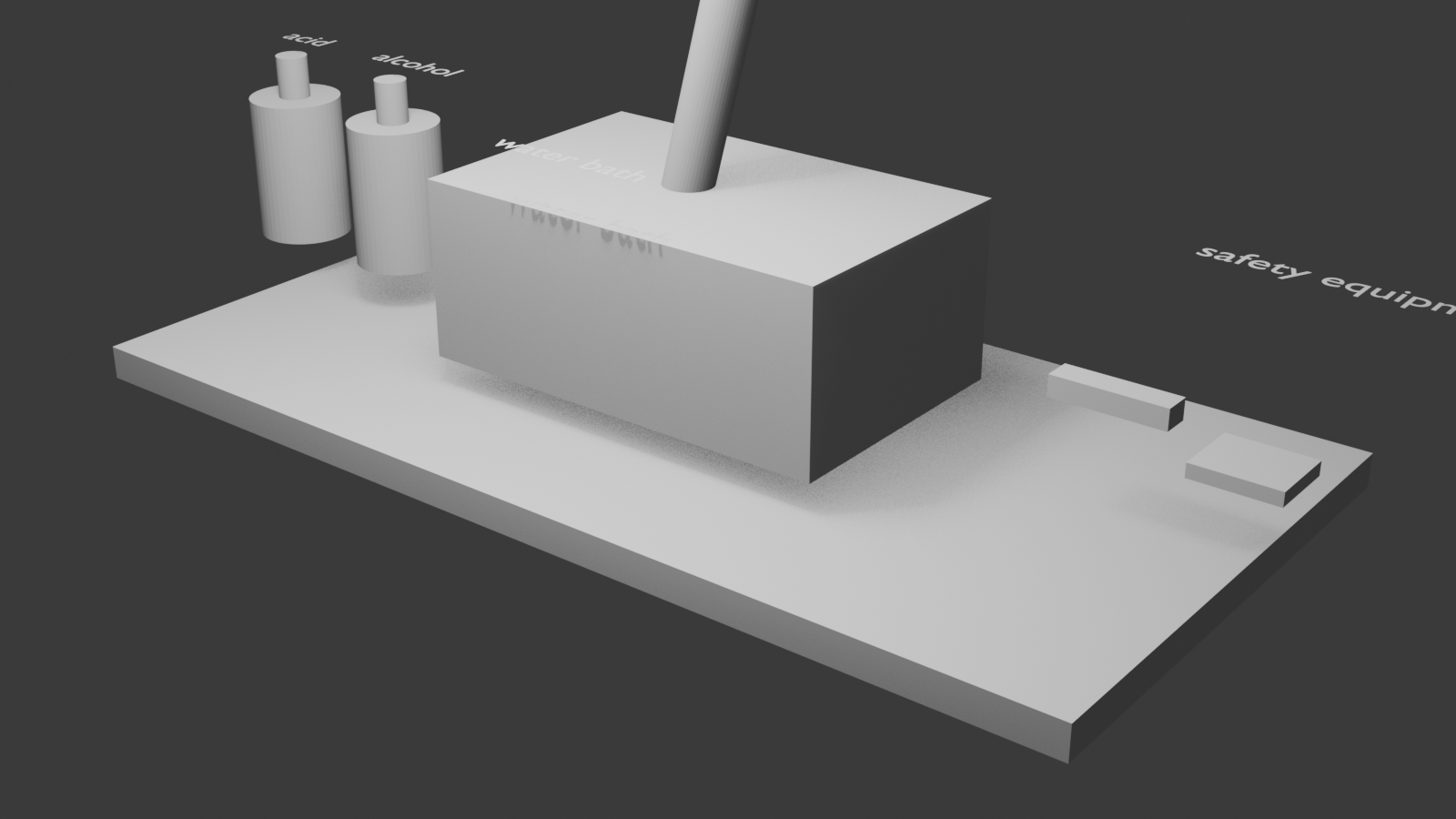
A typical school preparation of an ester involves:
- measuring a carboxylic acid and an alcohol
- adding a small amount of concentrated sulfuric acid as a catalyst
- warming the mixture in a water bath
- separating and identifying the ester product
Why add sulfuric acid?
A catalyst increases the rate of a reaction without being used up.
The sulfuric acid does not become part of the ester product. Instead, it helps the reaction pathway by making the molecules react more easily.
Students often predict:
“Adding more sulfuric acid should create more ester because more catalyst means more reaction.”
That feels reasonable, but it is not quite right. A catalyst affects how quickly equilibrium is reached, not where the equilibrium ends up. Adding more catalyst can make the reaction happen faster, but it does not automatically increase the final amount of ester.
03Why heat the mixture?
At room temperature, esterification happens slowly. Heating gives particles more kinetic energy, so collisions occur more frequently and with more energy.
A useful first model is:
- more collisions → faster reaction
The more precise model is:
- only collisions with enough energy and the correct orientation can lead to reaction
Heating increases the number of successful collisions.
The water bath is used instead of directly heating the mixture with a flame because many organic substances are volatile and flammable. A water bath provides gentle, controlled heating.
04The practical method and safety decisions
The laboratory method is not only about getting a reaction to happen. Chemists also need to control risks.
1. Wear appropriate protection
Safety glasses and a lab coat protect against splashes from acids and organic liquids.
2. Use a water bath
Alcohols such as ethanol are flammable. A naked flame creates an unnecessary ignition risk.
3. Handle concentrated sulfuric acid carefully
Concentrated sulfuric acid is corrosive. It can cause serious burns and must be handled using appropriate safety procedures.
4. Do not identify the ester by directly smelling the reaction mixture
A common classroom description is that esters have fruity smells. However, directly inhaling chemicals from a reaction vessel is unsafe.
If smell is used as an identification clue in a supervised demonstration, the correct technique is controlled wafting, where appropriate.
05Separating and identifying the ester
After the reaction, the mixture contains more than just ester. It may contain:
- unreacted alcohol
- unreacted acid
- catalyst
- water
- ester
The product needs to be separated from these substances.
A common approach is to add the reaction mixture to water. The ester may form a separate layer because many esters have limited solubility in water.
The layers can then be separated using techniques such as a separating funnel.

The observations give clues about the product:
| Observation | Possible explanation |
|---|---|
| Fruity odour | Formation of an ester |
| Two liquid layers after adding water | Different solubilities of substances |
| Reaction mixture becomes warm | Energy changes during reaction |
| Acidic solution before separation | Presence of acid reactant or catalyst |
Observations are evidence, but they do not prove the exact structure by themselves. In professional chemistry, techniques such as spectroscopy are used for stronger identification.
06Worked example: Identify the ester produced
A student reacts propan-1-ol with ethanoic acid.
What ester is produced?
Step 1
The alcohol is propan-1-ol:
\[ \ce{CH3CH2CH2OH} \]
The acid is ethanoic acid:
\[ \ce{CH3COOH} \]
Step 2
The alcohol contributes the propyl group, and the acid contributes the ethanoate group.
Step 3
Esters are named:
\[ \text{alkyl group} + \text{carboxylate group} \]
The product is propyl ethanoate.
The reaction is:
\[ \ce{CH3CH2CH2OH + CH3COOH <=> CH3COOCH2CH2CH3 + H2O} \]
The important reasoning is that the alcohol name comes first in the ester name, while the acid name changes from “-ic acid” to “-ate”.
07Worked example: Calculate the amount of ester possible
A student reacts \(0.50\ \mathrm{mol}\) of ethanol with \(0.40\ \mathrm{mol}\) of ethanoic acid.
The reaction is:
\[ \ce{CH3CH2OH + CH3COOH <=> CH3COOCH2CH3 + H2O} \]
What is the maximum amount of ethyl ethanoate that can form?
Step 1
The equation shows:
\[ 1\ \mathrm{mol\ ethanol} : 1\ \mathrm{mol\ ethanoic\ acid} : 1\ \mathrm{mol\ ester} \]
Step 2
There is:
\[ 0.50\ \mathrm{mol} \]
of ethanol and:
\[ 0.40\ \mathrm{mol} \]
of ethanoic acid.
Ethanoic acid runs out first.
Step 3
Because the ratio is \(1:1\):
\[ n(\text{ester}) = 0.40\ \mathrm{mol} \]
Step 4
The maximum theoretical amount of ethyl ethanoate is:
\[ \boxed{0.40\ \mathrm{mol}} \]
The actual amount would usually be lower because esterification is reversible and separation is not perfect.
08A common HSC mistake: confusing esterification with combustion
Students sometimes see an organic molecule and immediately think “combustion” because carbon and hydrogen are present.
But the reaction type depends on the reactants and conditions.
Combustion:
\[ \ce{hydrocarbon + O2 -> CO2 + H2O} \]
Esterification:
\[ \ce{alcohol + carboxylic acid <=> ester + H2O} \]
The key question is not “does it contain carbon?” Almost every organic compound does. The key question is “which functional groups are reacting?”
Understanding functional groups is also what allows you to build organic reaction pathways. You can extend this idea further with organic synthesis pathways in HSC Chemistry.
09Questions and solutions
Question 1
Ethanol and ethanoic acid are reacted in the presence of concentrated sulfuric acid and heat.
Name the ester formed.
Solution 1
The ester formed is ethyl ethanoate.
The alcohol contributes the alkyl name:
\[ \ce{CH3CH2OH} \]
Ethanol gives the name “ethyl”.
The carboxylic acid contributes the second part:
\[ \ce{CH3COOH} \]
Ethanoic acid changes to “ethanoate”.
Therefore:
\[ \ce{CH3CH2OH + CH3COOH <=> CH3COOCH2CH3 + H2O} \]
forms ethyl ethanoate and water.
The common mistake is reversing the name order. Esters are named alcohol part first, acid part second.
Question 2
A student performs an esterification reaction but forgets to add the sulfuric acid catalyst.
Predict what would happen to the reaction rate and explain why.
Solution 2
The reaction would occur more slowly because the catalyst is missing.
Sulfuric acid provides an alternative reaction pathway with lower activation energy. Without it, fewer collisions have enough energy to proceed to products.
The tempting prediction is that no ester will form at all. However, a catalyst changes the rate, not whether the reaction is possible. The alcohol and carboxylic acid can still react, but much more slowly.
Question 3
A student directly heats an ethanol and ethanoic acid mixture with a Bunsen burner instead of using a water bath.
Explain why this is a poor experimental choice.
Solution 3
Direct heating with a flame increases the safety risk because ethanol is flammable.
The reaction mixture contains volatile organic substances. A flame could ignite vapours above the liquid.
The better choice is a water bath because it provides controlled heating without an ignition source. The purpose of the water bath is not to make the reaction happen by itself; it improves safety while still providing the energy needed for faster collisions.
Question 4
Two groups perform the same esterification reaction.
Group A uses equal moles of ethanol and ethanoic acid.
Group B uses twice as many moles of ethanol as ethanoic acid.
Both groups use the same catalyst and temperature.
Which group can produce more ester? Explain your reasoning.
Solution 4
Group B does not automatically produce twice as much ester. The maximum amount is controlled by the limiting reactant.
The reaction ratio is:
\[ 1:1:1 \]
for ethanol, ethanoic acid, and ester.
If ethanoic acid is the smaller amount in Group B, the extra ethanol cannot all become ester because there is not enough acid available to react with it.
The tempting route is to think “more ethanol means more product”, but ester formation requires both reactants. The limiting reactant sets the maximum amount of ester.
Question 5
A student claims:
“Because esterification is reversible, heating the mixture must always reduce the amount of ester because the reverse reaction also speeds up.”
Evaluate this claim.
Assume the esterification reaction between an alcohol and carboxylic acid absorbs heat overall.
Solution 5
The claim is incorrect because the effect of heating depends on the energy change of the reaction, not simply on the fact that the reaction is reversible.
For an endothermic forward reaction:
\[ \ce{reactants + heat <=> products} \]
adding heat favours the products. Both forward and reverse reactions become faster, but the equilibrium position shifts towards the side that absorbs heat.
The tempting route is to focus only on the reverse reaction becoming faster. That ignores equilibrium. A temperature change affects both reaction rates and the final balance of reactants and products.
The assumption given in the question is important. If the forward esterification reaction were exothermic instead, heating would favour the reactants at equilibrium, even though the reaction might still reach equilibrium faster.
This idea connects ester production to a broader HSC Chemistry skill: predicting how changing conditions affects chemical systems. The same reasoning appears in equilibrium, reaction pathways, and industrial chemical processes. Understanding why esterification responds to conditions is more useful than memorising one laboratory recipe.