
Gravitational Field Strength vs Potential Energy: How Distance Changes Each
Learn why gravitational field strength decreases with the square of distance, while gravitational potential energy varies inversely with distance. Compare their equations, graphs, and physical meanings, then apply them in worked examples and challenging HSC-style questions.
A probe is moved from a distance \(r\) to \(2r\) from a planet’s centre. Predict what happens to its gravitational field strength and its gravitational potential energy. Do both halve because the distance doubles?
Only one quantity halves. The field-strength magnitude falls to one-quarter, while the potential energy becomes half as negative. For example, a potential energy of \(-100\ \mathrm{J}\) becomes \(-50\ \mathrm{J}\). Its numerical value has actually increased by \(50\ \mathrm{J}\).
The reason is that gravitational field strength and gravitational potential energy depend on distance in different ways. Knowing which quantity a question asks for is the first step towards choosing the right equation.
Here, \(r\) is the distance from the planet’s centre, not the height above its surface. The planet’s radius is \(R\).
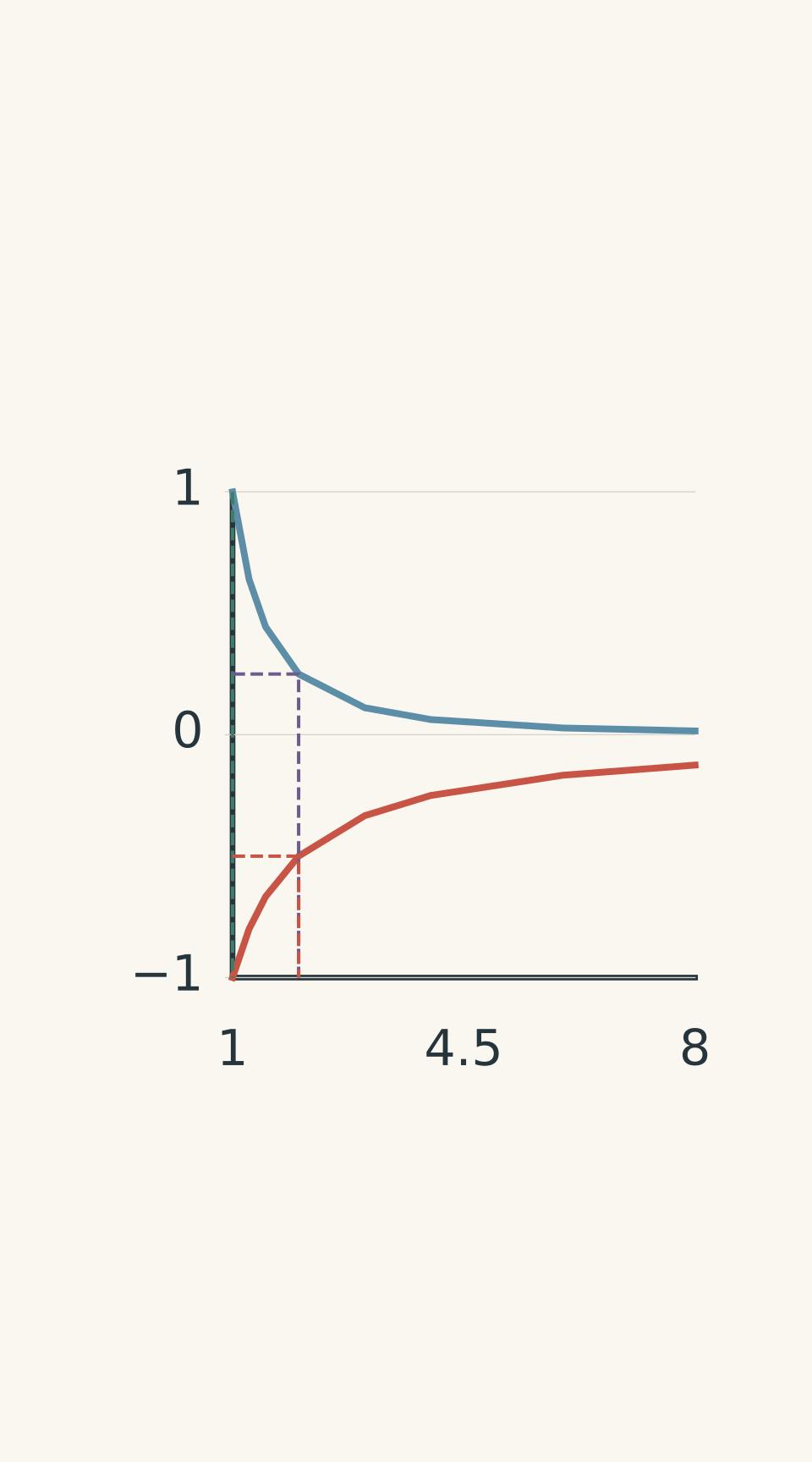
- Field strength: 1/x²
- Potential energy: −1/x
- x = 1: g/g(R) = 1
- x = 2: g/g(R) = 1/4
- x = 1: U/(GMm/R) = −1
- x = 2: U/(GMm/R) = −1/2
01Quick decision rule
When a question mentions gravity, first identify what you need to calculate.
- Field strength, gravitational acceleration, or force per unit mass: use the inverse-square relationship, \(g=\dfrac{GM}{r^2}\).
- Gravitational potential energy at a particular radius: use \(U=-\dfrac{GMm}{r}\), assuming the potential energy is zero at infinity.
- Energy transferred when an object moves between two radii: calculate \(\Delta U=U_f-U_i\), or use the combined equation
\[ \Delta U=GMm\left(\frac{1}{r_i}-\frac{1}{r_f}\right). \]
For a slow movement with no change in kinetic energy, the work done by an external agent equals \(\Delta U\). The work done by gravity is \(-\Delta U\).
Before substituting, check two things: the distance must be measured from the planet’s centre, and the reference point for potential energy must be clear.
Choose the correct gravitational equation
- Identify the target
g, U, or ΔU
Field strength, energy at a position, or energy change?
- Select the equation
g = GM/r²; U = −GMm/r; ΔU = GMm(1/rᵢ − 1/r_f)
For U, assume zero at infinity unless stated otherwise.
- Check distance and reference
r = R + h
Use centre-to-object distance; identify the potential-energy zero.
- Calculate and interpret
g: N kg⁻¹; U, ΔU: J
Use SI units. Outward motion gives ΔU > 0; field-strength magnitude is positive.
02What each quantity actually measures
1. Gravitational field strength: the force per unit mass
Imagine placing two objects at the same location outside a planet. One has a mass of \(1\ \mathrm{kg}\), and the other has a mass of \(10\ \mathrm{kg}\).
The heavier object experiences ten times the gravitational force. Does that mean the gravitational field is ten times stronger for the heavier object?
No. The field is a property of the location, determined by the planet’s mass and the distance from its centre. The heavier object experiences more force because it has more mass.
Gravitational field strength is the gravitational force per unit mass:
\[ g=\frac{F_g}{m}=\frac{GM}{r^2} \]
Here:
- \(g\) is the magnitude of gravitational field strength, measured in \(\mathrm{N\,kg^{-1}}\) or \(\mathrm{m\,s^{-2}}\).
- \(F_g\) is the magnitude of gravitational force, measured in newtons (\(\mathrm{N}\)).
- \(G\) is the universal gravitational constant, \(6.67\times10^{-11}\ \mathrm{N\,m^2\,kg^{-2}}\).
- \(M\) is the mass of the planet, measured in kilograms.
- \(m\) is the mass of the object experiencing gravity, measured in kilograms.
- \(r\) is the distance from the planet’s centre, measured in metres.
Notice that the object’s mass \(m\) cancels when calculating field strength. At the same location, a more massive object experiences more force, but the field strength is unchanged.
The gravitational field points towards the planet’s centre. The equation above gives its magnitude, which is positive.
2. Gravitational potential energy: the energy of the planet-object system
Now consider a different question. How much energy must you supply to move an object from its current position to infinitely far away from the planet, assuming it begins and ends at rest?
This is an energy question, not a force-per-unit-mass question.
With gravitational potential energy defined as zero at infinity,
\[ U=-\frac{GMm}{r} \]
The symbols \(G\), \(M\), \(m\), and \(r\) have the same meanings as before. However, \(U\) is measured in joules (\(\mathrm{J}\)).
There are two important differences from the field-strength equation:
- Potential energy depends on the mass of the object, \(m\).
- Potential energy is negative at any finite distance when the zero is defined at infinity.
Why negative? At a finite distance, the object is gravitationally bound to the planet. Energy must be supplied to separate them completely and reach infinity with no remaining kinetic energy.
If you double the object’s mass while keeping its position unchanged, its gravitational potential energy doubles in magnitude. The gravitational field strength at that position does not change.
3. Keep gravitational potential separate from potential energy
There is a third quantity that sometimes causes confusion: gravitational potential, usually written as \(\phi\).
Gravitational potential is potential energy per unit mass:
\[ \phi=\frac{U}{m}=-\frac{GM}{r} \]
It is measured in \(\mathrm{J\,kg^{-1}}\). Unlike \(U\), it does not depend on the mass of the object being considered.
| Quantity | What it describes | Equation, with zero at infinity | Unit |
|---|---|---|---|
| Field strength, \(g\) | Gravitational force per unit mass | \(\dfrac{GM}{r^2}\) | \(\mathrm{N\,kg^{-1}}\) |
| Gravitational potential, \(\phi\) | Potential energy per unit mass | \(-\dfrac{GM}{r}\) | \(\mathrm{J\,kg^{-1}}\) |
| Potential energy, \(U\) | Energy of the planet-object system | \(-\dfrac{GMm}{r}\) | \(\mathrm{J}\) |
Field strength vs potential energy
| Gravitational field strength (g) | g = GM/r² Local field quantity; units: N/kg Independent of test mass m |
|---|---|
| Gravitational potential energy (U) | U = −GMm/r Energy of the planet–object system; units: J U is directly proportional to m; negative with zero at infinity |
| Double the test mass at the same radius | m → 2m g stays unchanged |U| doubles |
These equations apply to a point mass or to a location outside a spherically symmetric planet, where the planet can be treated as if its mass were concentrated at its centre. They ignore the gravitational effects of other bodies.
Inside a planet, the exterior field-strength equation is not generally valid. You would need information about how the planet’s mass is distributed.
03Why the radius dependences differ
The key is to distinguish a local measurement from an energy change.
Field strength tells you how much gravitational force each kilogram experiences at one particular location. It depends on the inverse square of the distance:
\[ g\propto\frac{1}{r^2} \]
Potential energy tells you the energy of the planet-object system relative to the chosen zero. It depends on the inverse of the distance:
\[ U\propto-\frac{1}{r} \]
Potential energy is not simply another measurement of the force at one point. It reflects the work needed to move the object between positions. That work depends on the gravitational force acting over the distance travelled.
As the object moves away, gravity weakens with the square of the distance. The remaining work needed to reach infinity decreases with distance, producing the inverse-first-power relationship for potential energy.
Compare the changes directly
Suppose the radius increases by a factor of \(k\), while the planet and object remain unchanged. The equations give
\[ g(kr)=\frac{g(r)}{k^2} \]
and
\[ U(kr)=\frac{U(r)}{k}. \]
The second relationship assumes \(U=0\) at infinity.
| New radius | Field-strength magnitude | Potential energy |
|---|---|---|
| \(2r\) | \(g/4\) | \(U/2\), half as negative |
| \(3r\) | \(g/9\) | \(U/3\), one-third as negative |
| \(kr\) | \(g/k^2\) | \(U/k\) |
For example, if an object moves from \(r\) to \(3r\), its field-strength magnitude becomes one-ninth of its original value. Its potential energy becomes one-third of its original value.
If the original potential energy was \(-90\ \mathrm{J}\), the new value is \(-30\ \mathrm{J}\), not \(-10\ \mathrm{J}\).
The object has gained \(60\ \mathrm{J}\) of potential energy, even though the magnitude of that energy has decreased.
04Why gravitational potential energy approaches zero from below
With zero potential energy at infinity,
\[ U=-\frac{GMm}{r} \]
At any finite positive radius, the denominator is positive and the numerator carries a negative sign. Therefore, \(U\) is negative.
As \(r\) increases, the magnitude of \(GMm/r\) decreases. The potential energy consequently becomes less negative and approaches zero from below.
It never reaches zero at a finite distance in this idealised model.
Field strength behaves differently in sign, but similarly in its limiting value. Its magnitude remains positive at every finite radius and approaches zero as the distance increases.
This is why the two graphs have different shapes:
- \(g\) falls towards zero from above.
- \(U\) rises towards zero from below.
The zero of potential energy is a choice
The equation \(U=-GMm/r\) uses infinity as the zero reference. That choice is convenient, but it is not the only possible one.
Suppose instead that you define the potential energy to be zero at the planet’s surface, where \(r=R\). The potential energy outside the planet becomes
\[ U_R(r)=GMm\left(\frac{1}{R}-\frac{1}{r}\right). \]
At the surface, \(U_R(R)=0\). At larger radii, this value is positive.
That does not mean the gravitational interaction has changed. The reference has changed, so every potential-energy value for the same object has been shifted by the same constant.
The change in potential energy between two positions remains the same because the constant cancels when you subtract the initial value from the final value.
The sign and reference choice are explored further in Why Gravitational Potential Energy Is Negative Around a Planet.
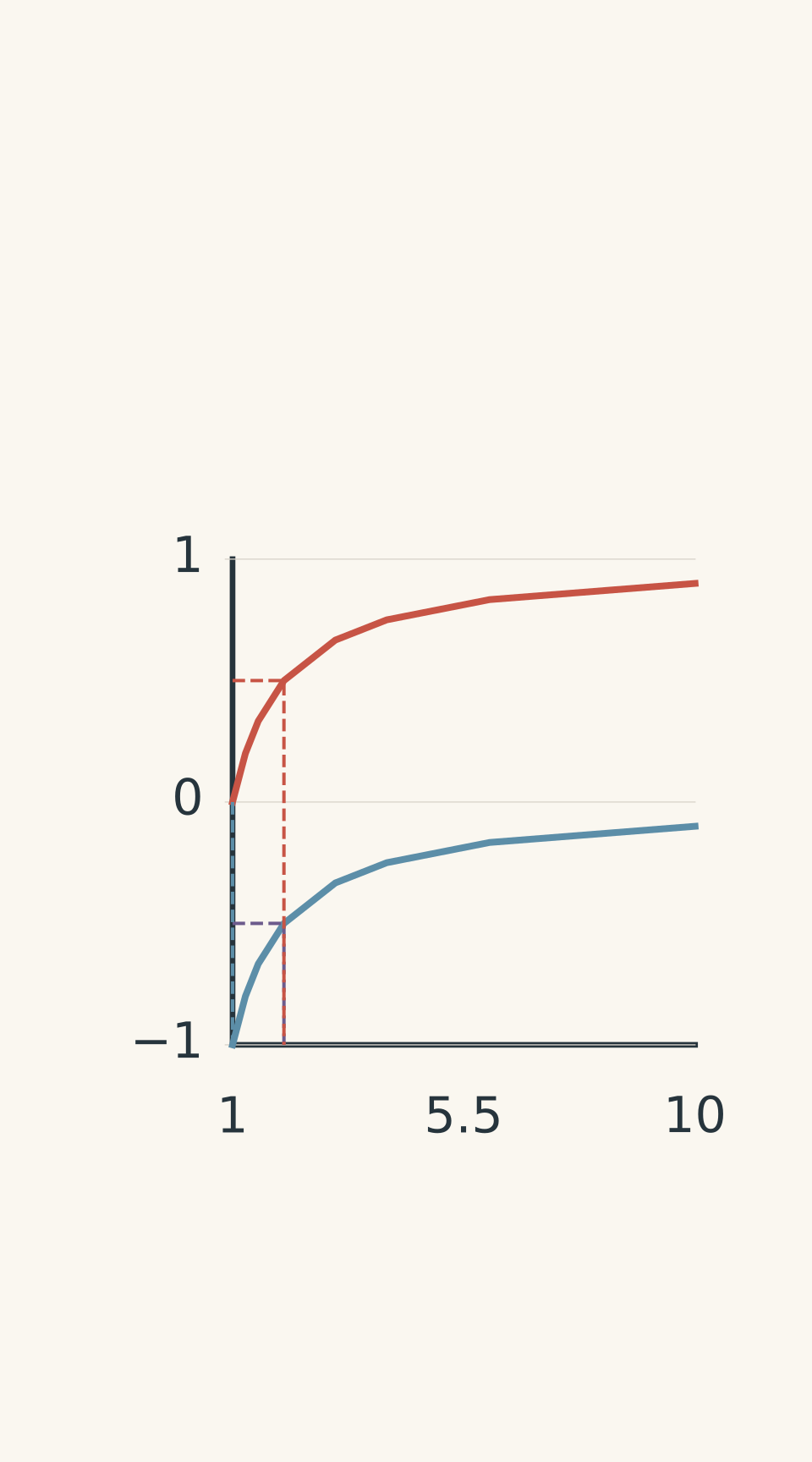
- Zero at infinity: U∞
- Zero at surface: U_R
- U∞ at R: −1
- U∞ at 2R: −0.5
- U_R at R: 0
- U_R at 2R: +0.5
05Worked examples
Worked example: calculate field strength and potential energy
An ideal spherical planet has a mass of \(6.0\times10^{24}\ \mathrm{kg}\). A probe of mass \(500\ \mathrm{kg}\) is located \(7.0\times10^6\ \mathrm{m}\) from the planet’s centre. Calculate the gravitational field-strength magnitude at the probe and its gravitational potential energy relative to infinity.
Step 1
The question asks for both a local field measurement and an energy value. Use
\[ g=\frac{GM}{r^2}, \qquad U=-\frac{GMm}{r}. \]
The probe’s mass is needed for \(U\), but not for \(g\).
Step 2
Substitute the planet’s mass and the centre-to-probe distance:
\[ \begin{aligned} g&=\frac{(6.67\times10^{-11})(6.0\times10^{24})} {(7.0\times10^6)^2}\\[4pt] &=\frac{4.00\times10^{14}}{4.90\times10^{13}}\\[4pt] &=8.2\ \mathrm{N\,kg^{-1}}. \end{aligned} \]
The gravitational field-strength magnitude is \(8.2\ \mathrm{N\,kg^{-1}}\), equivalent to an acceleration of \(8.2\ \mathrm{m\,s^{-2}}\) for an object in free fall.
Step 3
Now include the probe’s mass:
\[ \begin{aligned} U&=-\frac{GMm}{r}\\[4pt] &=-\frac{(4.00\times10^{14})(500)} {7.0\times10^6}\\[4pt] &=-2.86\times10^{10}\ \mathrm{J}\\[4pt] &\approx-2.9\times10^{10}\ \mathrm{J}. \end{aligned} \]
The potential energy is negative because the zero reference is at infinity.
Step 4
The units are correct: field strength is in \(\mathrm{N\,kg^{-1}}\), and potential energy is in joules. The field strength does not depend on the probe’s mass, whereas the potential energy does.
Worked example: calculate the energy transferred between two radii
An \(800\ \mathrm{kg}\) satellite moves slowly from \(r_i=8.0\times10^6\ \mathrm{m}\) to \(r_f=2.0\times10^7\ \mathrm{m}\) around a planet of mass \(5.0\times10^{24}\ \mathrm{kg}\). Taking the potential energy to be zero at infinity, calculate the change in potential energy and the work done by gravity.
Step 1
Calculating the potential energy at just one radius is not enough. Use
\[ \Delta U=U_f-U_i \]
or, directly,
\[ \Delta U=GMm\left(\frac{1}{r_i}-\frac{1}{r_f}\right). \]
Step 2
First, calculate the product \(GMm\):
\[ GMm=(6.67\times10^{-11})(5.0\times10^{24})(800) =2.67\times10^{17}\ \mathrm{J\,m}. \]
Then calculate the change:
\[ \begin{aligned} \Delta U &=(2.67\times10^{17}) \left(\frac{1}{8.0\times10^6} -\frac{1}{2.0\times10^7}\right)\\[4pt] &=(2.67\times10^{17})(7.50\times10^{-8})\\[4pt] &=+2.00\times10^{10}\ \mathrm{J}. \end{aligned} \]
The positive sign means the satellite’s potential energy has increased.
Step 3
For a change in potential energy,
\[ W_{\text{gravity}}=-\Delta U. \]
Therefore,
\[ W_{\text{gravity}}=-2.00\times10^{10}\ \mathrm{J}. \]
Because the satellite moves slowly and its kinetic energy does not change, the external agent must do \(+2.00\times10^{10}\ \mathrm{J}\) of work.
Step 4
The satellite has moved farther from the planet, so its potential energy has become less negative. Gravity acts against the outward movement, meaning gravity does negative work while the external agent supplies positive work.
06Common mistakes
Using altitude instead of radius. If the object is at height \(h\) above the surface, use \(r=R+h\). The equations require distance from the centre, not distance from the ground.
Using the inverse-square relationship for potential energy. Field strength follows \(1/r^2\), but potential energy follows \(-1/r\). Doubling the radius makes \(g\) one-quarter as large and halves the magnitude of \(U\).
Saying potential energy decreases when an object moves outward. With zero at infinity, \(U\) becomes less negative, so its numerical value increases. Its magnitude decreases.
Including the object’s mass in the field-strength equation. The test mass cancels when calculating \(g\). It remains in the potential-energy equation.
Treating negative potential energy as an absolute property. The sign depends on the chosen zero reference. Potential-energy changes and the resulting physical predictions remain consistent when the reference is changed correctly.
Using the exterior equations inside a planet. The formulas given here apply outside a spherical planet or to a point mass. Inside a planet, the gravitational field depends on the distribution of mass within it.
07Questions and solutions
Question 1
At a particular radius \(r=4R\), the gravitational field-strength magnitude is \(2.4\ \mathrm{N\,kg^{-1}}\), and an object has gravitational potential energy \(-3.0\times10^8\ \mathrm{J}\), with zero at infinity.
The same object is moved to \(r=8R\). Calculate its new field-strength magnitude and potential energy.
Solution 1
The new field-strength magnitude is \(0.60\ \mathrm{N\,kg^{-1}}\), and its potential energy is \(-1.5\times10^8\ \mathrm{J}\). Doubling the radius reduces field strength by a factor of four but halves the magnitude of potential energy.
For field strength,
\[ \begin{aligned} g_2&=g_1\left(\frac{r_1}{r_2}\right)^2\\[4pt] &=2.4\left(\frac{4R}{8R}\right)^2\\[4pt] &=0.60\ \mathrm{N\,kg^{-1}}. \end{aligned} \]
For potential energy,
\[ \begin{aligned} U_2&=U_1\frac{r_1}{r_2}\\[4pt] &=(-3.0\times10^8)\frac{4R}{8R}\\[4pt] &=-1.5\times10^8\ \mathrm{J}. \end{aligned} \]
The potential energy increases by \(+1.5\times10^8\ \mathrm{J}\). It becomes less negative, even though its magnitude decreases.
Question 2
A spherical planet has mass \(4.8\times10^{24}\ \mathrm{kg}\) and radius \(6.0\times10^6\ \mathrm{m}\). A \(750\ \mathrm{kg}\) probe is raised slowly from the planet’s surface to a height equal to the planet’s radius.
Calculate:
(a) the gravitational field-strength magnitude at the initial and final positions;
(b) the change in potential energy, taking zero at infinity;
(c) the work done by gravity.
Solution 2
The field strength falls from \(8.9\ \mathrm{N\,kg^{-1}}\) to \(2.2\ \mathrm{N\,kg^{-1}}\). The potential energy increases by \(+2.0\times10^{10}\ \mathrm{J}\), and gravity does \(-2.0\times10^{10}\ \mathrm{J}\) of work.
(a) Field strength
At the surface, \(r_i=R\). At the final position, the probe is at height \(h=R\), so its distance from the centre is
\[ r_f=R+h=2R. \]
The initial field strength is
\[ \begin{aligned} g_i&=\frac{GM}{R^2}\\[4pt] &=\frac{(6.67\times10^{-11})(4.8\times10^{24})} {(6.0\times10^6)^2}\\[4pt] &=8.9\ \mathrm{N\,kg^{-1}}. \end{aligned} \]
The final field strength is
\[ \begin{aligned} g_f&=\frac{GM}{(2R)^2}\\[4pt] &=\frac{g_i}{4}\\[4pt] &=2.2\ \mathrm{N\,kg^{-1}}. \end{aligned} \]
(b) Change in potential energy
Use the initial and final radii:
\[ \begin{aligned} \Delta U &=GMm\left(\frac{1}{R}-\frac{1}{2R}\right)\\[4pt] &=\frac{GMm}{2R}\\[4pt] &=\frac{(6.67\times10^{-11})(4.8\times10^{24})(750)} {1.2\times10^7}\\[4pt] &=+2.0\times10^{10}\ \mathrm{J}. \end{aligned} \]
The energy change is positive because the probe moves outward and becomes less gravitationally bound to the planet.
(c) Work done by gravity
The work done by gravity is the negative of the potential-energy change:
\[ W_{\text{gravity}}=-\Delta U =-2.0\times10^{10}\ \mathrm{J}. \]
The external agent supplies \(+2.0\times10^{10}\ \mathrm{J}\) of work because the probe is raised slowly without a net change in kinetic energy.
The important detail is that the final height is \(R\), but the final centre-to-probe distance is \(2R\). Confusing height with radius would give incorrect results.
Question 3
At one location outside a spherical planet, a \(300\ \mathrm{kg}\) probe has a gravitational field-strength magnitude of \(4.0\ \mathrm{N\,kg^{-1}}\) and a gravitational potential energy of \(-1.2\times10^{10}\ \mathrm{J}\).
Assume potential energy is zero at infinity. Determine the probe’s distance from the planet’s centre and the planet’s mass.
Solution 3
The probe is \(1.0\times10^7\ \mathrm{m}\) from the centre of a planet with mass approximately \(6.0\times10^{24}\ \mathrm{kg}\). The key is to combine the two equations to eliminate the unknown planet mass.
Start with the magnitudes of the two quantities:
\[ g=\frac{GM}{r^2}, \qquad |U|=\frac{GMm}{r}. \]
Dividing the second equation by the first gives
\[ \frac{|U|}{g}=mr. \]
Therefore,
\[ r=\frac{|U|}{mg}. \]
Substituting the values,
\[ \begin{aligned} r&=\frac{1.2\times10^{10}} {(300)(4.0)}\\[4pt] &=1.0\times10^7\ \mathrm{m}. \end{aligned} \]
Now use the field-strength equation to find the planet’s mass:
\[ M=\frac{gr^2}{G}. \]
Substituting,
\[ \begin{aligned} M&=\frac{(4.0)(1.0\times10^7)^2} {6.67\times10^{-11}}\\[4pt] &=6.0\times10^{24}\ \mathrm{kg}. \end{aligned} \]
The useful relationship here is \(|U|=mgr\), which applies at the same location outside the planet when the zero of potential energy is at infinity. It follows directly from combining the two equations, rather than introducing a new law.
Question 4
For a particular planet, \(GM/R=4.0\times10^7\ \mathrm{J\,kg^{-1}}\), where \(R\) is the planet’s radius.
A \(100\ \mathrm{kg}\) probe is at \(r=2R\). One textbook defines potential energy as zero at infinity, while another defines it as zero at the planet’s surface.
Calculate the potential energy at \(2R\) under both conventions. Then calculate the change in potential energy when the probe moves from the surface to \(2R\). Are the two textbooks inconsistent?
Solution 4
The potential energy at \(2R\) is \(-2.0\times10^9\ \mathrm{J}\) under the infinity-zero convention and \(+2.0\times10^9\ \mathrm{J}\) under the surface-zero convention. Both conventions give the same change in potential energy: \(+2.0\times10^9\ \mathrm{J}\). The textbooks are not inconsistent.
Infinity-zero convention
Using \(U=-GMm/r\),
\[ \begin{aligned} U_\infty(2R) &=-\frac{GMm}{2R}\\[4pt] &=-\frac{m}{2}\frac{GM}{R}\\[4pt] &=-\frac{100}{2}(4.0\times10^7)\\[4pt] &=-2.0\times10^9\ \mathrm{J}. \end{aligned} \]
Surface-zero convention
The potential energy is now
\[ U_R(r)=GMm\left(\frac{1}{R}-\frac{1}{r}\right). \]
At \(r=2R\),
\[ \begin{aligned} U_R(2R) &=GMm\left(\frac{1}{R}-\frac{1}{2R}\right)\\[4pt] &=\frac{GMm}{2R}\\[4pt] &=+2.0\times10^9\ \mathrm{J}. \end{aligned} \]
Change in potential energy
From the surface to \(2R\), the change under either convention is
\[ \begin{aligned} \Delta U &=\frac{GMm}{2R}\\[4pt] &=+2.0\times10^9\ \mathrm{J}. \end{aligned} \]
The two values at \(2R\) differ because the reference has shifted by \(GMm/R=4.0\times10^9\ \mathrm{J}\). That shift affects every potential-energy value for this probe equally, so it cancels when the final value is subtracted from the initial value.
The trap is to treat the numerical value of potential energy as independent of its reference. It is the change in potential energy that determines the work required to move the probe.
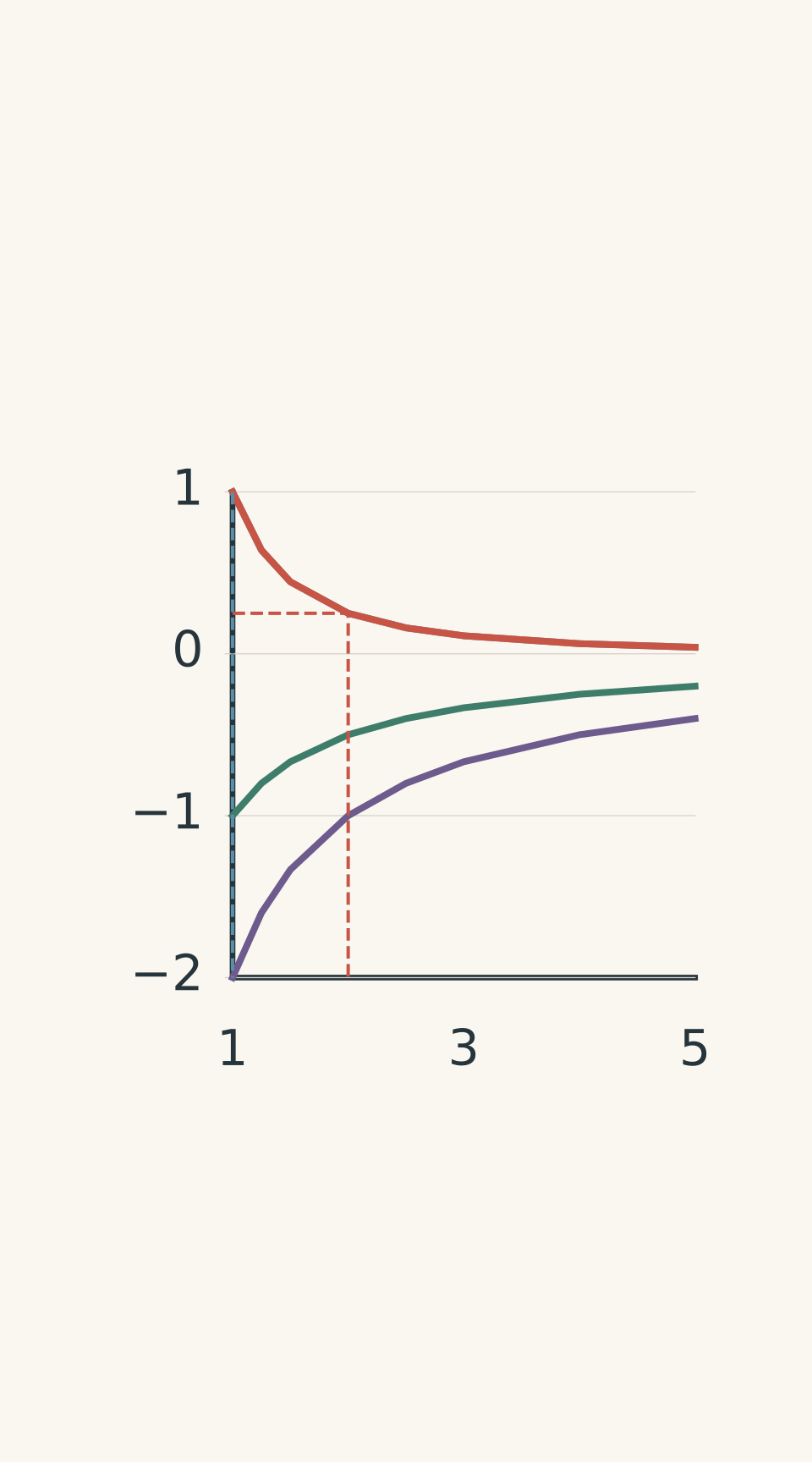
- Planet A: g/g_s
- Planet B: g/g_s (overlaps A)
- Planet A: U/(m g_s R) = −1/x
- Planet B: U/(m g_s R) = −2/x
- x = 1: g/g_s = 1
- x = 2: g/g_s = 0.25
Question 5
Planet A has mass \(M\) and radius \(R\). Planet B has mass \(4M\) and radius \(2R\). Both planets are spherical, and the gravitational effects of other bodies are negligible.
Their surface field-strength magnitudes are therefore equal:
\[ g_s=\frac{GM}{R^2}. \]
Identical probes of mass \(m\) are moved slowly from each planet’s surface to twice that planet’s own radius. Assume gravitational potential energy is zero at infinity.
A student argues:
“Both probes start in a field of strength \(g_s\) and finish in a field of strength \(g_s/4\), so the work required to move each probe must be the same.”
Evaluate this claim. Compare the potential-energy changes for the two probes and determine the ratio of their escape speeds from the two surfaces.
Solution 5
The student’s claim is incorrect. Planet B requires twice as much external work to move its probe from the surface to twice its own radius:
\[ \Delta U_A=\frac12 mg_sR, \qquad \Delta U_B=mg_sR. \]
The escape speed from planet B is also greater, by a factor of \(\sqrt{2}\).
The key is that matching field strengths at corresponding positions does not guarantee matching energy changes. The planets have different physical radii, so the distances over which the gravitational force acts are different.
Step 1: Check the field strengths.
For planet A, the surface field strength is
\[ g_{s,A}=\frac{GM}{R^2}=g_s. \]
For planet B,
\[ g_{s,B}=\frac{G(4M)}{(2R)^2} =\frac{GM}{R^2} =g_s. \]
The two surface field strengths are equal.
At twice each planet’s own radius, the field strength is one-quarter of its surface value:
\[ g_A(2R)=g_B(4R)=\frac{g_s}{4}. \]
So the student is correct about the field strengths at the starting and finishing positions.
Step 2: Calculate the energy change for planet A.
The probe starts at \(R\) and finishes at \(2R\).
Its initial potential energy is
\[ U_{A,i}=-\frac{GMm}{R}=-mg_sR. \]
Its final potential energy is
\[ U_{A,f}=-\frac{GMm}{2R} =-\frac12 mg_sR. \]
Therefore,
\[ \begin{aligned} \Delta U_A &=U_{A,f}-U_{A,i}\\[4pt] &=-\frac12 mg_sR+mg_sR\\[4pt] &=\frac12 mg_sR. \end{aligned} \]
Step 3: Calculate the energy change for planet B.
The probe starts at \(2R\) and finishes at \(4R\). These are twice the corresponding radii for planet A.
Its initial potential energy is
\[ U_{B,i}=-\frac{G(4M)m}{2R} =-2mg_sR. \]
Its final potential energy is
\[ U_{B,f}=-\frac{G(4M)m}{4R} =-mg_sR. \]
Therefore,
\[ \begin{aligned} \Delta U_B &=U_{B,f}-U_{B,i}\\[4pt] &=-mg_sR+2mg_sR\\[4pt] &=mg_sR. \end{aligned} \]
Comparing the changes,
\[ \frac{\Delta U_B}{\Delta U_A} =\frac{mg_sR}{\frac12 mg_sR} =2. \]
Planet B requires twice as much work because its probe travels through a radial interval that is twice as long. The field-strength profiles are identical when expressed in terms of the fraction of the planet’s radius, but planet B’s profile extends over twice the physical distance. Work depends on the force acting throughout the journey, not just on the field strengths at its endpoints.
Step 4: Compare the escape speeds.
Escape speed is the minimum speed needed to reach infinity with zero final kinetic energy, ignoring atmospheric resistance and other bodies.
Using conservation of energy, the initial kinetic energy must equal the magnitude of the initial gravitational potential energy:
\[ \frac12 mv_e^2=\frac{GMm}{R}. \]
For planet A,
\[ v_{e,A}=\sqrt{\frac{2GM}{R}} =\sqrt{2g_sR}. \]
For planet B,
\[ \begin{aligned} v_{e,B} &=\sqrt{\frac{2G(4M)}{2R}}\\[4pt] &=\sqrt{\frac{4GM}{R}}\\[4pt] &=\sqrt{2}\,v_{e,A}. \end{aligned} \]
Planet B has the greater escape speed, by a factor of \(\sqrt{2}\). Its surface field strength is identical to planet A’s, but its larger radius means that more energy per unit mass is required to reach infinity.
This is the deeper distinction: field strength describes the gravitational influence at a particular location, while potential energy accounts for the energy associated with the object’s position in the gravitational field.
08Next step: use potential energy to solve energy problems
Once you can distinguish \(g\) from \(U\), the next decision is whether a question asks about gravity at one location or energy transferred between two locations.
For lifting problems, use \(\Delta U\) to find the energy change. For escape-speed problems, combine the increase in gravitational potential energy with the initial kinetic energy using conservation of energy. Both applications depend on the same principle: field strength describes the local gravitational effect, while potential energy tracks how the system’s energy changes with position.