
Why Titration Results Can Be Precise but Inaccurate
Closely agreeing titres do not guarantee an accurate concentration. Learn how glassware preparation, standard-solution errors, endpoint choice, and burette readings affect titration results, with worked examples and HSC-style practice questions.
Three titration results are 24.80 mL, 24.81 mL, and 24.80 mL. They agree almost perfectly. You calculate the mean, substitute it into the formula, and get an HCl concentration of 0.101 M.
Now suppose the standard solution used in the experiment was prepared incorrectly. All three titres could agree just as closely, and the calculated concentration could still be wrong.
Would you trust the result? You should trust that the measurements are repeatable. You should not yet trust that the concentration is correct. Understanding the difference is essential when evaluating titration results in HSC Chemistry.
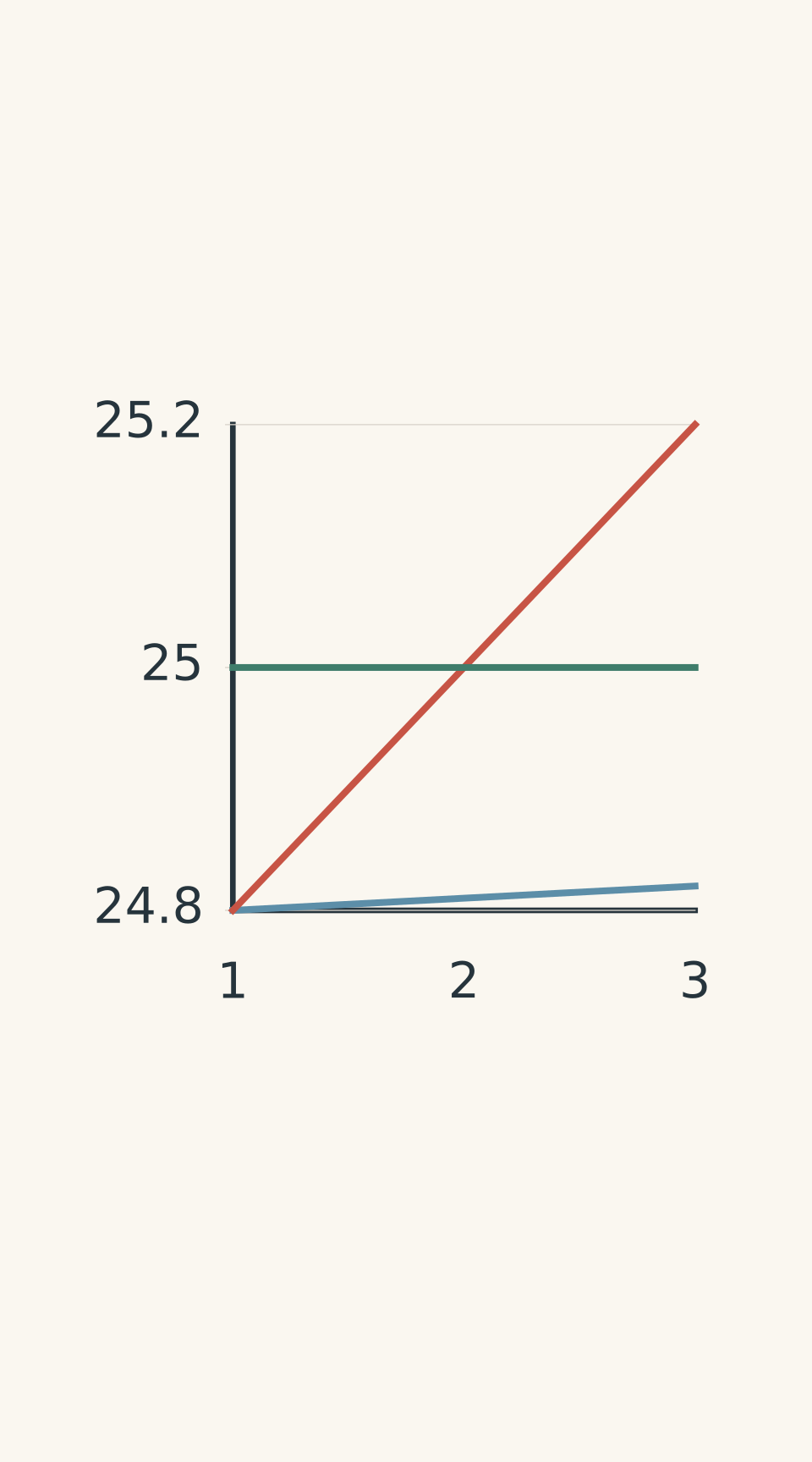
- High precision, biased
- Lower precision, accurate mean
- Reference (25.00 mL)
01Precision and accuracy are not the same
Precision describes how closely repeated measurements agree with one another. Accuracy describes how close a result is to the true or accepted value.
| Concept | What you examine | What it tells you |
|---|---|---|
| Precision | The spread of repeated titres | How repeatable the measurements are |
| Accuracy | The difference between the result and the true or accepted value | How close the result is to the correct value |
In a titration, closely agreeing titres are often called concordant titres. They suggest that random variation is small enough for the measurements to be repeatable.
However, a systematic error can shift every titre in the same direction.
Imagine that a burette contains a solution that has been unintentionally diluted. Every titration might produce a very similar titre, but the solution’s concentration is no longer what it was supposed to be. Repeating the measurement does not restore the original concentration.
This gives us a useful distinction:
- Random errors cause measurements to vary unpredictably. Repeating the titration and averaging concordant results can reduce their influence.
- Systematic errors introduce a consistent bias. Repeating the titration usually does not remove that bias.
A precise result can be inaccurate, and an accurate result can sometimes be obtained by coincidence. The aim is to minimise both types of error, not simply to collect titres that agree.
02Start with the titration calculation
To diagnose an error, you need to know how it affects the calculation. Otherwise, statements such as “the titre increases” or “the solution is diluted” do not tell you enough.
Consider a common experiment: determining the concentration of hydrochloric acid, HCl, using a standard sodium carbonate solution.
The procedure is as follows:
- A pipette transfers 25.00 mL of standard sodium carbonate solution into a conical flask.
- Hydrochloric acid of unknown concentration is placed in the burette.
- The acid is added until the indicator reaches the appropriate endpoint.
- The volume of acid delivered is recorded as the titre.
The reaction is:
\[ \ce{Na2CO3 + 2HCl -> 2NaCl + H2O + CO2} \]
One mole of sodium carbonate reacts with two moles of hydrochloric acid. That ratio is the key to the calculation.
At the equivalence point, the amount of HCl added is twice the amount of sodium carbonate originally present.
\[ n(\ce{HCl})=2n(\ce{Na2CO3}) \]
Since the amount of substance is \(n=cV\), we can write:
\[ c_{\ce{HCl}}V_{\ce{HCl}} = 2c_{\ce{Na2CO3}}V_{\ce{Na2CO3}} \]
Rearranging gives:
\[ \boxed{ c_{\ce{HCl}}= \frac{2c_{\ce{Na2CO3}}V_{\ce{Na2CO3}}} {V_{\ce{HCl}}} } \]
Here:
- \(c_{\ce{HCl}}\) is the calculated HCl concentration, in mol L\(^{-1}\).
- \(c_{\ce{Na2CO3}}\) is the known sodium carbonate concentration, in mol L\(^{-1}\).
- \(V_{\ce{Na2CO3}}\) is the pipetted sodium carbonate volume.
- \(V_{\ce{HCl}}\) is the titre, or volume of HCl delivered.
The two volumes must use the same units in this ratio. Using mL for both is fine.
From standard solution to HCl concentration
- Known standard solution
c(Na₂CO₃), V(Na₂CO₃)
Use the known concentration and pipetted volume.
- Calculate moles of Na₂CO₃
n = cV
Convert the aliquot volume to litres.
- Apply the reaction ratio
Na₂CO₃ : HCl = 1 : 2
Multiply moles of Na₂CO₃ by 2.
- Find moles of HCl
n(HCl) = 2n(Na₂CO₃)
Use the stoichiometric ratio at equivalence.
- Calculate HCl concentration
c(HCl) = n(HCl) / V(HCl)
Use the measured titre in litres to obtain mol L⁻¹.
Notice the relationship between concentration and titre. In this particular setup, the standard solution and its aliquot determine the numerator, while the measured acid titre is in the denominator.
That means:
- If the titre is too large, the calculated HCl concentration is too low.
- If the titre is too small, the calculated HCl concentration is too high.
- If the standard concentration used in the calculation is too high, the calculated HCl concentration is too high.
- If the standard concentration used in the calculation is too low, the calculated HCl concentration is too low.
Keep these relationships in mind as we examine the sources of error.
Worked example: Calculate a concentration from concordant titres
A student pipettes 25.00 mL of 0.0500 mol L\(^{-1}\) standard sodium carbonate solution into a conical flask. The concordant titres obtained when titrating with HCl are 24.70 mL, 24.75 mL, and 24.70 mL.
Calculate the mean titre and the concentration of HCl.
Step 1
\[ \begin{aligned} \bar V &=\frac{24.70+24.75+24.70}{3}\\ &=24.7167\ldots\ \mathrm{mL}\\ &=24.72\ \mathrm{mL} \end{aligned} \]
The mean is rounded to two decimal places, consistent with the recorded titres.
Step 2
One mole of sodium carbonate reacts with two moles of HCl, so:
\[ c_{\ce{HCl}}= \frac{2c_{\ce{Na2CO3}}V_{\ce{Na2CO3}}} {V_{\ce{HCl}}} \]
Step 3
\[ \begin{aligned} c_{\ce{HCl}} &=\frac{2(0.0500)(25.00)}{24.72}\\ &=0.10113\ldots\ \mathrm{mol\,L^{-1}}\\ &=\boxed{0.1011\ \mathrm{mol\,L^{-1}}} \end{aligned} \]
Step 4
The titres are closely grouped, so the measurements are precise. However, this calculation assumes that the standard concentration is correct, the correct amount of standard solution was delivered, and the endpoint was identified properly.
The calculation cannot independently verify those assumptions. A calculator can process incorrect experimental inputs perfectly.
03Error 1: Preparing the glassware incorrectly
One of the most tempting mistakes is to assume that any water left in the glassware will make the titration inaccurate in the same way.
It will not. The effect depends on where the water is and what the glassware is supposed to deliver.
Where leftover water changes the titration
| Water in the pipette | Fewer moles of Na₂CO₃ delivered; titre decreases. Calculated HCl concentration is too high. |
|---|---|
| Water in the conical flask | Na₂CO₃ moles and theoretical titre stay unchanged. No theoretical concentration bias. |
| Water in the burette | HCl is diluted; a larger titre is needed. Calculated concentration is too low relative to the original acid stock. |
Water left in the pipette
The pipette is used to transfer a measured volume of the standard sodium carbonate solution.
It should be rinsed with the solution it will contain before use. If it is rinsed with distilled water instead, some water may remain inside when the standard solution is added.
That water dilutes the solution in the pipette. The delivered aliquot therefore contains fewer moles of sodium carbonate than expected for 25.00 mL at the stated concentration.
The student still calculates the expected amount using \(c_{\ce{Na2CO3}}\times 25.00\ \mathrm{mL}\), so the numerator in the concentration calculation is too large relative to the actual amount of standard delivered.
Less sodium carbonate requires less HCl to reach equivalence. The measured titre is smaller than it should be.
Because the titre is in the denominator, the calculated HCl concentration is too high.
The important point is that the pipette has delivered fewer moles than the student assumes, even though the student has recorded the correct nominal pipette volume.
Water left in the burette
The burette contains the HCl being analysed.
It should be rinsed with the HCl solution before filling. If water remains inside, the acid is diluted.
The diluted acid has a lower concentration, so a larger volume is required to supply the moles of HCl needed to react with the known sodium carbonate.
The measured titre increases. If the aim is to determine the concentration of the original acid stock, the calculated concentration will be too low.
Strictly speaking, the titration determines the concentration of the liquid actually delivered from the burette. If that liquid has been diluted, the result describes the diluted solution rather than the original stock.
Water left in the conical flask
Now consider a different situation. The pipette delivers the correct amount of standard sodium carbonate, but the conical flask contains an extra 10 mL of distilled water.
Predict what happens to the titre.
The solution becomes more dilute, but the number of moles of sodium carbonate does not change. The same amount of HCl is required to react with those moles.
Therefore, provided the endpoint is detected correctly, the titre and calculated concentration are unchanged.
This is a crucial distinction: dilution does not necessarily change the amount of titrant required. In this case, water changes the volume and concentration of the mixture in the flask, but not the amount of sodium carbonate present.
The conical flask should be clean, but it does not need to be dry.
There is one important qualification. If the flask contains a residue of a reagent rather than distilled water, the result can change. Extra sodium carbonate would increase the titre and cause the calculated HCl concentration to be too low. Residual HCl would consume some sodium carbonate before any acid is delivered from the burette, decreasing the titre and causing the calculated concentration to be too high.
Always identify what is left in the glassware before predicting the error.
04Error 2: Preparing the standard solution incorrectly
The standard solution supplies the known concentration used in the calculation. If that concentration is wrong, the error flows directly into the calculated concentration of the unknown solution.
For this titration:
\[ c_{\ce{HCl}}\propto c_{\ce{Na2CO3}} \]
The calculated HCl concentration is directly proportional to the sodium carbonate concentration used in the formula.
If the stated standard concentration is too high, the calculated HCl concentration will also be too high. If the stated standard concentration is too low, the calculated HCl concentration will be too low.
The tricky part is identifying whether the stated concentration is too high or too low. Do not simply ask whether the solution itself is more concentrated or more dilute. Compare its actual concentration with the value entered into the calculation.
Common preparation errors
| Preparation error | Actual standard solution | Effect on calculated HCl concentration |
|---|---|---|
| Some weighed solid is lost during transfer, but the original mass is used in the calculation | Less concentrated than stated | Too high |
| The volumetric flask is filled above the calibration mark, but the nominal volume is used in the calculation | More dilute than stated | Too high |
| The volumetric flask is left below the calibration mark, but the nominal volume is used in the calculation | More concentrated than stated | Too low |
| The standard concentration is calculated using a mass that is too low | More concentrated than stated | Too low |
These predictions assume that the other measurements and the titration itself are correct.
Preparing an accurate standard solution
- Weigh the solid
Record the mass used to calculate the stated concentration.
- Transfer all the solid
Solid lost during transfer: actual concentration is lower than stated.
- Dissolve completely
Ensure all solute dissolves before making up the volume.
- Fill to the calibration mark
Above mark: actual concentration lower than stated.
Below mark: actual concentration higher than stated.
A useful way to reason through these errors is to separate two questions:
- What is the actual concentration of the standard solution?
- What concentration does the student use in the calculation?
The second value determines the direction of the calculation bias. If the student assumes that more sodium carbonate was present than actually was, the calculated HCl concentration will be too high. If the student assumes that less was present, the calculated concentration will be too low.
Worked example: A standard solution is too dilute
A student prepares a sodium carbonate solution intended to have a concentration of 0.0500 mol L\(^{-1}\). Some solid is lost during transfer, so the actual concentration is 0.0480 mol L\(^{-1}\). The student nevertheless uses 0.0500 mol L\(^{-1}\) in the calculation.
A 25.00 mL aliquot requires a titre of 24.00 mL of HCl.
Calculate the reported HCl concentration and the concentration obtained using the actual standard concentration.
Step 1
\[ \begin{aligned} c_{\ce{HCl}} &=\frac{2(0.0500)(25.00)}{24.00}\\ &=\boxed{0.1042\ \mathrm{mol\,L^{-1}}} \end{aligned} \]
Step 2
\[ \begin{aligned} c_{\ce{HCl}} &=\frac{2(0.0480)(25.00)}{24.00}\\ &=\boxed{0.1000\ \mathrm{mol\,L^{-1}}} \end{aligned} \]
Step 3
The reported concentration is 0.1042 mol L\(^{-1}\), whereas the result based on the actual standard concentration is 0.1000 mol L\(^{-1}\).
The student overestimates the HCl concentration because the numerator assumes more moles of sodium carbonate than the aliquot actually contains. The error is systematic: repeating the titration with the same incorrectly prepared standard solution will not fix it.
05Error 3: Choosing the wrong endpoint
The endpoint is the observed indicator colour change used to decide when to stop the titration. The equivalence point is the point at which the reactants have been added in the exact stoichiometric ratio.
These points are related, but they are not identical by definition. A suitable indicator changes colour close to the equivalence point.
Two different mistakes can occur here:
- The student chooses the correct indicator but adds too much titrant after the endpoint.
- The student chooses an indicator whose endpoint corresponds to the wrong stage of the reaction.
The first mistake has a predictable effect. In our HCl titration, overshooting the endpoint makes the titre too large, so the calculated HCl concentration is too low. Stopping before the endpoint makes the titre too small, so the calculated concentration is too high.
The second mistake requires more chemical information. The direction of the error depends on where the chosen endpoint lies relative to the required equivalence point.
Why sodium carbonate has a particularly useful example
Sodium carbonate reacts with HCl in two stages.
Two stages of carbonate neutralisation
- Stage 1: First proton accepted
CO₃²⁻ + H⁺ → HCO₃⁻
Mole ratio: 1 mol H⁺ per 1 mol CO₃²⁻.
- Stage 2: Second proton accepted
HCO₃⁻ + H⁺ → H₂CO₃ → CO₂ + H₂O
A second mole of H⁺ completes neutralisation.
- Overall titration ratio
Na₂CO₃ : HCl = 1 : 2
1 mol Na₂CO₃ reacts with 2 mol HCl.
At the first endpoint, carbonate ions have been converted into hydrogen carbonate ions. One mole of HCl has reacted per mole of sodium carbonate.
At the second endpoint, the hydrogen carbonate has reacted further. Complete neutralisation requires two moles of HCl per mole of sodium carbonate.
For a titration intended to measure the full reaction, methyl orange is suitable for detecting the second endpoint. Phenolphthalein changes colour at the first endpoint instead.
If a student uses phenolphthalein but still applies the full-reaction mole ratio of 1:2, the titre will be approximately half the required volume under idealised conditions. The calculated HCl concentration will therefore be approximately twice the true concentration.
The error is not simply that the indicator was “wrong”. The indicator identified a different chemical stage, and the student applied a mole ratio that did not match that stage.
This is why you cannot always predict the direction of an indicator error without knowing the reaction, the indicator’s transition range, and the intended equivalence point.
06Error 4: Reading the burette incorrectly
A burette does not have to start at 0.00 mL. The volume delivered is the final reading minus the initial reading.
\[ V_{\text{titre}}=V_{\text{final}}-V_{\text{initial}} \]
This subtraction matters because an error in either reading affects the titre differently.
Suppose the initial reading is correct, but the final reading is recorded too high. The calculated titre is too large, so the calculated HCl concentration is too low.
Now suppose the final reading is correct, but the initial reading is recorded too high. Subtracting an excessively large initial reading gives a titre that is too small, so the calculated HCl concentration is too high.
How burette reading errors affect concentration
| Final reading too high | Titre too high → calculated HCl concentration too low. |
|---|---|
| Initial reading too high | Titre too low → calculated HCl concentration too high. |
| Both readings shifted equally | Difference unchanged → no titre bias. |
For a clear, colourless solution, read the bottom of the meniscus at eye level. This reduces parallax error, which occurs when the reading changes with the observer’s viewing angle.
There is an important catch. If both readings have exactly the same systematic offset, the offset cancels when the initial reading is subtracted from the final reading. If the errors differ, the effect depends on which reading is wrong and by how much.
So the statement “parallax makes the titre too high” is incomplete. You need to know how the initial and final readings were affected.
07Questions and solutions
Question 1
A student titrates 25.00 mL of 0.0500 mol L\(^{-1}\) sodium carbonate solution with HCl. The mean concordant titre is 24.90 mL.
Calculate the HCl concentration, assuming complete neutralisation and no systematic errors.
Solution 1
The HCl concentration is \(0.1004\ \mathrm{mol\,L^{-1}}\). The calculation uses the 1:2 mole ratio between sodium carbonate and HCl.
The balanced equation is:
\[ \ce{Na2CO3 + 2HCl -> 2NaCl + H2O + CO2} \]
Therefore,
\[ \begin{aligned} c_{\ce{HCl}} &=\frac{2c_{\ce{Na2CO3}}V_{\ce{Na2CO3}}} {V_{\ce{HCl}}}\\[4pt] &=\frac{2(0.0500)(25.00)}{24.90}\\[4pt] &=0.1004\ \mathrm{mol\,L^{-1}} \end{aligned} \]
The result is the concentration calculated from the measurements. The assumption that the experiment contains no systematic errors is necessary before we can treat it as an accurate estimate of the unknown concentration.
Question 2
A student uses 25.00 mL of 0.0500 mol L\(^{-1}\) sodium carbonate to determine the concentration of HCl, which is actually 0.1000 mol L\(^{-1}\).
Consider two separate experiments.
- Experiment A: Water left in the pipette displaces 0.50 mL-equivalent of the standard solution, so the delivered aliquot contains the same amount of sodium carbonate as 24.50 mL of the standard solution.
- Experiment B: The pipette delivers the correct aliquot, but the conical flask contains an extra 5.0 mL of distilled water.
For each experiment, determine the expected HCl titre and the concentration the student calculates if they assume that 25.00 mL of the standard solution was delivered. Assume the endpoints are identified correctly.
Solution 2
Experiment A gives a titre of 24.50 mL and a calculated HCl concentration of \(0.1020\ \mathrm{mol\,L^{-1}}\). Experiment B gives a titre of 25.00 mL and a calculated concentration of \(0.1000\ \mathrm{mol\,L^{-1}}\).
In Experiment A, the actual amount of sodium carbonate delivered is:
\[ \begin{aligned} n(\ce{Na2CO3}) &=cV\\ &=0.0500(0.02450)\\ &=1.225\times10^{-3}\ \mathrm{mol} \end{aligned} \]
The required amount of HCl is twice this value:
\[ n(\ce{HCl})=2.450\times10^{-3}\ \mathrm{mol} \]
Since the actual HCl concentration is 0.1000 mol L\(^{-1}\), the titre is:
\[ \begin{aligned} V_{\ce{HCl}} &=\frac{n}{c}\\ &=\frac{2.450\times10^{-3}}{0.1000}\\ &=0.02450\ \mathrm{L}\\ &=24.50\ \mathrm{mL} \end{aligned} \]
The student assumes the full 25.00 mL aliquot was delivered, so the calculated concentration is:
\[ \begin{aligned} c_{\ce{HCl}} &=\frac{2(0.0500)(25.00)}{24.50}\\ &=\boxed{0.1020\ \mathrm{mol\,L^{-1}}} \end{aligned} \]
The calculated value is too high because the titre is smaller than expected while the numerator remains based on the full aliquot.
In Experiment B, the amount of sodium carbonate delivered is unchanged:
\[ n(\ce{Na2CO3})=0.0500(0.02500) =1.250\times10^{-3}\ \mathrm{mol} \]
The required HCl volume is therefore:
\[ V_{\ce{HCl}} =\frac{2(1.250\times10^{-3})}{0.1000} =0.02500\ \mathrm{L} \]
The titre remains 25.00 mL, and the calculated concentration is:
\[ c_{\ce{HCl}} =\frac{2(0.0500)(25.00)}{25.00} =\boxed{0.1000\ \mathrm{mol\,L^{-1}}} \]
The extra water in the conical flask changes the solution’s dilution, not the number of moles of sodium carbonate. That is why it does not change the theoretical titre.
Question 3
A student titrates 25.00 mL of 0.0500 mol L\(^{-1}\) sodium carbonate with HCl.
The initial burette reading is 0.18 mL, and the final reading is recorded as 24.96 mL. A later calibration check reveals that the final reading was 0.12 mL too high, while the initial reading was correct.
Calculate:
(a) the titre recorded by the student;
(b) the HCl concentration calculated from the recorded readings; and
(c) the corrected titre and HCl concentration.
Explain the direction of the error.
Solution 3
The student records a titre of 24.78 mL and calculates \(0.1009\ \mathrm{mol\,L^{-1}}\), but the corrected titre is 24.66 mL and the corrected concentration is \(0.1014\ \mathrm{mol\,L^{-1}}\). The final reading was too high, so the student overestimated the volume delivered.
(a) Recorded titre
\[ \begin{aligned} V_{\text{titre}} &=V_{\text{final}}-V_{\text{initial}}\\ &=24.96-0.18\\ &=\boxed{24.78\ \mathrm{mL}} \end{aligned} \]
(b) Calculated concentration using the recorded readings
\[ \begin{aligned} c_{\ce{HCl}} &=\frac{2(0.0500)(25.00)}{24.78}\\ &=\boxed{0.1009\ \mathrm{mol\,L^{-1}}} \end{aligned} \]
(c) Corrected titre and concentration
The corrected final reading is:
\[ 24.96-0.12=24.84\ \mathrm{mL} \]
Therefore,
\[ \begin{aligned} V_{\text{corrected}} &=24.84-0.18\\ &=\boxed{24.66\ \mathrm{mL}} \end{aligned} \]
Using the corrected titre:
\[ \begin{aligned} c_{\ce{HCl}} &=\frac{2(0.0500)(25.00)}{24.66}\\ &=\boxed{0.1014\ \mathrm{mol\,L^{-1}}} \end{aligned} \]
The original calculation used a titre that was 0.12 mL too large. Since the titre is in the denominator, the reported concentration was too low. Correcting the reading reduces the titre and increases the calculated concentration.
Question 4
A student titrates 25.00 mL of 0.0500 mol L\(^{-1}\) sodium carbonate with 0.1000 mol L\(^{-1}\) HCl.
The student uses phenolphthalein and stops at its colour-change endpoint. However, they calculate the HCl concentration using the equation for complete neutralisation, which assumes two moles of HCl per mole of sodium carbonate.
Assume the indicator detects the first equivalence point exactly.
(a) Calculate the titre at this endpoint.
(b) Calculate the HCl concentration the student reports.
(c) Explain why the direction of an endpoint error cannot always be predicted from the statement that the wrong indicator was used.
Solution 4
The titre is 12.50 mL, and the student calculates \(0.2000\ \mathrm{mol\,L^{-1}}\), twice the actual HCl concentration. The student has measured the first stage of the reaction but applied the mole ratio for complete neutralisation.
(a) Titre at the first equivalence point
The amount of sodium carbonate is:
\[ \begin{aligned} n(\ce{Na2CO3}) &=cV\\ &=0.0500(0.02500)\\ &=1.250\times10^{-3}\ \mathrm{mol} \end{aligned} \]
At the first equivalence point, one mole of HCl reacts per mole of sodium carbonate. Therefore:
\[ \begin{aligned} V_{\ce{HCl}} &=\frac{1.250\times10^{-3}}{0.1000}\\ &=0.01250\ \mathrm{L}\\ &=\boxed{12.50\ \mathrm{mL}} \end{aligned} \]
(b) Reported concentration
The student uses the full-neutralisation equation, so:
\[ \begin{aligned} c_{\ce{HCl}} &=\frac{2(0.0500)(25.00)}{12.50}\\ &=\boxed{0.2000\ \mathrm{mol\,L^{-1}}} \end{aligned} \]
The correct HCl concentration is 0.1000 mol L\(^{-1}\). The student has doubled the calculated concentration because the first endpoint requires only half the HCl volume needed for complete neutralisation.
(c) Why the direction is not universal
The error depends on the chemical reaction and the endpoint selected. Here, phenolphthalein detects the first equivalence point, while the calculation assumes the second. The smaller titre produces an overestimated concentration.
For a different reaction, the indicator transition could occur slightly before or after the intended equivalence point, or it could correspond to a different reaction stage. You must know that relationship before predicting the direction of the bias.
Question 5
A standard sodium carbonate solution is labelled 0.0500 mol L\(^{-1}\), but its actual concentration is 0.0498 mol L\(^{-1}\) because a small amount of solid was lost during transfer. The student continues to use the labelled concentration in every calculation.
The HCl being analysed is actually 0.1000 mol L\(^{-1}\). The student consistently overshoots the methyl-orange endpoint by an additional 0.10 mL on every titration.
(a) For a 25.00 mL aliquot of the standard solution, calculate the true equivalence titre, the observed titre, and the calculated HCl concentration.
(b) Repeat the calculation for a 20.00 mL aliquot, assuming the same absolute endpoint overshoot of 0.10 mL.
(c) Explain why obtaining the correct concentration in part (a), even across several concordant titres, does not establish that the method is accurate.
Solution 5
The first experiment gives the correct calculated concentration of \(0.1000\ \mathrm{mol\,L^{-1}}\) by coincidence, but the second gives \(0.09990\ \mathrm{mol\,L^{-1}}\). Two systematic errors cancel exactly in the first experiment, but they no longer cancel when the aliquot volume changes.
(a) The 25.00 mL aliquot
First, calculate the true equivalence titre using the actual standard concentration:
\[ \begin{aligned} V_{\text{equivalence}} &=\frac{2c_{\ce{Na2CO3}}V_{\ce{Na2CO3}}} {c_{\ce{HCl}}}\\ &=\frac{2(0.0498)(25.00)}{0.1000}\\ &=\boxed{24.90\ \mathrm{mL}} \end{aligned} \]
The student overshoots this point by 0.10 mL, so the observed titre is:
\[ V_{\text{observed}}=24.90+0.10 =\boxed{25.00\ \mathrm{mL}} \]
The student calculates the concentration using the labelled standard concentration:
\[ \begin{aligned} c_{\ce{HCl}} &=\frac{2(0.0500)(25.00)}{25.00}\\ &=\boxed{0.1000\ \mathrm{mol\,L^{-1}}} \end{aligned} \]
This is exactly the true HCl concentration.
However, the standard concentration used in the calculation is too high, which biases the result upwards. The endpoint overshoot makes the titre too large, which biases the result downwards. For these particular values, the two errors cancel exactly.
(b) The 20.00 mL aliquot
Calculate the true equivalence titre for the smaller aliquot:
\[ \begin{aligned} V_{\text{equivalence}} &=\frac{2(0.0498)(20.00)}{0.1000}\\ &=\boxed{19.92\ \mathrm{mL}} \end{aligned} \]
The same absolute overshoot gives an observed titre of:
\[ V_{\text{observed}}=19.92+0.10 =\boxed{20.02\ \mathrm{mL}} \]
Using the labelled standard concentration:
\[ \begin{aligned} c_{\ce{HCl}} &=\frac{2(0.0500)(20.00)}{20.02}\\ &=0.0999001\ldots\ \mathrm{mol\,L^{-1}}\\ &=\boxed{0.09990\ \mathrm{mol\,L^{-1}}} \end{aligned} \]
The calculated concentration is now slightly too low.
(c) Why the first result does not validate the method
The first result is accurate only by coincidence. It does not demonstrate that either systematic error is absent.
The concentration error in the standard solution creates a proportional bias in the numerator. The endpoint error adds a fixed volume to the titre. That fixed volume represents a larger fraction of a smaller titre, so the balance between the two errors changes when the aliquot volume decreases.
Even if the student obtains three or more identical titres of 25.00 mL, the same two biases can recur every time. The results may be highly precise while concealing an unreliable method.
The practical lesson is to assess repeatability and systematic error separately. Repeated titres help identify random variation; checking standard-solution preparation, glassware preparation, indicator choice, and burette readings helps identify shared bias. That distinction leads directly into uncertainty analysis, where you learn to separate the spread of measurements from errors that shift an entire set of results.