
Doppler Shift in Sound vs Light: Choosing the Right Model
Learn how the Doppler effect differs for sound and light, and how to choose the correct model for each problem. Includes worked examples, a model-selection table, common mistakes, and HSC-style practice questions with detailed solutions.
An ambulance siren sounds higher as it approaches and lower after it passes. A star can show a similar Doppler shift when its spectral lines move towards shorter or longer wavelengths. But the two situations require different models. Predict this before choosing a formula: if a sound source and listener close at the same rate in two different ways, must the listener hear the same pitch? No. Sound travels through a medium, so their separate velocities relative to that medium can matter.
01Quick decision rule
- Sound: Use the classical sound Doppler equation. Measure the source’s and observer’s velocities relative to the medium, such as still air.
- Light: Compare the observed wavelength with the known rest wavelength. For speeds much smaller than the speed of light, use the fractional wavelength shift to estimate radial velocity.
- Light at high speeds: Use the relativistic light-Doppler model, not the sound equation with the speed of light substituted into it.
- Astronomical redshift: Check whether the shift is caused by relative motion, cosmic expansion, or another effect before interpreting it as a velocity.
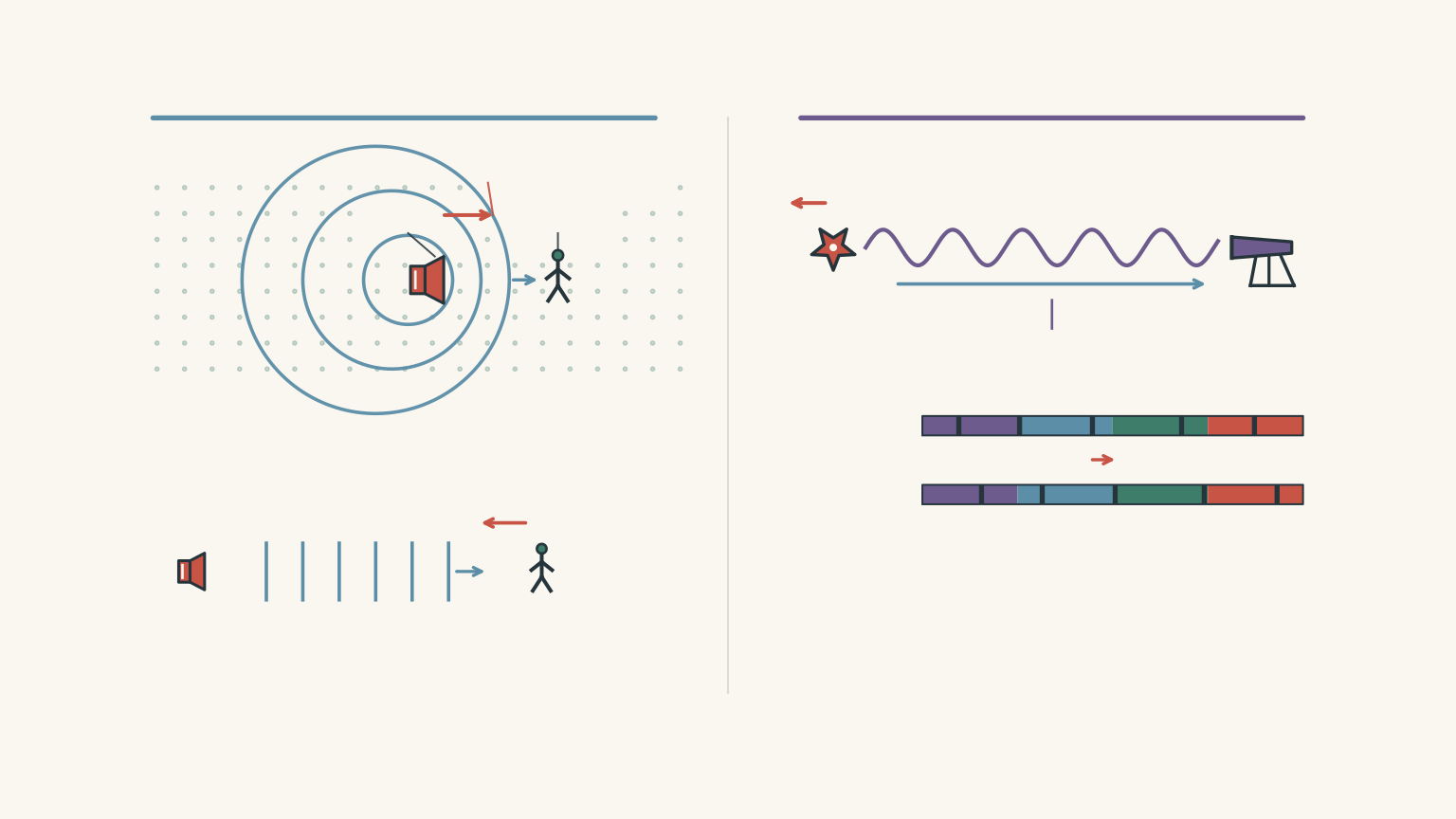
Due to technical limitations, this figure may display incorrectly or contain inaccuracies. Please check key details against your course materials.
02Model-selection table
| What the question gives you | Model to use | Essential check |
|---|---|---|
| A sound frequency, speed of sound, and source or observer velocities | Classical sound Doppler equation | Velocities are relative to the medium. |
| A known spectral line and its observed wavelength, with low relative speeds | \(z=\dfrac{\lambda_{\mathrm{obs}}-\lambda_0}{\lambda_0}\), then \(v_r\approx cz\) | Use the rest wavelength and check the sign of the shift. |
| Light from an object moving at a substantial fraction of \(c\) | Relativistic light-Doppler model | The low-speed approximation is no longer reliable. |
| A large redshift from a distant galaxy, with no stated cause | Investigate the origin of the redshift first | Cosmic expansion may contribute, so \(v_r\approx cz\) may not give a meaningful ordinary recession speed. |
The key distinction is the reference frame: sound velocities are measured relative to the medium, whereas the light-Doppler effect is described using the relative motion of the source and observer.
01Sound: why the medium matters
Imagine a buzzer producing a steady tone in still air. It emits successive wave crests at regular time intervals.
If the buzzer is stationary, the crests are evenly spaced in the air. If the buzzer moves towards a listener, each new crest is emitted from a position closer to the previous crest. The wavefronts become more closely spaced in front of the source.
If the buzzer moves away, the spacing increases behind it.
There is a second effect. An observer moving towards incoming wave crests meets them more frequently. An observer moving away meets them less frequently.
Think of road markings: moving past them faster means crossing more markings each second, while closer spacing also increases the crossing rate. For sound, the source changes the spacing of the crests, and the observer changes the rate at which they are encountered. The analogy is only a guide; sound crests are wave patterns travelling through a medium, not physical markings.
The sound Doppler equation
For motion along the line joining the source and observer, use
\[ f_{\mathrm{obs}} = f_s\frac{v+v_o}{v-v_s} \]
where:
- \(f_{\mathrm{obs}}\) is the observed frequency, in hertz (Hz).
- \(f_s\) is the frequency emitted by the source, in hertz (Hz).
- \(v\) is the speed of sound relative to the medium, in metres per second (m/s).
- \(v_o\) is the observer’s velocity component towards the source, relative to the medium, in m/s.
- \(v_s\) is the source’s velocity component towards the observer, relative to the medium, in m/s.
This is the classical sound model for a uniform medium and ordinary, subsonic source motion. If there is wind, account for the motion of the air by expressing the velocities relative to the medium.
The signs are part of the model, not a detail to add at the end.
- Observer moving towards the source: \(v_o>0\). The numerator increases, so the observed frequency increases.
- Observer moving away from the source: \(v_o<0\). The numerator decreases, so the observed frequency decreases.
- Source moving towards the observer: \(v_s>0\). The denominator decreases, so the observed frequency increases.
- Source moving away from the observer: \(v_s<0\). The denominator increases, so the observed frequency decreases.
An object can move towards the other object or away from it while both objects travel in the same direction. Assign the signs to each velocity separately.
Worked example: an approaching observer
A stationary buzzer emits a frequency of 500 Hz. An observer cycles towards it at 17 m/s through still air. The speed of sound is 340 m/s. Calculate the observed frequency.
Step 1
The wave travels through air, so use the classical sound Doppler equation. The source is stationary, giving \(v_s=0\), while the observer moves towards the source, giving \(v_o=+17\ \text{m/s}\).
Step 2
\[ \begin{aligned} f_{\mathrm{obs}} &=f_s\frac{v+v_o}{v-v_s}\\[4pt] &=500\frac{340+17}{340-0}\\[4pt] &=500\frac{357}{340}\\[4pt] &=525\ \text{Hz} \end{aligned} \]
Step 3
The frequency rises from 500 Hz to 525 Hz, as expected when the observer moves towards the source. The ratio of speeds is dimensionless, so the answer retains the unit Hz.
Notice that the buzzer still emits 500 Hz. The observer measures a different frequency because the crests arrive more frequently.
02Light: read the spectral line
Astronomers can identify elements in stars by comparing their spectra with known laboratory spectra. Particular atoms produce characteristic spectral lines at known wavelengths.
Suppose a laboratory line has wavelength \(\lambda_0\). A telescope measures the same line at wavelength \(\lambda_{\mathrm{obs}}\). Comparing these values reveals whether the line has shifted.
- Redshift: \(\lambda_{\mathrm{obs}}>\lambda_0\). The observed wavelength is longer and the frequency is lower.
- Blueshift: \(\lambda_{\mathrm{obs}}<\lambda_0\). The observed wavelength is shorter and the frequency is higher.
- No wavelength shift: \(\lambda_{\mathrm{obs}}=\lambda_0\). There is no net shift of that line in the model being considered.
A blueshift does not necessarily mean the star emits blue visible light. It means the identified spectral line has moved towards shorter wavelengths compared with its rest position.
Calculate the fractional wavelength shift
For a light-Doppler problem, first calculate the redshift parameter:
\[ z=\frac{\lambda_{\mathrm{obs}}-\lambda_0}{\lambda_0} \]
Here:
- \(z\) is the fractional wavelength shift. It has no units.
- \(\lambda_{\mathrm{obs}}\) is the observed wavelength.
- \(\lambda_0\) is the rest wavelength, measured in the laboratory.
For a Doppler shift caused by radial motion at speeds much smaller than the speed of light, use
\[ v_r\approx cz \]
where \(v_r\) is the radial velocity, taken as positive when the source is receding, and \(c=3.00\times10^8\ \text{m/s}\) is the speed of light in vacuum.
The radial component is the part of the motion directly towards or away from the observer. A positive result means recession; a negative result means approach, provided the shift is Doppler-dominated.
Use the fractional shift, not just the wavelength difference. A shift of 2 nm has a different significance for a line originally at 400 nm than for one originally at 800 nm.
The low-speed approximation also has limits. At speeds that are not small compared with \(c\), use the relativistic light-Doppler model specified or required by the question. Do not assume that \(v_r\approx cz\) remains accurate at high redshift.
Worked example: infer motion from a spectral line
A spectral line has a known rest wavelength of 500.0 nm. A telescope observes it at 502.0 nm. Assuming the shift is caused by low-speed Doppler motion, estimate the source’s radial velocity and state its direction.
Step 1
This is a light-spectrum problem. Use the fractional wavelength shift, followed by \(v_r\approx cz\). There is no sound medium to include.
Step 2
\[ \begin{aligned} z &=\frac{\lambda_{\mathrm{obs}}-\lambda_0}{\lambda_0}\\[4pt] &=\frac{502.0-500.0}{500.0}\\[4pt] &=0.0040 \end{aligned} \]
Both wavelengths are in nanometres, so their ratio is dimensionless.
Step 3
\[ \begin{aligned} v_r&\approx cz\\ &=(3.00\times10^8)(0.0040)\\ &=1.20\times10^6\ \text{m/s}\\ &=1.20\times10^3\ \text{km/s} \end{aligned} \]
Step 4
The result is positive, and the observed wavelength is longer than the rest wavelength. The source is therefore receding at an estimated radial speed of 1,200 km/s under the stated assumptions.
The result describes motion along the line of sight, not necessarily the source’s total speed.
A limit on astronomical redshift
A redshift is an observation, not a unique explanation for that observation.
For nearby objects, a Doppler interpretation may be appropriate when other effects are negligible. For very distant galaxies, cosmic expansion can produce redshift. Gravitational effects can also shift light.
Therefore, do not automatically convert every measured galaxy redshift into an ordinary recession speed using \(v_r\approx cz\). First check which physical model the question assumes.
05Common mistakes
Substituting the speed of light into the sound equation. The sound equation accounts for source and observer motion relative to a medium. Light in vacuum has no corresponding medium frame, and its Doppler shift follows the relativistic model of light.
Using the wavelength difference without dividing by the rest wavelength. Calculate \(z=(\lambda_{\mathrm{obs}}-\lambda_0)/\lambda_0\) before estimating the radial speed.
Mixing up the signs in the sound equation. Source motion changes the wavelength created in the medium; observer motion changes the rate at which crests are encountered. Assign each velocity its own sign.
Treating redshift as the object’s complete velocity. In the usual low-speed astronomical model, the shift estimates radial motion. It does not reveal transverse motion by itself.
Treating \(v_r\approx cz\) as an exact rule. It is a low-speed approximation for a Doppler-dominated shift, not a universal conversion for every astronomical redshift.
06Questions and solutions
Question 1
A stationary siren emits a frequency of 720 Hz. A cyclist rides towards it at 12 m/s through still air. The speed of sound is 330 m/s.
Calculate the frequency heard by the cyclist.
Solution 1
The cyclist hears approximately 746 Hz, which is higher than the emitted frequency because the cyclist moves towards the incoming sound wavefronts.
The source is stationary, so \(v_s=0\). The observer moves towards the source, so \(v_o=+12\ \text{m/s}\).
Using the sound Doppler equation,
\[ \begin{aligned} f_{\mathrm{obs}} &=f_s\frac{v+v_o}{v-v_s}\\[4pt] &=720\frac{330+12}{330-0}\\[4pt] &=720\frac{342}{330}\\[4pt] &=746.18\ \text{Hz} \end{aligned} \]
To three significant figures, \(f_{\mathrm{obs}}=746\ \text{Hz}\).
The frequency rises because the cyclist encounters more crests per second. The siren’s emitted frequency remains 720 Hz.
Question 2
A car’s siren emits 900 Hz and the car moves towards a cyclist at 25 m/s. The cyclist is initially stationary, then rides either towards the car at 5 m/s or directly away from it at 5 m/s. Assume the car remains behind the cyclist, and the speed of sound is 340 m/s in still air.
Calculate the frequency heard in each case. Explain why the two results differ, even though the car’s motion is unchanged.
Solution 2
The cyclist hears approximately 986 Hz when riding towards the car and 957 Hz when riding away from it. Both frequencies exceed 900 Hz because the car is approaching in both cases.
Case A: The cyclist rides towards the car.
The source moves towards the observer, so \(v_s=+25\ \text{m/s}\). The observer moves towards the source, so \(v_o=+5\ \text{m/s}\).
\[ \begin{aligned} f_{\mathrm{obs}} &=900\frac{340+5}{340-25}\\[4pt] &=900\frac{345}{315}\\[4pt] &=985.7\ \text{Hz} \end{aligned} \]
The source compresses the wavefront spacing, and the observer also encounters the wavefronts faster.
Case B: The cyclist rides away from the car.
The source still moves towards the observer, so \(v_s=+25\ \text{m/s}\). However, the observer now moves away from the source, so \(v_o=-5\ \text{m/s}\).
\[ \begin{aligned} f_{\mathrm{obs}} &=900\frac{340-5}{340-25}\\[4pt] &=900\frac{335}{315}\\[4pt] &=957.1\ \text{Hz} \end{aligned} \]
The observer’s motion reduces the rate at which wavefronts are encountered, but the approaching car still compresses the wavefronts.
The important distinction is that source motion and observer motion affect different parts of the equation. You cannot decide the observed frequency from the source’s motion alone.
Question 3
A spectral line has a rest wavelength of 486.1 nm and is observed at 487.0 nm. Assume the shift is caused by Doppler motion and the source’s radial speed is much smaller than the speed of light.
Calculate the fractional wavelength shift and estimate the source’s radial velocity. State whether the source is approaching or receding.
Solution 3
The source is receding at an estimated radial speed of 555 km/s. The positive fractional wavelength shift identifies a redshift.
First calculate the fractional shift:
\[ \begin{aligned} z &=\frac{\lambda_{\mathrm{obs}}-\lambda_0}{\lambda_0}\\[4pt] &=\frac{487.0-486.1}{486.1}\\[4pt] &=\frac{0.9}{486.1}\\[4pt] &\approx 0.001851 \end{aligned} \]
The wavelength difference and rest wavelength are both in nanometres, so the units cancel.
Now use the low-speed light-Doppler approximation:
\[ \begin{aligned} v_r&\approx cz\\ &=(3.00\times10^8)(0.001851)\\ &\approx 5.55\times10^5\ \text{m/s}\\ &\approx 555\ \text{km/s} \end{aligned} \]
Since the observed wavelength is greater than the rest wavelength, \(z\) and \(v_r\) are positive. Under the stated assumptions, the source is moving away from the observer.
The absolute shift of 0.9 nm is not enough by itself to determine the velocity. It must be compared with the original wavelength.
Question 4
A nearby star has two identified spectral lines. Their rest and observed wavelengths are:
| Rest wavelength | Observed wavelength |
|---|---|
| 400.0 nm | 404.0 nm |
| 600.0 nm | 606.0 nm |
Assume the shifts are Doppler-dominated and use the low-speed approximation. Independent measurements give the star a transverse speed of \(0.020c\).
(a) Calculate the fractional shift of each spectral line.
(b) Estimate the star’s radial velocity.
(c) Estimate its total speed using ordinary vector addition.
(d) A student concludes that the redshift proves the star is travelling directly away from Earth. Explain why this conclusion is incorrect.
Solution 4
Both spectral lines indicate the same radial recession speed of \(0.010c\). However, the star’s total speed is approximately \(0.0224c\), and the redshift does not prove that its motion is directly away from Earth.
Part (a): Compare the fractional shifts.
For the first line,
\[ z_1=\frac{404.0-400.0}{400.0}=0.010 \]
For the second line,
\[ z_2=\frac{606.0-600.0}{600.0}=0.010 \]
Both lines have the same fractional shift. Their absolute wavelength differences are different because their rest wavelengths are different.
The agreement supports the interpretation that both lines are shifted consistently with the same radial motion.
Part (b): Calculate the radial velocity.
Using \(v_r\approx cz\),
\[ \begin{aligned} v_r&\approx c(0.010)\\ &=(3.00\times10^8)(0.010)\\ &=3.00\times10^6\ \text{m/s}\\ &=3.00\times10^3\ \text{km/s} \end{aligned} \]
The positive radial velocity means the star is receding along the line of sight.
Part (c): Calculate the total speed.
Radial and transverse velocity components are perpendicular. Under the low-speed approximation, use Pythagoras:
\[ v_{\mathrm{total}}=\sqrt{v_r^2+v_t^2} \]
With \(v_r=0.010c\) and \(v_t=0.020c\),
\[ \begin{aligned} v_{\mathrm{total}} &=\sqrt{(0.010c)^2+(0.020c)^2}\\[4pt] &=c\sqrt{0.0001+0.0004}\\[4pt] &=c\sqrt{0.0005}\\[4pt] &\approx 0.0224c \end{aligned} \]
Converting to metres per second,
\[ v_{\mathrm{total}} \approx 0.0224(3.00\times10^8) =6.71\times10^6\ \text{m/s} \]
The total speed is larger than the radial component because it includes motion across the sky.
Part (d): Evaluate the student’s conclusion.
The conclusion is incorrect. A redshift indicates recession along the line of sight under the assumed Doppler model, but the star can also have transverse motion.
The spectral shift alone does not establish the complete direction or magnitude of the star’s velocity. Additional measurements are needed to determine its motion across the sky.
Question 5
Two experiments use the same 600 Hz sound source in still air, where the speed of sound is 343 m/s.
- Experiment A: The source is stationary, and the observer moves towards it at 10 m/s.
- Experiment B: The source is behind the observer. Both move in the same direction: the source travels at 50 m/s and the observer at 40 m/s. The source catches up with the observer.
In both experiments, the distance between the source and observer decreases at 10 m/s.
(a) Calculate the observed frequency in each experiment.
(b) Explain why equal rates of approach do not produce equal observed sound frequencies.
(c) If the waves were light instead, would the same relative radial motion produce the same Doppler shift to the usual HSC low-speed approximation? Explain why the result for sound cannot simply be transferred to light.
Solution 5
No, the sound frequencies are not equal. Experiment A gives approximately 617.5 Hz, while Experiment B gives approximately 620.5 Hz, despite the same rate of approach.
Part (a): Calculate both frequencies.
In Experiment A, the source is stationary, so \(v_s=0\). The observer moves towards the source, so \(v_o=+10\ \text{m/s}\).
\[ \begin{aligned} f_A &=600\frac{343+10}{343-0}\\[4pt] &=600\frac{353}{343}\\[4pt] &\approx 617.5\ \text{Hz} \end{aligned} \]
In Experiment B, the source moves towards the observer at 50 m/s, so \(v_s=+50\ \text{m/s}\). The observer moves away from the source at 40 m/s, so \(v_o=-40\ \text{m/s}\).
\[ \begin{aligned} f_B &=600\frac{343-40}{343-50}\\[4pt] &=600\frac{303}{293}\\[4pt] &\approx 620.5\ \text{Hz} \end{aligned} \]
The difference is approximately
\[ 620.5-617.5=3.0\ \text{Hz} \]
Both results are above 600 Hz, as expected when the source and observer close the gap.
Part (b): Explain why the frequencies differ.
The same closing speed does not guarantee the same sound frequency because sound propagates through the air.
In Experiment A, the stationary source creates evenly spaced wavefronts with wavelength
\[ \lambda_A=\frac{343}{600}\ \text{m} \]
The observer meets these wavefronts at a relative speed of \(343+10=353\ \text{m/s}\).
In Experiment B, the source moves through the air at 50 m/s. It creates more closely spaced wavefronts in front of itself, with spacing
\[ \lambda_B=\frac{343-50}{600} =\frac{293}{600}\ \text{m} \]
The observer moves in the same direction as the incoming wavefronts at 40 m/s, so the relative speed at which the wavefronts reach the observer is \(343-40=303\ \text{m/s}\).
The two experiments therefore differ in both wavefront spacing and encounter rate. Their effects combine to produce different frequencies.
A tempting shortcut is to use only the 10 m/s closing speed. That ignores the separate velocities relative to the air, which determine the sound-wave Doppler shift.
Part (c): Compare with light.
To the usual HSC low-speed approximation, two light source-observer pairs with the same relative radial motion have the same Doppler shift. The result depends on their relative motion, not on their separate velocities through an external medium.
Light in vacuum has no air-like medium that defines a preferred rest frame. Its Doppler shift follows the relativistic relationship between the source and observer, rather than the classical sound equation.
This is why substituting the speed of light into the sound formula is not a valid method. The equations describe different physical models, even though both explain shifts in observed frequency.
For the next step in an astronomy problem, check whether the observed spectral shift is actually Doppler-dominated. For distant galaxies, cosmological expansion can change what a simple velocity estimate means.