
When Is the Normal Force Not Equal to Weight? HSC Physics
Learn why the normal force does not always equal an object's weight, even when the object is stationary. Work through incline, angled-force, lift, and friction problems using free-body diagrams and a reliable step-by-step method.
You’re solving an incline question, the block is stationary, and you write \(N=mg\). It feels logical: zero acceleration means the forces balance. Then your normal force comes out too large.
The mistake is treating “the forces balance” as “the normal force balances the whole weight”. Those are not the same thing.
Before reading on, predict this: a \(4.0\ \text{kg}\) block rests on a fixed ramp inclined at \(30^\circ\) to the horizontal. Is its normal force \(39.2\ \text{N}\), \(19.6\ \text{N}\), or neither?
The answer is neither. The normal force is approximately \(33.9\ \text{N}\). The full weight is \(39.2\ \text{N}\), while \(19.6\ \text{N}\) is the component of gravity acting down the ramp.
The key is to identify which direction the normal force acts, then calculate the forces in that direction.
01The diagnosis: you’re balancing the wrong forces
The normal force, \(N\), is the contact force exerted by a surface perpendicular to that surface. The weight, \(mg\), is the gravitational force acting vertically downwards.
Here, \(m\) is mass in kilograms, and \(g\) is the gravitational field strength, approximately \(9.8\ \text{m s}^{-2}\) near Earth’s surface.
On a horizontal table, the normal force points vertically upwards. Weight points vertically downwards. They can balance each other directly.
On an inclined plane, the normal force is tilted relative to the vertical. It cannot balance the entire weight because the two forces do not point in opposite directions.
This is the first thing to check in your free-body diagram: draw the normal force perpendicular to the actual contact surface, not automatically vertically upwards.
When does the normal force equal weight?
| Horizontal surface | N = mg Zero vertical acceleration; no other vertical forces. |
|---|---|
| Incline at angle θ | N = mg cos θ Fixed straight plane; zero perpendicular acceleration; no other perpendicular forces. |
| Upward-angled pull | N = mg − F sin β Pull F acts at angle β above horizontal; zero vertical acceleration; contact maintained. |
What your free-body diagram should show
A free-body diagram isolates one object and shows every force acting on it. For normal-force questions, label these forces carefully.
| Situation | Essential force labels | Perpendicular force equation |
|---|---|---|
| Horizontal table | \(N\) upwards, \(mg\) downwards | \(N-mg=ma_y\) |
| Inclined plane | \(N\) perpendicular to the plane, \(mg\) vertically downwards | \(N-mg\cos\theta=ma_\perp\) |
| Horizontal surface with an upward-angled pull | \(N\) upwards, \(mg\) downwards, and the pull’s upward component | \(N+F_y-mg=ma_y\) |
Here, \(a_y\) is the vertical acceleration, \(a_\perp\) is the acceleration perpendicular to the surface, and \(F_y\) is the upward vertical component of an applied force. The table assumes no other forces with perpendicular components; additional forces must also be included when present.
For the inclined-plane equation, \(\theta\) is the angle between the plane and the horizontal. The equation uses the component of gravity perpendicular to the plane, \(mg\cos\theta\).
Notice what the equations have in common: they apply Newton’s second law along the direction perpendicular to the surface.
\[ \boxed{\sum F_\perp=ma_\perp} \]
The symbol \(\sum F_\perp\) means the net force perpendicular to the surface. This is the equation to start with, rather than assuming \(N=mg\).
02When does \(N=mg\) actually work?
Consider a book resting on a horizontal desk.
The book has no vertical acceleration. If its only vertical forces are the normal force and its weight, the net vertical force must be zero.
Taking upwards as positive,
\[ N-mg=0 \]
Therefore,
\[ \boxed{N=mg} \]
That result is correct because of the specific conditions, not simply because the book is stationary.
Now change one condition at a time.
Case 1: An object on an incline
Resolve gravity into two components:
- \(mg\cos\theta\), perpendicular to the plane and directed into it.
- \(mg\sin\theta\), parallel to the plane and directed down the slope.
If the object remains in contact with a fixed, straight incline, its acceleration perpendicular to the plane is zero. If no other force has a perpendicular component, the normal force balances only the perpendicular component of gravity.
\[ N-mg\cos\theta=0 \]
Hence,
\[ \boxed{N=mg\cos\theta} \]
The object can be stationary or accelerating down the slope. Either way, the normal force has this value, provided the perpendicular acceleration remains zero and no other perpendicular forces act.
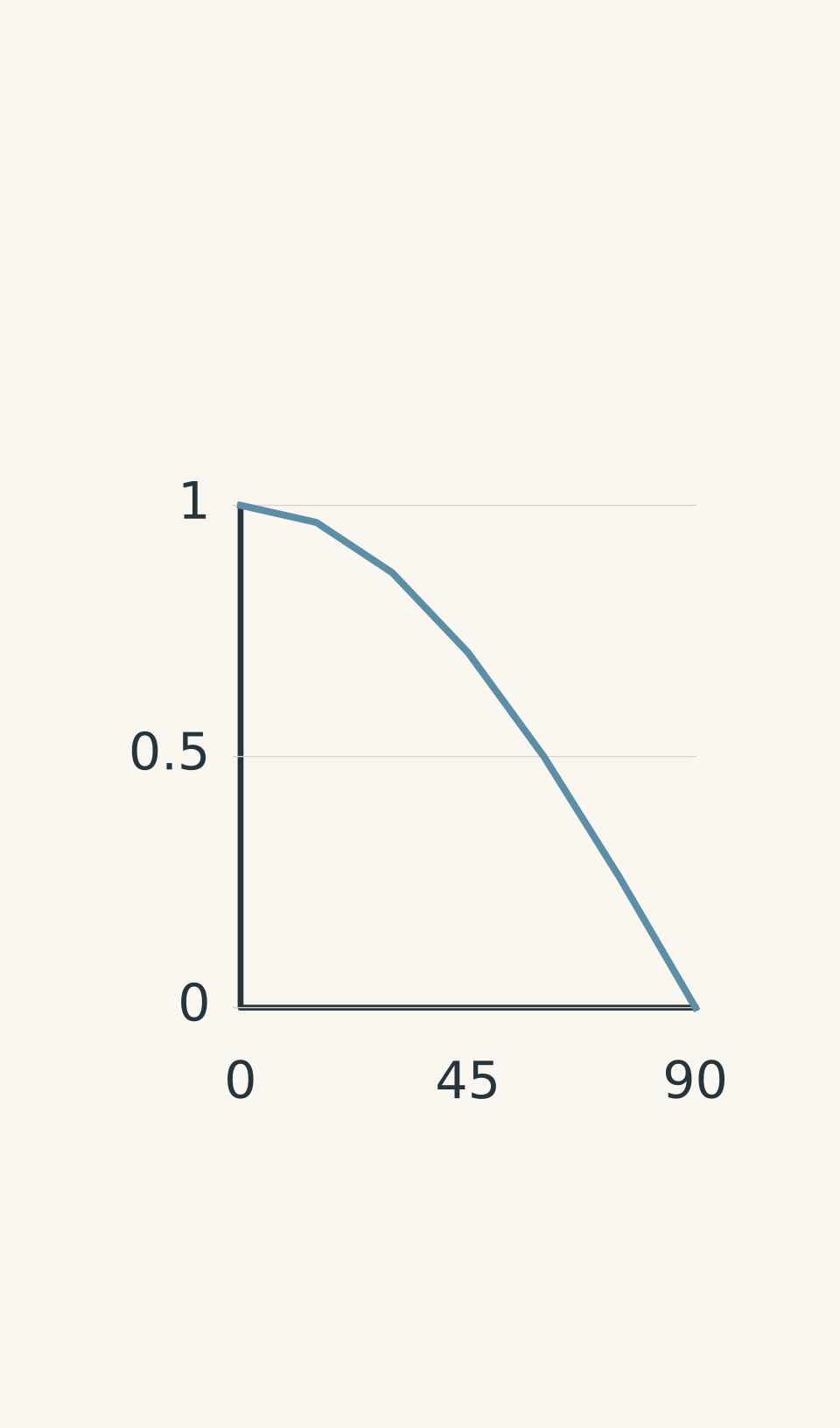
- N/(mg) = cos θ
The graph shows why the normal force decreases as the incline becomes steeper under these assumptions. At \(0^\circ\), the plane is horizontal, so \(N=mg\). At \(60^\circ\), the normal force is only half the weight.
The component \(mg\sin\theta\) is not the normal force. It acts along the slope and is relevant to the motion parallel to the plane.
Case 2: An extra force acts on the object
Return to the horizontal desk. Suppose you pull a box upwards at an angle.
Part of your pull acts horizontally. The other part acts vertically upwards, helping to support the box.
If the box has no vertical acceleration, the vertical forces satisfy
\[ N+F_y-mg=0 \]
Therefore,
\[ \boxed{N=mg-F_y} \]
The upward component of the pull reduces the normal force. If you instead push downwards at an angle, the downward component increases the normal force.
A force acting entirely parallel to a straight surface has no component perpendicular to that surface, so it does not directly change the normal force when the perpendicular acceleration remains zero.
Case 3: The object accelerates vertically
Now put the object on a scale inside a lift.
The scale measures the normal contact force exerted on the object. If the lift accelerates upwards, the normal force must exceed the weight to produce the net upward force.
Taking upwards as positive,
\[ N-mg=ma_y \]
Rearranging,
\[ \boxed{N=m(g+a_y)} \]
For an upward acceleration of magnitude \(a\),
\[ N=m(g+a) \]
For a downward acceleration of magnitude \(a\),
\[ N=m(g-a) \]
So a person can feel heavier or lighter without any change in their mass or the gravitational field strength. The support force has changed because the acceleration has changed.
In free fall, the normal force is zero even though gravity is still acting. The person and the lift accelerate downwards together, so the scale no longer supports the person.
03A reliable method for exam questions
Use this sequence whenever you are asked to calculate a normal force.
Step 1: Identify the contact surface.
Is the object on a horizontal floor, an incline, a wall, or a curved surface? The normal force must be perpendicular to the surface at the contact point.
Step 2: Draw the free-body diagram.
Include the weight, the normal force, and every applied force, tension, and friction force acting on the object. Weight is always vertically downwards near Earth’s surface. The normal force is perpendicular to the contact surface.
Step 3: Choose the perpendicular axis.
For a horizontal surface, use the vertical axis. For a straight incline, use axes parallel and perpendicular to the plane.
Step 4: Resolve forces into components.
Only the components perpendicular to the surface belong in the perpendicular force equation. A force parallel to the plane contributes nothing to this equation.
Step 5: Apply Newton’s second law.
Write
\[ \sum F_\perp=ma_\perp \]
Set \(a_\perp=0\) only when the object has no acceleration perpendicular to the surface. Contact with a fixed, straight plane usually gives this condition.
Step 6: Check whether contact is physically possible.
A normal force can push an object away from a surface, but it cannot pull an object towards the surface. In this model, \(N\) cannot be negative.
If your calculation gives \(N<0\), the assumed contact condition is impossible. Set \(N=0\) once contact is lost, then analyse the object’s motion without that normal force.
A reliable method for finding normal force
- Identify the surface
Choose the normal direction perpendicular to the contact surface.
- List all forces
Include weight, normal force, applied forces, tension, and friction.
- Resolve perpendicular components
Include only force components perpendicular to the surface.
- Apply Newton’s second law
ΣF⊥ = ma⊥
Use a⊥ = 0 only when perpendicular acceleration is zero.
- Check contact
N ≥ 0: contact may be maintained. N < 0: set N = 0 and reanalyse without contact.
04Worked examples
Worked example: A stationary box on an incline
A \(6.0\ \text{kg}\) box rests on a smooth incline at \(25^\circ\) to the horizontal. A rope parallel to the incline holds it stationary. Calculate the normal force. Take \(g=9.8\ \text{m s}^{-2}\).
Step 1
The normal force acts perpendicular to the plane. Gravity acts vertically downwards, and its perpendicular component into the plane is \(mg\cos25^\circ\).
The rope acts parallel to the plane, so it has no perpendicular component.
Step 2
The box has no perpendicular acceleration, so
\[ N-mg\cos25^\circ=0 \]
Therefore,
\[ N=mg\cos25^\circ \]
Step 3
\[ \begin{aligned} N&=(6.0\ \text{kg})(9.8\ \text{m s}^{-2}) \cos25^\circ\\ &=58.8\ \text{N}\times0.9063\\ &=53.3\ \text{N} \end{aligned} \]
The normal force is \(\boxed{53.3\ \text{N}}\).
Why the tempting answer fails: Writing \(N=mg=58.8\ \text{N}\) balances the normal force against the full weight, even though the forces are not opposite. The rope balances the component of gravity parallel to the incline; the normal force balances the perpendicular component.
The box is stationary, but that does not make the normal force equal to its weight.
Worked example: A box pulled at an angle
A \(10.0\ \text{kg}\) box is pulled across a horizontal floor by a \(50.0\ \text{N}\) force directed \(30^\circ\) above the horizontal. The box accelerates horizontally but has no vertical acceleration and remains in contact with the floor. Calculate the normal force.
Step 1
The normal force acts upwards, weight acts downwards, and the pull has an upward component.
The upward component of the pull is
\[ F_y=F\sin30^\circ \]
Step 2
There is no vertical acceleration, so
\[ N+F\sin30^\circ-mg=0 \]
Rearranging gives
\[ N=mg-F\sin30^\circ \]
Step 3
\[ \begin{aligned} N&=(10.0)(9.8)-50.0\sin30^\circ\\ &=98.0-25.0\\ &=73.0\ \text{N} \end{aligned} \]
The normal force is \(\boxed{73.0\ \text{N}}\).
Step 4
The horizontal component of the pull affects the horizontal motion. It does not appear in the vertical force equation because it has no vertical component.
The normal force is less than the weight because the upward component of the pull supports part of the box’s weight.
The wrong approach is to write \(N=mg=98.0\ \text{N}\) just because the floor is horizontal. The floor’s orientation alone is not enough; you must also account for every other force and the acceleration perpendicular to it.
How angled forces change the normal force
| No angled force | N = mg = 98 N Only vertical forces are N and weight. |
|---|---|
| Pull 50 N upward at 30° | N = mg − F sin 30° = 73 N The upward component reduces N by 25 N. |
| Push 50 N downward at 30° | N = mg + F sin 30° = 123 N The downward component increases N by 25 N. |
05Shortcuts that break under exam conditions
| What the question says | What you should actually check |
|---|---|
| “The object is stationary.” | Are there other forces, and is the surface horizontal? Zero acceleration does not automatically mean \(N=mg\). |
| “The object moves at constant speed.” | Constant speed in a straight line means zero acceleration, but you still need to balance the correct force components. |
| “The object accelerates horizontally.” | The normal force can still equal \(mg\) if the surface is horizontal, vertical acceleration is zero, and no other vertical forces act. |
| “A force pulls the object up the slope.” | Is the force parallel to the slope or angled away from it? Only the latter directly reduces \(N\). |
| “The object is pressed against a vertical wall.” | The normal force is horizontal. If the object is stationary, friction may support its weight vertically. |
| “The calculated normal force is negative.” | Contact cannot be maintained under the assumed conditions. Reanalyse the motion with \(N=0\). |
One more edge case matters. On a curved track, the object can accelerate perpendicular to the surface, so even \(N=mg\cos\theta\) may be incorrect. Return to Newton’s second law rather than relying on a memorised formula.
Also, normal force and weight are not a Newton’s third-law pair. Both act on the same object. The reaction to weight is the object’s gravitational pull on Earth; the reaction to the normal force is the object’s contact force on the surface.
Why the normal force matters for friction
This is where the misconception can cause a second error.
The maximum static friction is
\[ f_{s,\max}=\mu_sN \]
Here, \(f_{s,\max}\) is the maximum available static friction, and \(\mu_s\) is the coefficient of static friction. Static friction does not automatically equal this maximum; it adjusts to the value needed to prevent slipping, up to the limit.
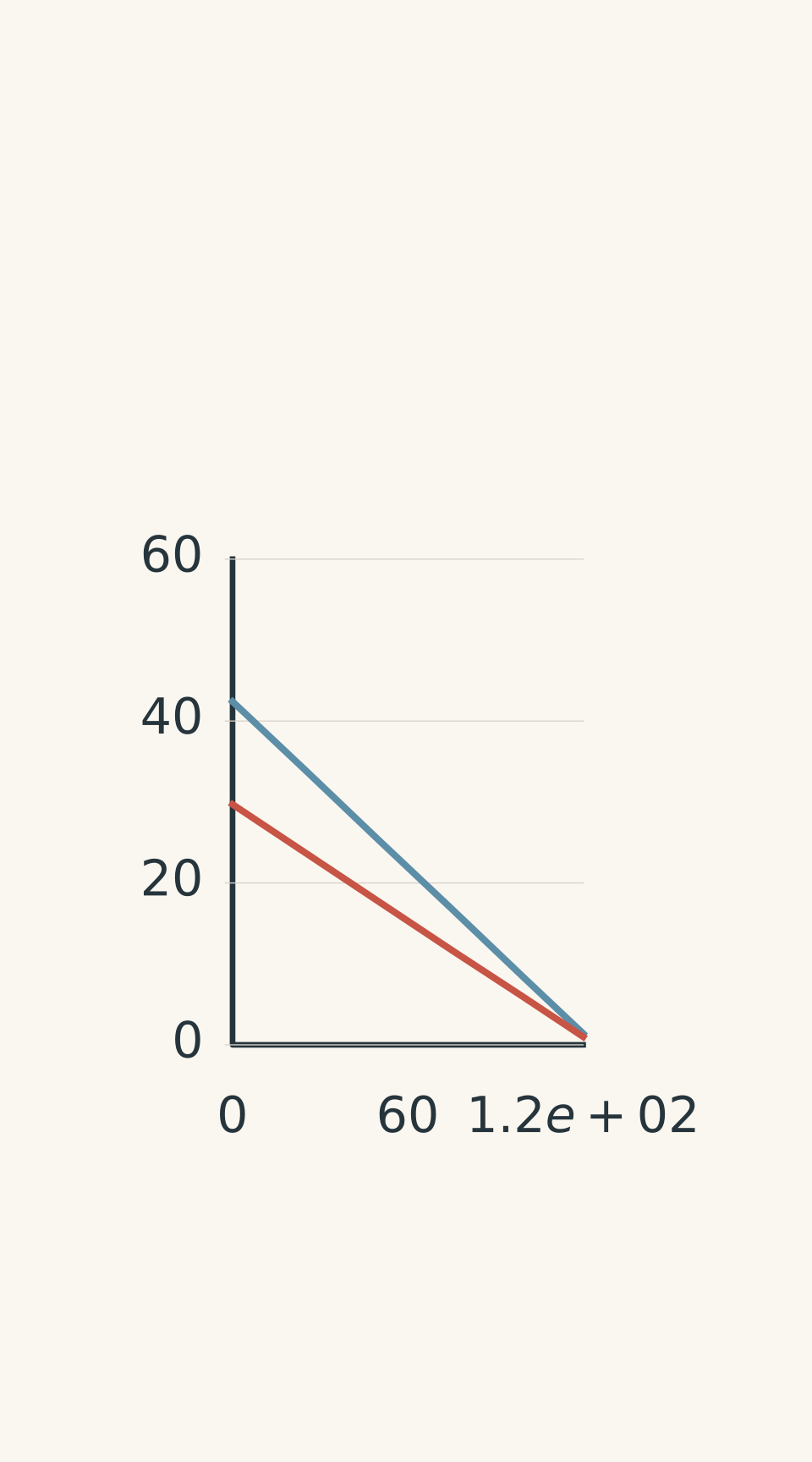
If an applied force pulls an object away from an incline, the normal force decreases. That also reduces the maximum static friction.
The force pulling the object up the slope may therefore become more effective in two ways at once: its component along the slope increases the tendency to move uphill, while its outward component reduces the friction available to resist that motion.
- Normal force N
- Maximum static friction μₛN
06A 30-second self-check
Before moving on from a normal-force calculation, ask yourself:
- Have I drawn \(N\) perpendicular to the actual surface?
- Have I included every force acting on the object?
- Have I resolved forces into components along the normal direction?
- Have I used \(\sum F_\perp=ma_\perp\) rather than assuming \(N=mg\)?
- Is my answer physically possible, with \(N\geq0\) while contact is maintained?
- If friction is involved, have I calculated \(N\) before finding the maximum available friction?
Now test whether you can apply the method when the conditions change.
07Questions and solutions
Question 1
A \(4.0\ \text{kg}\) box rests on a horizontal table. No other vertical forces act on it. Calculate the normal force exerted by the table. Take \(g=9.8\ \text{m s}^{-2}\).
Solution 1
The normal force is \(\boxed{39.2\ \text{N}}\), because the box has zero vertical acceleration and its only vertical forces are the normal force and weight.
Taking upwards as positive,
\[ N-mg=ma_y \]
Since \(a_y=0\),
\[ N=mg \]
Substitute the values:
\[ N=(4.0\ \text{kg})(9.8\ \text{m s}^{-2}) =39.2\ \text{N} \]
Here, \(N=mg\) is valid because the surface is horizontal, there are no additional vertical forces, and the box has no vertical acceleration. Do not generalise this result to every surface or every situation.
Question 2
An \(8.0\ \text{kg}\) crate is held stationary on a fixed incline at \(30^\circ\) to the horizontal. A force of \(25\ \text{N}\) acts parallel to the incline, directed up the slope. Static friction also acts, and the surface can supply whatever static friction is required.
Calculate:
(a) the normal force;
(b) the magnitude and direction of the static friction force.
Take \(g=9.8\ \text{m s}^{-2}\).
Solution 2
The normal force is \(\boxed{67.9\ \text{N}}\), and the static friction force is \(\boxed{14.2\ \text{N}}\) up the incline. The applied force and friction affect the force balance along the slope, but neither has a perpendicular component.
Part (a): Normal force
The component of gravity perpendicular to the incline is \(mg\cos30^\circ\). The crate has no perpendicular acceleration, so
\[ N-mg\cos30^\circ=0 \]
Therefore,
\[ \begin{aligned} N&=(8.0)(9.8)\cos30^\circ\\ &=78.4(0.8660)\\ &=67.9\ \text{N} \end{aligned} \]
Part (b): Static friction
The component of gravity down the slope is
\[ mg\sin30^\circ =(8.0)(9.8)(0.5) =39.2\ \text{N} \]
The applied force is \(25\ \text{N}\) up the slope. Without friction, the net force along the slope would be
\[ 39.2-25.0=14.2\ \text{N} \]
down the slope.
Since the crate is stationary, friction must oppose this tendency. It therefore acts up the slope with magnitude \(14.2\ \text{N}\).
The trap is to assume that friction must act down the slope because gravity has a downslope component. Friction opposes the tendency for relative motion between the surfaces, not gravity by itself.
Question 3
A \(12.0\ \text{kg}\) crate is moving to the right across a horizontal floor. It is pulled by a \(60.0\ \text{N}\) force at \(35^\circ\) above the horizontal and is also pushed vertically downwards by a \(20.0\ \text{N}\) force. The coefficient of kinetic friction is \(\mu_k=0.25\).
Assume the crate has no vertical acceleration and remains in contact with the floor.
Calculate:
(a) the normal force;
(b) the horizontal acceleration of the crate.
Take \(g=9.8\ \text{m s}^{-2}\).
Solution 3
The normal force is \(\boxed{103.2\ \text{N}}\), and the horizontal acceleration is approximately \(\boxed{1.95\ \text{m s}^{-2}}\) to the right. The downward push increases the normal force, which increases the kinetic friction and reduces the net horizontal force.
Part (a): Normal force
The vertical forces are the normal force and the upward component of the pull, balanced against the weight and the additional downward push.
Since vertical acceleration is zero,
\[ N+60.0\sin35^\circ-mg-20.0=0 \]
Rearrange:
\[ N=mg+20.0-60.0\sin35^\circ \]
Substitute:
\[ \begin{aligned} N&=117.6+20.0-34.4\\ &=103.2\ \text{N} \end{aligned} \]
Part (b): Horizontal acceleration
The kinetic friction force acts to the left because the crate is moving to the right relative to the floor.
Its magnitude is
\[ f_k=\mu_kN \]
Therefore,
\[ f_k=0.25(103.2)=25.8\ \text{N} \]
The horizontal component of the pulling force is
\[ F_x=60.0\cos35^\circ =49.1\ \text{N} \]
Taking right as positive, the net horizontal force is
\[ \begin{aligned} F_{\text{net},x}&=F_x-f_k\\ &=49.1-25.8\\ &=23.3\ \text{N} \end{aligned} \]
Apply Newton’s second law horizontally:
\[ a_x=\frac{F_{\text{net},x}}{m} \]
\[ a_x=\frac{23.3}{12.0} =1.94\ \text{m s}^{-2} \]
The crate accelerates to the right at approximately \(1.95\ \text{m s}^{-2}\).
A common error is to use \(N=mg\) when calculating friction. That would ignore both the upward component of the pull and the extra downward force, producing the wrong friction force and therefore the wrong acceleration.
Question 4
A \(60.0\ \text{kg}\) passenger stands on a scale inside a lift. The scale reads \(510\ \text{N}\).
(a) Calculate the passenger’s vertical acceleration.
(b) What can you conclude about the lift’s motion? Explain why the scale reading alone does not determine whether the lift is travelling upwards or downwards.
Take \(g=9.8\ \text{m s}^{-2}\). Assume the scale reading equals the normal force on the passenger and no other vertical forces act.
Solution 4
The passenger’s acceleration is \(\boxed{1.30\ \text{m s}^{-2}}\) downwards. The scale reading establishes the direction of acceleration, not the direction of velocity.
Part (a): Acceleration
Take upwards as positive. The vertical force equation is
\[ N-mg=ma_y \]
Rearranging,
\[ a_y=\frac{N-mg}{m} \]
The passenger’s weight is
\[ mg=(60.0)(9.8)=588\ \text{N} \]
Substitute:
\[ \begin{aligned} a_y&=\frac{510-588}{60.0}\\ &=\frac{-78}{60.0}\\ &=-1.30\ \text{m s}^{-2} \end{aligned} \]
The negative sign means the acceleration is downwards.
Part (b): Direction of motion
The lift is accelerating downwards. If it is travelling upwards, it must be slowing down. If it is travelling downwards, it must be speeding up.
It could also be instantaneously at rest as its downward motion begins. The scale reading alone does not tell you the lift’s velocity.
The tempting mistake is to say that a reading smaller than the passenger’s weight means the lift is travelling downwards. The reading tells you the acceleration, not the direction of travel. Velocity and acceleration are different quantities.
Question 5
A \(5.0\ \text{kg}\) block rests on a rough, fixed incline at \(30^\circ\) to the horizontal. The coefficient of static friction is \(\mu_s=0.70\).
A force \(F\) is applied at \(20^\circ\) above the plane, directed up the incline and away from the surface. Starting from \(F=0\), the force is increased slowly.
Assume the block initially remains at rest, the incline is straight, and the block has zero acceleration perpendicular to the plane while contact is maintained. Take \(g=9.8\ \text{m s}^{-2}\).
Determine:
(a) the force at which static friction changes direction;
(b) the force at which the block first begins to slip up the incline;
(c) whether the block loses contact with the incline before it begins to slip uphill.
Explain why treating \(N=mg\cos30^\circ\) as a constant gives the wrong answer for part (b).
Solution 5
Static friction changes direction at approximately \(\boxed{26.1\ \text{N}}\). The block first slips uphill at approximately \(\boxed{46.0\ \text{N}}\), well before the force would reduce the normal force to zero at approximately \(\boxed{124\ \text{N}}\).
The key is that the applied force has two components: one acts up the slope, while the other pulls the block away from the surface. The second component reduces the normal force and therefore reduces the maximum available static friction.
Step 1: Check that the block can initially remain at rest.
With \(F=0\), the normal force is
\[ N=mg\cos30^\circ \]
\[ N=(5.0)(9.8)\cos30^\circ =42.4\ \text{N} \]
The downslope component of gravity is
\[ mg\sin30^\circ =(5.0)(9.8)(0.5) =24.5\ \text{N} \]
The maximum static friction is
\[ f_{s,\max}=\mu_sN \]
\[ f_{s,\max}=0.70(42.4)=29.7\ \text{N} \]
Since \(24.5\ \text{N}<29.7\ \text{N}\), static friction can initially hold the block at rest. The stated starting condition is physically possible.
Step 2: Find when friction changes direction.
The component of the applied force parallel to the incline is \(F\cos20^\circ\), directed uphill.
Initially, gravity’s downslope component is larger, so friction acts uphill to prevent the block from sliding down.
Friction becomes zero when the two parallel components balance:
\[ F\cos20^\circ=mg\sin30^\circ \]
Therefore,
\[ F=\frac{mg\sin30^\circ}{\cos20^\circ} \]
Substitute:
\[ \begin{aligned} F&=\frac{(5.0)(9.8)\sin30^\circ} {\cos20^\circ}\\ &=\frac{24.5}{0.9397}\\ &=26.1\ \text{N} \end{aligned} \]
At \(26.1\ \text{N}\), no friction is needed to balance the forces along the slope.
For smaller applied forces, friction acts uphill. For larger applied forces, the applied force’s uphill component exceeds gravity’s downslope component, so friction must act downhill to prevent the block from moving uphill.
Step 3: Account for the changing normal force.
The applied force has an outward component \(F\sin20^\circ\). This reduces the normal force.
Because the block has no acceleration perpendicular to the plane while in contact,
\[ N+F\sin20^\circ-mg\cos30^\circ=0 \]
Hence,
\[ \boxed{N=mg\cos30^\circ-F\sin20^\circ} \]
Substitute the known values:
\[ N=42.4-F\sin20^\circ \]
This is the critical relationship. The normal force is not constant as \(F\) increases.
Step 4: Find when the block begins to slip uphill.
At the instant the block is about to slip uphill, static friction acts downhill at its maximum magnitude:
\[ f_s=\mu_sN \]
The net force along the slope is still zero at the threshold of motion. Therefore,
\[ F\cos20^\circ-mg\sin30^\circ=\mu_sN \]
Substitute the expression for \(N\):
\[ F\cos20^\circ-mg\sin30^\circ =\mu_s(mg\cos30^\circ-F\sin20^\circ) \]
Collect the terms containing \(F\):
\[ F(\cos20^\circ+\mu_s\sin20^\circ) =mg(\sin30^\circ+\mu_s\cos30^\circ) \]
Rearrange:
\[ F= \frac{mg(\sin30^\circ+\mu_s\cos30^\circ)} {\cos20^\circ+\mu_s\sin20^\circ} \]
Substituting \(m=5.0\ \text{kg}\), \(g=9.8\ \text{m s}^{-2}\), and \(\mu_s=0.70\),
\[ \begin{aligned} F&= \frac{49.0(0.500+0.70\times0.8660)} {0.9397+0.70\times0.3420}\\ &=\frac{54.2}{1.1791}\\ &=46.0\ \text{N} \end{aligned} \]
The block first slips uphill when the applied force reaches approximately \(46.0\ \text{N}\).
Why is this earlier than a calculation that keeps \(N=mg\cos30^\circ\)? If you incorrectly hold the normal force at \(42.4\ \text{N}\), you obtain
\[ F= \frac{mg\sin30^\circ+\mu_smg\cos30^\circ} {\cos20^\circ} \]
which gives approximately \(57.7\ \text{N}\).
That answer is too large because it assumes the maximum static friction stays fixed. In reality, the outward component of the applied force reduces \(N\), so the maximum friction falls as the applied force increases. The block reaches the friction limit sooner.
Step 5: Check whether contact is lost first.
Contact is lost when the normal force reaches zero:
\[ mg\cos30^\circ-F\sin20^\circ=0 \]
Therefore,
\[ F=\frac{mg\cos30^\circ}{\sin20^\circ} \]
Substitute:
\[ \begin{aligned} F&=\frac{(5.0)(9.8)\cos30^\circ} {\sin20^\circ}\\ &=\frac{42.4}{0.3420}\\ &=124\ \text{N} \end{aligned} \]
At the uphill-slip threshold of \(46.0\ \text{N}\), the normal force is still positive:
\[ \begin{aligned} N&=42.4-46.0\sin20^\circ\\ &\approx26.7\ \text{N} \end{aligned} \]
Therefore, the block begins to slip uphill before contact is lost.
The important interaction is that the force changes both the tendency to move along the incline and the contact force perpendicular to it. The normal force sets the maximum available static friction, so you cannot calculate the slipping threshold correctly without accounting for both components of the applied force.
The next time a question involves friction, calculate the normal force before using \(f_{s,\max}=\mu_sN\). In a lift question, use the same perpendicular-force reasoning to determine apparent weight. The dependable habit is always the same: identify the surface, resolve the forces, and apply Newton’s second law in the direction perpendicular to contact.