
Momentum or Kinetic Energy? A Guide to Collision Problems
Learn how to choose the right equations for collision problems by identifying your system, checking external impulses, and distinguishing elastic from inelastic collisions. Includes worked examples and five practice questions with detailed solutions.
A 2.0 kg trolley moving at \(+4.0\ \mathrm{m\,s^{-1}}\) collides with a stationary 1.0 kg trolley. The pair starts with a total momentum of \(+8.0\ \mathrm{kg\,m\,s^{-1}}\). Can you work out both final velocities from that information alone?
Before choosing an equation, consider three possibilities: conserve momentum, conserve kinetic energy, or conserve both. The correct choice depends on the system you’re studying, the external forces acting during the collision, and what you know about the collision itself.
Same start, different collision outcomes
| Initial state | m₁ = 2.0 kg, u₁ = +4.0 m/s; m₂ = 1.0 kg, u₂ = 0 Total momentum = +8.0 kg·m/s |
|---|---|
| Stick together | v₁ = v₂ = +2.67 m/s Momentum conservation determines the shared final velocity. |
| Separate after impact | 2.0v₁ + 1.0v₂ = 8.0 Velocities in m/s; momentum alone permits multiple outcomes. If elastic: v₁ = +1.33 m/s, v₂ = +5.33 m/s. |
The key is to start with momentum, provided the net external impulse is negligible. Kinetic energy is an additional condition, not something you automatically conserve whenever objects collide.
01Choose your system before choosing your equation
A system is the collection of objects whose motion you’re analysing. In a collision, deciding which objects belong to that system changes which forces count as external.
Imagine two trolleys colliding on a track.
If your system contains both trolleys, the forces they exert on each other are internal forces. By Newton’s third law, these forces are equal and opposite. Their impulses therefore cancel when you consider the total momentum of the pair.
However, if your system contains only the first trolley, the force exerted by the second trolley is external to your system. The first trolley’s momentum changes during the collision.
The system determines which forces are external
| System: A and B | F(B on A) = −F(A on B) Both forces are internal to the system. Their sum is zero; total momentum is unchanged if net external impulse is negligible. |
|---|---|
| System: A only | Δp(A) = J(B on A) The force from B is external to this system. It changes A’s momentum during the collision. |
Does an external force automatically mean momentum is not conserved?
Not necessarily. You need to consider the external impulse during the collision.
Impulse measures the effect of a force acting over a time interval. For a system, the net external impulse is equal to the change in its total momentum:
\[ J_{\text{ext}}=\Delta p_{\text{system}} =p_f-p_i \]
Here:
- \(J_{\text{ext}}\) is the net external impulse, measured in newton-seconds (\(\mathrm{N\,s}\)).
- \(p_i\) is the system’s total momentum before the collision.
- \(p_f\) is the system’s total momentum after the collision.
If the net external impulse is zero, or negligible compared with the momentum changes you’re investigating, total momentum is conserved:
\[ p_i\approx p_f \]
If the external impulse is significant, use the more general relationship:
\[ p_f=p_i+J_{\text{ext}} \]
This distinction is useful in HSC questions. A large collision force can act between two objects while the pair’s total momentum remains conserved, because that force is internal to the two-object system. Meanwhile, friction from the track is external and may change the pair’s total momentum.
The important question is not simply whether external forces exist. It’s whether their net impulse during the collision can be neglected.
02Momentum is the starting point for collision problems
Momentum describes an object’s mass and velocity together:
\[ p=mv \]
where \(p\) is momentum, \(m\) is mass in kilograms, and \(v\) is velocity in metres per second. Momentum is a vector, so direction matters.
For a one-dimensional collision between two objects, conservation of momentum gives:
\[ m_1u_1+m_2u_2=m_1v_1+m_2v_2 \]
Here:
- \(m_1\) and \(m_2\) are the objects’ masses.
- \(u_1\) and \(u_2\) are their initial velocities.
- \(v_1\) and \(v_2\) are their final velocities.
Choose a positive direction before substituting values. If right is positive, an object moving left has a negative velocity.
This equation applies to both elastic and inelastic collisions, provided the net external impulse on the chosen system is negligible.
That’s an important distinction. Momentum conservation does not require the objects to bounce perfectly, keep their original speeds, or retain all their kinetic energy. It requires the total momentum of the system to remain unchanged.
But momentum alone may not give you every unknown. If two objects have two unknown final velocities, the momentum equation provides only one relationship between them. You’ll need another condition to determine both velocities.
That is where the collision’s energy behaviour becomes important.
03Kinetic energy is an additional condition
Kinetic energy describes the energy an object has because of its motion:
\[ E_k=\frac12mv^2 \]
Unlike momentum, kinetic energy is a scalar. The velocity is squared, so direction does not affect its value.
For a two-object system, the total kinetic energy before the collision is:
\[ E_{k,i}=\frac12m_1u_1^2+\frac12m_2u_2^2 \]
The corresponding expression after the collision is:
\[ E_{k,f}=\frac12m_1v_1^2+\frac12m_2v_2^2 \]
Whether these two quantities are equal depends on the collision.
Elastic collisions
An elastic collision conserves the total kinetic energy of the colliding objects:
\[ E_{k,i}=E_{k,f} \]
If the net external impulse is also negligible, you can use both momentum conservation and kinetic energy conservation.
These provide two independent relationships, which can be enough to determine two unknown final velocities.
Inelastic collisions
In an inelastic collision, total kinetic energy is not conserved. Some kinetic energy is transferred into other forms, such as deformation, sound, thermal energy, or internal energy.
Momentum can still be conserved at the same time.
If two objects stick together after colliding, the collision is called perfectly inelastic. Both objects have the same final velocity:
\[ v_1=v_2=v_f \]
That shared velocity gives you an additional condition. You can calculate it using momentum conservation without assuming kinetic energy is conserved.
The kinetic energy of the objects will generally be lower after they stick together, even though the total energy of the complete system is conserved.
What is conserved in a collision?
| Elastic collision | pᵢ = pᶠ; Eₖ,ᵢ = Eₖ,ᶠ Total momentum and total kinetic energy are unchanged. |
|---|---|
| Inelastic collision | pᵢ = pᶠ; Eₖ,ᶠ < Eₖ,ᵢ Kinetic energy decreases; the difference transfers to other forms, such as sound, thermal energy, or deformation. |
One qualification is worth remembering for more demanding questions: if a spring or another internal energy store releases energy during a collision, the objects’ total kinetic energy can actually increase. That still doesn’t make the collision elastic. Elasticity is determined by whether the total kinetic energy is unchanged.
04A practical decision sequence
Use the following sequence whenever a collision question asks you to calculate final velocities, energy changes, or both.
Choose the right collision equations
- Define the system
Identify which objects are included.
- Check external impulse
pᶠ = pᵢ + Jₑₓₜ
Negligible impulse: conserve momentum. Otherwise, include net external impulse.
- Check elasticity
If explicitly elastic, conserve total kinetic energy as well. Otherwise, do not assume it.
- Check whether objects stick
v₁ = v₂ = vᶠ
Use a common final velocity and the appropriate momentum–impulse equation.
- Check for missing information
Count independent equations and unknowns. If needed, obtain another valid condition.
The method-selection table
| Information given | Equations to use | Common mistake |
|---|---|---|
| External impulse is negligible, but collision type is unknown | Momentum conservation | Assuming kinetic energy is conserved |
| Collision is explicitly elastic | Momentum and kinetic energy conservation | Forgetting velocity signs in the momentum equation |
| Objects stick together | Momentum conservation and a shared final velocity | Conserving kinetic energy as well |
| A significant external impulse is given | \(p_f=p_i+J_{\text{ext}}\) | Setting initial and final momentum equal |
| Two final velocities are unknown, but only momentum information is available | Momentum gives one relationship | Assuming one equation can determine two independent unknowns |
Four questions to ask yourself before calculating
- What objects belong to my system?
- Is the net external impulse during the collision negligible?
- Does the question state that the collision is elastic, that the objects stick together, or provide another condition?
- After writing the equations I can legitimately use, do I have enough independent relationships to solve for every unknown?
If you cannot justify conserving kinetic energy, don’t use it. If you have more unknowns than independent equations, you need more physical information. No amount of rearranging can supply a missing condition.
05Worked example: Two trolleys stick together
A 2.0 kg trolley moves to the right at \(4.0\ \mathrm{m\,s^{-1}}\) and collides with a stationary 1.0 kg trolley. The trolleys stick together. The net external horizontal impulse on the pair is negligible.
Calculate their common final velocity and the decrease in their total kinetic energy.
Step 1
Take both trolleys as one system. Since the net external horizontal impulse is negligible, total momentum is conserved.
Because the trolleys stick together, they share one final velocity, \(v_f\). We do not assume kinetic energy is conserved.
Step 2
\[ m_1u_1+m_2u_2=(m_1+m_2)v_f \]
Substitute the known values, taking right as positive:
\[ (2.0)(+4.0)+(1.0)(0)=(3.0)v_f \]
Therefore,
\[ v_f=\frac{8.0}{3.0} =+2.67\ \mathrm{m\,s^{-1}} \]
The trolleys move together to the right at \(2.67\ \mathrm{m\,s^{-1}}\).
Step 3
Before the collision, only the first trolley is moving:
\[ E_{k,i}=\frac12(2.0)(4.0)^2 =16.0\ \mathrm J \]
After the collision, the combined mass is \(3.0\ \mathrm{kg}\):
\[ E_{k,f}=\frac12(3.0) \left(\frac83\right)^2 =10.67\ \mathrm J \]
The decrease in kinetic energy is:
\[ \begin{aligned} E_{k,\text{decrease}} &=E_{k,i}-E_{k,f}\\ &=16.0-10.67\\ &=5.33\ \mathrm J \end{aligned} \]
Step 4
The trolleys’ total momentum is conserved, but their total kinetic energy decreases by \(5.33\ \mathrm J\).
That energy has not disappeared. It has been transferred into other forms, such as deformation, sound, or internal energy. The fact that the trolleys stick together tells us not to use kinetic energy conservation as an equation for their final motion.
06Worked example: The same trolleys collide elastically
The same 2.0 kg trolley, moving at \(4.0\ \mathrm{m\,s^{-1}}\), collides with a stationary 1.0 kg trolley. This time, the collision is stated to be elastic, and the trolleys separate after impact. The net external horizontal impulse is negligible.
Find the final velocity of each trolley.
Step 1
Both trolleys form the system, and the external impulse is negligible. We can therefore conserve total momentum.
The collision is explicitly elastic, so we can also conserve total kinetic energy. These two equations will determine the final velocities.
Step 2
Let \(v_1\) and \(v_2\) be the final velocities of the 2.0 kg and 1.0 kg trolleys, respectively.
\[ (2.0)(4.0)+(1.0)(0) =2.0v_1+1.0v_2 \]
Using velocities in \(\mathrm{m\,s^{-1}}\), this simplifies to:
\[ 2v_1+v_2=8 \]
Rearrange to express one unknown in terms of the other:
\[ v_2=8-2v_1 \]
Step 3
The initial total kinetic energy is \(16.0\ \mathrm J\). Since the collision is elastic, the final total kinetic energy must also be \(16.0\ \mathrm J\).
\[ \frac12(2.0)v_1^2+ \frac12(1.0)v_2^2=16 \]
Simplifying the numerical coefficients, with velocities measured in \(\mathrm{m\,s^{-1}}\):
\[ v_1^2+\frac12v_2^2=16 \]
Step 4
Substitute \(v_2=8-2v_1\) into the kinetic energy equation:
\[ v_1^2+\frac12(8-2v_1)^2=16 \]
Expanding and simplifying gives:
\[ 3v_1^2-16v_1+16=0 \]
Factorising:
\[ (3v_1-4)(v_1-4)=0 \]
Therefore,
\[ v_1=\frac43 \quad\text{or}\quad v_1=4 \]
The root \(v_1=4\) gives \(v_2=0\). This is the unchanged initial state, not the stated collision in which the trolleys interact and separate after impact. We therefore reject that solution.
The physical solution is:
\[ v_1=\frac43=+1.33\ \mathrm{m\,s^{-1}} \]
Then,
\[ v_2=8-2\left(\frac43\right) =\frac{16}{3} =+5.33\ \mathrm{m\,s^{-1}} \]
Step 5
The final momentum is:
\[ \begin{aligned} p_f &=(2.0)\left(\frac43\right) +(1.0)\left(\frac{16}{3}\right)\\ &=8.0\ \mathrm{kg\,m\,s^{-1}} \end{aligned} \]
The final kinetic energy is:
\[ \begin{aligned} E_{k,f} &=\frac12(2.0)\left(\frac43\right)^2\\ &\quad+\frac12(1.0)\left(\frac{16}{3}\right)^2\\ &=16.0\ \mathrm J \end{aligned} \]
Both quantities match their initial values, as required for this isolated elastic collision.
Notice how the starting data were identical in both worked examples. The first collision produced a shared final velocity and a decrease in kinetic energy. The second produced two different final velocities while conserving both momentum and kinetic energy.
The collision conditions determined which equations were legitimate.
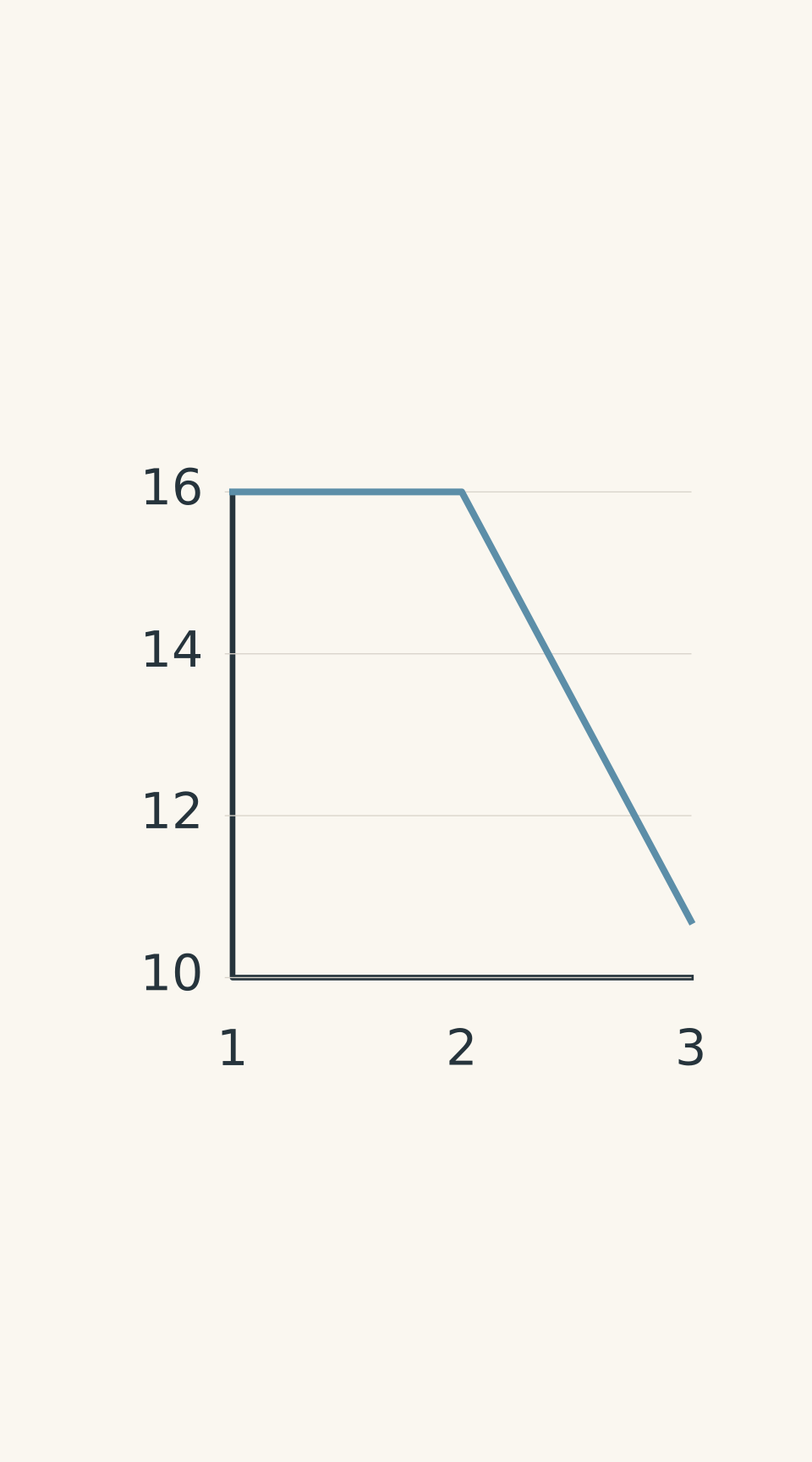
- Total kinetic energy
07Questions and solutions
Question 1
A 1.5 kg trolley moves to the right at \(6.0\ \mathrm{m\,s^{-1}}\) and collides with a stationary 2.5 kg trolley. They lock together, and the net external horizontal impulse is negligible.
Calculate their common final velocity and the decrease in total kinetic energy.
Solution 1
The trolleys move together at \(+2.25\ \mathrm{m\,s^{-1}}\), and their total kinetic energy decreases by approximately \(16.9\ \mathrm J\).
Since the trolleys stick together, they have one final velocity. Momentum conservation gives:
\[ \begin{aligned} (1.5)(6.0)+(2.5)(0)&=(1.5+2.5)v_f\\ 9.0&=4.0v_f\\ v_f&=+2.25\ \mathrm{m\,s^{-1}} \end{aligned} \]
Now calculate the initial kinetic energy:
\[ E_{k,i}=\frac12(1.5)(6.0)^2 =27.0\ \mathrm J \]
The final kinetic energy is:
\[ E_{k,f}=\frac12(4.0)(2.25)^2 =10.125\ \mathrm J \]
Therefore,
\[ \begin{aligned} E_{k,\text{decrease}} &=27.0-10.125\\ &=16.875\ \mathrm J\\ &\approx16.9\ \mathrm J \end{aligned} \]
The decrease occurs because the collision is perfectly inelastic. The momentum calculation is valid, but conserving kinetic energy would give the wrong result.
Question 2
A \(0.40\ \mathrm{kg}\) ball moves to the right at \(12\ \mathrm{m\,s^{-1}}\), colliding with a \(0.60\ \mathrm{kg}\) ball moving to the left at \(2.0\ \mathrm{m\,s^{-1}}\). After the collision, the first ball moves to the left at \(3.0\ \mathrm{m\,s^{-1}}\). Assume the net external impulse on the two-ball system is negligible.
Calculate the second ball’s final velocity. Determine whether the collision is elastic.
Solution 2
The second ball moves to the right at \(8.0\ \mathrm{m\,s^{-1}}\), and the collision is inelastic because total kinetic energy decreases by \(9.0\ \mathrm J\).
Take right as positive. Conservation of momentum gives:
\[ \begin{aligned} p_i&=(0.40)(+12)+(0.60)(-2.0)\\ &=3.6\ \mathrm{kg\,m\,s^{-1}} \end{aligned} \]
Let \(v_2\) be the second ball’s final velocity. Then:
\[ \begin{aligned} 3.6&=(0.40)(-3.0)+(0.60)v_2\\ 3.6&=-1.2+0.60v_2\\ v_2&=\frac{4.8}{0.60}\\ &=+8.0\ \mathrm{m\,s^{-1}} \end{aligned} \]
Now compare total kinetic energies.
Before the collision:
\[ \begin{aligned} E_{k,i} &=\frac12(0.40)(12)^2 +\frac12(0.60)(2.0)^2\\ &=28.8+1.2\\ &=30.0\ \mathrm J \end{aligned} \]
After the collision:
\[ \begin{aligned} E_{k,f} &=\frac12(0.40)(3.0)^2 +\frac12(0.60)(8.0)^2\\ &=1.8+19.2\\ &=21.0\ \mathrm J \end{aligned} \]
The decrease is:
\[ 30.0-21.0=9.0\ \mathrm J \]
The collision is not elastic because total kinetic energy changes. Momentum is still conserved because the net external impulse is negligible. These are separate conditions, and satisfying one does not automatically satisfy the other.
Question 3
A \(1.0\ \mathrm{kg}\) puck moves to the right at \(6.0\ \mathrm{m\,s^{-1}}\) and collides with a stationary \(2.0\ \mathrm{kg}\) puck. They stick together.
During the \(0.20\ \mathrm s\) collision, the average net external horizontal force on the two-puck system is \(5.0\ \mathrm N\) to the left.
Calculate the final velocity of the combined pucks. Explain the error in a calculation that assumes total momentum is conserved.
Solution 3
The combined pucks move to the right at \(1.67\ \mathrm{m\,s^{-1}}\). Assuming momentum is conserved would incorrectly give \(2.0\ \mathrm{m\,s^{-1}}\), because the external impulse is not negligible.
The initial total momentum is:
\[ p_i=(1.0)(6.0)+(2.0)(0) =6.0\ \mathrm{kg\,m\,s^{-1}} \]
The external impulse is:
\[ \begin{aligned} J_{\text{ext}} &=F_{\text{avg}}\Delta t\\ &=(-5.0)(0.20)\\ &=-1.0\ \mathrm{N\,s} \end{aligned} \]
Use the impulse-momentum relationship:
\[ \begin{aligned} p_f&=p_i+J_{\text{ext}}\\ &=6.0-1.0\\ &=5.0\ \mathrm{kg\,m\,s^{-1}} \end{aligned} \]
The combined mass is \(3.0\ \mathrm{kg}\), so:
\[ \begin{aligned} v_f&=\frac{p_f}{m_1+m_2}\\ &=\frac{5.0}{3.0}\\ &=+1.67\ \mathrm{m\,s^{-1}} \end{aligned} \]
If you incorrectly set \(p_f=p_i\), you would obtain:
\[ v_f=\frac{6.0}{3.0} =2.0\ \mathrm{m\,s^{-1}} \]
That result ignores the impulse of \(-1.0\ \mathrm{N\,s}\) applied by the surroundings. The internal collision forces cancel in the total momentum balance, but the external force from the surroundings changes the system’s momentum.
Question 4
During a collision, measurements show the following momenta:
- Object A changes from \(+10\ \mathrm{kg\,m\,s^{-1}}\) to \(+2\ \mathrm{kg\,m\,s^{-1}}\).
- Object B changes from \(-4\ \mathrm{kg\,m\,s^{-1}}\) to \(+4\ \mathrm{kg\,m\,s^{-1}}\).
One student argues that momentum was not conserved because object A lost momentum. Another argues that momentum was conserved because the pair’s total momentum remained constant.
Determine which student is correct for the two-object system and for object A alone. Calculate the net external impulse on the pair, and explain whether the data establish that the collision was elastic.
Solution 4
The second student is correct for the two-object system, but momentum is not conserved for object A alone. The pair’s net external impulse is zero, and the measurements do not establish whether the collision was elastic.
For the two-object system, the initial total momentum is:
\[ \begin{aligned} p_i&=+10+(-4)\\ &=+6\ \mathrm{kg\,m\,s^{-1}} \end{aligned} \]
The final total momentum is:
\[ \begin{aligned} p_f&=+2+(+4)\\ &=+6\ \mathrm{kg\,m\,s^{-1}} \end{aligned} \]
Therefore,
\[ J_{\text{ext}}=p_f-p_i=0\ \mathrm{N\,s} \]
The pair’s total momentum is unchanged. Object A’s momentum decreases by \(8\ \mathrm{kg\,m\,s^{-1}}\), while object B’s momentum increases by the same amount. Their changes cancel.
For object A alone, however, the force exerted by object B is external. Object A’s momentum is therefore not conserved during the collision.
Finally, momentum measurements alone cannot establish whether the collision was elastic. You would need enough information about the objects’ masses and velocities to compare their total kinetic energies before and after the collision. Equal total momentum does not imply equal total kinetic energy.
Question 5
A \(2.0\ \mathrm{kg}\) trolley A moves to the right at \(4.0\ \mathrm{m\,s^{-1}}\) and collides with a stationary \(1.0\ \mathrm{kg}\) trolley B. The net external horizontal impulse on the two-trolley system is negligible.
Immediately after the collision, measurements give:
- Trolley A: \(+1.0\ \mathrm{m\,s^{-1}}\).
- Trolley B: \(+6.0\ \mathrm{m\,s^{-1}}\).
The trolleys contain a preloaded spring mechanism that releases stored energy during contact. Assume the mechanism belongs to the system and that all other energy stores remain unchanged.
A student claims the measurements are impossible: “If the system is isolated, both momentum and kinetic energy must be conserved.”
Assess the claim. Calculate the total momentum and kinetic energy before and after the collision, then determine the change in the spring’s stored energy.
Solution 5
The measurements are consistent with momentum conservation, but the total kinetic energy increases by \(3.0\ \mathrm J\). The collision is not elastic: the spring releases \(3.0\ \mathrm J\) of stored energy, which becomes additional kinetic energy.
First, check momentum conservation.
Before the collision:
\[ \begin{aligned} p_i&=(2.0)(+4.0)+(1.0)(0)\\ &=+8.0\ \mathrm{kg\,m\,s^{-1}} \end{aligned} \]
After the collision:
\[ \begin{aligned} p_f&=(2.0)(+1.0)+(1.0)(+6.0)\\ &=+8.0\ \mathrm{kg\,m\,s^{-1}} \end{aligned} \]
The total momentum is unchanged. The internal forces between the trolleys, including those associated with the spring mechanism, can redistribute momentum between the objects without changing the system’s total momentum.
Now compare kinetic energies.
Initially:
\[ E_{k,i}=\frac12(2.0)(4.0)^2 =16.0\ \mathrm J \]
Finally:
\[ \begin{aligned} E_{k,f} &=\frac12(2.0)(1.0)^2 +\frac12(1.0)(6.0)^2\\ &=1.0+18.0\\ &=19.0\ \mathrm J \end{aligned} \]
The increase in kinetic energy is:
\[ \Delta E_k=19.0-16.0=+3.0\ \mathrm J \]
Since the spring is the only other energy store that changes, its stored energy must decrease by \(3.0\ \mathrm J\). The extra kinetic energy comes from that internal energy store.
The student’s mistake is confusing conservation of total energy with conservation of kinetic energy. An isolated system conserves its total energy, but energy can move between kinetic energy, elastic potential energy, thermal energy, and other forms.
The collision is not elastic because its total kinetic energy changes. The fact that momentum is conserved does not force kinetic energy to be conserved.
This is the deeper rule: momentum conservation concerns the net external impulse on a system, while kinetic energy conservation depends on the nature of the interaction and the energy transfers within that system.
The next useful concept is impulse-momentum. When a collision question supplies a force-time graph, the area under the graph gives the impulse, which tells you how much the system’s total momentum changes. That is the method to use when the assumption of negligible external impulse no longer holds.