
Circular Motion Foundations: 40-Mark Physics Practice Exam
Test your understanding of circular motion with this original 40-mark tutorgum Physics revision exam. Complete timed questions on speed, period, frequency, centripetal acceleration, inward force, and motion after force removal, then check your work against detailed solutions and a marking guide.
This original tutorgum practice paper assesses circular motion foundations: speed, period, frequency, centripetal acceleration, inward resultant force, and motion when the centripetal force is removed. It is a focused topic paper, not a full-course exam, and is not an official, endorsed, past, or predicted NESA paper.
01Exam instructions
- Suggested reading time: 5 minutes.
- Suggested working time: 50 minutes.
- Total marks: 40.
- Permitted equipment: Scientific calculator and blank working paper. No notes or formula sheet.
- Working: Show your equations, substitutions, and calculations. Include units in numerical answers.
- Precision: Give numerical answers to three significant figures unless an exact value is appropriate.
- Assumptions: Treat each stated circular-motion case as uniform at the specified speed. Use any additional assumptions stated in individual questions.
This paper assesses only the supplied circular motion foundations scope. It does not assess vertical-circle dynamics, banked-road analysis, gravitational orbits, or material from other modules. These are practice-paper conditions, not official examination rules.
02Questions
Question 1 (5 marks)
(a) Define the period and frequency of circular motion, and state their mathematical relationship. (3 marks)
(b) A wheel completes 72 revolutions in 18.0 s. Calculate its frequency and period. (2 marks)
Question 2 (5 marks)
A rigid platform rotates at a constant rate, completing one revolution every 1.50 s. Point A is 0.75 m from the centre, and point B is 0.25 m from the centre.
(a) Calculate the linear speed of point A. (2 marks)
(b) Calculate the linear speed of point B. (2 marks)
(c) State whether A and B have the same period and frequency, and give a reason. (1 mark)
Question 3 (5 marks)
A cyclist travels at a constant speed of 12.0 m/s around a circular bend of radius 24.0 m.
(a) Calculate the cyclist’s centripetal acceleration. (2 marks)
(b) State the direction of this acceleration and explain why the cyclist is accelerating even though their speed is constant. (3 marks)
Question 4 (5 marks)
A ball of mass 0.250 kg moves at 4.00 m/s in a horizontal circle of radius 0.800 m on a smooth horizontal table. A string connects the ball to the centre.
(a) Calculate the inward resultant force required to maintain this motion. (3 marks)
(b) Identify the real force that supplies this horizontal inward force. (1 mark)
(c) Explain why centripetal force should not be treated as an additional force on top of the force you identified in part (b). (1 mark)
Question 5 (7 marks)
A marker moves in a circle of radius 0.600 m at a constant rate. It completes 25 revolutions in 20.0 s.
(a) Calculate its frequency. (1 mark)
(b) Calculate its period. (1 mark)
(c) Calculate its linear speed. (2 marks)
(d) Calculate its centripetal acceleration. (2 marks)
(e) If the frequency doubles while the radius stays the same, state the factor by which the centripetal acceleration changes. (1 mark)
Question 6 (6 marks)
A puck moves in a circle on a horizontal, low-friction table while held by a string. At the instant the string breaks, the puck is at the northernmost point of the circle and its instantaneous velocity is directed east. After the break, assume friction is negligible and the table’s normal force balances the puck’s weight.
(a) Describe the direction of the puck’s initial path immediately after the string breaks. (2 marks)
(b) Describe the puck’s motion after the break under the stated assumptions. (2 marks)
(c) Explain the role of the string’s tension before the break and why the puck does not continue around the same circle afterwards. (2 marks)
Question 7 (7 marks)
A 1200 kg car travels at 18.0 m/s around a level circular bend of radius 45.0 m. The maximum available tyre-road friction that can act inward is 6.0 kN. Assume the car’s mass and the bend radius remain constant.
(a) Calculate the inward resultant force required at 18.0 m/s. (2 marks)
(b) Identify the real force that supplies the inward resultant force on the car. (1 mark)
(c) The car slows to 9.0 m/s while following the same bend. Calculate the new required inward resultant force and state how it compares with the original force. (3 marks)
(d) Is the available friction sufficient to provide the new required force? Use your result to justify your answer. (1 mark)
03Worked solutions and marking guide
Award marks for correct methods as well as final answers. Accept mathematically equivalent approaches. Where a numerical error in an earlier part is carried through consistently into a later part, award appropriate follow-through marks.
Solution 1
(a) The period, \(T\), is the time taken for one complete revolution. The frequency, \(f\), is the number of revolutions completed per second. They are reciprocals:
\[ f=\frac{1}{T} \qquad \text{and} \qquad T=\frac{1}{f} \]
Marking guide:
- 1 mark for correctly defining period.
- 1 mark for correctly defining frequency.
- 1 mark for the reciprocal relationship.
(b) Let \(N\) be the number of revolutions and \(t\) the elapsed time. Frequency is the number of revolutions divided by the elapsed time.
\[ \begin{aligned} f&=\frac{N}{t}\\ &=\frac{72}{18.0}\\ &=4.00\ \text{Hz} \end{aligned} \]
The period is the time taken for one revolution:
\[ \begin{aligned} T&=\frac{1}{f}\\ &=\frac{1}{4.00}\\ &=0.250\ \text{s} \end{aligned} \]
Answers: \(f=4.00\ \text{Hz}\) and \(T=0.250\ \text{s}\).
Marking guide:
- 1 mark for the correct frequency.
- 1 mark for the correct period.
Total: 5 marks.
Solution 2
The linear speed, \(v\), is the distance travelled along a circular path per unit time. A complete revolution covers the circumference of the circle, \(2\pi r\), where \(r\) is the radius. If the period is \(T\), then
\[ v=\frac{2\pi r}{T} \]
(a) For point A, the radius is 0.75 m and the period is 1.50 s.
\[ \begin{aligned} v_A&=\frac{2\pi(0.75)}{1.50}\\ &=3.14\ \text{m s}^{-1} \end{aligned} \]
Answer: \(3.14\ \text{m s}^{-1}\).
Marking guide:
- 1 mark for the correct relationship and substitution.
- 1 mark for the correct answer with units.
(b) For point B, the radius is 0.25 m. Its period is still 1.50 s.
\[ \begin{aligned} v_B&=\frac{2\pi(0.25)}{1.50}\\ &=1.05\ \text{m s}^{-1} \end{aligned} \]
Answer: \(1.05\ \text{m s}^{-1}\).
Marking guide:
- 1 mark for the correct relationship and substitution.
- 1 mark for the correct answer with units.
(c) Both points have the same period and frequency because they rotate together as part of the same rigid platform. Each completes one revolution in the same time.
Marking guide:
- 1 mark for identifying the same period and frequency and giving a valid reason.
Same period, different linear speeds
| Inner point | r = 0.25 m Period: 1.50 s Circumference: 1.57 m; speed: 1.05 m/s |
|---|---|
| Outer point | r = 0.75 m Period: 1.50 s Circumference: 4.71 m; speed: 3.14 m/s |
Total: 5 marks.
Solution 3
(a) Centripetal acceleration, \(a_c\), is the acceleration directed towards the centre of a circular path. For an object moving at speed \(v\) on a circle of radius \(r\),
\[ a_c=\frac{v^2}{r} \]
Substituting the cyclist’s speed and the bend’s radius:
\[ \begin{aligned} a_c&=\frac{(12.0)^2}{24.0}\\ &=\frac{144}{24.0}\\ &=6.00\ \text{m s}^{-2} \end{aligned} \]
Answer: \(6.00\ \text{m s}^{-2}\), directed towards the centre of the bend.
Marking guide:
- 1 mark for the correct equation and substitution.
- 1 mark for the correct numerical answer with units.
(b) The acceleration points radially inward, towards the centre of the circular path.
The cyclist’s speed is constant, but their velocity is not. Velocity includes both speed and direction, and the direction changes continuously as the cyclist travels around the bend. Since acceleration is the rate of change of velocity, the cyclist accelerates even though their speed stays constant.
Marking guide:
- 1 mark for identifying the direction as towards the centre.
- 1 mark for recognising that velocity changes direction.
- 1 mark for linking the change in velocity to acceleration.
Total: 5 marks.
Solution 4
(a) The inward resultant force, \(F_c\), required for circular motion depends on the object’s mass, speed, and radius:
\[ F_c=\frac{mv^2}{r} \]
Here, \(m=0.250\ \text{kg}\), \(v=4.00\ \text{m s}^{-1}\), and \(r=0.800\ \text{m}\).
\[ \begin{aligned} F_c&=\frac{0.250(4.00)^2}{0.800}\\ &=\frac{4.00}{0.800}\\ &=5.00\ \text{N} \end{aligned} \]
Answer: The required inward resultant force is \(5.00\ \text{N}\).
Marking guide:
- 1 mark for the correct equation.
- 1 mark for correct substitution.
- 1 mark for the correct answer with units.
(b) The tension in the string supplies the horizontal inward force.
Marking guide:
- 1 mark for identifying tension.
(c) Centripetal force is not a separate type of force. It describes the net inward resultant force acting on an object. In this case, the string’s tension provides that force.
Marking guide:
- 1 mark for explaining that centripetal force is the inward resultant of real forces, not an additional force.
Total: 5 marks.
Solution 5
(a) Frequency is the number of revolutions per second. The marker completes 25 revolutions in 20.0 s.
\[ \begin{aligned} f&=\frac{25}{20.0}\\ &=1.25\ \text{Hz} \end{aligned} \]
Answer: \(1.25\ \text{Hz}\).
Marking guide:
- 1 mark for the correct frequency.
(b) Period is the reciprocal of frequency.
\[ \begin{aligned} T&=\frac{1}{1.25}\\ &=0.800\ \text{s} \end{aligned} \]
Answer: \(0.800\ \text{s}\).
Marking guide:
- 1 mark for the correct period.
(c) The linear speed is the circumference divided by the period.
\[ \begin{aligned} v&=\frac{2\pi r}{T}\\ &=\frac{2\pi(0.600)}{0.800}\\ &=4.71\ \text{m s}^{-1} \end{aligned} \]
Answer: \(4.71\ \text{m s}^{-1}\).
Marking guide:
- 1 mark for the correct equation and substitution.
- 1 mark for the correct answer with units.
(d) Centripetal acceleration is the square of the speed divided by the radius.
\[ \begin{aligned} a_c&=\frac{v^2}{r}\\ &=\frac{(4.71)^2}{0.600}\\ &=37.0\ \text{m s}^{-2} \end{aligned} \]
Answer: \(37.0\ \text{m s}^{-2}\), directed towards the centre.
Marking guide:
- 1 mark for the correct equation and substitution.
- 1 mark for the correct answer with units.
(e) The centripetal acceleration increases by a factor of four.
Marking guide:
- 1 mark for stating that the acceleration quadruples.
The reason is that doubling the frequency at a fixed radius doubles the linear speed, since \(v=2\pi rf\). Because centripetal acceleration is proportional to the square of speed, doubling the speed multiplies the acceleration by \(2^2=4\).
Total: 7 marks.
Solution 6
(a) The puck initially travels east, along a tangent to the circle at the point where the string breaks.
A tangent is a straight line that touches a circle at one point and is perpendicular to the radius at that point. The puck’s instantaneous velocity gives the direction of its initial motion.
Marking guide:
- 1 mark for identifying the tangent as the initial path.
- 1 mark for identifying the direction as east.
(b) The puck continues in a straight line at constant velocity under the stated assumptions.
The horizontal resultant force is negligible, and the normal force balances the puck’s weight vertically. With no resultant force, there is no acceleration, so the puck’s velocity remains constant.
Marking guide:
- 1 mark for stating that the puck travels in a straight line.
- 1 mark for stating that its velocity, including its speed, remains constant.
(c) Before the break, the string’s tension supplies the inward resultant force that continually changes the direction of the puck’s velocity. When the string breaks, this tension disappears. With no remaining horizontal resultant force, there is no centripetal acceleration to keep the puck moving around the circle.
Marking guide:
- 1 mark for explaining that tension supplies the inward resultant force before the break.
- 1 mark for explaining that removing this force removes the inward acceleration required for circular motion.
The straight-line, constant-velocity result depends on the stated assumptions. If friction, air resistance, or another unbalanced force were significant, the puck’s velocity would change.
Total: 6 marks.
Solution 7
(a) The inward resultant force required to maintain circular motion is
\[ F_c=\frac{mv^2}{r} \]
Substitute the car’s mass, speed, and bend radius.
\[ \begin{aligned} F_c&=\frac{1200(18.0)^2}{45.0}\\ &=\frac{388800}{45.0}\\ &=8640\ \text{N}\\ &=8.64\ \text{kN} \end{aligned} \]
Answer: The required inward resultant force is \(8.64\ \text{kN}\).
Marking guide:
- 1 mark for the correct equation and substitution.
- 1 mark for the correct answer with units.
(b) Static friction between the tyres and the road supplies the inward resultant force, assuming the tyres roll without slipping. This friction acts towards the centre of the bend.
Marking guide:
- 1 mark for identifying friction between the tyres and road.
(c) When the speed falls to 9.0 m/s, the mass and radius remain unchanged.
\[ \begin{aligned} F_c&=\frac{1200(9.0)^2}{45.0}\\ &=\frac{97200}{45.0}\\ &=2160\ \text{N}\\ &=2.16\ \text{kN} \end{aligned} \]
Answer: The new required inward resultant force is \(2.16\ \text{kN}\), which is one-quarter of the original force.
Halving the speed reduces \(v^2\) to one-quarter of its original value. Since \(F_c=mv^2/r\), the required force also falls to one-quarter when the mass and radius are unchanged.
Marking guide:
- 1 mark for the correct method and substitution.
- 1 mark for the correct new force with units.
- 1 mark for identifying the one-quarter relationship and linking it to the squared speed.
(d) Yes. The available friction is sufficient because the required force of \(2.16\ \text{kN}\) is less than the maximum available inward friction of \(6.0\ \text{kN}\).
Marking guide:
- 1 mark for the correct conclusion supported by the comparison.
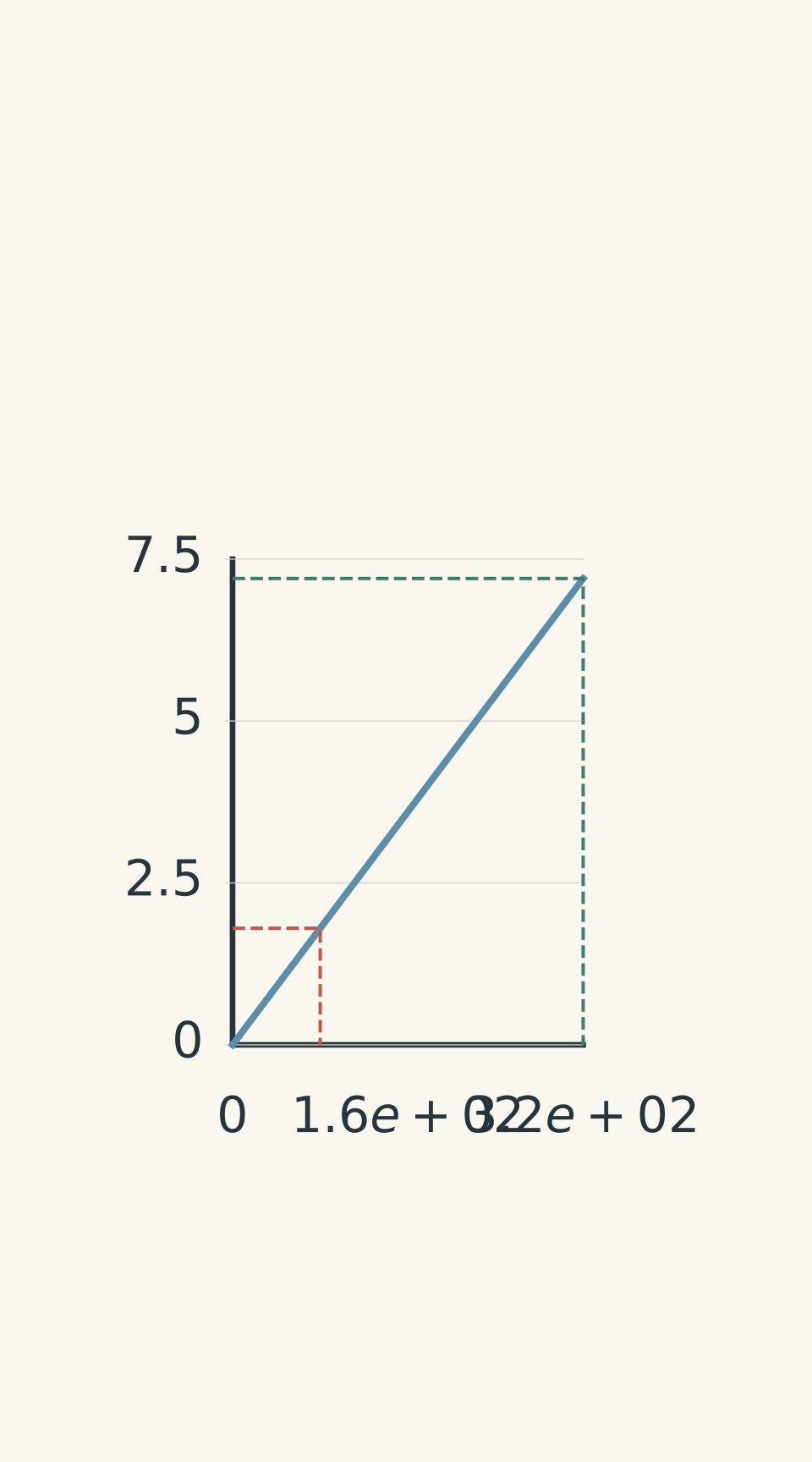
- Fixed radius: 45 m
- v = 9 m/s
- v = 18 m/s
Total: 7 marks.
Paper total: 40 marks.