
Connected Masses and Pulleys: Forces, Tension, and Friction
Learn how to solve connected-mass problems using separate free-body diagrams, consistent positive directions, and Newton’s second law. Follow worked examples to calculate acceleration and tension, include friction, and understand why tension cancels when analysing the combined system.
A block sits on a smooth table, connected over a pulley to a hanging mass. The hanging mass is pulled down by gravity, but it doesn’t fall freely: the string pulls upwards on it while also accelerating the block. If you write Newton’s second law for both masses, should tension still appear in the final equation for the system’s acceleration?
Predict before reading on. Is tension zero, or does it disappear for a different reason?
Tension is real, and it must appear in the equation for each individual mass. It disappears only when we combine those equations correctly. The reliable method is to draw a separate free-body diagram for each object, choose positive directions, and only then calculate.
One string, two linked motions
| System arrangement | Block A rests on a smooth horizontal table. A taut string passes over an ideal pulley to hanging mass B. |
|---|---|
| Linked motion | |a_A| = |a_B| A moves towards the pulley; B moves downwards. Both masses have equal acceleration magnitudes while the string remains taut. |
01One string, two motions
Picture the string as a very strict dance partner. If block A moves 5 cm towards the pulley, mass B must move 5 cm downwards. Neither can get ahead of the other while the string remains taut.
For an ideal string, this means both objects have the same speed and the same magnitude of acceleration. Their acceleration vectors point in different directions because they move along different paths.
The analogy has a limit: a real string can stretch, and a real string can go slack. Our model ignores those effects.
For the standard connected-mass problem, assume:
- The string is massless and inextensible, so its tension is uniform and its length is fixed.
- The pulley is ideal, so it has negligible rotational inertia and friction.
- The string remains taut, linking the motion of the two masses.
- The table is frictionless for the first model.
We will use \(g=9.8\ \text{m s}^{-2}\) unless a question states otherwise.
02Draw one free-body diagram per object
A free-body diagram (FBD) shows every force acting on one chosen object. It does not combine the forces on several objects into one diagram.
Separate free-body diagrams
| Block A — horizontal table | N ↑ m_Ag ↓ T → Forces: normal up, weight down, tension right. Acceleration: a →; vertical forces balance. |
|---|---|
| Mass B — hanging | T ↑ m_Bg ↓ Forces: tension up, weight down. Acceleration: a ↓; weight exceeds tension when B accelerates downwards. |
Call the block on the table A, with mass \(m_A\), and the hanging mass B, with mass \(m_B\).
For block A, the forces are:
- Tension \(T\), towards the pulley.
- Normal force \(N\), upwards from the table.
- Weight \(m_Ag\), downwards.
For hanging mass B, the forces are:
- Tension \(T\), upwards.
- Weight \(m_Bg\), downwards.
Notice that tension points in different directions on the two objects. It pulls A towards the pulley and pulls B upwards.
Choose positive directions before writing equations
For the usual situation, where the hanging mass descends, choose:
- Right as positive for A.
- Down as positive for B.
These directions are different in physical space, but they describe the same linked motion along the string.
The acceleration magnitude is \(a\) for both masses. If the calculated value of \(a\) is negative, the acceleration is opposite to the directions we chose.
For the smooth-table case, Newton’s second law gives the horizontal equation for A:
\[ T=m_Aa \]
There is no vertical acceleration for A, so its vertical forces balance:
\[ N-m_Ag=0 \]
For hanging mass B, gravity acts downwards and tension acts upwards. With downwards positive:
\[ m_Bg-T=m_Ba \]
These two horizontal or vertical motion equations are the starting point for almost every ideal connected-mass problem.
03Why tension cancels for the combined system
Look at the two equations again:
\[ T=m_Aa \]
\[ m_Bg-T=m_Ba \]
Tension appears in both. Add the equations, and the \(+T\) and \(-T\) terms cancel:
\[ m_Bg=(m_A+m_B)a \]
Rearranging gives the acceleration:
\[ \boxed{a=\frac{m_Bg}{m_A+m_B}} \]
Once you know the acceleration, substitute it into either individual equation to find the tension:
\[ T=m_Aa \]
Therefore,
\[ T=\frac{m_Am_Bg}{m_A+m_B} \]
Why tension cancels
- Write each mass’s equation
A: T = m_A a
B: m_B g − T = m_B aA positive: right; B positive: down.
Each equation applies Newton’s second law to one mass.
- Add the equations
m_B g = (m_A + m_B)a
The +T and −T terms cancel algebraically.
This is not cancellation of horizontal and vertical force vectors.
There is an important detail here. We say tension is an internal interaction in the combined ideal system because it transfers the pull between the connected masses. When we add their equations along their respective directions of motion, the tension terms cancel.
That does not mean the two tension arrows are opposite vectors in ordinary two-dimensional space. One points horizontally, and the other points vertically. The cancellation occurs in the linked-coordinate equations.
If you analyse either mass separately, tension is an external force acting on that object. You must include it.
This is why drawing one free-body diagram for the whole arrangement is usually less useful than drawing two separate diagrams and combining the equations afterwards.
A common trap: tension equals the hanging weight
It is tempting to assume that \(T=m_Bg\), because tension pulls upwards on B while gravity pulls downwards.
But Newton’s second law says:
\[ m_Bg-T=m_Ba \]
If B accelerates downwards, its weight must be greater than the upward tension. Otherwise, there would be no net downward force.
Only when B has zero acceleration does \(T=m_Bg\). A hanging mass can be stationary, or moving at constant velocity, with tension equal to its weight. An accelerating mass generally cannot.
04Worked example: A smooth table and a hanging mass
A 3.0 kg block A on a smooth horizontal table is connected over an ideal pulley to a 2.0 kg hanging mass B. The system is released from rest. Calculate its acceleration and the tension in the string.
Step 1: Write Newton’s second law for each mass.
Choose right as positive for A and down as positive for B.
For A:
\[ T=m_Aa \]
For B:
\[ m_Bg-T=m_Ba \]
Step 2: Combine the equations to find the acceleration.
The tension terms cancel, giving:
\[ \begin{aligned} a&=\frac{m_Bg}{m_A+m_B}\\\\[4pt] &=\frac{(2.0)(9.8)}{3.0+2.0}\\\\[4pt] &=3.92\ \text{m s}^{-2} \end{aligned} \]
The masses are in kilograms and \(g\) is in \(\text{m s}^{-2}\), so the result has units of acceleration.
Step 3: Find the tension using the equation for A.
\[ \begin{aligned} T&=m_Aa\\\ &=(3.0)(3.92)\\\ &=11.76\ \text{N}\\\ &\approx11.8\ \text{N} \end{aligned} \]
Step 4: Check the result using B.
The downward net force on B is:
\[ \begin{aligned} F_{\text{net}}&=m_Bg-T\\\ &=19.6-11.76\\\ &=7.84\ \text{N} \end{aligned} \]
Using \(F_{\text{net}}=m_Ba\):
\[ m_Ba=(2.0)(3.92)=7.84\ \text{N} \]
Both equations agree.
The system accelerates at \(3.92\ \text{m s}^{-2}\), with B moving downwards, and the tension is \(11.8\ \text{N}\). The tension is less than B’s weight of \(19.6\ \text{N}\), leaving a net downward force to accelerate the system.
Connected masses: force and acceleration directions
| Block A — 3.0 kg | T → a → On a smooth horizontal table. Tension and acceleration point right, towards the pulley. |
|---|---|
| Hanging mass B — 2.0 kg | T ↑ a ↓ Connected to A by the same taut string. Tension points up; acceleration points down. |
05Add friction without changing the setup
Now keep the same arrangement, but make the table rough.
There is one extra horizontal force on A: friction. If B descends and pulls A towards the pulley, A slides to the right, so friction acts to the left.
Predict what happens if A is already sliding to the left instead. Friction now points to the right, because it opposes the relative sliding between A and the table.
This is worth remembering: friction opposes relative sliding, not necessarily acceleration. An object can be moving left while accelerating right, and friction can still point right.
Kinetic friction opposes sliding
| A slides right | v_A → T → f_k ← Friction acts left, opposite A’s motion. Hanging mass B moves down. |
|---|---|
| A slides left | v_A ← T → f_k → Friction acts right, opposite A’s motion. Hanging mass B moves up. |
Calculate the friction force
For a block on a horizontal table, with no vertical acceleration and no other vertical forces,
\[ N=m_Ag \]
If the block is sliding, the kinetic friction magnitude is modelled by:
\[ f_k=\mu_kN \]
Here, \(f_k\) is the kinetic friction force, \(N\) is the normal force, and \(\mu_k\) is the coefficient of kinetic friction. The coefficient has no units.
Static friction is different. When the block is not sliding, static friction adjusts to whatever magnitude is needed to prevent slipping, up to a maximum:
\[ f_{s,\max}=\mu_sN \]
The coefficient \(\mu_s\) is the coefficient of static friction.
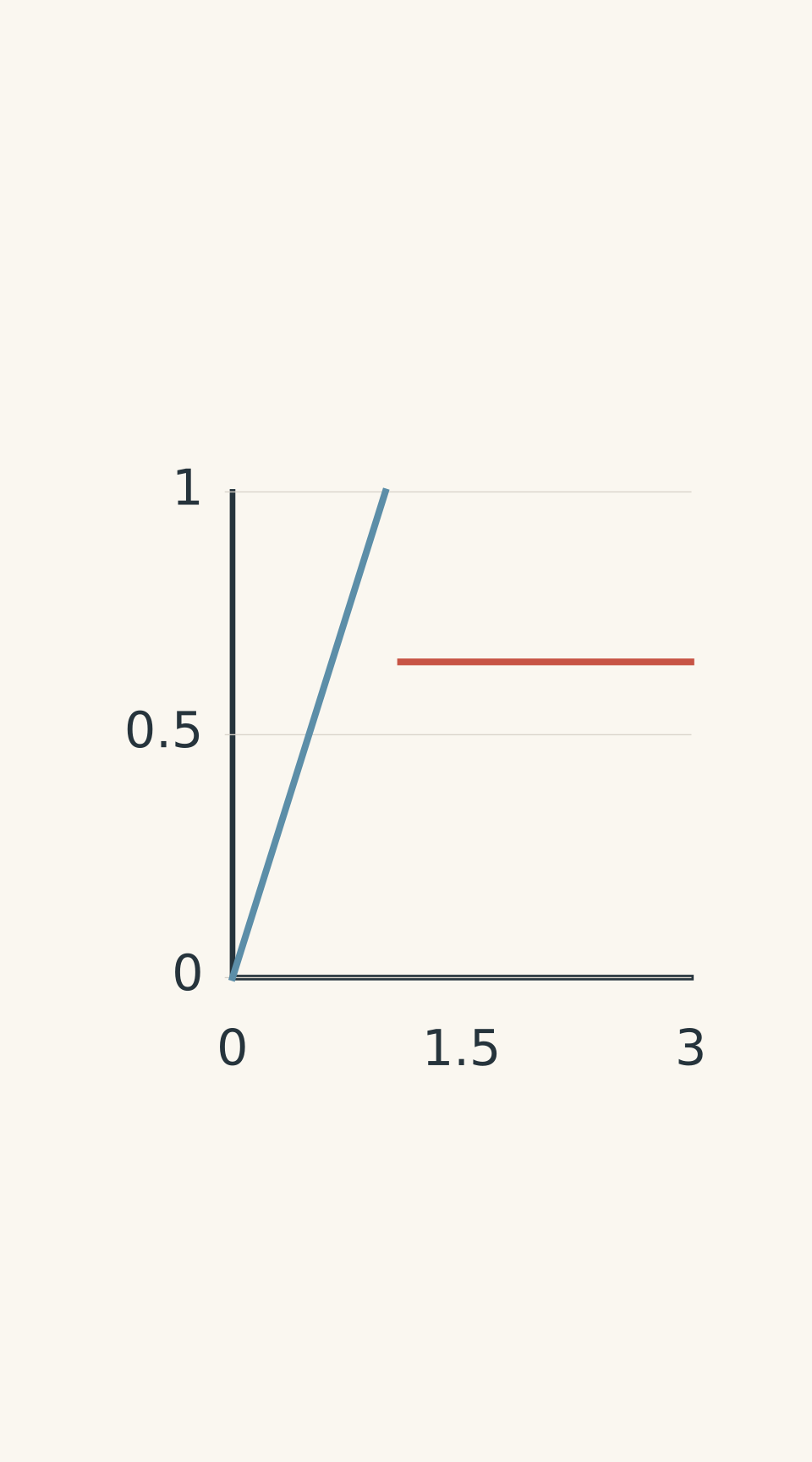
- Static: rises to fₛ,max = μₛN
- Kinetic: fₖ = μₖN, approximately constant
| Situation | What to use | Common mistake |
|---|---|---|
| The block is sliding | \(f_k=\mu_kN\) | Forgetting friction’s direction |
| The block remains at rest | \(f_s\leq\mu_sN\) in magnitude | Automatically setting friction to its maximum |
| The block is just about to slip | \(f_s=\mu_sN\) in magnitude | Confusing the limiting case with every stationary case |
This distinction matters when a system is released from rest. Before using kinetic friction to calculate acceleration, you must establish that the system actually starts moving.
Set up the equations with friction
Suppose B is descending and A is sliding towards the pulley. Keep right positive for A and down positive for B.
For A, tension pulls right and friction acts left:
\[ T-f_k=m_Aa \]
For B:
\[ m_Bg-T=m_Ba \]
Add the equations:
\[ m_Bg-f_k=(m_A+m_B)a \]
Therefore,
\[ \boxed{a=\frac{m_Bg-f_k}{m_A+m_B}} \]
This formula applies to the stated sliding direction, with friction opposing A’s rightward motion. The acceleration can be negative if the system is moving in that direction but slowing down.
The key change from the smooth-table model is the extra friction term. Tension still appears in each individual equation, and it still cancels when the equations are combined.
06Worked example: Include kinetic friction
A 4.0 kg block A is sliding to the right on a rough horizontal table. It is connected over an ideal pulley to a 3.0 kg hanging mass B, which is descending. The coefficient of kinetic friction between A and the table is \(0.20\). Calculate the acceleration and tension. Take \(g=9.8\ \text{m s}^{-2}\).
Step 1: Calculate the normal force and kinetic friction.
There is no vertical acceleration for A, so:
\[ \begin{aligned} N&=m_Ag\\\ &=(4.0)(9.8)\\\ &=39.2\ \text{N} \end{aligned} \]
The kinetic friction magnitude is:
\[ \begin{aligned} f_k&=\mu_kN\\\ &=(0.20)(39.2)\\\ &=7.84\ \text{N} \end{aligned} \]
Step 2: Write Newton’s second law for both masses.
For A:
\[ T-7.84=4.0a \]
For B:
\[ 29.4-T=3.0a \]
Step 3: Add the equations and solve for acceleration.
\[ \begin{aligned} a&=\frac{m_Bg-f_k}{m_A+m_B}\\\\[4pt] &=\frac{(3.0)(9.8)-7.84}{4.0+3.0}\\\\[4pt] &=\frac{21.56}{7.0}\\\\[4pt] &=3.08\ \text{m s}^{-2} \end{aligned} \]
Step 4: Calculate the tension.
Use the equation for A:
\[ \begin{aligned} T&=m_Aa+f_k\\\ &=(4.0)(3.08)+7.84\\\ &=20.16\ \text{N}\\\ &\approx20.2\ \text{N} \end{aligned} \]
Check using B:
\[ \begin{aligned} m_Bg-T&=29.4-20.16\\\ &=9.24\ \text{N}\\\ m_Ba&=(3.0)(3.08)\\\ &=9.24\ \text{N} \end{aligned} \]
The equations agree. The acceleration is \(3.08\ \text{m s}^{-2}\), with B descending, and the tension is \(20.2\ \text{N}\).
Notice that tension is still less than B’s weight of \(29.4\ \text{N}\). The remaining downward force accelerates both masses, while friction reduces the acceleration compared with the smooth-table case.
Connected masses with kinetic friction
| Block A — 4.0 kg | N ↑ m_Ag ↓ T → f_k ← Normal force balances weight vertically: N = m_Ag. Motion is right; tension pulls right and kinetic friction acts left. |
|---|---|
| Hanging mass B — 3.0 kg | T ↑ m_Bg ↓ Motion is down; weight acts down and tension acts up. For downward-positive motion: m_Bg − T = m_Ba. |
| Linked motion | |a_A| = |a_B| A accelerates horizontally; B accelerates vertically. Tension T and acceleration a remain unknown. |
07Questions and solutions
Question 1
A 2.0 kg block on a smooth horizontal table is connected over an ideal pulley to a 1.0 kg hanging mass. The system is released from rest. Calculate the acceleration and tension. Take \(g=9.8\ \text{m s}^{-2}\).
Solution 1
The acceleration is \(3.27\ \text{m s}^{-2}\), with the hanging mass moving downwards, and the tension is \(6.53\ \text{N}\).
For the block on the table, \(T=m_Aa\). For the hanging mass, \(m_Bg-T=m_Ba\). Adding these equations eliminates tension:
\[ \begin{aligned} a&=\frac{m_Bg}{m_A+m_B}\\\\[4pt] &=\frac{(1.0)(9.8)}{2.0+1.0}\\\\[4pt] &=3.27\ \text{m s}^{-2} \end{aligned} \]
Now calculate tension using the block’s equation:
\[ \begin{aligned} T&=m_Aa\\\ &=(2.0)(3.2667)\\\ &=6.53\ \text{N} \end{aligned} \]
As a check, the hanging mass has a net downward force of \(9.8-6.53=3.27\ \text{N}\). Dividing by its mass gives \(3.27\ \text{m s}^{-2}\), as required.
Question 2
A 5.0 kg block is sliding towards a pulley on a horizontal table. It is connected to a 2.0 kg hanging mass that is descending. The coefficient of kinetic friction is \(0.15\).
Calculate the acceleration and tension. Explain why the tension is not equal to the weight of the hanging mass.
Take \(g=9.8\ \text{m s}^{-2}\).
Solution 2
The acceleration is \(1.75\ \text{m s}^{-2}\), with the hanging mass descending, and the tension is \(16.1\ \text{N}\).
First, calculate the normal force and friction on the 5.0 kg block:
\[ \begin{aligned} N&=(5.0)(9.8)=49.0\ \text{N}\\\ f_k&=(0.15)(49.0)=7.35\ \text{N} \end{aligned} \]
Write Newton’s second law for each mass:
\[ T-7.35=5.0a \]
\[ 19.6-T=2.0a \]
Adding the equations eliminates tension:
\[ \begin{aligned} a&=\frac{19.6-7.35}{5.0+2.0}\\\ &=\frac{12.25}{7.0}\\\ &=1.75\ \text{m s}^{-2} \end{aligned} \]
Calculate the tension using the block’s equation:
\[ \begin{aligned} T&=m_Aa+f_k\\\ &=(5.0)(1.75)+7.35\\\ &=16.1\ \text{N} \end{aligned} \]
The tension is less than the hanging mass’s weight of \(19.6\ \text{N}\) because the hanging mass accelerates downwards. Its net downward force is \(19.6-16.1=3.5\ \text{N}\), which equals \(m_Ba\).
The tempting mistake is to set \(T=m_Bg\). That would make the net force on the hanging mass zero, contradicting its non-zero acceleration.
Question 3
A 4.0 kg block rests on a horizontal table and is connected over an ideal pulley to a 1.50 kg hanging mass. The coefficients of static and kinetic friction are \(0.40\) and \(0.25\), respectively.
The system is initially released from rest.
- Determine whether it starts moving.
- The hanging mass is then increased to 1.70 kg, and the system is released from rest again. Calculate the acceleration and tension once it starts moving.
Take \(g=9.8\ \text{m s}^{-2}\).
Solution 3
The system with the 1.50 kg hanging mass remains at rest. With the 1.70 kg hanging mass, it accelerates at \(1.20\ \text{m s}^{-2}\), with the hanging mass descending, and the tension is \(14.6\ \text{N}\).
First case: 1.50 kg hanging mass
Calculate the normal force on the block:
\[ N=(4.0)(9.8)=39.2\ \text{N} \]
The maximum static friction is:
\[ f_{s,\max}=(0.40)(39.2)=15.68\ \text{N} \]
The hanging mass’s weight is:
\[ m_Bg=(1.50)(9.8)=14.7\ \text{N} \]
For the system to remain at rest, the tension must balance the hanging weight, so \(T=14.7\ \text{N}\). The block therefore needs \(14.7\ \text{N}\) of static friction to balance tension.
That is possible because \(14.7\ \text{N}\) is less than the maximum static friction of \(15.68\ \text{N}\). The system stays at rest.
Second case: 1.70 kg hanging mass
The new hanging weight is:
\[ m_Bg=(1.70)(9.8)=16.66\ \text{N} \]
This exceeds the maximum static friction of \(15.68\ \text{N}\). Static friction can no longer keep the system at rest, so the hanging mass begins to descend.
Once sliding begins, use kinetic friction:
\[ f_k=(0.25)(39.2)=9.80\ \text{N} \]
The acceleration is:
\[ \begin{aligned} a&=\frac{m_Bg-f_k}{m_A+m_B}\\\\[4pt] &=\frac{16.66-9.80}{4.0+1.70}\\\\[4pt] &=\frac{6.86}{5.70}\\\\[4pt] &=1.20\ \text{m s}^{-2} \end{aligned} \]
Calculate the tension:
\[ \begin{aligned} T&=m_Aa+f_k\\\ &=(4.0)(1.2035)+9.80\\\ &=14.61\ \text{N}\\\ &\approx14.6\ \text{N} \end{aligned} \]
The crucial distinction is between starting to move and continuing to slide. The first decision uses the maximum static friction. The acceleration after slipping begins uses kinetic friction. Using kinetic friction to predict whether a stationary system starts moving would give the wrong result.
Question 4
A 4.0 kg block A is sliding to the right on a rough horizontal table. It is connected over an ideal pulley to a hanging mass B, which is descending. The coefficient of kinetic friction is \(0.20\), and the measured acceleration magnitude is \(1.50\ \text{m s}^{-2}\).
Determine the hanging mass and the tension in the string. Explain why setting \(T=m_Bg\) would give the wrong mass.
Take \(g=9.8\ \text{m s}^{-2}\).
Connected masses: forces and acceleration
| Block A — 4.0 kg | N ↑ m_Ag ↓ Normal force acts upwards; weight acts downwards. Tension pulls right, while kinetic friction opposes sliding and acts left. |
|---|---|
| Hanging mass B — unknown mass | T ↑ m_Bg ↓ Tension acts upwards; weight acts downwards. The hanging mass accelerates downwards with the same acceleration magnitude as A. |
Solution 4
The hanging mass is \(1.67\ \text{kg}\), and the tension is \(13.84\ \text{N}\).
Start with the block on the table. Its normal force and kinetic friction are:
\[ \begin{aligned} N&=(4.0)(9.8)=39.2\ \text{N}\\\ f_k&=(0.20)(39.2)=7.84\ \text{N} \end{aligned} \]
Because A accelerates to the right,
\[ T-f_k=m_Aa \]
Therefore,
\[ \begin{aligned} T&=m_Aa+f_k\\\ &=(4.0)(1.50)+7.84\\\ &=13.84\ \text{N} \end{aligned} \]
Now analyse the hanging mass. It accelerates downwards, so:
\[ m_Bg-T=m_Ba \]
Rearrange to isolate the unknown mass:
\[ m_B(g-a)=T \]
\[ \begin{aligned} m_B&=\frac{T}{g-a}\\\\[4pt] &=\frac{13.84}{9.8-1.50}\\\\[4pt] &=\frac{13.84}{8.30}\\\\[4pt] &=1.67\ \text{kg} \end{aligned} \]
The temptation is to use \(T=m_Bg\), which would give a mass of \(13.84/9.8=1.41\ \text{kg}\). That assumes the hanging mass has zero acceleration.
But B is accelerating downwards. Its weight must exceed tension by exactly \(m_Ba\). The acceleration measurement is what allows us to distinguish the two forces and infer the correct mass.
Question 5
A 4.0 kg block A rests on a rough horizontal table, connected over an ideal pulley to a 2.0 kg hanging mass B. The coefficients of static and kinetic friction are \(0.60\) and \(0.25\), respectively.
A horizontal force \(P\) pulls A away from the pulley, to the left. Initially, the system is at rest. Take \(g=9.8\ \text{m s}^{-2}\).
Four stages of connected-mass motion
- Initially at rest
P ← T →
Static friction balances the difference between P and T; its direction depends on their relative magnitudes.
- P = 45 N
P ← T → fₖ →
v_A ←, v_B ↑; a_A ←, a_B ↑. Acceleration magnitude: 2.60 m/s².
- P drops to 27 N
P ← T → fₖ →
v_A ←, v_B ↑; a_A →, a_B ↓. Acceleration magnitude: 0.40 m/s².
- Stopped at rest
P ← T → fₛ →
Static friction is 7.4 N right; the system remains at rest.
(a) Find the full range of \(P\geq0\) for which the system can remain at rest.
(b) The force is increased to \(45\ \text{N}\). Once A starts moving left, calculate the acceleration magnitude and tension.
(c) While A is still moving left and B is moving up, \(P\) is suddenly reduced to \(27\ \text{N}\) and held there. Calculate the instantaneous acceleration and tension. Then determine whether the system reverses direction after A reaches zero speed.
Assume the string remains taut and the friction coefficients remain constant.
Solution 5
The system can remain at rest for \(0\leq P\leq43.12\ \text{N}\). At \(P=45\ \text{N}\), it accelerates at \(2.60\ \text{m s}^{-2}\) to the left for A and upwards for B, with tension \(24.8\ \text{N}\). When \(P\) drops to \(27\ \text{N}\), the acceleration reverses to the right for A and downwards for B, with magnitude \(0.40\ \text{m s}^{-2}\) and tension \(18.8\ \text{N}\). The system slows down, stops, and remains at rest rather than reversing.
This problem requires you to track three different conditions: static equilibrium, motion with kinetic friction, and the instant when a moving system returns to rest.
Part (a): Find the range of \(P\) that allows equilibrium.
First calculate the normal force and maximum static friction:
\[ \begin{aligned} N&=(4.0)(9.8)=39.2\ \text{N}\\\ f_{s,\max}&=(0.60)(39.2)\\\ &=23.52\ \text{N} \end{aligned} \]
When the system is at rest, the hanging mass has zero acceleration. Therefore, its tension equals its weight:
\[ T=m_Bg=(2.0)(9.8)=19.6\ \text{N} \]
On A, tension acts right and the applied force \(P\) acts left. Static friction can act in either direction, depending on which way the block would otherwise tend to slip.
The signed friction force needed for equilibrium is \(P-T\), taking right as positive. Equilibrium is possible if its magnitude does not exceed the maximum static friction:
\[ |P-T|\leq f_{s,\max} \]
Substitute the values:
\[ |P-19.6|\leq23.52 \]
This gives:
\[ -3.92\leq P\leq43.12 \]
Since \(P\geq0\), the physically allowed range is:
\[ \boxed{0\leq P\leq43.12\ \text{N}} \]
The tempting assumption is that friction always points left because the hanging mass pulls A towards the pulley. But if \(P\) becomes sufficiently large, A tends to slip left instead, and static friction must point right. Friction adjusts to the tendency to slip; it does not have one permanent direction.
Part (b): Increase \(P\) to \(45\ \text{N}\).
Since \(45\ \text{N}\) exceeds the maximum force for static equilibrium, the block starts moving left and the hanging mass rises.
The kinetic friction magnitude is:
\[ f_k=\mu_kN=(0.25)(39.2)=9.80\ \text{N} \]
For this part, choose left as positive for A and up as positive for B, matching the motion.
The equations are:
\[ P-T-f_k=m_Aa \]
\[ T-m_Bg=m_Ba \]
Add them to eliminate tension:
\[ P-f_k-m_Bg=(m_A+m_B)a \]
Therefore,
\[ \begin{aligned} a&=\frac{P-f_k-m_Bg}{m_A+m_B}\\\\[4pt] &=\frac{45-9.80-19.6}{4.0+2.0}\\\\[4pt] &=\frac{15.6}{6.0}\\\\[4pt] &=2.60\ \text{m s}^{-2} \end{aligned} \]
The tension follows from the equation for B:
\[ \begin{aligned} T&=m_B(g+a)\\\ &=(2.0)(9.8+2.60)\\\ &=24.8\ \text{N} \end{aligned} \]
The tension exceeds B’s weight because B accelerates upwards. Its net force points upwards, so \(T>m_Bg\).
Part (c): Reduce \(P\) to \(27\ \text{N}\) while the system is still moving.
The velocity cannot change instantaneously when the applied force changes. Immediately after \(P\) drops, A is still moving left and B is still moving up. Therefore, kinetic friction on A still points right.
Keep left and up positive. The same equations apply, but \(P=27\ \text{N}\):
\[ \begin{aligned} a&=\frac{27-9.80-19.6}{6.0}\\\\[4pt] &=\frac{-2.40}{6.0}\\\\[4pt] &=-0.40\ \text{m s}^{-2} \end{aligned} \]
The negative sign means the acceleration points opposite to the chosen positive directions. A accelerates right, and B accelerates downwards. Since they are still moving left and up, they are slowing down.
The tension is:
\[ \begin{aligned} T&=m_B(g+a)\\\ &=(2.0)(9.8-0.40)\\\ &=18.8\ \text{N} \end{aligned} \]
Notice the trap: \(P=27\ \text{N}\) is greater than the hanging weight of \(19.6\ \text{N}\). That alone does not determine the acceleration. Kinetic friction and the hanging weight together exceed the applied force, so the acceleration points right and down.
What happens when the system stops?
At zero speed, kinetic friction no longer applies. Static friction can now adjust to maintain equilibrium.
The tension required to hold B at rest is again \(19.6\ \text{N}\). For A to remain stationary, static friction must act right with magnitude:
\[ \begin{aligned} f_s&=P-T\\\ &=27-19.6\\\ &=7.4\ \text{N} \end{aligned} \]
This is less than the maximum static friction of \(23.52\ \text{N}\). Static friction can therefore hold the system at rest, and it does not reverse direction.
The exact stopping time and distance cannot be calculated without knowing the speed when \(P\) changes. But the final state is determined: the system slows down, reaches zero speed, and stays there.
The lesson is broader than a pulley calculation. The direction of velocity tells you which way kinetic friction acts; the direction of acceleration tells you whether the motion is speeding up or slowing down. They are not necessarily the same.
Once you can set up these equations reliably, the next useful extension is a connected-mass system with a block on an inclined plane. You will use the same free-body-diagram method, but resolve the block’s weight into components parallel and perpendicular to the slope before combining the equations.