
Why Static Friction Isn’t Always at Its Maximum
Static friction adjusts to balance the forces acting on a stationary object, up to a maximum limit. Learn how to calculate the actual friction force, avoid common HSC exam mistakes, and handle inclined-plane problems with confidence.
You see a stationary block in a physics question, identify the coefficient of static friction, and immediately write \(f_s=\mu_sN\). It looks like the obvious equation to use. Unfortunately, it can give you the wrong answer.
The problem is that this equation gives the maximum possible static friction, not necessarily the friction actually acting on the object. Static friction adjusts to provide exactly the force needed to prevent slipping, up to that maximum.
Imagine gently pushing a heavy box across a rough floor. Predict what happens: does the floor immediately exert its strongest possible frictional force, or does it provide just enough friction to stop the box moving? It does the second. The box can remain perfectly stationary even when the friction acting on it is nowhere near its maximum.
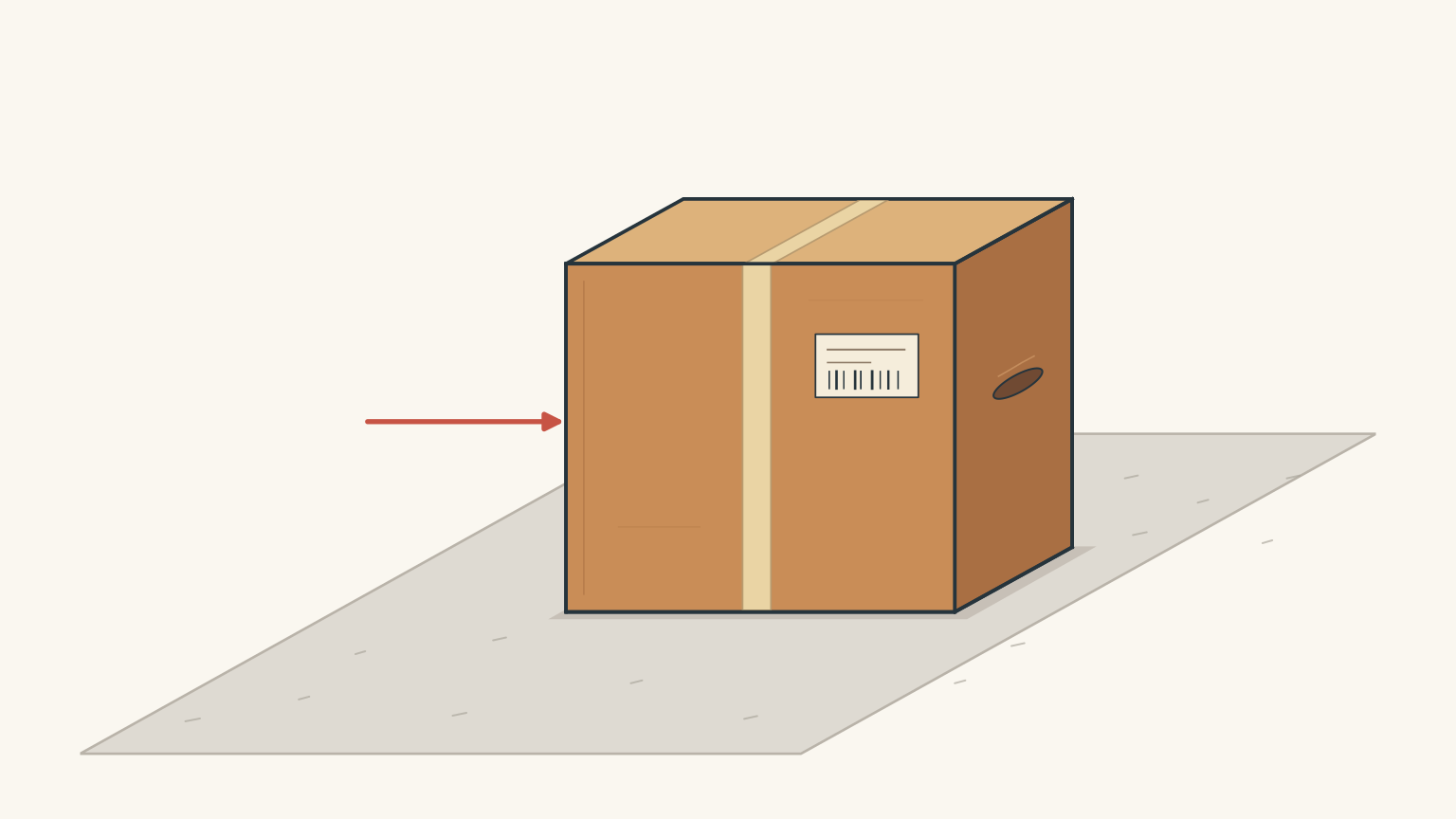
01Static friction adjusts to the situation
Think about the soles of your shoes when you walk across a basketball court. Your shoes need friction to grip the floor, but they don’t need the maximum possible grip every time you take a step. The frictional force responds to the tendency of your foot to slip.
Static friction works in a similar way. It prevents two surfaces in contact from sliding relative to each other.
The important idea is that static friction is a self-adjusting force. Its magnitude depends on the other forces acting on the object.
For example:
- If nothing tries to slide the object, static friction can be zero.
- If a 5 N force tries to slide it right, static friction can act with a magnitude of 5 N to the left.
- If a 15 N force tries to slide it right, static friction can increase to 15 N, provided the surfaces can supply that much friction.
- If the required friction exceeds the available maximum, the object can no longer remain stationary.
There is a limit to how much static friction the surfaces can provide.
The maximum static friction is:
\[ f_{s,\max}=\mu_sN \]
where:
- \(f_{s,\max}\) is the maximum static-friction force, measured in newtons (N).
- \(\mu_s\) is the coefficient of static friction, which has no units.
- \(N\) is the normal force, measured in newtons (N).
The actual static-friction force must satisfy:
\[ 0\leq |f_s|\leq \mu_sN \]
This inequality is the equation you should remember.
The actual friction can take any magnitude within this range, depending on what is needed to prevent sliding.
When does static friction actually reach its maximum?
Only when the object is on the verge of slipping.
This situation is called limiting equilibrium. The object is still stationary, but the static-friction force has reached its maximum possible value.
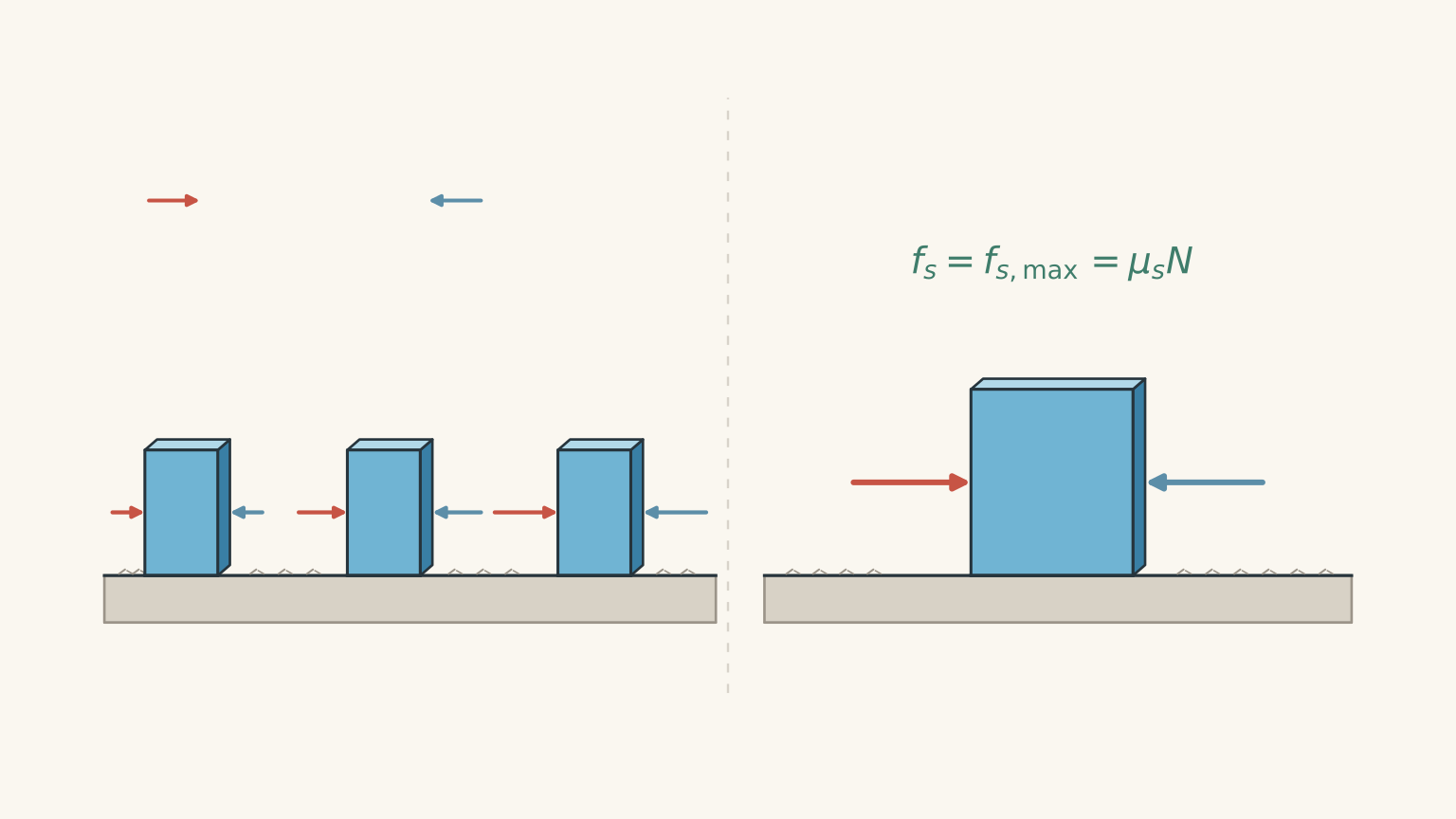
You can think of the relationship like this:
| Situation | Friction force |
|---|---|
| No tendency to slide | Zero |
| Stationary, with a small tendency to slide | Whatever force is needed |
| Stationary, close to slipping | Close to its maximum |
| Just about to slip | \(f_s=\mu_sN\) |
| Already sliding | Use kinetic friction |
The maximum is a limit, not a default value.
02Why substituting the maximum gives the wrong answer
Let’s look at what happens when you use the maximum static friction in every stationary-object problem.
Worked example: A crate pushed across a horizontal floor
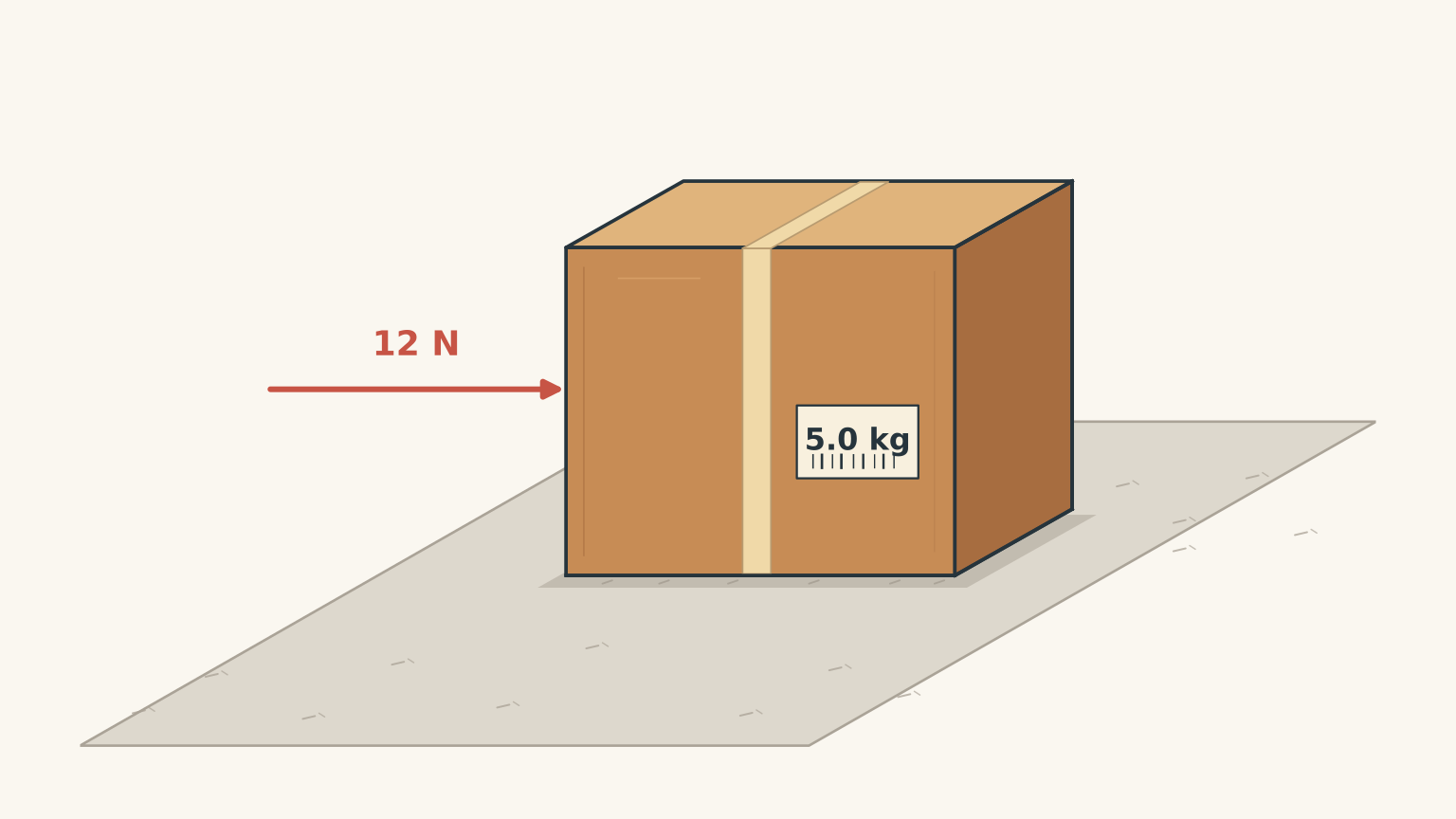
A 5.0 kg crate rests on a horizontal floor. A horizontal force of 12 N is applied to the right. The coefficient of static friction between the crate and floor is 0.50.
Calculate the actual static-friction force acting on the crate and compare it with the maximum possible static friction.
Take \(g=9.8\text{ m s}^{-2}\).
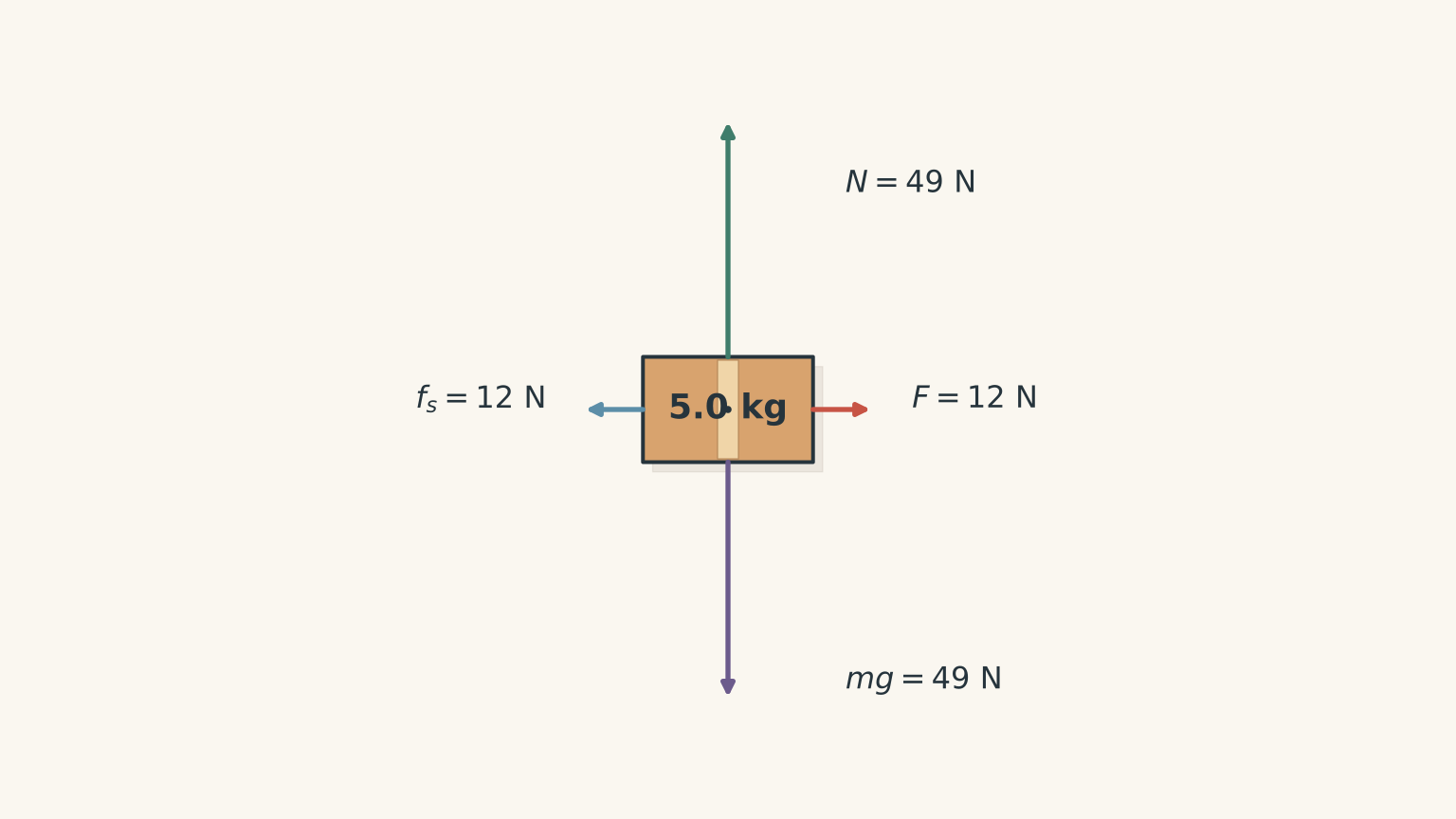
Step 1
There are no other vertical forces, and the crate has no vertical acceleration.
Therefore:
\[ N=mg \]
\[ N=5.0\times9.8 \]
\[ N=49.0\text{ N} \]
Step 2
Using the maximum-friction equation:
\[ f_{s,\max}=\mu_sN \]
\[ f_{s,\max}=0.50\times49.0 \]
\[ f_{s,\max}=24.5\text{ N} \]
This tells us the floor can provide up to 24.5 N of static friction.
It does not tell us that 24.5 N is actually acting.
Step 3
The applied force is 12 N to the right.
For the crate to remain stationary, its resultant horizontal force must be zero.
Therefore, static friction must provide an equal force in the opposite direction:
\[ f_s=12\text{ N} \]
The friction acts to the left.
Step 4
The required friction is 12 N, while the maximum available friction is 24.5 N.
\[ 12<24.5 \]
Therefore, static friction is sufficient to keep the crate stationary.
Correct result
\[ \boxed{f_s=12\text{ N to the left}} \]
Notice that the actual friction is less than half the maximum.
What would the incorrect method give?
A common mistake is to write:
\[ f_s=\mu_sN=24.5\text{ N} \]
and conclude that friction acts with a magnitude of 24.5 N to the left.
But then the resultant horizontal force would be:
\[ F_{\text{net}}=12-24.5 \]
\[ F_{\text{net}}=-12.5\text{ N} \]
This would mean the crate accelerates to the left.
That contradicts the information in the question: the crate is stationary.
The mistake is treating the maximum possible friction as though it must always act. The correct method is to calculate the friction required for equilibrium first, then check whether the maximum is large enough.
03Static friction on an inclined plane
The same principle applies on an inclined plane, but there is another detail that students often overlook: the normal force changes.
On a horizontal surface, you can often use \(N=mg\). On an inclined plane, this is generally incorrect.
Consider a block resting on a slope at an angle \(\theta\) to the horizontal.
The weight \(mg\) acts vertically downwards. However, the normal force acts perpendicular to the inclined surface, not vertically upwards.
We therefore resolve the weight into two components:
- \(mg\sin\theta\), parallel to the slope and directed downwards.
- \(mg\cos\theta\), perpendicular to the slope and directed into the surface.
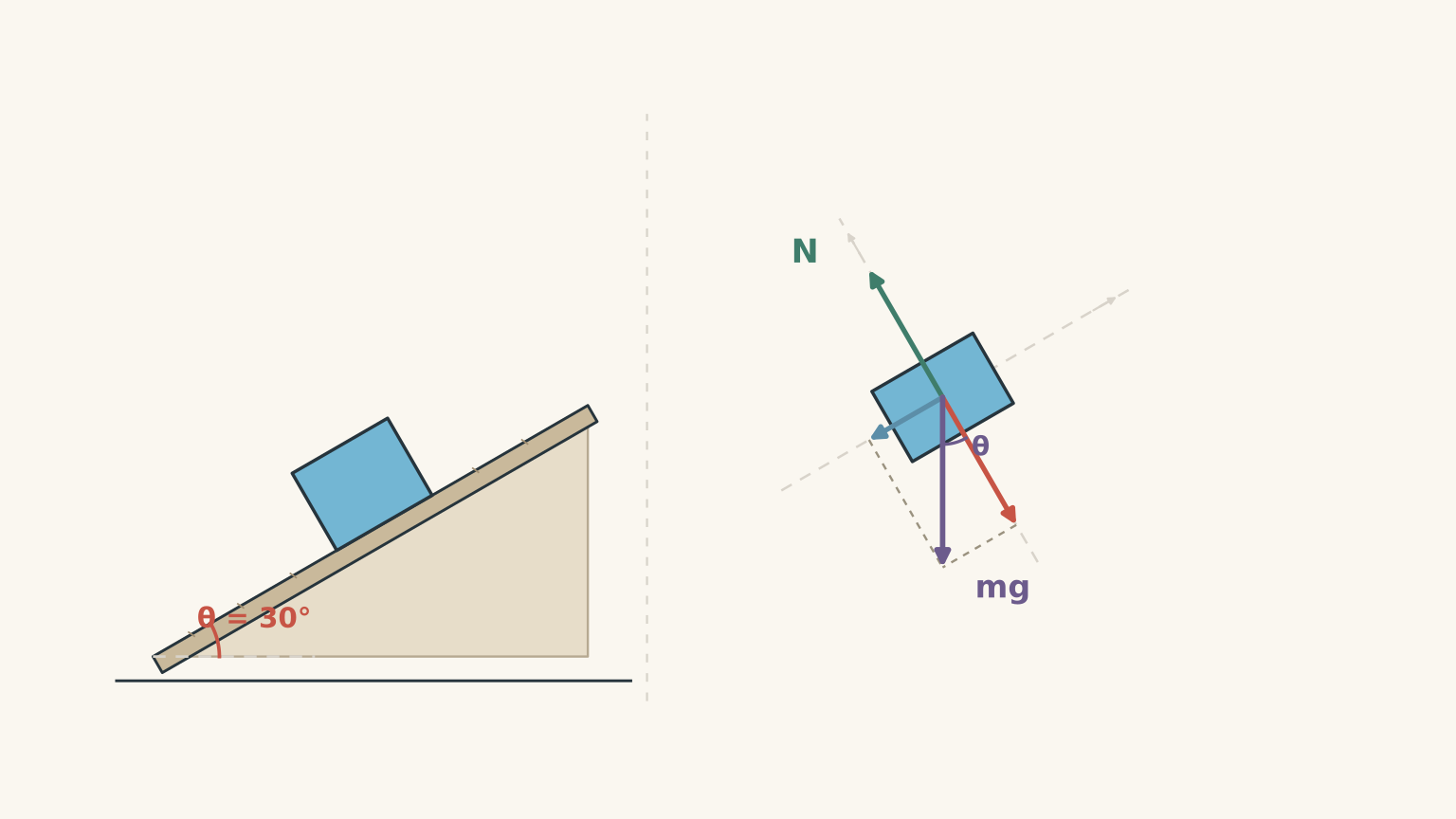
If there are no other forces acting perpendicular to the surface, the normal force balances the perpendicular component of weight.
Therefore:
\[ N=mg\cos\theta \]
The maximum static friction becomes:
\[ \boxed{f_{s,\max}=\mu_smg\cos\theta} \]
This is different from the horizontal-surface expression because the normal force is different.
For an inclined plane, don’t automatically substitute \(mg\) for \(N\).
Also remember that the equation \(N=mg\cos\theta\) assumes there are no additional perpendicular forces and no acceleration perpendicular to the plane. If a rope or an applied force pushes or pulls the block away from the surface, you must include that force when calculating \(N\).
Worked example: A crate held on a ramp
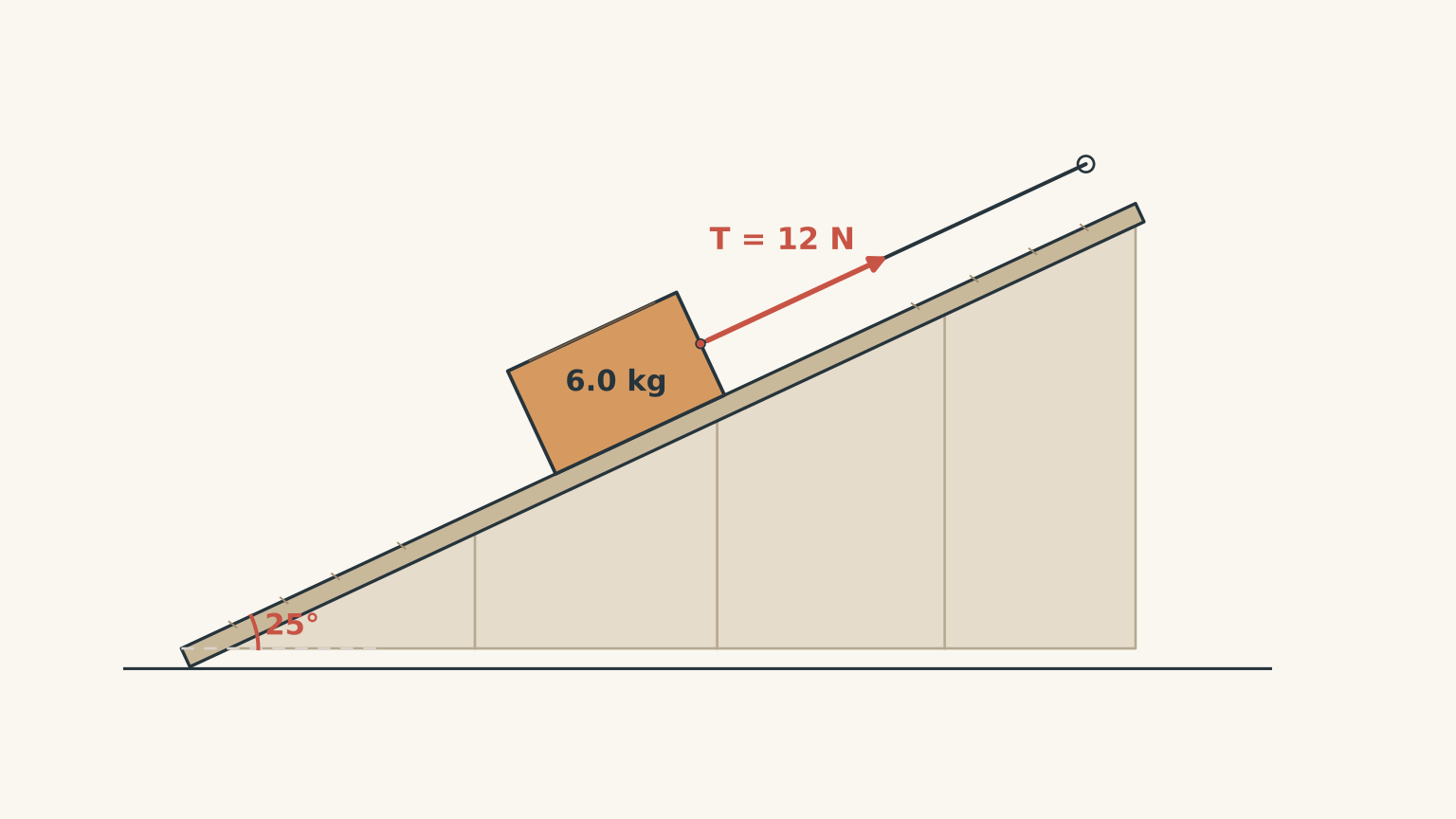
A 6.0 kg crate rests on an inclined plane at \(25^\circ\) to the horizontal. A rope parallel to the plane pulls the crate upwards with a tension of 12 N.
The coefficient of static friction between the crate and plane is 0.40.
Determine:
- The actual static-friction force.
- The maximum possible static-friction force.
- Whether the crate remains stationary.
Take \(g=9.8\text{ m s}^{-2}\).
Step 1
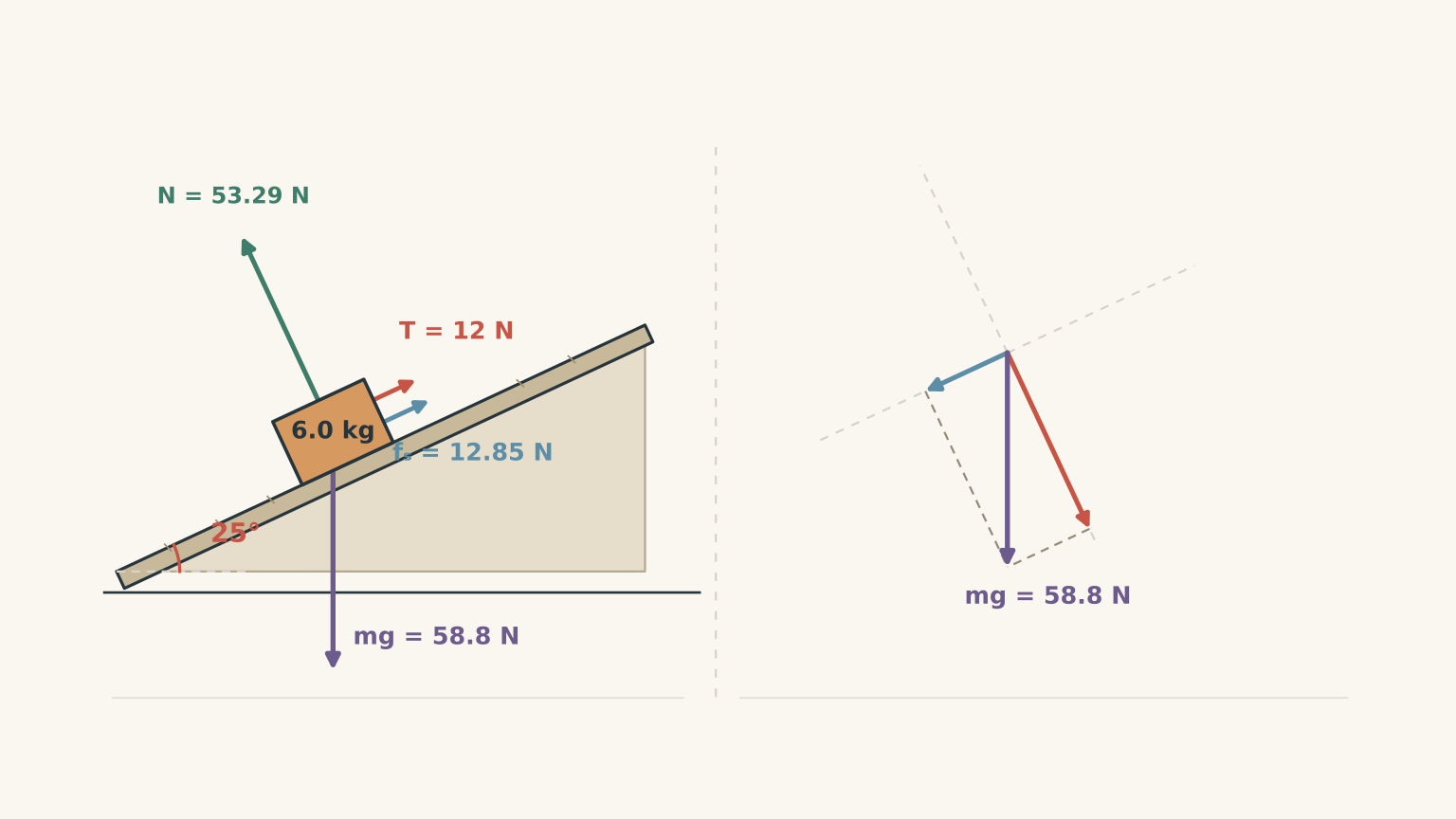
The component of weight down the slope is:
\[ F_{\parallel}=mg\sin25^\circ \]
\[ =6.0\times9.8\times\sin25^\circ \]
\[ =24.85\text{ N} \]
The perpendicular component is:
\[ F_{\perp}=mg\cos25^\circ \]
\[ =6.0\times9.8\times\cos25^\circ \]
\[ =53.29\text{ N} \]
Step 2
There are no other forces perpendicular to the inclined plane.
Therefore:
\[ N=53.29\text{ N} \]
Step 3
There are two forces acting parallel to the plane before considering friction:
- Weight component: 24.85 N down the slope.
- Tension: 12 N up the slope.
The crate would tend to slide down the slope because the weight component is larger than the tension.
Static friction must oppose this tendency, so it acts up the slope.
For equilibrium:
\[ f_s+12=24.85 \]
\[ \boxed{f_s=12.85\text{ N}} \]
Step 4
\[ f_{s,\max}=\mu_sN \]
\[ =0.40\times53.29 \]
\[ =21.32\text{ N} \]
Step 5
The required friction is 12.85 N, while the maximum is 21.32 N.
\[ 12.85<21.32 \]
Therefore, the crate remains stationary.
The answers are:
\[ \boxed{f_s=12.85\text{ N up the slope}} \]
\[ \boxed{f_{s,\max}=21.32\text{ N}} \]
The crate does not need the full 21.32 N of friction. It only needs 12.85 N to balance the other forces.
04The method to use in an HSC exam
When you see a stationary object with static friction, follow this sequence.
Step 1: Draw a free-body diagram.
Identify every force acting on the object.
Include weight, normal force, tension, applied forces, and friction where relevant.
Step 2: Choose convenient axes.
For an inclined plane, choose axes parallel and perpendicular to the surface.
This makes resolving forces much easier.
Step 3: Calculate the normal force.
Use the forces perpendicular to the surface.
Do not automatically assume \(N=mg\).
Step 4: Calculate the friction required for equilibrium.
Consider the forces parallel to the surface, excluding friction.
Determine which way the object would tend to slide if friction were absent.
Static friction acts in the opposite direction and balances the other parallel forces if equilibrium is possible.
Step 5: Compare the required friction with the maximum.
Calculate:
\[ f_{s,\max}=\mu_sN \]
Then check:
\[ |f_s|\leq\mu_sN \]
If this condition is satisfied, static equilibrium is possible.
If the required friction is greater than the maximum, static friction cannot prevent slipping.
If the object is just about to slip, the two values are equal.
Watch the wording of the question
Small changes in exam wording can change which friction equation you should use.
| Exam wording | What you should do |
|---|---|
| The object is stationary | Find the friction required for equilibrium. |
| The object is just about to move | Set \(f_s=\mu_sN\). |
| The object is on the verge of slipping | Use limiting static friction. |
| The object is sliding | Use \(f_k=\mu_kN\). |
| The object moves at constant speed | Use kinetic friction and zero resultant force. |
Static friction versus kinetic friction
These two types of friction are not interchangeable.
Static friction acts when surfaces are not sliding relative to each other. Its magnitude adjusts to oppose the tendency to slide, up to its maximum.
Kinetic friction acts when surfaces are sliding relative to each other.
In the usual HSC friction model:
\[ f_k=\mu_kN \]
where \(\mu_k\) is the coefficient of kinetic friction.
Unlike static friction, kinetic friction is generally modelled as having an approximately constant magnitude for a given normal force.
For many common surfaces, \(\mu_k\) is smaller than \(\mu_s\), although you should use the coefficients supplied in the question rather than assume a particular relationship.
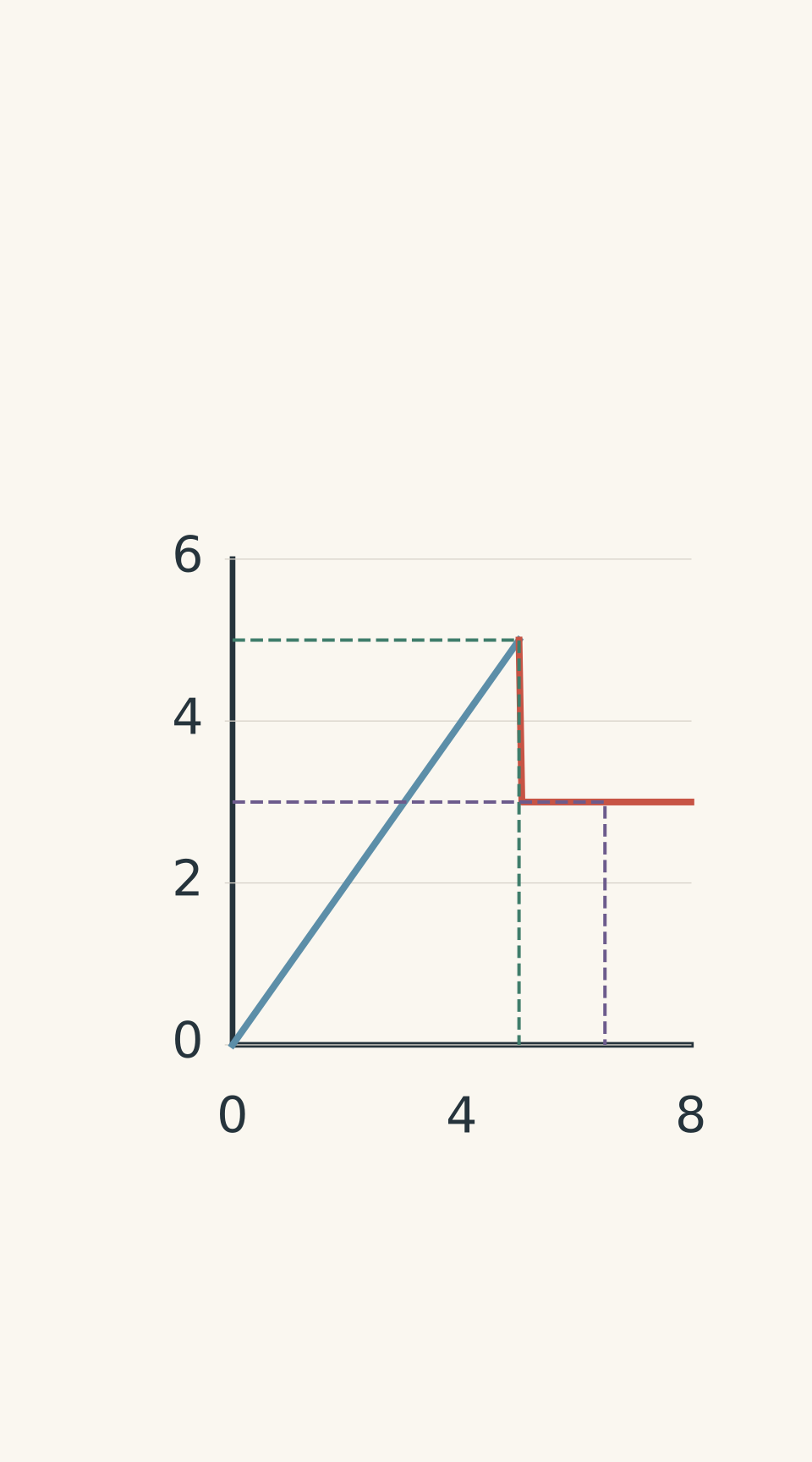
- Static friction (stationary)
- Friction during and after slipping
- Maximum static friction
- Kinetic friction
One more useful connection: in connected-mass questions, tension can create the tendency to slide, while static friction adjusts to balance it. You need to set up the force diagrams for both objects before deciding whether the system can remain stationary. The same reasoning is used in Connected Masses and Pulleys: Forces, Tension, and Friction.
05Questions and solutions
The following questions move from straightforward friction calculations to situations where the direction of friction, normal force, or motion changes. Try each question before reading its solution.
Question 1
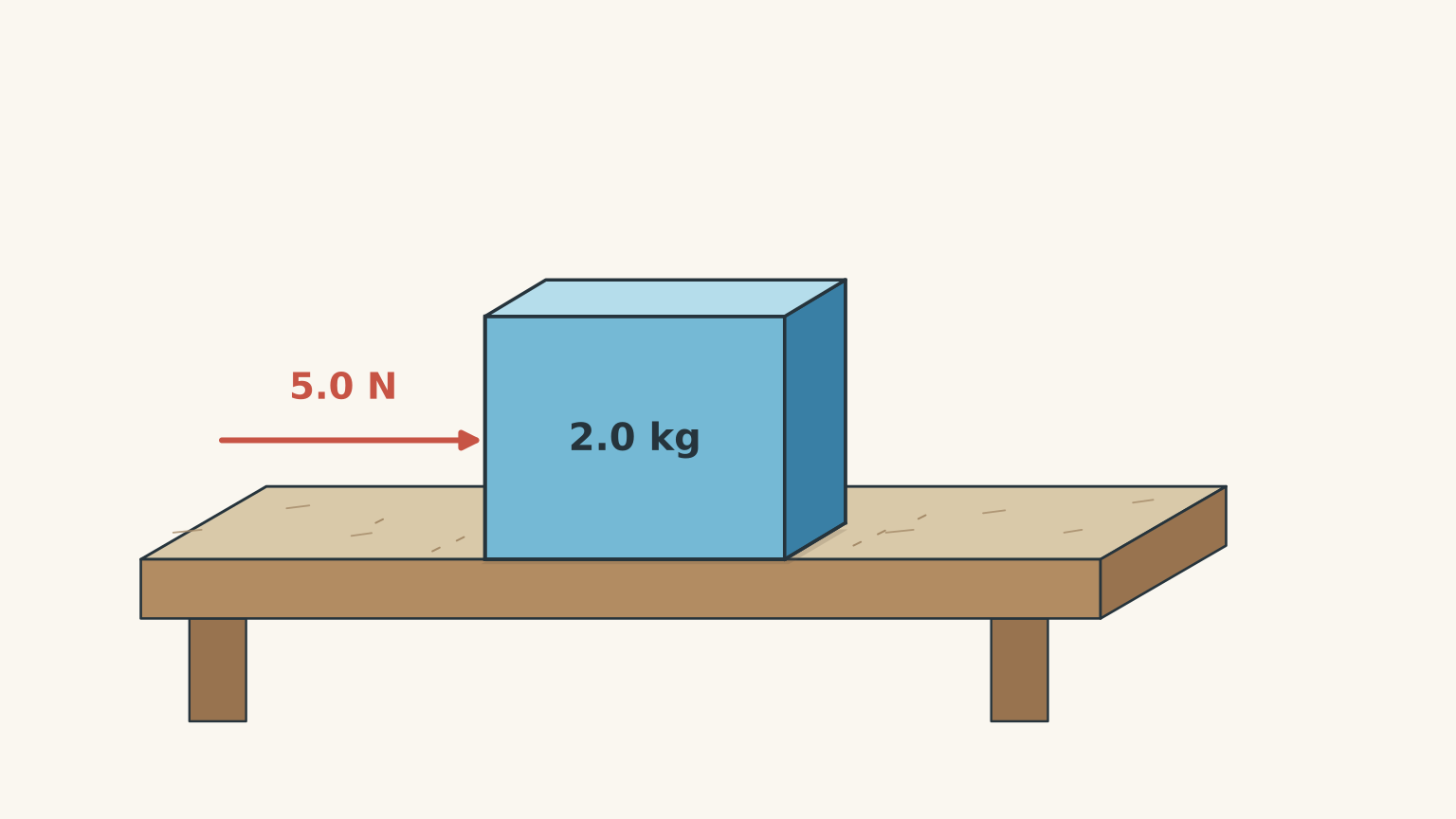
A 2.0 kg block rests on a horizontal table. A horizontal force of 5.0 N is applied to the right.
The coefficient of static friction between the block and table is 0.40.
Calculate:
a) The normal force acting on the block.
b) The actual static-friction force, including its direction.
c) The maximum possible static-friction force.
Take \(g=9.8\text{ m s}^{-2}\).
Solution 1
The actual static friction is 5.0 N to the left, and the maximum possible static friction is 7.84 N.
Part a: Normal force
The block has no vertical acceleration, and there are no other vertical forces.
\[ N=mg \]
\[ N=2.0\times9.8 \]
\[ \boxed{N=19.6\text{ N}} \]
Part b: Actual static friction
The applied force is 5.0 N to the right.
For the block to remain stationary, friction must balance this force.
\[ \boxed{f_s=5.0\text{ N to the left}} \]
Part c: Maximum static friction
\[ f_{s,\max}=\mu_sN \]
\[ =0.40\times19.6 \]
\[ \boxed{f_{s,\max}=7.84\text{ N}} \]
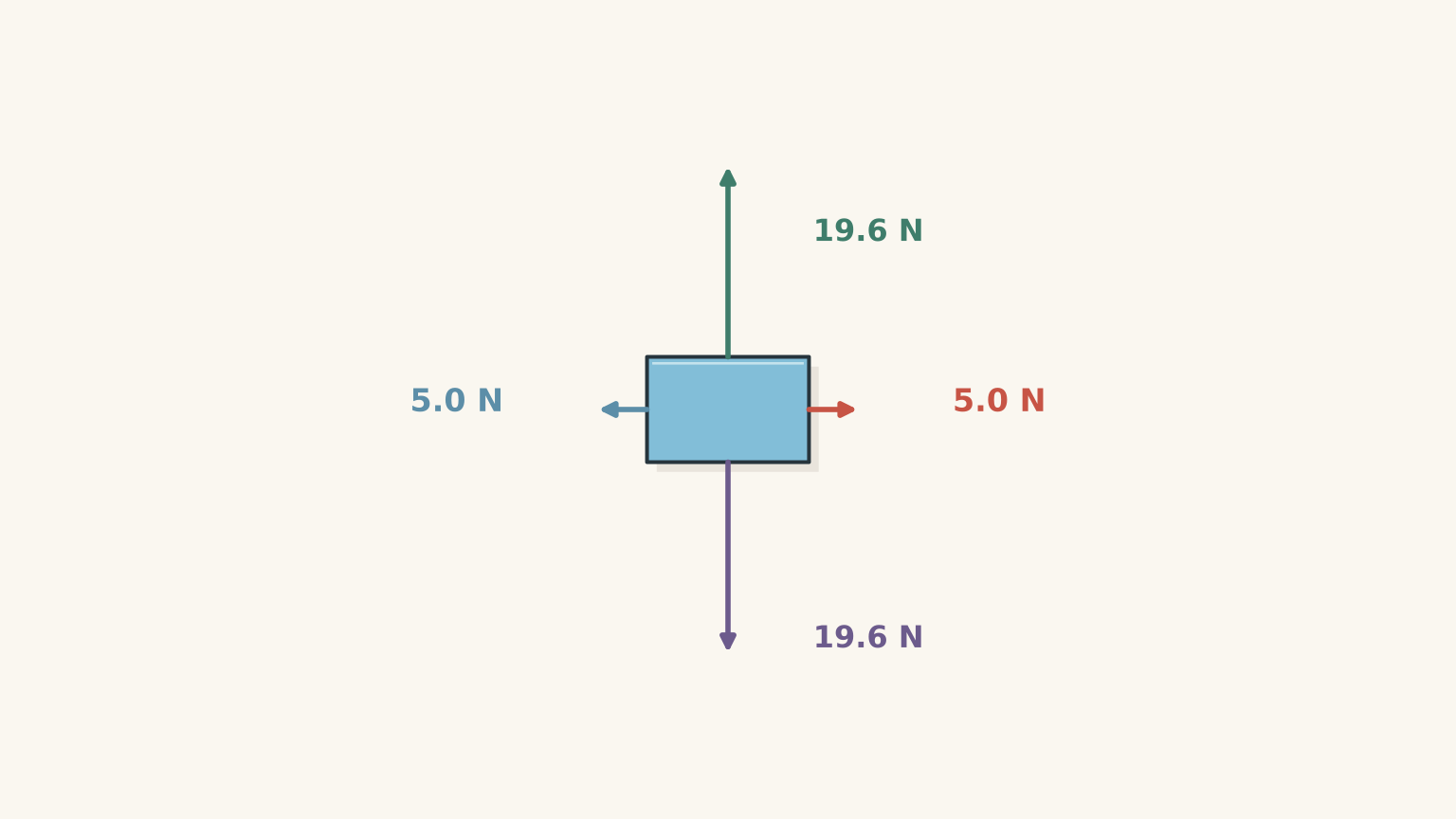
The required friction is smaller than the maximum:
\[ 5.0<7.84 \]
Therefore, the block can remain stationary.
The common mistake would be to report 7.84 N as the actual friction. That would produce an unbalanced horizontal force, even though the question describes a stationary block.
Question 2
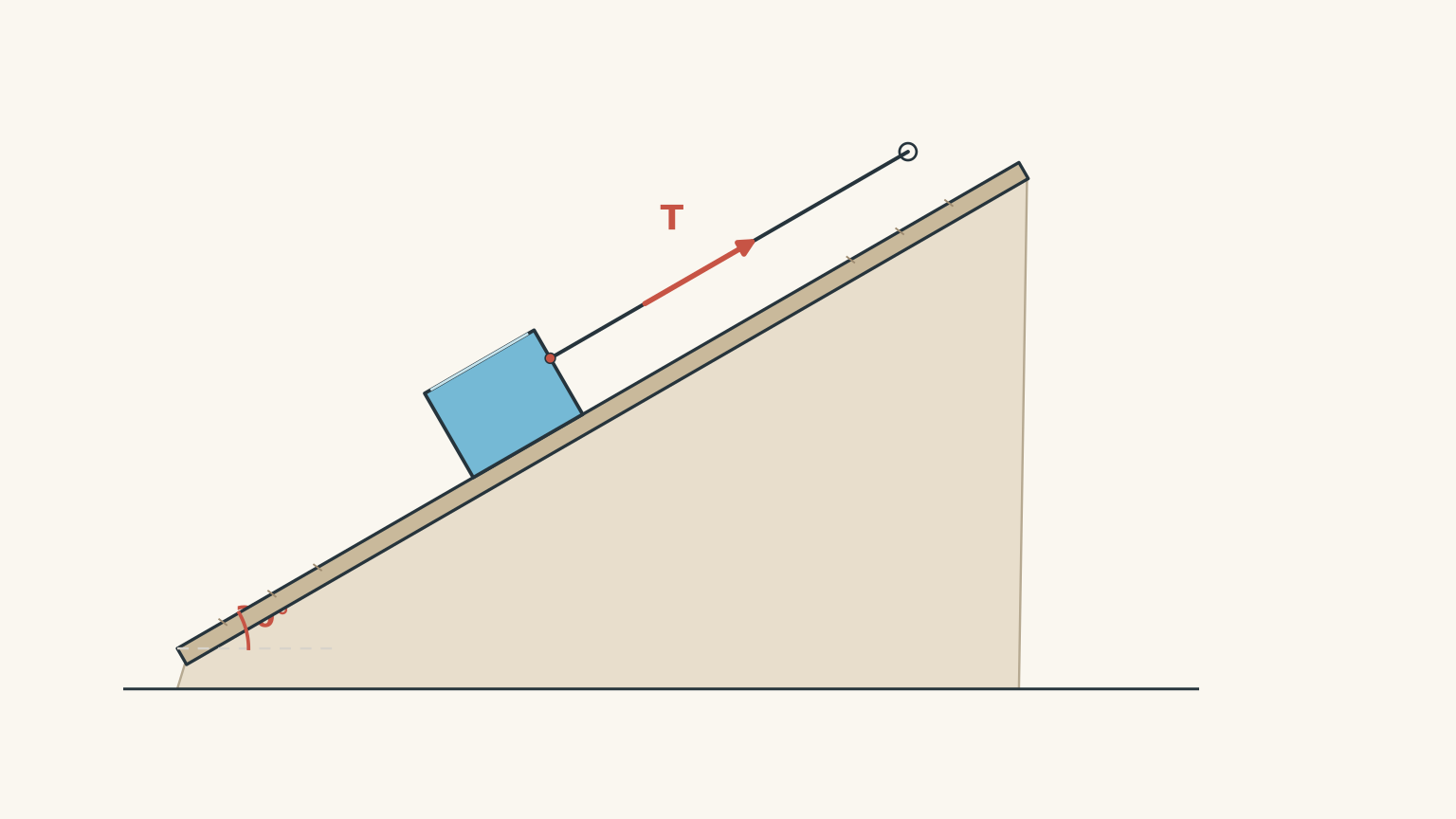
A 4.0 kg block rests on an inclined plane at \(30^\circ\) to the horizontal. A rope runs parallel to the inclined plane and pulls the block upwards with a tension \(T\).
The coefficient of static friction between the block and plane is 0.40.
a) Determine the range of rope tensions for which the block can remain stationary.
b) Calculate the actual static-friction force, including its direction, when the tension is:
- 10 N.
- 25 N.
Take \(g=9.8\text{ m s}^{-2}\).
Solution 2
The block can remain stationary when the tension is between approximately 6.02 N and 33.18 N.
At 10 N, friction acts up the slope with a magnitude of 9.6 N. At 25 N, friction acts down the slope with a magnitude of 5.4 N.
Part a: Find the range of tensions
First, calculate the component of weight acting down the slope:
\[ mg\sin30^\circ =4.0\times9.8\times0.5 \]
\[ =19.6\text{ N} \]
Next, calculate the normal force:
\[ N=mg\cos30^\circ \]
\[ =4.0\times9.8\times0.8660 \]
\[ =33.95\text{ N} \]
The maximum static friction is:
\[ f_{s,\max}=0.40\times33.95 \]
\[ =13.58\text{ N} \]
For equilibrium, friction must balance the difference between the weight component and tension.
Therefore, the magnitude of the required friction is:
\[ |f_s|=|19.6-T| \]
Static equilibrium is possible when:
\[ |19.6-T|\leq13.58 \]
This gives:
\[ -13.58\leq19.6-T\leq13.58 \]
Solving the two inequalities:
\[ \boxed{6.02\leq T\leq33.18\text{ N}} \]
At either boundary, static friction reaches its maximum.
Part b: Calculate friction at each tension
When \(T=10\text{ N}\):
\[ f_s=19.6-10 \]
\[ \boxed{f_s=9.6\text{ N up the slope}} \]
The weight component is greater than the tension, so the block would tend to slide downwards without friction. Friction therefore acts upwards.
When \(T=25\text{ N}\):
\[ f_s=19.6-25 \]
\[ f_s=-5.4\text{ N} \]
The negative sign indicates that friction acts in the opposite direction to our assumed positive direction.
\[ \boxed{f_s=5.4\text{ N down the slope}} \]
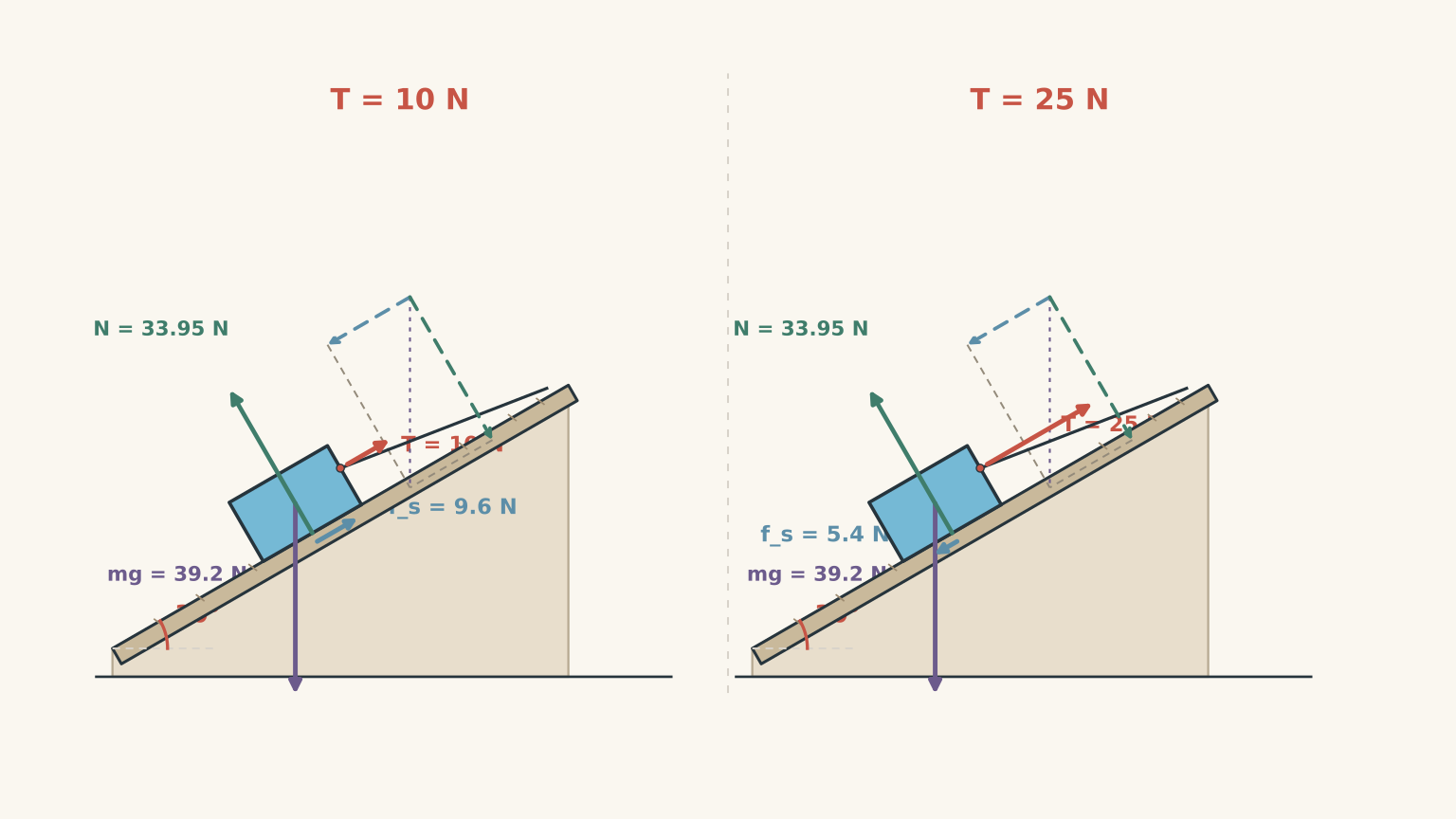
This is an important result. Static friction does not always act up an inclined plane.
It opposes the tendency to slide. When the rope pulls harder than the downslope component of weight, that tendency reverses, and so does friction.
Question 3
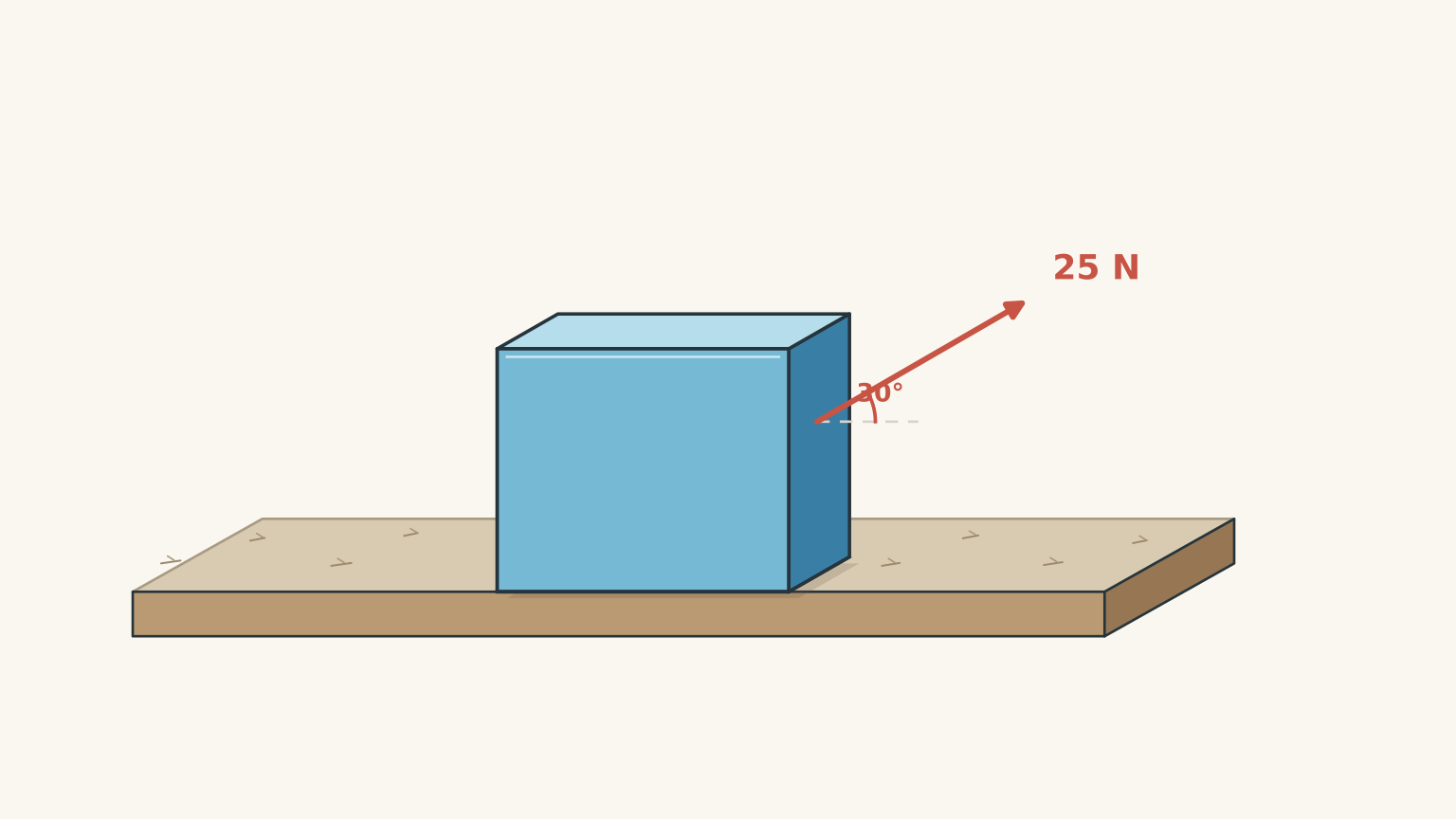
A 5.0 kg block rests on a rough horizontal surface. A force of 25 N is applied at an angle of \(30^\circ\) above the horizontal, pulling the block towards the right.
The coefficient of static friction is 0.45.
Determine:
a) The normal force.
b) The horizontal force that static friction must balance.
c) The maximum possible static friction.
d) Whether the block can remain stationary, and the minimum coefficient of static friction required to prevent it from moving.
Take \(g=9.8\text{ m s}^{-2}\).
Solution 3
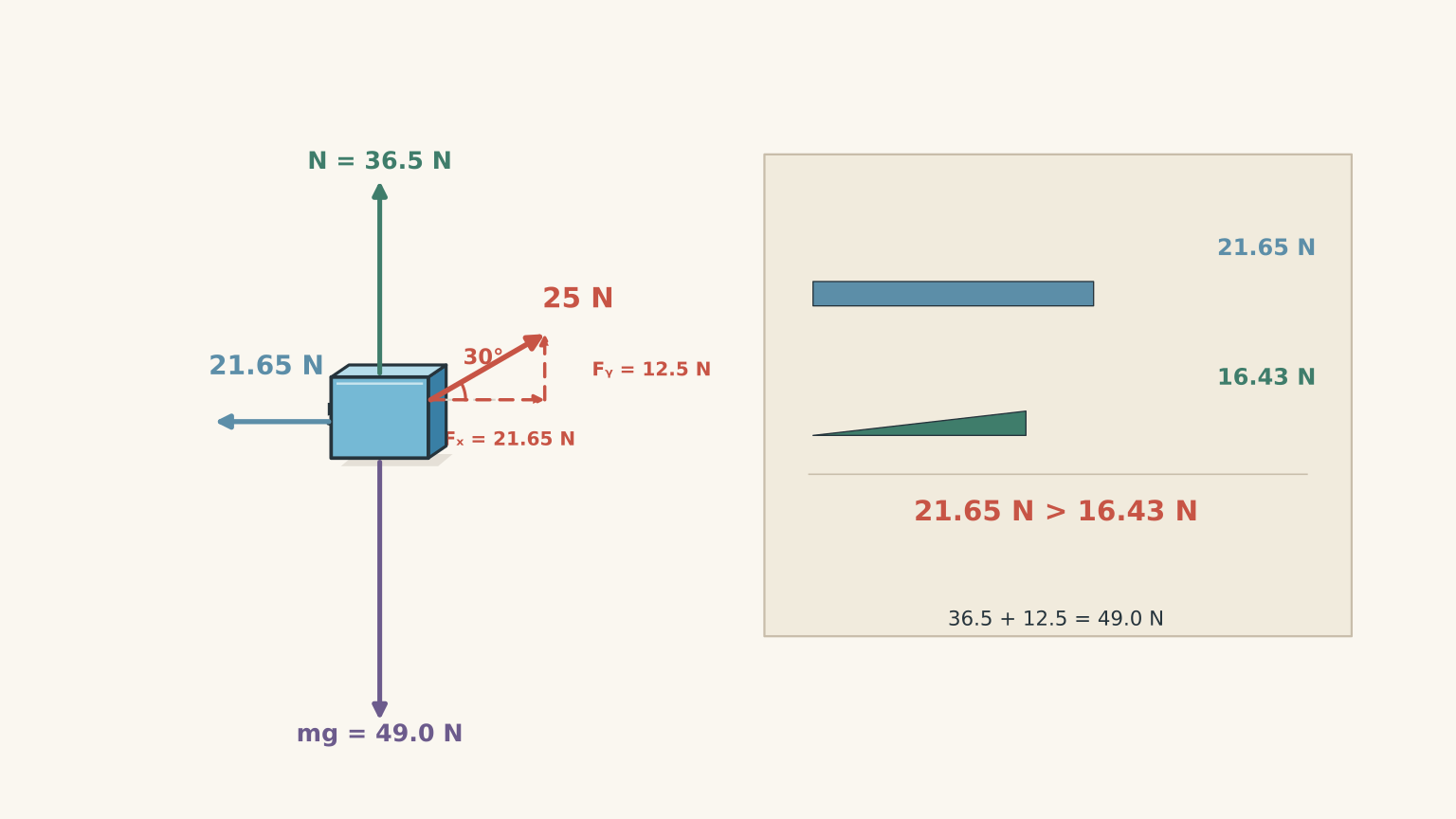
The block cannot remain stationary. It requires 21.65 N of friction, but the maximum available static friction is only 16.43 N.
Part a: Calculate the normal force
The applied force has an upward vertical component.
Resolving vertically:
\[ N+25\sin30^\circ-mg=0 \]
Rearranging:
\[ N=mg-25\sin30^\circ \]
\[ =5.0\times9.8-25\times0.5 \]
\[ \boxed{N=36.5\text{ N}} \]
Notice that the normal force is smaller than the weight of 49 N because the applied force partially lifts the block.
Part b: Find the required static friction
The horizontal component of the applied force is:
\[ F_x=25\cos30^\circ \]
\[ =25\times0.8660 \]
\[ \boxed{F_x=21.65\text{ N}} \]
If the block is to remain stationary, friction must balance this horizontal force.
The required friction is therefore 21.65 N to the left.
Part c: Calculate maximum static friction
\[ f_{s,\max}=\mu_sN \]
\[ =0.45\times36.5 \]
\[ \boxed{f_{s,\max}=16.43\text{ N}} \]
Part d: Determine whether the block remains stationary
Compare the required friction with the maximum:
\[ 21.65>16.43 \]
The required friction exceeds the maximum available friction.
Therefore, static equilibrium is impossible, and the block will begin sliding.
To find the minimum coefficient of static friction needed, use:
\[ \mu_{s,\min}=\frac{f_s}{N} \]
\[ =\frac{21.65}{36.5} \]
\[ \boxed{\mu_{s,\min}=0.593} \]
There is a particularly tempting mistake here.
If you incorrectly use \(N=mg=49\text{ N}\), you obtain:
\[ f_{s,\max}=0.45\times49=22.05\text{ N} \]
You might conclude that the block remains stationary because 22.05 N exceeds 21.65 N.
But that conclusion is wrong. The upward component of the applied force reduces the normal force, which also reduces the maximum static friction.
This is why you must resolve forces perpendicular to the surface before calculating the friction limit.
Question 4
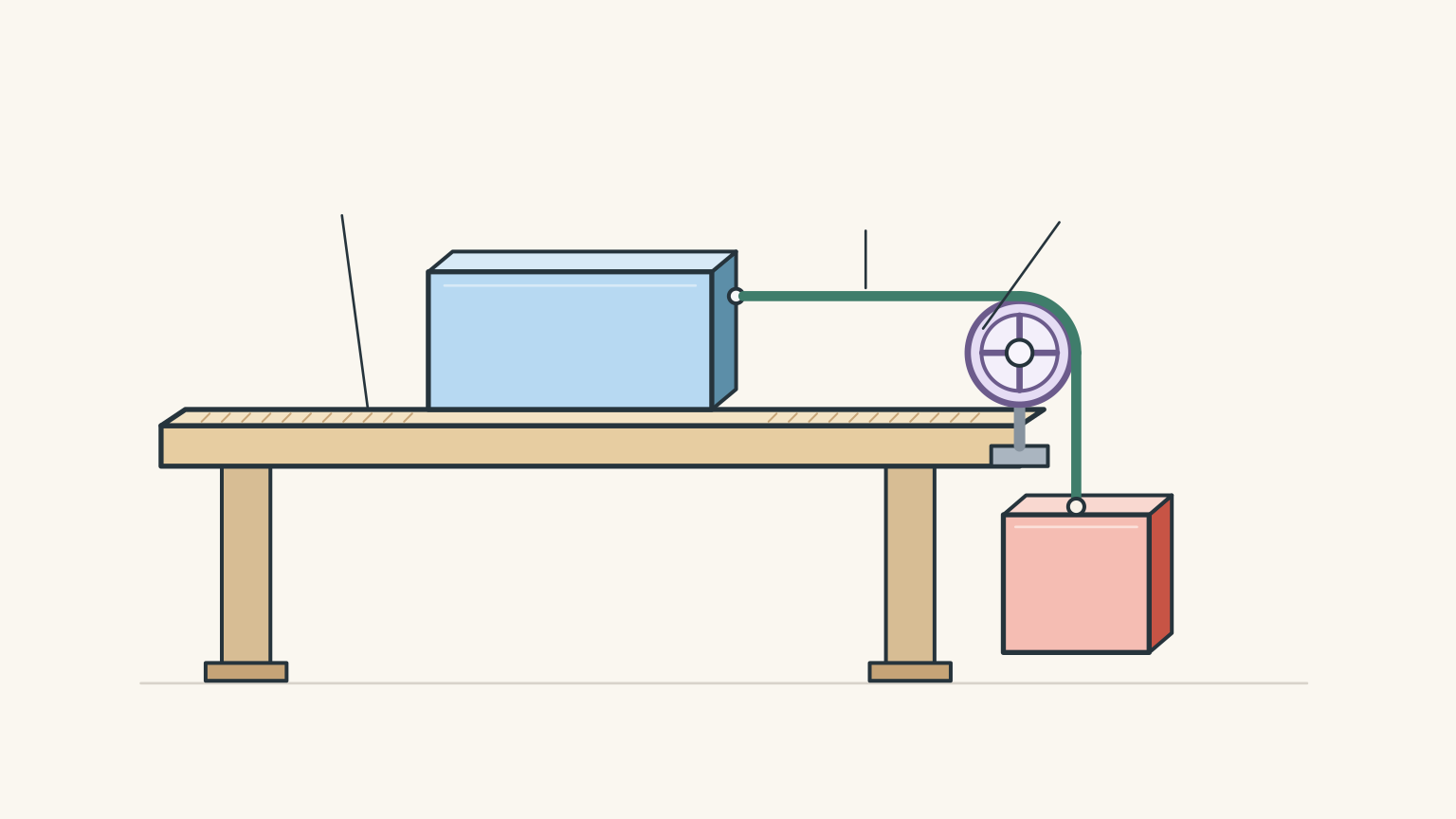
A 5.0 kg block rests on a horizontal table and is connected by a light string over a frictionless pulley to a hanging mass of 1.5 kg.
The coefficient of static friction between the block and table is 0.35. The coefficient of kinetic friction is 0.25.
a) Determine whether the system can remain stationary. Calculate the actual static friction and its maximum possible value.
b) An additional 0.50 kg mass is gently added to the hanging side, bringing its total mass to 2.0 kg. Determine whether the system can remain stationary.
c) If the system starts moving, calculate its acceleration and direction.
Take \(g=9.8\text{ m s}^{-2}\).
Solution 4
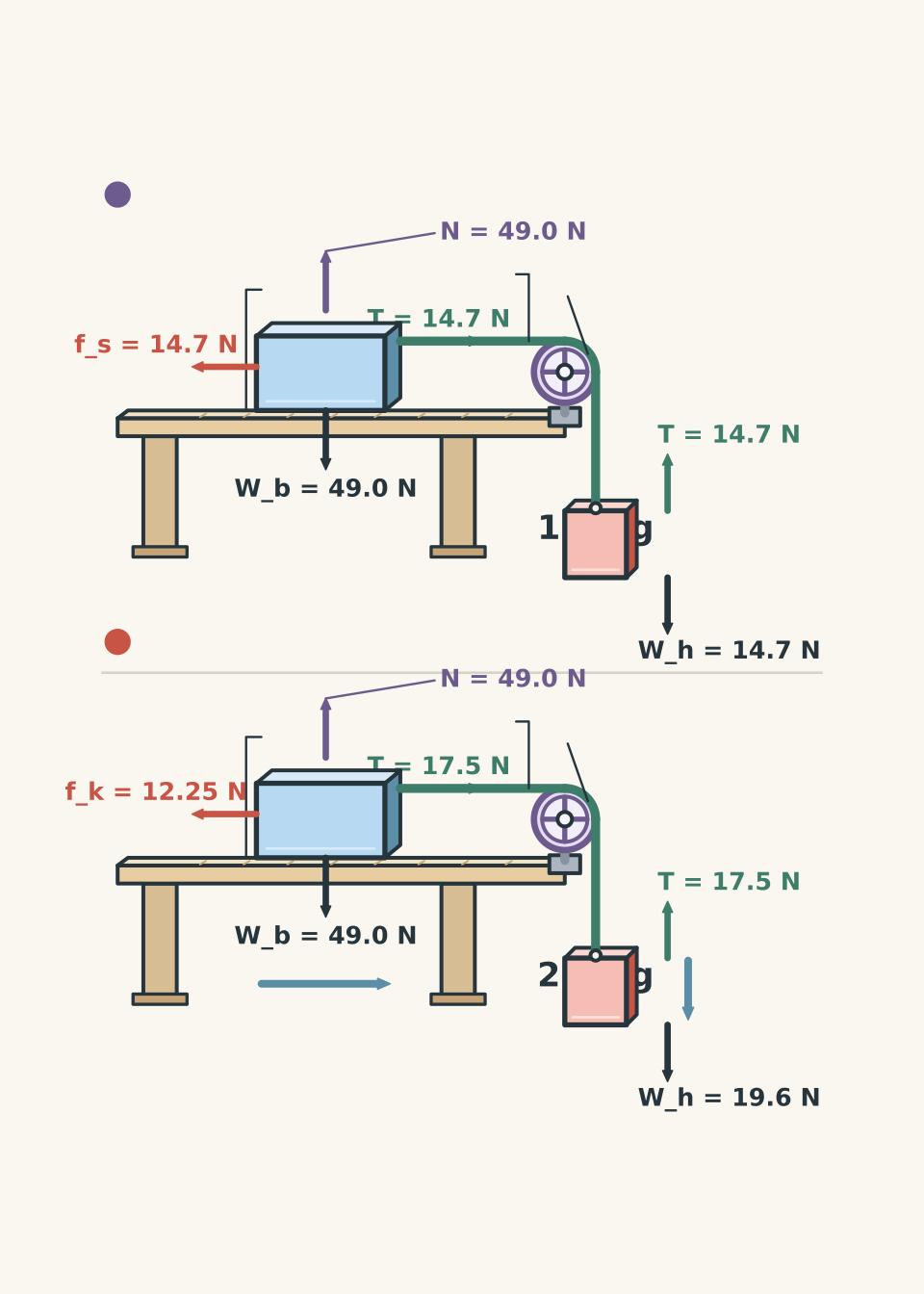
Initially, the system can remain stationary. The actual static friction is 14.7 N, while its maximum is 17.15 N.
After the hanging mass increases to 2.0 kg, static equilibrium becomes impossible. The hanging mass accelerates downwards at \(1.05\text{ m s}^{-2}\).
Part a: Initial stationary system
Start with the hanging mass.
Since it is stationary, its resultant force must be zero.
Therefore, the tension in the string is:
\[ T=m_hg \]
\[ =1.5\times9.8 \]
\[ T=14.7\text{ N} \]
The tension pulls the block on the table towards the pulley.
For the block to remain stationary, friction must balance the tension.
\[ \boxed{f_s=14.7\text{ N}} \]
Now calculate the normal force on the 5.0 kg block:
\[ N=mg \]
\[ =5.0\times9.8 \]
\[ N=49.0\text{ N} \]
The maximum static friction is:
\[ f_{s,\max}=0.35\times49.0 \]
\[ \boxed{f_{s,\max}=17.15\text{ N}} \]
Since:
\[ 14.7<17.15 \]
the system can remain stationary.
Part b: Add another 0.50 kg
The hanging mass is now 2.0 kg.
If the system were stationary, the tension would need to be:
\[ T=2.0\times9.8 \]
\[ T=19.6\text{ N} \]
The block on the table would therefore require 19.6 N of static friction.
However:
\[ 19.6>17.15 \]
The required friction exceeds the maximum available friction.
Static equilibrium is impossible.
The hanging mass moves downwards, pulling the block towards the pulley.
Part c: Calculate the acceleration
Once the system is moving, we must use kinetic friction instead of static friction.
The kinetic-friction force is:
\[ f_k=\mu_kN \]
\[ =0.25\times49.0 \]
\[ \boxed{f_k=12.25\text{ N}} \]
Now consider the entire system.
The external forces driving the motion are:
- The hanging weight: 19.6 N downwards.
- Kinetic friction: 12.25 N opposing the block’s motion.
The resultant driving force is:
\[ F_{\text{net}}=19.6-12.25 \]
\[ =7.35\text{ N} \]
The total mass of the system is:
\[ m_{\text{total}}=5.0+2.0=7.0\text{ kg} \]
Using Newton’s second law:
\[ F_{\text{net}}=m_{\text{total}}a \]
\[ 7.35=7.0a \]
\[ \boxed{a=1.05\text{ m s}^{-2}} \]
The hanging mass accelerates downwards, and the block on the table accelerates towards the pulley.
Notice the change between the two situations.
Initially, static friction provides exactly 14.7 N, not its maximum of 17.15 N.
After adding mass, the required static friction becomes too large. The system starts moving, and kinetic friction takes over.
This is why identifying the state of motion is just as important as identifying the coefficient of friction.
Question 5
This final question combines the normal force, inclined-plane components, changing friction direction, and limiting equilibrium.
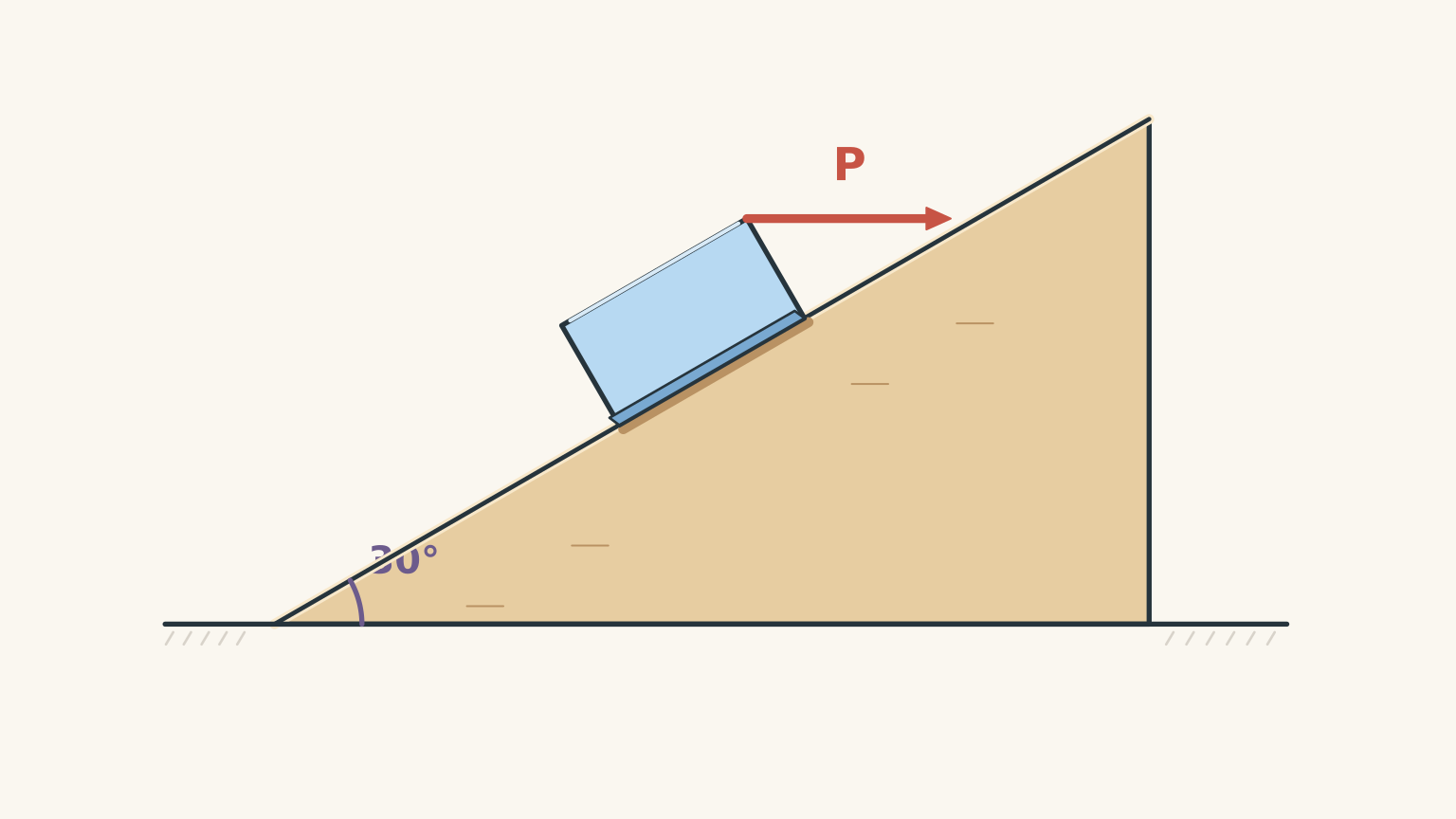
A 10 kg block rests on a rough inclined plane that rises to the right at \(30^\circ\) to the horizontal.
A horizontal force \(P\) acts on the block towards the right. The coefficient of static friction between the block and plane is 0.40.
For each chosen value of \(P\), consider whether the block can be in static equilibrium.
Take \(g=9.8\text{ m s}^{-2}\).
a) Derive the complete range of horizontal forces \(P\) for which static equilibrium is possible.
b) Calculate the actual static-friction force, including its direction, when:
- \(P=20\text{ N}\).
- \(P=80\text{ N}\).
c) Determine the value of \(P\) at which the static-friction force becomes zero.
d) Explain why assuming that friction always acts up the inclined plane gives an incorrect result.
Solution 5
Static equilibrium is possible when:
\[ \boxed{14.1\text{ N}\leq P\leq124.5\text{ N}} \]
At \(P=20\text{ N}\), friction acts up the slope with a magnitude of approximately 31.7 N.
At \(P=80\text{ N}\), friction acts down the slope with a magnitude of approximately 20.3 N.
Friction becomes zero when:
\[ \boxed{P=56.6\text{ N}} \]
The key difficulty is that the horizontal force changes both the tendency to slide and the normal force.
Part a: Derive the range of forces
First, resolve the horizontal applied force into components parallel and perpendicular to the incline.
Because the plane rises to the right:
- The component parallel to the slope is \(P\cos30^\circ\), acting up the slope.
- The component perpendicular to the slope is \(P\sin30^\circ\), acting into the surface.
The weight also has two components:
- \(mg\sin30^\circ\), acting down the slope.
- \(mg\cos30^\circ\), acting into the surface.
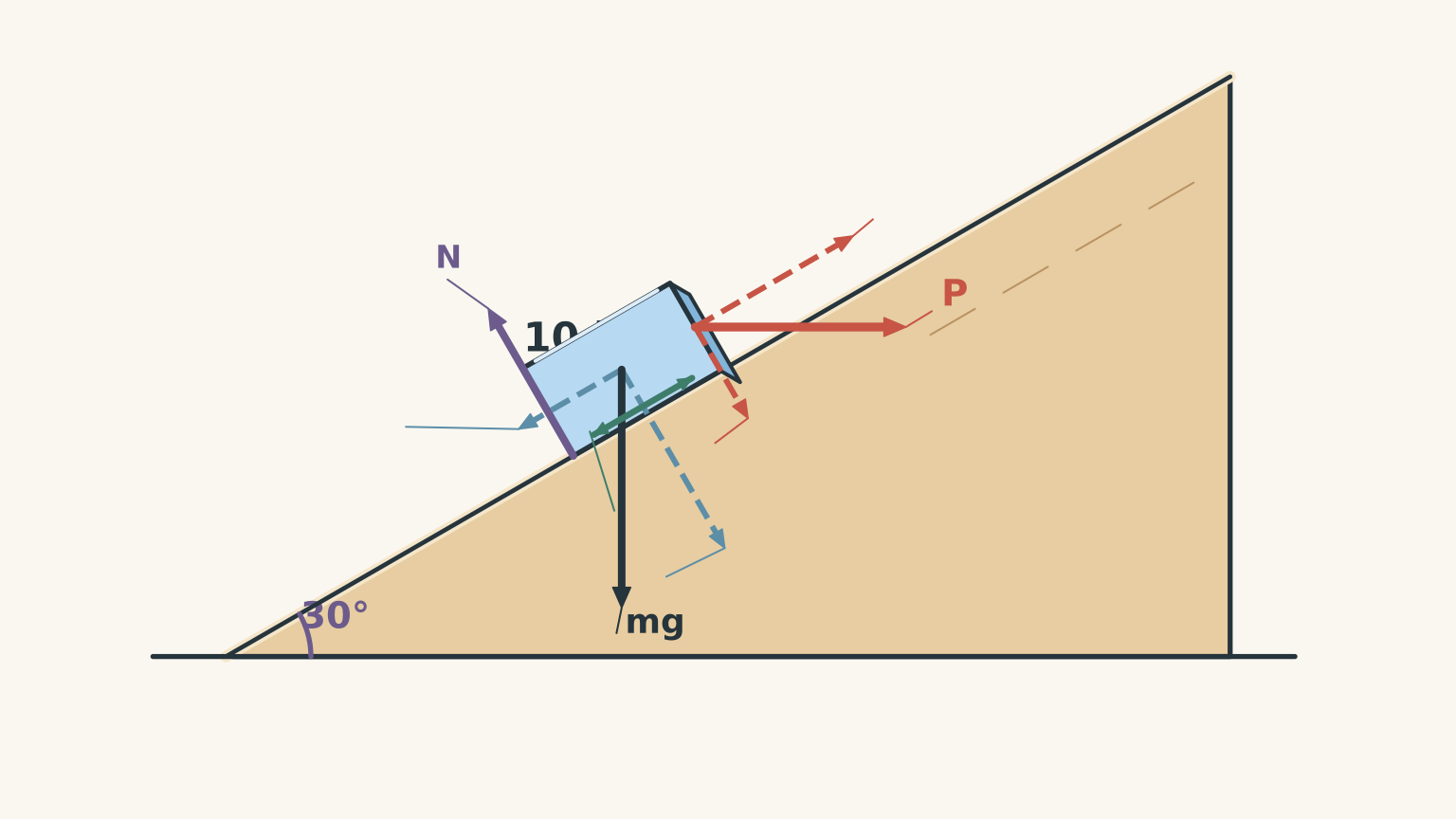
Start by calculating the normal force.
There is no acceleration perpendicular to the plane, so:
\[ N=mg\cos30^\circ+P\sin30^\circ \]
Substituting the known values:
\[ N=10(9.8)(0.8660)+0.5P \]
Therefore:
\[ \boxed{N=84.87+0.5P} \]
This is an important result.
Unlike the previous inclined-plane examples, the normal force is not constant. As the horizontal force increases, it pushes the block harder into the plane, increasing the normal force.
Now consider the forces parallel to the incline.
Taking up the slope as positive, the forces excluding friction have a resultant of:
\[ P\cos30^\circ-mg\sin30^\circ \]
For equilibrium, static friction must balance this resultant.
Therefore, the signed static-friction force is:
\[ f_s=mg\sin30^\circ-P\cos30^\circ \]
Substitute the known values:
\[ \boxed{f_s=49-0.8660P} \]
A positive result means friction acts up the slope. A negative result means it acts down the slope.
For static equilibrium to be possible, the required friction cannot exceed the maximum available friction:
\[ |f_s|\leq\mu_sN \]
Substitute the expressions for friction and normal force:
\[ |49-0.8660P| \leq0.40(84.87+0.5P) \]
This is the condition that determines the allowable range of \(P\).
Expanding the right-hand side:
\[ |49-0.8660P| \leq33.95+0.20P \]
Split the absolute-value inequality into two conditions.
First:
\[ 49-0.8660P\leq33.95+0.20P \]
Rearranging:
\[ 15.05\leq1.0660P \]
\[ P\geq14.1\text{ N} \]
Second:
\[ 49-0.8660P\geq-(33.95+0.20P) \]
Rearranging:
\[ 82.95\geq0.6660P \]
\[ P\leq124.5\text{ N} \]
Combining both conditions:
\[ \boxed{14.1\leq P\leq124.5\text{ N}} \]
This is the complete range for which static equilibrium is possible.
At the lower boundary, friction reaches its maximum while acting up the slope.
At the upper boundary, friction reaches its maximum while acting down the slope.
Part b: Find friction when \(P=20\text{ N}\) and \(P=80\text{ N}\)
First consider \(P=20\text{ N}\).
The normal force is:
\[ N=84.87+0.5(20) \]
\[ N=94.87\text{ N} \]
The required static friction is:
\[ f_s=49-0.8660(20) \]
\[ f_s=31.68\text{ N} \]
The positive sign means friction acts up the slope.
Check the maximum:
\[ f_{s,\max}=0.40\times94.87 \]
\[ f_{s,\max}=37.95\text{ N} \]
Since:
\[ 31.68<37.95 \]
static equilibrium is possible.
Therefore:
\[ \boxed{f_s=31.7\text{ N up the slope}} \]
Now consider \(P=80\text{ N}\).
The normal force becomes:
\[ N=84.87+0.5(80) \]
\[ N=124.87\text{ N} \]
The required static friction is:
\[ f_s=49-0.8660(80) \]
\[ f_s=-20.28\text{ N} \]
The negative sign tells us that friction acts down the slope.
The maximum available friction is:
\[ f_{s,\max}=0.40\times124.87 \]
\[ f_{s,\max}=49.95\text{ N} \]
Since:
\[ 20.28<49.95 \]
static equilibrium is possible.
Therefore:
\[ \boxed{f_s=20.3\text{ N down the slope}} \]
Part c: Find when friction is zero
Static friction is zero when the forces parallel to the incline already balance without it.
Therefore:
\[ mg\sin30^\circ=P\cos30^\circ \]
Rearranging:
\[ P=\frac{mg\sin30^\circ}{\cos30^\circ} \]
\[ P=mg\tan30^\circ \]
Substituting:
\[ P=10\times9.8\times\tan30^\circ \]
\[ \boxed{P=56.6\text{ N}} \]
At this particular applied force, the horizontal force’s upslope component exactly balances the downslope component of weight.
No friction is needed.
Part d: Why does friction change direction?
This is the conceptual hinge of the question.
A tempting approach is to assume that friction must always act up the slope because gravity pulls the block down the slope.
That reasoning ignores the horizontal applied force.
When \(P\) is relatively small, the downslope component of gravity is greater than the upslope component of the applied force. The block tends to slide down, so friction acts up.
When \(P=56.6\text{ N}\), those components balance, so friction is zero.
When \(P\) becomes greater than 56.6 N, the horizontal force’s upslope component becomes larger than gravity’s downslope component. The block now tends to slide up the plane, so friction must act down the plane.
There is another important detail: increasing \(P\) also increases the normal force because the horizontal push has a component into the inclined surface.
Consequently, the maximum available static friction increases as well.
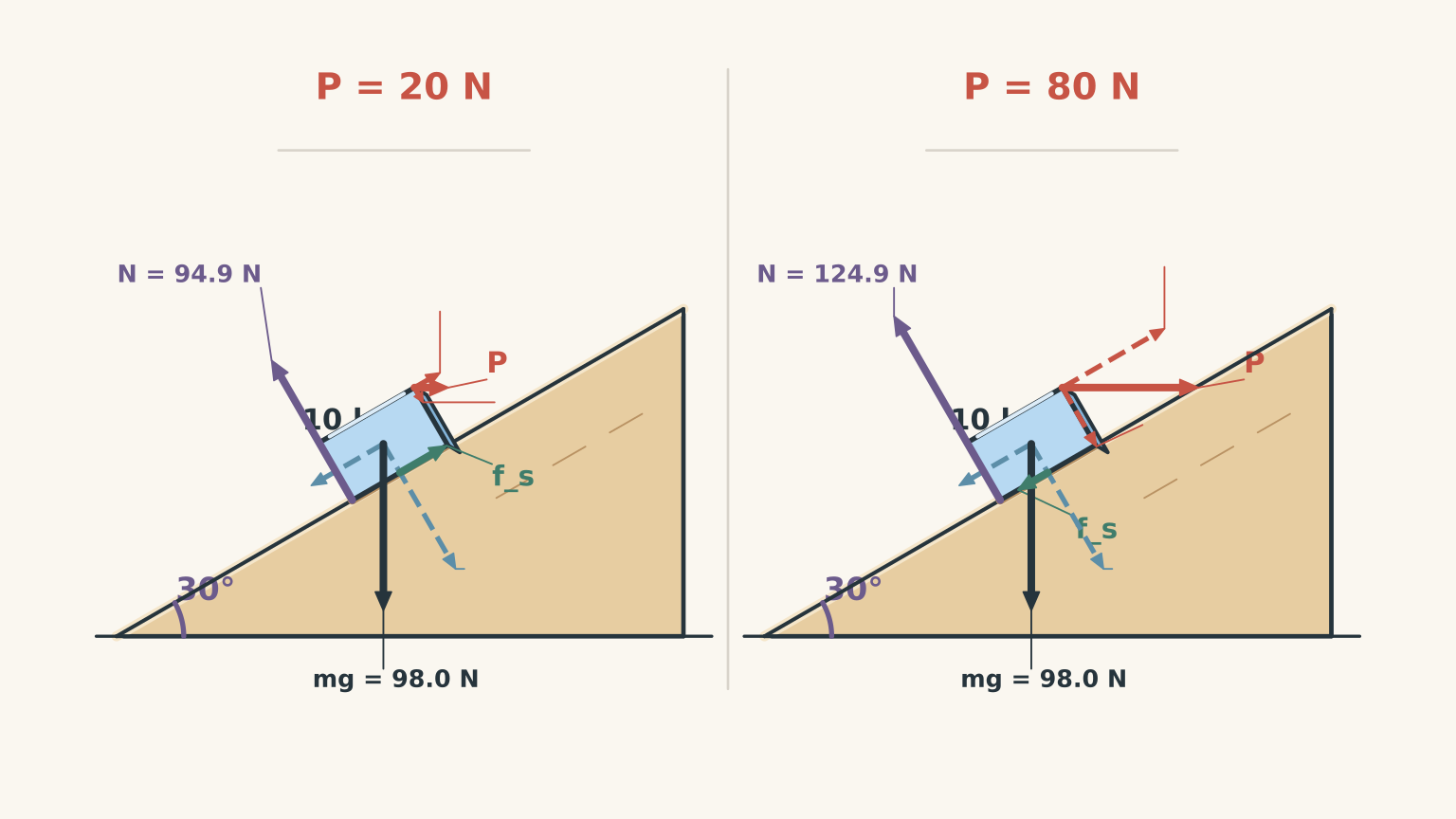
The two effects work together:
- The applied force changes the direction and magnitude of the tendency to slide.
- The perpendicular component of the applied force changes the normal force, which changes the maximum available friction.
This is why simply using \(N=mg\cos30^\circ\) and assuming friction always points up the slope would fail.
06Exam self-check: Before you move on
Whenever you encounter a stationary object involving static friction, run through these five checks.
- [ ] Have I drawn all the forces acting on the object?
- [ ] Have I calculated the normal force using the perpendicular force balance?
- [ ] Have I found the friction actually required to produce equilibrium?
- [ ] Have I chosen the friction direction opposite to the tendency to slide?
- [ ] Have I checked that the required friction is no greater than \(\mu_sN\)?
The most important distinction is simple:
\[ \boxed{\text{Required friction}\neq\text{maximum friction}} \]
They are equal only when the object is on the verge of slipping.
Once this becomes automatic, you’ll be much better prepared for connected-mass systems, inclined planes, and questions where an applied force changes the normal reaction. In those problems, the best starting point is always the same: establish the forces first, calculate the friction required, and only then check its maximum.