
Mass-Energy Equivalence: Using E = mc² in HSC Physics
Learn how to use E = mc² to calculate energy from mass changes, understand mass defects, and solve HSC-style nuclear physics problems.
Imagine a process in which just \(1.0\) g of mass decreases. Does that sound like much? It shouldn’t. But if that mass difference appears entirely as energy, the result is
\[ E = (0.001\ \text{kg})(3.00\times10^8\ \text{m/s})^2 \]
\[ E = 9.0\times10^{13}\ \text{J} \]
A tiny mass difference can therefore correspond to an enormous amount of energy. That is the problem mass-energy equivalence solves.
A tiny mass corresponds to enormous rest energy
| Mass | m = 1.0 g = 0.001 kg A small amount of rest mass Assumes complete conversion to energy |
|---|---|
| Mass–energy equivalence | E = mc² c = 3.00 × 10⁸ m/s c² = 9.00 × 10¹⁶ m²/s² |
| Rest energy | E = 9.0 × 10¹³ J Equivalent to 90 trillion joules The enormous value comes from the factor c² |
01The first idea: mass is a form of energy
The equation
\[ E = mc^2 \]
says that a mass \(m\) has an associated rest energy \(E\).
Here:
- \(E\) is rest energy, measured in joules (J),
- \(m\) is rest mass, measured in kilograms (kg),
- \(c\) is the speed of light in vacuum, \(3.00\times10^8\ \text{m/s}\).
The important part is \(c^2\):
\[ c^2 = (3.00\times10^8)^2 = 9.00\times10^{16}\ \text{m}^2\text{/s}^2 \]
So one kilogram of mass corresponds to
\[ 9.00\times10^{16}\ \text{J} \]
of rest energy.
Think of mass and energy as two ways of keeping track of the same physical account. The exchange rate is \(c^2\), which is absurdly large.
The analogy breaks down if you imagine that mass is literally a pile of energy waiting to be withdrawn. It isn’t. In relativity, mass and energy are related properties of a physical system. The equation tells you the energy equivalent of a given rest mass.
If you want to rebuild the special-relativity ideas behind this result, see Einstein’s Two Postulates of Special Relativity Explained.
02What does “mass converted to energy” actually mean?
This phrase is useful, but it can also create a bad mental model.
Suppose a nuclear reaction starts with a total rest mass \(m_\text{initial}\) and finishes with a smaller total rest mass \(m_\text{final}\).
The mass difference is
\[ \Delta m = m_\text{initial} - m_\text{final} \]
If \(\Delta m\) is positive, the corresponding rest energy is released:
\[ \Delta E = \Delta m c^2 \]
The “missing” mass has not simply vanished. The corresponding energy appears in other forms, such as:
- kinetic energy of particles,
- electromagnetic radiation,
- thermal energy,
- other internal energy.
The total energy is still conserved.
Nuclear reactions: where does the missing mass go?
- Before: reactants
Total rest mass = m₁
Higher combined rest mass
Initially negligible kinetic energy
- Nuclear reaction
Δm = m₁ − m₂ > 0
The mass defect releases energy
ΔE = Δm c²
- After: products and released energy
Total rest mass = m₂ < m₁
Energy becomes particle motion and radiation
Total energy remains conserved
This is why nuclear reactions can release so much energy. The change in mass is small, but the conversion factor \(c^2\) is enormous.
A useful decision rule
When you see a mass-energy question, ask:
Am I being given a mass, a mass difference, or an energy?
Then choose the matching form:
\[ E = mc^2 \]
for the energy equivalent of a mass, or
\[ \Delta E = \Delta m c^2 \]
for the energy associated with a mass change.
If you know the energy and need the equivalent mass change, rearrange:
\[ \Delta m = \frac{\Delta E}{c^2} \]
The units work as well:
\[ \text{kg}\times\frac{\text{m}^2}{\text{s}^2} = \text{J} \]
because \(1\ \text{J}=1\ \text{kg m}^2\text{/s}^2\).
03Why nuclear reactions matter
The equation applies to every physical system, not just nuclear reactions. Even a chemical reaction has a mass-energy change.
The difference is scale.
Chemical reactions mainly rearrange electrons and chemical bonds, so their energy changes correspond to extremely small mass changes. Nuclear reactions involve changes in the nucleus and can have much larger energy changes per reaction.
So don’t memorise:
“Nuclear reactions use \(E=mc^2\), but chemical reactions don’t.”
The better statement is:
Mass-energy equivalence applies to both. Nuclear reactions usually produce much larger measurable mass-energy changes.
Mass–energy changes: chemical vs nuclear
| Chemical reaction | ΔE ≈ 5 eV → Δm ≈ 8.9 × 10⁻³⁶ kg Energy released by bond and electron rearrangement Mass change is extremely small |
|---|---|
| Nuclear reaction | ΔE ≈ 200 MeV → Δm ≈ 3.6 × 10⁻²⁸ kg Fission-scale energy release per reaction Mass change is about 4 × 10⁷ times larger |
04Worked example: 2.0 mg of mass converted to energy
Question: If \(2.0\) mg of mass were completely converted into energy, how much energy would be released?
Step 1
Since \(1\ \text{mg}=1.0\times10^{-6}\ \text{kg}\),
\[ m = 2.0\times10^{-6}\ \text{kg} \]
Step 2
\[ E=(2.0\times10^{-6})(3.00\times10^8)^2 \]
Step 3
\[ E=2.0\times10^{-6}\times9.00\times10^{16} \]
\[ E=1.8\times10^{11}\ \text{J} \]
Step 4
The energy equivalent is \(1.8\times10^{11}\) J, or \(180\) billion joules.
The important thing is not the arithmetic. It is the scale: only \(2.0\) mg of mass corresponds to a huge rest-energy equivalent.
In a real nuclear reaction, you would not normally convert all of a macroscopic object’s mass into energy. You would calculate the much smaller mass defect.
05Mass defect: the quantity you actually use in nuclear problems
For a nuclear reaction, you may be given the total mass before and after the reaction.
For example:
\[ m_\text{before}=6.0130\ \text{u} \]
\[ m_\text{after}=6.0095\ \text{u} \]
The mass defect is
\[ \Delta m=6.0130-6.0095 \]
\[ \Delta m=0.0035\ \text{u} \]
The atomic mass unit, \(u\), is not a unit you can put directly into \(E=mc^2\). Convert it to kilograms first:
\[ 1\ \text{u}=1.66\times10^{-27}\ \text{kg} \]
So
\[ 0.0035\ \text{u} = 0.0035(1.66\times10^{-27})\ \text{kg} \]
Once the mass difference is in kilograms, \(E=\Delta mc^2\) works normally.
From nuclear mass defect to released energy
- Mass defect in u
Δm = 0.0030 u
Mass difference between initial and final states
- Convert to kilograms
0.0030 u × 1.66 × 10⁻²⁷ kg/u
Δm = 4.98 × 10⁻³⁰ kg
- Multiply by c²
ΔE = Δm c²
c = 3.00 × 10⁸ m/s
c² = 9.00 × 10¹⁶ m²/s²
- Energy released
ΔE = 4.48 × 10⁻¹³ J
Energy released per reaction
Worked example: energy from a nuclear mass defect
Question: A nuclear reaction has a mass defect of \(0.0030\) u per reaction. A sample undergoes \(2.00\) mol of these reactions. If \(80.0\%\) of the released energy is transferred to the surroundings, calculate the energy transferred.
Use \(1\ \text{u}=1.66\times10^{-27}\ \text{kg}\) and \(N_A=6.02\times10^{23}\ \text{mol}^{-1}\).
Step 1
\[ \Delta m = (0.0030)(1.66\times10^{-27}) \]
\[ \Delta m=4.98\times10^{-30}\ \text{kg} \]
Step 2
\[ \Delta E=\Delta mc^2 \]
\[ \Delta E = (4.98\times10^{-30})(3.00\times10^8)^2 \]
\[ \Delta E=4.48\times10^{-13}\ \text{J} \]
So each reaction releases \(4.48\times10^{-13}\) J.
Step 3
\[ N=(2.00)(6.02\times10^{23}) \]
\[ N=1.204\times10^{24}\ \text{reactions} \]
Step 4
\[ E_\text{total} = (4.48\times10^{-13})(1.204\times10^{24}) \]
\[ E_\text{total}=5.40\times10^{11}\ \text{J} \]
Step 5
\[ E_\text{transferred} = 0.800(5.40\times10^{11}) \]
\[ E_\text{transferred} = 4.32\times10^{11}\ \text{J} \]
Step 6
The surroundings receive \(4.32\times10^{11}\) J.
Notice the two separate ideas. The mass defect determines the total energy released. The \(80.0\%\) factor then tells us how much of that energy reaches the surroundings.
06The misconception to avoid: “mass is destroyed”
A student might say:
“The products have less mass, so some matter has been destroyed.”
It is easy to see why that sounds reasonable. But it is not the best description.
The more precise picture is that the initial system has a larger rest-energy total than the final system. The difference in rest energy is transferred into other forms of energy.
In an isolated system:
\[ \text{total energy before} = \text{total energy after} \]
The rest mass of the products can therefore be lower while the total energy remains conserved.
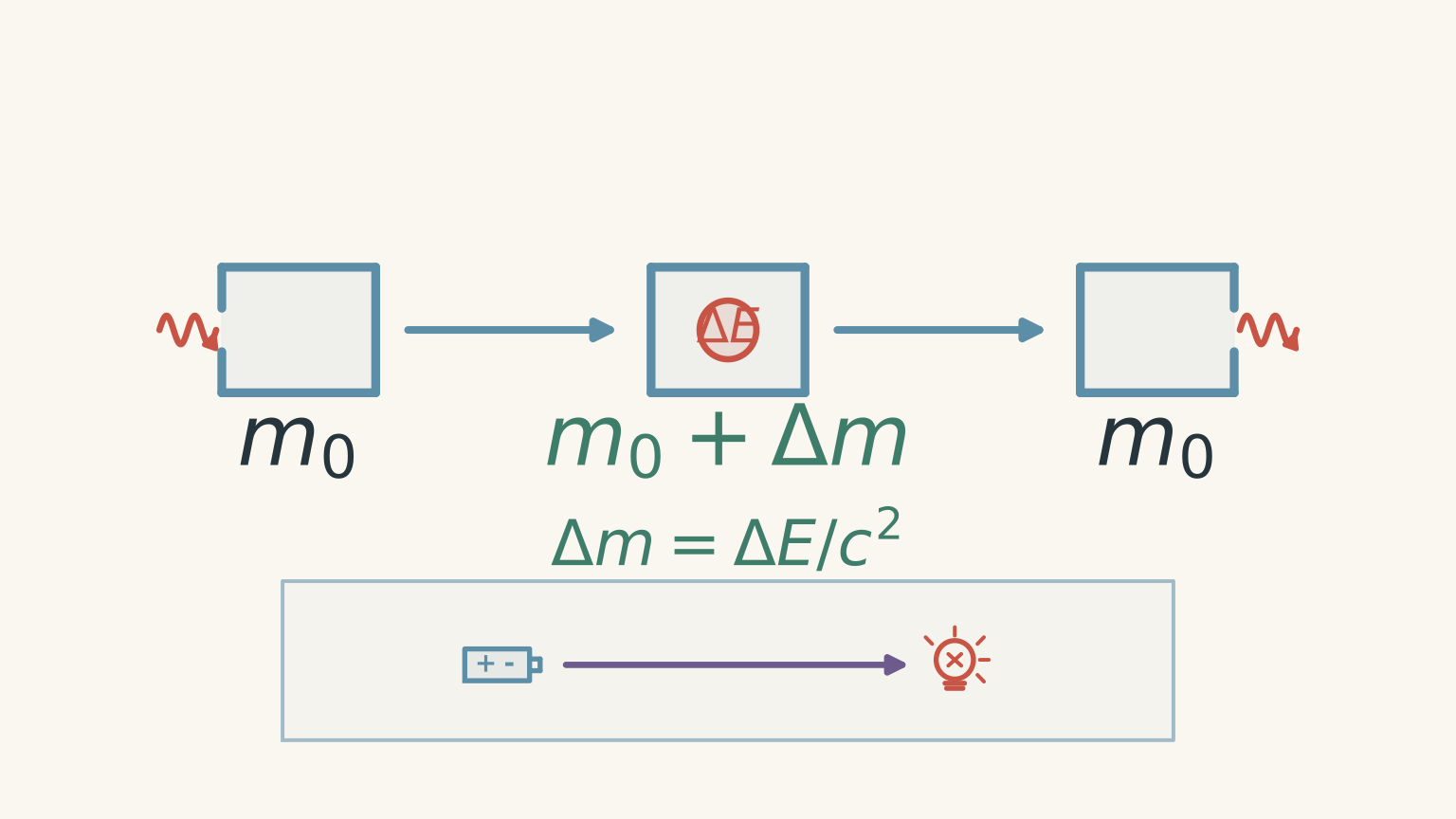
There is another important consequence. The process can work in the opposite direction too. If energy is supplied to a system and becomes part of its rest energy, the system’s mass can increase by
\[ \Delta m=\frac{\Delta E}{c^2} \]
That idea becomes especially useful when you think carefully about what counts as the “system”.
07Questions and solutions
Question 1
A process has a mass decrease of \(6.0\) micrograms. Assuming the corresponding rest energy is completely released, calculate the energy released.
Solution 1
The energy released is \(5.4\times10^8\) J.
First convert the mass to kilograms:
\[ 6.0\ \mu\text{g} = 6.0\times10^{-9}\ \text{kg} \]
Use
\[ \Delta E=\Delta mc^2 \]
so
\[ \Delta E = (6.0\times10^{-9})(3.00\times10^8)^2 \]
\[ \Delta E=5.4\times10^8\ \text{J} \]
The key constraint is that the stated mass decrease is the mass-energy change being converted. A common mistake is to use \(6.0\times10^{-6}\) kg, forgetting that a microgram is \(10^{-9}\) kg.
Question 2
A nuclear process releases \(4.5\times10^{12}\) J of energy. Assume this energy corresponds entirely to a decrease in rest mass.
- Calculate the mass decrease.
- If the original system had a mass of \(0.50\) kg, what percentage of its original mass was converted to the released energy?
Solution 2
The mass decrease is \(5.0\times10^{-5}\) kg, which is \(0.010\%\) of the original mass.
Rearrange the equation:
\[ \Delta m=\frac{\Delta E}{c^2} \]
Substitute:
\[ \Delta m = \frac{4.5\times10^{12}} {(3.00\times10^8)^2} \]
\[ \Delta m = 5.0\times10^{-5}\ \text{kg} \]
This is
\[ 0.050\ \text{g} \]
For the percentage:
\[ \text{percentage} = \frac{5.0\times10^{-5}}{0.50}\times100 \]
\[ \text{percentage}=0.010\% \]
The tempting route is to think that a huge energy release must require a large fraction of the original mass. It does not. The factor \(c^2\) is so large that a very small mass change can correspond to enormous energy.
Question 3
Two reactions each release \(1.0\times10^9\) J of energy. One is a chemical reaction and the other is a nuclear reaction.
A student argues that only the nuclear reaction has a mass-energy change because \(E=mc^2\) is a nuclear equation. Explain why the student is wrong, and state what is different about the two reactions.
Solution 3
Both reactions have a mass-energy change; the nuclear reaction generally has a much larger measurable mass change for a given amount of material.
Mass-energy equivalence is not restricted to nuclear physics. If a system releases energy, its total rest-energy balance changes, and the corresponding mass-equivalent change is
\[ \Delta m=\frac{\Delta E}{c^2} \]
For either reaction in the question:
\[ \Delta m = \frac{1.0\times10^9} {(3.00\times10^8)^2} \]
\[ \Delta m \approx1.1\times10^{-8}\ \text{kg} \]
So the same released energy corresponds to the same mass-equivalent change, regardless of whether the energy came from a chemical or nuclear process.
The important difference is the physical scale of the energy changes. Nuclear processes can release much more energy per reaction because the energies associated with nuclear binding are much larger than typical chemical bond energies.
The trap is treating \(E=mc^2\) as a special “nuclear formula”. It is a general consequence of mass-energy equivalence.
Question 4
A nuclear reaction has a mass defect of \(0.0040\) u per reaction. A sample undergoes \(1.00\times10^{20}\) reactions.
Of the released energy:
- \(70\%\) becomes kinetic energy of the reaction products,
- \(20\%\) becomes electromagnetic radiation,
- \(10\%\) remains as internal energy.
- Calculate the total energy released.
- Calculate the kinetic energy of the products.
- A detector measures only the electromagnetic radiation and records \(20\%\) of the calculated total energy. Has \(E=mc^2\) failed? Explain.
Solution 4
The reaction releases \(6.0\times10^7\) J in total, \(4.2\times10^7\) J becomes kinetic energy, and the detector’s \(20\%\) reading does not contradict \(E=mc^2\).
First convert the mass defect:
\[ \Delta m = (0.0040)(1.66\times10^{-27}) \]
\[ \Delta m=6.64\times10^{-30}\ \text{kg} \]
The energy per reaction is
\[ \Delta E = (6.64\times10^{-30})(3.00\times10^8)^2 \]
\[ \Delta E=5.98\times10^{-13}\ \text{J} \]
For \(1.00\times10^{20}\) reactions:
\[ E_\text{total} = (5.98\times10^{-13})(1.00\times10^{20}) \]
\[ E_\text{total}\approx6.0\times10^7\ \text{J} \]
The kinetic energy is \(70\%\) of this:
\[ E_\text{kinetic} = 0.70(6.0\times10^7) \]
\[ E_\text{kinetic}=4.2\times10^7\ \text{J} \]
The detector measures only the radiation channel, which contains \(20\%\):
\[ E_\text{radiation} = 0.20(6.0\times10^7) \]
\[ E_\text{radiation}=1.2\times10^7\ \text{J} \]
So no, \(E=mc^2\) has not failed.
The tempting mistake is to compare the detector’s reading with the entire mass-energy difference. The detector is measuring only one destination for the released energy. The remaining energy is carried by the moving products and internal energy.
Energy accounting must include the whole system, not just whichever output is easiest to measure.
Question 5
A perfectly sealed box is initially at rest and has a rest mass of \(2.000\) kg.
An external source transfers \(9.00\times10^6\) J of electromagnetic radiation into the box. The box absorbs the radiation and remains at rest.
Later, the box releases exactly \(9.00\times10^6\) J of radiation back to the surroundings.
A student says:
“The radiation has no rest mass, so the mass of the box cannot change.”
Another student says:
“The box must become more massive when the energy enters it.”
Who is correct? Calculate the change in the box’s mass after the energy enters, and explain what happens when the energy leaves.
Solution 5
The second student is correct: after the external energy enters and is stored inside the box, the box’s rest mass increases by \(1.00\times10^{-10}\) kg. When the same energy leaves, the box returns to its original rest mass.
The key is the system boundary.
Before the radiation enters, the box does not contain that \(9.00\times10^6\) J of energy. After the radiation has been completely absorbed, that energy is part of the box’s total energy.
The corresponding increase in rest mass is
\[ \Delta m=\frac{\Delta E}{c^2} \]
\[ \Delta m = \frac{9.00\times10^6} {(3.00\times10^8)^2} \]
\[ \Delta m=1.00\times10^{-10}\ \text{kg} \]
So the box’s rest mass becomes
\[ m_\text{after} = 2.0000000001\ \text{kg} \]
in principle.
The first student’s reasoning contains a subtle truth: electromagnetic radiation does not have rest mass. But that does not mean energy carried by radiation has no effect on the mass-energy of a larger system.
Once the radiation is trapped inside the box, its energy contributes to the energy of the complete system. If the box later emits the same \(9.00\times10^6\) J, that energy crosses the system boundary and the box’s mass decreases by the same amount.
There is an even deeper version of the same idea. If a battery inside the sealed box powers a lamp, the total mass of the box does not suddenly increase when the lamp produces light. The battery loses internal energy while the light gains it. Nothing has crossed the boundary, so the total energy of the closed system has simply been rearranged.
That is the hinge in this problem: \(E=mc^2\) is about the energy and mass of a system, so you must first decide what the system includes.
08Where this leads next
Mass-energy equivalence becomes much more interesting when energy is used to create particle rest mass. In a particle accelerator, supplied energy can contribute to the rest energy of newly produced particles, while the particles may also carry kinetic energy.
That is one reason accelerator experiments are such useful tests of relativity. See How Particle Accelerators Test Relativity: HSC Physics.
For HSC problems, keep the core decision simple:
\[ \boxed{\Delta E=\Delta mc^2} \]
Find the relevant mass difference, convert it to kilograms, multiply by \(c^2\), and then check where the resulting energy actually goes.