
How to Calculate CO₂ Volume from a Carbonate Reaction
Learn how to calculate carbon dioxide volume from a carbonate reacting with an acid solution. Follow worked examples that connect reacting mass, solution concentration, mole ratios, and limiting reagents, then practise with progressively harder questions and solutions.
Drop 2.50 g of calcium carbonate chips into 80.0 mL of 0.500 mol L⁻¹ hydrochloric acid. The mixture fizzes, releasing carbon dioxide. But do all the chips react, and how much gas can you collect?
A tempting first step is to convert all 2.50 g of solid into moles and assume every mole produces a mole of gas. That prediction might be wrong. The reaction also needs acid, and there might not be enough.
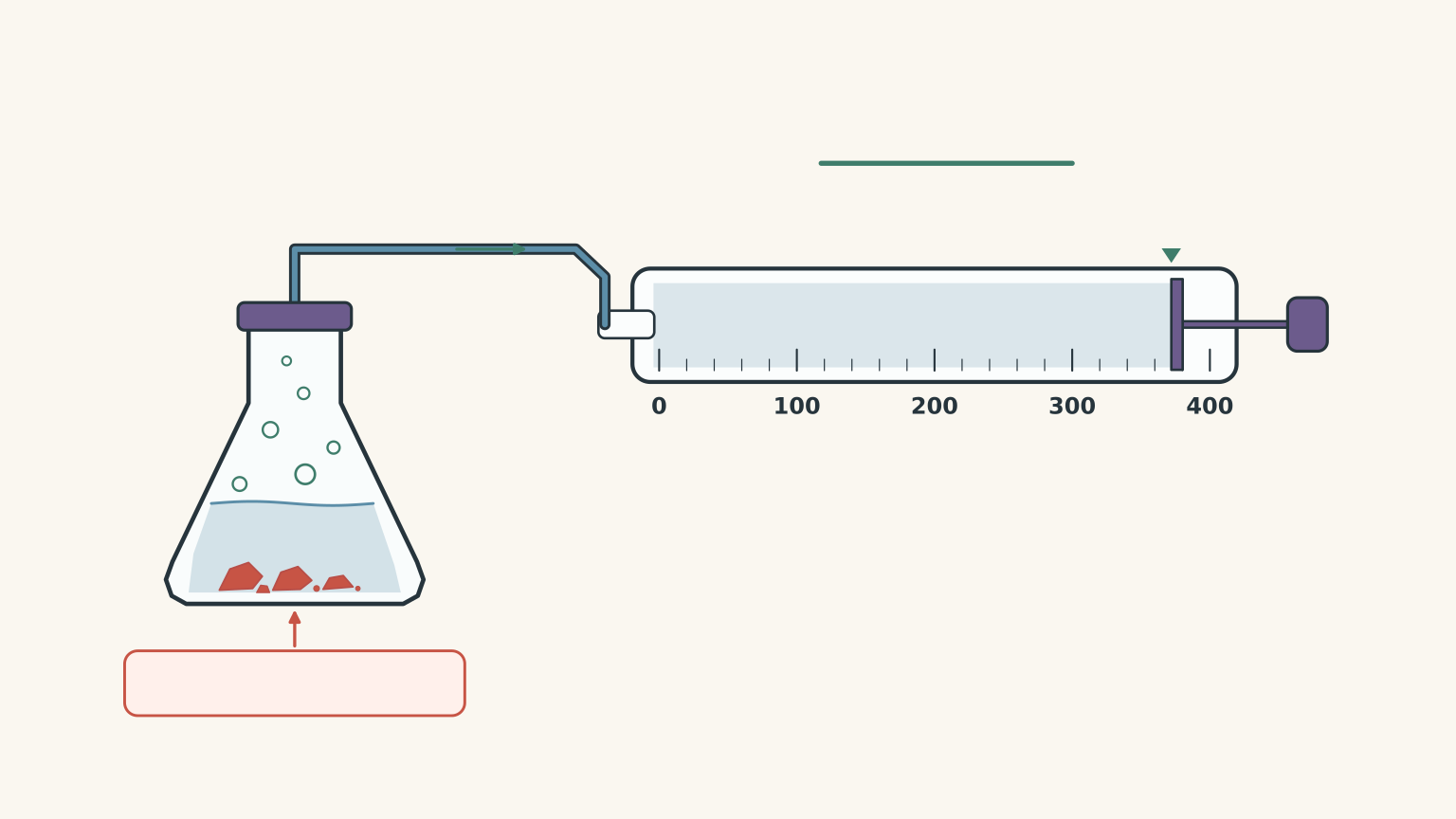
Unsupported construction: connected reaction apparatus
| Required apparatus schematic | CaCO₃ + 2HCl → CaCl₂ + H₂O + CO₂ Show calcium carbonate chips and hydrochloric acid solution inside a conical flask, with carbon dioxide bubbles forming. Show a sealed delivery tube connecting the flask to a gas syringe, whose graduated scale measures the collected carbon dioxide volume. |
|---|
Before calculating, make a prediction: if the fizzing stops while solid remains at the bottom, what has run out?
The acid may have run out first. To work out how much gas a reaction produces, you need to connect three different measurements: the mass of the solid, the concentration and volume of the acid solution, and the volume of gas produced.
01Start with the reaction, not the calculator
Calcium carbonate, \(\ce{CaCO3}\), reacts with hydrochloric acid, \(\ce{HCl}\), to produce carbon dioxide gas.
The balanced equation is
\[ \ce{CaCO3(s) + 2HCl(aq) -> CaCl2(aq) + H2O(l) + CO2(g)} \]
The bubbles are carbon dioxide escaping from the reaction mixture. The other products are calcium chloride dissolved in water and liquid water.
The equation tells you something more useful than the product names: the ratio in which the reactants are consumed.
- One mole of \(\ce{CaCO3}\) reacts with two moles of \(\ce{HCl}\).
- One mole of \(\ce{CaCO3}\) produces one mole of \(\ce{CO2}\).
- Two moles of \(\ce{HCl}\) produce one mole of \(\ce{CO2}\).
These are mole ratios, taken directly from the coefficients in the balanced equation.
Think of the reaction as a slightly ridiculous dance. Every carbonate needs two acid partners. If the acid queue empties, some carbonate is left standing on the sidelines.
The analogy has a limit: particles do not literally pair up and dance. The coefficients describe the relative numbers of moles consumed and produced, not the physical size or mass of the particles.
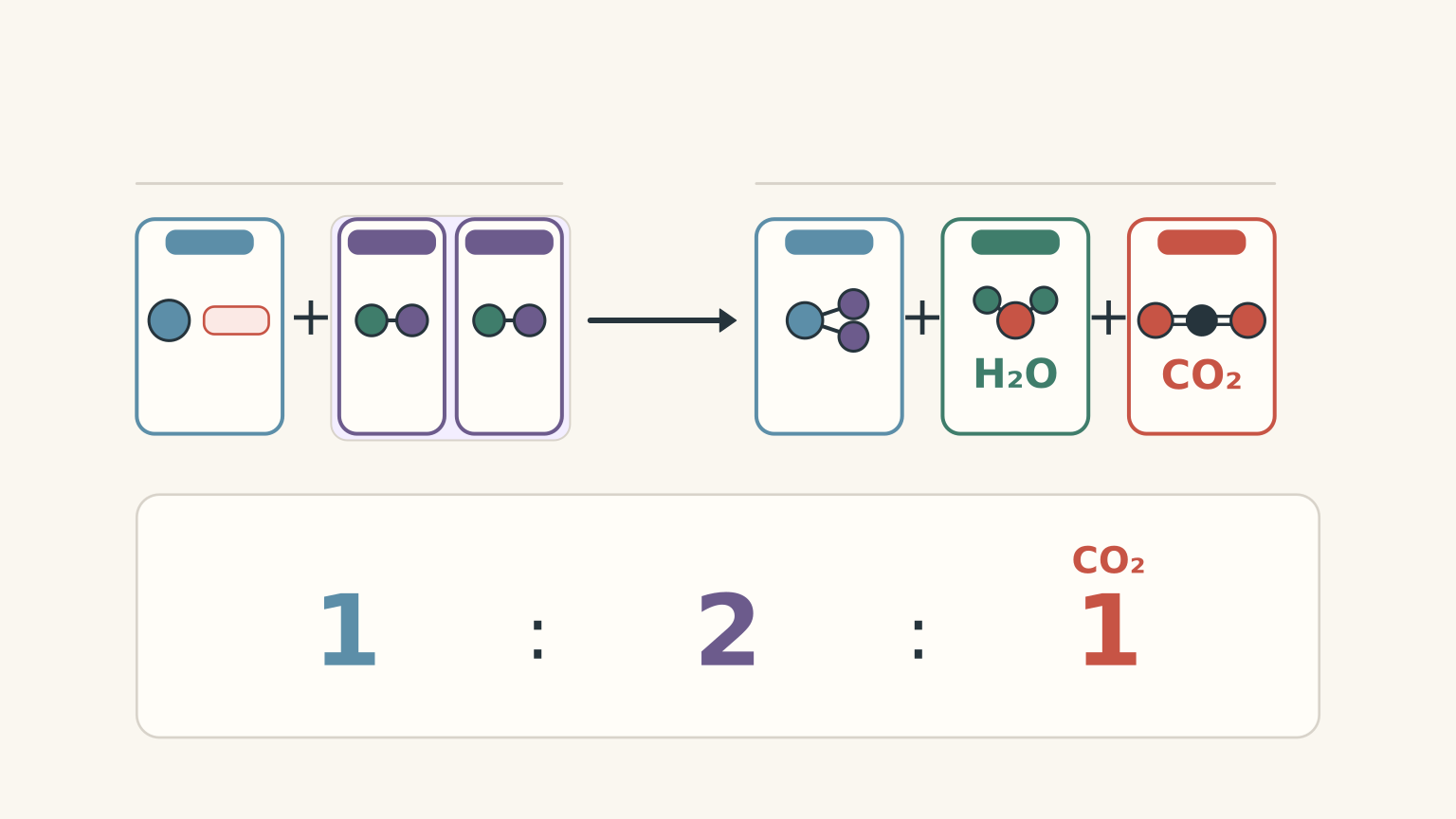
The key idea is that you cannot calculate the final gas volume until you know how many moles of carbon dioxide can actually form.
02Convert the measurements into moles
The three quantities in this problem use different units. Your job is to convert each measurement into moles, then use the balanced equation to connect them.
From solid mass to moles
The relationship between mass and amount of substance is
\[ n=\frac{m}{M} \]
where:
- \(n\) is the amount of substance, in mol;
- \(m\) is the mass, in g;
- \(M\) is the molar mass, in g mol⁻¹.
For calcium carbonate,
\[ \begin{aligned} M(\ce{CaCO3}) &=40.1+12.0+3(16.0)\\ &=100.1\ \mathrm{g\,mol^{-1}} \end{aligned} \]
So 100.1 g of pure calcium carbonate contains approximately one mole of \(\ce{CaCO3}\).
If you weigh 2.50 g, the amount is
\[ n(\ce{CaCO3}) =\frac{2.50\ \mathrm g} {100.1\ \mathrm{g\,mol^{-1}}} =0.02498\ \mathrm{mol} \]
Notice that the mass in grams is not the number of moles. You must divide by the molar mass.
From solution concentration and volume to moles
A solution’s concentration tells you how much solute is dissolved in a given volume.
The relationship is
\[ n=cV \]
where:
- \(n\) is the amount of dissolved solute, in mol;
- \(c\) is the concentration, in mol L⁻¹;
- \(V\) is the volume of solution, in L.
There is one important trap: convert millilitres to litres before using this formula.
For example,
\[ 80.0\ \mathrm{mL}=0.0800\ \mathrm L \]
For 80.0 mL of 0.500 mol L⁻¹ hydrochloric acid,
\[ \begin{aligned} n(\ce{HCl})&=cV\\ &=0.500\ \mathrm{mol\,L^{-1}} \times 0.0800\ \mathrm L\\ &=0.0400\ \mathrm{mol} \end{aligned} \]
The solution therefore contains 0.0400 mol of hydrochloric acid.
Do not multiply by 80.0 directly. Doing so would introduce a factor-of-1000 error.
From moles of gas to gas volume
Once you know the amount of carbon dioxide produced, you can calculate its volume.
For a gas at 25°C and 100 kPa, the molar volume is approximately
\[ V_m=24.8\ \mathrm{L\,mol^{-1}} \]
Here, \(V_m\) means the volume occupied by one mole of gas at the stated temperature and pressure.
The gas volume is therefore
\[ V_{\mathrm{gas}}=n(\ce{CO2})V_m \]
For example, 0.0200 mol of carbon dioxide occupies
\[ \begin{aligned} V_{\mathrm{gas}} &=0.0200\ \mathrm{mol} \times 24.8\ \mathrm{L\,mol^{-1}}\\ &=0.496\ \mathrm L \end{aligned} \]
That is 496 mL of gas.
The molar volume depends on temperature and pressure. It is not a universal constant for every gas sample. More generally, you can use the ideal gas equation, \(PV=nRT\), where \(P\) is pressure, \(V\) is gas volume, \(n\) is amount, \(R\) is the gas constant, and \(T\) is absolute temperature in kelvin.
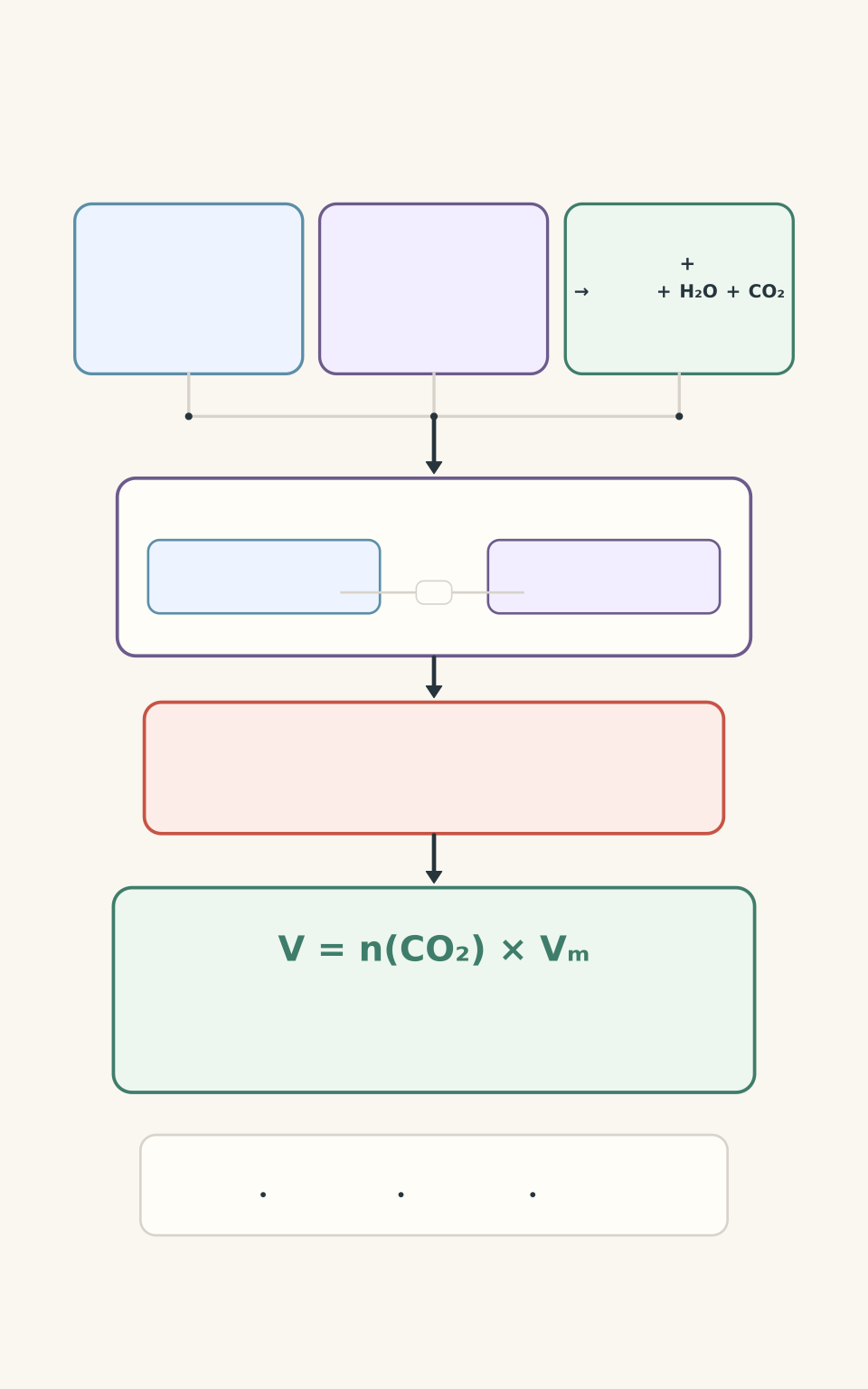
03Find the limiting reagent
You now know how to calculate the moles of each reactant. The next question is which reactant controls the amount of carbon dioxide produced.
The limiting reagent is the reactant that is consumed first and therefore limits the amount of product. The other reactant may be left over.
For the reaction
\[ \ce{CaCO3 + 2HCl -> CaCl2 + H2O + CO2} \]
each mole of calcium carbonate requires two moles of hydrochloric acid.
If you have \(n(\ce{CaCO3})\) moles of carbonate, the amount of acid needed to consume all of it is
\[ n_{\mathrm{required}}(\ce{HCl}) =2n(\ce{CaCO3}) \]
Compare this required amount with the acid actually available.
| Comparison | What happens? | Moles of CO2 produced |
|---|---|---|
| Available HCl is less than required HCl | HCl is limiting | \(n(\ce{HCl})/2\) |
| Available HCl is greater than required HCl | CaCO3 is limiting | \(n(\ce{CaCO3})\) |
| Available HCl equals required HCl | Both are consumed together | \(n(\ce{CaCO3})=n(\ce{HCl})/2\) |
This comparison is the most important decision in the entire calculation.
Do not compare the masses of the reactants directly. Do not compare the volume of solid with the volume of acid. Compare their amounts in moles using the balanced equation.
Why adding more solid can stop increasing the gas volume
Imagine keeping the amount of acid fixed while adding progressively more calcium carbonate.
At first, adding more carbonate increases the amount of carbon dioxide produced. Eventually, however, there is more carbonate than the acid can react with. Beyond that point, extra carbonate remains unreacted, and the gas volume stops increasing.
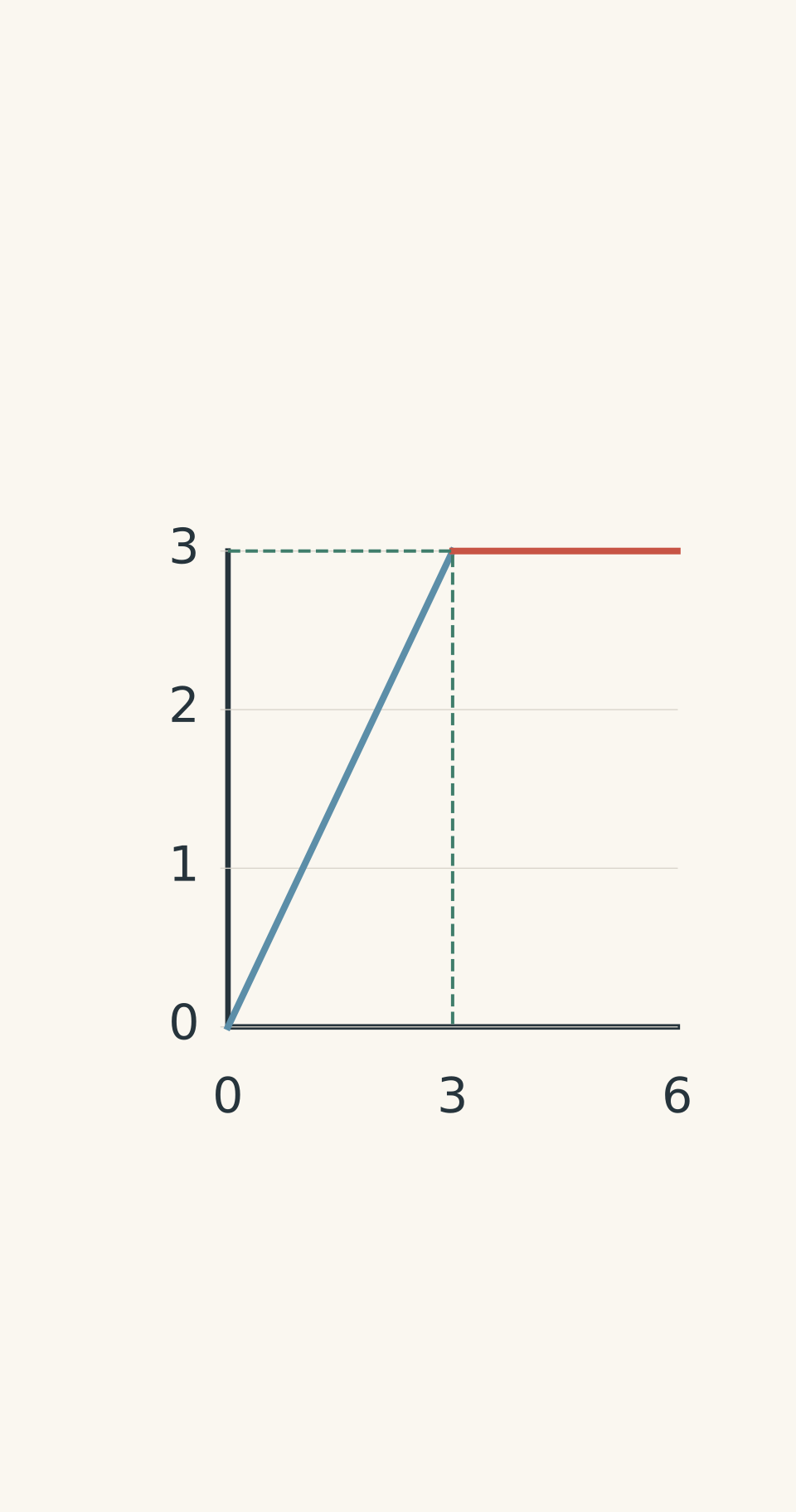
- Carbonate-controlled — rising
- Acid-limited — plateau
- Limiting point
This is why doubling the mass of solid does not necessarily double the gas volume. The answer depends on which reactant limits the reaction.
04Work through the complete calculation
Worked example: Calculate gas volume when acid is in excess
Question: A 1.50 g sample of pure calcium carbonate reacts completely with excess hydrochloric acid. Calculate the volume of carbon dioxide produced at 25°C and 100 kPa. Use \(M(\ce{CaCO3})=100.1\ \mathrm{g\,mol^{-1}}\) and \(V_m=24.8\ \mathrm{L\,mol^{-1}}\).
Step 1
The acid is in excess, so calcium carbonate is the limiting reagent. The balanced equation shows a 1:1 mole ratio between \(\ce{CaCO3}\) and \(\ce{CO2}\).
Step 2
\[ \begin{aligned} n(\ce{CaCO3}) &=\frac{m}{M}\\ &=\frac{1.50\ \mathrm g} {100.1\ \mathrm{g\,mol^{-1}}}\\ &=0.01499\ \mathrm{mol} \end{aligned} \]
Step 3
One mole of calcium carbonate produces one mole of carbon dioxide. Therefore,
\[ n(\ce{CO2})=0.01499\ \mathrm{mol} \]
Step 4
\[ \begin{aligned} V_{\mathrm{gas}} &=n(\ce{CO2})V_m\\ &=0.01499\ \mathrm{mol} \times24.8\ \mathrm{L\,mol^{-1}}\\ &=0.372\ \mathrm L \end{aligned} \]
The final answer is 0.372 L, or 372 mL, of carbon dioxide.
This result makes sense: the acid is in excess, so all the calcium carbonate can react. Each mole of the solid produces one mole of gas.
Worked example: Find the limiting reagent and the mass of gas produced from a weighed solid
Question: A 2.50 g sample of pure calcium carbonate is added to 80.0 mL of 0.500 mol L⁻¹ hydrochloric acid. Calculate the volume of carbon dioxide produced at 25°C and 100 kPa, and the mass of calcium carbonate remaining after the reaction. Assume the reaction proceeds to completion as far as the available acid allows.
Step 1
Using \(M(\ce{CaCO3})=100.1\ \mathrm{g\,mol^{-1}}\),
\[ \begin{aligned} n(\ce{CaCO3}) &=\frac{2.50\ \mathrm g} {100.1\ \mathrm{g\,mol^{-1}}}\\ &=0.02498\ \mathrm{mol} \end{aligned} \]
Step 2
First, convert the solution volume:
\[ 80.0\ \mathrm{mL}=0.0800\ \mathrm L \]
Then use \(n=cV\):
\[ \begin{aligned} n(\ce{HCl}) &=0.500\ \mathrm{mol\,L^{-1}} \times0.0800\ \mathrm L\\ &=0.0400\ \mathrm{mol} \end{aligned} \]
Step 3
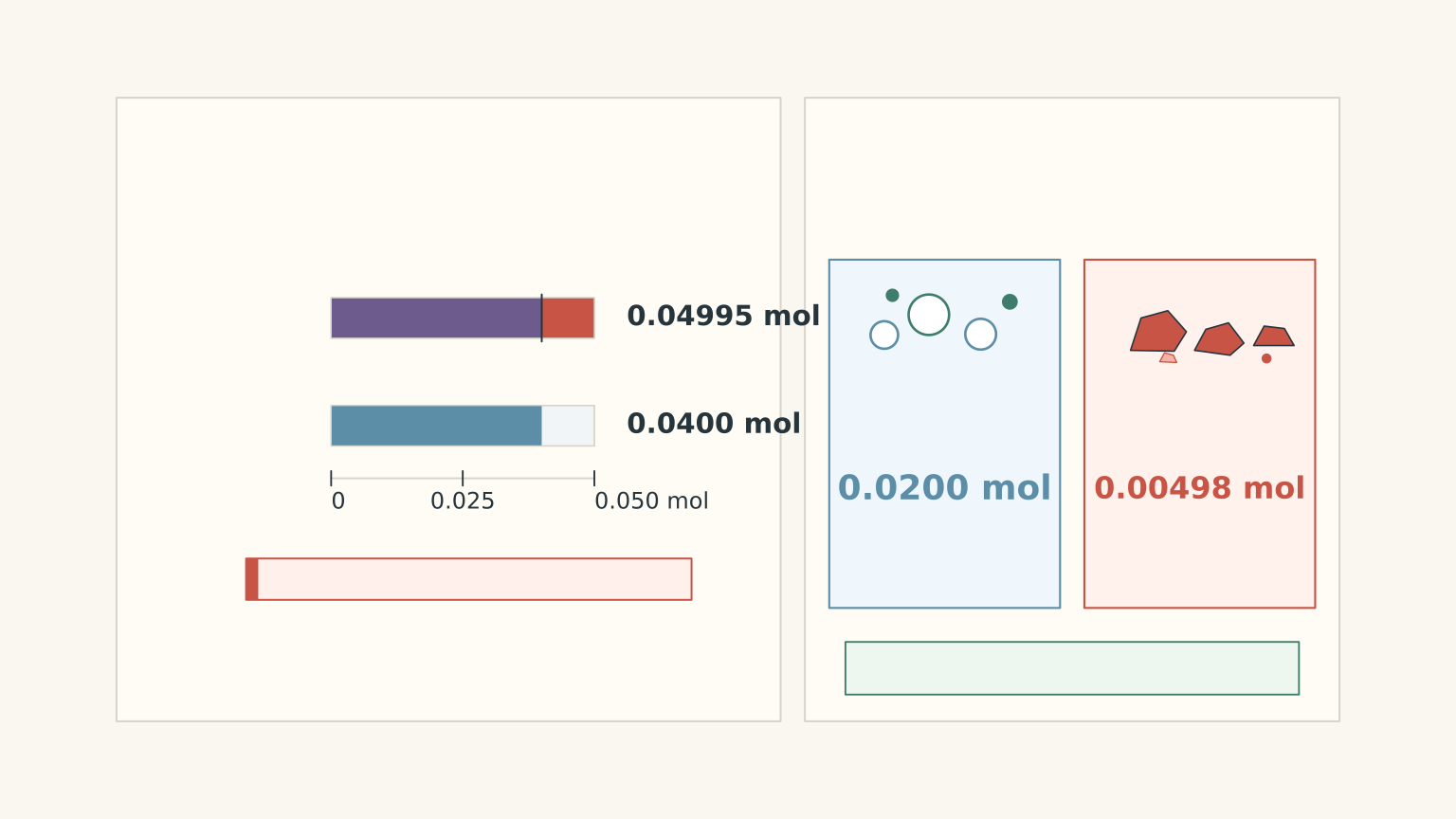
The amount of acid needed to react with all the carbonate is
\[ \begin{aligned} n_{\mathrm{required}}(\ce{HCl}) &=2n(\ce{CaCO3})\\ &=2(0.02498)\\ &=0.04995\ \mathrm{mol} \end{aligned} \]
Only 0.0400 mol of acid is available, which is less than the required 0.04995 mol.
Therefore, hydrochloric acid is the limiting reagent. Some calcium carbonate must remain unreacted.
Step 4
The equation gives a 2:1 ratio of \(\ce{HCl}\) to \(\ce{CO2}\).
\[ \begin{aligned} n(\ce{CO2}) &=\frac{n(\ce{HCl})}{2}\\ &=\frac{0.0400}{2}\\ &=0.0200\ \mathrm{mol} \end{aligned} \]
Now convert to gas volume:
\[ \begin{aligned} V_{\mathrm{gas}} &=n(\ce{CO2})V_m\\ &=0.0200\ \mathrm{mol} \times24.8\ \mathrm{L\,mol^{-1}}\\ &=0.496\ \mathrm L \end{aligned} \]
The reaction produces 0.496 L, or 496 mL, of carbon dioxide.
Step 5
The mole ratio between \(\ce{CaCO3}\) consumed and \(\ce{CO2}\) produced is 1:1. Therefore, 0.0200 mol of calcium carbonate reacts.
The remaining amount is
\[ \begin{aligned} n_{\mathrm{remaining}}(\ce{CaCO3}) &=0.02498-0.0200\\ &=0.00498\ \mathrm{mol} \end{aligned} \]
Convert this amount back into mass:
\[ \begin{aligned} m_{\mathrm{remaining}} &=nM\\ &=0.00498\ \mathrm{mol} \times100.1\ \mathrm{g\,mol^{-1}}\\ &=0.498\ \mathrm g \end{aligned} \]
Approximately 0.498 g of calcium carbonate remains.
Notice how the result answers two different questions. The available acid determines the amount of gas produced, while the difference between the initial and reacted amounts of carbonate determines the mass of solid remaining.
05Check whether your answer makes chemical sense
A correct-looking calculation can still contain a unit error or a mistaken mole ratio. Before accepting your answer, check three things.
Check 1: Is the gas amount consistent with the limiting reagent?
In the second worked example, 0.0400 mol of HCl can produce at most
\[ \frac{0.0400}{2}=0.0200\ \mathrm{mol\ CO2} \]
The calculated amount of gas is exactly 0.0200 mol. It does not exceed the maximum permitted by the available acid.
If you had calculated 0.0250 mol of carbon dioxide by assuming all the carbonate reacted, your answer would violate the balanced equation and the amount of acid available.
Check 2: Are the units correct?
- Convert the mass of solid to moles using molar mass.
- Convert the solution volume from mL to L before using \(n=cV\).
- Use the mole ratios from the balanced equation.
- Convert moles of gas to volume using the correct temperature and pressure.
A result in litres can be converted to millilitres by multiplying by 1000.
Check 3: Does the leftover solid agree with the reaction?
If acid is limiting, some calcium carbonate can remain after the reaction stops. If carbonate is limiting, all the carbonate should be consumed under the assumptions used here.
The amount remaining must also be non-negative. A negative amount of solid is a clear sign that the reactants or their mole ratios have been handled incorrectly.
One final trap is worth remembering: a more concentrated acid does not automatically produce more gas. The concentration tells you how many moles are present per litre, but the volume of solution matters too. Always calculate \(n=cV\) before deciding which reactant limits the reaction.
06Questions and solutions
Use \(M(\ce{CaCO3})=100.1\ \mathrm{g\,mol^{-1}}\) and a molar gas volume of \(24.8\ \mathrm{L\,mol^{-1}}\) at 25°C and 100 kPa unless stated otherwise.
Question 1
A 0.500 g sample of pure calcium carbonate reacts with excess hydrochloric acid.
Calculate the volume of carbon dioxide produced at 25°C and 100 kPa.
Solution 1
The volume of carbon dioxide is 0.124 L, or 124 mL.
Because hydrochloric acid is in excess, calcium carbonate is the limiting reagent. The balanced equation gives a 1:1 mole ratio between calcium carbonate and carbon dioxide.
First, calculate the amount of calcium carbonate:
\[ \begin{aligned} n(\ce{CaCO3}) &=\frac{m}{M}\\ &=\frac{0.500\ \mathrm g} {100.1\ \mathrm{g\,mol^{-1}}}\\ &=0.004995\ \mathrm{mol} \end{aligned} \]
Therefore,
\[ n(\ce{CO2})=0.004995\ \mathrm{mol} \]
Calculate the gas volume:
\[ \begin{aligned} V_{\mathrm{gas}} &=n(\ce{CO2})V_m\\ &=0.004995\ \mathrm{mol} \times24.8\ \mathrm{L\,mol^{-1}}\\ &=0.1239\ \mathrm L\\ &\approx0.124\ \mathrm L \end{aligned} \]
The result is about 124 mL. The essential step was using the 1:1 mole ratio, rather than assuming that the mass of the solid directly determines the gas volume.
Question 2
A 1.20 g sample of impure limestone contains calcium carbonate and non-reactive material only. The sample reacts completely with 50.0 mL of 0.400 mol L⁻¹ hydrochloric acid, producing 0.198 L of carbon dioxide at 25°C and 100 kPa.
Assume all the calcium carbonate reacts, the inert material does not react, and no gas is lost.
Calculate the percentage by mass of calcium carbonate in the sample, and identify the limiting reagent.
Solution 2
The sample contains 66.6% calcium carbonate by mass, and calcium carbonate is the limiting reagent.
Start with the measured gas volume. Convert it into moles:
\[ \begin{aligned} n(\ce{CO2}) &=\frac{V_{\mathrm{gas}}}{V_m}\\ &=\frac{0.198\ \mathrm L} {24.8\ \mathrm{L\,mol^{-1}}}\\ &=0.007984\ \mathrm{mol} \end{aligned} \]
The equation gives a 1:1 mole ratio between \(\ce{CaCO3}\) and \(\ce{CO2}\). Therefore,
\[ n(\ce{CaCO3})=0.007984\ \mathrm{mol} \]
Convert this amount into the mass of calcium carbonate:
\[ \begin{aligned} m(\ce{CaCO3}) &=nM\\ &=0.007984\ \mathrm{mol} \times100.1\ \mathrm{g\,mol^{-1}}\\ &=0.799\ \mathrm g \end{aligned} \]
The percentage by mass is
\[ \begin{aligned} \%\ce{CaCO3} &=\frac{m(\ce{CaCO3})}{m_{\mathrm{sample}}} \times100\\ &=\frac{0.799\ \mathrm g}{1.20\ \mathrm g} \times100\\ &=66.6\% \end{aligned} \]
Now check the limiting reagent.
The amount of acid initially available is
\[ \begin{aligned} n(\ce{HCl}) &=cV\\ &=0.400\ \mathrm{mol\,L^{-1}} \times0.0500\ \mathrm L\\ &=0.0200\ \mathrm{mol} \end{aligned} \]
The measured carbon dioxide requires
\[ \begin{aligned} n_{\mathrm{required}}(\ce{HCl}) &=2n(\ce{CaCO3})\\ &=2(0.007984)\\ &=0.01597\ \mathrm{mol} \end{aligned} \]
There are 0.0200 mol of acid available, which exceeds the 0.01597 mol required. Therefore, the acid is in excess and calcium carbonate is limiting.
The remaining sample mass is inert material:
\[ m_{\mathrm{inert}}=1.20-0.799=0.401\ \mathrm g \]
This is consistent with the stated composition. The crucial move was working backwards from the measured gas volume to determine how much reactive carbonate the sample contained.
Question 3
A 2.00 g sample of pure calcium carbonate is treated with 60.0 mL of 0.500 mol L⁻¹ hydrochloric acid. After the initial fizzing stops, an additional 22.0 mL of the same acid is added to the same flask.
Assume the reaction proceeds to completion as far as the available acid allows, and all carbon dioxide from both stages is collected at 25°C and 100 kPa.
Calculate:
- the mass of calcium carbonate remaining after the first addition;
- the total volume of carbon dioxide collected after the second addition.
Solution 3
Approximately 0.499 g of calcium carbonate remains after the first addition, and the total carbon dioxide volume after the second addition is 0.496 L.
First, calculate the initial amount of calcium carbonate:
\[ \begin{aligned} n(\ce{CaCO3}) &=\frac{2.00\ \mathrm g} {100.1\ \mathrm{g\,mol^{-1}}}\\ &=0.01998\ \mathrm{mol} \end{aligned} \]
The initial amount of hydrochloric acid is
\[ \begin{aligned} n(\ce{HCl})_{\mathrm{initial}} &=0.500\ \mathrm{mol\,L^{-1}} \times0.0600\ \mathrm L\\ &=0.0300\ \mathrm{mol} \end{aligned} \]
Since one mole of carbonate requires two moles of acid, the initial acid can react with
\[ n(\ce{CaCO3})_{\mathrm{reacted}} =\frac{0.0300}{2} =0.0150\ \mathrm{mol} \]
The initial acid is limiting. Therefore, the amount of carbonate remaining after the first addition is
\[ \begin{aligned} n(\ce{CaCO3})_{\mathrm{remaining}} &=0.01998-0.0150\\ &=0.00498\ \mathrm{mol} \end{aligned} \]
Convert this to mass:
\[ \begin{aligned} m_{\mathrm{remaining}} &=0.00498\ \mathrm{mol} \times100.1\ \mathrm{g\,mol^{-1}}\\ &\approx0.499\ \mathrm g \end{aligned} \]
Now consider the additional acid.
Its amount is
\[ \begin{aligned} n(\ce{HCl})_{\mathrm{added}} &=0.500\ \mathrm{mol\,L^{-1}} \times0.0220\ \mathrm L\\ &=0.0110\ \mathrm{mol} \end{aligned} \]
The remaining carbonate needs
\[ \begin{aligned} n_{\mathrm{required}}(\ce{HCl}) &=2(0.00498)\\ &=0.00996\ \mathrm{mol} \end{aligned} \]
The second addition supplies 0.0110 mol of acid, which is enough to react with all the remaining carbonate. The extra acid is in excess, so the entire original carbonate sample eventually reacts.
The total amount of carbon dioxide is therefore equal to the initial amount of calcium carbonate:
\[ n(\ce{CO2})=0.01998\ \mathrm{mol} \]
The total gas volume is
\[ \begin{aligned} V_{\mathrm{gas}} &=0.01998\ \mathrm{mol} \times24.8\ \mathrm{L\,mol^{-1}}\\ &=0.4955\ \mathrm L\\ &\approx0.496\ \mathrm L \end{aligned} \]
The second acid addition changes the final gas volume because it allows the carbonate left over from the first stage to react. To solve a problem like this, track what remains after each stage rather than treating each addition as a separate reaction with a fresh sample.
Question 4
Two trials use identical 1.50 g samples of pure calcium carbonate.
- Trial A uses 40.0 mL of 0.500 mol L⁻¹ hydrochloric acid.
- Trial B uses 100.0 mL of 0.250 mol L⁻¹ hydrochloric acid.
Both reactions proceed to completion as far as the available acid allows. Calculate the volume of carbon dioxide produced in each trial at 25°C and 100 kPa, and the mass of calcium carbonate remaining in each flask.
Explain why the trial using the more concentrated acid does not produce more gas.
Solution 4
Trial B produces more carbon dioxide: 0.310 L compared with 0.248 L in Trial A. Approximately 0.499 g of calcium carbonate remains in Trial A, compared with 0.249 g in Trial B.
Both trials start with
\[ \begin{aligned} n(\ce{CaCO3}) &=\frac{1.50\ \mathrm g} {100.1\ \mathrm{g\,mol^{-1}}}\\ &=0.01499\ \mathrm{mol} \end{aligned} \]
The amount of acid required to react with all the carbonate is
\[ n_{\mathrm{required}}(\ce{HCl}) =2(0.01499)=0.02997\ \mathrm{mol} \]
Trial A
The amount of acid is
\[ \begin{aligned} n(\ce{HCl}) &=0.500\ \mathrm{mol\,L^{-1}} \times0.0400\ \mathrm L\\ &=0.0200\ \mathrm{mol} \end{aligned} \]
This is less than the required 0.02997 mol, so hydrochloric acid is limiting.
The amount of carbon dioxide produced is
\[ n(\ce{CO2})=\frac{0.0200}{2} =0.0100\ \mathrm{mol} \]
The gas volume is
\[ \begin{aligned} V_{\mathrm{gas}} &=0.0100\ \mathrm{mol} \times24.8\ \mathrm{L\,mol^{-1}}\\ &=0.248\ \mathrm L \end{aligned} \]
The carbonate consumed is 0.0100 mol, leaving
\[ \begin{aligned} n_{\mathrm{remaining}} &=0.01499-0.0100\\ &=0.00499\ \mathrm{mol} \end{aligned} \]
Its remaining mass is
\[ m_{\mathrm{remaining}} =0.00499\ \mathrm{mol} \times100.1\ \mathrm{g\,mol^{-1}} \approx0.499\ \mathrm g \]
Trial B
The amount of acid is
\[ \begin{aligned} n(\ce{HCl}) &=0.250\ \mathrm{mol\,L^{-1}} \times0.1000\ \mathrm L\\ &=0.0250\ \mathrm{mol} \end{aligned} \]
This is also less than the required 0.02997 mol, so hydrochloric acid is limiting again.
The amount of carbon dioxide produced is
\[ n(\ce{CO2})=\frac{0.0250}{2} =0.0125\ \mathrm{mol} \]
The gas volume is
\[ \begin{aligned} V_{\mathrm{gas}} &=0.0125\ \mathrm{mol} \times24.8\ \mathrm{L\,mol^{-1}}\\ &=0.310\ \mathrm L \end{aligned} \]
The amount of carbonate remaining is
\[ \begin{aligned} n_{\mathrm{remaining}} &=0.01499-0.0125\\ &=0.00249\ \mathrm{mol} \end{aligned} \]
Its mass is
\[ m_{\mathrm{remaining}} =0.00249\ \mathrm{mol} \times100.1\ \mathrm{g\,mol^{-1}} \approx0.249\ \mathrm g \]
The tempting prediction is that Trial A must produce more gas because its acid is more concentrated. But concentration alone does not determine the amount of acid present.
Trial A contains 0.0200 mol of acid, while Trial B contains 0.0250 mol. Both are acid-limited, so Trial B produces more gas despite using the less concentrated solution.
Question 5
A 2.40 g sample contains only calcium carbonate and an inert solid. It reacts with 80.0 mL of 0.500 mol L⁻¹ hydrochloric acid, producing 0.496 L of carbon dioxide at 25°C and 100 kPa. The dried solid residue has a mass of 0.398 g.
Assume all calcium carbonate reacts whenever acid is available, the inert solid remains unchanged, no gas is lost, and the stated measurements are consistent within their precision.
(a) Determine the initial mass of calcium carbonate and the initial mass of inert solid.
(b) Determine whether the hydrochloric acid is limiting, the calcium carbonate is limiting, or neither reactant is in excess.
(c) Suppose you double the mass of the original solid mixture but keep the acid volume and concentration unchanged. Predict the new gas volume and the composition and mass of the final dry residue.
Explain why doubling the mass of solid does not double the gas volume in this case.
Solution 5
(a) The initial mixture contains approximately 2.002 g of calcium carbonate and 0.398 g of inert solid.
(b) The original reaction mixture is exactly stoichiometric: neither reactant is in excess, and both are consumed together.
(c) Doubling the solid mixture produces the same theoretical gas volume, 0.496 L. The acid becomes limiting, and the final dry residue has a mass of approximately 2.80 g, consisting of 2.002 g of unreacted calcium carbonate and 0.796 g of inert solid.
Part (a): Determine the initial composition.
First, calculate the amount of carbon dioxide produced:
\[ \begin{aligned} n(\ce{CO2}) &=\frac{V_{\mathrm{gas}}}{V_m}\\ &=\frac{0.496\ \mathrm L} {24.8\ \mathrm{L\,mol^{-1}}}\\ &=0.0200\ \mathrm{mol} \end{aligned} \]
The balanced equation gives a 1:1 ratio between calcium carbonate consumed and carbon dioxide produced. Since all the calcium carbonate reacts whenever acid is available, the initial sample contained
\[ n(\ce{CaCO3})=0.0200\ \mathrm{mol} \]
Its mass was
\[ \begin{aligned} m(\ce{CaCO3}) &=nM\\ &=0.0200\ \mathrm{mol} \times100.1\ \mathrm{g\,mol^{-1}}\\ &=2.002\ \mathrm g \end{aligned} \]
The initial sample mass was 2.40 g, so the inert solid had a mass of
\[ \begin{aligned} m_{\mathrm{inert}} &=2.400-2.002\\ &=0.398\ \mathrm g \end{aligned} \]
This matches the measured dried residue of 0.398 g. The mass balance supports the conclusion that all the calcium carbonate reacted and only the inert solid remained.
Part (b): Check the reactant ratio.
The initial amount of hydrochloric acid was
\[ \begin{aligned} n(\ce{HCl}) &=cV\\ &=0.500\ \mathrm{mol\,L^{-1}} \times0.0800\ \mathrm L\\ &=0.0400\ \mathrm{mol} \end{aligned} \]
The 0.0200 mol of calcium carbonate requires
\[ \begin{aligned} n_{\mathrm{required}}(\ce{HCl}) &=2n(\ce{CaCO3})\\ &=2(0.0200)\\ &=0.0400\ \mathrm{mol} \end{aligned} \]
The amount of acid available equals the amount required. Therefore, the reactants are present in the exact stoichiometric ratio.
This is the important boundary case. It is tempting to insist that one reactant must always be limiting and the other must always be in excess. That is not true. When the amounts match the balanced equation exactly, both reactants are consumed together, so neither is in excess.
Part (c): Double the solid but keep the acid unchanged.
Doubling the mass of the mixture doubles the initial amounts of both solids.
The new calcium carbonate amount is
\[ n(\ce{CaCO3})=2(0.0200)=0.0400\ \mathrm{mol} \]
The new inert-solid mass is
\[ m_{\mathrm{inert}}=2(0.398)=0.796\ \mathrm g \]
However, the amount of acid remains 0.0400 mol. It can react with only
\[ n(\ce{CaCO3})_{\mathrm{reacted}} =\frac{0.0400}{2} =0.0200\ \mathrm{mol} \]
The reaction therefore produces
\[ n(\ce{CO2})=0.0200\ \mathrm{mol} \]
and the gas volume is still
\[ \begin{aligned} V_{\mathrm{gas}} &=0.0200\ \mathrm{mol} \times24.8\ \mathrm{L\,mol^{-1}}\\ &=0.496\ \mathrm L \end{aligned} \]
The doubled mixture initially contains 0.0400 mol of calcium carbonate, but only 0.0200 mol can react with the available acid. The remaining carbonate is
\[ n(\ce{CaCO3})_{\mathrm{remaining}} =0.0400-0.0200 =0.0200\ \mathrm{mol} \]
Its mass is 2.002 g. Adding the 0.796 g of inert solid gives the final dry residue:
\[ \begin{aligned} m_{\mathrm{residue}} &=2.002+0.796\\ &=2.798\ \mathrm g\\ &\approx2.80\ \mathrm g \end{aligned} \]
The doubled solid mixture therefore produces the same theoretical gas volume as the original mixture, but leaves a much larger solid residue.
The key constraint is that the amount of acid has not changed. It still supports the production of only 0.0200 mol of carbon dioxide. Doubling the amount of solid does not increase that limit; it simply leaves more calcium carbonate unreacted.
This is the deeper use of the limiting-reagent calculation: it allows you to predict not only how much product forms, but also how a reaction responds when its starting conditions change.
Once you can connect mass, solution concentration, mole ratios, and gas volume reliably, you can use the same method for more complicated reaction problems, including impure samples, excess reagents, sequential additions, and experimental measurements used to infer an unknown concentration or composition.