
Q vs Keq: How to Predict the Direction of Equilibrium
Learn how to calculate the reaction quotient, Q, and compare it with Keq to predict whether a reaction shifts towards reactants, towards products, or remains at equilibrium. Includes three worked examples, common mistakes, and five exam-style questions with fully explained solutions.
A reaction mixture can contain more product than reactant and still be driven backwards. It can also contain very little product and be driven forwards. So, how do you predict which way an equilibrium will move?
You can’t tell from the concentrations alone. You need to compare the mixture’s current composition with the composition it would have at equilibrium at the same temperature.
Here’s a prediction to make before we go further. Suppose a reaction’s equilibrium benchmark is 10, but a calculation using the mixture’s current concentrations gives 4. Should the reaction move forwards or backwards?
It moves forwards, towards products. The current mixture’s quotient is below the equilibrium value, so the net reaction must increase that quotient.
This comparison is the purpose of the reaction quotient, \(Q\), and the equilibrium constant, \(K_{\mathrm{eq}}\).
01Think of \(Q\) as a snapshot
Imagine taking a photograph of a reaction mixture halfway through a chemical process. The photograph tells you how much of each substance is present at that moment, but it doesn’t tell you whether the reaction is moving towards products or reactants.
The reaction quotient, \(Q\), turns that snapshot into a number. The equilibrium constant, \(K_{\mathrm{eq}}\), provides the benchmark for the same reaction at equilibrium and at the same temperature.
For a given temperature:
- \(Q\) tells you what the mixture looks like right now.
- \(K_{\mathrm{eq}}\) tells you the value of the quotient when the mixture is at equilibrium.
- Comparing them tells you the direction of the net reaction.
Q vs K_eq: Current composition and equilibrium benchmark
| Current mixture: Q | aA + bB ⇌ cC + dD Snapshot: calculate the quotient using concentrations at this moment. Describes the current composition, not reaction speed. |
|---|---|
| Equilibrium benchmark: K_eq | Same reaction, same temperature The value of the same quotient when the mixture is at equilibrium. Does not specify a fixed amount of product. |
| Compare Q with K_eq | Q < K_eq: net reaction moves towards products. Q > K_eq: net reaction moves towards reactants; Q = K_eq: no net shift. |
The key is that you’re comparing two values calculated using the same expression. You aren’t simply comparing the concentration of one reactant with the concentration of one product.
02How to calculate the reaction quotient
Consider a general balanced reaction:
\[ aA+bB\rightleftharpoons cC+dD \]
Its concentration reaction quotient is
\[ Q_c=\frac{[C]^c[D]^d}{[A]^a[B]^b} \]
The symbols mean:
- \([A]\), \([B]\), \([C]\), and \([D]\) are the current molar concentrations of the substances, usually in \(\mathrm{mol\\,L^{-1}}\).
- \(a\), \(b\), \(c\), and \(d\) are the coefficients in the balanced equation.
- The subscript \(c\) indicates that the quotient is calculated using concentrations.
Notice the exponents. Each concentration is raised to the power of its coefficient in the balanced equation.
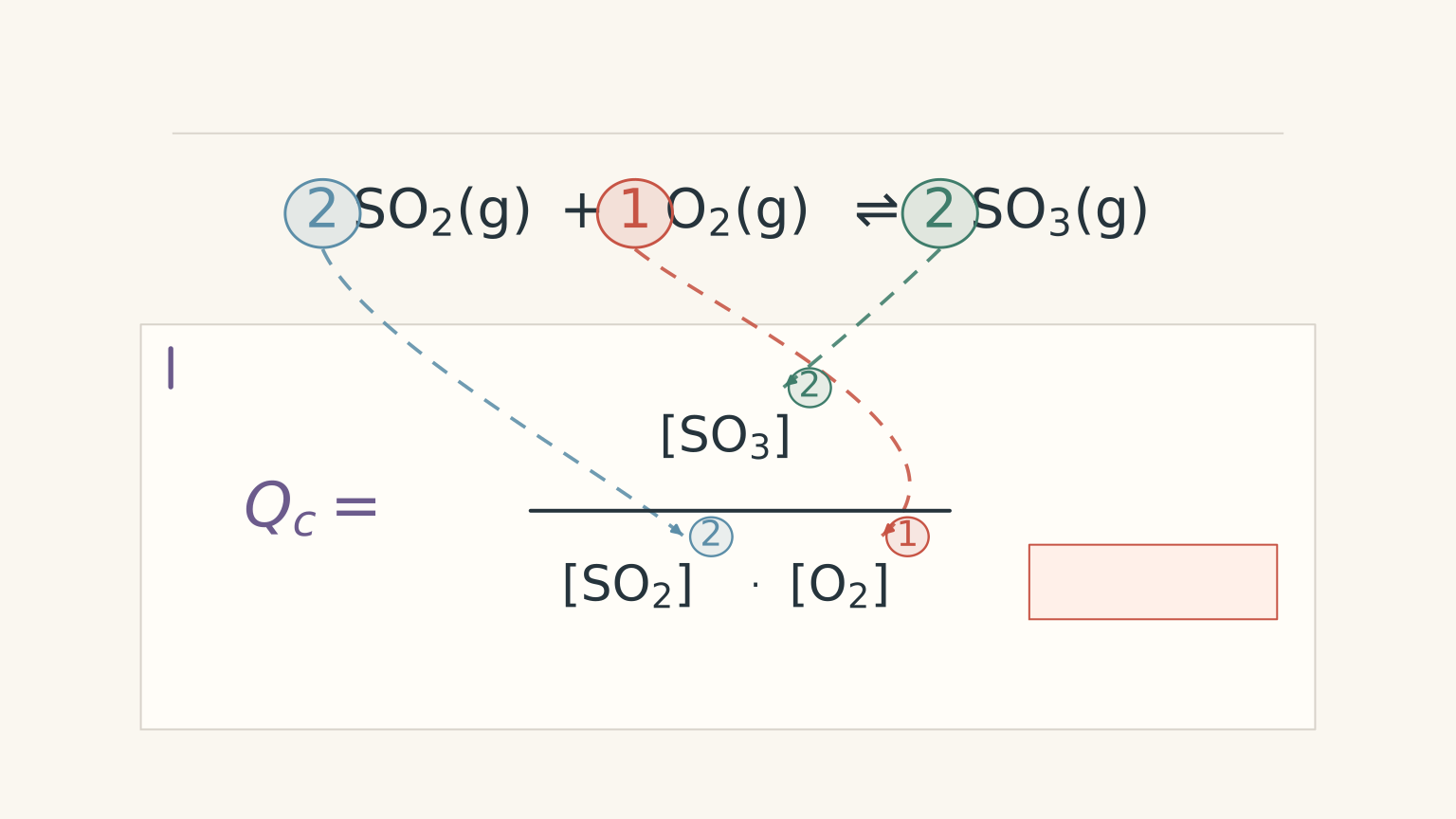
For example, consider:
\[ \ce{2SO2(g) + O2(g) <=> 2SO3(g)} \]
The reaction quotient is
\[ Q_c=\frac{[\ce{SO3}]^2} {[\ce{SO2}]^2[\ce{O2}]} \]
The coefficient 2 in front of \(\ce{SO3}\) becomes an exponent of 2. The coefficient 2 in front of \(\ce{SO2}\) does the same. The coefficient 1 in front of \(\ce{O2}\) means its concentration is simply raised to the first power.
For concentration-based equilibrium expressions, pure solids and pure liquids are omitted. Only the relevant gaseous and aqueous species appear in the expression.
One important distinction: \(Q_c\) can be calculated at any moment, whether or not the system is at equilibrium. \(K_c\) uses the same expression, but its value is determined by the equilibrium concentrations at a particular temperature.
03The decision rule: compare \(Q_c\) with \(K_c\)
Once you’ve calculated \(Q_c\), you only need three rules.
| Comparison | Net reaction direction | Meaning |
|---|---|---|
| \(Q_c\<K_c\) | Reactants \(\rightarrow\) products | The quotient is too small, so the net reaction moves forwards. |
| \(Q_c>K_c\) | Products \(\rightarrow\) reactants | The quotient is too large, so the net reaction moves backwards. |
| \(Q_c=K_c\) | No net shift | The system is at equilibrium. |
Compare Qc with Kc to predict equilibrium direction
| Qc < Kc | Reactants → Products Net reaction moves forwards towards products. Qc increases until it reaches Kc. |
|---|---|
| Qc > Kc | Products → Reactants Net reaction moves backwards towards reactants. Qc decreases until it reaches Kc. |
| Qc = Kc | Forward ⇌ Reverse Forward and reverse reaction rates are equal. No net change in concentrations; the system is at equilibrium. |
At equilibrium, the forward and reverse reactions still occur. They simply occur at equal rates, so the concentrations remain constant overall.
The arrows in the table describe the net direction. They don’t mean that one of the two reactions has stopped.
Let’s apply the rules to three different mixtures.
Worked example: \(Q_c\<K_c\)
For the reaction \(\ce{H2(g) + I2(g) <=> 2HI(g)}\), the equilibrium constant at a particular temperature is \(K_c=16.0\).
At one instant, the concentrations are:
- \([\ce{H2}]=0.20\ \mathrm{mol\\,L^{-1}}\)
- \([\ce{I2}]=0.10\ \mathrm{mol\\,L^{-1}}\)
- \([\ce{HI}]=0.40\ \mathrm{mol\\,L^{-1}}\)
Calculate \(Q_c\) and predict the net reaction direction.
Step 1: Write the reaction quotient using the balanced equation.
\[ Q_c=\frac{[\ce{HI}]^2} {[\ce{H2}][\ce{I2}]} \]
Step 2: Substitute the current concentrations.
\[ \begin{aligned} Q_c&=\frac{(0.40)^2}{(0.20)(0.10)}\\[4pt] &=\frac{0.16}{0.020}\\[4pt] &=8.0 \end{aligned} \]
Step 3: Compare the quotient with the equilibrium constant.
\[ Q_c=8.0\<K_c=16.0 \]
The net reaction moves forwards:
\[ \ce{H2(g) + I2(g) -> 2HI(g)} \]
The current quotient is too small compared with its equilibrium value. The mixture therefore forms HI overall until \(Q_c\) reaches \(K_c\), assuming the temperature and other conditions remain constant.
Worked example: \(Q_c>K_c\)
For the reaction \(\ce{N2O4(g) <=> 2NO2(g)}\), suppose \(K_c=0.20\) at the stated temperature.
At a particular moment:
- \([\ce{N2O4}]=0.20\ \mathrm{mol\\,L^{-1}}\)
- \([\ce{NO2}]=0.30\ \mathrm{mol\\,L^{-1}}\)
Calculate \(Q_c\) and determine the net reaction direction.
Step 1: Write the correct quotient.
\[ Q_c=\frac{[\ce{NO2}]^2}{[\ce{N2O4}]} \]
Step 2: Substitute the current concentrations.
\[ \begin{aligned} Q_c&=\frac{(0.30)^2}{0.20}\\[4pt] &=\frac{0.090}{0.20}\\[4pt] &=0.45 \end{aligned} \]
Step 3: Compare \(Q_c\) with \(K_c\).
\[ Q_c=0.45>K_c=0.20 \]
The net reaction moves backwards, towards \(\ce{N2O4}\):
\[ \ce{2NO2(g) -> N2O4(g)} \]
The quotient is already greater than its equilibrium value. The mixture must consume \(\ce{NO2}\) overall to bring the quotient down.
Notice that the concentration of \(\ce{NO2}\) is only 1.5 times the concentration of \(\ce{N2O4}\). That comparison alone doesn’t determine the direction. The squared concentration in the quotient is essential.
Worked example: \(Q_c=K_c\)
For the reaction
\[ \ce{2SO2(g) + O2(g) <=> 2SO3(g)} \]
the equilibrium constant is \(K_c=4.0\times10^2\).
The current concentrations are:
- \([\ce{SO2}]=0.10\ \mathrm{mol\\,L^{-1}}\)
- \([\ce{O2}]=0.040\ \mathrm{mol\\,L^{-1}}\)
- \([\ce{SO3}]=0.40\ \mathrm{mol\\,L^{-1}}\)
Determine whether the mixture will shift in either direction.
Step 1: Write the reaction quotient.
\[ Q_c=\frac{[\ce{SO3}]^2} {[\ce{SO2}]^2[\ce{O2}]} \]
Step 2: Substitute the concentrations and evaluate.
\[ \begin{aligned} Q_c&=\frac{(0.40)^2}{(0.10)^2(0.040)}\\[4pt] &=\frac{0.16}{0.00040}\\[4pt] &=400 \end{aligned} \]
Step 3: Compare the two values.
\[ Q_c=400=K_c \]
There is no net reaction shift. The system is at equilibrium because the current quotient matches the equilibrium constant.
The forward and reverse reactions continue at equal rates. You should not describe this as the reaction stopping.
04The mistakes that cause trouble in exams
Mistake 1: Using the wrong equation
Suppose the original reaction is written forwards:
\[ \ce{A <=> B} \]
Its quotient and equilibrium constant are
\[ Q_c=\frac{[\ce{B}]}{[\ce{A}]}, \qquad K_c=\frac{[\ce{B}]_{\mathrm{eq}}} {[\ce{A}]_{\mathrm{eq}}} \]
If you reverse the equation, both expressions are inverted:
\[ Q_{c,\mathrm{rev}}=\frac{1}{Q_c} \]
\[ K_{c,\mathrm{rev}}=\frac{1}{K_c} \]
You must use the correct equilibrium constant for the equation as written. Reversing the equation doesn’t change the physical state of the mixture, but it does reverse the direction described as forwards.
Mistake 2: Forgetting the exponents
For
\[ \ce{2SO2(g) + O2(g) <=> 2SO3(g)} \]
the correct expression is
\[ Q_c=\frac{[\ce{SO3}]^2} {[\ce{SO2}]^2[\ce{O2}]} \]
It is not \([\ce{SO3}]/([\ce{SO2}][\ce{O2}])\).
The coefficients in the balanced equation determine the powers in the expression. If you write the expression incorrectly, your comparison with \(K_c\) is no longer valid.
Mistake 3: Assuming a large \(K_c\) means the reaction must move forwards
A large equilibrium constant tells you that the equilibrium composition favours products relative to reactants for the equation as written. It does not tell you the direction of the reaction at this moment.
Suppose \(K_c=1000\).
- If \(Q_c=100\), the reaction moves forwards because \(Q_c\<K_c\).
- If \(Q_c=2000\), the reaction moves backwards because \(Q_c>K_c\).
Both mixtures have the same equilibrium constant. Their current compositions are different, so their net reaction directions are different.
Always compare \(Q_c\) with \(K_c\). Never predict the direction from the size of \(K_c\) alone.
Mistake 4: Comparing values at different temperatures
The equilibrium constant depends on temperature. If the temperature changes, you must use the value of \(K_c\) for the new temperature.
In a rigid vessel, immediately after a temperature change and before the reaction has had time to respond, the concentrations remain unchanged. That means \(Q_c\) initially remains unchanged too, but \(K_c\) may change.
The correct comparison is then between the existing \(Q_c\) and the new \(K_c\).
Reassess equilibrium after each change
- Stage 1: Volume changes
Temperature constant
Concentrations change; recalculate Qc.
Kc stays constant. Compare Qc with Kc.
- Stage 2: Temperature changes
Rigid vessel; immediately after the change
Concentrations and Qc initially remain unchanged.
Kc changes. Compare the existing Qc with the new Kc.
05Questions and solutions
Question 1
For the reaction \(\ce{CO(g) + Cl2(g) <=> COCl2(g)}\), the equilibrium constant at a particular temperature is \(K_c=10.0\).
At one instant, the concentrations are \([\ce{CO}]=0.10\ \mathrm{mol\\,L^{-1}}\), \([\ce{Cl2}]=0.20\ \mathrm{mol\\,L^{-1}}\), and \([\ce{COCl2}]=0.30\ \mathrm{mol\\,L^{-1}}\).
Calculate \(Q_c\) and state the net reaction direction.
Solution 1
The net reaction moves backwards, towards \(\ce{CO}\) and \(\ce{Cl2}\), because \(Q_c=15.0>K_c=10.0\).
The reaction quotient is
\[ Q_c=\frac{[\ce{COCl2}]}{[\ce{CO}][\ce{Cl2}]} \]
Substituting the current concentrations:
\[ \begin{aligned} Q_c&=\frac{0.30}{(0.10)(0.20)}\\[4pt] &=\frac{0.30}{0.020}\\[4pt] &=15.0 \end{aligned} \]
Since \(Q_c>K_c\), the quotient is above its equilibrium value. The mixture consumes \(\ce{COCl2}\) overall and forms reactants until equilibrium is restored.
Question 2
At a fixed temperature, the reaction
\[ \ce{H2(g) + I2(g) <=> 2HI(g)} \]
has \(K_c=16.0\). A mixture that is not at equilibrium has \(Q_c=12.0\).
The volume of the vessel is suddenly halved at constant temperature. Assume that no appreciable reaction occurs during the compression.
Calculate the new reaction quotient immediately after compression, and predict the net reaction direction. Explain why the pressure increase does not change that direction.
Solution 2
Immediately after compression, \(Q_c'=12.0\<K_c=16.0\), so the net reaction still moves forwards towards HI.
Halving the volume doubles the concentration of every gas present. The reaction quotient after compression is therefore
\[ Q_c'= \frac{(2[\ce{HI}])^2} {(2[\ce{H2}])(2[\ce{I2}])} \]
Expanding the factors gives
\[ Q_c'= \frac{4[\ce{HI}]^2} {4[\ce{H2}][\ce{I2}]} =Q_c \]
The factors of 4 cancel because the total stoichiometric coefficients are equal on both sides: there are two moles of gaseous reactants and two moles of gaseous products in the balanced equation.
Therefore,
\[ Q_c'=12.0<16.0=K_c \]
The mixture continues to react forwards.
The tempting prediction is that increasing pressure must force the reaction towards one side. However, for this reaction, doubling every concentration leaves \(Q_c\) unchanged. The compression does not change the net direction, although the mixture was already moving towards products because it was not at equilibrium.
Question 3
For the reaction
\[ \ce{H2(g) + I2(g) <=> 2HI(g)} \]
the equilibrium constant is \(K_c=16.0\).
At a particular instant, \([\ce{H2}]=0.10\ \mathrm{mol\\,L^{-1}}\), \([\ce{I2}]=0.20\ \mathrm{mol\\,L^{-1}}\), and \([\ce{HI}]=0.40\ \mathrm{mol\\,L^{-1}}\).
A student reverses the equation to
\[ \ce{2HI(g) <=> H2(g) + I2(g)} \]
but continues to use \(K_c=16.0\).
Calculate the correct equilibrium constant and reaction quotient for the reversed equation. Determine the net reaction direction as the reversed equation is written.
Solution 3
For the reversed equation, the net reaction moves backwards, towards HI, because \(Q_{c,\mathrm{rev}}=0.125>K_{c,\mathrm{rev}}=0.0625\).
First, reversing the equation requires taking the reciprocal of the original equilibrium constant:
\[ K_{c,\mathrm{rev}}=\frac{1}{16.0}=0.0625 \]
The quotient for the reversed equation is
\[ Q_{c,\mathrm{rev}}= \frac{[\ce{H2}][\ce{I2}]}{[\ce{HI}]^2} \]
Substituting the concentrations:
\[ \begin{aligned} Q_{c,\mathrm{rev}} &=\frac{(0.10)(0.20)}{(0.40)^2}\\[4pt] &=\frac{0.020}{0.16}\\[4pt] &=0.125 \end{aligned} \]
Since \(Q_{c,\mathrm{rev}}>K_{c,\mathrm{rev}}\), the reaction moves backwards as the reversed equation is written. That means HI is formed overall.
This agrees with the original equation. Using the original expression gives \(Q_c=8.0<16.0\), so the original reaction moves forwards towards HI. The physical direction is consistent; only the way forwards and backwards are labelled has changed.
Question 4
Consider the exothermic forward reaction
\[ \ce{N2(g) + 3H2(g) <=> 2NH3(g)} \]
At temperature \(T_1\), the mixture is at equilibrium and \(K_c=6.0\). The temperature is raised to \(T_2\), where \(K_c=2.0\).
Assume the vessel is rigid and no appreciable reaction occurs during the temperature change.
Immediately after heating, what is \(Q_c\), and which way does the net reaction move? Explain why \(Q_c\) does not instantly become 2.0.
Solution 4
Immediately after heating, \(Q_c=6.0>K_c(T_2)=2.0\), so the net reaction moves backwards, towards \(\ce{N2}\) and \(\ce{H2}\).
Before heating, the mixture is at equilibrium. Therefore,
\[ Q_c(T_1)=K_c(T_1)=6.0 \]
The temperature change occurs in a rigid vessel. Before the reaction has time to respond, the amounts of each substance and the volume are unchanged, so their concentrations are unchanged. Consequently, the quotient calculated from those concentrations remains
\[ Q_c(T_2)=6.0 \]
However, the equilibrium constant has changed to 2.0. The correct comparison is now
\[ Q_c=6.0>K_c(T_2)=2.0 \]
The net reaction must move backwards to reduce the quotient.
The important distinction is that changing the temperature can change \(K_c\) without instantly changing the concentrations. The new equilibrium constant is not automatically the new reaction quotient.
Question 5
Consider the exothermic forward reaction
\[ \ce{2NO2(g) <=> N2O4(g)} \]
At temperature \(T_1\), the mixture is at equilibrium, with
\[ [\ce{NO2}]=0.20\ \mathrm{mol\\,L^{-1}} \]
\[ [\ce{N2O4}]=0.20\ \mathrm{mol\\,L^{-1}} \]
and \(K_c(T_1)=5.0\).
The following changes are made in order:
- The vessel is compressed to half its original volume at \(T_1\).
- Before any appreciable reaction occurs, the temperature is raised to \(T_2\). The vessel is now rigid, and \(K_c(T_2)=1.0\).
Assume that compression doubles every gas concentration and that the temperature change does not alter the concentrations instantaneously.
Determine the net reaction direction immediately after both changes. Calculate \(Q_c\) after compression and again immediately after heating. Explain why the compression prediction alone gives the wrong final direction.
Solution 5
Immediately after both changes, the net reaction moves backwards, towards \(\ce{NO2}\), because \(Q_c=2.5>K_c(T_2)=1.0\).
The key is to track the composition and equilibrium constant separately through the two disturbances.
Step 1: Confirm the initial equilibrium.
For the reaction as written,
\[ Q_c=\frac{[\ce{N2O4}]}{[\ce{NO2}]^2} \]
Initially,
\[ \begin{aligned} Q_c&=\frac{0.20}{(0.20)^2}\\[4pt] &=\frac{0.20}{0.040}\\[4pt] &=5.0 \end{aligned} \]
This matches \(K_c(T_1)=5.0\), as expected for a mixture at equilibrium.
Step 2: Calculate \(Q_c\) immediately after compression.
The volume halves, so both concentrations double:
\[ [\ce{NO2}]=0.40\ \mathrm{mol\\,L^{-1}} \]
\[ [\ce{N2O4}]=0.40\ \mathrm{mol\\,L^{-1}} \]
The new quotient is
\[ \begin{aligned} Q_c&=\frac{0.40}{(0.40)^2}\\[4pt] &=\frac{0.40}{0.16}\\[4pt] &=2.5 \end{aligned} \]
At this stage, the temperature has not changed, so \(K_c\) is still 5.0. Thus,
\[ Q_c=2.5\<K_c(T_1)=5.0 \]
If the temperature remained at \(T_1\), the net reaction would move forwards towards \(\ce{N2O4}\).
Step 3: Reassess the mixture immediately after heating.
The temperature is now raised to \(T_2\), before any appreciable reaction occurs. Because the vessel is rigid and the concentrations have not yet changed, the quotient remains
\[ Q_c=2.5 \]
But the new equilibrium constant is \(K_c(T_2)=1.0\). Therefore,
\[ Q_c=2.5>K_c(T_2)=1.0 \]
The net reaction now moves backwards, towards \(\ce{NO2}\).
Step 4: Explain the apparent contradiction.
The tempting prediction is that compression favours \(\ce{N2O4}\), because the forward reaction reduces the total number of gas molecules. That prediction is correct for compression considered on its own at \(T_1\).
But the reaction has not yet had time to respond to compression when the temperature changes. Heating an exothermic forward reaction lowers its equilibrium constant, as shown by the change from 5.0 to 1.0. The current quotient remains 2.5, which is now above the new equilibrium value.
The final direction must therefore be backwards. You cannot combine two separate Le Chatelier predictions without tracking the state of the mixture after each change. Recalculate \(Q_c\) when concentrations change, update \(K_c\) when temperature changes, and compare the two values for the conditions that actually exist.
Once you can compare \(Q_c\) and \(K_c\) reliably, you can use the same method to explain changes in concentration, pressure, and temperature without relying on separate rules to memorise. The next useful step is connecting those changes to the broader principles of equilibrium in the tutorgum HSC Chemistry Module 5 Equilibrium: Complete Topic Summary.