
Which Ion Precipitates First? A Worked HSC Chemistry Example
Learn how to predict which ion precipitates first using solubility products (Ksp) and initial ion concentrations. Follow worked examples to calculate precipitation thresholds, assess selective precipitation, and determine how much of an ion remains dissolved.
A solution contains \(0.010\ \mathrm{mol\,L^{-1}}\) silver ions, \(\mathrm{Ag^+}\), and \(0.010\ \mathrm{mol\,L^{-1}}\) lead(II) ions, \(\mathrm{Pb^{2+}}\). You add sodium chloride solution, \(\ce{NaCl}\), drop by drop. Both ions can form an insoluble chloride.
Which solid appears first: silver chloride, \(\ce{AgCl}\), or lead(II) chloride, \(\ce{PbCl2}\)? More importantly, can you use that difference to separate the two ions?
Make a prediction before reading on. The answer depends on more than which salt has the smaller solubility product.
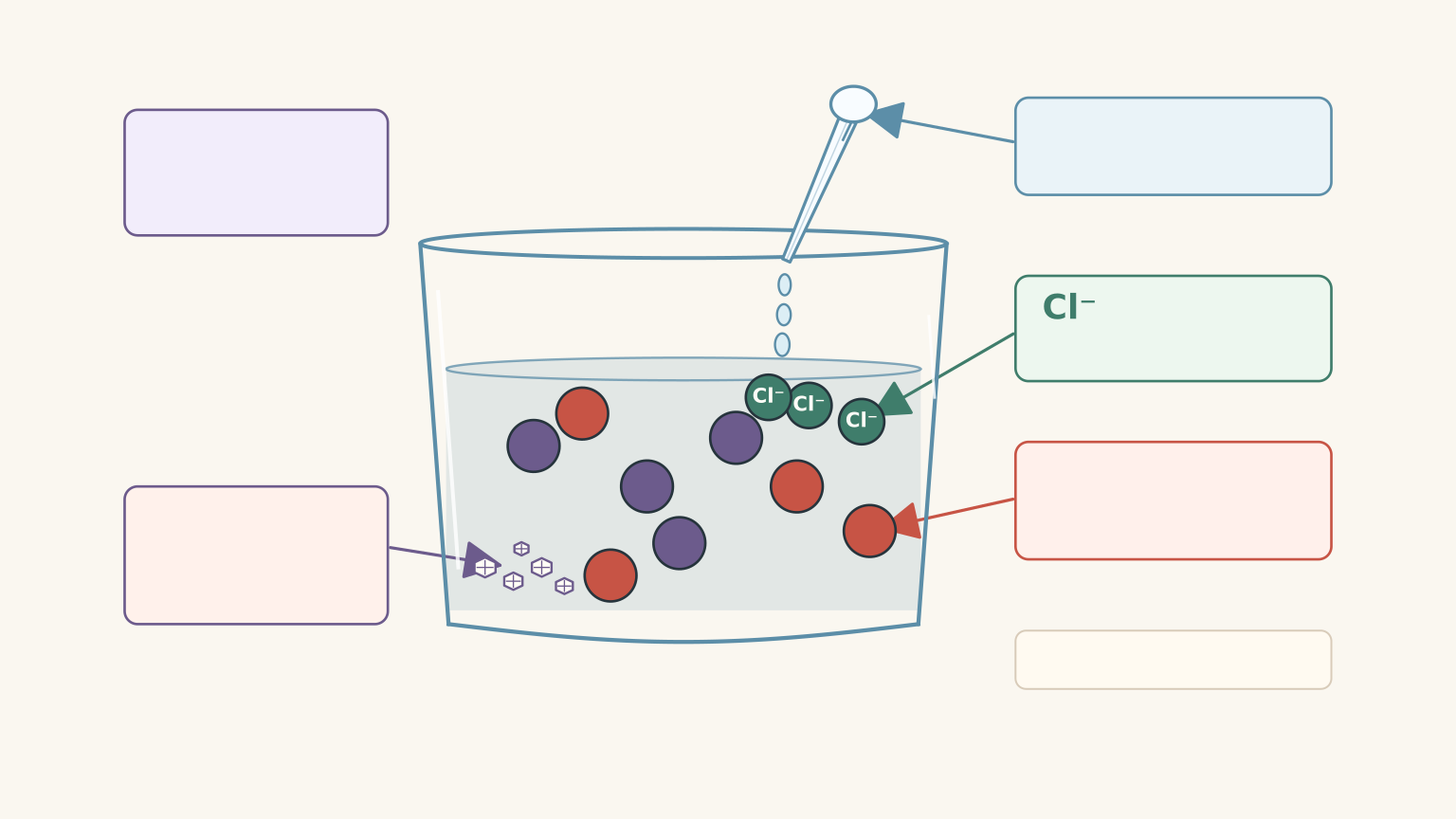
01What makes a precipitate start?
In this mixture, \(\ce{AgCl}\) precipitates first. But the reliable way to predict this is to calculate when each salt reaches saturation, rather than simply comparing their \(K_{sp}\) values.
Think of precipitation as a tripwire. The solution has a current ion product, and each solid has its own saturation threshold. Once the solution reaches that threshold, the solid can begin to form.
The tripwire analogy has one limitation: forming a precipitate removes ions from the solution. Their concentrations change, so the ion product changes too.
Step 1: Understand the ion product
The ion product, \(Q_{sp}\), is calculated using the current concentrations of the dissolved ions that could form a particular solid.
Compare it with the solubility product, \(K_{sp}\), at the same temperature.
| Condition | Meaning |
|---|---|
| \(Q_{sp}K_{sp}\) | The solution is supersaturated. Precipitation is thermodynamically favoured. |
In HSC calculations, we generally assume precipitation can begin as soon as saturation is reached, without considering delays caused by crystal nucleation.
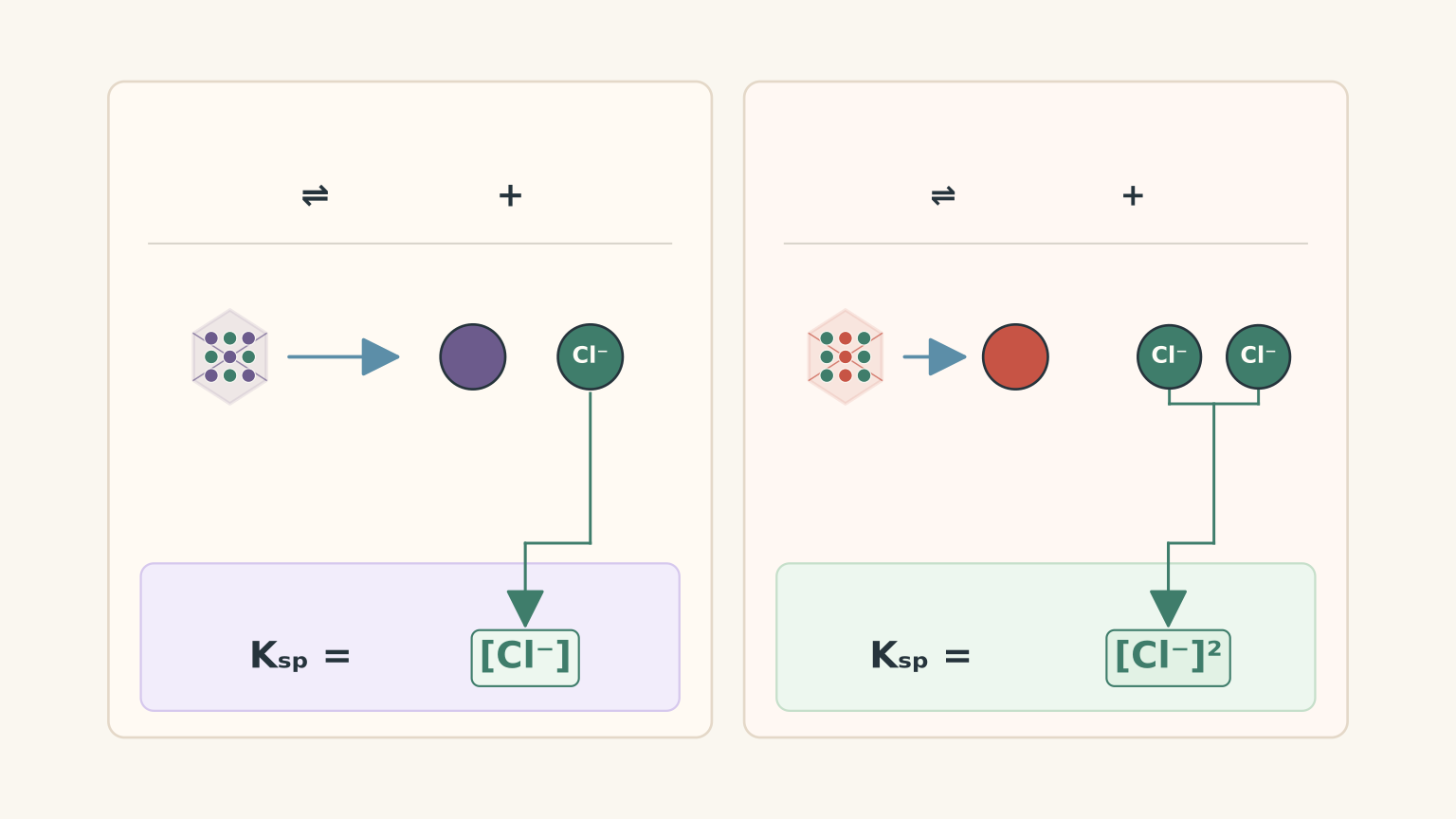
Step 2: Write the dissolution equations
Start with silver chloride.
\[ \ce{AgCl(s) <=> Ag+(aq) + Cl-(aq)} \]
One mole of \(\ce{AgCl}\) releases one mole of \(\mathrm{Ag}^{+}\) and one mole of \(\mathrm{Cl}^{-}\). Therefore,
\[ Q_{sp}(\ce{AgCl}) =[\mathrm{Ag^+}][\mathrm{Cl^-}] \]
At equilibrium with solid silver chloride,
\[ K_{sp}(\ce{AgCl}) =[\mathrm{Ag^+}][\mathrm{Cl^-}] \]
Now consider lead(II) chloride.
\[ \ce{PbCl2(s) <=> Pb^2+(aq) + 2Cl-(aq)} \]
One mole of \(\ce{PbCl2}\) releases two moles of chloride ions. The chloride concentration is therefore squared in the expression:
\[ Q_{sp}(\ce{PbCl2}) =[\mathrm{Pb^{2+}}][\mathrm{Cl^-}]^2 \]
At equilibrium with solid lead(II) chloride,
\[ K_{sp}(\ce{PbCl2}) =[\mathrm{Pb^{2+}}][\mathrm{Cl^-}]^2 \]
The solid itself does not appear in either expression. Only the dissolved ions are included.
Step 3: Find the chloride concentration at the onset of precipitation
Before either solid has formed, use the initial concentrations of the metal ions. At the instant a solid first begins to form, set its ion product equal to its \(K_{sp}\).
For silver chloride:
\[ [\mathrm{Ag^+}][\mathrm{Cl^-}] =K_{sp}(\ce{AgCl}) \]
Rearrange to find the chloride concentration:
\[ [\mathrm{Cl^-}] =\frac{K_{sp}(\ce{AgCl})}{[\mathrm{Ag^+}]} \]
For lead(II) chloride:
\[ [\mathrm{Pb^{2+}}][\mathrm{Cl^-}]^2 =K_{sp}(\ce{PbCl2}) \]
Rearrange and take the square root:
\[ [\mathrm{Cl^-}] =\sqrt{\frac{K_{sp}(\ce{PbCl2})} {[\mathrm{Pb^{2+}}]}} \]
These two equations are the key to predicting which ion precipitates first.
02Worked example: Which chloride forms first?
A solution contains \(0.010\ \mathrm{mol\,L^{-1}}\) of both \(\mathrm{Ag}^{+}\) and \(\mathrm{Pb}^{2+}\). At \(25^\circ\mathrm{C}\), use the following solubility products:
- \(K_{sp}(\ce{AgCl})=1.8\times10^{-10}\)
- \(K_{sp}(\ce{PbCl2})=1.7\times10^{-5}\)
Calculate the free chloride concentration at which each solid first forms. Identify the first precipitate.
Step 1
The reagent supplies \(\mathrm{Cl}^{-}\), so calculate the chloride concentration required to reach saturation for each salt.
Step 2
Using the \(1:1\) dissolution equation,
\[ \begin{aligned} [\mathrm{Cl^-}]_{\ce{AgCl}} &=\frac{K_{sp}(\ce{AgCl})}{[\mathrm{Ag^+}]}\\[4pt] &=\frac{1.8\times10^{-10}}{1.0\times10^{-2}}\\[4pt] &=1.8\times10^{-8}\ \mathrm{mol\,L^{-1}} \end{aligned} \]
Silver chloride begins to precipitate when the free chloride concentration reaches \(1.8\times10^{-8}\ \mathrm{mol\,L^{-1}}\).
Step 3
Because the chloride concentration is squared, take the square root:
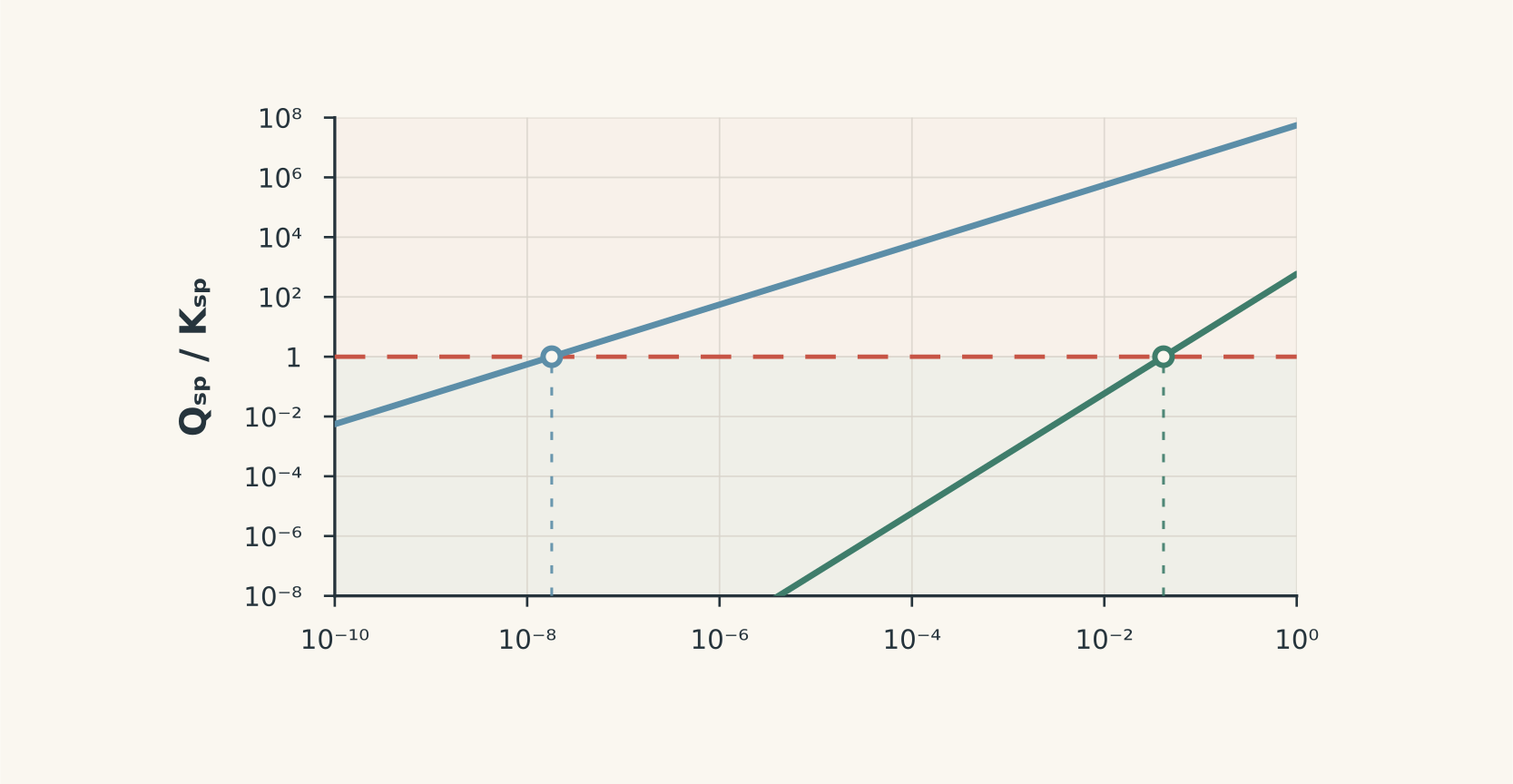
\[ \begin{aligned} [\mathrm{Cl^-}]_{\ce{PbCl2}} &=\sqrt{\frac{K_{sp}(\ce{PbCl2})} {[\mathrm{Pb^{2+}}]}}\\[4pt] &=\sqrt{\frac{1.7\times10^{-5}}{1.0\times10^{-2}}}\\[4pt] &=\sqrt{1.7\times10^{-3}}\\[4pt] &=4.1\times10^{-2}\ \mathrm{mol\,L^{-1}} \end{aligned} \]
Lead(II) chloride begins to precipitate at approximately \(0.041\ \mathrm{mol\,L^{-1}}\) free chloride.
Step 4
Silver chloride begins to form at \(1.8\times10^{-8}\ \mathrm{mol\,L^{-1}}\), whereas lead(II) chloride requires approximately \(4.1\times10^{-2}\ \mathrm{mol\,L^{-1}}\).
Therefore, \(\ce{AgCl}\) precipitates first. Its chloride threshold is more than two million times lower than the threshold for \(\ce{PbCl2}\) in this mixture.
Notice that these are free chloride concentrations, not the total amount of \(\ce{NaCl}\) that must be added.
03Why the smaller Ksp does not always win
It is tempting to conclude that the salt with the smaller \(K_{sp}\) must always precipitate first. That is not a reliable rule.
The onset concentration depends on three things:
- The value of \(K_{sp}\).
- The initial concentration of the metal ion.
- The stoichiometry of the dissolution equation, which determines the powers in the \(K_{sp}\) expression.
For the two salts in our example, the relevant equations are:
| Solid | Ion product | Chloride concentration at onset |
|---|---|---|
| \(\ce{AgCl}\) | \([\mathrm{Ag^+}][\mathrm{Cl^-}]\) | \(\dfrac{K_{sp}}{[\mathrm{Ag^+}]}\) |
| \(\ce{PbCl2}\) | \([\mathrm{Pb^{2+}}][\mathrm{Cl^-}]^2\) | \(\sqrt{\dfrac{K_{sp}}{[\mathrm{Pb^{2+}}]}}\) |
A smaller \(K_{sp}\) often indicates lower solubility, but comparing two \(K_{sp}\) values directly can be misleading, particularly when the salts have different dissolution stoichiometries.
Use this decision rule whenever a question asks which ion precipitates first:
- Write the balanced dissolution equation for each possible solid.
- Write the correct \(K_{sp}\) expression, including the appropriate powers.
- Set \(Q_{sp}=K_{sp}\) for each solid at the onset of precipitation.
- Use the initial free metal-ion concentrations to calculate the required reagent-ion concentration.
- Compare the calculated thresholds. The solid with the lower threshold forms first, assuming the stated equilibrium model applies.
There is one more important detail. The threshold tells you when the first trace of a solid can form. It does not tell you how much of that ion will be removed from solution.
Once precipitation begins, the concentration of the precipitating ion decreases. To work out what remains in solution, you must use the equilibrium condition again.
04Worked example: Can you remove silver ions without precipitating lead ions?
Return to the original solution, with initial concentrations of \(0.010\ \mathrm{mol\,L^{-1}}\) for both \(\mathrm{Ag}^{+}\) and \(\mathrm{Pb}^{2+}\).
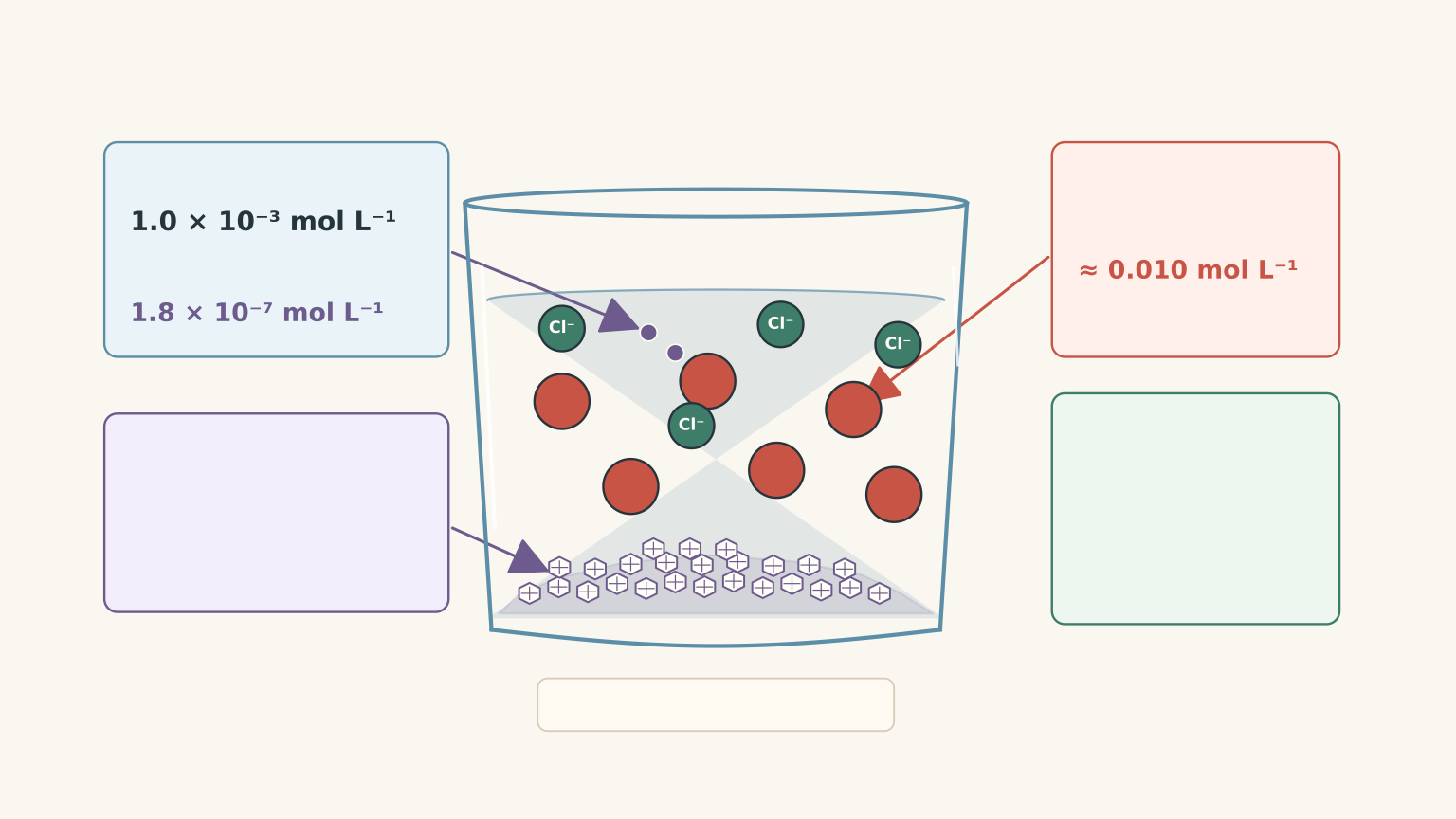
Suppose enough \(\ce{NaCl}\) has been added that the free chloride concentration reaches \(1.0\times10^{-3}\ \mathrm{mol\,L^{-1}}\). Assume solid \(\ce{AgCl}\) is present, the volume change is negligible, and no significant complex formation occurs.
Calculate the equilibrium concentration of \(\mathrm{Ag}^{+}\) and determine whether \(\ce{PbCl2}\) precipitates.
Step 1
Because solid \(\ce{AgCl}\) is present, the solution is saturated with respect to silver chloride:
\[ K_{sp}(\ce{AgCl}) =[\mathrm{Ag^+}][\mathrm{Cl^-}] \]
Rearrange:
\[ \begin{aligned} [\mathrm{Ag^+}] &=\frac{K_{sp}(\ce{AgCl})}{[\mathrm{Cl^-}]}\\[4pt] &=\frac{1.8\times10^{-10}}{1.0\times10^{-3}}\\[4pt] &=1.8\times10^{-7}\ \mathrm{mol\,L^{-1}} \end{aligned} \]
The silver-ion concentration has fallen from \(0.010\) to \(1.8\times10^{-7}\ \mathrm{mol\,L^{-1}}\).
Step 2
No \(\ce{PbCl2}\) has formed, so its dissolved lead-ion concentration remains approximately \(0.010\ \mathrm{mol\,L^{-1}}\).
Calculate its ion product:
\[ \begin{aligned} Q_{sp}(\ce{PbCl2}) &=[\mathrm{Pb^{2+}}][\mathrm{Cl^-}]^2\\[4pt] &=(1.0\times10^{-2})(1.0\times10^{-3})^2\\[4pt] &=1.0\times10^{-8} \end{aligned} \]
Compare this with \(K_{sp}(\ce{PbCl2})=1.7\times10^{-5}\).
Since
\[ 1.0\times10^{-8}<1.7\times10^{-5}, \]
the solution is unsaturated with respect to lead(II) chloride. No \(\ce{PbCl2}\) precipitates under the stated assumptions.
Step 3
The fraction of the original silver-ion concentration remaining is
\[ \frac{1.8\times10^{-7}}{1.0\times10^{-2}} =1.8\times10^{-5} \]
That means approximately \(99.9982\%\) of the original silver ions have been removed from solution, while the lead ions remain dissolved.
This is the useful part of selective precipitation: you can remove almost all of one ion without necessarily precipitating the other.
05Using selective precipitation to separate ions
Selective precipitation works when two ions have sufficiently different precipitation thresholds.
For our idealised example, the threshold for \(\ce{AgCl}\) is extremely low, while \(\ce{PbCl2}\) does not begin forming until the free chloride concentration is much higher.
A sensible separation strategy is therefore:
- Add \(\ce{NaCl}\) gradually to the mixed solution.
- Allow \(\ce{AgCl}\) to form and reach equilibrium.
- Keep the free chloride concentration below the threshold for \(\ce{PbCl2}\), while allowing enough chloride to reduce the dissolved silver concentration to an acceptable level.
- Filter the mixture to collect the \(\ce{AgCl}\) solid.
- Keep the filtrate, which contains the dissolved lead ions.
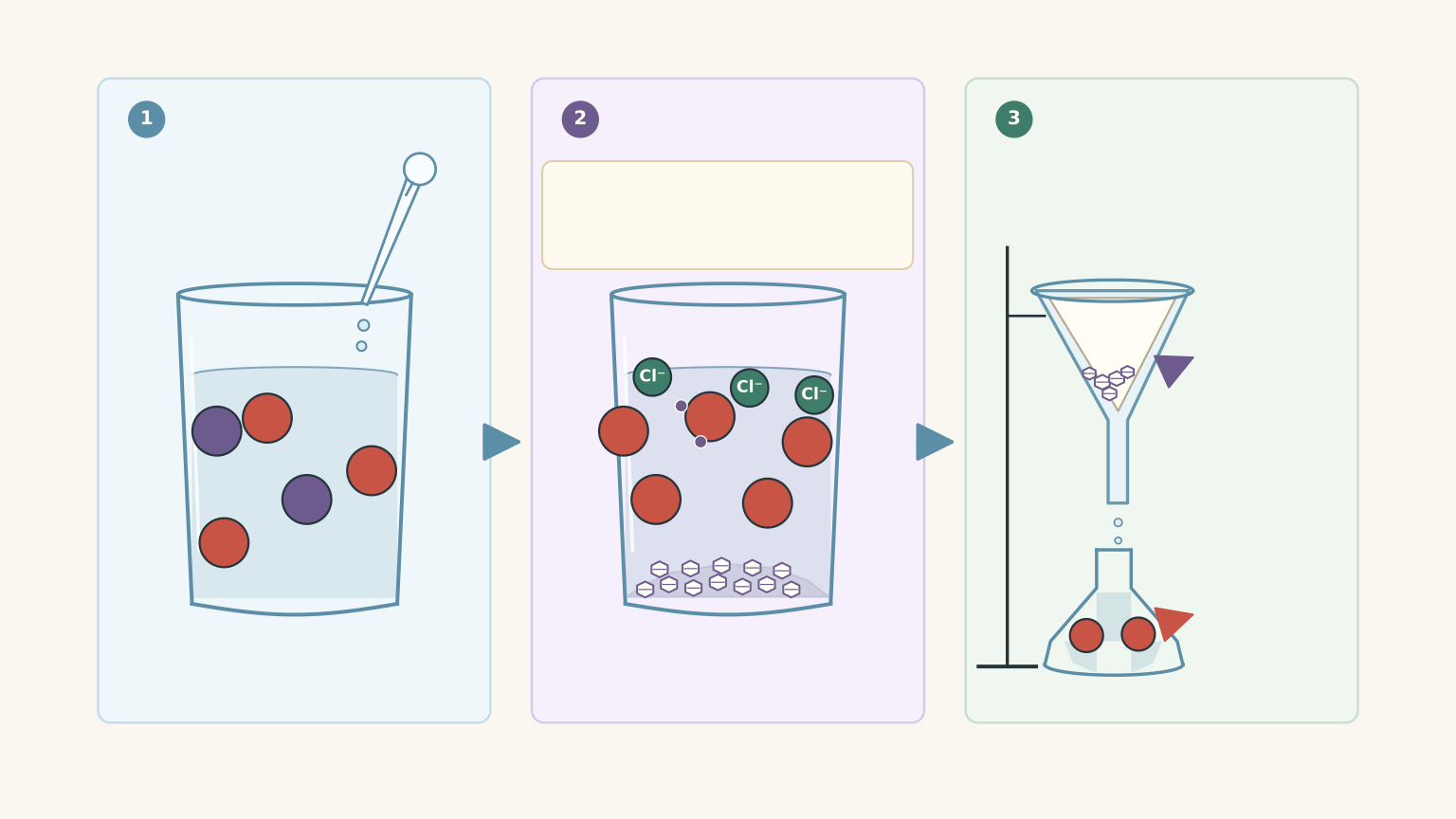
Both \(\ce{AgCl}\) and \(\ce{PbCl2}\) are white solids, so colour alone would not distinguish them in a mixed precipitate. The separation depends on controlling the chemical conditions, not on looking at the solid.
What assumptions make the separation work?
The calculations above use a simplified equilibrium model. Before applying the results to a real solution, check the assumptions.
- Temperature is fixed. The quoted \(K_{sp}\) values apply at \(25^\circ\mathrm{C}\). Solubility products change with temperature.
- Concentrations approximate activities. The calculations use free-ion concentrations as an approximation to the thermodynamic activities used in equilibrium constants. This becomes less accurate as ionic strength increases.
- Complex formation is negligible. Chloride can form soluble complexes with some metal ions. Such complexes can change the free-ion concentrations and alter the separation, especially in excess chloride.
- Side reactions are absent or negligible. Other dissolved ions, competing precipitates, or changes in pH may affect the equilibria.
- The reagent concentration means free-ion concentration. The free \([\mathrm{Cl^-}]\) is not the same as the total amount of \(\ce{NaCl}\) added. Some chloride enters the precipitated solids, and adding solution can change the volume.
- Equilibrium is reached. The simple model ignores delays in nucleation and crystal growth.
The distinction between the amount of reagent added and its free concentration is especially important. \(K_{sp}\) tells you the equilibrium relationship between dissolved ions. Stoichiometry and mass balance tell you how much reagent is needed to reach a particular state.
For the equilibrium concepts behind this calculation, see tutorgum’s HSC Chemistry Module 5 Equilibrium: Complete Topic Summary.
06Questions and solutions
Question 1
A solution contains \(2.0\times10^{-3}\ \mathrm{mol\,L^{-1}}\) of \(\mathrm{Ag}^{+}\) and \(5.0\times10^{-3}\ \mathrm{mol\,L^{-1}}\) of \(\mathrm{Pb}^{2+}\). At \(25^\circ\mathrm{C}\), use \(K_{sp}(\ce{AgCl})=1.8\times10^{-10}\) and \(K_{sp}(\ce{PbCl2})=1.7\times10^{-5}\).
Calculate the free chloride concentration at which each solid first forms. Which precipitates first?
Solution 1
Silver chloride precipitates first, beginning at \(9.0\times10^{-8}\ \mathrm{mol\,L^{-1}}\) free chloride, compared with approximately \(5.8\times10^{-2}\ \mathrm{mol\,L^{-1}}\) for lead(II) chloride.
For silver chloride,
\[ \begin{aligned} [\mathrm{Cl^-}]_{\ce{AgCl}} &=\frac{1.8\times10^{-10}}{2.0\times10^{-3}}\\[4pt] &=9.0\times10^{-8}\ \mathrm{mol\,L^{-1}} \end{aligned} \]
For lead(II) chloride,
\[ \begin{aligned} [\mathrm{Cl^-}]_{\ce{PbCl2}} &=\sqrt{\frac{1.7\times10^{-5}}{5.0\times10^{-3}}}\\[4pt] &=\sqrt{3.4\times10^{-3}}\\[4pt] &=5.8\times10^{-2}\ \mathrm{mol\,L^{-1}} \end{aligned} \]
The lower threshold belongs to \(\ce{AgCl}\). Use the initial metal-ion concentrations because neither solid has yet removed an appreciable amount of its metal ion.
Question 2
In the original mixture, \([\mathrm{Ag^+}]=[\mathrm{Pb^{2+}}]=0.010\ \mathrm{mol\,L^{-1}}\), and solid \(\ce{AgCl}\) is already present.
You want to lower the equilibrium silver-ion concentration to \(1.0\times10^{-6}\ \mathrm{mol\,L^{-1}}\) or less. Calculate the minimum free chloride concentration required. Then determine whether \(\ce{PbCl2}\) precipitates at that chloride concentration.
Assume negligible volume change and no significant complex formation.
Solution 2
A free chloride concentration of \(1.8\times10^{-4}\ \mathrm{mol\,L^{-1}}\) is sufficient, and lead(II) chloride remains unsaturated.
Because \(\ce{AgCl}\) is already present, use its equilibrium expression:
\[ K_{sp}(\ce{AgCl}) =[\mathrm{Ag^+}][\mathrm{Cl^-}] \]
Rearrange to find the required chloride concentration:
\[ \begin{aligned} [\mathrm{Cl^-}] &=\frac{K_{sp}(\ce{AgCl})}{[\mathrm{Ag^+}]}\\[4pt] &=\frac{1.8\times10^{-10}}{1.0\times10^{-6}}\\[4pt] &=1.8\times10^{-4}\ \mathrm{mol\,L^{-1}} \end{aligned} \]
Now check the lead(II) chloride ion product:
\[ \begin{aligned} Q_{sp}(\ce{PbCl2}) &=[\mathrm{Pb^{2+}}][\mathrm{Cl^-}]^2\\[4pt] &=(1.0\times10^{-2})(1.8\times10^{-4})^2\\[4pt] &=3.24\times10^{-10} \end{aligned} \]
Since \(3.24\times10^{-10}<1.7\times10^{-5}\), \(\ce{PbCl2}\) does not precipitate.
The important point is that the required chloride concentration was calculated from the desired remaining silver concentration, not from the initial onset of precipitation. You can use \(K_{sp}\) to control how much of an ion remains dissolved.
Question 3
Keep the initial lead-ion concentration at \(1.0\times10^{-2}\ \mathrm{mol\,L^{-1}}\), but allow the initial silver-ion concentration to vary.
Calculate the critical initial \([\mathrm{Ag^+}]\) at which \(\ce{AgCl}\) and \(\ce{PbCl2}\) would begin to precipitate at the same free chloride concentration.
Then determine which solid forms first if the initial silver-ion concentration is \(4.0\times10^{-9}\ \mathrm{mol\,L^{-1}}\). Explain what this reveals about the claim that the salt with the smaller \(K_{sp}\) always precipitates first.
Solution 3
The critical silver-ion concentration is approximately \(4.4\times10^{-9}\ \mathrm{mol\,L^{-1}}\). At \(4.0\times10^{-9}\ \mathrm{mol\,L^{-1}}\), \(\ce{PbCl2}\) precipitates first, despite having the larger \(K_{sp}\).
First, calculate the lead(II) chloride threshold:
\[ \begin{aligned} [\mathrm{Cl^-}]_{\ce{PbCl2}} &=\sqrt{\frac{1.7\times10^{-5}}{1.0\times10^{-2}}}\\[4pt] &=4.1\times10^{-2}\ \mathrm{mol\,L^{-1}} \end{aligned} \]
At the critical point, silver chloride must reach saturation at exactly the same chloride concentration. Therefore,
\[ [\mathrm{Ag^+}]_{\mathrm{crit}} =\frac{K_{sp}(\ce{AgCl})} {[\mathrm{Cl^-}]_{\ce{PbCl2}}} \]
Substituting,
\[ \begin{aligned} [\mathrm{Ag^+}]_{\mathrm{crit}} &=\frac{1.8\times10^{-10}}{4.1\times10^{-2}}\\[4pt] &\approx4.4\times10^{-9}\ \mathrm{mol\,L^{-1}} \end{aligned} \]
Now test the stated silver concentration:
\[ \begin{aligned} [\mathrm{Cl^-}]_{\ce{AgCl}} &=\frac{1.8\times10^{-10}}{4.0\times10^{-9}}\\[4pt] &=4.5\times10^{-2}\ \mathrm{mol\,L^{-1}} \end{aligned} \]
The silver chloride threshold is \(0.045\ \mathrm{mol\,L^{-1}}\), which is higher than the lead(II) chloride threshold of approximately \(0.041\ \mathrm{mol\,L^{-1}}\). Therefore, lead(II) chloride reaches saturation first.
The tempting argument is that silver chloride has the smaller \(K_{sp}\), so it must precipitate first. The missing factor is the starting silver-ion concentration. When that concentration is sufficiently low, its ion product takes longer to reach saturation, even though its \(K_{sp}\) is smaller.
Question 4
A solution initially contains \(0.010\ \mathrm{mol\,L^{-1}}\) of both \(\mathrm{Ag}^{+}\) and \(\mathrm{Pb}^{2+}\). Chloride is added until the free chloride concentration reaches \(5.0\times10^{-2}\ \mathrm{mol\,L^{-1}}\).
Assume solid \(\ce{PbCl2}\) is present at equilibrium, complex formation is negligible, and the volume change is negligible.
Calculate the equilibrium \([\mathrm{Pb^{2+}}]\) and the percentage of the initial lead ions removed from solution. Would filtering at this point achieve a clean separation of silver ions from lead ions?
Solution 4
The equilibrium lead-ion concentration is \(6.8\times10^{-3}\ \mathrm{mol\,L^{-1}}\), so approximately \(32\%\) of the initial lead ions have been removed. Filtering at this point would not give a clean separation because both chloride solids are present.
Since solid \(\ce{PbCl2}\) is present, its ion product equals its solubility product:
\[ K_{sp}(\ce{PbCl2}) =[\mathrm{Pb^{2+}}][\mathrm{Cl^-}]^2 \]
Rearrange:
\[ \begin{aligned} [\mathrm{Pb^{2+}}] &=\frac{K_{sp}(\ce{PbCl2})}{[\mathrm{Cl^-}]^2}\\[4pt] &=\frac{1.7\times10^{-5}}{(5.0\times10^{-2})^2}\\[4pt] &=\frac{1.7\times10^{-5}}{2.5\times10^{-3}}\\[4pt] &=6.8\times10^{-3}\ \mathrm{mol\,L^{-1}} \end{aligned} \]
The fraction of the initial lead-ion concentration removed is
\[ \begin{aligned} \text{Fraction removed} &=\frac{0.010-0.0068}{0.010}\\[4pt] &=0.32 \end{aligned} \]
Therefore, approximately \(32\%\) has precipitated.
The free chloride concentration has passed the \(\ce{PbCl2}\) onset threshold of approximately \(0.041\ \mathrm{mol\,L^{-1}}\). Lead(II) chloride has begun to form alongside the silver chloride that was already present. Filtering now collects a mixture of solids.
Also notice that reaching the precipitation threshold does not remove all the lead ions. The remaining dissolved concentration is determined by equilibrium, not by the fact that a precipitate has appeared.
Question 5
A solution contains solid \(\ce{AgCl}\), but no solid \(\ce{PbCl2}\). Its free chloride concentration is \(0.020\ \mathrm{mol\,L^{-1}}\), and its dissolved lead-ion concentration is \(0.010\ \mathrm{mol\,L^{-1}}\).
A student argues that lead(II) chloride cannot begin to precipitate unless more \(\ce{NaCl}\) is added, because its original threshold was approximately \(0.041\ \mathrm{mol\,L^{-1}}\).
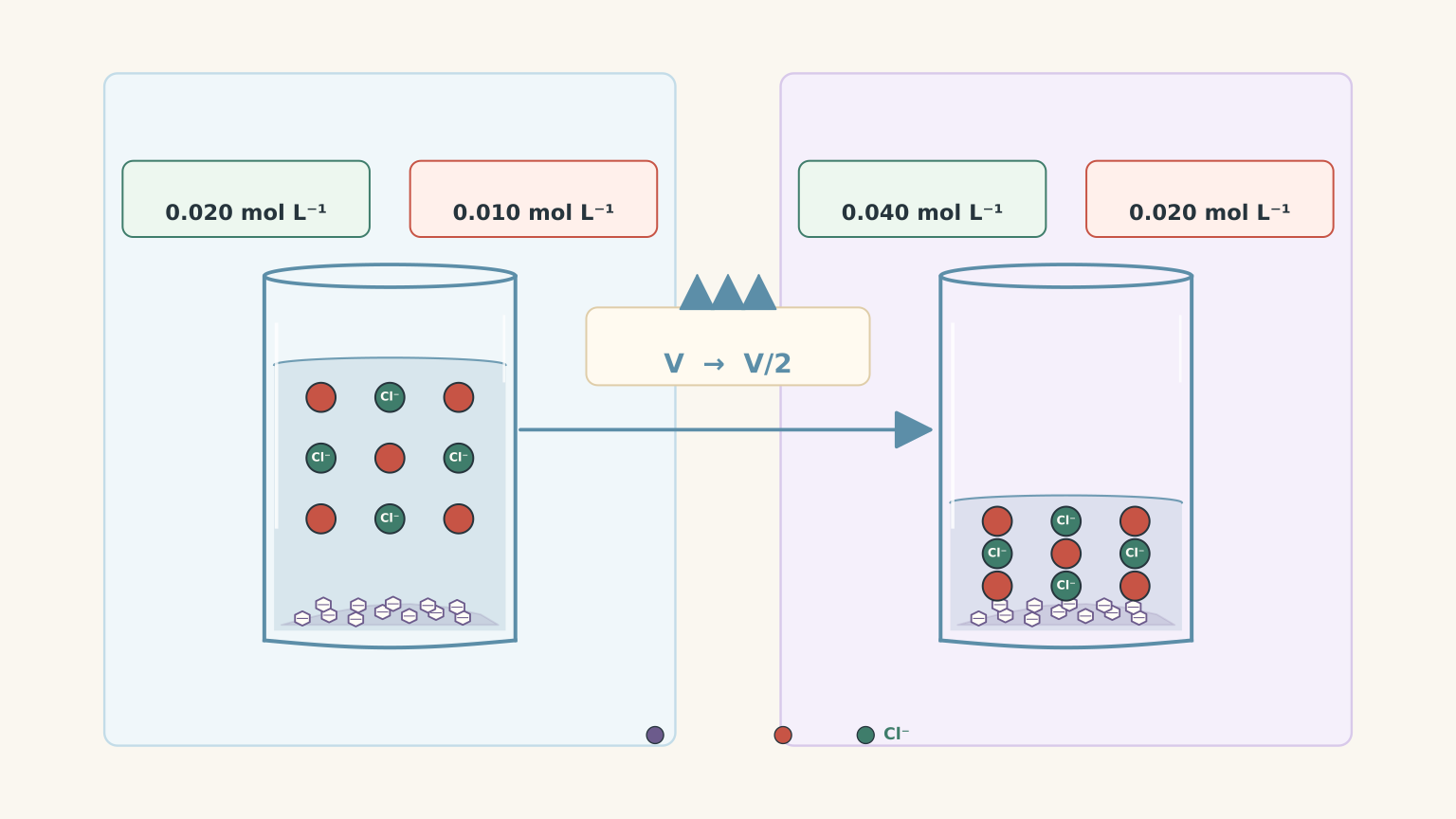
Instead, the solution is evaporated to half its original volume at constant temperature. Assume no chloride or lead is lost, and neglect the small redistribution of chloride caused by \(\ce{AgCl}\) re-equilibrating. Ignore activity effects and complex formation.
Does \(\ce{PbCl2}\) begin to precipitate? Calculate the ion product immediately after the volume halves but before any new \(\ce{PbCl2}\) forms. Explain why those concentrations cannot be treated as the final equilibrium concentrations.
Solution 5
Yes. \(\ce{PbCl2}\) begins to precipitate during evaporation, even though no additional sodium chloride is added.
Before evaporation, the lead(II) chloride ion product is
\[ \begin{aligned} Q_{sp} &=[\mathrm{Pb^{2+}}][\mathrm{Cl^-}]^2\\[4pt] &=(0.010)(0.020)^2\\[4pt] &=4.0\times10^{-6} \end{aligned} \]
This is less than \(K_{sp}(\ce{PbCl2})=1.7\times10^{-5}\), so no lead(II) chloride precipitates initially.
When the volume halves, the concentrations of dissolved lead ions and free chloride would each double if no new lead precipitate formed:
\[ [\mathrm{Pb^{2+}}]=0.020\ \mathrm{mol\,L^{-1}} \]
\[ [\mathrm{Cl^-}]\approx0.040\ \mathrm{mol\,L^{-1}} \]
Calculate the ion product at this instant:
\[ \begin{aligned} Q_{sp} &=(0.020)(0.040)^2\\[4pt] &=(0.020)(1.6\times10^{-3})\\[4pt] &=3.2\times10^{-5} \end{aligned} \]
Since
\[ 3.2\times10^{-5}>1.7\times10^{-5}, \]
the solution becomes supersaturated with respect to \(\ce{PbCl2}\). Precipitation is therefore thermodynamically favoured.
The tempting approach is to compare \(0.040\ \mathrm{mol\,L^{-1}}\) with the original threshold of \(0.041\ \mathrm{mol\,L^{-1}}\) and conclude that no precipitate forms. But that original threshold was calculated for a lead-ion concentration of \(0.010\ \mathrm{mol\,L^{-1}}\). After evaporation, the lead-ion concentration has doubled, so the old threshold no longer applies.
Once \(\ce{PbCl2}\) starts to form, it removes both \(\mathrm{Pb}^{2+}\) and \(\mathrm{Cl}^{-}\) from solution. Their concentrations fall until the ion product returns to \(K_{sp}\), assuming equilibrium is reached. The doubled concentrations are the values immediately before new precipitation begins, not the final equilibrium values.
This is why selective precipitation is not just about memorising a threshold. You must recalculate the ion product whenever conditions change.
The next useful step is to combine this onset calculation with a mass balance. \(K_{sp}\) tells you the free-ion concentrations at equilibrium; stoichiometry tells you how much reagent is needed to reach them. That same combination is essential when calculating solubility in the presence of a common ion.