
Concentration and Dilution: HSC Chemistry Practice Exam
Test your understanding of concentration and dilution with this original 50-mark NSW HSC Chemistry practice paper. Includes a suggested 75-minute working time, exam-style questions, complete worked solutions, and a detailed marking guide.
This is an original tutorgum practice paper for NSW HSC Chemistry, covering the chemistry-2025 concentration and dilution problem scope. It tests concentration unit conversions, amount concentration calculations, mass and volume calculations, dilution using conservation of solute, practical solution preparation, and different ways of expressing concentration.
The paper is designed to test both calculation skills and your understanding of what happens to a solution during dilution. It is a focused topic revision paper, not a full-course examination or an official, endorsed, past, or predicted NESA paper.
01Exam instructions
Suggested reading time: 5 minutes
Suggested working time: 75 minutes
Total marks: 50
Permitted equipment:
- Scientific calculator.
- Pen and pencil.
- Ruler.
General instructions:
- Attempt every question.
- Show all working for calculations. A correct final answer without working may not receive full marks.
- Include appropriate units in every numerical answer.
- Give answers to 3 significant figures unless the question or supplied data indicates otherwise.
- Convert volumes into litres when using amount concentration in \(\mathrm{mol\,L^{-1}}\).
- Unless otherwise stated, assume that no solute is lost during dilution or transfer.
- All stated solution volumes refer to the final volume of the solution, not the volume of water added.
For this paper, percentage concentration expressed as % (m/v) means the number of grams of solute present in every 100 mL of final solution.
The conditions above are suggested conditions for this original practice paper, not claims about official examination requirements.
02Questions
Question 1 (6 marks)
Concentration can be expressed using different units. Complete the following conversions, showing your working where appropriate.
(a) Convert a mass concentration of \(3.60\ \mathrm{g\,L^{-1}}\) into \(\mathrm{mg\,mL^{-1}}\).
(2 marks)
(b) Convert an amount concentration of \(0.0250\ \mathrm{mol\,L^{-1}}\) into \(\mathrm{mmol\,L^{-1}}\).
(1 mark)
(c) Convert a mass concentration of \(4.50\ \mathrm{mg\,mL^{-1}}\) into \(\mathrm{g\,L^{-1}}\).
(2 marks)
(d) A solution has a concentration of \(0.800\%\) (m/v). Express this concentration in \(\mathrm{g\,L^{-1}}\).
(1 mark)
Question 2 (8 marks)
Use the relationship between amount concentration, chemical amount, and solution volume to answer the following questions.
(a) A solution contains \(0.0180\ \mathrm{mol}\) of dissolved solute in a final volume of \(250.0\ \mathrm{mL}\).
Calculate its amount concentration in \(\mathrm{mol\,L^{-1}}\).
(2 marks)
(b) Calculate the amount, in moles, of solute present in \(35.0\ \mathrm{mL}\) of a solution with an amount concentration of \(0.120\ \mathrm{mol\,L^{-1}}\).
(2 marks)
(c) A sample contains \(0.0800\ \mathrm{mol}\) of potassium nitrate, \(\mathrm{KNO_3}\).
Given that the molar mass of potassium nitrate is \(101.1\ \mathrm{g\,mol^{-1}}\), calculate the mass of potassium nitrate in the sample.
(2 marks)
(d) What volume of a \(0.0750\ \mathrm{mol\,L^{-1}}\) solution contains exactly \(0.0150\ \mathrm{mol}\) of dissolved solute?
Express your answer in millilitres.
(2 marks)
Question 3 (8 marks)
A laboratory has a potassium chloride stock solution with an amount concentration of \(0.800\ \mathrm{mol\,L^{-1}}\).
A student uses this solution to prepare more dilute solutions.
(a) The student transfers \(25.00\ \mathrm{mL}\) of the stock solution into a volumetric flask and adds distilled water until the final solution volume reaches \(250.0\ \mathrm{mL}\).
Calculate the amount concentration of the diluted solution.
(3 marks)
(b) Calculate the volume of the original stock solution required to prepare \(100.0\ \mathrm{mL}\) of a potassium chloride solution with an amount concentration of \(0.120\ \mathrm{mol\,L^{-1}}\).
(2 marks)
(c) A student claims that adding water to a solution decreases the amount of solute present because the concentration becomes lower.
Explain why this statement is incorrect. In your answer, also describe what happens to the concentration if the original solution volume is doubled by adding water.
(3 marks)
Question 4 (8 marks)
A student performs a two-stage dilution using a stock solution with an amount concentration of \(2.00\ \mathrm{mol\,L^{-1}}\).
The procedure is as follows:
- First, \(10.0\ \mathrm{mL}\) of the original stock solution is transferred into a \(100.0\ \mathrm{mL}\) volumetric flask.
- Distilled water is added until the flask reaches its calibration mark.
- Next, \(20.0\ \mathrm{mL}\) of the first diluted solution is transferred into a second \(250.0\ \mathrm{mL}\) volumetric flask.
- Distilled water is added until the second flask reaches its calibration mark.
Assume no solute is lost during either transfer.
(a) Calculate the amount concentration of the solution in the first volumetric flask.
(2 marks)
(b) Calculate the amount concentration of the final solution in the second volumetric flask.
(4 marks)
(c) Calculate the amount of solute, in moles, present in the final \(250.0\ \mathrm{mL}\) solution.
(2 marks)
Question 5 (10 marks)
A student needs to prepare \(100.0\ \mathrm{mL}\) of a solution with an amount concentration of \(0.0400\ \mathrm{mol\,L^{-1}}\).
They have access to a stock solution with an amount concentration of \(0.200\ \mathrm{mol\,L^{-1}}\).
The available apparatus includes:
- A \(20.00\ \mathrm{mL}\) volumetric pipette.
- A pipette filler.
- A \(100.0\ \mathrm{mL}\) volumetric flask.
- A beaker.
- Deionised water.
- A dropper.
- A stopper for the volumetric flask.
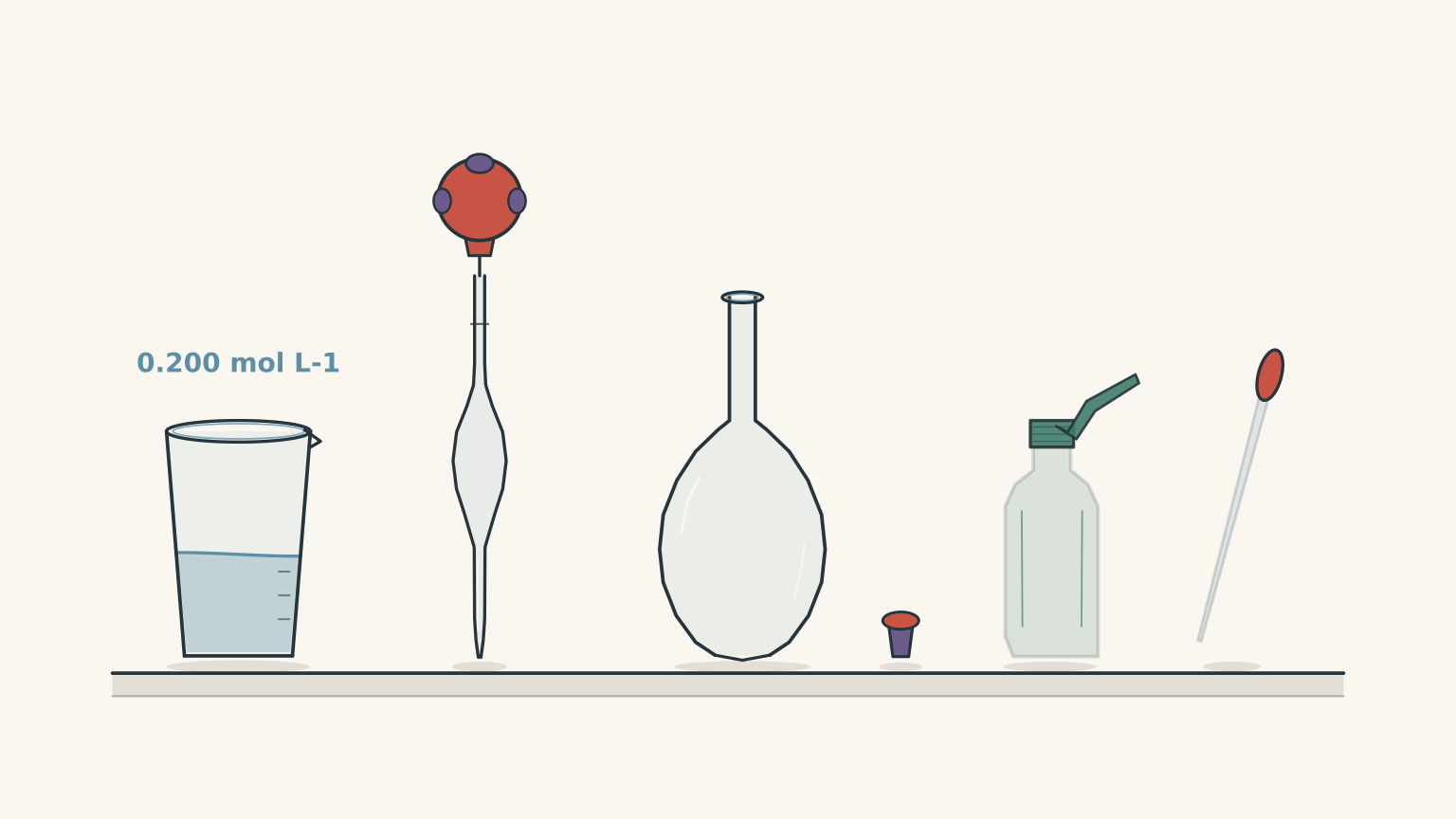
(a) Calculate the volume of stock solution required to prepare the desired diluted solution.
(2 marks)
(b) Describe a suitable method for preparing the solution using the available apparatus.
Your answer should include how the stock solution is measured and transferred, how the final volume is obtained, and how the solution is mixed.
(4 marks)
(c) Another student rinses the volumetric pipette with deionised water immediately before measuring the stock solution. They do not rinse it with stock solution afterwards.
Explain how this could affect the concentration of the final prepared solution.
(2 marks)
(d) Explain why:
- The bottom of the meniscus should be read at eye level when using the volumetric glassware.
- The volumetric flask should be inverted several times after it has been filled and stoppered.
(2 marks)
Question 6 (10 marks)
A student prepares a glucose solution by dissolving \(8.00\ \mathrm{g}\) of glucose in distilled water and making the final solution volume up to \(200.0\ \mathrm{mL}\).
The molar mass of glucose is \(180.16\ \mathrm{g\,mol^{-1}}\).
(a) Calculate the mass concentration of the glucose solution in \(\mathrm{g\,L^{-1}}\).
(2 marks)
(b) Express the concentration of the glucose solution as a percentage concentration in % (m/v).
(2 marks)
(c) Calculate the amount concentration of glucose in \(\mathrm{mol\,L^{-1}}\).
(3 marks)
(d) A laboratory report describes a solution using percentage concentration, while another report describes it using amount concentration in \(\mathrm{mol\,L^{-1}}\).
Explain what each of these concentration descriptions measures and why both can describe the same solution.
(3 marks)
03Worked solutions and marking guide
The solutions below show the expected reasoning, not just the final answers. Pay attention to unit conversions, particularly when using \(c=n/V\), because volume must be expressed in litres.
Equivalent mathematical methods are acceptable. Follow-through marks should be awarded where a student uses an earlier incorrect numerical result correctly in a later calculation, provided the method is valid.
Solution 1
(a) Convert \(3.60\ \mathrm{g\,L^{-1}}\) into \(\mathrm{mg\,mL^{-1}}\).
We need to convert both the mass and volume units.
First, convert grams into milligrams:
\[ 3.60\ \mathrm{g}=3600\ \mathrm{mg} \]
Next, convert litres into millilitres:
\[ 1\ \mathrm{L}=1000\ \mathrm{mL} \]
Therefore,
\[ \begin{aligned} 3.60\ \mathrm{g\,L^{-1}} &=\frac{3600\ \mathrm{mg}}{1000\ \mathrm{mL}}\\ &=3.60\ \mathrm{mg\,mL^{-1}} \end{aligned} \]
Answer:
\[ \boxed{3.60\ \mathrm{mg\,mL^{-1}}} \]
Marking guide (2 marks):
- Correct conversion of grams to milligrams and litres to millilitres. (1 mark)
- Correct final concentration with units. (1 mark)
(b) Convert \(0.0250\ \mathrm{mol\,L^{-1}}\) into \(\mathrm{mmol\,L^{-1}}\).
We know that:
\[ 1\ \mathrm{mol}=1000\ \mathrm{mmol} \]
Therefore,
\[ 0.0250\times1000=25.0 \]
Answer:
\[ \boxed{25.0\ \mathrm{mmol\,L^{-1}}} \]
Marking guide (1 mark):
- Correct conversion and answer with units. (1 mark)
(c) Convert \(4.50\ \mathrm{mg\,mL^{-1}}\) into \(\mathrm{g\,L^{-1}}\).
Convert milligrams into grams:
\[ 4.50\ \mathrm{mg}=0.00450\ \mathrm{g} \]
Convert millilitres into litres:
\[ 1\ \mathrm{mL}=0.001\ \mathrm{L} \]
Therefore,
\[ \begin{aligned} 4.50\ \mathrm{mg\,mL^{-1}} &=\frac{0.00450\ \mathrm{g}}{0.001\ \mathrm{L}}\\ &=4.50\ \mathrm{g\,L^{-1}} \end{aligned} \]
Answer:
\[ \boxed{4.50\ \mathrm{g\,L^{-1}}} \]
An important conversion to remember is that:
\[ 1\ \mathrm{mg\,mL^{-1}} = 1\ \mathrm{g\,L^{-1}} \]
This works because both the mass and volume units are changing by a factor of 1000.
Marking guide (2 marks):
- Correct conversion of mass and volume units. (1 mark)
- Correct final concentration with units. (1 mark)
(d) Convert \(0.800\%\) (m/v) into \(\mathrm{g\,L^{-1}}\).
Percentage mass/volume concentration means grams of solute per 100 mL of final solution.
Therefore:
\[ 0.800\%=0.800\ \mathrm{g/100\,mL} \]
To convert this into grams per litre:
\[ \begin{aligned} 0.800\times10&=8.00 \end{aligned} \]
Answer:
\[ \boxed{8.00\ \mathrm{g\,L^{-1}}} \]
Marking guide (1 mark):
- Correct conversion from grams per 100 mL to grams per litre. (1 mark)
Solution 2
(a) Calculate the amount concentration.
The relevant relationship is:
\[ c=\frac{n}{V} \]
Where:
- \(c\) is amount concentration in \(\mathrm{mol\,L^{-1}}\).
- \(n\) is chemical amount in moles.
- \(V\) is solution volume in litres.
The volume must first be converted into litres:
\[ 250.0\ \mathrm{mL}=0.2500\ \mathrm{L} \]
Substitute the values:
\[ \begin{aligned} c&=\frac{0.0180}{0.2500}\\ &=0.0720\ \mathrm{mol\,L^{-1}} \end{aligned} \]
Answer:
\[ \boxed{0.0720\ \mathrm{mol\,L^{-1}}} \]
Marking guide (2 marks):
- Correct conversion of volume into litres. (1 mark)
- Correct substitution and calculated concentration. (1 mark)
(b) Calculate the amount of solute.
Rearrange the concentration equation:
\[ n=cV \]
Convert the volume into litres:
\[ 35.0\ \mathrm{mL}=0.0350\ \mathrm{L} \]
Substitute:
\[ \begin{aligned} n&=0.120\times0.0350\\ &=0.00420\ \mathrm{mol} \end{aligned} \]
Answer:
\[ \boxed{0.00420\ \mathrm{mol}} \]
Marking guide (2 marks):
- Correct rearrangement and volume conversion. (1 mark)
- Correct calculation and units. (1 mark)
(c) Calculate the mass of potassium nitrate.
The relationship between chemical amount, mass, and molar mass is:
\[ m=nM \]
Where:
- \(m\) is mass in grams.
- \(n\) is chemical amount in moles.
- \(M\) is molar mass in \(\mathrm{g\,mol^{-1}}\).
Substitute:
\[ \begin{aligned} m&=0.0800\times101.1\\ &=8.088\ \mathrm{g} \end{aligned} \]
To three significant figures:
Answer:
\[ \boxed{8.09\ \mathrm{g}} \]
Marking guide (2 marks):
- Correct use of the mass and molar mass relationship. (1 mark)
- Correct calculated mass with units and appropriate precision. (1 mark)
(d) Calculate the required solution volume.
Start with:
\[ c=\frac{n}{V} \]
Rearrange to make volume the subject:
\[ V=\frac{n}{c} \]
Substitute:
\[ \begin{aligned} V&=\frac{0.0150}{0.0750}\\ &=0.200\ \mathrm{L} \end{aligned} \]
Convert litres into millilitres:
\[ 0.200\times1000=200 \]
Answer:
\[ \boxed{200\ \mathrm{mL}} \]
Marking guide (2 marks):
- Correct rearrangement and substitution. (1 mark)
- Correct volume conversion and final answer. (1 mark)
Solution 3
(a) Calculate the concentration after dilution.
During an ideal dilution, the amount of solute remains constant.
Therefore:
\[ n_{\text{before}}=n_{\text{after}} \]
Using \(n=cV\), this gives:
\[ c_1V_1=c_2V_2 \]
Where:
- \(c_1\) is the original concentration.
- \(V_1\) is the original solution volume transferred.
- \(c_2\) is the diluted concentration.
- \(V_2\) is the final solution volume.
Rearrange:
\[ c_2=\frac{c_1V_1}{V_2} \]
Substitute:
\[ \begin{aligned} c_2&=\frac{0.800\times25.00}{250.0}\\ &=0.0800\ \mathrm{mol\,L^{-1}} \end{aligned} \]
Both volumes are in millilitres, so their units cancel.
Answer:
\[ \boxed{0.0800\ \mathrm{mol\,L^{-1}}} \]
Marking guide (3 marks):
- Correct identification and use of the conservation of solute relationship. (1 mark)
- Correct substitution using the original and final volumes. (1 mark)
- Correct concentration with units. (1 mark)
(b) Calculate the volume of stock solution required.
We are given:
\[ c_1=0.800\ \mathrm{mol\,L^{-1}} \]
\[ c_2=0.120\ \mathrm{mol\,L^{-1}} \]
\[ V_2=100.0\ \mathrm{mL} \]
Using:
\[ c_1V_1=c_2V_2 \]
Rearrange to find the original volume:
\[ V_1=\frac{c_2V_2}{c_1} \]
Substitute:
\[ \begin{aligned} V_1&=\frac{0.120\times100.0}{0.800}\\ &=15.0\ \mathrm{mL} \end{aligned} \]
Answer:
\[ \boxed{15.0\ \mathrm{mL}} \]
The student needs 15.0 mL of the original stock solution, then must add water until the final volume reaches 100.0 mL.
Marking guide (2 marks):
- Correct rearrangement and substitution. (1 mark)
- Correct calculated volume with units. (1 mark)
(c) Explain what happens to the amount of solute and concentration during dilution.
The student’s statement is incorrect because adding water does not remove solute from the solution.
During an ideal dilution:
- The amount of solute remains constant.
- The total solution volume increases.
- The concentration decreases.
If the original volume is doubled while the amount of solute remains unchanged, the concentration is halved.
This follows from:
\[ c=\frac{n}{V} \]
If \(n\) stays constant and \(V\) doubles, \(c\) must become half its original value.
Marking guide (3 marks):
- Identifies that the amount of solute remains constant during dilution. (1 mark)
- Identifies that the solution volume doubles. (1 mark)
- Correctly explains that the concentration is halved. (1 mark)
Solution 4
(a) Calculate the concentration after the first dilution.
The original stock solution has:
\[ c_1=2.00\ \mathrm{mol\,L^{-1}} \]
The volume transferred is:
\[ V_1=10.0\ \mathrm{mL} \]
The final volume is:
\[ V_2=100.0\ \mathrm{mL} \]
Use the dilution relationship:
\[ c_1V_1=c_2V_2 \]
Rearrange:
\[ c_2=\frac{c_1V_1}{V_2} \]
Substitute:
\[ \begin{aligned} c_2&=\frac{2.00\times10.0}{100.0}\\ &=0.200\ \mathrm{mol\,L^{-1}} \end{aligned} \]
Answer:
\[ \boxed{0.200\ \mathrm{mol\,L^{-1}}} \]
Marking guide (2 marks):
- Correct dilution relationship and substitution. (1 mark)
- Correct concentration with units. (1 mark)
(b) Calculate the concentration after the second dilution.
This is the part where students often make mistakes.
The second dilution starts with the solution from the first flask, not the original stock solution.
Therefore, the starting concentration for the second dilution is:
\[ c_1=0.200\ \mathrm{mol\,L^{-1}} \]
The volume transferred is:
\[ V_1=20.0\ \mathrm{mL} \]
The final volume is:
\[ V_2=250.0\ \mathrm{mL} \]
Use:
\[ c_1V_1=c_2V_2 \]
Rearrange:
\[ c_2=\frac{c_1V_1}{V_2} \]
Substitute:
\[ \begin{aligned} c_2&=\frac{0.200\times20.0}{250.0}\\ &=0.0160\ \mathrm{mol\,L^{-1}} \end{aligned} \]
Answer:
\[ \boxed{0.0160\ \mathrm{mol\,L^{-1}}} \]
Notice that we used the concentration after the first dilution as the starting concentration for the second dilution.
You cannot simply use the original stock concentration for both stages. Each dilution must be calculated using the solution actually being transferred.
Marking guide (4 marks):
- Correct identification of the first diluted solution’s concentration. (1 mark)
- Correct use of the dilution relationship for the second stage. (1 mark)
- Correct substitution of the second-stage volumes. (1 mark)
- Correct final concentration with units. (1 mark)
(c) Calculate the amount of solute in the final solution.
We know:
\[ c=0.0160\ \mathrm{mol\,L^{-1}} \]
Convert the final volume into litres:
\[ 250.0\ \mathrm{mL}=0.2500\ \mathrm{L} \]
Rearrange the amount concentration equation:
\[ n=cV \]
Substitute:
\[ \begin{aligned} n&=0.0160\times0.2500\\ &=0.00400\ \mathrm{mol} \end{aligned} \]
Answer:
\[ \boxed{0.00400\ \mathrm{mol}} \]
Marking guide (2 marks):
- Correct use of \(n=cV\), including volume conversion. (1 mark)
- Correct amount with units. (1 mark)
Follow-through is appropriate here: if a student obtains an incorrect concentration in part (b), they can still receive marks in part (c) for correctly using their calculated concentration to determine the amount.
Solution 5
(a) Calculate the volume of stock solution required.
We are given:
\[ c_1=0.200\ \mathrm{mol\,L^{-1}} \]
\[ c_2=0.0400\ \mathrm{mol\,L^{-1}} \]
\[ V_2=100.0\ \mathrm{mL} \]
Use:
\[ c_1V_1=c_2V_2 \]
Rearrange:
\[ V_1=\frac{c_2V_2}{c_1} \]
Substitute:
\[ \begin{aligned} V_1&=\frac{0.0400\times100.0}{0.200}\\ &=20.0\ \mathrm{mL} \end{aligned} \]
Answer:
\[ \boxed{20.0\ \mathrm{mL}} \]
The student needs to transfer 20.0 mL of stock solution and make the final solution volume up to 100.0 mL.
Marking guide (2 marks):
- Correct rearrangement and substitution. (1 mark)
- Correct volume with units. (1 mark)
(b) Describe a suitable method for preparing the solution.
A suitable method is:
Pour a small amount of the stock solution into a clean beaker. Rinse the volumetric pipette with a small amount of this stock solution. This removes any residual water that could dilute the measured sample.
Attach the pipette filler and draw stock solution into the pipette. Adjust the liquid level until the bottom of the meniscus is aligned with the calibration mark at eye level.
Transfer the measured 20.0 mL of stock solution into the \(100.0\ \mathrm{mL}\) volumetric flask. Allow the pipette to drain naturally.
Add deionised water to the flask until the liquid level approaches the calibration mark. Use a dropper to add the final drops until the bottom of the meniscus sits exactly on the mark.
Stopper the flask and invert it several times to mix the solution thoroughly.
The final volume must be exactly 100.0 mL. It is not necessary to add 80.0 mL of water by measuring it separately. The solution must be made up to the final calibration mark.
Marking guide (4 marks):
- Correctly rinses the pipette with stock solution and measures the aliquot using a pipette filler. (1 mark)
- Correctly transfers the measured stock solution into the volumetric flask. (1 mark)
- Adds deionised water to the calibration mark using an appropriate meniscus reading. (1 mark)
- Stopper and invert the flask to ensure thorough mixing. (1 mark)
(c) Explain the effect of rinsing the pipette with deionised water.
If deionised water remains inside the pipette, it can mix with the stock solution being measured.
This slightly dilutes the stock solution inside the pipette, meaning the transferred aliquot contains fewer moles of solute than intended.
Consequently, the final prepared solution will have a concentration lower than the desired \(0.0400\ \mathrm{mol\,L^{-1}}\).
Answer: The final solution will be less concentrated than intended because residual water dilutes the stock solution before it is transferred.
Marking guide (2 marks):
- Explains that residual water dilutes the stock solution in the pipette. (1 mark)
- Identifies that the final solution will have a lower concentration than intended. (1 mark)
(d) Explain the purpose of reading the meniscus at eye level and inverting the flask.
Reading the bottom of the meniscus at eye level reduces parallax error.
Parallax error occurs when a measurement is viewed from an angle rather than directly level with the liquid surface. This can cause the volume to be read incorrectly.
Inverting the stoppered volumetric flask several times ensures that the solute is evenly distributed throughout the solution.
Without adequate mixing, the concentration may not be uniform throughout the flask.
Marking guide (2 marks):
- Explains that reading the meniscus at eye level minimises parallax error. (1 mark)
- Explains that inversion ensures a uniform, thoroughly mixed solution. (1 mark)
Solution 6
(a) Calculate the mass concentration in \(\mathrm{g\,L^{-1}}\).
Mass concentration is calculated using:
\[ \text{Mass concentration}=\frac{\text{Mass of solute}}{\text{Volume of solution}} \]
We are given:
\[ m=8.00\ \mathrm{g} \]
\[ V=200.0\ \mathrm{mL} \]
Convert the volume into litres:
\[ 200.0\ \mathrm{mL}=0.2000\ \mathrm{L} \]
Substitute:
\[ \begin{aligned} \text{Mass concentration} &=\frac{8.00}{0.2000}\\ &=40.0\ \mathrm{g\,L^{-1}} \end{aligned} \]
Answer:
\[ \boxed{40.0\ \mathrm{g\,L^{-1}}} \]
Marking guide (2 marks):
- Correct conversion of volume into litres. (1 mark)
- Correct calculation and units. (1 mark)
(b) Express the concentration as % (m/v).
Percentage mass/volume concentration describes the mass of solute present in every 100 mL of solution.
We are given:
\[ 8.00\ \mathrm{g\ in\ }200.0\ \mathrm{mL} \]
To find the mass in 100 mL, divide both quantities by two:
\[ \frac{8.00}{2}=4.00\ \mathrm{g} \]
Therefore, there are 4.00 g of glucose in every 100 mL of solution.
Answer:
\[ \boxed{4.00\%\ (\mathrm{m/v})} \]
Marking guide (2 marks):
- Correctly determines the mass of glucose per 100 mL. (1 mark)
- Correctly expresses the result as a percentage concentration. (1 mark)
(c) Calculate the amount concentration in \(\mathrm{mol\,L^{-1}}\).
We first need to calculate the number of moles of glucose.
Use:
\[ n=\frac{m}{M} \]
Where:
- \(n\) is the amount in moles.
- \(m\) is the mass in grams.
- \(M\) is the molar mass in \(\mathrm{g\,mol^{-1}}\).
Substitute:
\[ \begin{aligned} n&=\frac{8.00}{180.16}\\ &=0.0444\ \mathrm{mol} \end{aligned} \]
Next, calculate the amount concentration using:
\[ c=\frac{n}{V} \]
The solution volume is:
\[ 200.0\ \mathrm{mL}=0.2000\ \mathrm{L} \]
Substitute:
\[ \begin{aligned} c&=\frac{0.0444}{0.2000}\\ &=0.222\ \mathrm{mol\,L^{-1}} \end{aligned} \]
Answer:
\[ \boxed{0.222\ \mathrm{mol\,L^{-1}}} \]
Marking guide (3 marks):
- Correct calculation of the number of moles using mass and molar mass. (1 mark)
- Correct conversion of solution volume into litres. (1 mark)
- Correct amount concentration with units and appropriate precision. (1 mark)
(d) Explain the difference between percentage concentration and amount concentration.
Percentage concentration and amount concentration describe the concentration of a solution in different ways.
Percentage mass/volume concentration describes the mass of dissolved solute in every 100 mL of final solution.
For example, a glucose solution with a concentration of \(4.00\%\) (m/v) contains 4.00 g of glucose per 100 mL of solution.
Amount concentration describes the number of moles of dissolved solute in every litre of solution.
It is expressed in \(\mathrm{mol\,L^{-1}}\).
Both measurements describe the same solution, but they use different units and measure different quantities.
To convert between mass-based and amount-based descriptions, the molar mass of the solute is needed.
Answer: Percentage concentration describes the mass of solute per 100 mL of solution, whereas amount concentration describes the number of moles of solute per litre of solution. Both can describe the same solution because mass and chemical amount are related through molar mass.
Marking guide (3 marks):
- Correctly explains what percentage mass/volume concentration measures. (1 mark)
- Correctly explains what amount concentration measures. (1 mark)
- Explains that both describe the same solution using different concentration units, with molar mass allowing conversion between them. (1 mark)
End of practice paper
Total: 50 marks
For another round of focused practice, see tutorgum’s Concentration and Dilution: HSC Chemistry Practice Exam.