
Electric Forces and Fields: 50-Mark HSC Physics Practice Exam
Test your understanding of electric forces and fields with this original 50-mark tutorgum practice paper for the supplied 2025-edition NSW HSC Physics scope. Includes seven timed questions, fully worked solutions, and a detailed marking guide.
This original tutorgum practice paper assesses the electric forces and fields content in the supplied 2025-edition NSW HSC Physics scope. It is a focused topic assessment, not a full-course HSC Physics examination, and it is not an official, endorsed, past, or predicted NESA paper.
The paper covers Coulomb’s law, factors affecting electrostatic force, electric field strength due to point charges, electric field-line diagrams, superposition of electric fields from pairs of charges and dipoles, and the force on a charge in an electric field. It does not assess electric potential, circuits, magnetic fields, or other Physics modules.
01Exam instructions
| Assessment condition | Details |
|---|---|
| Suggested reading time | 5 minutes |
| Suggested working time | 75 minutes |
| Total marks | 50 |
| Questions | 7 |
| Equipment | Scientific calculator, ruler, pens and pencils |
| Resources | No notes or internet access |
These are the conditions for this tutorgum practice paper, not claims about official NESA examination rules.
Instructions:
- Answer all seven questions.
- Show your working for all calculations. Numerical answers without working may not receive full marks.
- Give numerical answers to three significant figures unless otherwise stated.
- Include appropriate SI units.
- Clearly state directions whenever a question involves an electric field or force.
- Treat all charges as stationary point charges.
- Treat air as a vacuum for electrostatic calculations.
- Assume the test charges are sufficiently small that they do not affect the arrangement of source charges.
Supplied constants:
\[ k=8.99\times10^9\ \mathrm{N\,m^2\,C^{-2}} \]
\[ e=1.60\times10^{-19}\ \mathrm{C} \]
Useful unit conversions:
\[ 1\ \mu\mathrm{C}=1.00\times10^{-6}\ \mathrm{C} \]
\[ 1\ \mathrm{nC}=1.00\times10^{-9}\ \mathrm{C} \]
For Question 7, \(\varepsilon_r\) represents the relative permittivity of the medium. Use the following relationship for the magnitude of the electrostatic force in a uniform medium:
\[ F=\frac{k|q_1q_2|}{\varepsilon_r r^2} \]
For air, take \(\varepsilon_r=1\).
02Questions
Question 1 (6 marks)
Two stationary point charges are placed in air, 0.300 m apart. The first charge is \(+4.00\ \mu\mathrm{C}\), and the second charge is \(-1.50\ \mu\mathrm{C}\).
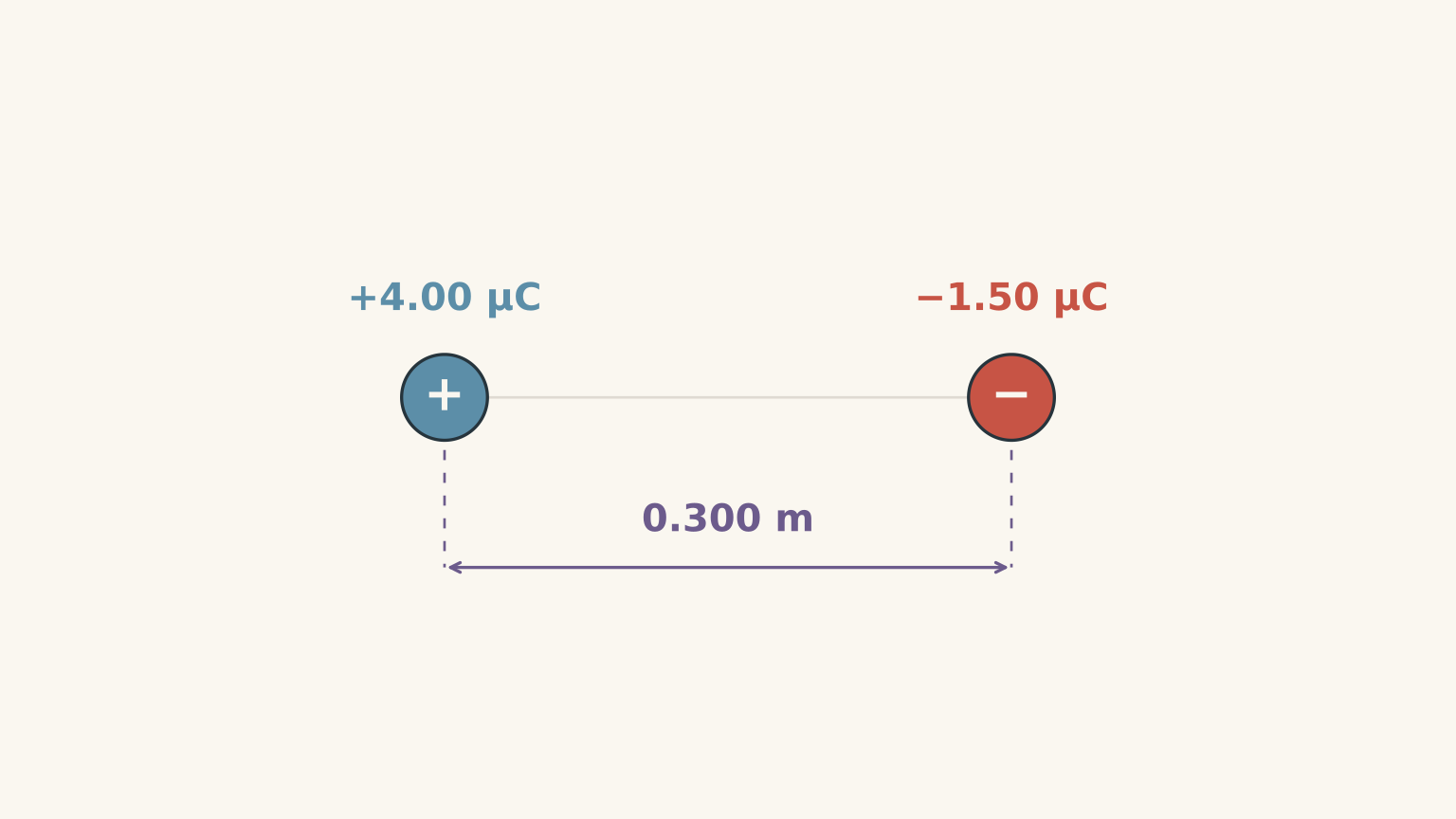
(a) Calculate the magnitude of the electrostatic force acting between the two charges. (2 marks)
(b) State whether the force is attractive or repulsive. State the direction of the force acting on each charge. (2 marks)
(c) The separation between the charges is increased to 0.600 m, with both charge magnitudes remaining unchanged.
Calculate the new magnitude of the electrostatic force. (2 marks)
Question 2 (7 marks)
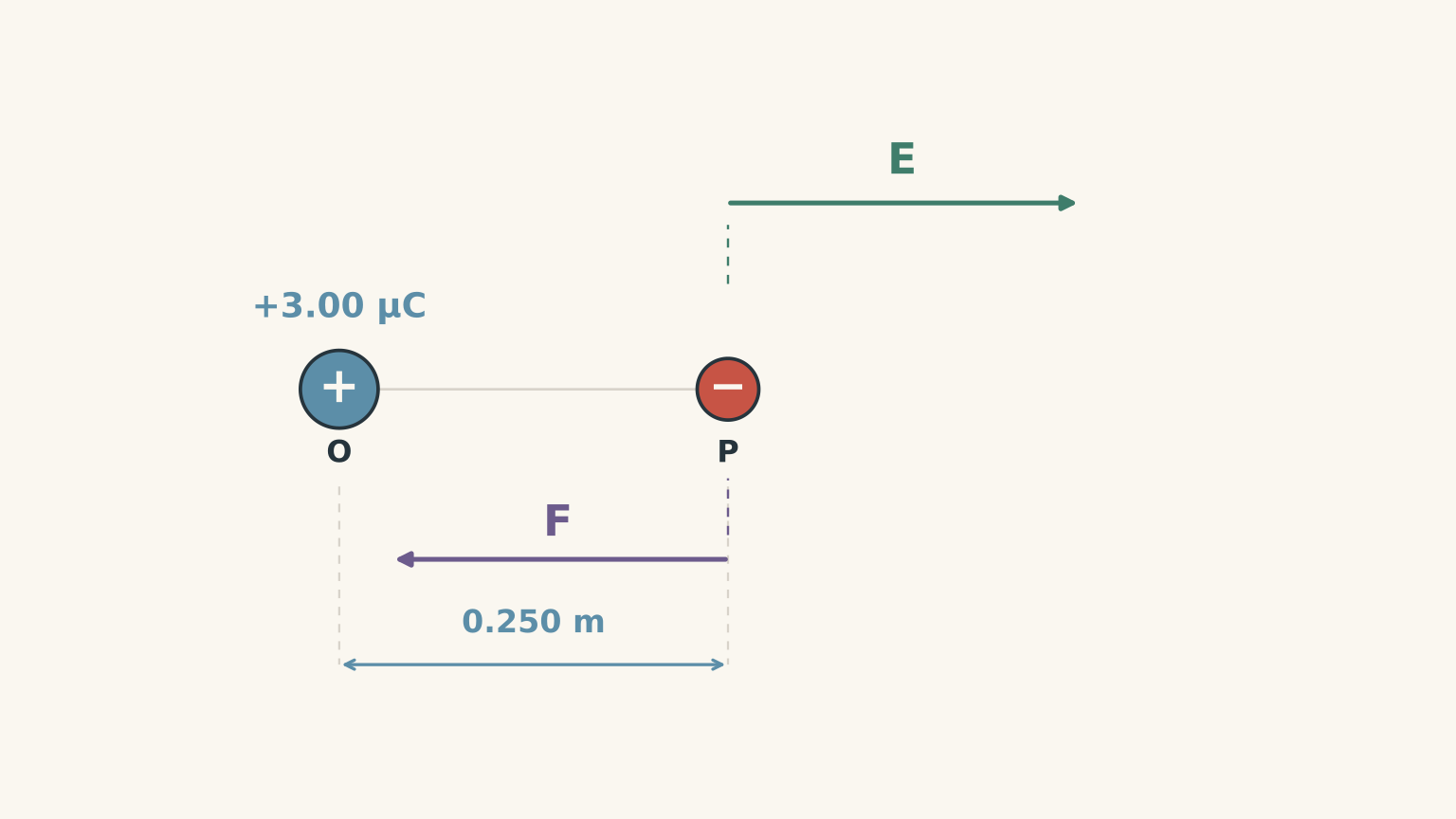
An isolated source charge of \(+3.00\ \mu\mathrm{C}\) is located at point O. Point P is situated 0.250 m to the right of O.
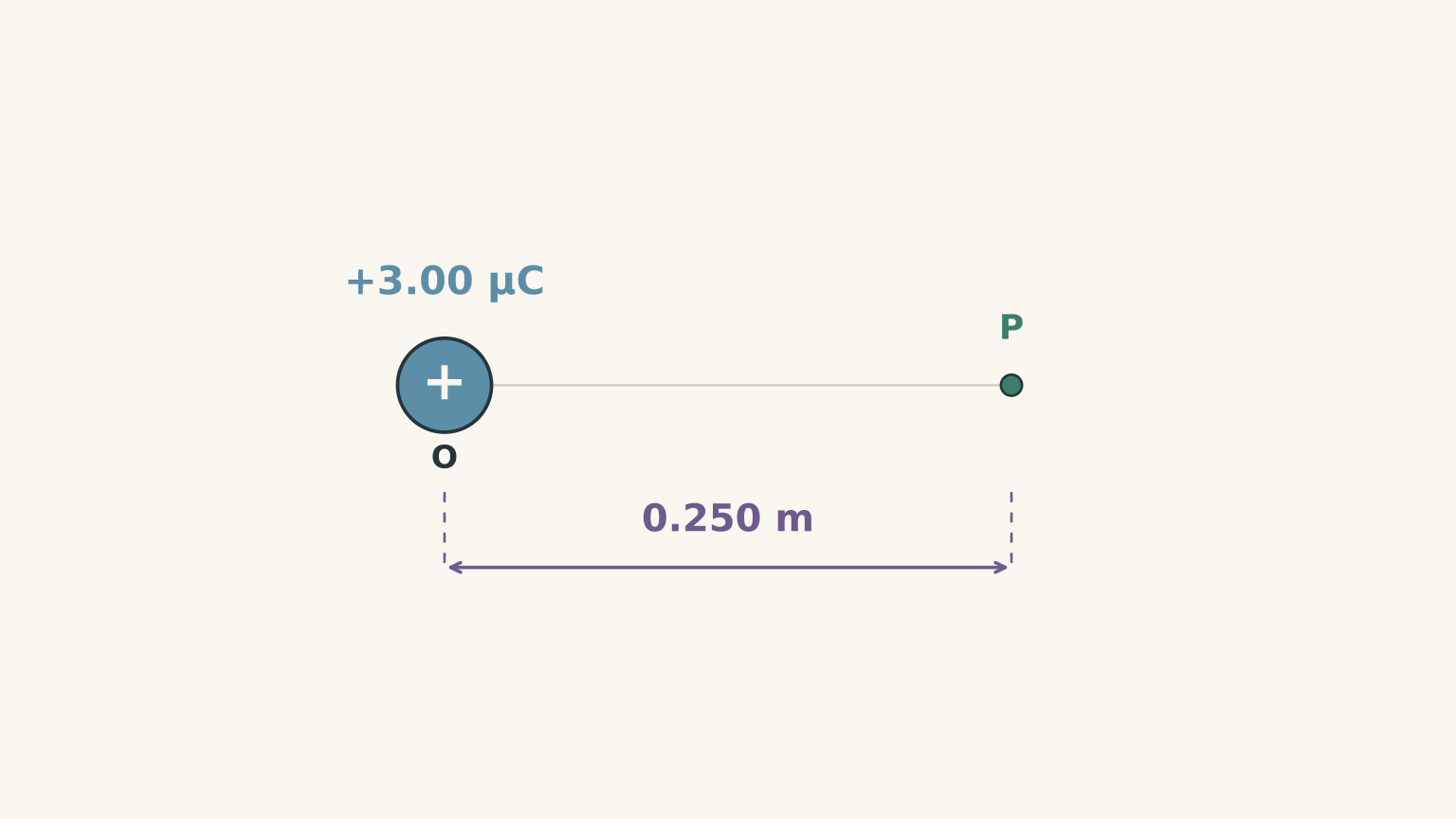
(a) Calculate the magnitude and direction of the electric field at P due to the source charge. (3 marks)
(b) An electron is placed at P.
Calculate the magnitude and direction of the electrostatic force acting on the electron. (2 marks)
(c) Explain why the electric field produced by the source charge does not depend on the charge of the electron, while the force acting on the electron does. (2 marks)
Question 3 (8 marks)
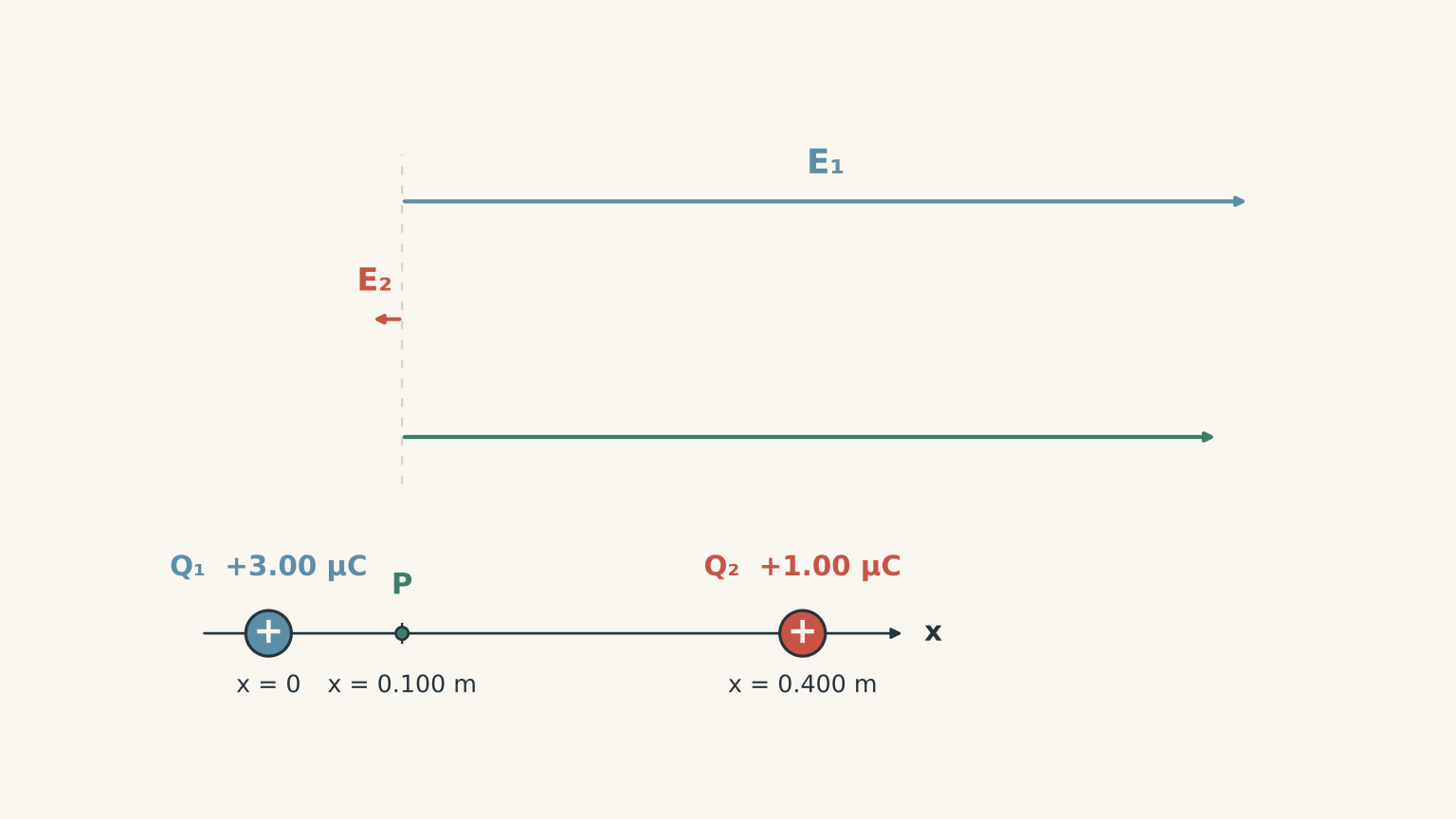
Two positive point charges are positioned along a horizontal x-axis.
- Charge \(Q_1=+3.00\ \mu\mathrm{C}\) is located at \(x=0\).
- Charge \(Q_2=+1.00\ \mu\mathrm{C}\) is located at \(x=0.400\ \mathrm{m}\).
- Point P is located at \(x=0.100\ \mathrm{m}\).
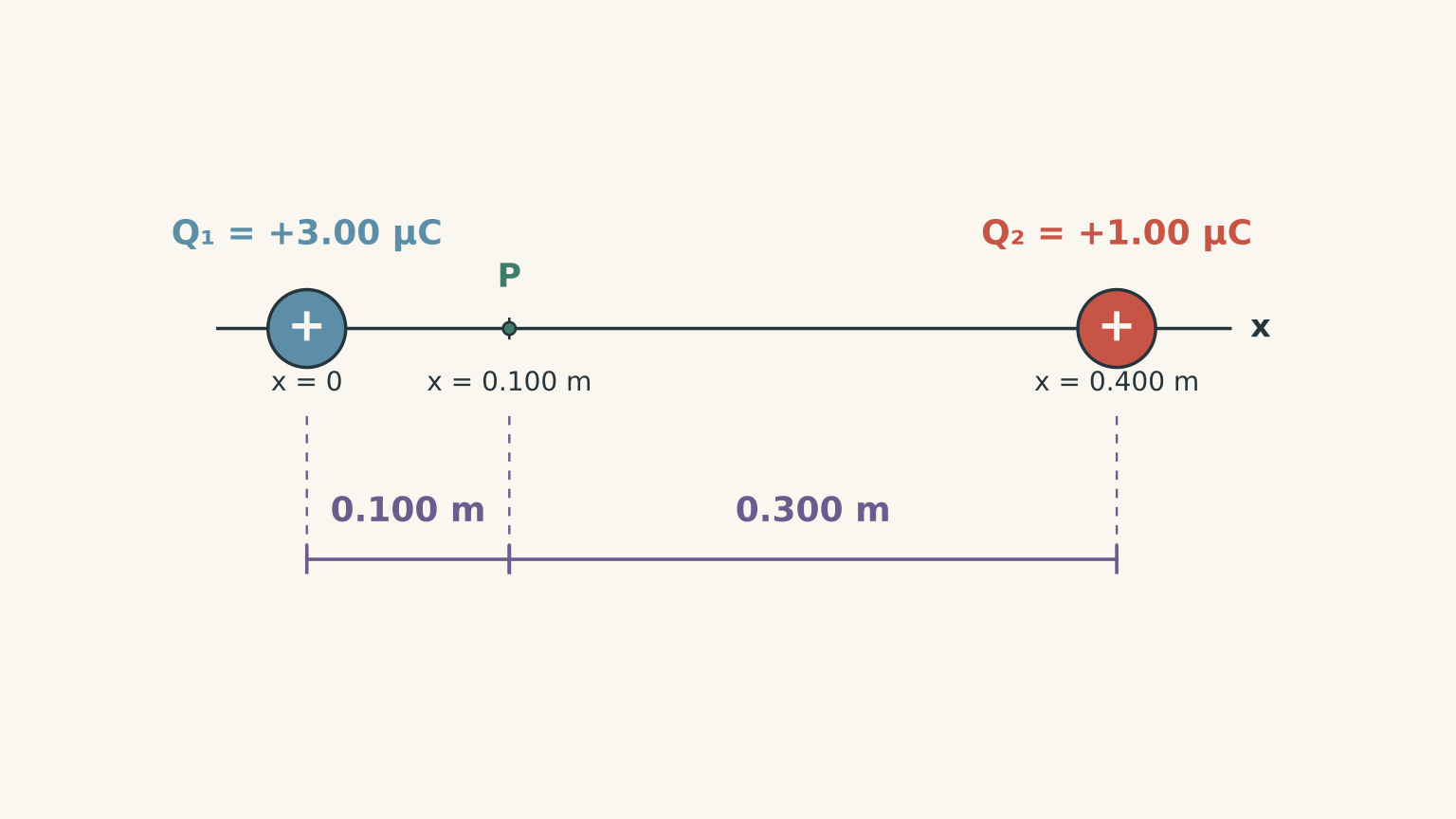
(a) State the direction of the electric field at P due to each source charge separately. (2 marks)
(b) Calculate the magnitude and direction of the resultant electric field at P. (4 marks)
(c) A test charge of \(-2.00\ \mathrm{nC}\) is placed at P.
Calculate the magnitude and direction of the force acting on the test charge. (2 marks)
Question 4 (7 marks)
Electric field-line diagrams provide a way to represent the direction and relative strength of electric fields.
Figure 4A shows the field lines around an isolated point charge Q. Points P and R are located at distances of 0.200 m and 0.400 m from Q, respectively.
Figure 4B shows the electric field-line pattern around two point charges of equal magnitude and opposite sign. Point S is located on the perpendicular bisector of the line joining the charges.
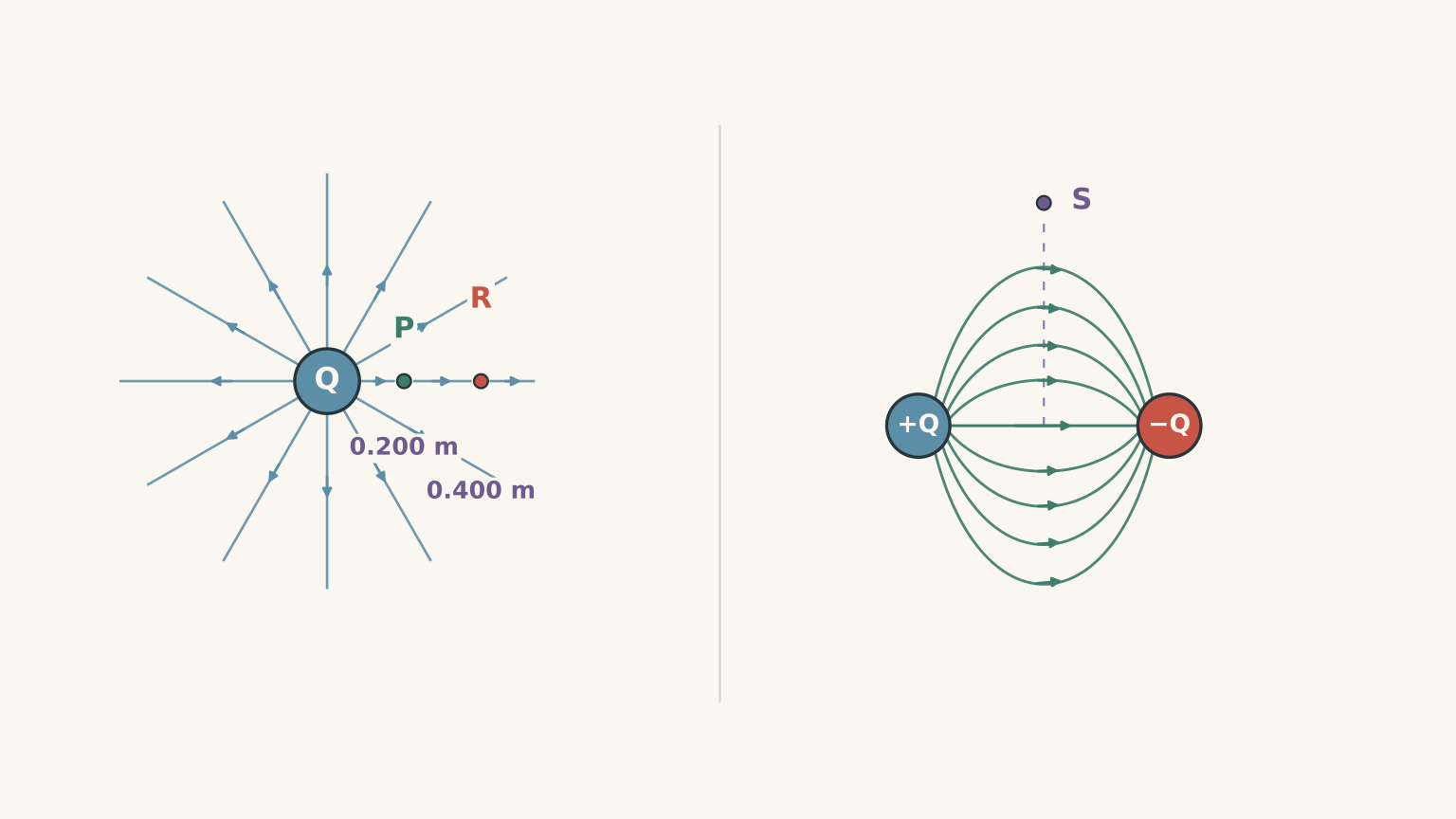
(a) Refer to Figure 4A.
(i) Identify the sign of charge Q. (1 mark)
(ii) Calculate the ratio of electric field strength at P to electric field strength at R.
State which point experiences the stronger electric field. (2 marks)
(iii) Explain what the relative spacing of electric field lines represents. (1 mark)
(b) Refer to Figure 4B.
Determine the direction of the resultant electric field at S.
Explain your answer by considering the electric field contributions from both source charges. (3 marks)
Question 5 (6 marks)
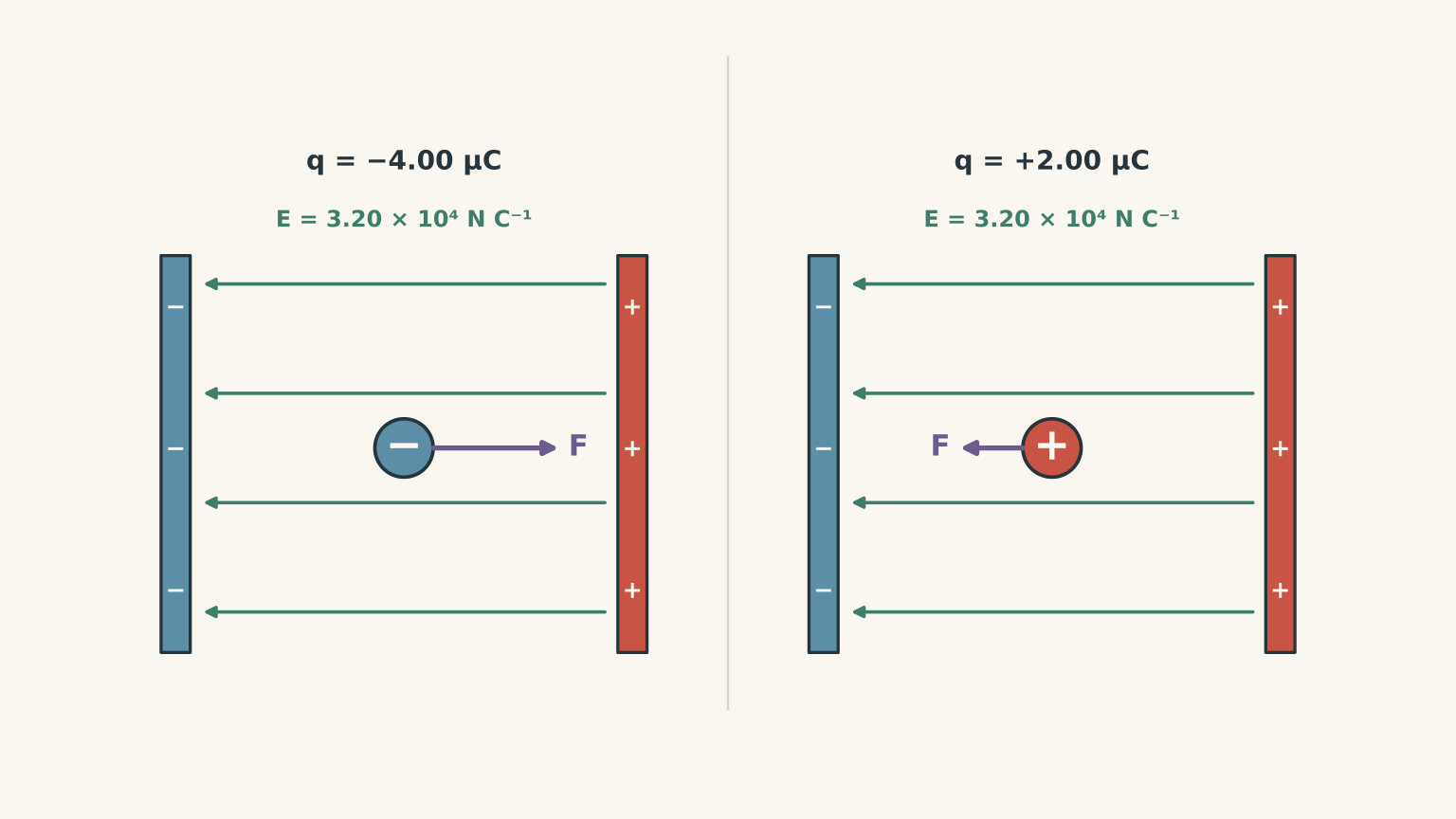
A uniform electric field exists between two parallel plates. The field has a magnitude of \(3.20\times10^4\ \mathrm{N\,C^{-1}}\) and points horizontally to the left.
Point P is located within the uniform field.
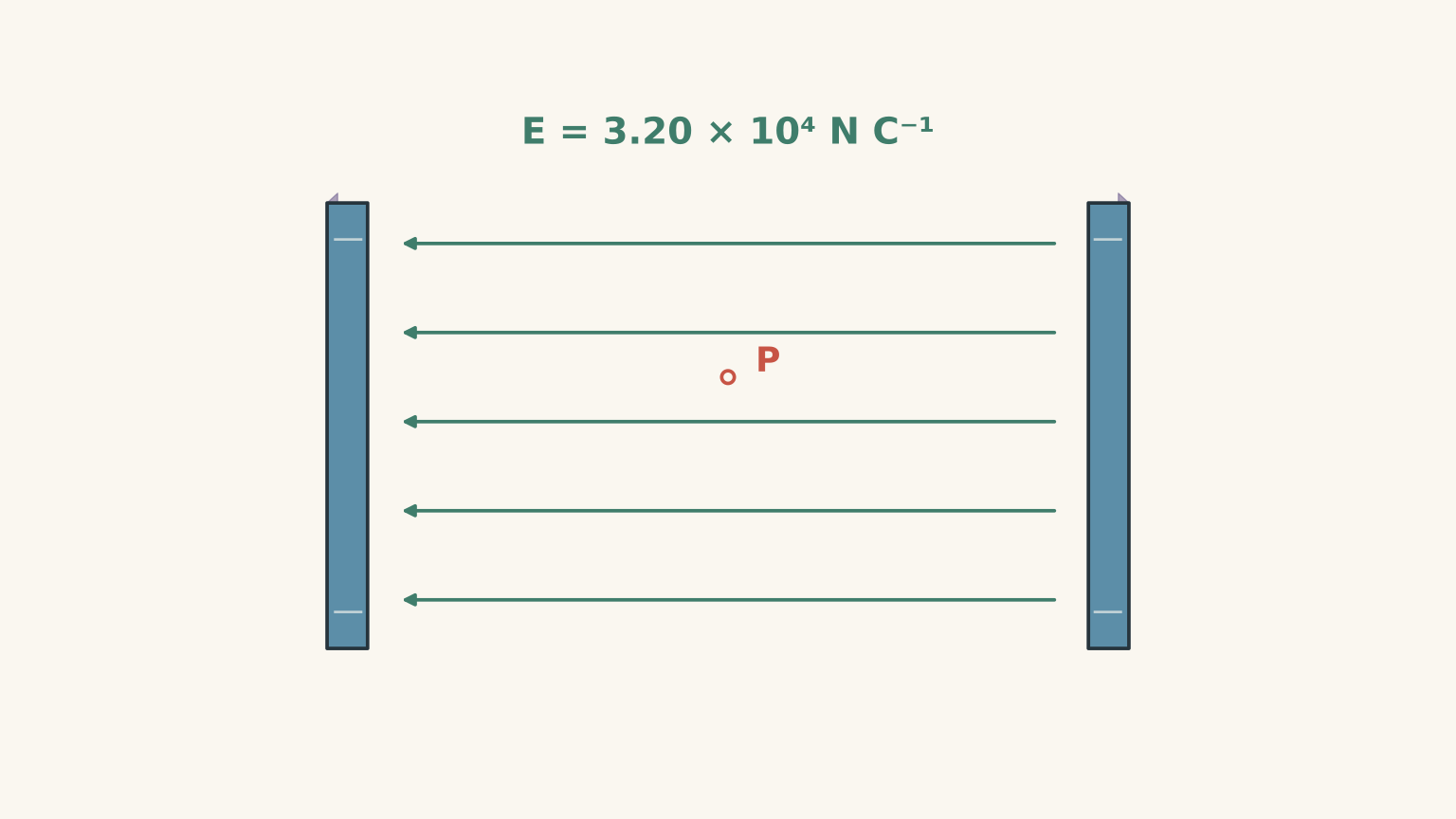
(a) A charge of \(-4.00\ \mu\mathrm{C}\) is placed at P.
Calculate the magnitude of the electrostatic force acting on the charge. (2 marks)
(b) State the direction of the force acting on this charge. (1 mark)
(c) In a separate trial, a charge of \(+2.00\ \mu\mathrm{C}\) is placed at the same point P.
Calculate the magnitude and direction of the force acting on this charge. Compare its force magnitude with that calculated in part (a). (3 marks)
Question 6 (8 marks)
Two stationary point charges, each with a charge of \(+2.00\ \mu\mathrm{C}\), are positioned at points A and B.
Their positions are:
- A: \((0,0)\)
- B: \((0.300,0)\)
- P: \((0,0.400)\)
All coordinates are measured in metres. The distance from B to P is 0.500 m.
Take the positive x-direction as right and the positive y-direction as upwards.
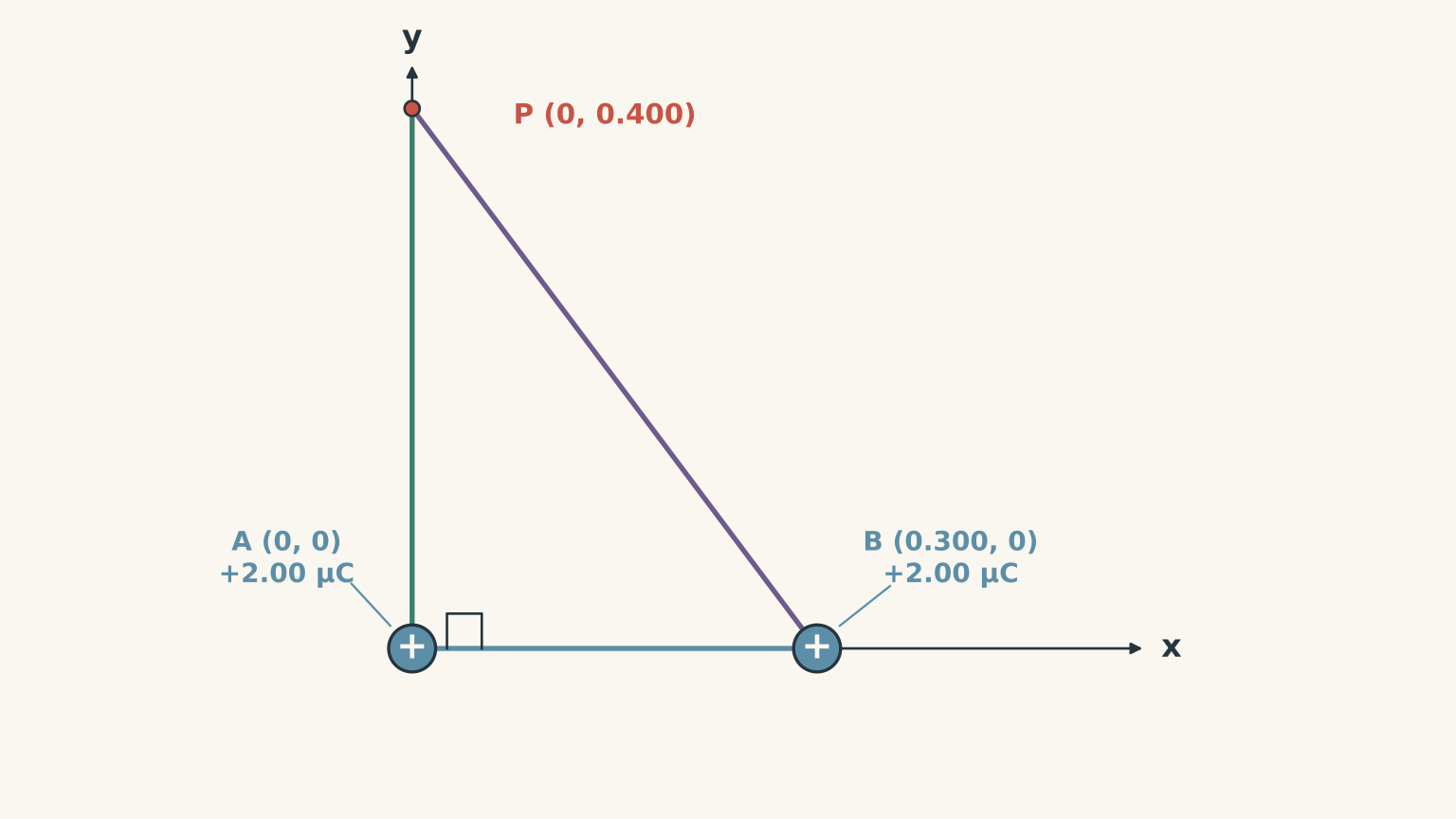
(a) Calculate the magnitude and direction of the electric field at P due to the charge at A. (2 marks)
(b) Calculate the magnitude of the electric field at P due to the charge at B.
Resolve this field into its horizontal and vertical components. (3 marks)
(c) Determine the magnitude and direction of the resultant electric field at P.
Express your direction as an angle west of north. (3 marks)
Question 7 (8 marks)
Two stationary point charges are separated by 0.300 m in air.
Their charges are:
\[ q_1=+5.00\ \mu\mathrm{C} \]
\[ q_2=-2.00\ \mu\mathrm{C} \]
(a) Calculate the initial magnitude of the electrostatic force between the charges. (3 marks)
(b) The arrangement is changed as follows:
- The magnitude of \(q_1\) is doubled.
- The magnitude of \(q_2\) is tripled.
- The separation between the charges is doubled to 0.600 m.
- The charges are now placed in a medium with relative permittivity \(\varepsilon_r=2.00\).
Calculate the new magnitude of the electrostatic force. (3 marks)
(c) Keeping the new charges and separation unchanged, the relative permittivity of the medium is increased from 2.00 to 4.00.
Calculate the resulting force magnitude and explain the effect of this change in medium. (2 marks)
03Worked solutions and marking guide
Solution 1
(a) Calculate the electrostatic force.
Use Coulomb’s law:
\[ F=\frac{k|q_1q_2|}{r^2} \]
Convert the charges into coulombs:
\[ q_1=4.00\times10^{-6}\ \mathrm{C} \]
\[ q_2=-1.50\times10^{-6}\ \mathrm{C} \]
Substitute the values:
\[ \begin{aligned} F&=\frac{8.99\times10^9 |(4.00\times10^{-6})(-1.50\times10^{-6})|} {(0.300)^2}\\ &=\frac{0.05394}{0.0900}\\ &=0.599\ \mathrm{N} \end{aligned} \]
The magnitude of the electrostatic force is:
\[ \boxed{F=0.599\ \mathrm{N}} \]
Marking guide:
- Correct Coulomb’s law relationship and substitution: 1 mark.
- Correct magnitude with units: 1 mark.
(b) Determine the type and direction of the force.
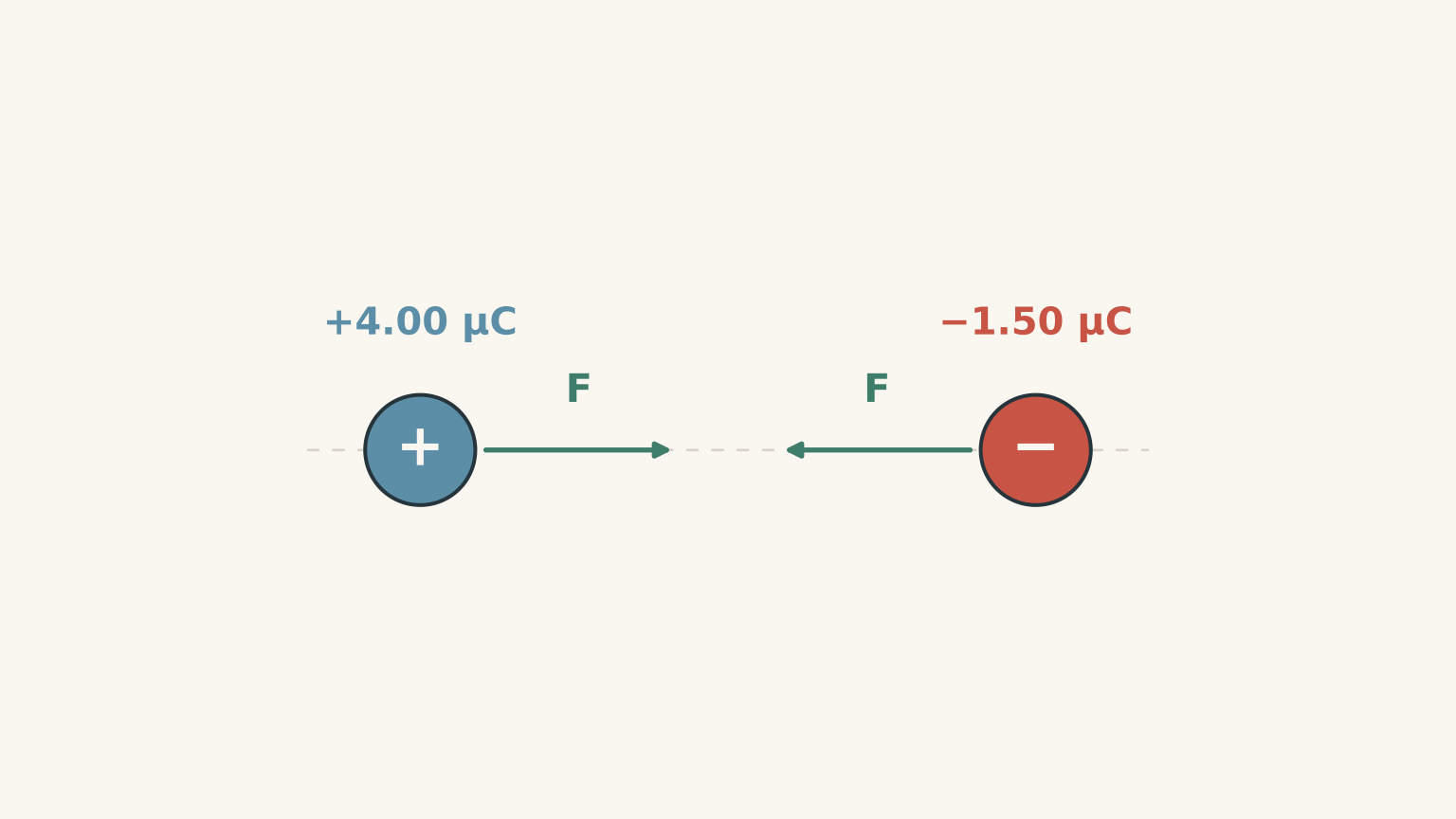
The charges have opposite signs.
Opposite charges attract, so the force is attractive.
- The positive charge experiences a force towards the negative charge.
- The negative charge experiences a force towards the positive charge.
The forces act towards one another along the line joining the charges.
Marking guide:
- Identifies the force as attractive: 1 mark.
- Correct direction of force on both charges: 1 mark.
(c) Calculate the new force when the separation doubles.
The original separation is 0.300 m.
The new separation is 0.600 m.
Coulomb’s law shows that electrostatic force is inversely proportional to the square of separation:
\[ F\propto\frac{1}{r^2} \]
Therefore:
\[ \frac{F_{\mathrm{new}}}{F_{\mathrm{old}}} = \left(\frac{0.300}{0.600}\right)^2 \]
\[ F_{\mathrm{new}}=0.599\times\frac14 \]
\[ \boxed{F_{\mathrm{new}}=0.150\ \mathrm{N}} \]
Doubling the separation reduces the force to one-quarter of its original magnitude.
Marking guide:
- Correct inverse-square relationship and scaling factor: 1 mark.
- Correct new force magnitude: 1 mark.
Total: 6 marks.
Solution 2
(a) Calculate the electric field at P.
The electric field strength due to a point charge is:
\[ E=\frac{k|Q|}{r^2} \]
Here:
- \(Q=+3.00\times10^{-6}\ \mathrm{C}\)
- \(r=0.250\ \mathrm{m}\)
Substitute:
\[ \begin{aligned} E&=\frac{(8.99\times10^9)(3.00\times10^{-6})} {(0.250)^2}\\ &=\frac{26970}{0.0625}\\ &=431520\ \mathrm{N\,C^{-1}} \end{aligned} \]
Therefore:
\[ E=4.32\times10^5\ \mathrm{N\,C^{-1}} \]
The source charge is positive, so its electric field points away from it.
Since P is to the right of O, the field points to the right.
\[ \boxed{E=4.32\times10^5\ \mathrm{N\,C^{-1}}\text{ right}} \]
Marking guide:
- Correct point-charge field equation and substitution: 1 mark.
- Correct field magnitude: 1 mark.
- Correct direction: 1 mark.
(b) Calculate the force on the electron.
The force on a charge in an electric field is:
\[ F=qE \]
For the magnitude:
\[ F=|q|E \]
An electron has a charge of:
\[ q=-1.60\times10^{-19}\ \mathrm{C} \]
Substitute:
\[ \begin{aligned} F&=(1.60\times10^{-19})(4.3152\times10^5)\\ &=6.90432\times10^{-14}\ \mathrm{N} \end{aligned} \]
Therefore, the force magnitude is:
\[ F=6.90\times10^{-14}\ \mathrm{N} \]
The electron is negatively charged, so its force acts in the opposite direction to the electric field.
The field points right, so the force points left.
\[ \boxed{F=6.90\times10^{-14}\ \mathrm{N}\text{ left}} \]
Marking guide:
- Correct force magnitude: 1 mark.
- Correct force direction, accounting for the negative charge: 1 mark.
(c) Explain the difference between electric field and force.
The electric field at a location is determined by the source charge and its distance from that location.
For a point source charge:
\[ E=\frac{k|Q|}{r^2} \]
The test charge does not appear in this equation. Therefore, changing the test charge does not change the electric field produced by the source charge.
However, the force depends on the test charge:
\[ F=qE \]
A larger test charge experiences a proportionally larger force in the same field. Changing the sign of the test charge also reverses the force direction.
Marking guide:
- Explains that the source charge and position determine the electric field, independently of the test charge: 1 mark.
- Explains that force depends on the test charge through \(F=qE\): 1 mark.
Total: 7 marks.
Solution 3
(a) Determine the field directions at P.
Both source charges are positive.
Electric fields point away from positive source charges.
Consider each charge separately.
- The field due to \(Q_1\) points to the right because P is to the right of \(Q_1\).
- The field due to \(Q_2\) points to the left because P is to the left of \(Q_2\).
The two contributions therefore act in opposite directions.
Marking guide:
- Correct direction due to \(Q_1\): 1 mark.
- Correct direction due to \(Q_2\): 1 mark.
(b) Calculate the resultant electric field.
First calculate the field due to each source charge.
For \(Q_1\):
\[ E_1=\frac{k|Q_1|}{r_1^2} \]
The distance from \(Q_1\) to P is 0.100 m.
\[ \begin{aligned} E_1&=\frac{(8.99\times10^9)(3.00\times10^{-6})} {(0.100)^2}\\ &=2.697\times10^6\ \mathrm{N\,C^{-1}} \end{aligned} \]
This field points right.
For \(Q_2\):
\[ E_2=\frac{k|Q_2|}{r_2^2} \]
The distance from \(Q_2\) to P is 0.300 m.
\[ \begin{aligned} E_2&=\frac{(8.99\times10^9)(1.00\times10^{-6})} {(0.300)^2}\\ &=9.99\times10^4\ \mathrm{N\,C^{-1}} \end{aligned} \]
This field points left.
The two fields point in opposite directions, so subtract their magnitudes:
\[ E_{\mathrm{net}}=E_1-E_2 \]
\[ \begin{aligned} E_{\mathrm{net}} &=2.697\times10^6-9.9889\times10^4\\ &=2.5971\times10^6\ \mathrm{N\,C^{-1}} \end{aligned} \]
The larger contribution is from \(Q_1\), so the resultant field points right.
\[ \boxed{E_{\mathrm{net}}=2.60\times10^6\ \mathrm{N\,C^{-1}}\text{ right}} \]
Marking guide:
- Correct distances used for both source charges: 1 mark.
- Correct magnitude of \(E_1\): 1 mark.
- Correct magnitude of \(E_2\): 1 mark.
- Correct vector combination, resultant magnitude and direction: 1 mark.
(c) Calculate the force on the negative test charge.
Use:
\[ F=qE \]
For the magnitude:
\[ F=|q|E_{\mathrm{net}} \]
Substitute:
\[ \begin{aligned} F&=(2.00\times10^{-9})(2.5971\times10^6)\\ &=5.1942\times10^{-3}\ \mathrm{N} \end{aligned} \]
Therefore:
\[ F=5.19\times10^{-3}\ \mathrm{N} \]
The resultant electric field points right.
The test charge is negative, so the force acts in the opposite direction.
\[ \boxed{F=5.19\times10^{-3}\ \mathrm{N}\text{ left}} \]
Marking guide:
- Correct application of \(F=|q|E\): 1 mark.
- Correct force magnitude and direction: 1 mark.
Total: 8 marks.
Solution 4
(a) Interpret Figure 4A.
(i) Identify the sign of Q.
The electric field lines point outwards from Q.
Electric field lines point away from positive charges and towards negative charges.
Therefore:
\[ \boxed{Q\text{ is positive}} \]
Marking guide:
- Correct identification of a positive charge: 1 mark.
(ii) Compare the electric field strengths at P and R.
For a point charge:
\[ E=\frac{k|Q|}{r^2} \]
The source charge is unchanged, so:
\[ E\propto\frac{1}{r^2} \]
The distances are:
\[ r_P=0.200\ \mathrm{m} \]
\[ r_R=0.400\ \mathrm{m} \]
The ratio is:
\[ \frac{E_P}{E_R} = \frac{r_R^2}{r_P^2} \]
Substitute:
\[ \begin{aligned} \frac{E_P}{E_R} &=\left(\frac{0.400}{0.200}\right)^2\\ &=2^2\\ &=4 \end{aligned} \]
Therefore:
\[ \boxed{E_P:E_R=4:1} \]
The electric field at P is four times stronger than at R.
Marking guide:
- Correct inverse-square relationship: 1 mark.
- Correct ratio and identification of the stronger field: 1 mark.
(iii) Explain what field-line spacing represents.
The spacing of electric field lines represents relative electric field strength.
- Closely spaced field lines indicate a stronger electric field.
- Widely spaced field lines indicate a weaker electric field.
Marking guide:
- Correctly relates closer spacing to greater field strength: 1 mark.
(b) Determine the resultant field direction at S in Figure 4B.
The two charges have equal magnitudes and opposite signs.
Consider the electric field contribution from each charge separately.
At S:
- The field due to the positive charge points away from that charge, diagonally upwards and to the right.
- The field due to the negative charge points towards that charge, diagonally downwards and to the right.
Because S is equidistant from both charges, and the charges have equal magnitudes, the two field contributions have equal magnitudes.
Their vertical components cancel.
Their horizontal components both point to the right, so they add together.
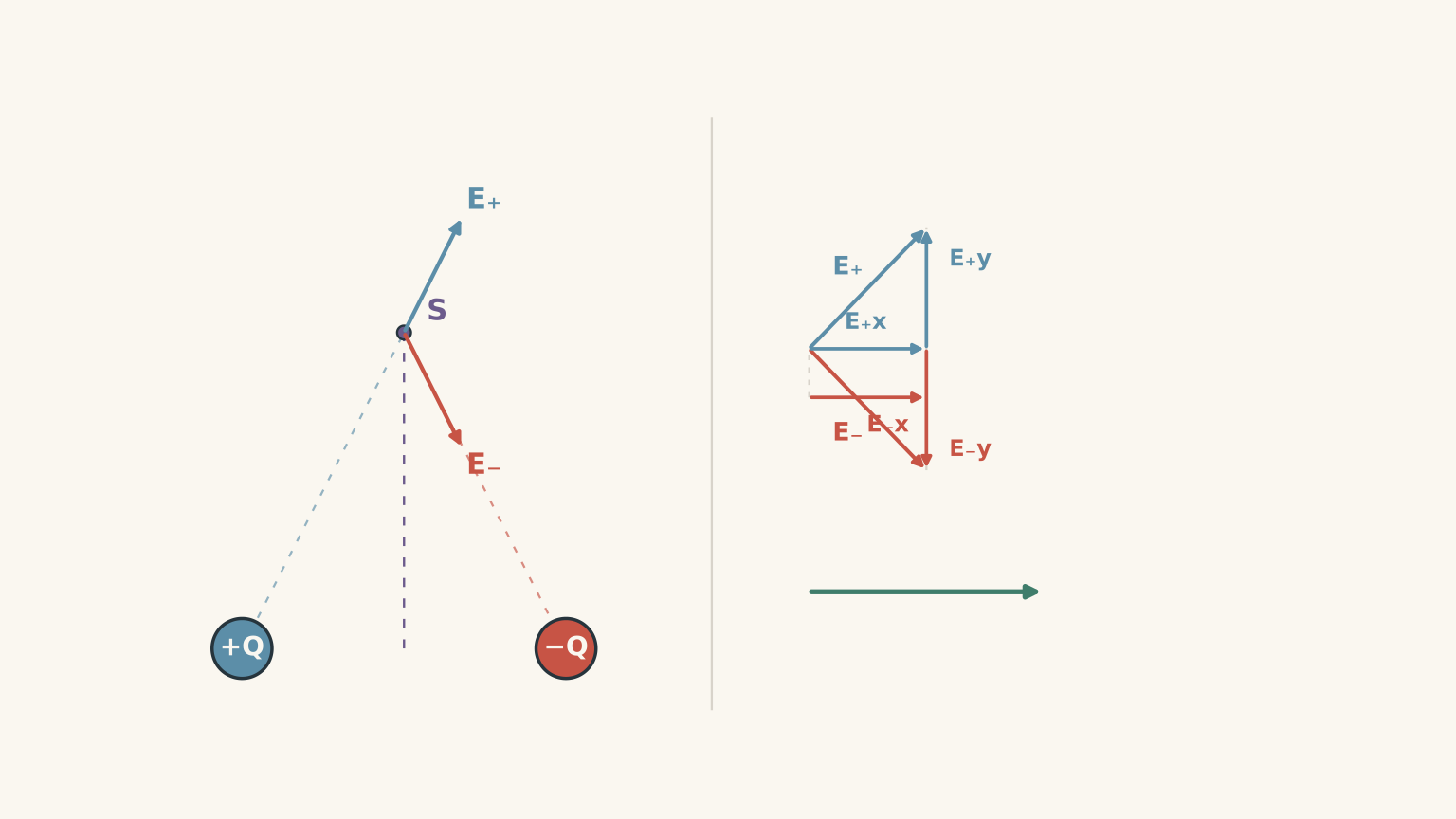
Therefore, the resultant electric field at S points horizontally from the positive charge towards the negative charge.
\[ \boxed{\text{Resultant field points to the right}} \]
Marking guide:
- Correct resultant direction: 1 mark.
- Correct directions of the individual field contributions: 1 mark.
- Explains cancellation of vertical components and addition of horizontal components: 1 mark.
Total: 7 marks.
Solution 5
(a) Calculate the force on the negative charge.
The force on a charge in an electric field is:
\[ F=qE \]
For the magnitude:
\[ F=|q|E \]
Given:
\[ |q|=4.00\times10^{-6}\ \mathrm{C} \]
\[ E=3.20\times10^4\ \mathrm{N\,C^{-1}} \]
Substitute:
\[ \begin{aligned} F&=(4.00\times10^{-6})(3.20\times10^4)\\ &=0.128\ \mathrm{N} \end{aligned} \]
Therefore:
\[ \boxed{F=0.128\ \mathrm{N}} \]
Marking guide:
- Correct relationship and substitution: 1 mark.
- Correct force magnitude: 1 mark.
(b) Determine the force direction.
The electric field points left.
A negative charge experiences a force in the opposite direction to the electric field.
Therefore:
\[ \boxed{\text{Force points right}} \]
Marking guide:
- Correctly identifies the opposite direction: 1 mark.
(c) Calculate and compare the force on the positive charge.
The second charge is:
\[ q_2=+2.00\times10^{-6}\ \mathrm{C} \]
Calculate the force magnitude:
\[ F_2=|q_2|E \]
\[ \begin{aligned} F_2&=(2.00\times10^{-6})(3.20\times10^4)\\ &=0.0640\ \mathrm{N} \end{aligned} \]
The second charge is positive, so its force acts in the same direction as the electric field.
Therefore:
\[ \boxed{F_2=0.0640\ \mathrm{N}\text{ left}} \]
Compare the two magnitudes:
\[ \frac{F_2}{F_1} = \frac{0.0640}{0.128} =0.500 \]
The positive charge experiences half the force magnitude of the negative charge.
The two forces act in opposite directions.
Marking guide:
- Correct force magnitude of 0.0640 N: 1 mark.
- Correct direction, left: 1 mark.
- Correct comparison: half the magnitude of the first force: 1 mark.
Total: 6 marks.
Solution 6
(a) Calculate the electric field due to charge A.
Use the point-charge electric field equation:
\[ E_A=\frac{k|Q_A|}{r_A^2} \]
The charge at A is:
\[ Q_A=2.00\times10^{-6}\ \mathrm{C} \]
The distance from A to P is:
\[ r_A=0.400\ \mathrm{m} \]
Substitute:
\[ \begin{aligned} E_A&=\frac{(8.99\times10^9)(2.00\times10^{-6})} {(0.400)^2}\\ &=\frac{17980}{0.160}\\ &=112375\ \mathrm{N\,C^{-1}} \end{aligned} \]
Therefore:
\[ E_A=1.12\times10^5\ \mathrm{N\,C^{-1}} \]
Since the charge at A is positive, its field points away from A.
Point P is directly above A, so the field points vertically upwards.
\[ \boxed{E_A=1.12\times10^5\ \mathrm{N\,C^{-1}}\text{ upwards}} \]
Marking guide:
- Correct field magnitude: 1 mark.
- Correct direction: 1 mark.
(b) Calculate and resolve the electric field due to charge B.
First calculate the magnitude of the field.
The distance from B to P is 0.500 m.
\[ E_B=\frac{k|Q_B|}{r_B^2} \]
Substitute:
\[ \begin{aligned} E_B&=\frac{(8.99\times10^9)(2.00\times10^{-6})} {(0.500)^2}\\ &=\frac{17980}{0.250}\\ &=71920\ \mathrm{N\,C^{-1}} \end{aligned} \]
Therefore:
\[ \boxed{E_B=7.19\times10^4\ \mathrm{N\,C^{-1}}} \]
Now determine its direction.
Because B is positively charged, the field at P points away from B.
From B to P, the horizontal displacement is 0.300 m to the left, and the vertical displacement is 0.400 m upwards.
The direction ratios are therefore:
\[ \frac{E_{Bx}}{E_B}=-\frac{0.300}{0.500}=-0.600 \]
\[ \frac{E_{By}}{E_B}=\frac{0.400}{0.500}=0.800 \]
Resolve the field into components.
Horizontal component:
\[ \begin{aligned} E_{Bx}&=(-0.600)(71920)\\ &=-43152\ \mathrm{N\,C^{-1}} \end{aligned} \]
Vertical component:
\[ \begin{aligned} E_{By}&=(0.800)(71920)\\ &=57536\ \mathrm{N\,C^{-1}} \end{aligned} \]
Therefore:
\[ \boxed{E_{Bx}=-4.32\times10^4\ \mathrm{N\,C^{-1}}} \]
\[ \boxed{E_{By}=+5.75\times10^4\ \mathrm{N\,C^{-1}}} \]
The negative horizontal component indicates leftwards, while the positive vertical component indicates upwards.
Marking guide:
- Correct field magnitude: 1 mark.
- Correct direction ratios or vector direction: 1 mark.
- Correct horizontal and vertical components, including signs: 1 mark.
(c) Calculate the resultant electric field.
Electric fields are vectors, so their components must be added separately.
For the horizontal components:
\[ E_x=E_{Ax}+E_{Bx} \]
The field from A has no horizontal component.
Therefore:
\[ E_x=-43152\ \mathrm{N\,C^{-1}} \]
For the vertical components:
\[ E_y=E_{Ay}+E_{By} \]
\[ \begin{aligned} E_y&=112375+57536\\ &=169911\ \mathrm{N\,C^{-1}} \end{aligned} \]
The resultant field therefore has components:
\[ E_x=-4.32\times10^4\ \mathrm{N\,C^{-1}} \]
\[ E_y=+1.70\times10^5\ \mathrm{N\,C^{-1}} \]
Calculate its magnitude using Pythagoras’ theorem:
\[ E_{\mathrm{net}}=\sqrt{E_x^2+E_y^2} \]
\[ \begin{aligned} E_{\mathrm{net}} &=\sqrt{(-43152)^2+(169911)^2}\\ &=175305\ \mathrm{N\,C^{-1}} \end{aligned} \]
Therefore:
\[ E_{\mathrm{net}}=1.75\times10^5\ \mathrm{N\,C^{-1}} \]
Now calculate the direction.
The resultant points upwards and to the left, so measure the angle west of north:
\[ \tan\theta=\frac{|E_x|}{E_y} \]
\[ \theta=\tan^{-1}\left(\frac{43152}{169911}\right) \]
\[ \theta=14.3^\circ \]
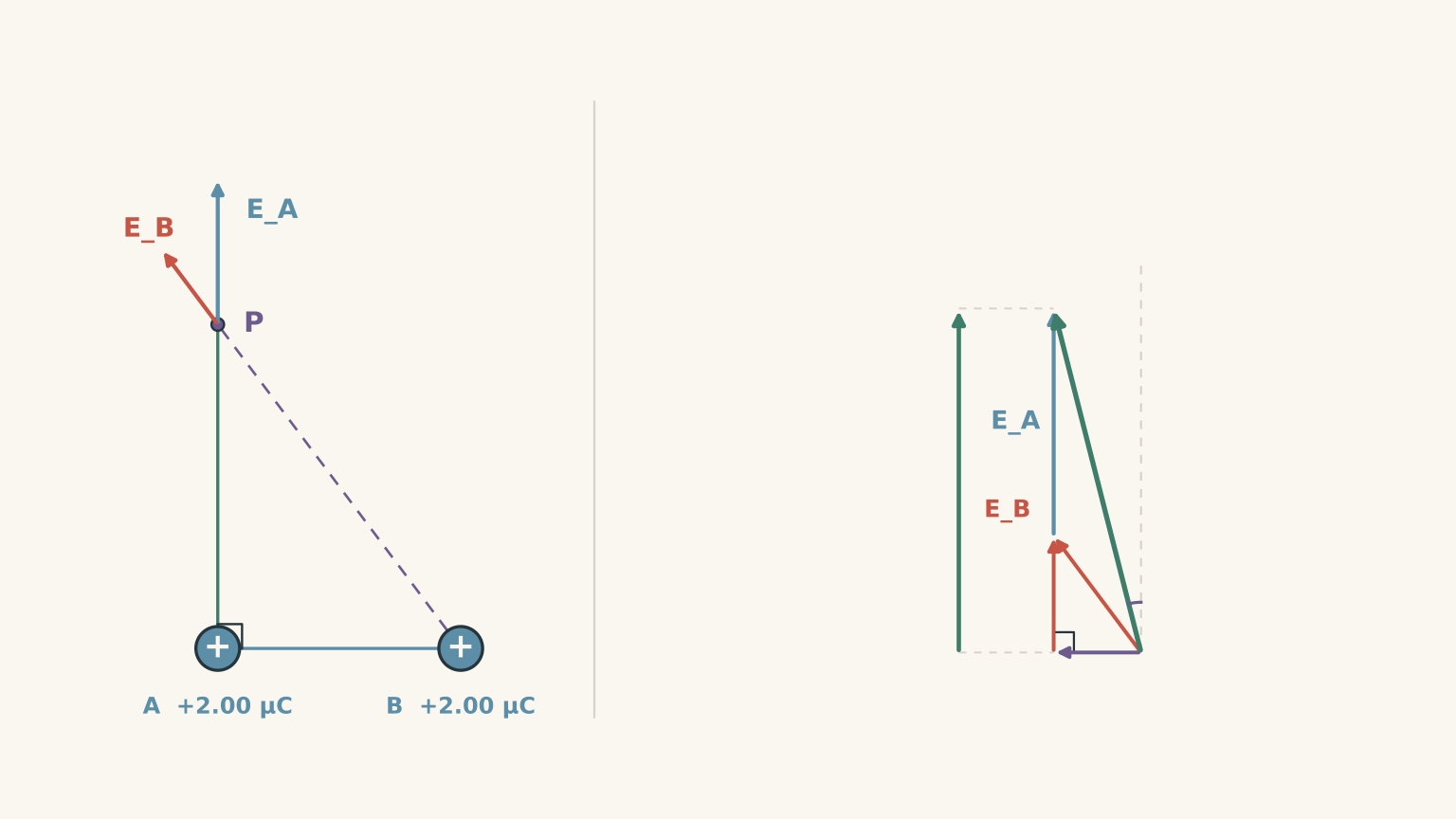
The final answer is:
\[ \boxed{ E_{\mathrm{net}}=1.75\times10^5\ \mathrm{N\,C^{-1}} } \]
\[ \boxed{14.3^\circ\text{ west of north}} \]
Marking guide:
- Correct addition of horizontal and vertical components: 1 mark.
- Correct resultant magnitude: 1 mark.
- Correct angle and direction: 1 mark.
Total: 8 marks.
Solution 7
(a) Calculate the initial electrostatic force.
Use Coulomb’s law:
\[ F=\frac{k|q_1q_2|}{r^2} \]
Convert the charges:
\[ q_1=5.00\times10^{-6}\ \mathrm{C} \]
\[ q_2=-2.00\times10^{-6}\ \mathrm{C} \]
The separation is:
\[ r=0.300\ \mathrm{m} \]
Substitute:
\[ \begin{aligned} F&=\frac{(8.99\times10^9) |(5.00\times10^{-6})(-2.00\times10^{-6})|} {(0.300)^2}\\ &=\frac{0.0899}{0.0900}\\ &=0.9989\ \mathrm{N} \end{aligned} \]
Therefore:
\[ \boxed{F=0.999\ \mathrm{N}} \]
Marking guide:
- Correct Coulomb’s law relationship: 1 mark.
- Correct substitution using SI units: 1 mark.
- Correct force magnitude: 1 mark.
(b) Calculate the new electrostatic force.
There are three changes to consider.
First, the magnitude of the first charge doubles:
\[ |q_1'|=2|q_1| \]
Second, the magnitude of the second charge triples:
\[ |q_2'|=3|q_2| \]
Together, these changes multiply the product of the charge magnitudes by six:
\[ |q_1'q_2'|=6|q_1q_2| \]
Third, the separation doubles:
\[ r'=2r \]
Because separation is squared in the denominator, doubling it reduces the force by a factor of four.
Finally, the relative permittivity is 2.00, which reduces the force by a further factor of two compared with air.
We can combine these changes using the ratio:
\[ \frac{F'}{F} = \frac{2\times3}{2.00\times2^2} \]
\[ \frac{F'}{F}=\frac{6}{8}=0.750 \]
Therefore:
\[ F'=0.750F \]
Using the original force:
\[ \begin{aligned} F'&=0.750(0.9989)\\ &=0.7492\ \mathrm{N} \end{aligned} \]
The new force magnitude is:
\[ \boxed{F'=0.749\ \mathrm{N}} \]
Notice that increasing the charges does not automatically increase the final force. The increased separation and the change in medium must also be considered.
Marking guide:
- Correct combined charge factor of 6: 1 mark.
- Correct treatment of squared separation and relative permittivity: 1 mark.
- Correct new force magnitude: 1 mark.
(c) Calculate the force when relative permittivity increases to 4.00.
The new charges and separation remain unchanged.
The only change is:
\[ \varepsilon_r:2.00\longrightarrow4.00 \]
From the supplied relationship:
\[ F\propto\frac{1}{\varepsilon_r} \]
Doubling the relative permittivity halves the electrostatic force.
Therefore:
\[ F_{\mathrm{new}}=\frac{0.7492}{2} \]
\[ \boxed{F_{\mathrm{new}}=0.375\ \mathrm{N}} \]
The force decreases because a medium with a greater relative permittivity produces a smaller electrostatic force between the same charges at the same separation.
Marking guide:
- Correct inverse relationship between force and relative permittivity: 1 mark.
- Correct new force magnitude: 1 mark.
Total: 8 marks.
04Final mark summary
| Question | Assessed content | Marks |
|---|---|---|
| 1 | Coulomb’s law, charge interaction and separation | 6 |
| 2 | Point-charge electric field and force on an electron | 7 |
| 3 | Superposition of electric fields along a line | 8 |
| 4 | Electric field-line diagrams and dipole superposition | 7 |
| 5 | Force on positive and negative charges in an electric field | 6 |
| 6 | Two-dimensional electric field superposition | 8 |
| 7 | Charge magnitude, separation and medium | 8 |
| Total | 50 |
Marking notes:
- Award method marks where a correct approach is demonstrated, even if an earlier arithmetic error affects the final answer.
- Accept mathematically equivalent vector methods and correctly expressed directions.
- Apply follow-through marking where a later calculation correctly uses an earlier incorrect numerical result.
- Accept equivalent direction descriptions, such as leftwards instead of westwards.
- Numerical answers should be consistent with the stated significant figures and include units.
The most important skill across this paper is keeping the source charges, the electric field they produce, and the force on a separate test charge distinct. When several source charges are present, calculate their individual field contributions before combining them as vectors.“`