
Energy Profiles and Bonding: Chemistry Practice Exam
Test your understanding of energy profiles and bonding with this original 40-mark Chemistry 2017 practice exam. Includes timed questions, complete worked solutions, and a detailed marking guide.
This original tutorgum practice paper assesses the Chemistry 2017 syllabus scope on energy profiles and bonding. It covers activation energy, enthalpy changes in forward and reverse reactions, catalysts, temperature changes during combustion and ionic dissociation, and the energy absorbed or released when bonds break and form.
This is a focused topic assessment, not a full-course HSC Chemistry examination or an official NESA paper. All questions, data, and solutions are original.
01Exam instructions
| Assessment detail | Conditions |
|---|---|
| Suggested working time | 60 minutes |
| Reading time | 5 minutes |
| Total marks | 40 |
| Permitted equipment | Scientific calculator, ruler, pencil, and eraser |
| Working | Show calculations and include appropriate units |
| Numerical answers | Use appropriate precision |
Assessed content
This paper covers the following Chemistry 2017 syllabus content:
- Energy profile diagrams, including reactant and product enthalpy levels, activation energy, and enthalpy change.
- Calculating activation energies in both forward and reverse reactions.
- Endothermic and exothermic reactions, including temperature changes during combustion and ionic dissociation in aqueous solution.
- Catalysts providing an alternative reaction pathway with lower activation energy, without changing overall enthalpy change.
- Energy absorbed during bond breaking and energy released during bond formation.
Other Chemistry modules and syllabus editions are excluded. Quantitative calorimetry calculations using specific heat capacity, numerical bond enthalpy calculations, and detailed catalytic mechanisms are not assessed.
02Questions
Question 1 (5 marks)
A reaction proceeds from reactants R to products P. The enthalpy values at three points on its energy profile are provided below.
| Position on energy profile | Enthalpy (kJ mol⁻¹) |
|---|---|
| Reactants, R | 125 |
| Products, P | 45 |
| Transition state (highest point) | 205 |
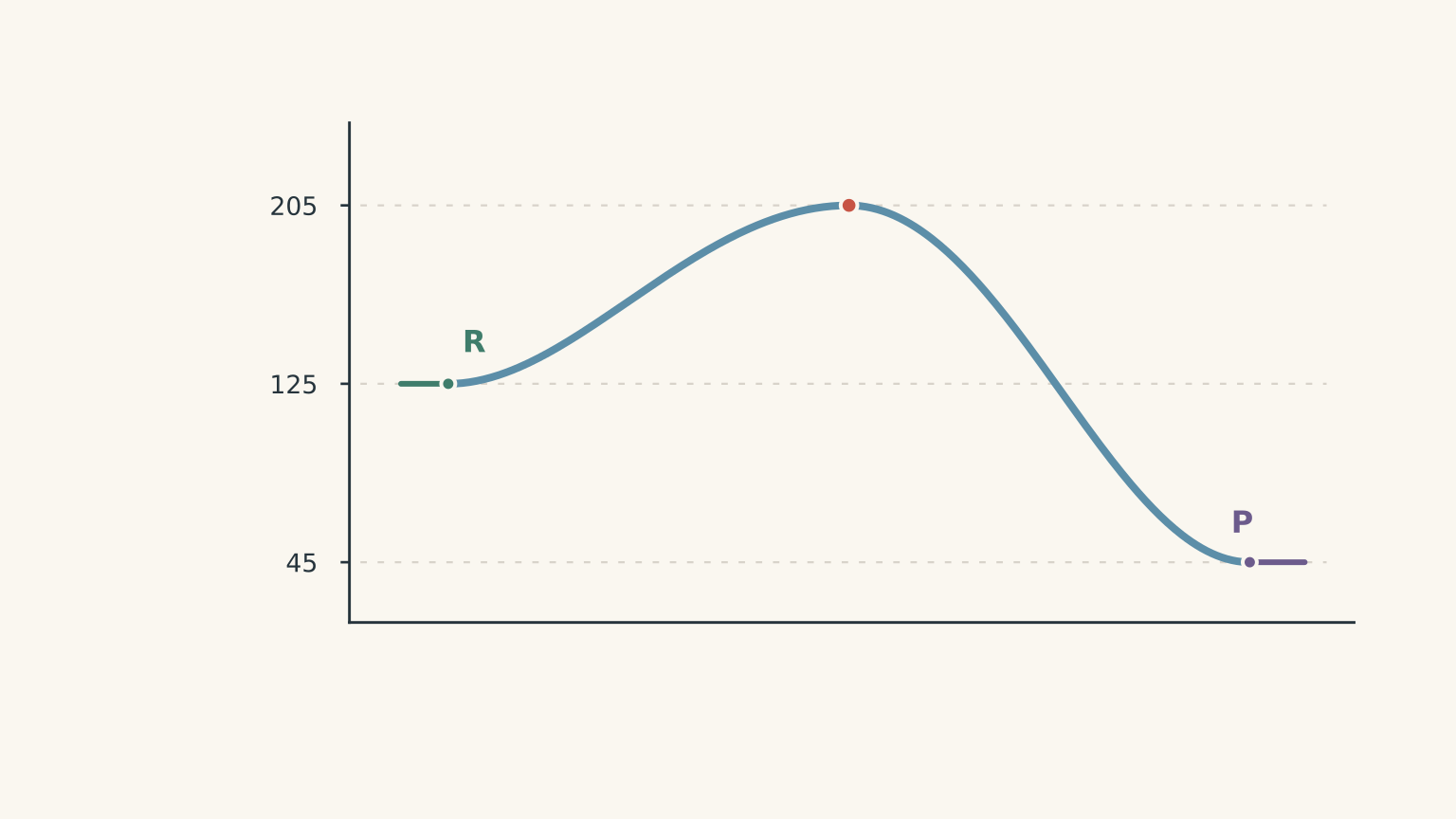
(a) Calculate the activation energy of the forward reaction. (1 mark)
(b) Calculate the enthalpy change, ΔH, for the forward reaction. Include the correct sign. (2 marks)
(c) Calculate the activation energy of the reverse reaction. (1 mark)
(d) Classify the forward reaction as endothermic or exothermic. (1 mark)
Question 2 (7 marks)
A reaction proceeds from reactants A to products B.
The following information is provided:
- Enthalpy of reactants A = 70 kJ mol⁻¹
- Enthalpy of products B = 150 kJ mol⁻¹
- Forward activation energy = 95 kJ mol⁻¹

(a) Construct an energy profile diagram for the forward reaction. Your diagram must include:
- Reactant and product enthalpy levels.
- The transition-state peak.
- The forward activation energy, correctly labelled.
- The enthalpy change, correctly labelled with its sign.
(4 marks)
(b) Calculate the activation energy of the reverse reaction. Show your working. (2 marks)
(c) Classify the forward reaction as endothermic or exothermic. (1 mark)
Question 3 (9 marks)
A chemist investigates the effect of a catalyst on a reaction.
The measured activation energies are shown below.
| Reaction pathway | Forward activation energy (kJ mol⁻¹) | Reverse activation energy (kJ mol⁻¹) |
|---|---|---|
| Without catalyst | 92 | 128 |
| With catalyst | 57 | 93 |
(a) Calculate the enthalpy change for the forward reaction using the uncatalysed activation energies. (2 marks)
(b) Calculate the reduction in forward activation energy when the catalyst is introduced. (1 mark)
(c) Calculate the reduction in reverse activation energy when the catalyst is introduced. (1 mark)
(d) On the blank axes provided, sketch the energy profiles for the catalysed and uncatalysed pathways on the same set of axes.
Your diagram must clearly distinguish the two pathways and show the relative positions of the reactants, products, and transition-state peaks. (3 marks)

(e) Explain why introducing a catalyst does not change the overall enthalpy change of the reaction. (2 marks)
Question 4 (5 marks)
A student investigates the energy released during the combustion of ethanol.
The student uses an ethanol burner to heat water in a metal can. The temperature of the water is recorded before and after combustion.
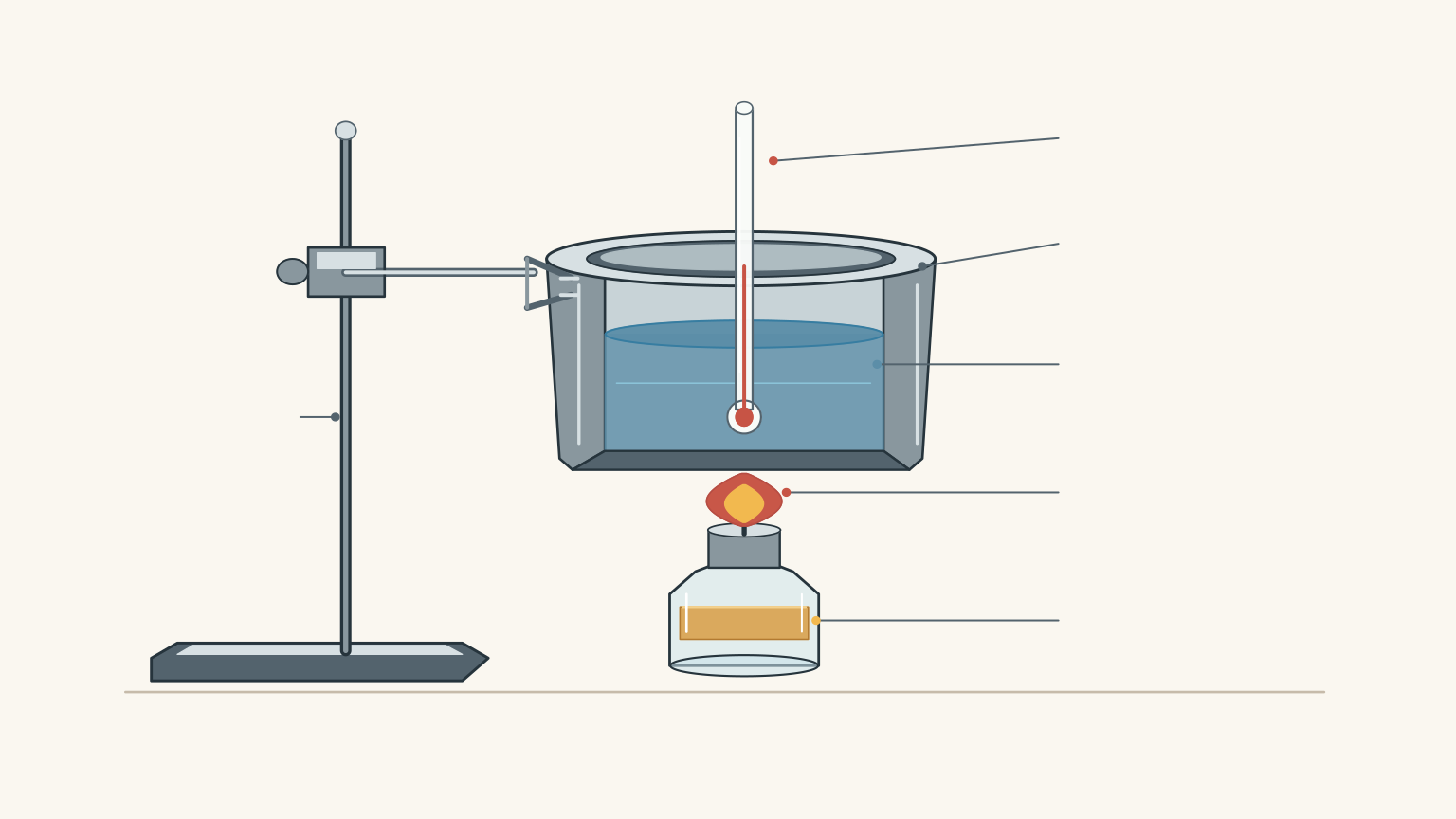
The following measurements are recorded:
| Measurement | Temperature |
|---|---|
| Initial water temperature | 20.5°C |
| Final water temperature | 32.0°C |
(a) Calculate the temperature change of the water. (1 mark)
(b) Classify the combustion of ethanol as endothermic or exothermic. (1 mark)
(c) State the direction of energy transfer between the combustion reaction and the water. (1 mark)
(d) Some energy released during combustion heats the metal can and surrounding air rather than the water.
Explain how this affects the measured temperature rise compared with an ideal experiment in which all the released energy heats the water. (2 marks)
Question 5 (6 marks)
A student investigates the ionic dissociation of ammonium nitrate in water.
A sample of solid ammonium nitrate is added to water in an insulated cup. The mixture is stirred, and the temperature is recorded before and after the solid dissolves.
The process can be represented by:
\[ \ce{NH4NO3(s) -> NH4+(aq) + NO3-(aq)} \]
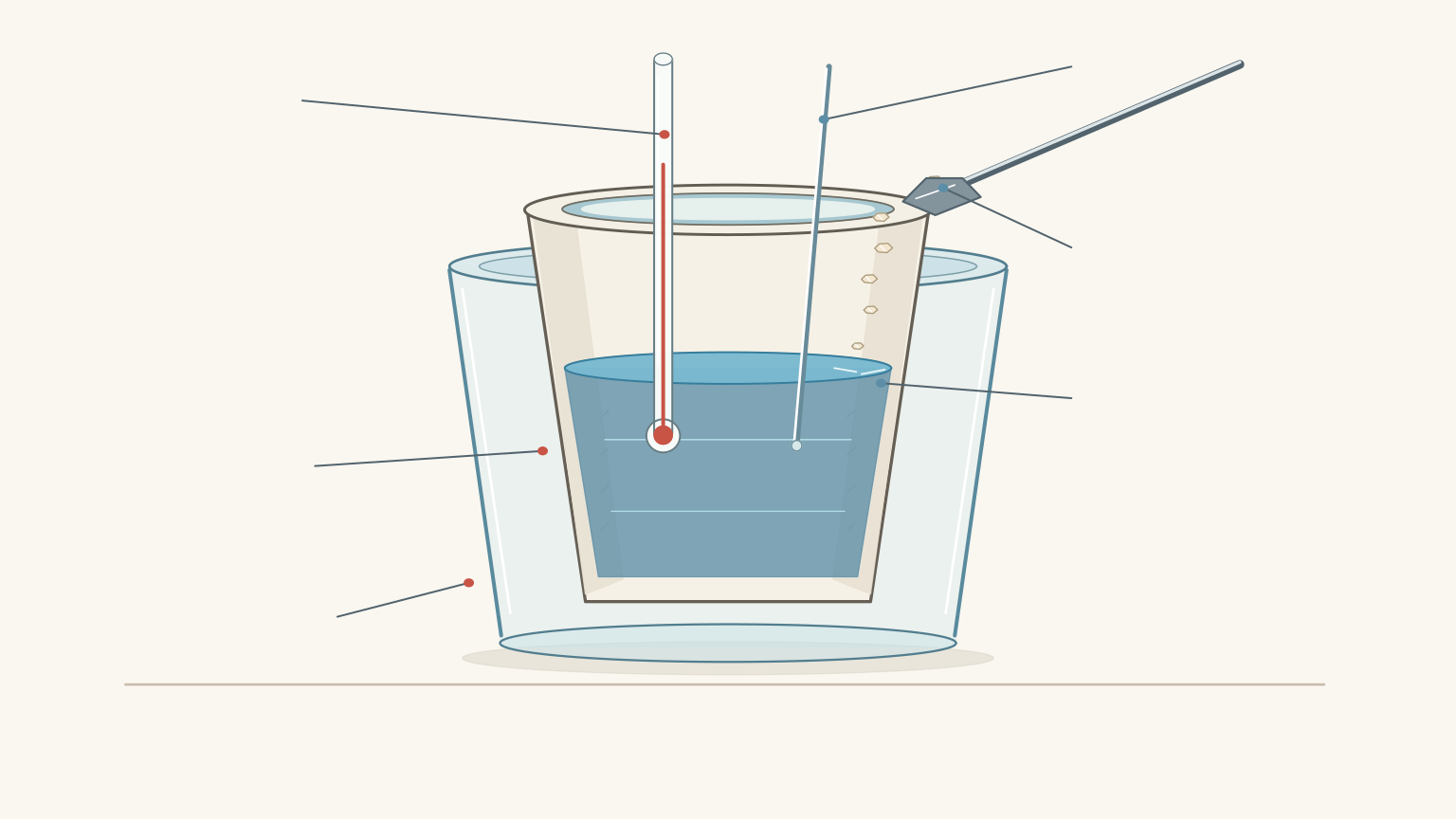
The student records the following temperatures:
| Measurement | Temperature |
|---|---|
| Initial water temperature | 22.0°C |
| Final solution temperature | 17.5°C |
(a) Calculate the temperature change of the solution. (1 mark)
(b) Classify the ionic dissociation process as endothermic or exothermic. (1 mark)
(c) State the direction of energy transfer between the dissociation process and the surrounding water. (2 marks)
(d) Explain why stirring the solution before recording the final temperature improves the reliability of the measurement. (2 marks)
Question 6 (8 marks)
Consider the following simplified molecular reaction:
\[ \ce{X2(g) + Y2(g) -> 2XY(g)} \]
Assume all bonds in the molecules are covalent.
For this reaction, breaking the reactant bonds requires more energy than is released when the product bonds form.
(a) Identify:
- The bonds that must be broken.
- The bonds that must be formed.
(2 marks)
(b) State whether energy is absorbed or released during each of the following processes:
- Breaking the reactant bonds.
- Forming the product bonds.
(2 marks)
(c) Using the information provided, determine whether the forward reaction is endothermic or exothermic.
Explain your answer in terms of the relative enthalpies of the reactants and products. (2 marks)
(d) Consider the reverse reaction.
State the sign of its enthalpy change and describe the relative enthalpy levels of its reactants and products on an energy profile diagram. (2 marks)
03Worked solutions and marking guide
Solution 1
(a) Forward activation energy (1 mark)
Activation energy is the energy difference between the reactants and the transition state.
\[ E_{a,\mathrm{forward}} =H_{\mathrm{transition}}-H_R \]
Substituting:
\[ E_{a,\mathrm{forward}}=205-125 \]
\[ \boxed{E_{a,\mathrm{forward}}=80\text{ kJ mol}^{-1}} \]
Marking:
- 1 mark: Correct answer of 80 kJ mol⁻¹.
(b) Forward enthalpy change (2 marks)
Enthalpy change is calculated by subtracting the reactant enthalpy from the product enthalpy.
\[ \Delta H=H_{\mathrm{products}}-H_{\mathrm{reactants}} \]
Substituting:
\[ \Delta H=45-125 \]
\[ \boxed{\Delta H=-80\text{ kJ mol}^{-1}} \]
The negative sign indicates that the products have lower enthalpy than the reactants.
Energy is released overall, so the reaction is exothermic.
Marking:
- 1 mark: Correctly identifies and applies the product-minus-reactant relationship.
- 1 mark: Correct answer of −80 kJ mol⁻¹, including the negative sign.
(c) Reverse activation energy (1 mark)
For the reverse reaction, the reactants are the original products.
Therefore, the activation energy is the difference between the transition-state enthalpy and the original product enthalpy.
\[ E_{a,\mathrm{reverse}}=205-45 \]
\[ \boxed{E_{a,\mathrm{reverse}}=160\text{ kJ mol}^{-1}} \]
Marking:
- 1 mark: Correct answer of 160 kJ mol⁻¹.
(d) Reaction classification (1 mark)
The forward reaction is exothermic because its enthalpy change is negative.
Marking:
- 1 mark: Correctly identifies the reaction as exothermic.
Solution 2
(a) Constructing the energy profile (4 marks)
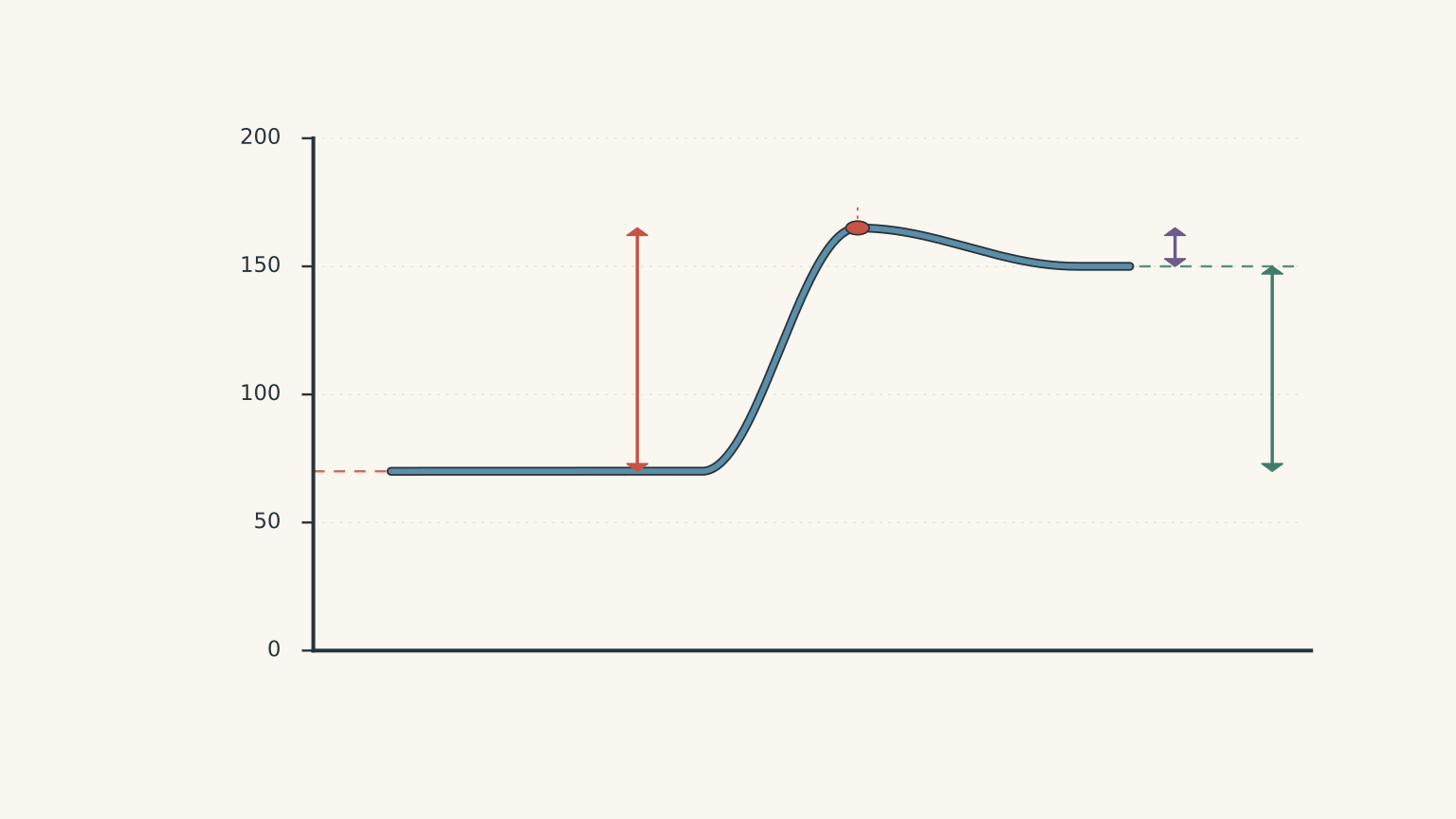
Start by placing the reactants at 70 kJ mol⁻¹ and the products at 150 kJ mol⁻¹.
The products must sit higher on the enthalpy axis because their enthalpy is greater than that of the reactants.
Next, calculate the enthalpy at the transition-state peak.
The forward activation energy is the difference between the peak and the reactant enthalpy.
\[ E_{a,\mathrm{forward}}=H_{\mathrm{peak}}-H_A \]
Rearranging:
\[ H_{\mathrm{peak}}=H_A+E_{a,\mathrm{forward}} \]
\[ H_{\mathrm{peak}}=70+95 \]
\[ H_{\mathrm{peak}}=165\text{ kJ mol}^{-1} \]
The enthalpy change is:
\[ \Delta H=H_B-H_A \]
\[ \Delta H=150-70 \]
\[ \Delta H=+80\text{ kJ mol}^{-1} \]
The completed energy profile should look like this:
Marking:
- 1 mark: Correctly labelled axes and appropriate energy profile shape.
- 1 mark: Reactants at 70 and products at 150 kJ mol⁻¹, with products higher.
- 1 mark: Transition-state peak at 165 kJ mol⁻¹.
- 1 mark: Correctly labelled forward activation energy of 95 kJ mol⁻¹ and enthalpy change of +80 kJ mol⁻¹.
(b) Reverse activation energy (2 marks)
The reverse reaction starts at the original product enthalpy of 150 kJ mol⁻¹.
Its transition-state peak remains at 165 kJ mol⁻¹.
Therefore:
\[ E_{a,\mathrm{reverse}} =H_{\mathrm{peak}}-H_B \]
\[ E_{a,\mathrm{reverse}}=165-150 \]
\[ \boxed{E_{a,\mathrm{reverse}}=15\text{ kJ mol}^{-1}} \]
Marking:
- 1 mark: Correctly identifies the transition-state enthalpy as 165 kJ mol⁻¹.
- 1 mark: Correct reverse activation energy of 15 kJ mol⁻¹.
Follow-through marks should be awarded if a student makes a minor error in part (a) but uses their calculated peak consistently.
(c) Reaction classification (1 mark)
The forward reaction is endothermic.
Its enthalpy change is positive, meaning the products have greater enthalpy than the reactants.
Marking:
- 1 mark: Correctly identifies the reaction as endothermic.
Solution 3
(a) Calculating the forward enthalpy change (2 marks)
The relationship between forward activation energy, reverse activation energy, and enthalpy change is:
\[ \Delta H=E_{a,\mathrm{forward}}-E_{a,\mathrm{reverse}} \]
Using the uncatalysed values:
\[ \Delta H=92-128 \]
\[ \boxed{\Delta H=-36\text{ kJ mol}^{-1}} \]
The reaction is exothermic because its enthalpy change is negative.
Marking:
- 1 mark: Correctly applies the relationship between forward activation energy, reverse activation energy, and enthalpy change.
- 1 mark: Correct answer of −36 kJ mol⁻¹.
(b) Reduction in forward activation energy (1 mark)
Subtract the catalysed activation energy from the uncatalysed activation energy.
\[ \text{Reduction}=92-57 \]
\[ \boxed{35\text{ kJ mol}^{-1}} \]
Marking:
- 1 mark: Correct answer of 35 kJ mol⁻¹.
(c) Reduction in reverse activation energy (1 mark)
Apply the same method to the reverse activation energies.
\[ \text{Reduction}=128-93 \]
\[ \boxed{35\text{ kJ mol}^{-1}} \]
Marking:
- 1 mark: Correct answer of 35 kJ mol⁻¹.
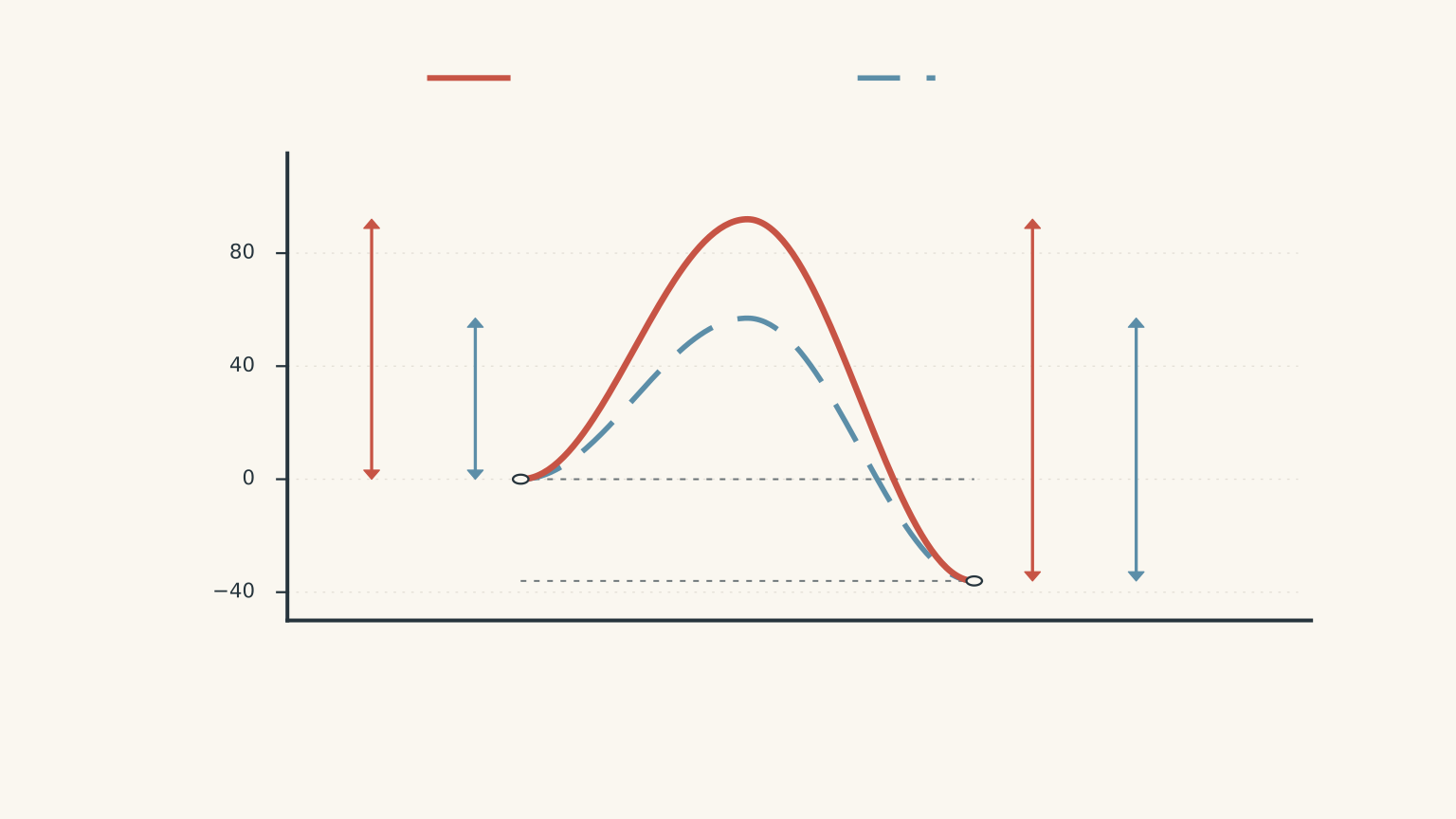
(d) Comparing the energy profiles (3 marks)
Both pathways must begin at the same reactant enthalpy and finish at the same product enthalpy.
The uncatalysed pathway has a higher transition-state peak.
The catalysed pathway has a lower peak because the catalyst provides an alternative reaction pathway with lower activation energy.
The following diagram shows the correct relationship. The reactant enthalpy has been set to zero as a convenient reference.
Marking:
- 1 mark: Both pathways have the same reactant and product enthalpy levels.
- 1 mark: The catalysed pathway has a lower transition-state peak.
- 1 mark: Both pathways are correctly labelled, with appropriate activation energy differences shown.
(e) Why the enthalpy change remains unchanged (2 marks)
Enthalpy change depends on the difference between the enthalpy of the products and the enthalpy of the reactants.
A catalyst changes the reaction pathway and lowers the activation energy. However, it does not change the enthalpy of the reactants or products.
Therefore, the overall enthalpy change remains unchanged.
\[ \boxed{\Delta H=-36\text{ kJ mol}^{-1}} \]
Marking:
- 1 mark: Identifies that the catalyst does not change the reactant and product enthalpy levels.
- 1 mark: Explains that the difference between these levels, and therefore ΔH, remains unchanged.
Solution 4
(a) Temperature change (1 mark)
Temperature change is calculated using:
\[ \Delta T=T_{\mathrm{final}}-T_{\mathrm{initial}} \]
Substituting:
\[ \Delta T=32.0-20.5 \]
\[ \boxed{\Delta T=+11.5^\circ\mathrm{C}} \]
Marking:
- 1 mark: Correct answer of +11.5°C.
(b) Reaction classification (1 mark)
The combustion of ethanol is exothermic.
The temperature of the surrounding water increases, indicating that energy has been transferred from the combustion reaction to the surroundings.
Marking:
- 1 mark: Correctly identifies the reaction as exothermic.
(c) Direction of energy transfer (1 mark)
Energy is transferred from the combustion reaction to the water.
The water gains thermal energy, causing its temperature to increase.
Marking:
- 1 mark: Correctly identifies energy transfer from the reaction to the water.
(d) Effect of energy loss (2 marks)
Not all the energy released by combustion is transferred to the water.
Some energy heats the metal can and escapes into the surrounding air.
As a result, less energy heats the water, producing a smaller measured temperature rise than in an ideal experiment where all the released energy heats the water.
Marking:
- 1 mark: Identifies that some energy is transferred to the apparatus or surrounding air.
- 1 mark: Explains that this reduces the energy transferred to the water and therefore lowers its measured temperature rise.
Solution 5
(a) Temperature change (1 mark)
Use the final temperature minus the initial temperature.
\[ \Delta T=T_{\mathrm{final}}-T_{\mathrm{initial}} \]
Substituting:
\[ \Delta T=17.5-22.0 \]
\[ \boxed{\Delta T=-4.5^\circ\mathrm{C}} \]
The negative sign indicates that the temperature decreased.
Marking:
- 1 mark: Correct answer of −4.5°C.
(b) Reaction classification (1 mark)
The ionic dissociation of ammonium nitrate in water is endothermic.
The surrounding solution decreases in temperature because the process absorbs energy.
Marking:
- 1 mark: Correctly identifies the process as endothermic.
(c) Direction of energy transfer (2 marks)
Energy is transferred from the surrounding water to the dissociation process.
The dissociation process absorbs this energy, reducing the thermal energy of the surrounding water and causing its temperature to decrease.
Marking:
- 1 mark: Identifies energy transfer from the water to the dissociation process.
- 1 mark: Explains that the process absorbs energy from the surroundings.
(d) Importance of stirring (2 marks)
Stirring distributes the dissolved ammonium nitrate and thermal energy throughout the solution.
Without stirring, different parts of the solution may have different temperatures. The thermometer might then record a temperature that does not represent the solution as a whole.
Stirring helps produce a uniform temperature, making the final measurement more reliable.
Marking:
- 1 mark: Explains that stirring distributes the temperature more evenly throughout the solution.
- 1 mark: Explains that a uniform solution allows a more representative and reliable thermometer reading.
Solution 6
(a) Identifying bonds broken and formed (2 marks)
The reaction is:
\[ \ce{X2 + Y2 -> 2XY} \]
The reactants contain one X-X bond and one Y-Y bond.
These bonds must be broken before the atoms can rearrange.
The products contain two X-Y bonds, which must form.
Therefore:
- Bonds broken: one X-X bond and one Y-Y bond.
- Bonds formed: two X-Y bonds.
Marking:
- 1 mark: Correctly identifies the X-X and Y-Y bonds as broken.
- 1 mark: Correctly identifies the two X-Y bonds as formed.
(b) Energy changes during bond breaking and formation (2 marks)
Breaking bonds requires energy to overcome the attractive forces holding the bonded atoms together.
Therefore, bond breaking is an energy-absorbing process.
Forming bonds releases energy as the atoms establish new bonds.
Therefore, bond formation is an energy-releasing process.
Marking:
- 1 mark: Correctly states that breaking bonds absorbs energy.
- 1 mark: Correctly states that forming bonds releases energy.
(c) Classifying the forward reaction (2 marks)
The question states that breaking the reactant bonds requires more energy than is released when the product bonds form.
This means the energy absorbed is greater than the energy released.
The reaction therefore absorbs energy overall.
\[ \boxed{\Delta H>0} \]
The forward reaction is endothermic.
An endothermic reaction has products at a higher enthalpy than its reactants.
Marking:
- 1 mark: Identifies the reaction as endothermic and states that ΔH is positive.
- 1 mark: Explains that the products have higher enthalpy than the reactants.
(d) Reverse reaction (2 marks)
The reverse reaction is:
\[ \ce{2XY(g) -> X2(g) + Y2(g)} \]
The reverse reaction starts with the original products, which have higher enthalpy.
It finishes with the original reactants, which have lower enthalpy.
Therefore, energy is released overall during the reverse reaction.
The reverse reaction is exothermic, and its enthalpy change is negative.
\[ \boxed{\Delta H_{\mathrm{reverse}}<0} \]
The reverse reaction has an enthalpy change equal in magnitude but opposite in sign to that of the forward reaction.
Marking:
- 1 mark: Correctly identifies that the reverse reaction starts at a higher enthalpy and finishes at a lower enthalpy.
- 1 mark: Correctly identifies the reverse reaction as exothermic, with a negative enthalpy change.
04End of practice paper
Total: 40 marks.
When reviewing your performance, pay particular attention to three distinctions:
- Activation energy is the energy difference between the reactants and the transition state. It is not the same as enthalpy change.
- A catalyst lowers activation energy by providing an alternative pathway. It does not change the enthalpy levels of the reactants or products.
- Breaking bonds absorbs energy, while forming bonds releases energy. The overall reaction depends on the balance between these two energy changes.
These distinctions connect almost every question in this paper. If you can explain them clearly and apply them to unfamiliar energy profiles, you’ve developed a solid understanding of this topic.