
Force Diagrams and Newton’s Laws: HSC Physics Practice Exam
Test your understanding of force diagrams and Newton’s laws with this original 60-mark NSW HSC Physics practice paper. Includes timed exam questions, detailed worked solutions, and a question-by-question marking guide.
This is an original tutorgum practice paper for Year 11-12 NSW HSC Physics, covering the Physics 2017 syllabus scope of force diagrams and Newton’s laws. It is a focused topic assessment, not a full-course mock exam or an official NESA paper. It tests your ability to identify forces, construct free-body diagrams, calculate resultant forces, apply Newton’s three laws, and resolve forces into components.
Attempt the questions under timed conditions before looking at the worked solutions. Show your working, include units, and pay attention to the direction of every force and acceleration.
01Exam instructions
| Assessment detail | Conditions |
|---|---|
| Suggested reading time | 5 minutes |
| Suggested working time | 90 minutes |
| Total marks | 60 |
| Equipment | Scientific calculator, ruler, pens or pencils |
| Syllabus edition | Physics 2017 |
| Paper type | Original tutorgum practice paper |
These are suggested conditions for this practice paper, not a statement of official NESA examination requirements.
General instructions
- Answer all seven questions.
- Show all working for calculations. A correct numerical answer without working may not receive full marks.
- Include appropriate units and directions in your final answers.
- Draw clear, labelled free-body diagrams wherever requested.
- Use three significant figures unless an exact value is appropriate.
- Assume air resistance is negligible unless stated otherwise.
- All angles are measured from the horizontal unless stated otherwise.
Use the following constant throughout:
\[ g=9.8\ \mathrm{m\,s^{-2}} \]
Here, \(g\) is the gravitational field strength.
For calculations, \(F_{\text{net}}\) represents resultant force in newtons (N), \(m\) represents mass in kilograms (kg), and \(a\) represents acceleration in metres per second squared (\(\mathrm{m\,s^{-2}}\)).
The relationship between these quantities is:
\[ F_{\text{net}}=ma \]
Assessed content
This paper assesses:
- Contact forces and field forces.
- Identifying the objects responsible for individual forces.
- Free-body diagrams.
- Resultant forces and translational equilibrium.
- Newton’s first, second, and third laws.
- Distinguishing balanced forces from action-reaction pairs.
- Resolving forces into horizontal and vertical components.
- Applying Newton’s laws to individual objects and combined systems.
Inclined-plane dynamics, circular motion, energy, momentum, and other syllabus modules are excluded.
02Questions
Question 1 (8 marks)
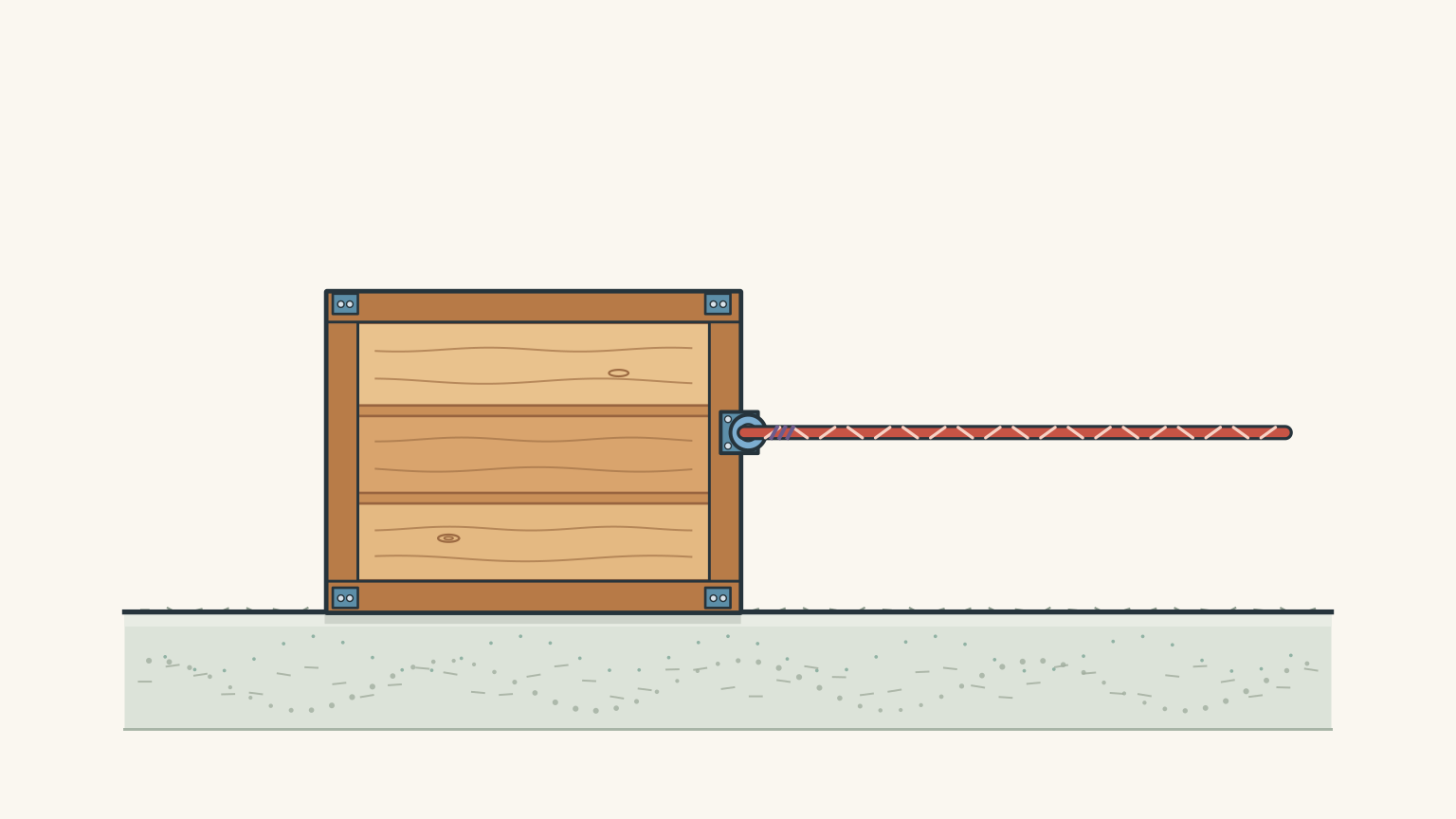
A crate rests on a rough, horizontal floor. A light rope attached to the right-hand side of the crate pulls horizontally towards the right. The crate remains stationary.
Assume air resistance is negligible.
Due to technical limitations, this figure may display incorrectly or contain inaccuracies. Please check key details against your course materials.
(a) Identify the four forces acting on the crate. For each force, name the object exerting it. (4 marks)
(b) Classify each of the four forces as either a contact force or a field force. (2 marks)
(c) Draw a free-body diagram of the crate. Include all forces acting on it, with their correct directions and labels. (2 marks)
Question 2 (8 marks)
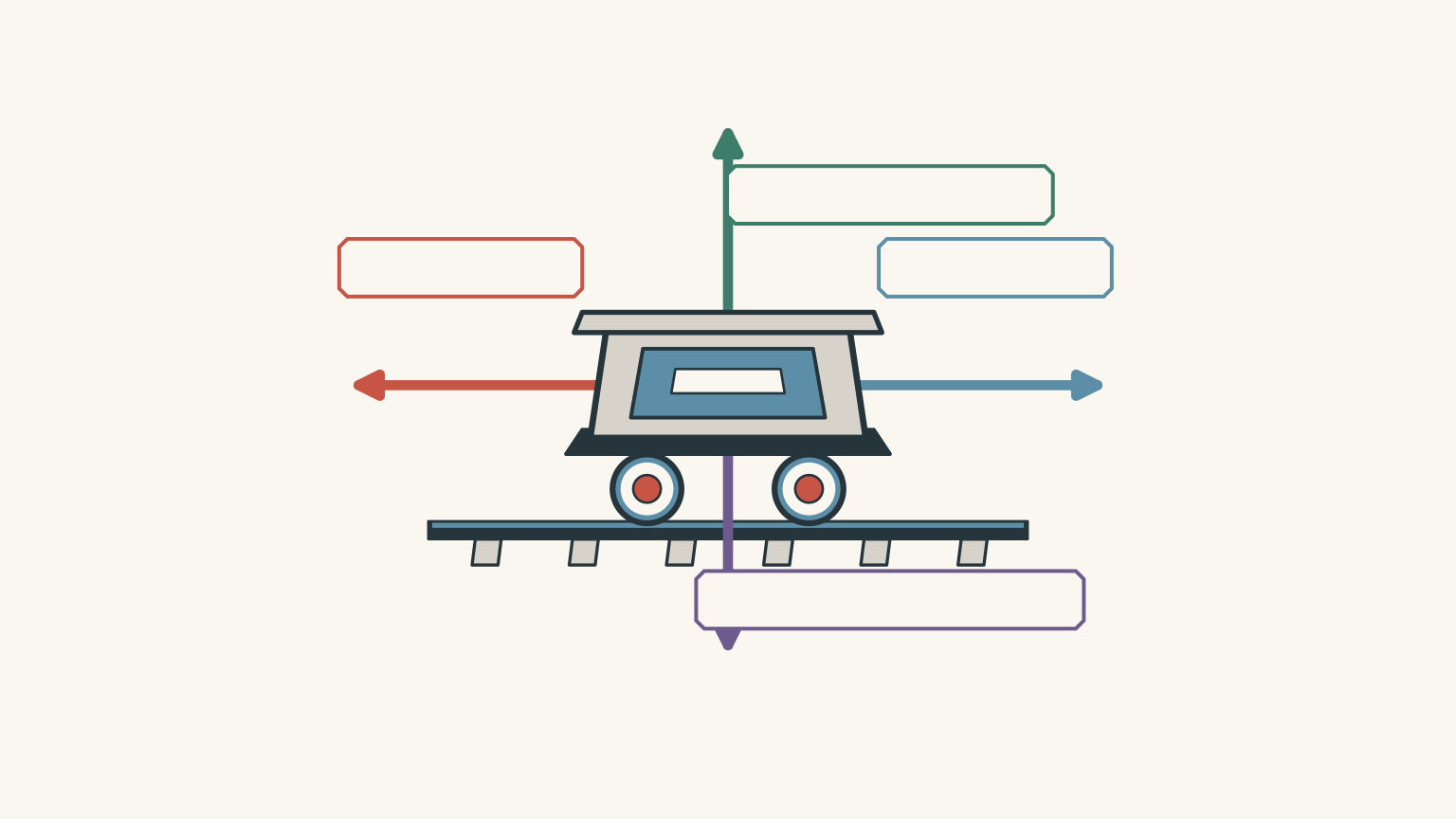
A trolley with a mass of \(5.0\ \mathrm{kg}\) moves east along a horizontal track at a constant velocity of \(2.0\ \mathrm{m\,s^{-1}}\).
At a particular instant, the forces acting on the trolley are:
- A horizontal force of \(12\ \mathrm{N}\) east.
- A horizontal force of \(12\ \mathrm{N}\) west.
- An upward normal force of \(49\ \mathrm{N}\).
- A downward gravitational force of \(49\ \mathrm{N}\).
Due to technical limitations, this figure may display incorrectly or contain inaccuracies. Please check key details against your course materials.
(a) Calculate the resultant horizontal force and the resultant vertical force acting on the trolley. (2 marks)
(b) Determine the trolley’s acceleration and state its velocity after a further \(3.0\ \mathrm{s}\), assuming the forces remain unchanged. (2 marks)
(c) An additional horizontal force of \(8.0\ \mathrm{N}\) west is now applied to the trolley. All other forces remain unchanged.
Calculate:
- The new resultant force acting on the trolley.
- The new acceleration of the trolley. (3 marks)
(d) Explain, using Newton’s first law, why the trolley does not require a resultant force towards the east to maintain its original constant eastward velocity. (1 mark)
Question 3 (9 marks)
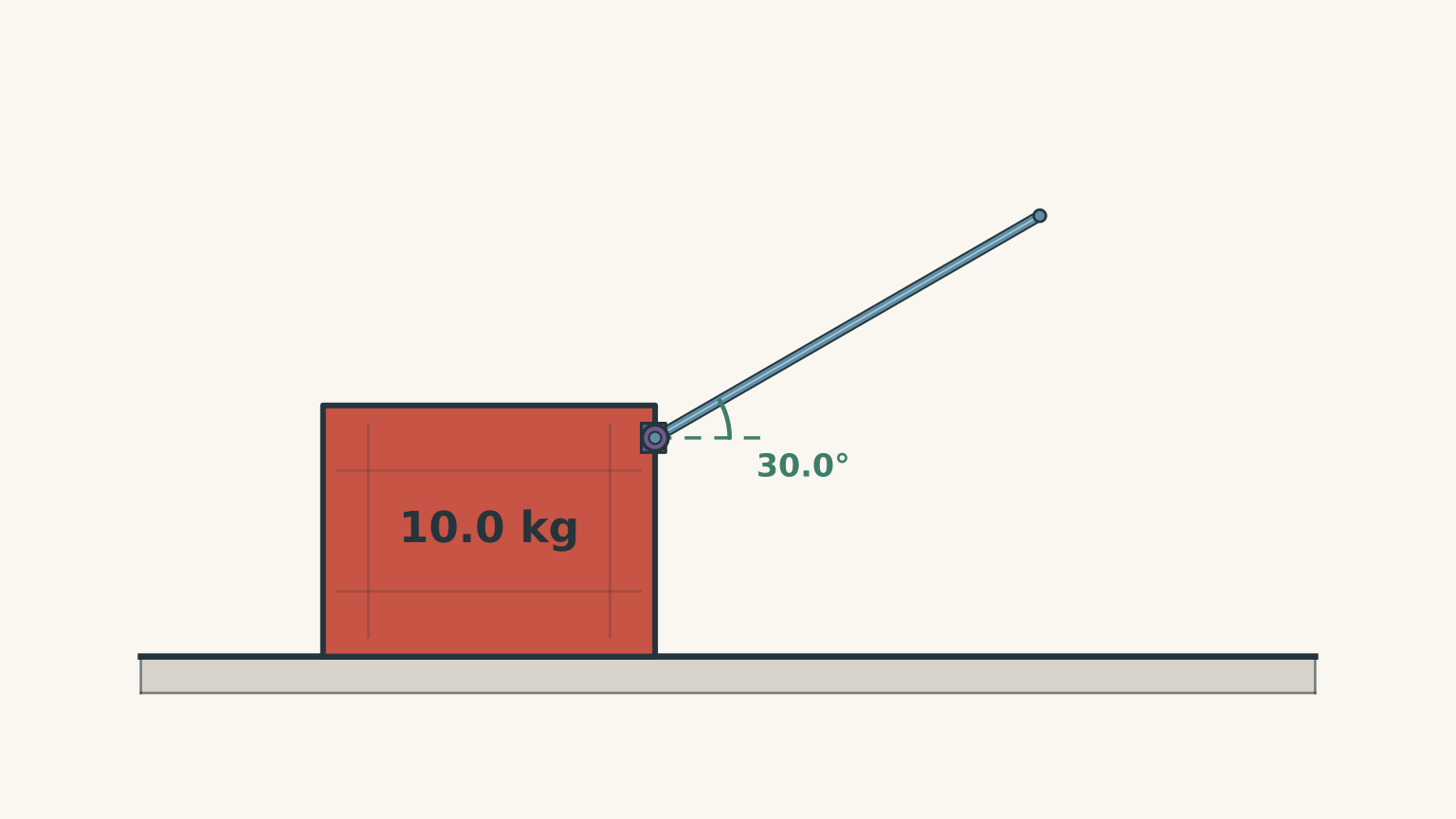
A crate with a mass of \(10.0\ \mathrm{kg}\) is pulled along a level floor by a rope. The rope exerts a force of \(60.0\ \mathrm{N}\) at an angle of \(30.0^\circ\) above the horizontal.
A frictional force of \(12.0\ \mathrm{N}\) acts horizontally towards the left.
The crate remains in contact with the floor and has zero vertical acceleration. Assume no other forces act on the crate apart from gravity, the normal reaction, the rope tension, and friction.
Due to technical limitations, this figure may display incorrectly or contain inaccuracies. Please check key details against your course materials.
(a) Draw a free-body diagram of the crate, showing all forces acting on it. (2 marks)
(b) Resolve the \(60.0\ \mathrm{N}\) pulling force into:
- Its horizontal component.
- Its vertical component.
(2 marks)
(c) Calculate the normal reaction force exerted by the floor on the crate. (2 marks)
(d) Calculate the resultant horizontal force and the horizontal acceleration of the crate. (3 marks)
Question 4 (10 marks)
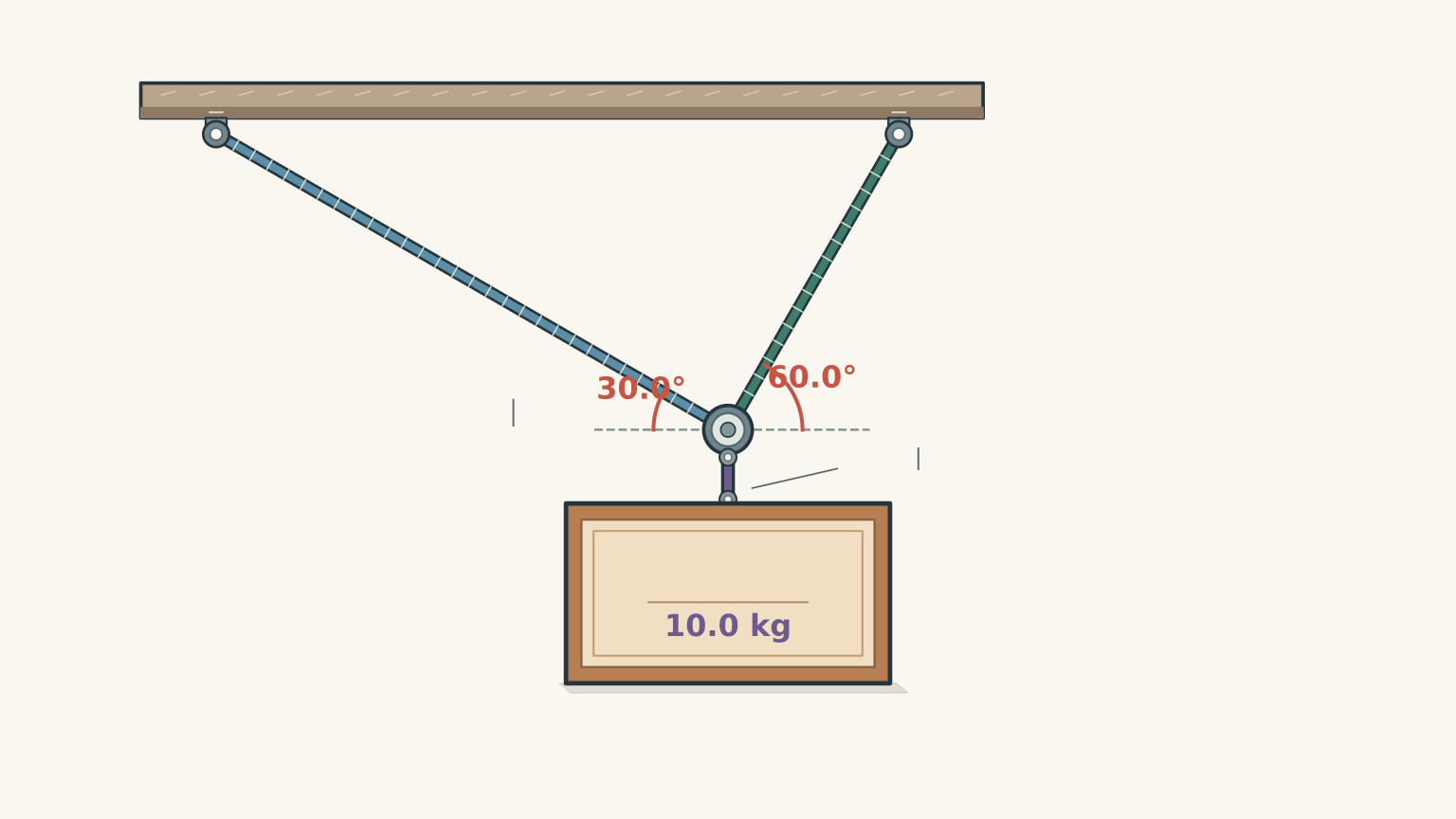
A \(10.0\ \mathrm{kg}\) sign is suspended from a small junction ring by a short vertical connector. Two support cables meet at the ring.
The left cable extends upwards and to the left, making an angle of \(30.0^\circ\) above the horizontal.
The right cable extends upwards and to the right, making an angle of \(60.0^\circ\) above the horizontal.
The entire arrangement is stationary. Treat the sign, connector, and ring as one system. Ignore the mass of the connector and ring.
Due to technical limitations, this figure may display incorrectly or contain inaccuracies. Please check key details against your course materials.
(a) Draw a free-body diagram of the combined sign, connector, and ring system. (2 marks)
(b) Write an equation for horizontal equilibrium, resolving the two cable tensions into their horizontal components. (2 marks)
(c) Calculate the tension in each cable.
Show your working using both horizontal and vertical equilibrium. (5 marks)
(d) State the resultant force acting on the system. (1 mark)
Question 5 (8 marks)
A skater with a mass of \(60.0\ \mathrm{kg}\) stands on skates beside a fixed vertical wall. The wall is directly to the skater’s right.
The skater pushes the wall towards the right. The wall exerts a horizontal force of \(90.0\ \mathrm{N}\) on the skater towards the left.
A resistive force of \(10.0\ \mathrm{N}\) acts horizontally towards the right on the skater.
The skater has zero vertical acceleration. Assume these are the only horizontal forces acting on the skater.
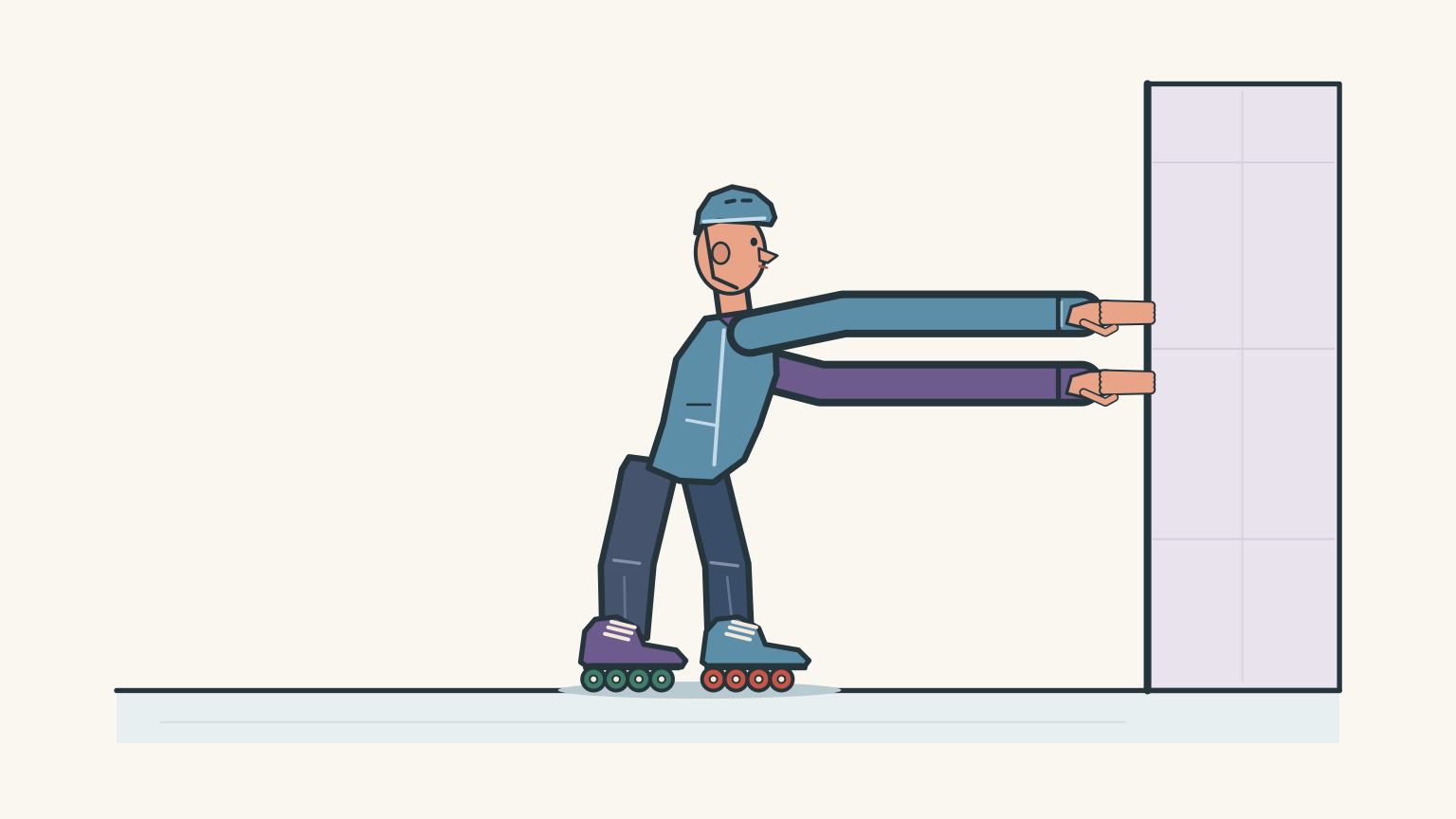
Due to technical limitations, this figure may display incorrectly or contain inaccuracies. Please check key details against your course materials.
(a) State the Newton’s third law partner of the force exerted by the wall on the skater. Include its magnitude, direction, and the object on which it acts. (2 marks)
(b) Explain why the two forces in this action-reaction pair do not cancel each other on a free-body diagram of the skater. (2 marks)
(c) Draw a free-body diagram of the skater, including all forces acting on them. (2 marks)
(d) Calculate the resultant horizontal force and the horizontal acceleration of the skater. (2 marks)
Question 6 (10 marks)
Two carts, A and B, are connected by a light, taut string and move along a horizontal track.
Cart A has a mass of \(3.0\ \mathrm{kg}\), while cart B has a mass of \(2.0\ \mathrm{kg}\).
A horizontal force of \(20.0\ \mathrm{N}\) acts towards the right on cart A.
The track exerts a resistive force of \(2.0\ \mathrm{N}\) towards the left on cart A and a resistive force of \(3.0\ \mathrm{N}\) towards the left on cart B.
Assume both carts accelerate together, the string remains taut, and there are no other horizontal forces.
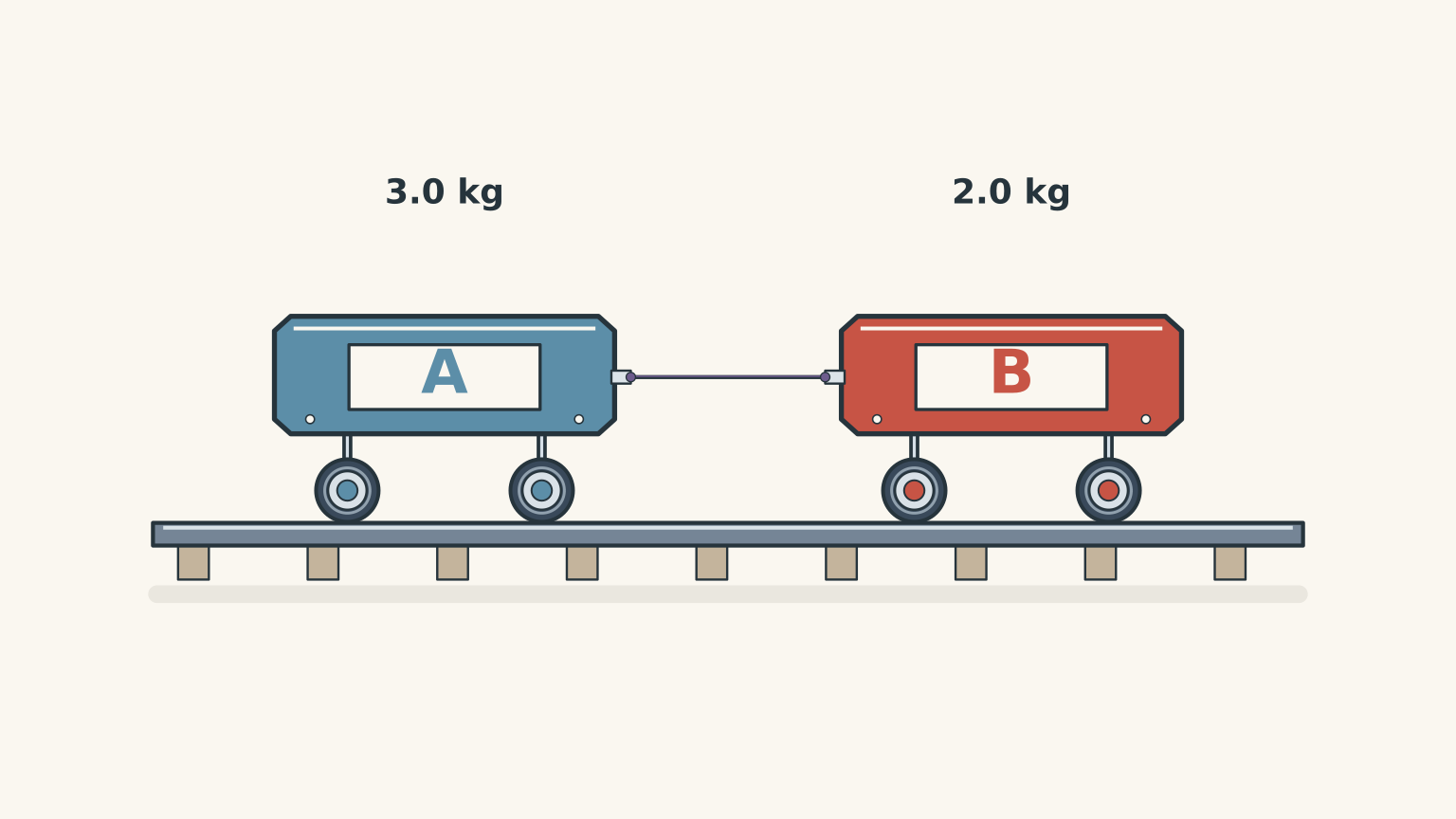
Due to technical limitations, this figure may display incorrectly or contain inaccuracies. Please check key details against your course materials.
(a) Considering both carts as one combined system, identify all external horizontal forces and state whether the string tension is an internal or external force. (2 marks)
(b) Draw a free-body diagram of the combined two-cart system. Include all external forces acting on the system. (2 marks)
(c) Calculate the acceleration of the combined system. (3 marks)
(d) Calculate the tension in the connecting string. (3 marks)
Question 7 (7 marks)
A \(10.0\ \mathrm{kg}\) puck rests on a low-friction horizontal surface.
Two perpendicular horizontal forces act on the puck simultaneously:
- A force of \(30.0\ \mathrm{N}\) towards the east.
- A force of \(40.0\ \mathrm{N}\) towards the north.
The vertical forces acting on the puck are balanced. The puck is initially stationary.
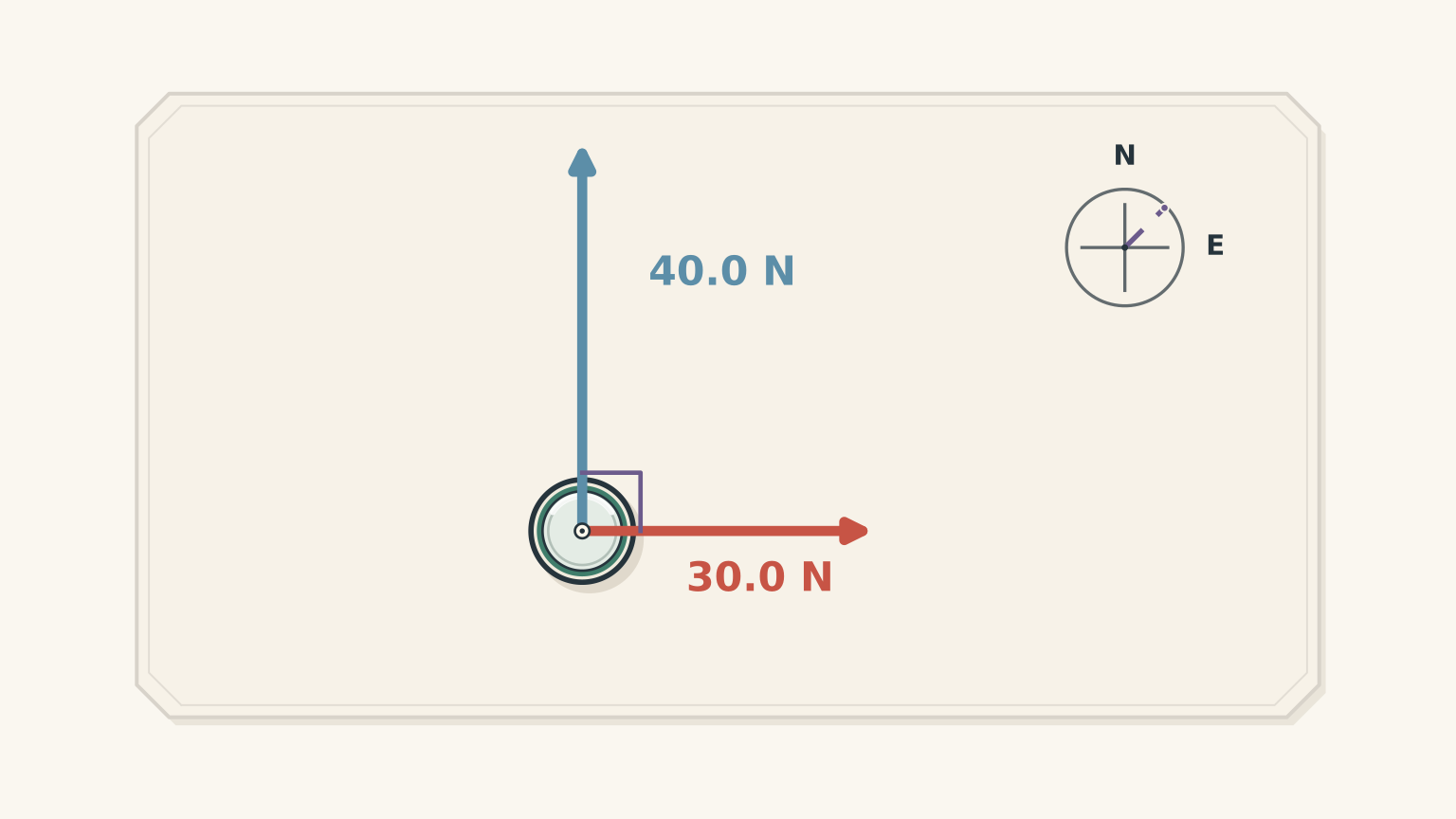
Due to technical limitations, this figure may display incorrectly or contain inaccuracies. Please check key details against your course materials.
(a) Using a vector diagram and calculation, determine the magnitude and direction of the resultant horizontal force. Express the direction as an angle north of east. (3 marks)
(b) Calculate the magnitude and direction of the puck’s acceleration. (2 marks)
(c) Calculate the puck’s velocity after \(2.00\ \mathrm{s}\), assuming both forces remain constant. (2 marks)
03Worked solutions and marking guide
Solution 1
(a) Identify the four forces and their sources.
The crate experiences four forces.
- Gravitational force: exerted by the Earth on the crate.
- Normal reaction force: exerted by the floor on the crate.
- Tension force: exerted by the rope on the crate.
- Static frictional force: exerted by the floor on the crate.
The important distinction is that forces are interactions between objects. When identifying a force, name both the force and the object responsible for exerting it.
(b) Classify the forces.
| Force | Classification |
|---|---|
| Gravitational force | Field force |
| Normal reaction | Contact force |
| Tension | Contact force |
| Static friction | Contact force |
Gravity is a field force because the Earth attracts the crate without needing direct physical contact.
The other three forces require physical contact between the interacting objects.
(c) Free-body diagram.
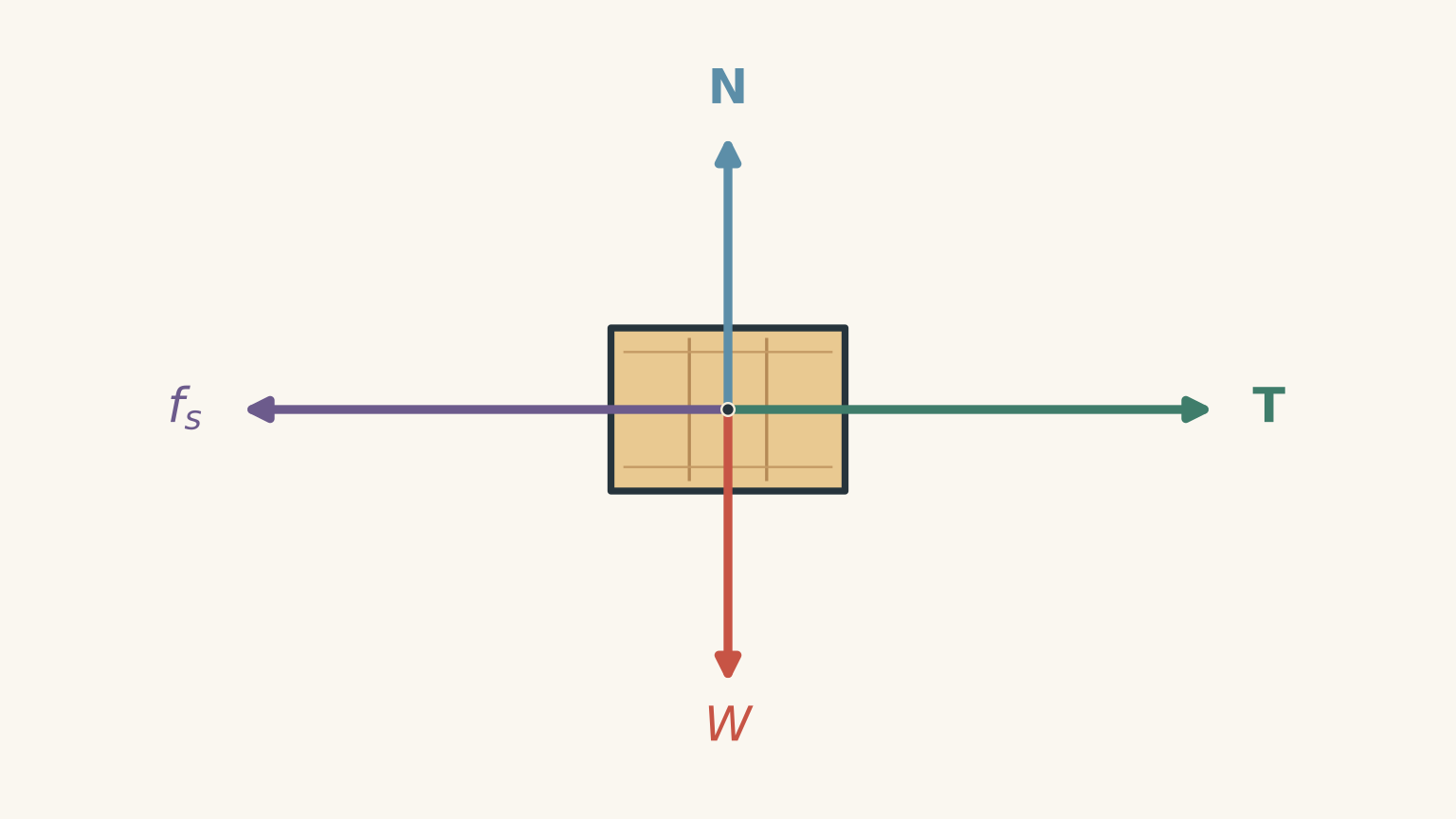
Due to technical limitations, this figure may display incorrectly or contain inaccuracies. Please check key details against your course materials.
Because the crate is stationary, its horizontal and vertical forces must balance.
- Tension acts towards the right, so static friction acts towards the left.
- Weight acts downwards, so the normal reaction acts upwards.
The force magnitudes are balanced in each direction, although their actual values are not given.
Marking guide (8 marks)
| Part | Required response | Marks |
|---|---|---|
| (a) | Each of the four correct forces with its source | 4 |
| (b) | Correct classification of each force (0.5 each) | 2 |
| (c) | Isolated crate with only the four acting forces | 1 |
| (c) | Correct directions and labels | 1 |
| Total | 8 |
Solution 2
(a) Calculate the resultant forces.
The resultant force is the vector sum of all forces acting on an object.
Take east and upwards as positive directions.
Horizontal resultant:
\[ F_{\text{net},x}=12-12 \]
\[ \boxed{F_{\text{net},x}=0\ \mathrm{N}} \]
Vertical resultant:
\[ F_{\text{net},y}=49-49 \]
\[ \boxed{F_{\text{net},y}=0\ \mathrm{N}} \]
The resultant force is zero in both directions.
(b) Determine the acceleration and velocity.
Apply Newton’s second law:
\[ F_{\text{net}}=ma \]
Rearrange:
\[ a=\frac{F_{\text{net}}}{m} \]
Substitute the values:
\[ a=\frac{0}{5.0} \]
\[ \boxed{a=0\ \mathrm{m\,s^{-2}}} \]
The trolley has zero acceleration, so its velocity remains constant.
It was initially travelling east at \(2.0\ \mathrm{m\,s^{-1}}\).
Therefore, after a further \(3.0\ \mathrm{s}\):
\[ \boxed{v=2.0\ \mathrm{m\,s^{-1}}\text{ east}} \]
This is an example of Newton’s first law.
Zero resultant force does not mean zero velocity. It means zero acceleration, so an object maintains its existing velocity.
(c) Calculate the new resultant force and acceleration.
An additional \(8.0\ \mathrm{N}\) force acts west.
The total horizontal force towards the west is now:
\[ 12+8=20\ \mathrm{N} \]
The force towards the east remains \(12\ \mathrm{N}\).
Therefore:
\[ F_{\text{net}}=20-12 \]
\[ \boxed{F_{\text{net}}=8.0\ \mathrm{N}\text{ west}} \]
Apply Newton’s second law:
\[ a=\frac{F_{\text{net}}}{m} \]
\[ a=\frac{8.0}{5.0} \]
\[ \boxed{a=1.6\ \mathrm{m\,s^{-2}}\text{ west}} \]
The trolley accelerates west, even though its initial velocity is east.
Remember that velocity and acceleration do not have to point in the same direction.
(d) Explain using Newton’s first law.
Newton’s first law states that an object maintains its state of rest or constant velocity unless acted on by a non-zero resultant force.
The trolley does not need a forward resultant force to keep moving east. Its existing eastward velocity continues because the resultant force is zero.
Marking guide (8 marks)
| Part | Required response | Marks |
|---|---|---|
| (a) | Correct horizontal resultant | 1 |
| (a) | Correct vertical resultant | 1 |
| (b) | Correct zero acceleration | 1 |
| (b) | Correct constant velocity after 3.0 s | 1 |
| (c) | Correct new resultant force and direction | 1 |
| (c) | Correct application of \(a=F_{\text{net}}/m\) | 1 |
| (c) | Correct acceleration and direction | 1 |
| (d) | Explains that zero resultant force maintains constant velocity, not necessarily rest | 1 |
| Total | 8 |
Solution 3
(a) Draw a free-body diagram.
The crate experiences four forces:
- Weight vertically downwards.
- Normal reaction vertically upwards.
- Tension from the rope diagonally upwards and to the right.
- Friction horizontally towards the left.
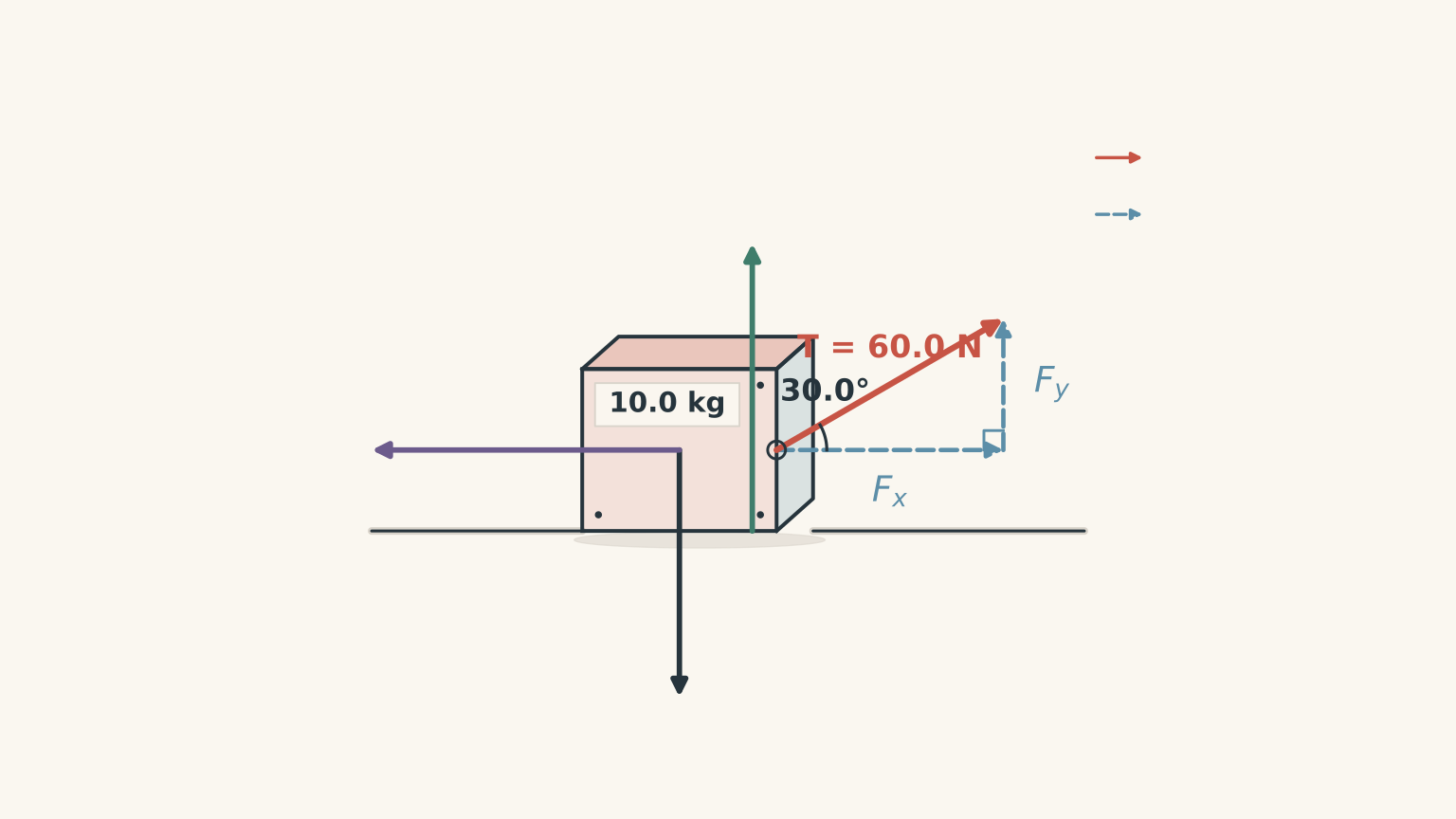
Due to technical limitations, this figure may display incorrectly or contain inaccuracies. Please check key details against your course materials.
Notice that the rope tension is not horizontal. This is why it must be resolved into two components before calculating the horizontal and vertical resultant forces.
(b) Resolve the pulling force into components.
The horizontal component is:
\[ F_x=F\cos\theta \]
Here, \(F_x\) is the horizontal component, \(F\) is the pulling force, and \(\theta\) is the angle measured from the horizontal.
Substitute:
\[ F_x=60.0\cos30^\circ \]
\[ \boxed{F_x=52.0\ \mathrm{N}} \]
The vertical component is:
\[ F_y=F\sin\theta \]
Substitute:
\[ F_y=60.0\sin30^\circ \]
\[ \boxed{F_y=30.0\ \mathrm{N}} \]
Both components act towards the right and upwards respectively.
(c) Calculate the normal reaction force.
First, calculate the crate’s weight:
\[ W=mg \]
\[ W=10.0\times9.8 \]
\[ W=98.0\ \mathrm{N} \]
The crate has zero vertical acceleration, so its vertical resultant force must be zero.
Taking upwards as positive:
\[ F_{\text{net},y}=0 \]
\[ N+30.0-98.0=0 \]
Rearrange:
\[ N=98.0-30.0 \]
\[ \boxed{N=68.0\ \mathrm{N}} \]
The normal reaction is smaller than the crate’s weight because the rope also provides an upward force.
(d) Calculate the resultant horizontal force and acceleration.
The horizontal forces are:
- \(52.0\ \mathrm{N}\) towards the right from the rope.
- \(12.0\ \mathrm{N}\) towards the left from friction.
Taking right as positive:
\[ F_{\text{net},x}=52.0-12.0 \]
\[ F_{\text{net},x}=40.0\ \mathrm{N} \]
The resultant horizontal force is:
\[ \boxed{40.0\ \mathrm{N}\text{ right}} \]
Now apply Newton’s second law:
\[ F_{\text{net}}=ma \]
Rearrange:
\[ a=\frac{F_{\text{net}}}{m} \]
Substitute:
\[ a=\frac{40.0}{10.0} \]
\[ \boxed{a=4.00\ \mathrm{m\,s^{-2}}\text{ right}} \]
The crate accelerates towards the right because the horizontal component of the pulling force is greater than the frictional force.
Marking guide (9 marks)
| Part | Required response | Marks |
|---|---|---|
| (a) | Includes all four forces acting on the crate | 1 |
| (a) | Correct directions and labels | 1 |
| (b) | Correct component equations using cosine and sine | 1 |
| (b) | Correct component magnitudes and units | 1 |
| (c) | Correct vertical equilibrium equation | 1 |
| (c) | Correct normal reaction of 68.0 N | 1 |
| (d) | Correct horizontal resultant of 40.0 N | 1 |
| (d) | Correct application of Newton’s second law | 1 |
| (d) | Correct acceleration and direction | 1 |
| Total | 9 |
Solution 4
(a) Draw a free-body diagram.
Treat the sign, connector, and ring as one combined system.
There are three external forces:
- The gravitational force acting vertically downwards.
- The tension from the left cable, acting upwards and to the left.
- The tension from the right cable, acting upwards and to the right.
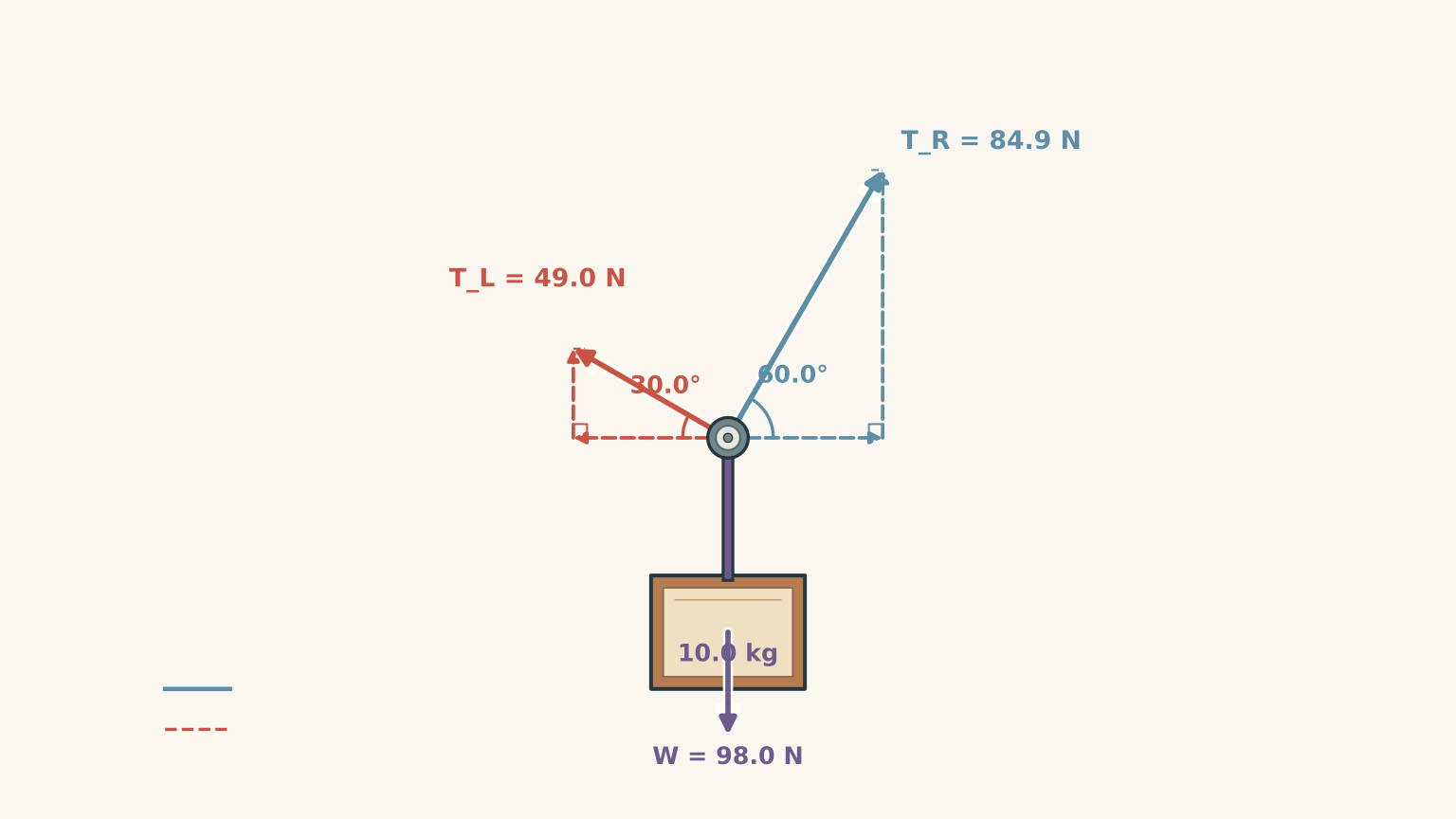
Due to technical limitations, this figure may display incorrectly or contain inaccuracies. Please check key details against your course materials.
The sign is stationary, so the resultant force in both horizontal and vertical directions must be zero.
(b) Write the horizontal equilibrium equation.
The left cable pulls towards the left, while the right cable pulls towards the right.
The horizontal components must balance.
\[ \sum F_x=0 \]
Therefore:
\[ T_R\cos60^\circ-T_L\cos30^\circ=0 \]
Rearrange:
\[ \boxed{T_R\cos60^\circ=T_L\cos30^\circ} \]
This equation relates the two unknown cable tensions.
(c) Calculate the tension in each cable.
First, calculate the weight of the sign.
\[ W=mg \]
\[ W=10.0\times9.8 \]
\[ W=98.0\ \mathrm{N} \]
Because the system is stationary, the vertical forces must also balance.
Therefore:
\[ \sum F_y=0 \]
\[ T_L\sin30^\circ + T_R\sin60^\circ -98.0=0 \]
Rearrange the horizontal equilibrium equation from part (b):
\[ T_R=\frac{T_L\cos30^\circ}{\cos60^\circ} \]
Using the trigonometric values:
\[ T_R=1.732T_L \]
Substitute this into the vertical equilibrium equation:
\[ 0.5T_L+0.866(1.732T_L)=98.0 \]
Simplify:
\[ 0.5T_L+1.50T_L=98.0 \]
\[ 2.00T_L=98.0 \]
Therefore:
\[ \boxed{T_L=49.0\ \mathrm{N}} \]
Now calculate the right cable tension:
\[ T_R=1.732\times49.0 \]
\[ \boxed{T_R=84.9\ \mathrm{N}} \]
The final answers are:
- Left cable tension: \(49.0\ \mathrm{N}\).
- Right cable tension: \(84.9\ \mathrm{N}\).
The right cable has a greater tension because its vertical component must help balance the sign’s weight while its horizontal component balances the left cable.
(d) State the resultant force.
The system is stationary and in equilibrium.
Therefore, the resultant force is:
\[ \boxed{F_{\text{net}}=0\ \mathrm{N}} \]
The two cable tensions do not individually equal the weight. Their combined horizontal and vertical components produce the required balance.
Marking guide (10 marks)
| Part | Required response | Marks |
|---|---|---|
| (a) | Correct weight and two cable tensions identified | 1 |
| (a) | Correct directions and angles | 1 |
| (b) | Correct horizontal components | 1 |
| (b) | Correct horizontal equilibrium equation | 1 |
| (c) | Correct weight calculation | 1 |
| (c) | Correct vertical equilibrium equation | 1 |
| (c) | Correct substitution using horizontal equilibrium | 1 |
| (c) | Correct left cable tension | 1 |
| (c) | Correct right cable tension | 1 |
| (d) | Correct zero resultant force | 1 |
| Total | 10 |
Solution 5
(a) Identify the Newton’s third law partner.
The wall exerts a force of \(90.0\ \mathrm{N}\) towards the left on the skater.
Newton’s third law states that when one object exerts a force on another object, the second object exerts an equal and opposite force on the first.
Therefore, the skater exerts a force of:
\[ \boxed{90.0\ \mathrm{N}\text{ towards the right on the wall}} \]
This is the action-reaction partner of the wall’s force on the skater.
(b) Explain why these forces do not cancel.
The two forces act on different objects.
- The wall exerts a leftward force on the skater.
- The skater exerts a rightward force on the wall.
They are equal in magnitude and opposite in direction, but they cannot cancel on a free-body diagram of the skater because only forces acting on the skater belong on that diagram.
This is a common source of mistakes in Newton’s third law questions.
Balanced forces act on the same object. Action-reaction pairs act on different objects.
(c) Draw a free-body diagram of the skater.
The skater experiences four forces:
- Gravitational force downwards.
- Normal reaction from the ground upwards.
- Force from the wall towards the left.
- Resistive force towards the right.
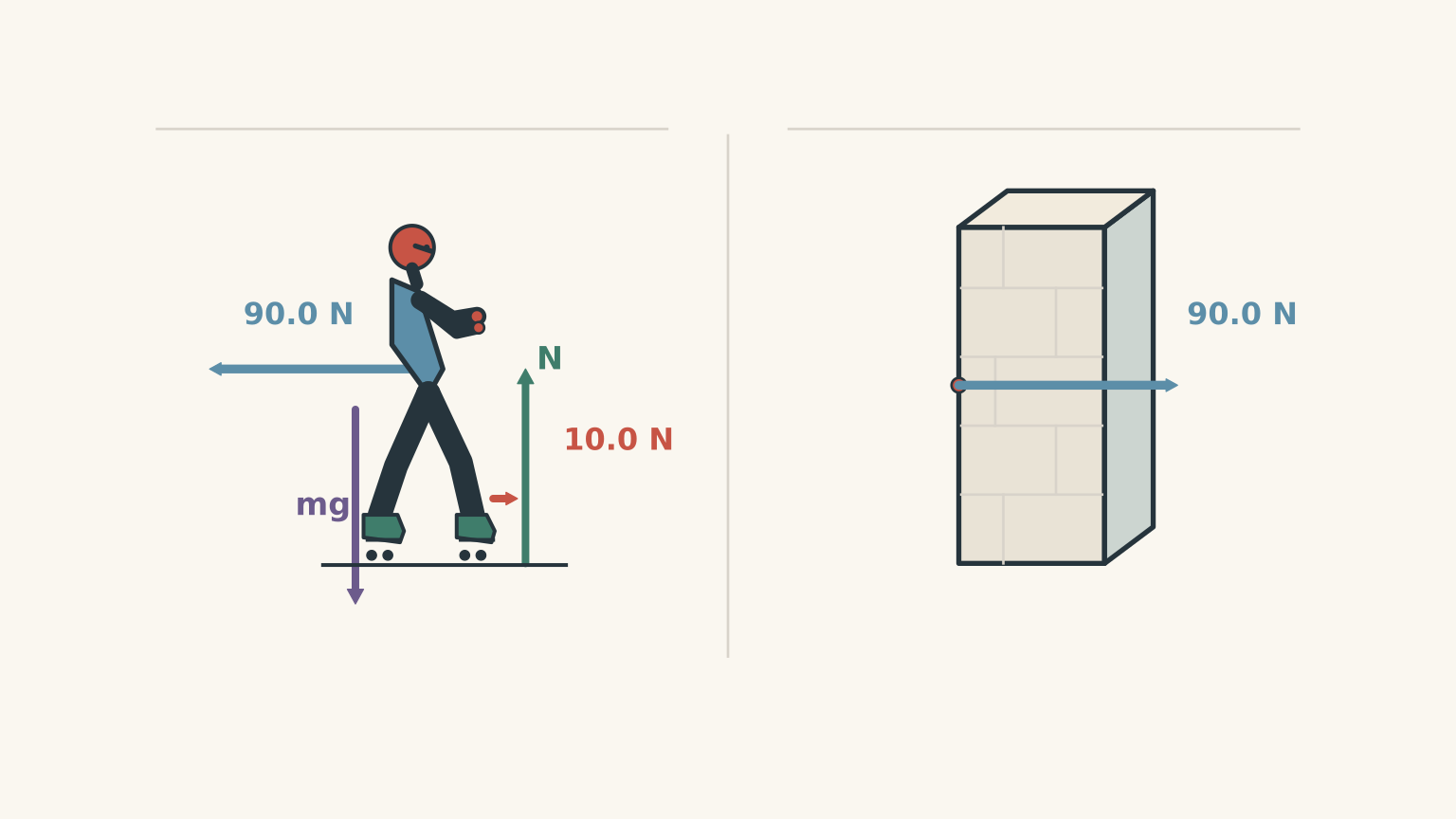
Due to technical limitations, this figure may display incorrectly or contain inaccuracies. Please check key details against your course materials.
Since the skater has zero vertical acceleration, the normal reaction balances the gravitational force.
For reference:
\[ W=mg \]
\[ W=60.0\times9.8=588\ \mathrm{N} \]
Therefore, the normal reaction is also \(588\ \mathrm{N}\).
(d) Calculate the resultant horizontal force and acceleration.
The wall exerts \(90.0\ \mathrm{N}\) towards the left.
The resistive force is \(10.0\ \mathrm{N}\) towards the right.
Taking left as positive:
\[ F_{\text{net}}=90.0-10.0 \]
\[ \boxed{F_{\text{net}}=80.0\ \mathrm{N}\text{ left}} \]
Apply Newton’s second law:
\[ a=\frac{F_{\text{net}}}{m} \]
\[ a=\frac{80.0}{60.0} \]
\[ \boxed{a=1.33\ \mathrm{m\,s^{-2}}\text{ left}} \]
The skater accelerates away from the wall.
Marking guide (8 marks)
| Part | Required response | Marks |
|---|---|---|
| (a) | Identifies the force exerted by the skater on the wall | 1 |
| (a) | Correct magnitude and direction | 1 |
| (b) | Recognises that the forces act on different objects | 1 |
| (b) | Explains why they cannot cancel on the skater’s free-body diagram | 1 |
| (c) | Includes all four forces acting on the skater | 1 |
| (c) | Correct directions and labels | 1 |
| (d) | Correct resultant force and direction | 1 |
| (d) | Correct acceleration and direction | 1 |
| Total | 8 |
Solution 6
(a) Identify the external and internal forces.
Consider carts A and B as one combined system.
The external horizontal forces acting on this system are:
- The applied \(20.0\ \mathrm{N}\) force towards the right.
- The \(2.0\ \mathrm{N}\) resistive force on cart A towards the left.
- The \(3.0\ \mathrm{N}\) resistive force on cart B towards the left.
The tension in the connecting string is an internal force.
Why?
The string pulls cart A towards cart B and pulls cart B towards cart A. These forces are interactions between objects within the combined system.
When we consider both carts as one system, the internal tension forces cancel.
(b) Draw a free-body diagram of the combined system.
The combined system has:
- Applied force of \(20.0\ \mathrm{N}\) towards the right.
- Resistive force of \(2.0\ \mathrm{N}\) towards the left.
- Resistive force of \(3.0\ \mathrm{N}\) towards the left.
- Total gravitational force downwards.
- Total normal reaction upwards.
The string tension is not included because it is internal to the combined system.
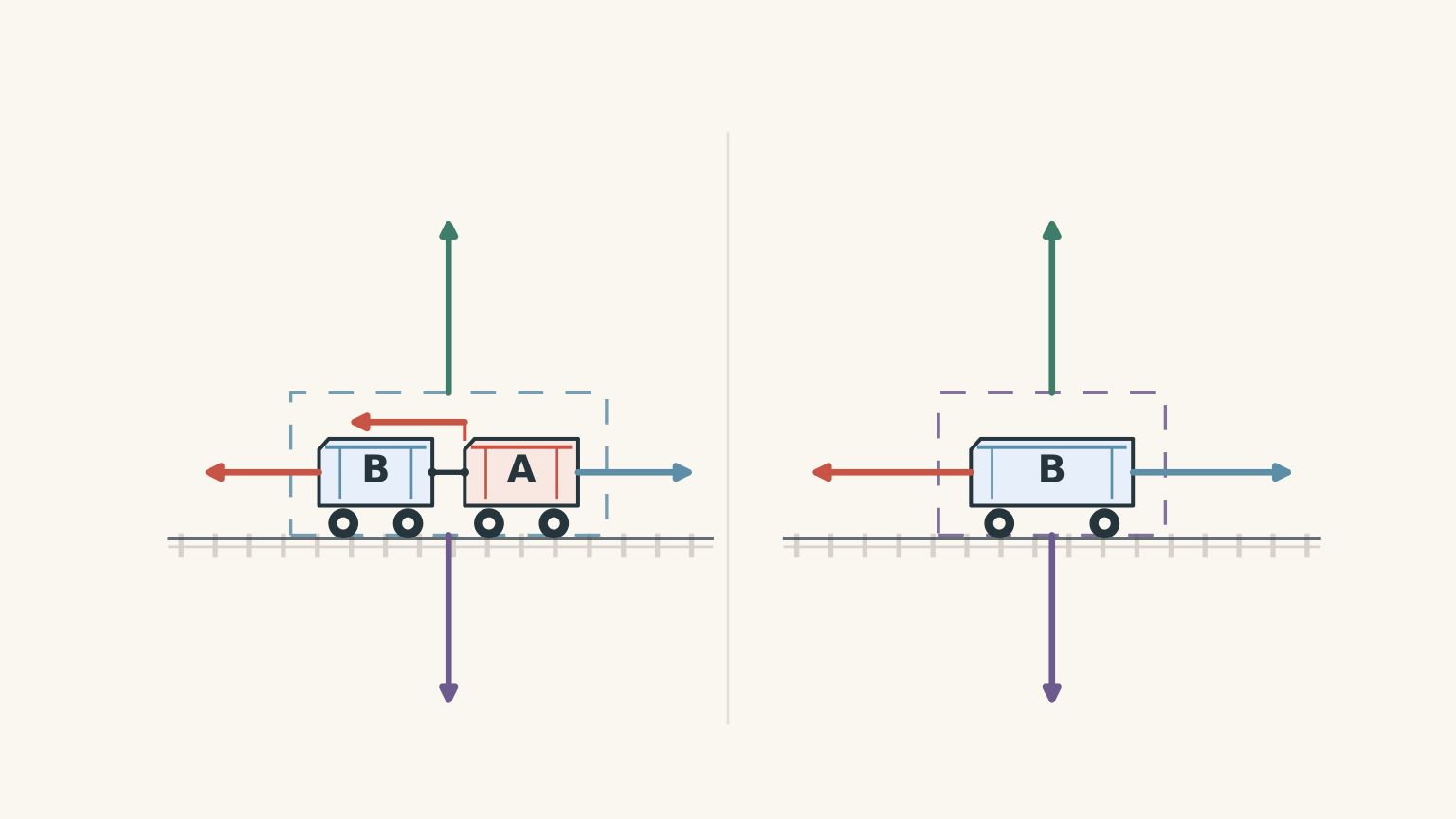
Due to technical limitations, this figure may display incorrectly or contain inaccuracies. Please check key details against your course materials.
(c) Calculate the acceleration of the combined system.
First, calculate the total mass:
\[ m_{\text{total}}=m_A+m_B \]
\[ m_{\text{total}}=3.0+2.0 \]
\[ m_{\text{total}}=5.0\ \mathrm{kg} \]
Next, calculate the horizontal resultant force.
Taking right as positive:
\[ F_{\text{net}}=20.0-2.0-3.0 \]
\[ F_{\text{net}}=15.0\ \mathrm{N} \]
Apply Newton’s second law:
\[ F_{\text{net}}=ma \]
Rearrange:
\[ a=\frac{F_{\text{net}}}{m} \]
Substitute:
\[ a=\frac{15.0}{5.0} \]
\[ \boxed{a=3.00\ \mathrm{m\,s^{-2}}\text{ right}} \]
Both carts accelerate together at \(3.00\ \mathrm{m\,s^{-2}}\).
(d) Calculate the tension in the string.
Now consider cart B by itself.
This is an important change of system.
When we isolate cart B, the tension becomes an external force acting on it.
The horizontal forces on cart B are:
- Tension \(T\) towards the right.
- Friction of \(3.0\ \mathrm{N}\) towards the left.
Cart B has a mass of \(2.0\ \mathrm{kg}\) and accelerates at \(3.00\ \mathrm{m\,s^{-2}}\).
Apply Newton’s second law:
\[ F_{\text{net}}=m_Ba \]
Taking right as positive:
\[ T-3.0=2.0\times3.00 \]
\[ T-3.0=6.0 \]
Rearrange:
\[ T=6.0+3.0 \]
\[ \boxed{T=9.0\ \mathrm{N}} \]
The tension in the string is \(9.0\ \mathrm{N}\).
Notice how choosing the correct system makes the calculation much easier. For the combined system, tension is internal. For cart B alone, tension is an external force.
Marking guide (10 marks)
| Part | Required response | Marks |
|---|---|---|
| (a) | Identifies the applied force and both resistive forces as external | 1 |
| (a) | Identifies string tension as internal | 1 |
| (b) | Correct horizontal external forces, excluding tension | 1 |
| (b) | Correct vertical forces | 1 |
| (c) | Correct resultant horizontal force | 1 |
| (c) | Correct total mass | 1 |
| (c) | Correct acceleration and direction | 1 |
| (d) | Correct application of Newton’s second law to cart B | 1 |
| (d) | Correct substitution using cart B’s acceleration | 1 |
| (d) | Correct string tension | 1 |
| Total | 10 |
Solution 7
(a) Determine the resultant horizontal force.
The puck experiences two perpendicular horizontal forces:
- \(30.0\ \mathrm{N}\) east.
- \(40.0\ \mathrm{N}\) north.
Because the forces are perpendicular, we can use Pythagoras’ theorem to calculate the magnitude of the resultant.
\[ F_{\text{net}}= \sqrt{30.0^2+40.0^2} \]
\[ F_{\text{net}}= \sqrt{900+1600} \]
\[ F_{\text{net}}=\sqrt{2500} \]
\[ \boxed{F_{\text{net}}=50.0\ \mathrm{N}} \]
Now calculate the direction.
Let \(\theta\) be the angle north of east.
Using trigonometry:
\[ \tan\theta=\frac{\text{opposite}}{\text{adjacent}} \]
\[ \tan\theta=\frac{40.0}{30.0} \]
Therefore:
\[ \theta=\tan^{-1}\left(\frac{40.0}{30.0}\right) \]
\[ \boxed{\theta=53.1^\circ} \]
The resultant force is:
\[ \boxed{50.0\ \mathrm{N},\ 53.1^\circ\text{ north of east}} \]
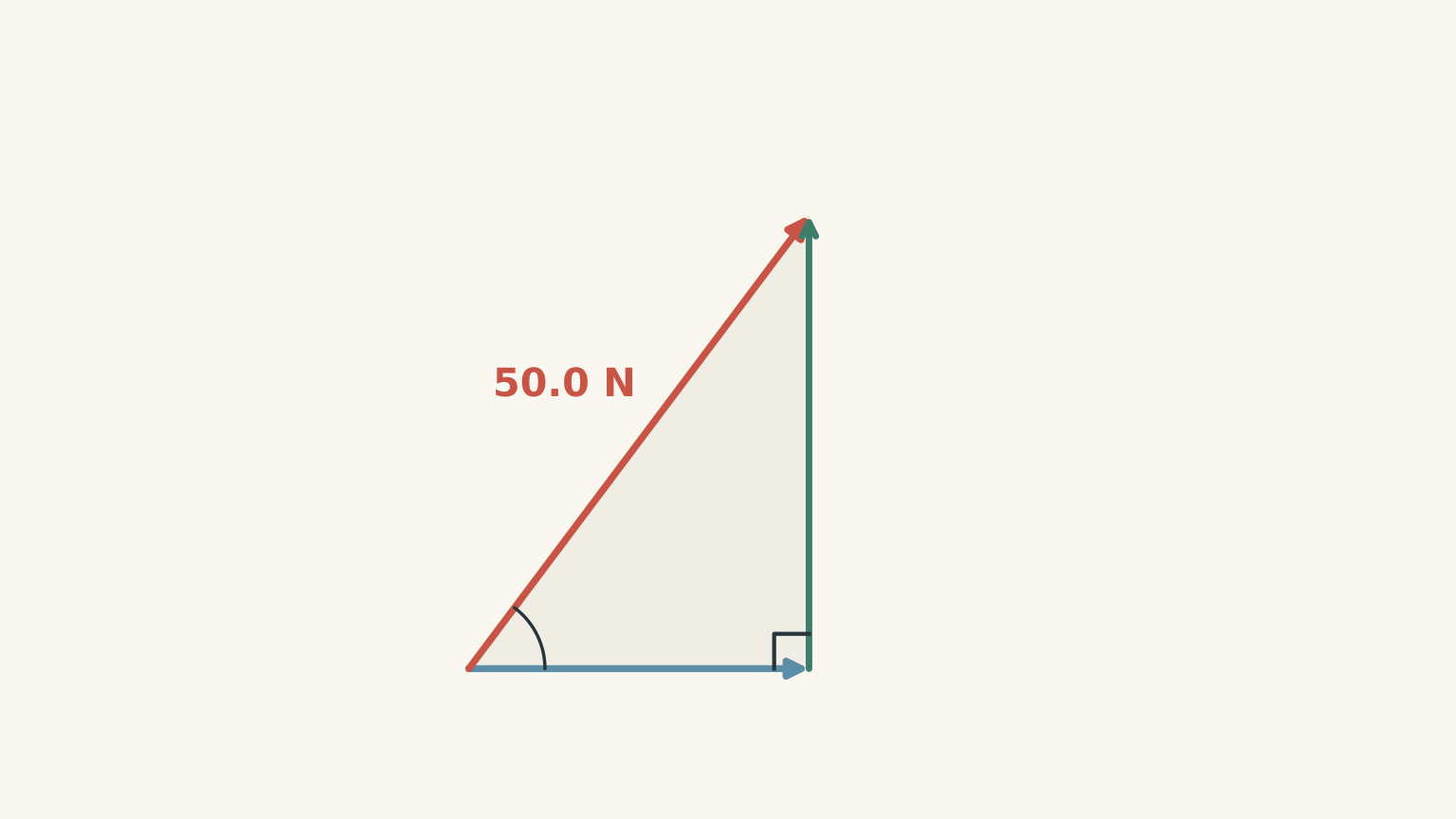
Due to technical limitations, this figure may display incorrectly or contain inaccuracies. Please check key details against your course materials.
(b) Calculate the acceleration.
Apply Newton’s second law:
\[ F_{\text{net}}=ma \]
Rearrange:
\[ a=\frac{F_{\text{net}}}{m} \]
Substitute:
\[ a=\frac{50.0}{10.0} \]
\[ \boxed{a=5.00\ \mathrm{m\,s^{-2}}} \]
The acceleration has the same direction as the resultant force.
Therefore:
\[ \boxed{a=5.00\ \mathrm{m\,s^{-2}},\ 53.1^\circ\text{ north of east}} \]
(c) Calculate the velocity after \(2.00\ \mathrm{s}\).
The puck starts from rest, so its initial velocity is zero.
Use the constant-acceleration equation:
\[ v=u+at \]
where \(v\) is final velocity, \(u\) is initial velocity, \(a\) is acceleration, and \(t\) is elapsed time.
Substitute:
\[ v=0+(5.00\times2.00) \]
\[ \boxed{v=10.0\ \mathrm{m\,s^{-1}}} \]
The velocity points in the same direction as the acceleration.
Therefore, the final answer is:
\[ \boxed{ 10.0\ \mathrm{m\,s^{-1}}, \ 53.1^\circ\text{ north of east} } \]
Marking guide (7 marks)
| Part | Required response | Marks |
|---|---|---|
| (a) | Correct vector diagram showing perpendicular forces and resultant | 1 |
| (a) | Correct resultant magnitude | 1 |
| (a) | Correct direction | 1 |
| (b) | Correct application of Newton’s second law | 1 |
| (b) | Correct acceleration magnitude and direction | 1 |
| (c) | Correct use of the constant-acceleration equation | 1 |
| (c) | Correct velocity magnitude and direction | 1 |
| Total | 7 |
04Final revision checklist
Before considering this paper complete, check that you can perform each of the following without looking at the solutions.
- [ ] Identify the object exerting each force.
- [ ] Distinguish contact forces from field forces.
- [ ] Draw a free-body diagram containing only forces acting on the chosen object.
- [ ] Calculate resultant forces in horizontal and vertical directions.
- [ ] Recognise equilibrium and explain what zero resultant force means.
- [ ] Apply Newton’s first law to objects moving at constant velocity.
- [ ] Apply \(F_{\text{net}}=ma\) to calculate acceleration or resultant force.
- [ ] Identify action-reaction pairs and explain why they act on different objects.
- [ ] Resolve angled forces using sine and cosine.
- [ ] Choose between analysing an individual object and analysing a combined system.
- [ ] Calculate the resultant of two perpendicular forces.
- [ ] Include correct directions and units in vector answers.
Common mistakes to check
Drawing forces that do not act on the chosen object. Always isolate the object first. A force exerted by an object on something else does not belong on its free-body diagram.
Confusing balanced forces with Newton’s third law pairs. Balanced forces act on the same object. Third-law pairs act on different objects.
Assuming zero resultant force means zero velocity. An object can move at constant velocity while experiencing zero resultant force.
Using the wrong trigonometric function. When the angle is measured from the horizontal, use cosine for the horizontal component and sine for the vertical component.
Using total mass when calculating the tension in one cart. If you isolate an individual cart, use that cart’s mass and acceleration.
Forgetting direction in vector calculations. A force of \(50\ \mathrm{N}\) is not a complete vector answer if the question also asks for its direction.
Equivalent mathematical methods should receive the same credit where they demonstrate correct physics. Follow-through marks are appropriate when an earlier numerical error is carried consistently into a later calculation and the subsequent method is correct.
The key skill across this entire topic is choosing the correct object or system before applying Newton’s laws. Once you have done that, identifying the forces, resolving components, and calculating acceleration become much more straightforward.