
How to Compare Two Fuels Fairly Using Calorimetry Data
Learn how to compare fuels using experimental calorimetry data. Work through heat calculations, fuel mass corrections, molar enthalpy, and energy released per gram or millilitre, with HSC-style worked examples and practice questions.
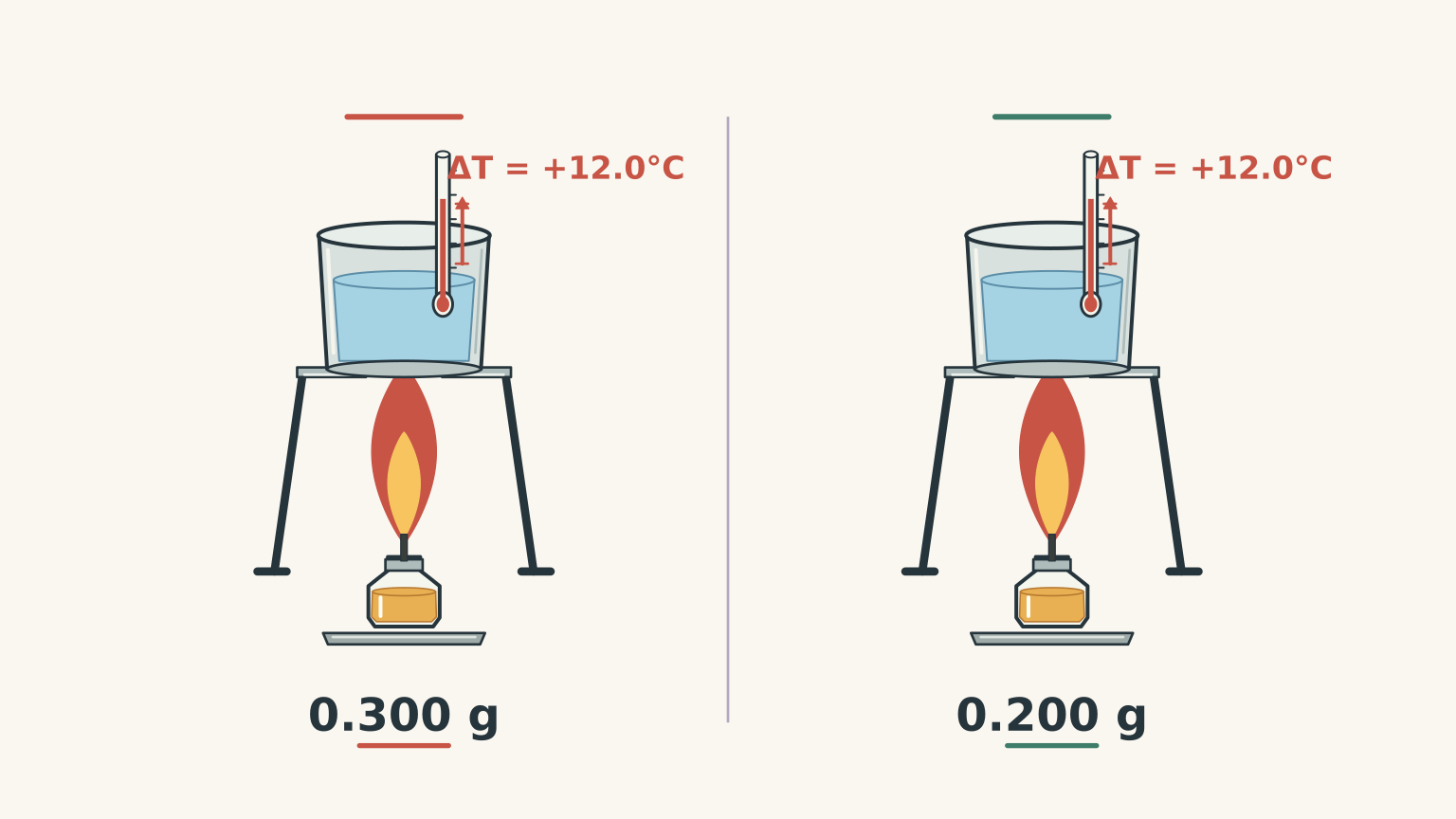
Two spirit burners each heat 100.0 g of water by 12.0°C. Burner A loses 0.300 g of fuel, while burner B loses just 0.200 g.
The temperature rises are identical. Does that mean the fuels release the same amount of energy?
Not quite. Both experiments transfer the same amount of heat to the water, but burner B achieves this using less fuel. It therefore has a greater measured energy release per gram.
This is the key to comparing fuels fairly using calorimetry data: calculate the heat transferred to the surroundings, determine the actual amount of fuel that reacted, and divide by the appropriate amount of fuel.
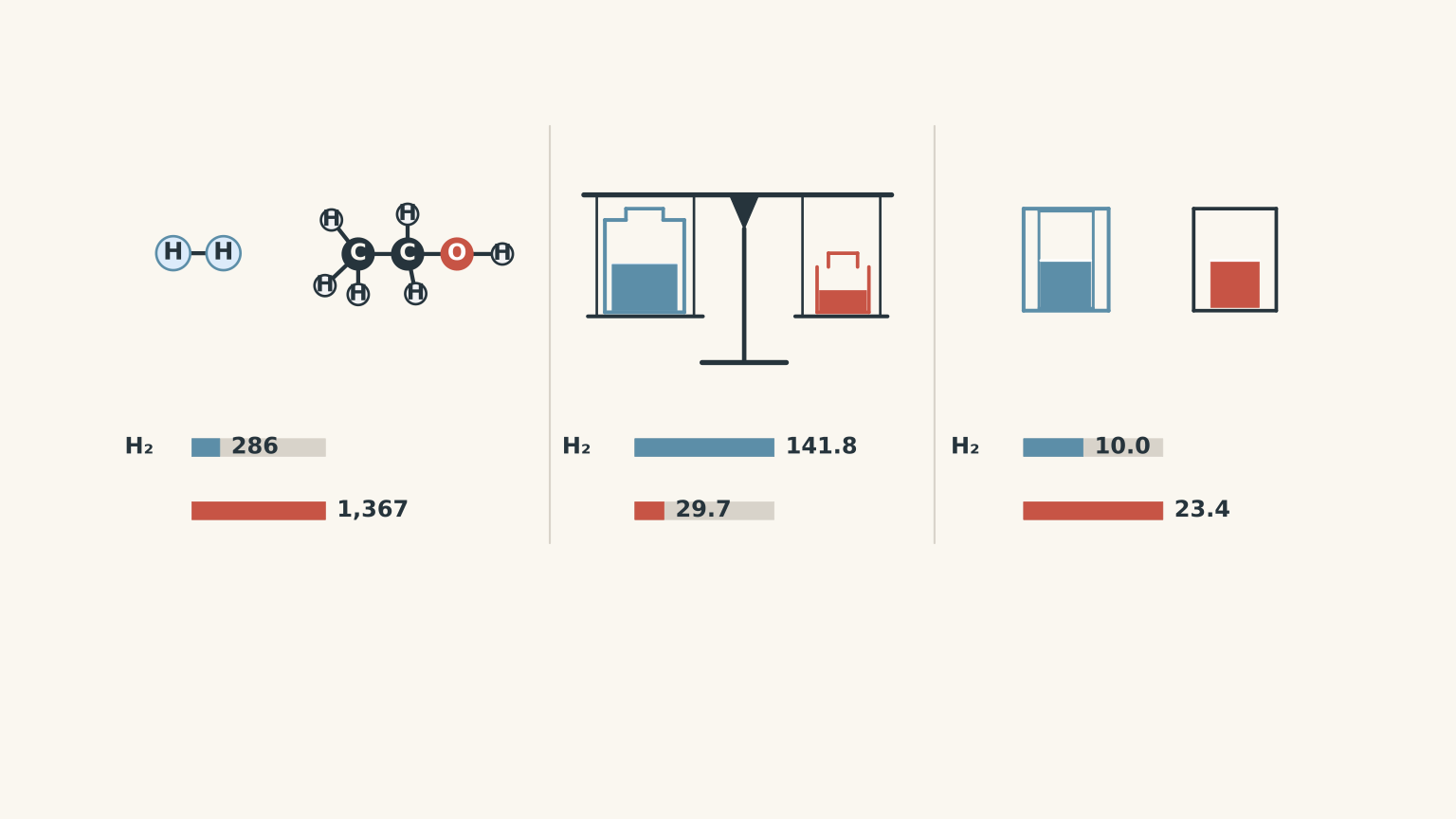
The correct comparison depends on what you want to know:
- Energy per mole (kJ mol⁻¹): Compare the experimental molar enthalpies of combustion.
- Energy per gram (kJ g⁻¹): Compare how much energy each fuel provides for a given mass.
- Energy per millilitre (kJ mL⁻¹): Compare how much energy each fuel provides for a given volume.
These measurements can produce different rankings. Let’s work through why.
Due to technical limitations, this figure may display incorrectly or contain inaccuracies. Please check key details against your course materials.
01Understand what is gaining and losing heat
Before calculating an enthalpy change, identify the system and its surroundings.
In a combustion experiment:
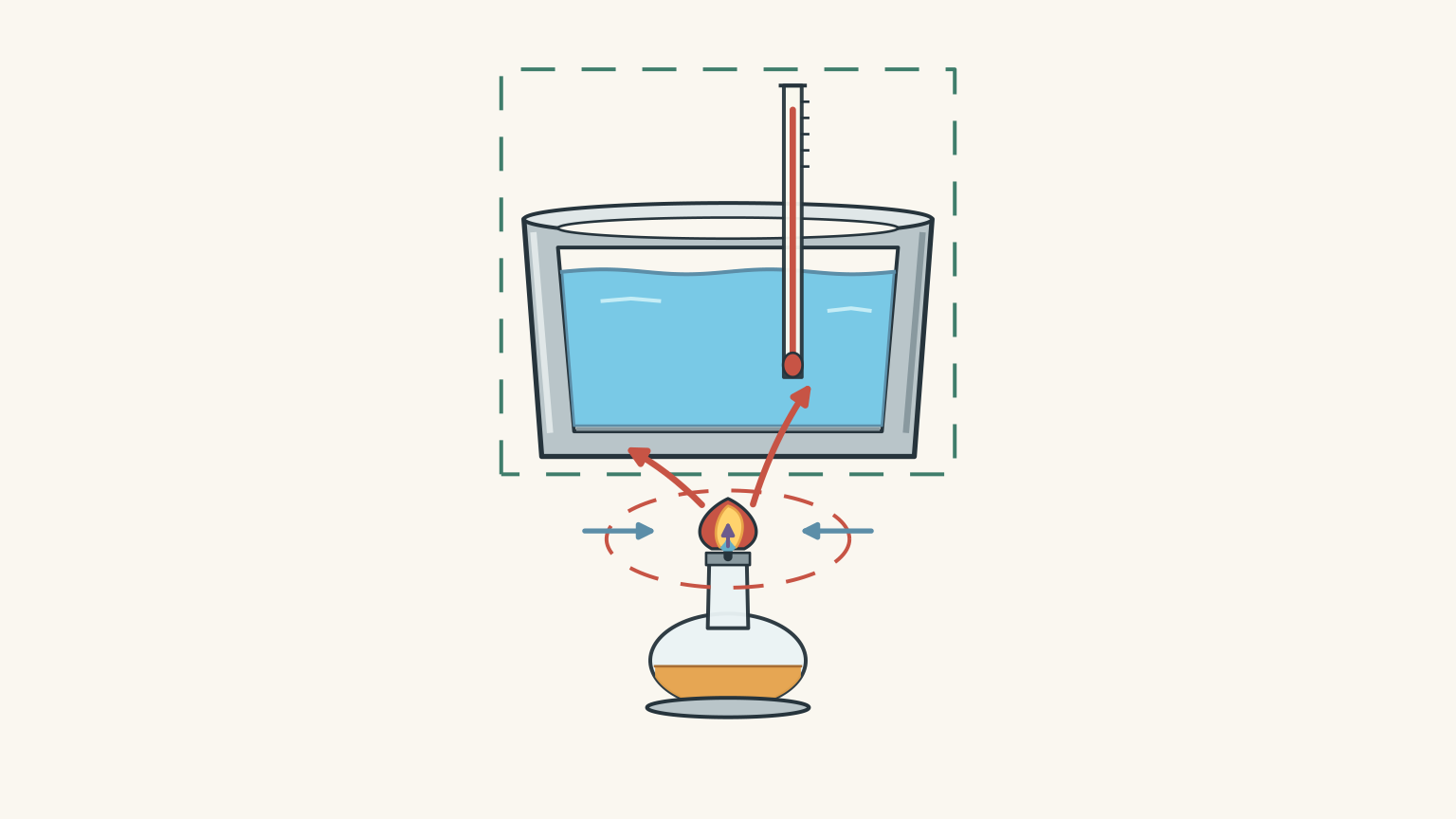
- The system is the chemical reaction: the fuel reacts with oxygen to form combustion products.
- The surroundings are everything receiving heat from that reaction. In a simple calorimetry experiment, these include the water and the calorimeter.
When a fuel burns, energy is transferred from the reaction to the surroundings.
This means the water temperature increases, but the combustion reaction loses energy.
Due to technical limitations, this figure may display incorrectly or contain inaccuracies. Please check key details against your course materials.
Understanding the sign of heat transfer
The symbol \(q\) represents heat transferred.
For an exothermic combustion reaction:
- The surroundings gain heat, so \(q_{\text{surroundings}}\) is positive.
- The combustion reaction loses heat, so \(q_{\text{combustion}}\) is negative.
Assuming no heat escapes to the room, conservation of energy gives:
\[ q_{\text{combustion}}=-q_{\text{surroundings}} \]
This negative sign is important.
If the water absorbs 5.00 kJ of heat, the combustion reaction releases 5.00 kJ:
\[ q_{\text{water}}=+5.00\text{ kJ} \]
\[ q_{\text{combustion}}=-5.00\text{ kJ} \]
The reaction is exothermic because its enthalpy change is negative.
You might also see energy released reported as a positive number. For example, a fuel releasing 5.00 kJ has an energy release of 5.00 kJ, but the corresponding reaction heat is -5.00 kJ.
Keep these two ways of reporting energy separate.
02Calculate the heat absorbed by the surroundings
The first calculation is usually the heat absorbed by the water.
Use:
\[ q_{\text{water}}=mc\Delta T \]
Where:
- \(q_{\text{water}}\) = heat absorbed by the water, in joules (J).
- \(m\) = mass of water, in grams (g).
- \(c\) = specific heat capacity of water, \(4.18\text{ J g}^{-1}\,^\circ\text{C}^{-1}\).
- \(\Delta T\) = temperature change, in °C.
Calculate the temperature change using:
\[ \Delta T=T_{\text{final}}-T_{\text{initial}} \]
A temperature rise gives a positive value of \(\Delta T\), meaning the water has gained heat.
Don’t forget the calorimeter itself
Here is a detail that can change your answer.
The water isn’t the only thing absorbing energy. The metal container and other parts of the calorimeter also warm up.
If the question provides the calorimeter’s heat capacity, include it:
\[ q_{\text{cal}}=C_{\text{cal}}\Delta T \]
Where:
- \(q_{\text{cal}}\) = heat absorbed by the calorimeter, in J or kJ.
- \(C_{\text{cal}}\) = heat capacity of the calorimeter, in J °C⁻¹ or kJ °C⁻¹.
- \(\Delta T\) = temperature change, in °C.
The total heat absorbed is then:
\[ q_{\text{surroundings}} =q_{\text{water}}+q_{\text{cal}} \]
And the heat released by the combustion reaction is:
\[ \boxed{q_{\text{combustion}} =-(q_{\text{water}}+q_{\text{cal}})} \]
If the question does not provide a calorimeter heat capacity, you may be expected to ignore it. Follow the assumptions given.
However, remember that ignoring the calorimeter’s heat absorption generally underestimates the magnitude of the heat released.
For a more detailed explanation of the temperature-rise calculation, see How to Calculate Enthalpy Change from a Temperature Rise.
What about heat lost to the room?
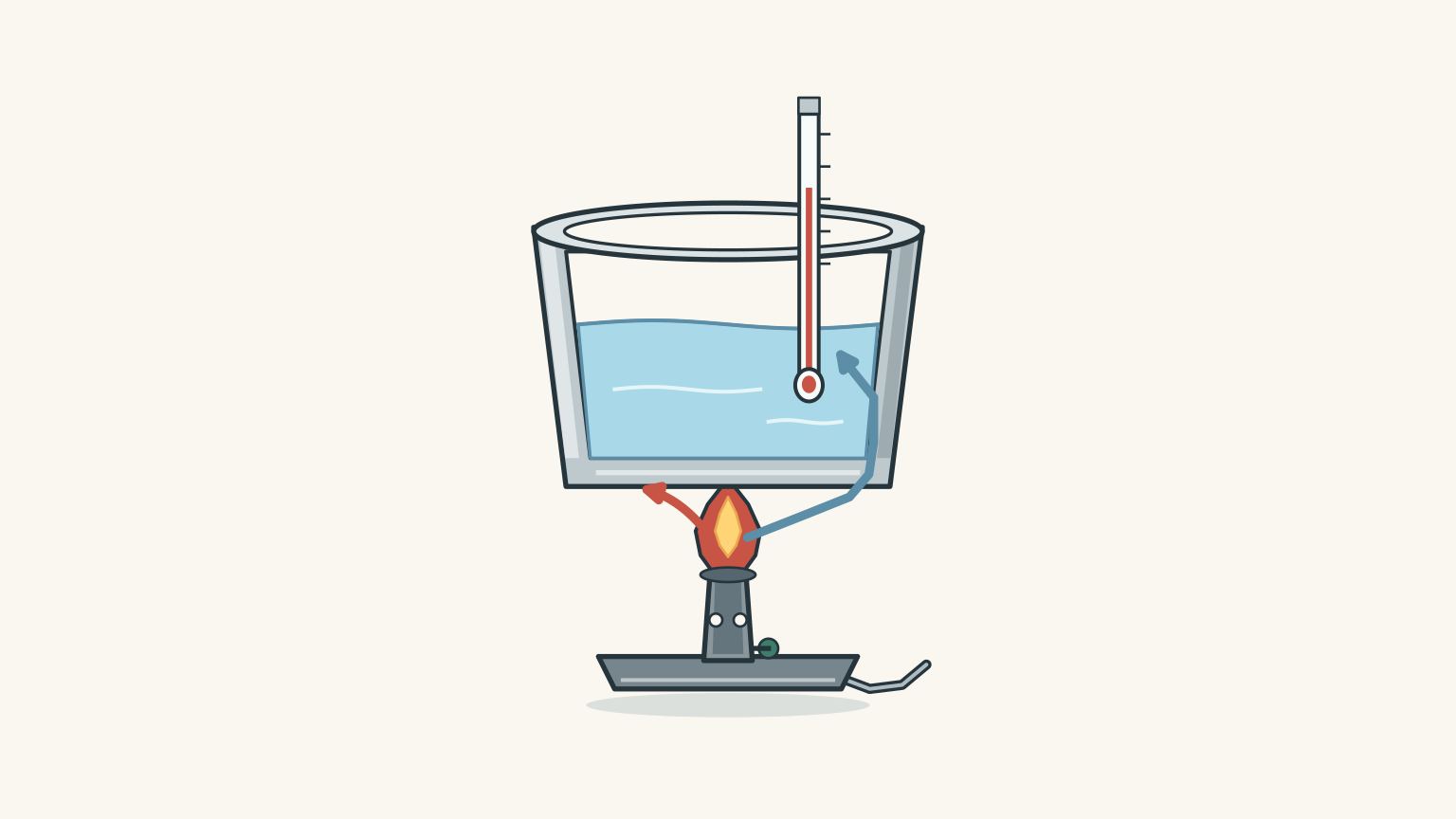
In a real spirit-burner experiment, some energy escapes into the air rather than heating the water and calorimeter.
If this energy is not measured, the calculated heat release is smaller than the actual heat released.
This means the experimental enthalpy of combustion will usually be less negative than the true value for complete combustion.
For now, use the assumption that heat loss to the surroundings is negligible unless the question provides a correction.
03Determine how much fuel actually reacted
This is the second major part of a fair comparison.
Imagine two experiments:
- Experiment A burns 0.500 g of fuel.
- Experiment B burns 0.250 g of fuel.
Even if both experiments release 5.00 kJ, the fuels haven’t demonstrated the same energy release per gram.
You need to know the amount of fuel that actually reacted.
For a spirit burner, this is often determined by weighing the burner before and after combustion.
\[ m_{\text{fuel burnt}} =m_{\text{initial}}-m_{\text{final}} \]
For example:
\[ m_{\text{fuel burnt}}=50.80-50.50 \]
\[ =0.30\text{ g} \]
The fuel mass burnt is 0.30 g.
A limitation of this method: evaporation
There is a catch.
A spirit burner can lose fuel through evaporation as well as combustion. If fuel evaporates without burning, the measured mass decrease overestimates the amount that reacted.
A more careful experiment uses an evaporation control.
For example:
- Burner mass decreases by 0.400 g during the burning trial.
- A matched unlit control loses 0.050 g through evaporation.
The estimated mass actually burnt is:
\[ m_{\text{burnt}}=0.400-0.050 \]
\[ \boxed{m_{\text{burnt}}=0.350\text{ g}} \]
This correction assumes the unlit control provides a reliable estimate of evaporation during the burning trial.
If a question explicitly states that all measured mass loss is due to combustion, you can use the full mass decrease.
Converting mass into moles
If the question asks for molar enthalpy of combustion, you need the number of moles of fuel burnt.
Use:
\[ n=\frac{m}{M} \]
Where:
- \(n\) = amount of fuel, in mol.
- \(m\) = mass of fuel burnt, in g.
- \(M\) = molar mass of the fuel, in g mol⁻¹.
For example, if 0.300 g of a fuel with a molar mass of 60.0 g mol⁻¹ burns:
\[ n=\frac{0.300}{60.0} \]
\[ \boxed{n=0.00500\text{ mol}} \]
Notice that equal masses of two different fuels do not necessarily represent equal numbers of moles.
This is one reason you cannot automatically compare their molar enthalpies using the same mass of fuel.
04Choose the correct basis for comparison
Now you have the heat released and the amount of fuel that reacted.
The final step is choosing the correct denominator.
| What are you comparing? | Calculation | Units |
|---|---|---|
| Molar enthalpy of combustion | \(q_{\text{combustion}}/n\) | kJ mol⁻¹ |
| Energy released per gram | \(|q_{\text{combustion}}|/m\) | kJ g⁻¹ |
| Energy released per millilitre | \(|q_{\text{combustion}}|/V\) | kJ mL⁻¹ |
For molar enthalpy, retain the negative sign because combustion is exothermic.
For energy per gram or millilitre, the positive magnitude is normally used because you’re describing how much energy the fuel provides.
When should you use each comparison?
Molar enthalpy of combustion
Use this when the question asks which fuel has the more exothermic combustion reaction per mole.
A more negative value means more energy is released per mole of fuel.
Energy per gram
Use this when comparing fuels based on mass.
For example, if you’re transporting fuel in a vehicle, a higher energy release per gram means more energy can be carried for the same fuel mass.
Energy per millilitre
Use this when comparing fuels based on storage volume.
A fuel can have a lower energy release per gram but a higher energy release per millilitre if it is sufficiently dense.
There is no universally correct answer to which fuel is better without specifying the comparison.
Due to technical limitations, this figure may display incorrectly or contain inaccuracies. Please check key details against your course materials.
05Worked examples
Worked example: Comparing two fuels using energy per gram
Two fuels are tested using identical spirit burners and calorimeters. Each experiment heats 100.0 g of water by 15.0°C.
The following data are recorded:
| Measurement | Fuel A | Fuel B |
|---|---|---|
| Mass of fuel burnt | 0.300 g | 0.200 g |
| Mass of water | 100.0 g | 100.0 g |
| Temperature rise | 15.0°C | 15.0°C |
Assume complete combustion, negligible heat loss, and negligible heat absorption by the calorimeter.
Calculate the energy released per gram for each fuel. Determine which fuel has the greater mass-specific energy.
Step 1
Both experiments have the same water mass and temperature rise.
\[ q_{\text{water}}=mc\Delta T \]
\[ =100.0\times4.18\times15.0 \]
\[ =6270\text{ J} \]
Convert to kilojoules:
\[ q_{\text{water}}=6.27\text{ kJ} \]
Step 2
Since the water absorbs 6.27 kJ, each combustion reaction releases 6.27 kJ.
\[ q_{\text{combustion}}=-6.27\text{ kJ} \]
Step 3
For Fuel A:
\[ e_A=\frac{6.27}{0.300} \]
\[ \boxed{e_A=20.9\text{ kJ g}^{-1}} \]
For Fuel B:
\[ e_B=\frac{6.27}{0.200} \]
\[ \boxed{e_B=31.4\text{ kJ g}^{-1}} \]
Step 4
Fuel B releases more energy per gram.
Both fuels transferred the same amount of heat to the water, but Fuel B required less fuel to do so.
The important point is that identical temperature rises do not necessarily indicate identical energy content per gram.
Worked example: Comparing molar enthalpies of combustion
Methanol and ethanol are tested separately using the same calorimeter.
Each experiment uses 150.0 g of water. The calorimeter has a heat capacity of 0.200 kJ °C⁻¹.
The experimental data are:
| Measurement | Methanol | Ethanol |
|---|---|---|
| Mass burnt | 0.160 g | 0.230 g |
| Molar mass | 32.0 g mol⁻¹ | 46.0 g mol⁻¹ |
| Temperature rise | 4.40°C | 8.30°C |
The specific heat capacity of water is 4.18 J g⁻¹ °C⁻¹.
Calculate the experimental molar enthalpy of combustion for each fuel and determine which is more exothermic per mole.
All experimental data are illustrative.
Step 1
\[ q_{\text{water}}=mc\Delta T \]
\[ =150.0\times4.18\times4.40 \]
\[ =2758.8\text{ J} \]
Convert to kilojoules:
\[ q_{\text{water}}=2.759\text{ kJ} \]
Step 2
\[ q_{\text{cal}}=C_{\text{cal}}\Delta T \]
\[ =0.200\times4.40 \]
\[ =0.880\text{ kJ} \]
Step 3
\[ q_{\text{surroundings}}=2.759+0.880 \]
\[ =3.639\text{ kJ} \]
Therefore:
\[ q_{\text{combustion}}=-3.639\text{ kJ} \]
Step 4
\[ n=\frac{m}{M} \]
\[ =\frac{0.160}{32.0} \]
\[ =0.00500\text{ mol} \]
Step 5
\[ \Delta_c H=\frac{q_{\text{combustion}}}{n} \]
\[ =\frac{-3.639}{0.00500} \]
\[ \boxed{\Delta_c H=-728\text{ kJ mol}^{-1}} \]
Step 6
First, calculate the heat absorbed by the water:
\[ q_{\text{water}}=150.0\times4.18\times8.30 \]
\[ =5204.1\text{ J}=5.204\text{ kJ} \]
Next, calculate the heat absorbed by the calorimeter:
\[ q_{\text{cal}}=0.200\times8.30 \]
\[ =1.660\text{ kJ} \]
Total heat absorbed:
\[ q_{\text{surroundings}}=5.204+1.660 \]
\[ =6.864\text{ kJ} \]
Therefore:
\[ q_{\text{combustion}}=-6.864\text{ kJ} \]
Calculate the amount of ethanol burnt:
\[ n=\frac{0.230}{46.0} \]
\[ =0.00500\text{ mol} \]
Calculate its molar enthalpy:
\[ \Delta_c H=\frac{-6.864}{0.00500} \]
\[ \boxed{\Delta_c H=-1373\text{ kJ mol}^{-1}} \]
Step 7
| Fuel | Experimental molar enthalpy |
|---|---|
| Methanol | -728 kJ mol⁻¹ |
| Ethanol | -1373 kJ mol⁻¹ |
Ethanol has the more negative molar enthalpy of combustion.
It releases more energy per mole than methanol under the stated experimental assumptions.
Notice that both experiments burnt exactly 0.00500 mol of fuel. This makes the comparison particularly straightforward, although the calculation method works even when different mole amounts are used.
Due to technical limitations, this figure may display incorrectly or contain inaccuracies. Please check key details against your course materials.
06A common trap: More energy per mole doesn’t always mean more energy per gram
Consider two hypothetical fuels with the following illustrative data:
| Measurement | Fuel P | Fuel Q |
|---|---|---|
| Molar mass | 16.0 g mol⁻¹ | 44.0 g mol⁻¹ |
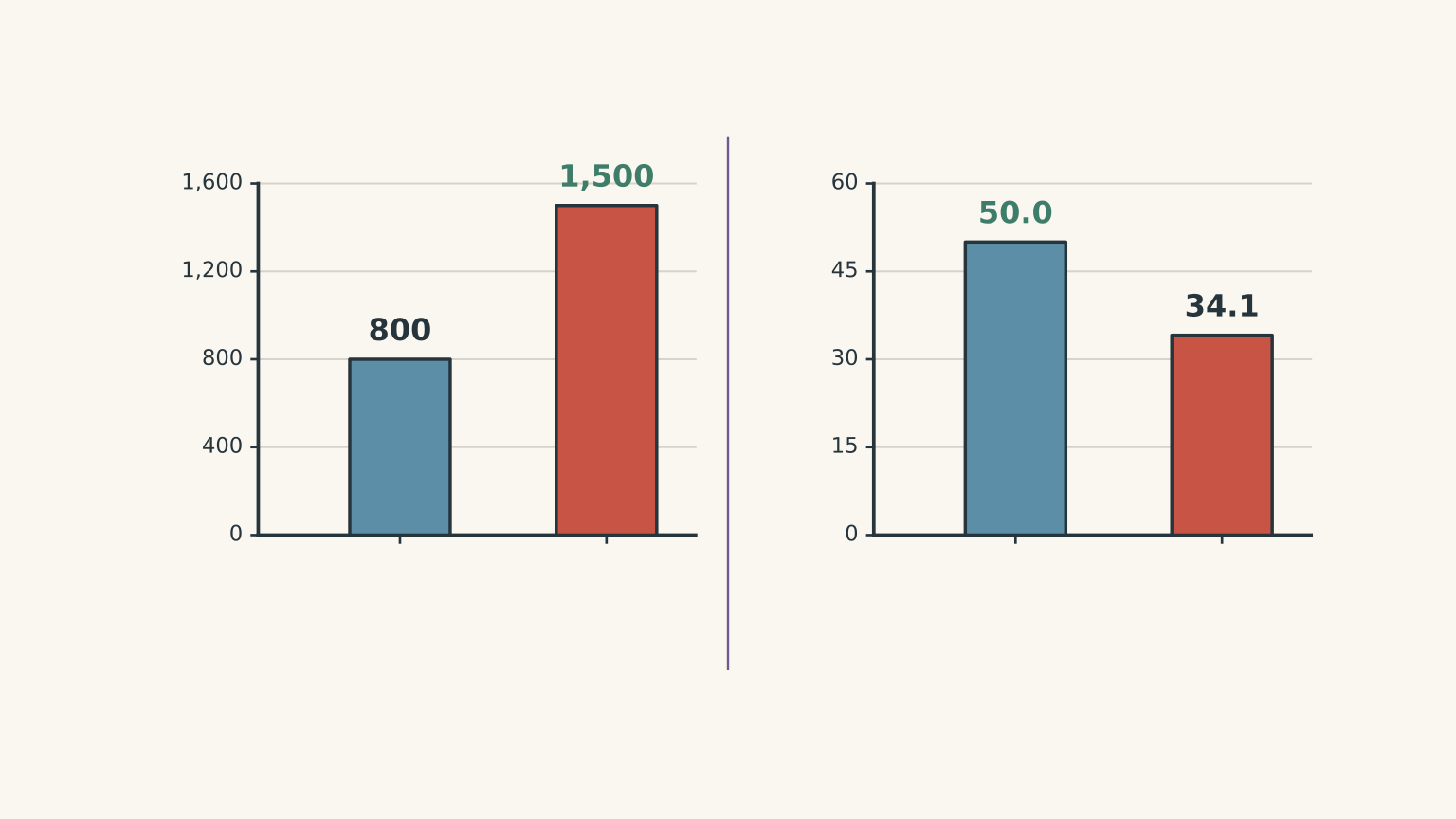
| Molar enthalpy of combustion | -800 kJ mol⁻¹ | -1500 kJ mol⁻¹ |
Which fuel releases more energy?
Per mole, Fuel Q releases more energy because its enthalpy of combustion is more negative.
But let’s compare energy per gram.
For Fuel P:
\[ e_P=\frac{800}{16.0} \]
\[ =50.0\text{ kJ g}^{-1} \]
For Fuel Q:
\[ e_Q=\frac{1500}{44.0} \]
\[ =34.1\text{ kJ g}^{-1} \]
Fuel P actually releases more energy per gram.
Due to technical limitations, this figure may display incorrectly or contain inaccuracies. Please check key details against your course materials.
This is a useful distinction to remember:
- A larger molar enthalpy magnitude does not automatically mean a larger energy release per gram.
- A larger energy release per gram does not automatically mean a larger energy release per millilitre.
- You must state the basis of comparison before deciding which fuel performs better.
For more on how fuel structure relates to energy release, see Organic Fuels and Biofuels: HSC Chemistry Comparison Guide.
07Questions and solutions
Question 1
A student burns 0.150 g of a fuel beneath a container holding 100.0 g of water.
The water temperature increases by 6.00°C.
Assume that the calorimeter absorbs negligible heat, all the fuel burns completely, and no heat is lost to the surroundings.
Given that the specific heat capacity of water is 4.18 J g⁻¹ °C⁻¹, calculate:
a) The heat absorbed by the water.
b) The heat released by the combustion reaction.
c) The energy released per gram of fuel.
Solution 1
The fuel releases 2.51 kJ of heat, equivalent to 16.7 kJ per gram.
a) Heat absorbed by the water
Use:
\[ q_{\text{water}}=mc\Delta T \]
Substitute:
\[ q_{\text{water}} =100.0\times4.18\times6.00 \]
\[ =2508\text{ J} \]
\[ \boxed{q_{\text{water}}=+2.508\text{ kJ}} \]
b) Heat released by combustion
The water gains heat, so the combustion reaction loses an equal amount under the stated assumptions.
\[ q_{\text{combustion}}=-q_{\text{water}} \]
\[ \boxed{q_{\text{combustion}}=-2.508\text{ kJ}} \]
c) Energy released per gram
Divide the positive magnitude of the heat released by the mass of fuel burnt.
\[ e=\frac{2.508}{0.150} \]
\[ \boxed{e=16.7\text{ kJ g}^{-1}} \]
This value allows the fuel to be compared with another fuel on a mass basis.
Question 2
A student uses a calorimeter containing 200.0 g of water to investigate a fuel.
The following information is recorded:
- Initial water temperature: 20.0°C
- Final water temperature: 27.50°C
- Mass of fuel burnt: 0.300 g
- Molar mass of fuel: 60.0 g mol⁻¹
- Calorimeter heat capacity: 0.350 kJ °C⁻¹
Assume complete combustion and negligible heat loss to the room.
Calculate the experimental molar enthalpy of combustion of the fuel.
Explain why ignoring the calorimeter’s heat capacity would produce an inaccurate result.
Solution 2
The experimental molar enthalpy of combustion is -1779 kJ mol⁻¹. Ignoring the calorimeter would underestimate the magnitude of the enthalpy change.
Step 1: Calculate the temperature change.
\[ \Delta T=27.50-20.0 \]
\[ =7.50^\circ\text{C} \]
Step 2: Calculate the heat absorbed by the water.
\[ q_{\text{water}}=mc\Delta T \]
\[ =200.0\times4.18\times7.50 \]
\[ =6270\text{ J} \]
\[ =6.270\text{ kJ} \]
Step 3: Calculate the heat absorbed by the calorimeter.
\[ q_{\text{cal}}=C_{\text{cal}}\Delta T \]
\[ =0.350\times7.50 \]
\[ =2.625\text{ kJ} \]
Step 4: Calculate the total heat absorbed.
\[ q_{\text{surroundings}} =6.270+2.625 \]
\[ =8.895\text{ kJ} \]
Therefore:
\[ q_{\text{combustion}}=-8.895\text{ kJ} \]
Step 5: Calculate the moles of fuel burnt.
\[ n=\frac{m}{M} \]
\[ =\frac{0.300}{60.0} \]
\[ =0.00500\text{ mol} \]
Step 6: Calculate the molar enthalpy of combustion.
\[ \Delta_c H=\frac{-8.895}{0.00500} \]
\[ \boxed{\Delta_c H=-1779\text{ kJ mol}^{-1}} \]
The calorimeter also absorbs heat, so using only the water’s temperature rise ignores part of the energy released by the fuel.
If we ignored the calorimeter, we would calculate:
\[ \Delta_c H=\frac{-6.270}{0.00500} \]
\[ =-1254\text{ kJ mol}^{-1} \]
This is less negative than the corrected result.
The calculation would therefore underestimate the magnitude of the experimental enthalpy of combustion.
Question 3
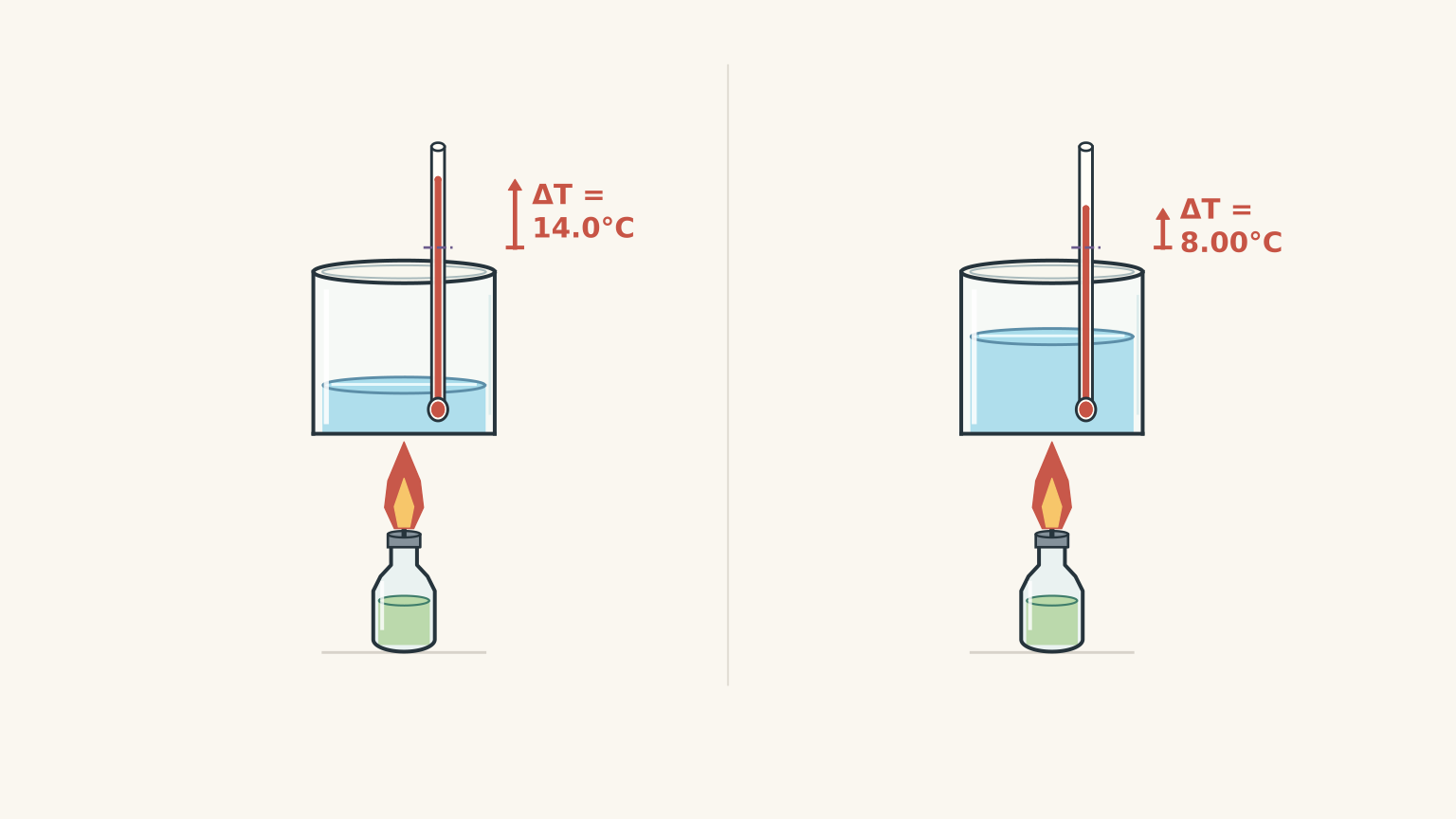
Two fuels, A and B, are tested using different quantities of water.
Each fuel sample has a mass of 0.200 g and undergoes complete combustion.
| Measurement | Fuel A | Fuel B |
|---|---|---|
| Mass of water | 100.0 g | 200.0 g |
| Temperature rise | 14.0°C | 8.00°C |
| Mass of fuel burnt | 0.200 g | 0.200 g |
Assume the calorimeters have negligible heat capacity and there is no heat loss.
Determine which fuel releases more energy per gram.
A student argues that Fuel A must be better because it produces the larger temperature rise. Explain why this reasoning is incorrect.
Due to technical limitations, this figure may display incorrectly or contain inaccuracies. Please check key details against your course materials.
Solution 3
Fuel B releases more energy per gram, despite producing a smaller temperature rise.
The student’s mistake is comparing temperature changes without accounting for the different masses of water.
Step 1: Calculate the heat absorbed by the water in Fuel A’s experiment.
\[ q_A=mc\Delta T \]
\[ =100.0\times4.18\times14.0 \]
\[ =5852\text{ J} \]
\[ =5.852\text{ kJ} \]
Step 2: Calculate the energy released per gram by Fuel A.
\[ e_A=\frac{5.852}{0.200} \]
\[ \boxed{e_A=29.3\text{ kJ g}^{-1}} \]
Step 3: Calculate the heat absorbed by the water in Fuel B’s experiment.
\[ q_B=mc\Delta T \]
\[ =200.0\times4.18\times8.00 \]
\[ =6688\text{ J} \]
\[ =6.688\text{ kJ} \]
Step 4: Calculate the energy released per gram by Fuel B.
\[ e_B=\frac{6.688}{0.200} \]
\[ \boxed{e_B=33.4\text{ kJ g}^{-1}} \]
Step 5: Compare the results.
Fuel B releases more energy per gram:
\[ 33.4>29.3 \]
Although Fuel A produces a larger temperature rise, it heats a smaller quantity of water.
Fuel B transfers more total energy to its surroundings.
This question demonstrates why you must calculate \(q=mc\Delta T\) rather than comparing temperature rises alone.
Question 4
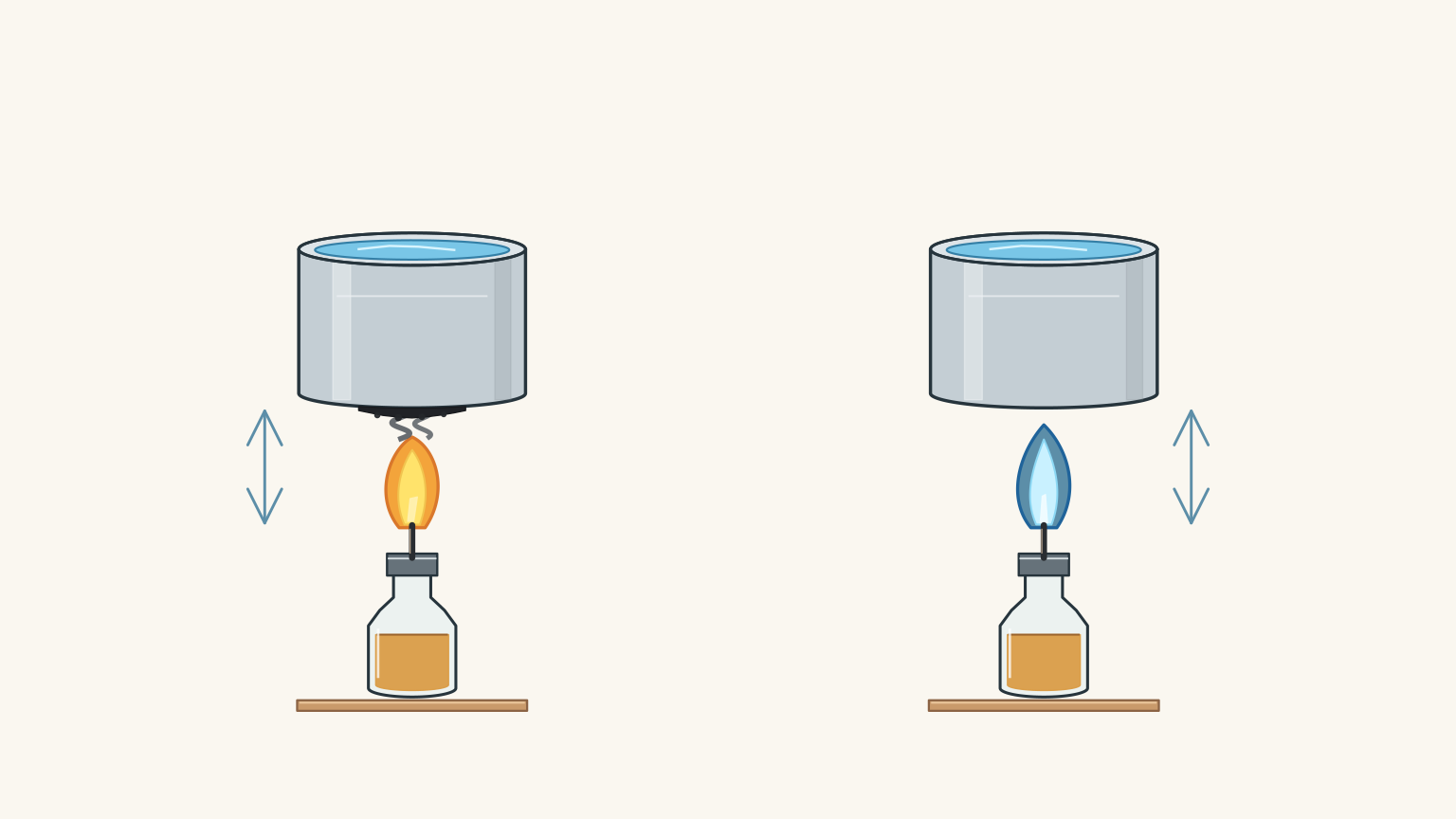
A student investigates two fuels using identical calorimeters, equal water masses, and the same burner-to-calorimeter distance.
The same measured mass decrease is recorded for each burner.
However, Fuel R produces a yellow, smoky flame and leaves a black deposit on the underside of the calorimeter. Fuel S burns with a cleaner blue flame.
Fuel R produces a larger water temperature rise.
The student concludes:
“Fuel R must have a more negative molar enthalpy of complete combustion because it produces the larger temperature rise.”
Evaluate this conclusion.
Identify two reasons why the conclusion is not justified, and suggest two improvements to the experimental method.
Due to technical limitations, this figure may display incorrectly or contain inaccuracies. Please check key details against your course materials.
Solution 4
The student’s conclusion is not justified. A larger temperature rise does not establish that Fuel R has a more negative molar enthalpy of complete combustion.
There are several problems with the reasoning.
Reason 1: Incomplete combustion
The black soot indicates that some carbon is not being fully oxidised to carbon dioxide.
Incomplete combustion can produce carbon monoxide and solid carbon instead of the complete combustion products.
This means some chemical energy remains in the products rather than being released through complete combustion.
The measured heat therefore does not necessarily represent the enthalpy change for complete combustion.
A yellow flame and soot are useful warning signs, although flame colour alone cannot quantify the extent of incomplete combustion.
Reason 2: Temperature rise does not establish molar enthalpy
Even if both burners lose the same mass of fuel, they may not consume the same number of moles.
Different fuels have different molar masses.
To compare molar enthalpies fairly, the student must:
- Calculate the heat absorbed by the surroundings.
- Determine the actual amount of fuel that reacted.
- Convert the mass into moles.
- Divide the heat released by the number of moles.
The different flames may also transfer different proportions of their released energy to the calorimeter.
Two improvements
Use a calibrated combustion calorimeter with a controlled excess supply of oxygen to promote complete combustion and measure the heat absorbed more reliably.
Control and measure the actual amount of fuel consumed. Account for evaporation, maintain consistent experimental conditions, and repeat trials to improve reliability.
The important distinction is that a larger measured temperature rise shows greater heating of the water. It does not, by itself, prove a greater molar enthalpy of complete combustion.
Question 5
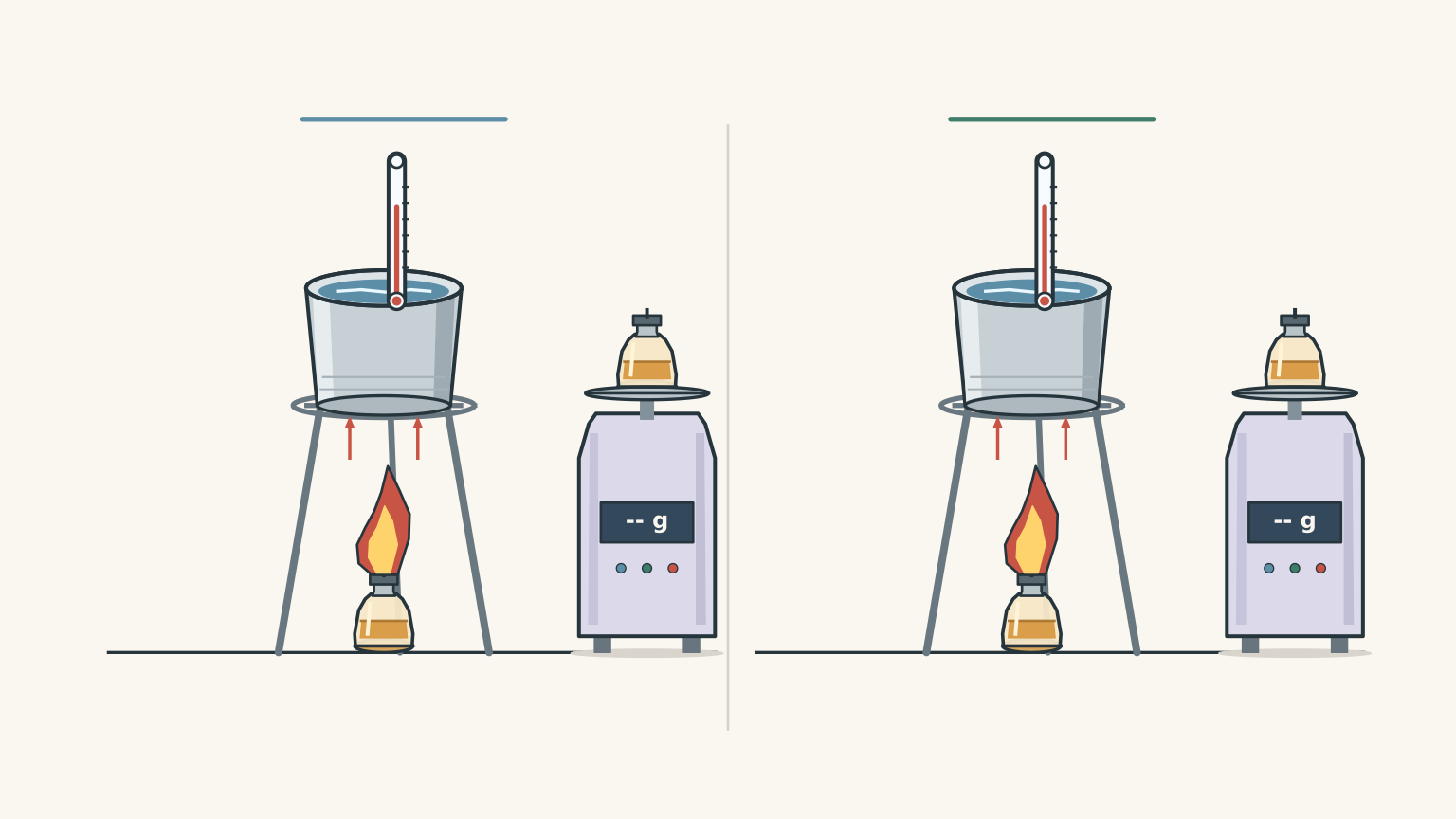
Two hypothetical liquid fuels, A and B, are investigated using identical calorimeters.
Each calorimeter contains 100.0 g of water and has a heat capacity of 0.120 kJ °C⁻¹.
The specific heat capacity of water is 4.18 J g⁻¹ °C⁻¹.
The following results are obtained:
| Measurement | Fuel A | Fuel B |
|---|---|---|
| Temperature rise | 4.00°C | 10.0°C |
| Burner mass decrease during burning | 0.300 g | 0.500 g |
| Mass decrease in matched unlit control | 0.200 g | 0.200 g |
| Molar mass | 30.0 g mol⁻¹ | 60.0 g mol⁻¹ |
| Density | 0.750 g mL⁻¹ | 1.00 g mL⁻¹ |
Assume:
- The unlit control accurately measures the fuel lost through evaporation during each burning trial.
- The remaining fuel is completely combusted.
- All heat released is absorbed by the water and calorimeter.
- Heat loss to the room is negligible.
- The densities apply at the experimental temperature.
A student looks at the results and claims:
“Fuel B is clearly better because it produces a larger temperature rise.”
Evaluate this statement.
Calculate the following for both fuels:
a) The actual mass of fuel burnt.
b) The experimental molar enthalpy of combustion.
c) The energy released per gram.
d) The energy released per millilitre.
Finally, explain how forgetting to correct for evaporation would affect the comparison.
Due to technical limitations, this figure may display incorrectly or contain inaccuracies. Please check key details against your course materials.
Solution 5
There is no single winner across all comparison methods.
Fuel B has the more negative molar enthalpy of combustion and releases more energy per millilitre. However, Fuel A releases more energy per gram.
The evaporation correction is essential because ignoring it actually reverses the mass-specific energy ranking.
Step 1: Calculate the actual mass of fuel burnt.
Subtract the mass lost through evaporation from the total mass decrease.
For Fuel A:
\[ m_A=0.300-0.200 \]
\[ \boxed{m_A=0.100\text{ g}} \]
For Fuel B:
\[ m_B=0.500-0.200 \]
\[ \boxed{m_B=0.300\text{ g}} \]
Notice that Fuel B actually burns three times as much fuel by mass.
This will affect the total heat released in each experiment.
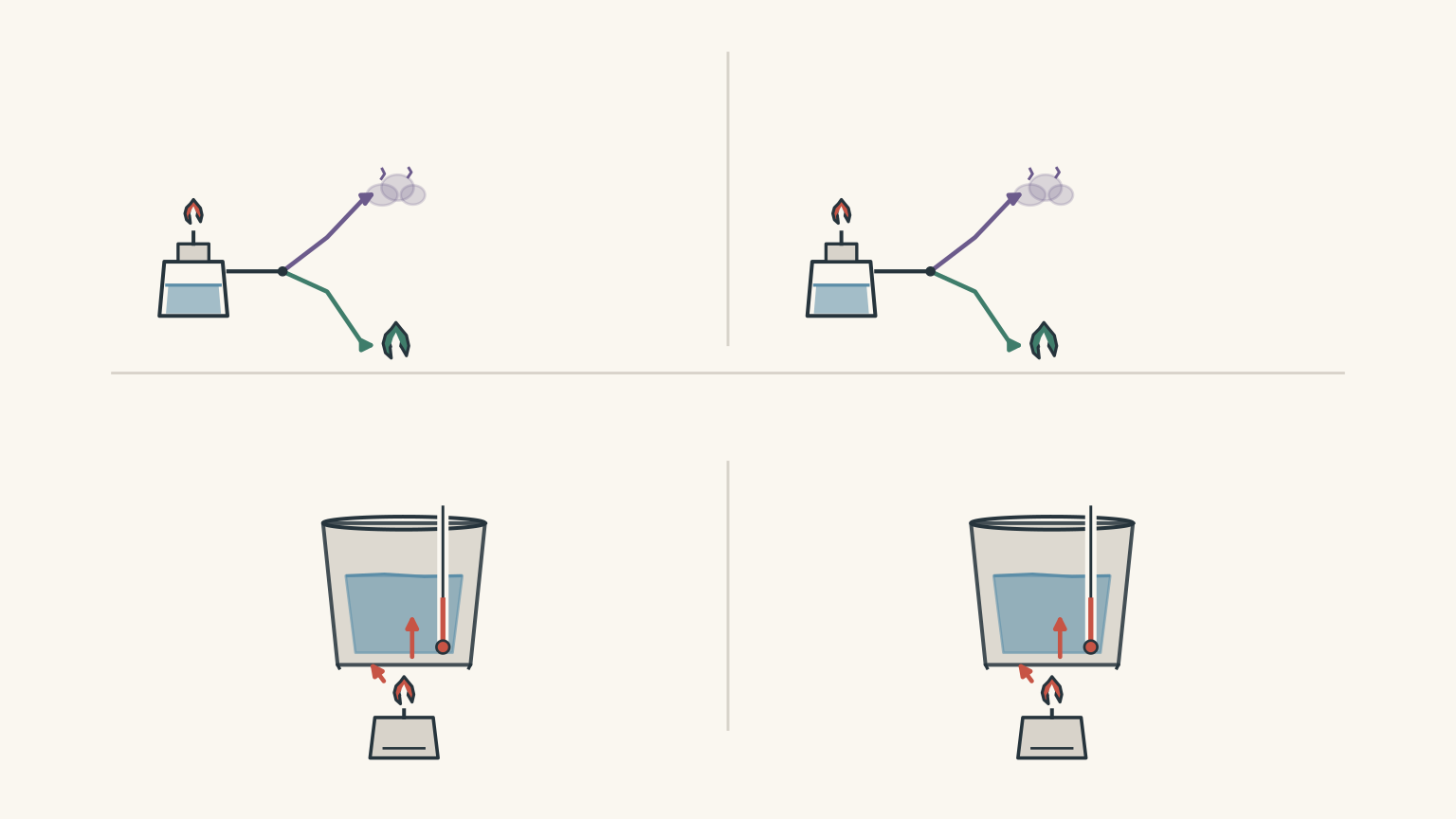
Due to technical limitations, this figure may display incorrectly or contain inaccuracies. Please check key details against your course materials.
Step 2: Calculate the heat released by Fuel A.
First, calculate the heat absorbed by the water:
\[ q_{\text{water,A}}=mc\Delta T \]
\[ =100.0\times4.18\times4.00 \]
\[ =1672\text{ J} \]
\[ =1.672\text{ kJ} \]
Next, calculate the heat absorbed by the calorimeter:
\[ q_{\text{cal,A}}=C_{\text{cal}}\Delta T \]
\[ =0.120\times4.00 \]
\[ =0.480\text{ kJ} \]
Total heat absorbed:
\[ q_{\text{surroundings,A}} =1.672+0.480 \]
\[ =2.152\text{ kJ} \]
Therefore:
\[ \boxed{q_{\text{combustion,A}}=-2.152\text{ kJ}} \]
Step 3: Calculate the heat released by Fuel B.
Heat absorbed by the water:
\[ q_{\text{water,B}} =100.0\times4.18\times10.0 \]
\[ =4180\text{ J} \]
\[ =4.180\text{ kJ} \]
Heat absorbed by the calorimeter:
\[ q_{\text{cal,B}}=0.120\times10.0 \]
\[ =1.200\text{ kJ} \]
Total heat absorbed:
\[ q_{\text{surroundings,B}} =4.180+1.200 \]
\[ =5.380\text{ kJ} \]
Therefore:
\[ \boxed{q_{\text{combustion,B}}=-5.380\text{ kJ}} \]
Fuel B does release more total heat in this experiment.
However, we cannot use this result alone to decide which fuel is better.
Step 4: Calculate the experimental molar enthalpy of combustion.
For Fuel A:
\[ n_A=\frac{m_A}{M_A} \]
\[ =\frac{0.100}{30.0} \]
\[ =0.00333\text{ mol} \]
Therefore:
\[ \Delta_c H_A=\frac{-2.152}{0.00333} \]
Using the unrounded mole value:
\[ \boxed{\Delta_c H_A=-646\text{ kJ mol}^{-1}} \]
For Fuel B:
\[ n_B=\frac{m_B}{M_B} \]
\[ =\frac{0.300}{60.0} \]
\[ =0.00500\text{ mol} \]
Therefore:
\[ \Delta_c H_B=\frac{-5.380}{0.00500} \]
\[ \boxed{\Delta_c H_B=-1076\text{ kJ mol}^{-1}} \]
Fuel B has the more negative molar enthalpy of combustion.
It releases more energy per mole than Fuel A.
Step 5: Calculate the energy released per gram.
Use the positive magnitude of the heat released.
For Fuel A:
\[ e_A=\frac{2.152}{0.100} \]
\[ \boxed{e_A=21.5\text{ kJ g}^{-1}} \]
For Fuel B:
\[ e_B=\frac{5.380}{0.300} \]
\[ \boxed{e_B=17.9\text{ kJ g}^{-1}} \]
Fuel A releases more energy per gram.
This is the opposite of the molar comparison.
Fuel B releases more energy per mole, but its larger molar mass means that it provides less energy for the same mass of fuel.
Step 6: Calculate the energy released per millilitre.
First, calculate the volume of fuel consumed.
Use:
\[ V=\frac{m}{\rho} \]
Where:
- \(V\) = volume of fuel burnt, in mL.
- \(m\) = mass of fuel burnt, in g.
- \(\rho\) = density, in g mL⁻¹.
For Fuel A:
\[ V_A=\frac{0.100}{0.750} \]
\[ =0.133\text{ mL} \]
Energy released per millilitre:
\[ e_{V,A}=\frac{2.152}{0.133} \]
Using the unrounded volume:
\[ \boxed{e_{V,A}=16.1\text{ kJ mL}^{-1}} \]
For Fuel B:
\[ V_B=\frac{0.300}{1.00} \]
\[ =0.300\text{ mL} \]
Energy released per millilitre:
\[ e_{V,B}=\frac{5.380}{0.300} \]
\[ \boxed{e_{V,B}=17.9\text{ kJ mL}^{-1}} \]
Fuel B releases more energy per millilitre.
Its greater density gives it an advantage when comparing the amount of energy stored in a fixed volume.
Step 7: Evaluate the student’s conclusion and the evaporation correction.
The results can be summarised as follows:
| Comparison | Fuel A | Fuel B | Better result |
|---|---|---|---|
| Molar enthalpy | -646 kJ mol⁻¹ | -1076 kJ mol⁻¹ | B, more exothermic |
| Energy per gram | 21.5 kJ g⁻¹ | 17.9 kJ g⁻¹ | A |
| Energy per mL | 16.1 kJ mL⁻¹ | 17.9 kJ mL⁻¹ | B |
The student’s statement is incomplete.
Fuel B does produce the larger temperature rise and transfers more total heat to the surroundings. However, it also consumes more fuel.
The temperature rise alone cannot establish which fuel has the greater energy content per unit mass, mole, or volume.
There is one final trap.
Suppose the student forgets to correct for evaporation and uses the total burner mass decrease as the mass burnt.
The incorrect energy-per-gram calculations would be:
For Fuel A:
\[ e_A=\frac{2.152}{0.300} \]
\[ =7.17\text{ kJ g}^{-1} \]
For Fuel B:
\[ e_B=\frac{5.380}{0.500} \]
\[ =10.76\text{ kJ g}^{-1} \]
The student would incorrectly conclude that Fuel B releases more energy per gram.
The correct comparison shows the opposite.
This happens because a large portion of Fuel A’s measured mass decrease was caused by evaporation rather than combustion.
The experiment therefore demonstrates why a fair comparison needs more than a temperature reading and a before-and-after burner mass.
It needs a reliable estimate of the amount that actually reacted, an appropriate energy calculation, and a clearly stated basis of comparison.
08Where to go next
Once you can compare experimental combustion data correctly, the next useful step is explaining why different fuel molecules release different amounts of energy.
The molecular structure, composition, and products of complete combustion all contribute to the enthalpy change.
That connects calorimetry measurements to the broader chemistry of organic fuels and biofuels.
The key distinction to carry into your next HSC question is simple: calculate the heat first, identify the amount that reacted, and only then decide whether you need kJ per mole, kJ per gram, or kJ per millilitre.