
Why Incomplete Combustion Changes Fuel Calorimetry Results
Discover why incomplete combustion produces a less negative enthalpy change than complete combustion. Learn how carbon monoxide, soot, heat loss, and fuel evaporation affect experimental calorimetry results, with worked calculations and challenging HSC Chemistry practice questions.
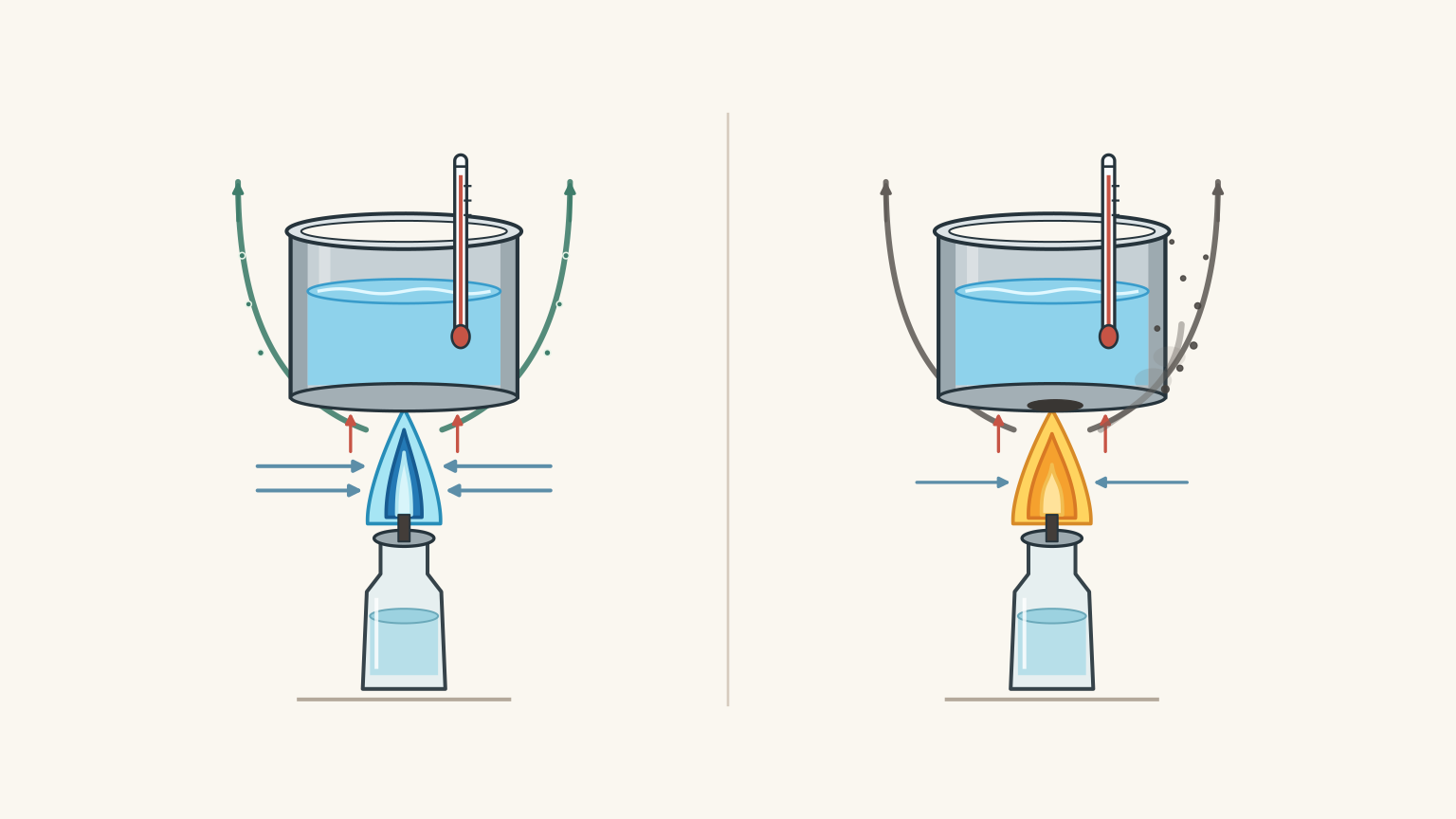
A spirit burner loses 0.460 g of ethanol, but the water above it warms much less than expected. Did fewer moles of fuel react?
Not necessarily. The ethanol may have been completely consumed as a fuel, while some of its carbon stopped at carbon monoxide or solid carbon instead of becoming carbon dioxide. These products still contain chemical energy, so incomplete combustion releases less energy per mole of fuel.
This makes the experimental enthalpy change less negative than it would be for complete combustion. However, there’s another complication: heat escaping from the apparatus or fuel evaporating without burning can also make the calculated result less negative. You need to separate these effects before interpreting your answer.
Due to technical limitations, this figure may display incorrectly or contain inaccuracies. Please check key details against your course materials.
01Why incomplete combustion releases less energy
Start with what happens to the carbon atoms in a fuel.
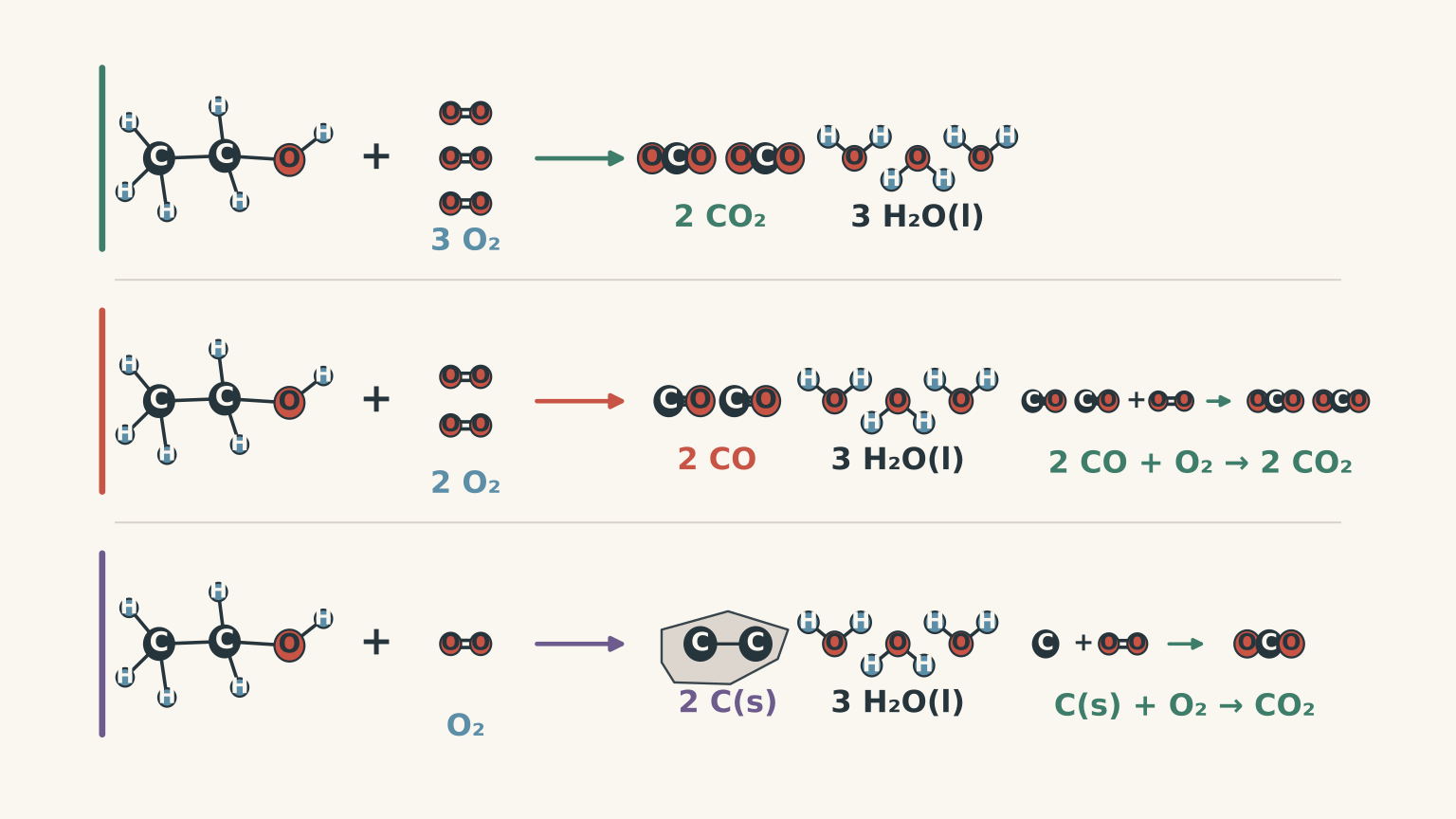
Ethanol, like many common fuels, contains carbon, hydrogen, and oxygen. When it burns completely, its carbon atoms become carbon dioxide, while its hydrogen atoms become water.
The balanced equation is:
\[ \ce{C2H5OH(l) + 3O2(g) -> 2CO2(g) + 3H2O(l)} \]
This is complete combustion.
But what happens if there isn’t enough oxygen available?
Some carbon may only be partially oxidised, forming carbon monoxide:
\[ \ce{C2H5OH(l) + 2O2(g) -> 2CO(g) + 3H2O(l)} \]
Alternatively, some carbon may form solid carbon, commonly seen as soot:
\[ \ce{C2H5OH(l) + O2(g) -> 2C(s) + 3H2O(l)} \]
Both reactions represent incomplete combustion.
The important difference: some chemical energy remains
Think about carbon monoxide. It can still react with oxygen:
\[ \ce{2CO(g) + O2(g) -> 2CO2(g)} \]
This reaction releases additional energy.
In other words, carbon monoxide hasn’t reached the same oxidation state as carbon dioxide. Further oxidation is still possible.
The same principle applies to solid carbon:
\[ \ce{C(s) + O2(g) -> CO2(g)} \]
If carbon remains as soot, additional energy could be released by oxidising it to carbon dioxide.
This is the central reason incomplete combustion changes the calorimetry result: the products have not reached the same lower-energy chemical state as the products of complete combustion.
Comparing the energy released
Consider the following rounded, illustrative reaction enthalpies for ethanol. All equations produce liquid water.
| Combustion pathway | Enthalpy change per mole of ethanol |
|---|---|
| Complete combustion to CO2 | -1367 kJ mol⁻¹ |
| Incomplete combustion to CO | -801 kJ mol⁻¹ |
| Incomplete combustion to solid C | -580 kJ mol⁻¹ |
These values are illustrative data for the stated reaction pathways. Use the values supplied in an examination question if they differ.
Notice the pattern.
Complete combustion releases the most energy per mole. Producing carbon monoxide releases less, and producing solid carbon releases less again.
The reaction enthalpies are all negative because all three reactions are exothermic. However, their magnitudes are different.
For example, compare complete combustion with combustion producing carbon monoxide:
\[ \begin{aligned} \Delta H_{\text{complete}}&=-1367\\ \Delta H_{\text{incomplete}}&=-801 \end{aligned} \]
The difference is:
\[ 1367-801=566\ \mathrm{kJ\,mol^{-1}} \]
That is 566 kJ less energy released per mole of ethanol.
The missing energy hasn’t mysteriously disappeared. It remains available for further chemical reactions involving the partially oxidised products.
Due to technical limitations, this figure may display incorrectly or contain inaccuracies. Please check key details against your course materials.
02What the calorimetry experiment actually measures
Before calculating an enthalpy change, you need to understand what the experiment measures.
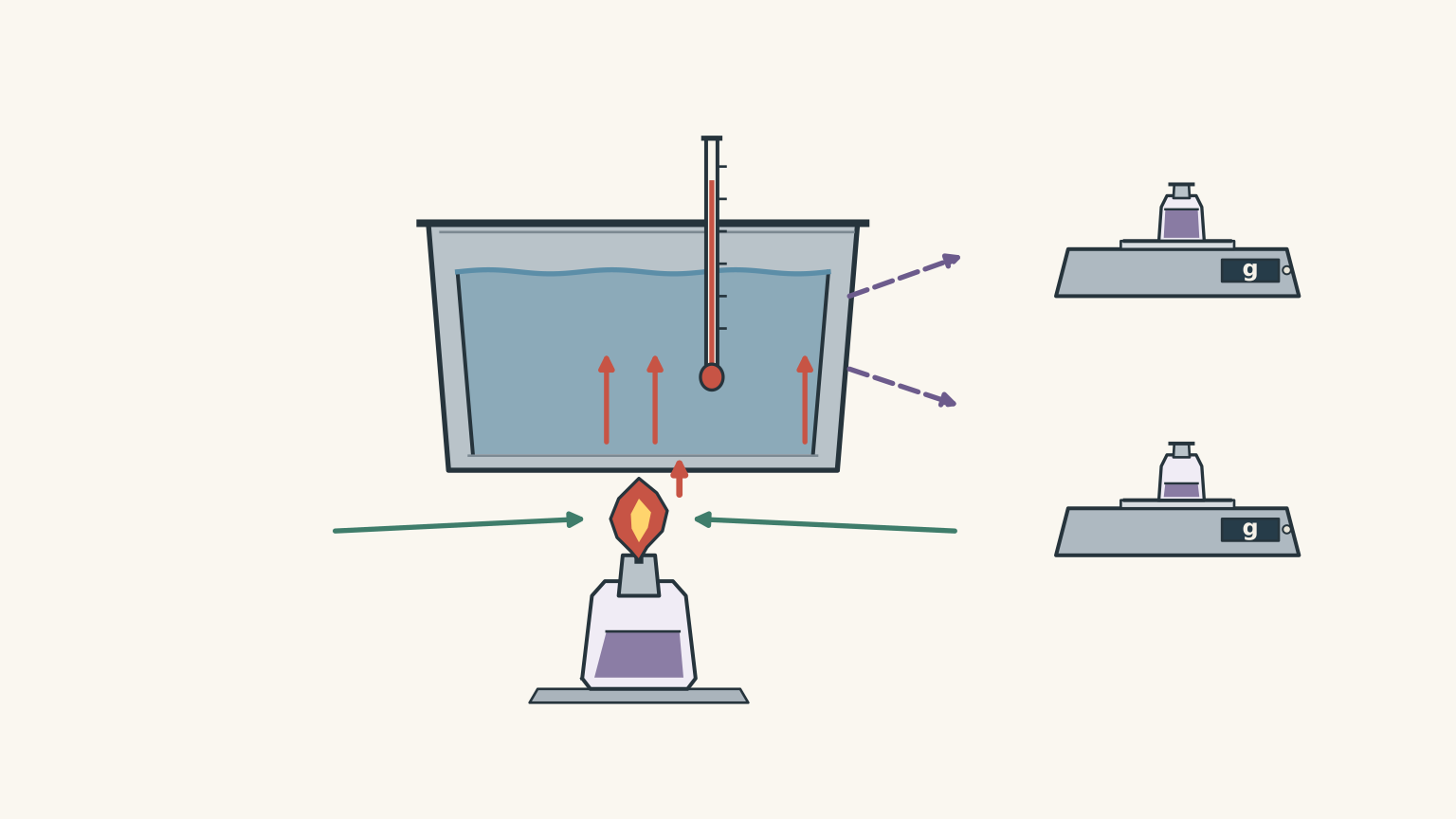
Imagine a spirit burner positioned beneath a metal container holding water.
A thermometer sits in the water without touching the metal base. The burner heats the container, and the thermometer records the water’s temperature change.
Before combustion, the burner is weighed. After combustion, it is weighed again.
You now have two important measurements:
- The temperature increase tells you how much heat the water has absorbed.
- The decrease in burner mass provides an estimate of how much fuel has been consumed.
Neither measurement directly tells you the enthalpy change of the reaction.
Due to technical limitations, this figure may display incorrectly or contain inaccuracies. Please check key details against your course materials.
What should the experiment show?
Suppose you burn the same amount of ethanol under two different conditions.
In the first experiment, combustion is complete. In the second, combustion is incomplete.
Assume both experiments capture all the energy released.
Which should produce the greater temperature increase?
Complete combustion should produce the greater temperature increase because it releases more energy per mole of ethanol.
However, this prediction depends on an important assumption: the experiments must capture the same proportion of the energy released.
A smaller temperature increase does not automatically prove incomplete combustion.
The second experiment might simply have lost more heat to the surrounding air, or its flame might have transferred energy less effectively to the container.
How could you improve the experiment?
The original apparatus has a limitation: it measures energy transferred to the water, not the total energy released by the chemical reaction.
A more reliable comparison would control several factors:
- Use the same mass of water and the same initial temperature.
- Keep the burner-to-container distance constant.
- Stir the water consistently.
- Account for the heat absorbed by the metal container and thermometer.
- Reduce heat loss using appropriate insulation and a draft shield that does not restrict oxygen.
- Measure fuel evaporation separately using a matched unlit control.
- Analyse the exhaust gases to identify carbon monoxide and carbon dioxide.
A soot deposit is evidence that some carbon has formed as a solid. However, soot alone cannot tell you how much carbon monoxide is present.
Carbon monoxide is colourless, so flame appearance is not a reliable way to quantify its production. A suitable exhaust-gas analyser provides stronger evidence.
The key experimental distinction is between measuring less heat and actually releasing less chemical energy. They can produce similar thermometer readings, but they have different causes.
03Before calculating: identify the system, surroundings, and amount reacted
Three decisions need to be made before you calculate an experimental enthalpy change.
1. Identify the system and surroundings
The system is the chemical reaction: the ethanol reacting with oxygen.
The surroundings are everything receiving heat from the reaction. In this experiment, these include:
- The water.
- The metal container.
- The thermometer.
- The surrounding air and other apparatus.
When combustion occurs, the system releases energy and the surroundings gain energy.
This gives the following sign convention:
| Substance | What happens | Sign of q |
|---|---|---|
| Combustion reaction | Loses heat | Negative |
| Water | Gains heat | Positive |
| Calorimeter | Gains heat | Positive |
The symbol \(q\) represents heat transferred.
For an ideal insulated calorimeter:
\[ q_{\text{reaction}}=-q_{\text{surroundings}} \]
If the water gains 8.00 kJ, the reaction loses 8.00 kJ, provided the water absorbs all the released energy.
This negative sign is important. A positive temperature change in the water does not mean the combustion reaction has a positive enthalpy change.
2. Calculate the amount of fuel that actually reacted
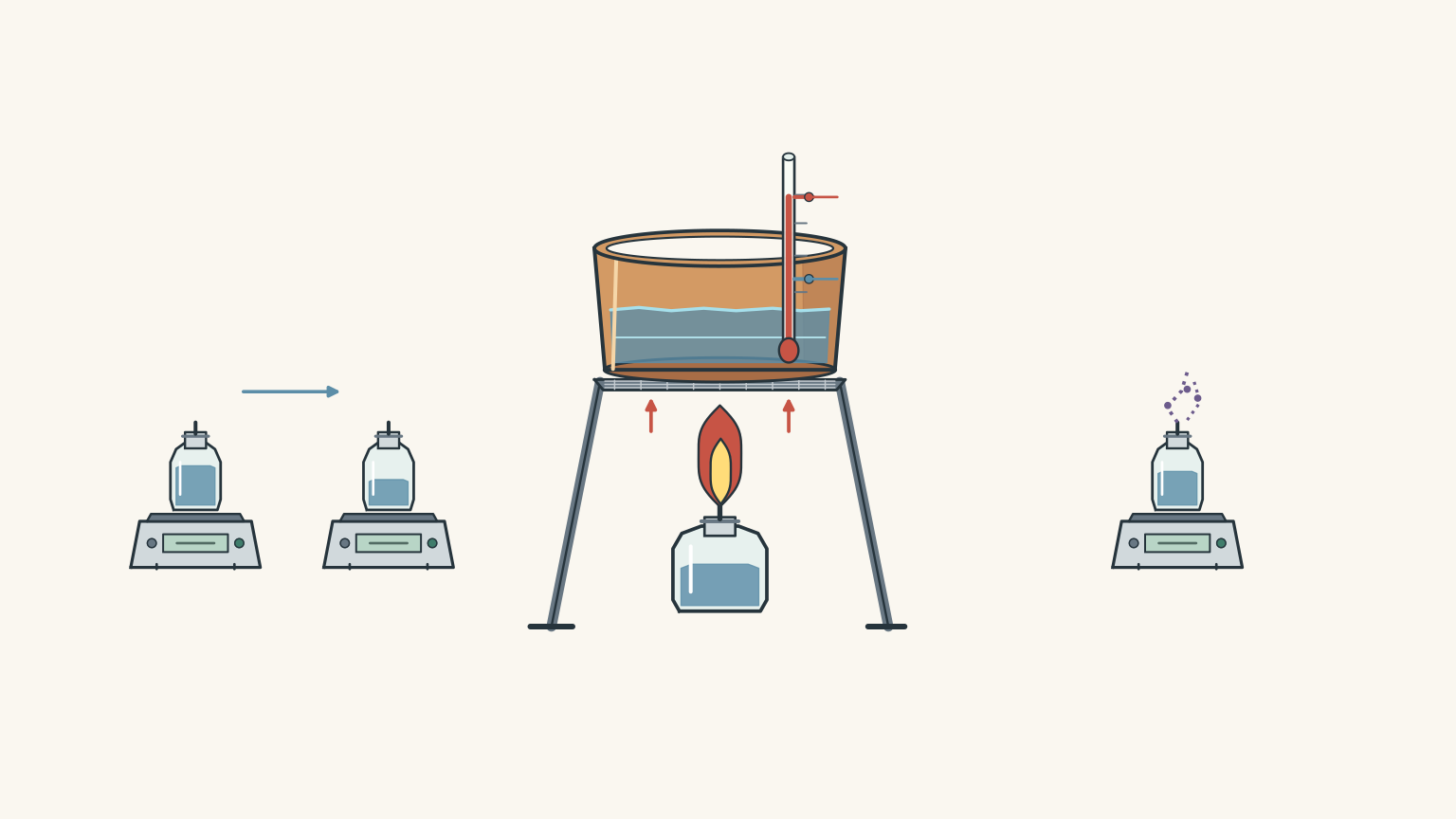
This is particularly important in spirit-burner experiments.
You might determine the fuel mass loss using:
\[ m_{\text{loss}}=m_{\text{initial}}-m_{\text{final}} \]
However, this mass loss does not necessarily represent the amount of fuel that reacted.
Some fuel may have evaporated without burning.
For example:
- Mass lost during the burning trial: 0.480 g.
- Mass lost through evaporation in an unlit control: 0.020 g.
The estimated mass that actually reacted is:
\[ m_{\text{reacted}}=0.480-0.020 \]
\[ m_{\text{reacted}}=0.460\ \mathrm{g} \]
You then convert this mass into moles:
\[ n_{\text{fuel}}=\frac{m_{\text{reacted}}}{M} \]
where:
- \(n_{\text{fuel}}\) is the amount of fuel reacted, in mol.
- \(m_{\text{reacted}}\) is the mass of fuel that reacted, in g.
- \(M\) is the molar mass of the fuel, in g mol⁻¹.
An important distinction:
All the fuel can be consumed without undergoing complete combustion.
For example, every ethanol molecule might react, but some of its carbon could still end up as carbon monoxide rather than carbon dioxide.
Incomplete combustion does not automatically mean that some ethanol remains unreacted.
For a more detailed explanation of determining the correct denominator, see How to Find the Reacted Amount in Molar Enthalpy Calculations.
3. Understand the assumptions behind the heat calculation
The heat absorbed by the water is calculated using:
\[ q_{\text{water}}=mc\Delta T \]
where:
- \(q_{\text{water}}\) is the heat absorbed by the water, in J.
- \(m\) is the mass of water, in g.
- \(c\) is the specific heat capacity of water, usually \(4.18\ \mathrm{J\,g^{-1}\,^\circ C^{-1}}\).
- \(\Delta T\) is the temperature change, in °C.
If the calorimeter itself absorbs heat, include:
\[ q_{\text{cal}}=C_{\text{cal}}\Delta T \]
Here, \(C_{\text{cal}}\) is the heat capacity of the calorimeter, in J °C⁻¹.
The total measured heat absorbed is then:
\[ q_{\text{captured}}= q_{\text{water}}+q_{\text{cal}} \]
If all the energy released by combustion is captured:
\[ q_{\text{reaction}}=-q_{\text{captured}} \]
In a real experiment, some energy escapes into the air. If that energy is not measured, the calculated reaction enthalpy will be less negative than the actual value.
This introduces an important distinction:
- Incomplete combustion reduces the energy released by the chemical reaction itself.
- Heat loss reduces the amount of energy measured by the calorimeter.
Both can make an experimental enthalpy value less negative, but they are not the same thing.
For the general calorimetry calculation, see Heat of Combustion: Calculations for HSC Chemistry.
04Calculating the effect of incomplete combustion
The experimental molar enthalpy change is calculated using:
\[ \Delta H_{\text{exp}}= \frac{q_{\text{reaction}}}{n_{\text{fuel}}} \]
where:
- \(\Delta H_{\text{exp}}\) is the experimental enthalpy change per mole of fuel, in kJ mol⁻¹.
- \(q_{\text{reaction}}\) is the heat change of the reaction, in kJ.
- \(n_{\text{fuel}}\) is the amount of fuel that reacted, in mol.
Notice that the reaction enthalpy is negative for exothermic combustion.
There is one more important detail.
The standard molar enthalpy of combustion refers to complete combustion. If the fuel undergoes incomplete combustion, the calculated value represents the enthalpy change for the actual product pathway, not the standard molar enthalpy of complete combustion.
Let’s work through two examples.
Worked example 1: Comparing complete and incomplete combustion
A sample containing 0.0100 mol of ethanol undergoes either complete combustion or incomplete combustion, producing carbon monoxide and liquid water.
The respective reaction enthalpies are:
- Complete combustion: \(-1367\ \mathrm{kJ\,mol^{-1}}\).
- Incomplete combustion to CO: \(-801\ \mathrm{kJ\,mol^{-1}}\).
Calculate the heat released by each reaction and determine how much less energy the incomplete reaction releases.
Step 1
\[ q_{\text{reaction}}=n\Delta H \]
Step 2
\[ \begin{aligned} q_{\text{complete}} &=0.0100\times(-1367)\\ &=-13.67\ \mathrm{kJ} \end{aligned} \]
The complete combustion reaction releases 13.67 kJ.
Step 3
\[ \begin{aligned} q_{\text{incomplete}} &=0.0100\times(-801)\\ &=-8.01\ \mathrm{kJ} \end{aligned} \]
The incomplete combustion reaction releases 8.01 kJ.
Step 4
\[ 13.67-8.01=5.66\ \mathrm{kJ} \]
The incomplete reaction releases 5.66 kJ less energy.
The reason is that carbon monoxide still contains chemical energy that could be released through further oxidation.
Both reactions are exothermic, but complete combustion is more exothermic.
Worked example 2: Calculating the experimental enthalpy after correcting fuel mass loss
A student burns ethanol beneath a container holding 200.0 g of water.
The following illustrative measurements are recorded:
| Measurement | Value |
|---|---|
| Mass lost by burner during burning | 0.480 g |
| Mass lost in an unlit evaporation control | 0.020 g |
| Initial water temperature | 20.00 °C |
| Final water temperature | 29.57 °C |
| Specific heat capacity of water | 4.18 J g⁻¹ °C⁻¹ |
| Molar mass of ethanol | 46.0 g mol⁻¹ |
Assume that the calorimeter absorbs negligible heat, no heat escapes, and all the fuel remaining after the evaporation correction reacts. Product analysis confirms that carbon monoxide is the only carbon-containing combustion product.
Calculate the experimental molar enthalpy change.
Step 1
\[ \begin{aligned} \Delta T&=T_f-T_i\\ &=29.57-20.00\\ &=9.57^\circ\mathrm{C} \end{aligned} \]
Step 2
Subtract the evaporation loss from the measured mass loss:
\[ \begin{aligned} m_{\text{reacted}} &=0.480-0.020\\ &=0.460\ \mathrm{g} \end{aligned} \]
Step 3
\[ \begin{aligned} n_{\text{ethanol}} &=\frac{m}{M}\\ &=\frac{0.460}{46.0}\\ &=0.0100\ \mathrm{mol} \end{aligned} \]
Step 4
\[ \begin{aligned} q_{\text{water}} &=mc\Delta T\\ &=200.0\times4.18\times9.57\\ &=8000.52\ \mathrm{J}\\ &=8.00\ \mathrm{kJ} \end{aligned} \]
The water gains 8.00 kJ.
Step 5
Because all the released heat is assumed to be absorbed by the water:
\[ q_{\text{reaction}}=-8.00\ \mathrm{kJ} \]
Now divide by the amount of ethanol reacted:
\[ \begin{aligned} \Delta H_{\text{exp}} &=\frac{-8.00}{0.0100}\\ &=-800\ \mathrm{kJ\,mol^{-1}} \end{aligned} \]
The experimental molar enthalpy change is:
\[ \Delta H_{\text{exp}} =-800\ \mathrm{kJ\,mol^{-1}} \]
This is close to the illustrative value of \(-801\ \mathrm{kJ\,mol^{-1}}\) for incomplete combustion producing carbon monoxide.
The agreement makes sense because the question specified the combustion products and assumed that all released energy was captured.
If the product analysis had not been supplied, the calorimetry result alone would not prove that carbon monoxide was the product.
Due to technical limitations, this figure may display incorrectly or contain inaccuracies. Please check key details against your course materials.
05How to recognise the different causes of a low result
A less negative experimental enthalpy does not automatically mean incomplete combustion.
There are three main possibilities to consider.
| Cause | What actually happens | Effect on calculated enthalpy |
|---|---|---|
| Incomplete combustion | Some carbon forms CO or C instead of CO2 | Less energy released per mole |
| Heat loss | Some released energy escapes measurement | Calculated value becomes less negative |
| Fuel evaporation | Fuel mass loss is mistaken for fuel that reacted | Calculated value becomes less negative |
Notice that these errors affect different parts of the calculation.
Incomplete combustion changes the chemical reaction.
Heat loss makes the measured heat smaller.
Evaporation makes the calculated amount of fuel reacted too large if it is not corrected.
All three can produce a less negative result, which is why you need additional experimental information before deciding what happened.
06Questions and solutions
Question 1
An ethanol burner operates with a limited supply of oxygen. The combustion produces carbon monoxide and liquid water.
(a) Write the balanced chemical equation for this reaction.
(b) Identify the system and surroundings in a calorimetry experiment.
(c) If the water temperature increases, state the signs of \(q_{\text{water}}\) and \(q_{\text{reaction}}\).
(d) Explain why the reaction remains exothermic even though combustion is incomplete.
Solution 1
The reaction is exothermic, with \(q_{\text{reaction}}<0\) and \(q_{\text{water}}>0\).
(a) Balanced equation
\[ \ce{C2H5OH(l) + 2O2(g) -> 2CO(g) + 3H2O(l)} \]
There are two carbon atoms, six hydrogen atoms, and three oxygen atoms on each side.
(b) System and surroundings
The system is the ethanol reacting with oxygen.
The surroundings include the water, metal container, thermometer, and surrounding air.
(c) Signs of heat transfer
Because the water warms, it gains heat:
\[ q_{\text{water}}>0 \]
The reaction loses heat:
\[ q_{\text{reaction}}<0 \]
(d) Why the reaction is still exothermic
Incomplete combustion does not mean that no energy is released.
The ethanol still reacts with oxygen, forming products at a lower enthalpy than the reactants. However, carbon monoxide has not been oxidised as fully as carbon dioxide.
Consequently, the reaction releases less energy than complete combustion, but it still releases energy overall.
Question 2
A student conducts an ethanol combustion experiment and obtains the following illustrative data:
| Measurement | Value |
|---|---|
| Initial burner mass | 42.680 g |
| Final burner mass | 42.190 g |
| Mass lost by an unlit control | 0.030 g |
| Mass of water | 150.0 g |
| Initial water temperature | 19.0 °C |
| Final water temperature | 30.0 °C |
| Calorimeter heat capacity | 0.100 kJ °C⁻¹ |
| Specific heat capacity of water | 4.18 J g⁻¹ °C⁻¹ |
| Molar mass of ethanol | 46.0 g mol⁻¹ |
Assume that the calorimeter and water capture all the energy released, and that product analysis confirms carbon monoxide is the only carbon-containing combustion product.
(a) Calculate the mass of ethanol that actually reacted.
(b) Calculate the amount of ethanol that reacted, in mol.
(c) Calculate the total heat absorbed by the water and calorimeter.
(d) Calculate the experimental molar enthalpy change.
(e) Explain how ignoring the evaporation correction would affect the calculated enthalpy.
Solution 2
The experimental molar enthalpy change is approximately \(-800\ \mathrm{kJ\,mol^{-1}}\).
(a) Mass of ethanol reacted
The measured burner mass loss is:
\[ 42.680-42.190=0.490\ \mathrm{g} \]
Subtract the evaporation loss:
\[ \begin{aligned} m_{\text{reacted}} &=0.490-0.030\\ &=0.460\ \mathrm{g} \end{aligned} \]
(b) Amount of ethanol reacted
\[ \begin{aligned} n&=\frac{m}{M}\\ &=\frac{0.460}{46.0}\\ &=0.0100\ \mathrm{mol} \end{aligned} \]
(c) Total heat absorbed
First calculate the temperature change:
\[ \Delta T=30.0-19.0=11.0^\circ\mathrm{C} \]
Heat absorbed by the water:
\[ \begin{aligned} q_{\text{water}} &=mc\Delta T\\ &=150.0\times4.18\times11.0\\ &=6897\ \mathrm{J}\\ &=6.897\ \mathrm{kJ} \end{aligned} \]
Heat absorbed by the calorimeter:
\[ \begin{aligned} q_{\text{cal}} &=C_{\text{cal}}\Delta T\\ &=0.100\times11.0\\ &=1.100\ \mathrm{kJ} \end{aligned} \]
Therefore:
\[ \begin{aligned} q_{\text{surroundings}} &=6.897+1.100\\ &=7.997\ \mathrm{kJ} \end{aligned} \]
(d) Experimental molar enthalpy change
The reaction loses the energy gained by the surroundings:
\[ q_{\text{reaction}}=-7.997\ \mathrm{kJ} \]
Therefore:
\[ \begin{aligned} \Delta H_{\text{exp}} &=\frac{-7.997}{0.0100}\\ &=-799.7\ \mathrm{kJ\,mol^{-1}} \end{aligned} \]
To three significant figures:
\[ \Delta H_{\text{exp}} =-800\ \mathrm{kJ\,mol^{-1}} \]
This is consistent with the supplied incomplete-combustion pathway.
(e) Effect of ignoring evaporation
If the student uses the full 0.490 g mass loss, the calculated amount becomes:
\[ n=\frac{0.490}{46.0} =0.01065\ \mathrm{mol} \]
The student would then divide the same negative reaction heat by too many moles.
The resulting enthalpy would be approximately:
\[ \Delta H_{\text{wrong}} =\frac{-7.997}{0.01065} \]
\[ \Delta H_{\text{wrong}} \approx-751\ \mathrm{kJ\,mol^{-1}} \]
This is less negative than the correct result.
The important point is that evaporation does not change the chemical enthalpy of combustion. It changes the accuracy of the measured amount of fuel reacted.
Question 3
During an ethanol combustion experiment, product analysis indicates that:
- 60% of the carbon atoms form carbon dioxide.
- 40% of the carbon atoms form carbon monoxide.
Assume all hydrogen forms liquid water.
Use the following illustrative pathway enthalpies:
- Complete combustion: \(-1367\ \mathrm{kJ\,mol^{-1}}\).
- Incomplete combustion to carbon monoxide: \(-801\ \mathrm{kJ\,mol^{-1}}\).
A total of 0.0150 mol of ethanol reacts.
(a) Determine the average enthalpy change per mole of ethanol.
(b) Write the balanced equation for the mixed-product reaction.
(c) Calculate the total heat released by the reaction.
Solution 3
The average enthalpy change is \(-1141\ \mathrm{kJ\,mol^{-1}}\), and the reaction releases approximately 17.1 kJ.
(a) Average enthalpy change
The reaction produces a mixture of carbon dioxide and carbon monoxide.
Because the two pathways have different enthalpy changes, calculate the weighted average.
For each mole of ethanol, 60% of the carbon atoms follow the complete pathway, while 40% follow the incomplete pathway.
\[ \begin{aligned} \Delta H_{\text{average}} &=0.60(-1367)+0.40(-801)\\ &=-820.2-320.4\\ &=-1140.6\ \mathrm{kJ\,mol^{-1}} \end{aligned} \]
Therefore:
\[ \Delta H_{\text{average}} \approx-1141\ \mathrm{kJ\,mol^{-1}} \]
(b) Balanced equation
Each ethanol molecule contains two carbon atoms.
For one mole of ethanol:
- 1.2 mol of carbon dioxide forms.
- 0.8 mol of carbon monoxide forms.
- 3 mol of water forms.
The balanced equation is:
\[ \ce{C2H5OH(l) + 2.6O2(g) -> 1.2CO2(g) + 0.8CO(g) + 3H2O(l)} \]
Check the oxygen atoms:
- Ethanol contributes 1 oxygen atom.
- Oxygen gas contributes 5.2 oxygen atoms.
- The products contain 2.4 oxygen atoms in carbon dioxide, 0.8 in carbon monoxide, and 3 in water.
Both sides contain 6.2 oxygen atoms.
(c) Total heat released
Use:
\[ q_{\text{reaction}}=n\Delta H \]
Substitute:
\[ \begin{aligned} q_{\text{reaction}} &=0.0150\times(-1140.6)\\ &=-17.109\ \mathrm{kJ} \end{aligned} \]
Therefore, approximately 17.1 kJ of energy is released.
The key is that the enthalpy change depends on the proportions of the different products, not simply on the amount of ethanol consumed.
Question 4
Two students conduct separate ethanol combustion experiments using identical calorimeters.
Both experiments use 0.0100 mol of ethanol that actually reacts. The water mass is 200.0 g in each experiment, and the initial temperature is the same.
The following observations are recorded:
| Observation | Trial A | Trial B |
|---|---|---|
| Water temperature increase | 8.00 °C | 5.00 °C |
| Flame appearance | Clean blue flame | Yellow, smoky flame |
| Soot deposit | None observed | Present |
| Exhaust analysis | Mostly CO2; no detectable CO | Not performed |
Assume both experiments use the same burner-to-container distance and stirring conditions.
(a) Calculate the heat absorbed by the water in each experiment.
(b) Calculate the difference in heat absorbed by the water.
(c) Does the lower temperature increase in Trial B prove that incomplete combustion is responsible for the entire difference? Explain.
(d) Suggest an additional measurement that would help distinguish incomplete combustion from differences in heat transfer.
Solution 4
Trial B transfers 2.51 kJ less heat to the water, and the soot deposit provides evidence of incomplete combustion. However, the temperature difference alone cannot establish how much less chemical energy the reaction released.
(a) Heat absorbed by the water
For Trial A:
\[ \begin{aligned} q_A&=mc\Delta T\\ &=200.0\times4.18\times8.00\\ &=6688\ \mathrm{J}\\ &=6.688\ \mathrm{kJ} \end{aligned} \]
For Trial B:
\[ \begin{aligned} q_B&=mc\Delta T\\ &=200.0\times4.18\times5.00\\ &=4180\ \mathrm{J}\\ &=4.180\ \mathrm{kJ} \end{aligned} \]
(b) Difference in heat absorbed
\[ \begin{aligned} \Delta q&=6.688-4.180\\ &=2.508\ \mathrm{kJ} \end{aligned} \]
Trial B transfers approximately 2.51 kJ less energy to the water.
(c) Does this prove incomplete combustion caused the entire difference?
No.
The soot deposit establishes that some carbon has formed as a solid rather than being fully oxidised to carbon dioxide.
This is evidence of incomplete combustion.
However, the experiment does not establish the exact proportion of carbon monoxide, carbon dioxide, and solid carbon produced.
There is also another issue.
The different flame conditions may change how efficiently energy is transferred to the water. Trial B could lose a greater proportion of its released energy to the surrounding air.
The measured heat absorbed by the water is therefore not necessarily equal to the total energy released by the reaction.
The tempting conclusion is that Trial B released exactly 2.51 kJ less chemical energy. That conclusion assumes both flames transfer energy to the water with identical efficiency, which has not been established.
(d) Additional measurement
A suitable exhaust-gas analyser could measure the concentrations of carbon monoxide and carbon dioxide.
A soot collection or measurement method could also help quantify solid carbon formation.
These measurements would provide evidence about the actual combustion products.
To compare the chemical energy released fairly, the experiment would also need better control of heat losses and the energy absorbed by the apparatus.
Question 5
A carefully controlled ethanol combustion experiment produces an unusual result.
A student burns 0.460 g of ethanol beneath a calorimeter containing 250.0 g of water.
The following measurements are obtained:
| Measurement | Value |
|---|---|
| Mass of ethanol reacted | 0.460 g |
| Molar mass of ethanol | 46.0 g mol⁻¹ |
| Initial water temperature | 20.00 °C |
| Final water temperature | 30.37 °C |
| Mass of water | 250.0 g |
| Specific heat capacity of water | 4.18 J g⁻¹ °C⁻¹ |
| Oxygen consumed | 0.0250 mol |
Assume:
- All the ethanol has reacted.
- No fuel has escaped through evaporation.
- All the heat released is absorbed by the water.
- The calorimeter absorbs negligible heat.
- All hydrogen atoms form liquid water.
- The only carbon-containing products are carbon dioxide, carbon monoxide, and solid carbon.
- All reaction enthalpies below refer to one mole of ethanol, with liquid water as the hydrogen-containing product.
The following illustrative pathway enthalpies are supplied:
| Carbon-containing product | Enthalpy change per mole of ethanol |
|---|---|
| All carbon forms CO2 | -1367 kJ mol⁻¹ |
| All carbon forms CO | -801 kJ mol⁻¹ |
| All carbon forms C(s) | -580 kJ mol⁻¹ |
Determine:
(a) The experimental enthalpy change per mole of ethanol.
(b) The fraction of carbon atoms that form carbon dioxide, carbon monoxide, and solid carbon.
(c) The balanced overall reaction equation.
(d) Explain why the calorimetry result alone would not necessarily be enough to determine the products.
Solution 5
The carbon atoms are distributed equally between carbon dioxide and carbon monoxide, with no solid carbon formed.
The measured oxygen consumption is the additional constraint that makes this conclusion unique.
(a) Experimental enthalpy change
First calculate the amount of ethanol reacted:
\[ \begin{aligned} n_{\text{ethanol}} &=\frac{0.460}{46.0}\\ &=0.0100\ \mathrm{mol} \end{aligned} \]
Calculate the temperature change:
\[ \begin{aligned} \Delta T&=30.37-20.00\\ &=10.37^\circ\mathrm{C} \end{aligned} \]
Calculate the heat absorbed by the water:
\[ \begin{aligned} q_{\text{water}} &=mc\Delta T\\ &=250.0\times4.18\times10.37\\ &=10836.65\ \mathrm{J}\\ &=10.84\ \mathrm{kJ} \end{aligned} \]
The reaction loses this energy:
\[ q_{\text{reaction}}=-10.84\ \mathrm{kJ} \]
Now calculate the experimental enthalpy change:
\[ \begin{aligned} \Delta H_{\text{exp}} &=\frac{-10.84}{0.0100}\\ &=-1084\ \mathrm{kJ\,mol^{-1}} \end{aligned} \]
(b) Determine the carbon product fractions
This is the difficult part.
The tempting approach is to notice that \(-1084\) is halfway between \(-1367\) and \(-801\).
You might therefore predict that half the carbon forms carbon dioxide and half forms carbon monoxide.
That prediction is correct, but the enthalpy result alone does not prove it.
Solid carbon is also an allowed product, so we need to use the oxygen consumption as an independent constraint.
Let:
- \(x\) = fraction of carbon atoms forming CO2.
- \(y\) = fraction of carbon atoms forming CO.
- \(z\) = fraction of carbon atoms forming solid carbon.
Because all carbon must appear in one of these three products:
\[ x+y+z=1 \]
The enthalpy change is a weighted combination of the three possible pathways:
\[ -1367x-801y-580z=-1084 \]
We now use the measured oxygen consumption.
The student consumed 0.0250 mol of oxygen for 0.0100 mol of ethanol.
Therefore:
\[ n(\ce{O2})= \frac{0.0250}{0.0100} =2.50\ \mathrm{mol} \]
This is 2.50 mol of oxygen per mole of ethanol.
We can express the oxygen requirement in terms of the product fractions.
For one mole of ethanol:
- The ethanol itself supplies one oxygen atom.
- The three water molecules require three oxygen atoms.
- Carbon dioxide requires four oxygen atoms for every two carbon atoms.
- Carbon monoxide requires two oxygen atoms for every two carbon atoms.
- Solid carbon requires no oxygen atoms.
Balancing the oxygen atoms gives:
\[ 1+2n(\ce{O2})=3+4x+2y \]
Rearranging:
\[ n(\ce{O2})=1+2x+y \]
Since the measured oxygen consumption is 2.50 mol:
\[ 1+2x+y=2.50 \]
Therefore:
\[ 2x+y=1.50 \]
We now have three equations:
\[ x+y+z=1 \]
\[ 787x+221y=504 \]
\[ 2x+y=1.50 \]
The middle equation comes from substituting \(z=1-x-y\) into the enthalpy equation.
Solve the oxygen equation for \(y\):
\[ y=1.50-2x \]
Substitute into the enthalpy equation:
\[ 787x+221(1.50-2x)=504 \]
Expand:
\[ 787x+331.5-442x=504 \]
\[ 345x=172.5 \]
\[ x=0.500 \]
Now calculate \(y\):
\[ y=1.50-2(0.500) \]
\[ y=0.500 \]
Finally:
\[ z=1-0.500-0.500 \]
\[ z=0 \]
Therefore:
| Carbon product | Fraction of carbon atoms |
|---|---|
| CO2 | 0.500 or 50% |
| CO | 0.500 or 50% |
| C(s) | 0 or 0% |
(c) Balanced overall reaction
Each ethanol molecule contains two carbon atoms.
Half of these form carbon dioxide, and half form carbon monoxide.
Therefore, one mole of ethanol produces one mole of each product.
The balanced equation is:
\[ \ce{C2H5OH(l) + 2.5O2(g) -> CO2(g) + CO(g) + 3H2O(l)} \]
This equation also confirms the oxygen consumption of 2.50 mol per mole of ethanol.
(d) Why the calorimetry result alone is insufficient
The measured enthalpy change is exactly halfway between the complete-combustion and carbon-monoxide-only pathways.
If you assumed these were the only two possible outcomes, a 50:50 mixture would follow.
But the question also allows solid carbon.
A different mixture containing some solid carbon could produce approximately the same enthalpy change while consuming a different amount of oxygen.
For example, a mixture with approximately:
- 60.0% of carbon atoms forming CO2.
- 14.4% forming CO.
- 25.6% forming solid carbon.
would give approximately the same enthalpy change using the supplied pathway values.
However, it would consume only about 2.34 mol of oxygen per mole of ethanol, rather than the measured 2.50 mol.
The oxygen measurement rules out this alternative.
This is the important conceptual point: a calorimetry measurement tells you the total energy change, but it does not always uniquely identify the products responsible for that energy change.
You need an independent measurement or constraint, such as oxygen consumption or exhaust-gas composition, to distinguish competing product mixtures.
07Where this leads next
Incomplete combustion changes the enthalpy of a fuel because it changes the chemical products, not simply because the experiment becomes less efficient.
When interpreting a fuel-calorimetry result, keep three questions separate:
- How much energy did the surroundings absorb?
- How many moles of fuel actually reacted?
- What products did the reaction form?
The next useful step is combining balanced combustion equations with thermochemical data. Once you know the products, you can determine which reaction enthalpy is appropriate rather than assuming every fuel undergoes complete combustion.