
Why a Pleasant Smell Cannot Identify an Ester or Prove Safety
A fruity smell does not prove that an ester has formed, that a reaction is complete, or that a chemical is safe. Learn how molecular structure, reversible reactions, equilibrium, and chemical tests provide more reliable evidence.
A student heats an alcohol with a carboxylic acid during an esterification practical. A little later, a sweet, fruity odour is noticed. Has the desired ester definitely formed? And, more importantly, does the pleasant smell mean the vapour is safe?
Neither conclusion follows.
A pleasant smell is not a definitive chemical test because different substances can produce similar odours, and a reaction mixture can contain several compounds at once. It is not a safety test either. An odour tells you that volatile molecules have reached the air, not whether those molecules are harmless.
Consider one prediction before going further: if an esterification mixture smells fruity, must all the original carboxylic acid have reacted?
No. Esterification is reversible, so the mixture can contain ester, unreacted alcohol, unreacted carboxylic acid, water, and the acid catalyst simultaneously.
Understanding this requires connecting three ideas: molecular structure, chemical equilibrium, and the limitations of chemical testing.
01What does a pleasant smell actually tell you?
When you smell a substance, some of its molecules have entered the air as vapour and reached receptors in your nose.
This is related to a physical property called volatility, which describes how readily a substance enters the gas phase.
A volatile liquid can release molecules into the surrounding air. Those molecules travel through the air and interact with olfactory receptors, producing a sensory response that your brain interprets as a particular smell.
However, this process does not identify the molecules uniquely.
Think of an odour as a warning light rather than a molecular barcode. It can tell you that something is present, but it cannot reliably tell you exactly what that substance is.
Why smell is not a reliable identification method
There are several problems with using smell to identify an unknown chemical.
1. Different compounds can have similar odours.
Many esters have characteristic fruity or sweet odours. However, a fruity smell does not uniquely identify an ester.
Other volatile organic compounds can produce similar sensory responses.
2. A mixture can have several different odours at once.
An esterification mixture is not necessarily pure ester. Unreacted alcohol, carboxylic acid, and other volatile substances may contribute to the overall smell.
One strongly odorous component may dominate the mixture, even if it represents only a small proportion of the sample.
3. Smell depends on concentration and temperature.
A warm liquid often releases more vapour than the same liquid at a lower temperature.
Consequently, a sample may produce a stronger odour simply because it is warmer. That does not necessarily mean more ester has formed.
4. People do not detect every odour equally.
Individuals have different sensitivities to particular chemicals. Exposure can also overload olfactory receptors, reducing the ability to detect an odour.
The smell may become less noticeable even though the chemical is still present.
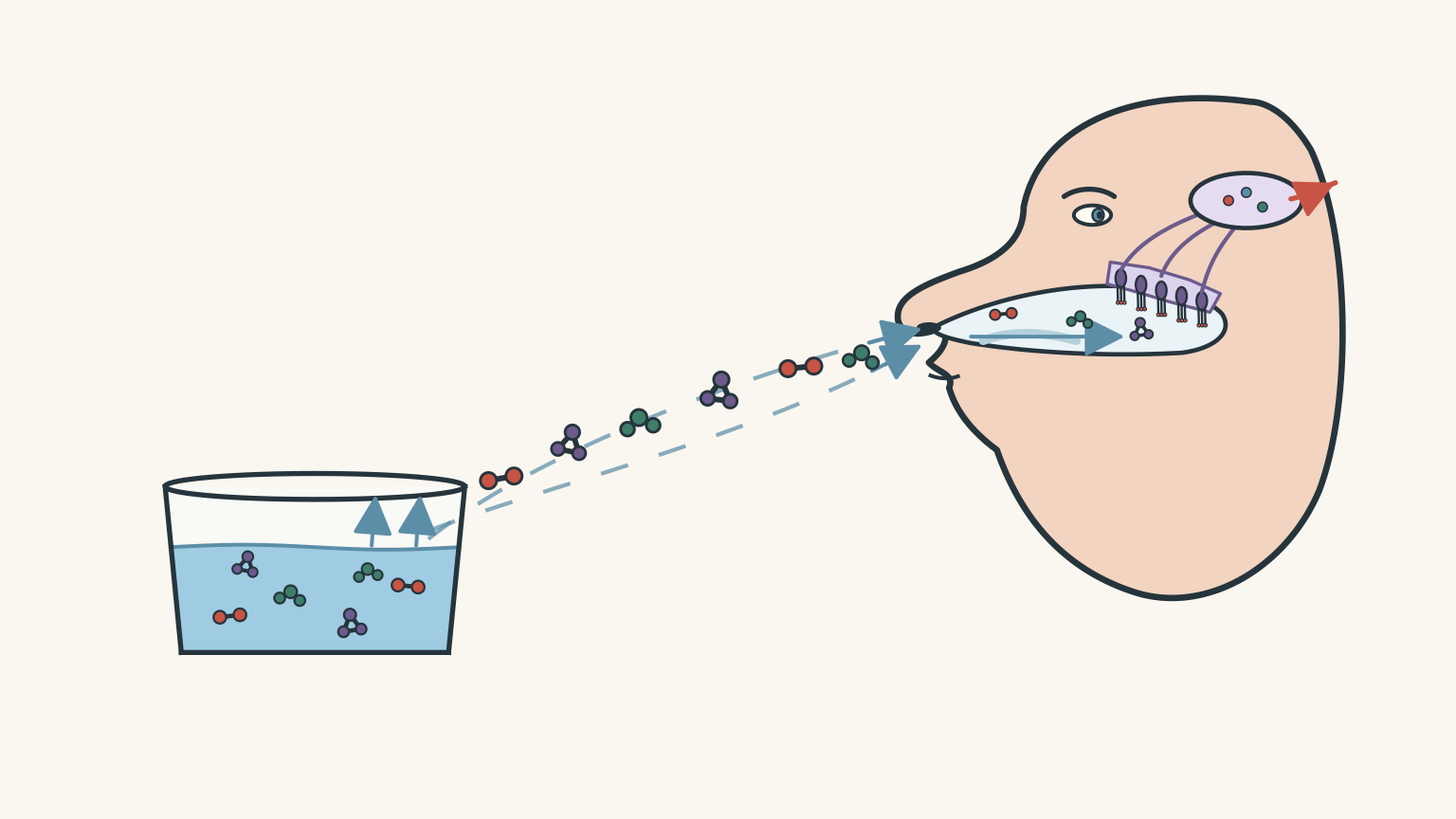
Due to technical limitations, this figure may display incorrectly or contain inaccuracies. Please check key details against your course materials.
Why a pleasant smell does not mean a chemical is safe
This is the more important limitation.
A chemical’s smell and its toxicity are different properties.
Toxicity describes the potential of a substance to cause harm. It depends on the chemical itself and the nature of exposure, including concentration, exposure route, and duration.
A substance can have a pleasant odour and still present health risks. Another hazardous substance might have little or no detectable odour.
Safe Work Australia’s June 2023 Model Code of Practice: Managing risks of hazardous chemicals in the workplace explicitly warns against relying on odour to detect hazardous chemicals. It also explains that not everyone can detect certain chemical odours and that high concentrations can overload nasal receptors.
You can read the Safe Work Australia Code of Practice.
The practical rule is straightforward: never deliberately smell an unknown chemical or reaction mixture to identify it or assess its safety. Follow the laboratory risk assessment, chemical labels, Safety Data Sheets (SDS), and your teacher’s instructions.
For more on chemical hazards and appropriate laboratory controls, see Safe Handling and Disposal of Organic Substances for HSC Chemistry.
A useful comparison
| Observation | What it might indicate | What it does not establish |
|---|---|---|
| Fruity odour | A volatile compound, possibly an ester, is present | The exact chemical identity |
| No noticeable odour | No odour was detected under those conditions | That the chemical is absent or safe |
| Stronger odour after heating | More volatile material may have entered the air | That more ester has formed |
| Odour becomes weaker | Concentration, temperature, airflow, or sensory response may have changed | That the reaction has finished |
| Pleasant odour | The person finds the smell pleasant | That the substance is non-toxic |
The key distinction is that smell is a sensory observation, not a chemical measurement.
02Why esters make this misconception particularly tempting
Esters are well known for their characteristic odours. Some have fruity or sweet smells and are used in flavouring and fragrance applications.
This makes them a useful example of why an observation can be consistent with a chemical reaction without proving that the reaction has occurred as expected.
To understand the problem, look at how an ester is actually formed.
A carboxylic acid reacts with an alcohol to produce an ester and water.
The general equation is:
\[ \ce{RCOOH + R'OH <=> RCOOR' + H2O} \]
Here:
- \(R\) represents the carbon-containing group from the carboxylic acid.
- \(R'\) represents the carbon-containing group from the alcohol.
- \(\ce{RCOOH}\) represents the carboxylic acid.
- \(\ce{R'OH}\) represents the alcohol.
- \(\ce{RCOOR'}\) represents the ester.
The double arrow indicates that the reaction is reversible.
What actually makes the product an ester?
The defining feature is its connectivity, not its smell.
An ester contains the functional group:
\[ \ce{-C(=O)-O-} \]
The carbonyl carbon is double-bonded to one oxygen and single-bonded to another oxygen. That second oxygen is attached to another carbon-containing group.
For example, consider the reaction between propanoic acid and butan-1-ol.
The reactants are:
\[ \ce{CH3CH2COOH} \]
and
\[ \ce{HOCH2CH2CH2CH3} \]
The product is:
\[ \ce{CH3CH2C(=O)OCH2CH2CH2CH3} \]
This ester is called butyl propanoate.
Notice how the atoms are connected:
- The propanoic acid contributes the propanoate portion.
- The butan-1-ol contributes the butyl portion.
- The alcohol’s oxygen becomes the single-bonded oxygen in the ester linkage.
- Water is also produced during the reaction.
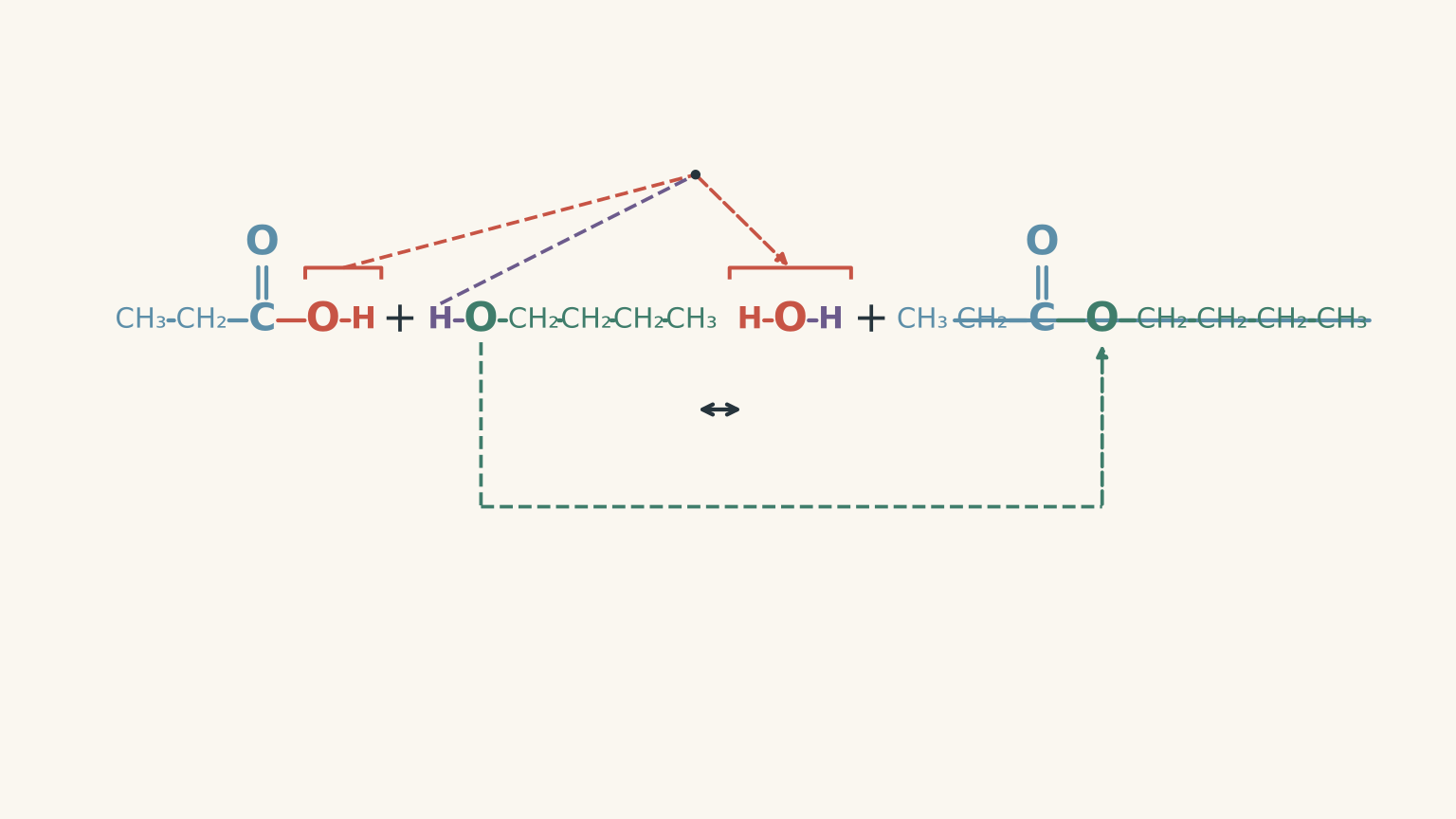
Due to technical limitations, this figure may display incorrectly or contain inaccuracies. Please check key details against your course materials.
This is why structural evidence is more useful than an odour description.
A molecule is classified as an ester because of its bonding arrangement. A fruity smell cannot tell you whether the oxygen atoms have the correct connectivity.
03Why esterification does not necessarily produce pure ester
There is another reason a pleasant odour cannot confirm a successful ester preparation.
Esterification is a reversible reaction.
Imagine mixing ethanol and ethanoic acid to produce ethyl ethanoate.
The equation is:
\[ \ce{CH3COOH + CH3CH2OH <=> CH3COOCH2CH3 + H2O} \]
The forward reaction produces ester and water.
The reverse reaction consumes ester and water, reforming the carboxylic acid and alcohol.
Eventually, the reaction can reach dynamic equilibrium.
At dynamic equilibrium:
- The forward and reverse reactions continue.
- The forward and reverse reaction rates are equal.
- The concentrations of all substances remain constant.
- The concentrations do not have to be equal.
This last point is particularly important.
Equilibrium does not mean that all the reactants have been converted into products.
A reaction mixture can contain a substantial amount of unreacted starting material while still containing enough ester to produce a noticeable odour.
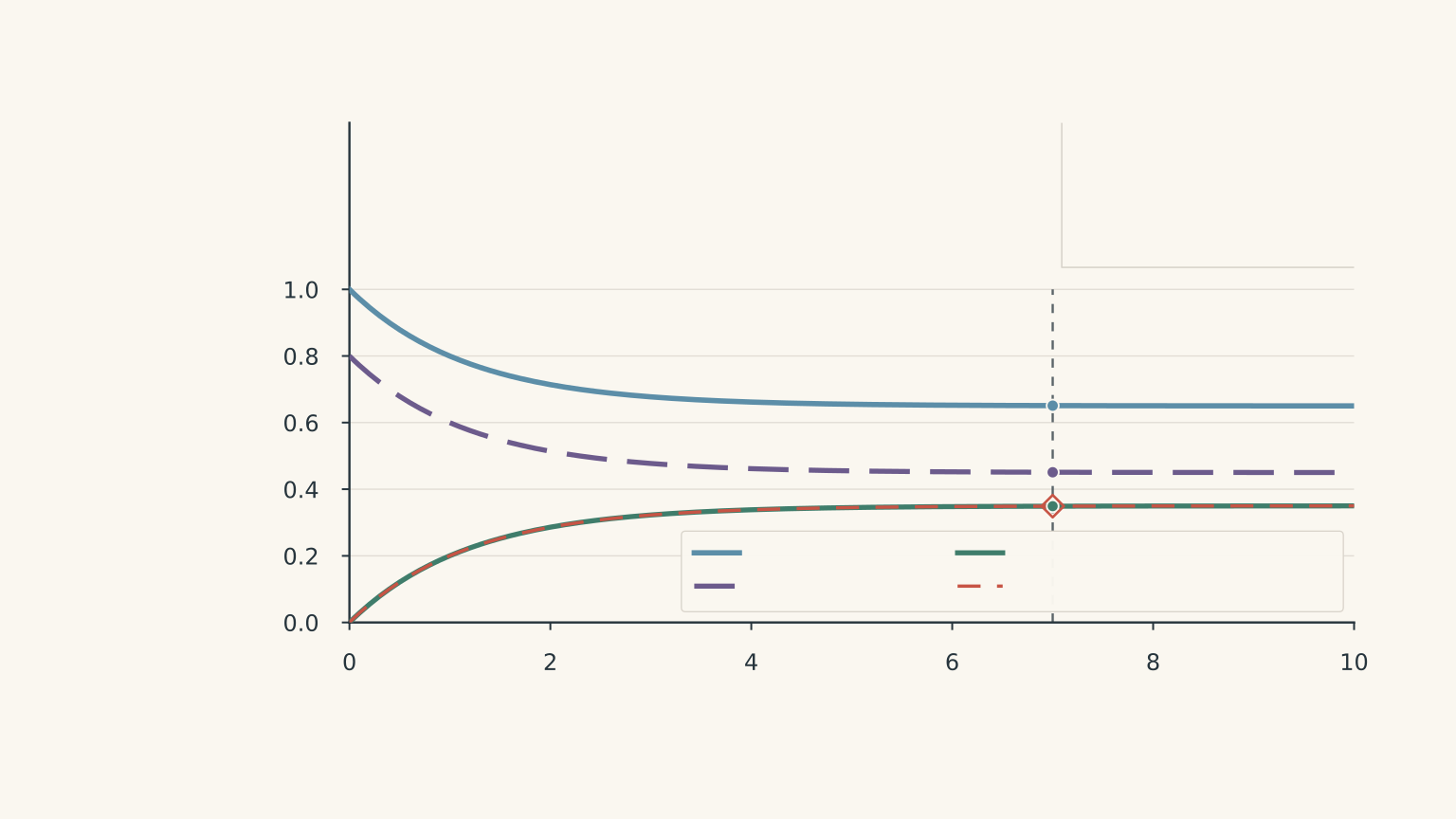
Due to technical limitations, this figure may display incorrectly or contain inaccuracies. Please check key details against your course materials.
What do the reagents actually do?
The reagents and conditions used during esterification have different purposes.
| Reagent or condition | Role | Important distinction |
|---|---|---|
| Carboxylic acid | Reactant | Supplies the acid-derived portion of the ester |
| Alcohol | Reactant | Supplies the alcohol-derived portion |
| Concentrated sulfuric acid | Acid catalyst | Increases the rates of the forward and reverse reactions |
| Heat | Reaction condition | Increases reaction rates |
| Reflux condenser | Apparatus | Returns condensed vapour to the reaction flask |
| Removal of water | Equilibrium adjustment | Favours ester formation because water is a product |
Concentrated sulfuric acid is particularly important.
As an acid catalyst, it provides hydrogen ions that help activate the carbonyl group, making it easier for the alcohol to participate in the reaction.
It lowers the activation energy for the reaction pathway and increases the rates of both forward and reverse reactions.
However, a catalyst does not change the equilibrium constant, \(K_c\), or independently increase the equilibrium yield.
Concentrated sulfuric acid can also act as a dehydrating agent. Its ability to absorb water can help favour ester formation by reducing the amount of a product.
These are two separate roles:
- Catalysis increases the rate at which equilibrium is reached.
- Removing water changes the equilibrium position towards ester formation.
Do not confuse the two.
What is the purpose of refluxing?
During an esterification practical, the reactants are heated to increase the reaction rate.
However, alcohols and esters can be volatile. Heating them in an open vessel could cause reactants and products to escape.
A reflux condenser helps prevent this.
The reaction mixture sits in a round-bottom flask below a vertical condenser. Vapour rises from the heated flask, enters the condenser, cools, and becomes liquid again.
The liquid then flows back into the reaction flask.
Cooling water enters the bottom of the condenser and leaves through the upper outlet, keeping the condenser jacket filled with cooling water.
The apparatus allows prolonged heating while reducing the loss of volatile substances.
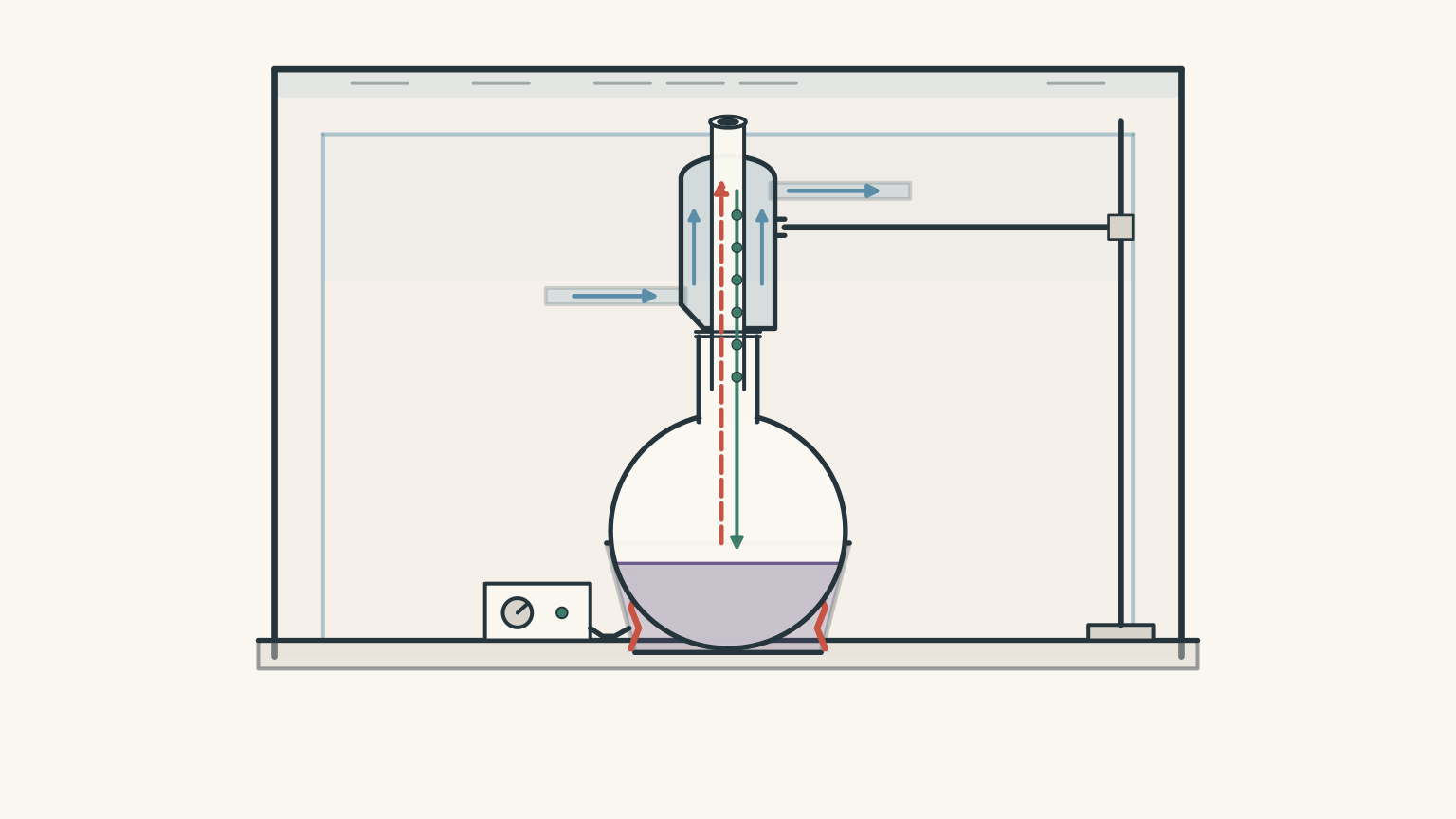
Due to technical limitations, this figure may display incorrectly or contain inaccuracies. Please check key details against your course materials.
Here is the important limitation: reflux does not automatically remove the water produced by esterification.
It returns condensed vapours to the reaction mixture. Therefore, it should not be confused with a process that selectively removes a product and shifts equilibrium.
04Worked example: calculating equilibrium in an esterification reaction
A mixture of butanoic acid and methanol is heated until equilibrium is established.
The measured equilibrium concentrations are:
| Substance | Equilibrium concentration |
|---|---|
| Butanoic acid | 0.30 mol L⁻¹ |
| Methanol | 0.20 mol L⁻¹ |
| Methyl butanoate | 0.15 mol L⁻¹ |
| Water | 0.15 mol L⁻¹ |
Calculate \(K_c\) and explain what the result tells you about the reaction mixture.
The values are illustrative data, not measurements from an actual experiment.
Step 1
\[ \ce{CH3CH2CH2COOH + CH3OH} \]
\[ \ce{<=> CH3CH2CH2COOCH3 + H2O} \]
All four substances have a coefficient of one.
Step 2
For this reaction:
\[ K_c= \frac{[\text{ester}][\text{water}]} {[\text{acid}][\text{alcohol}]} \]
Step 3
\[ K_c= \frac{0.15\times0.15} {0.30\times0.20} \]
\[ K_c=\frac{0.0225}{0.060} \]
\[ K_c=0.375 \]
Step 4
The equilibrium constant is \(0.375\) at the specified temperature.
Since \(K_c\) is less than one, the equilibrium favours the reactants under these conditions.
However, this does not mean that no ester has formed.
The mixture contains \(0.15\text{ mol L}^{-1}\) of methyl butanoate, alongside unreacted butanoic acid and methanol.
An ester can therefore be present even when the reactants are favoured at equilibrium.
This is exactly why a noticeable odour cannot be used to determine the percentage conversion or the purity of the product.
05Why a positive chemical test does not necessarily mean the ester is absent
Suppose you have prepared an ester and want to check whether unreacted carboxylic acid remains.
A useful chemical test involves sodium carbonate, \(\ce{Na2CO3}\).
Carboxylic acids react with sodium carbonate to produce carbon dioxide gas.
For ethanoic acid:
\[ \ce{2CH3COOH + Na2CO3} \]
\[ \ce{-> 2CH3COONa + H2O + CO2} \]
The carbon dioxide produces visible bubbling.
The gas can also be passed through limewater, \(\ce{Ca(OH)2}\).
\[ \ce{CO2 + Ca(OH)2 -> CaCO3 + H2O} \]
The formation of insoluble calcium carbonate makes the limewater appear cloudy.
This provides evidence that carbon dioxide was produced.
However, there is an important complication.
Sulfuric acid can produce the same result
Remember that concentrated sulfuric acid was added during esterification as a catalyst.
If some remains in the crude reaction mixture, it can also react with sodium carbonate.
\[ \ce{H2SO4 + Na2CO3} \]
\[ \ce{-> Na2SO4 + H2O + CO2} \]
Both the unreacted carboxylic acid and the sulfuric acid catalyst can therefore produce carbon dioxide.
This means that bubbling in an unpurified reaction mixture does not establish whether the desired ester is present.
It establishes that an acidic substance has reacted with the carbonate.
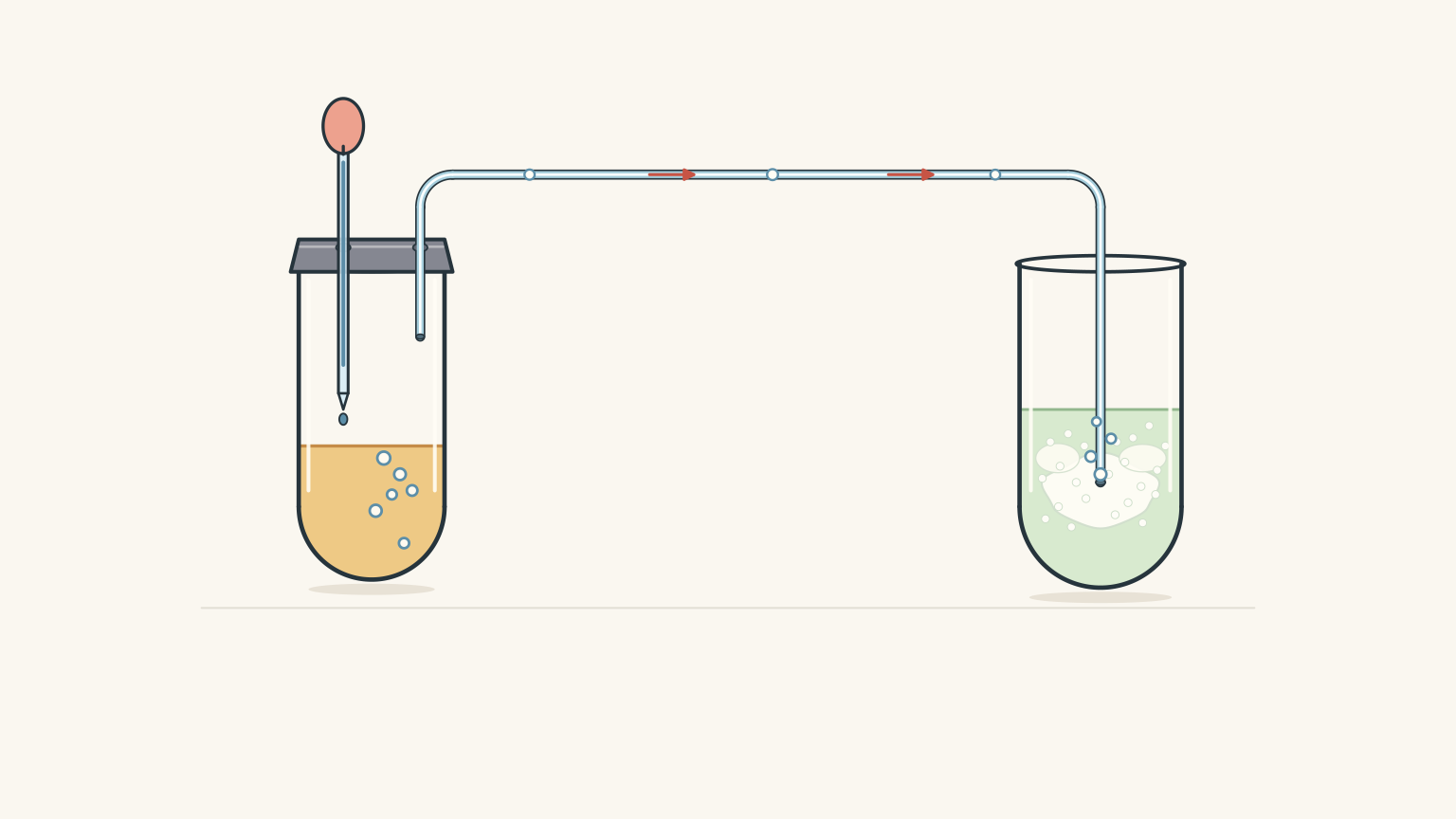
Due to technical limitations, this figure may display incorrectly or contain inaccuracies. Please check key details against your course materials.
What would provide better evidence?
The first improvement is to separate the desired ester from the other substances in the reaction mixture.
During a supervised purification procedure, water washing and an aqueous sodium carbonate wash can remove or neutralise residual acidic substances. The organic layer can then be separated and dried.
For the full explanation of these steps, see How to Purify an Ester After a Small-Scale Preparation.
However, even the absence of bubbling after purification does not prove that the sample is pure ester.
It only suggests that readily detectable acidic material is no longer present under the test conditions.
Other substances, such as unreacted alcohol and water, may still remain.
This is where instrumental analysis becomes useful.
Using infrared spectroscopy to identify an ester
Infrared spectroscopy (IR) provides information about the bonds present in a substance.
Different bonds absorb infrared radiation at characteristic wavenumbers.
For an ester, useful evidence includes:
- A strong carbonyl absorption associated with the \(\ce{C=O}\) bond.
- Absorption associated with the ester \(\ce{C-O}\) bond.
- No broad carboxylic-acid O-H absorption in a sufficiently purified sample.
A carboxylic acid also has a carbonyl group, but it has a characteristic broad O-H absorption.
This difference helps distinguish an ester from a carboxylic acid.
There is an additional complication: unreacted alcohol also contains an O-H bond. An impure reaction mixture may therefore show O-H absorption even when ester has formed.
The spectrum must be interpreted using the complete sample composition, rather than treating one peak as definitive.
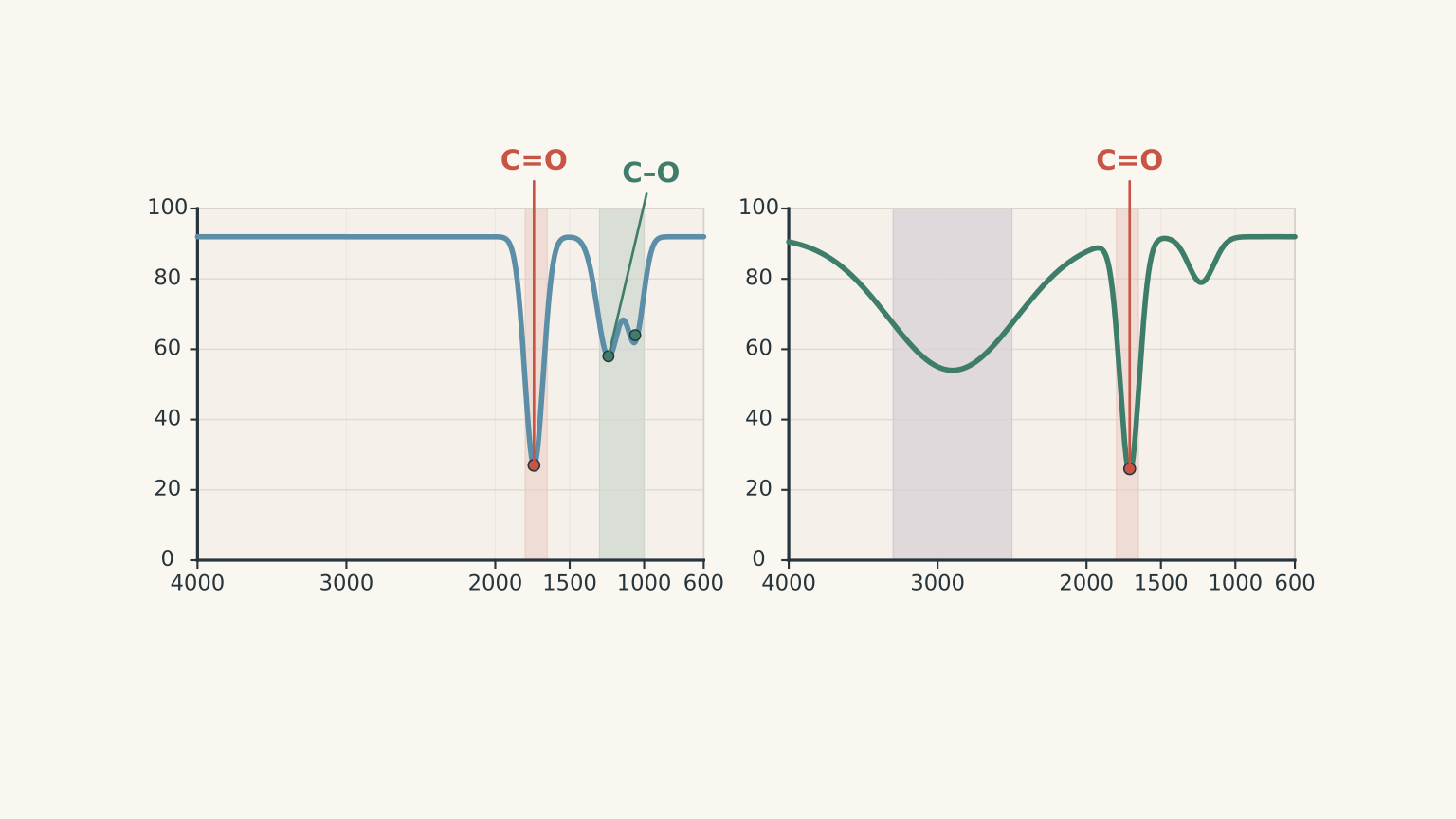
Due to technical limitations, this figure may display incorrectly or contain inaccuracies. Please check key details against your course materials.
The NSW Department of Education’s Chemistry Module 8 guide covers sodium carbonate testing for carboxylic acids and instrumental techniques such as infrared spectroscopy for analysing organic compounds.
The broader principle is that chemical tests and instrumental techniques provide different types of evidence. Combining them is much more reliable than relying on smell.
06A practical way to evaluate an unknown esterification product
When interpreting an esterification experiment, separate three different questions.
Question 1: Has an ester formed?
Look at the reaction conditions, the expected product structure, and appropriate chemical or instrumental evidence.
A characteristic odour might be consistent with ester formation, but it cannot confirm it.
Question 2: Is the sample pure?
Consider whether unreacted alcohol, carboxylic acid, water, or sulfuric acid remains.
A successful reaction does not automatically produce a pure product.
Question 3: Is the sample safe to handle?
Use the chemical identity, concentration, SDS, and laboratory risk assessment.
A pleasant odour cannot establish that a substance is safe to inhale or handle.
Keeping these questions separate prevents a common experimental mistake: using one observation to make three different conclusions.
07Questions and solutions
Question 1
A student carries out an esterification reaction using ethanol and ethanoic acid. During the practical, a pleasant fruity odour is noticed.
The student concludes that:
- Ethyl ethanoate has definitely formed.
- All the ethanoic acid has reacted.
- The reaction mixture is safe because the smell is pleasant.
Explain why all three conclusions are unjustified.
Solution 1
None of the three conclusions can be established from the odour alone.
A fruity smell may be consistent with ester formation, but it does not uniquely identify ethyl ethanoate.
Other volatile compounds in the reaction mixture may contribute to the smell. Furthermore, esterification is reversible, so unreacted ethanol and ethanoic acid can remain at equilibrium.
The mixture may therefore contain ethyl ethanoate without being pure.
Finally, pleasantness has no reliable relationship with toxicity. The safety of a chemical must be assessed using its identity, concentration, exposure routes, and appropriate safety information.
The correct conclusion is that an odour was noticed, but further chemical or instrumental evidence is needed to establish product identity and purity. The odour must not be used as a safety assessment.
Question 2
An equilibrium mixture is formed by reacting ethanoic acid with ethanol at a constant temperature.
The following equilibrium concentrations are measured:
| Substance | Concentration (mol L⁻¹) |
|---|---|
| Ethanoic acid | 0.30 |
| Ethanol | 0.20 |
| Ethyl ethanoate | 0.12 |
| Water | 0.12 |
(a) Calculate the equilibrium constant, \(K_c\).
(b) A student argues that because \(K_c\) is less than one, ethyl ethanoate cannot be present in a noticeable amount. Explain why this reasoning is incorrect.
Solution 2
(a) The equilibrium constant is \(0.24\).
Step 1: Write the balanced equation.
\[ \ce{CH3COOH + CH3CH2OH} \]
\[ \ce{<=> CH3COOCH2CH3 + H2O} \]
Step 2: Write the equilibrium expression.
\[ K_c= \frac{[\text{ester}][\text{water}]} {[\text{acid}][\text{alcohol}]} \]
Step 3: Substitute the given concentrations.
\[ K_c= \frac{0.12\times0.12} {0.30\times0.20} \]
\[ K_c=\frac{0.0144}{0.060} \]
\[ K_c=0.24 \]
(b) The student is incorrect because a value of \(K_c\) below one does not mean that no products are present.
A value below one indicates that the equilibrium favours the reactants under the specified conditions.
However, the equilibrium mixture still contains \(0.12\text{ mol L}^{-1}\) of ethyl ethanoate.
Whether its odour is noticeable depends on factors such as its volatility, concentration, and the sensitivity of the person detecting it.
The equilibrium constant describes the equilibrium composition. It does not tell you whether a particular odour will be detectable.
Question 3
A student prepares an ester using ethanoic acid and ethanol, with concentrated sulfuric acid as a catalyst.
The unpurified reaction mixture is divided into a small test portion. When sodium carbonate is added, visible bubbles form.
The gas is passed through limewater, which becomes cloudy.
The student concludes that no ester has formed because the mixture still contains acid.
(a) Identify the gas produced.
(b) Explain why the observation does not prove that esterification has failed.
(c) Write balanced equations for the reactions that could produce the gas.
(d) Explain what additional evidence would be needed to establish the presence of the ester.
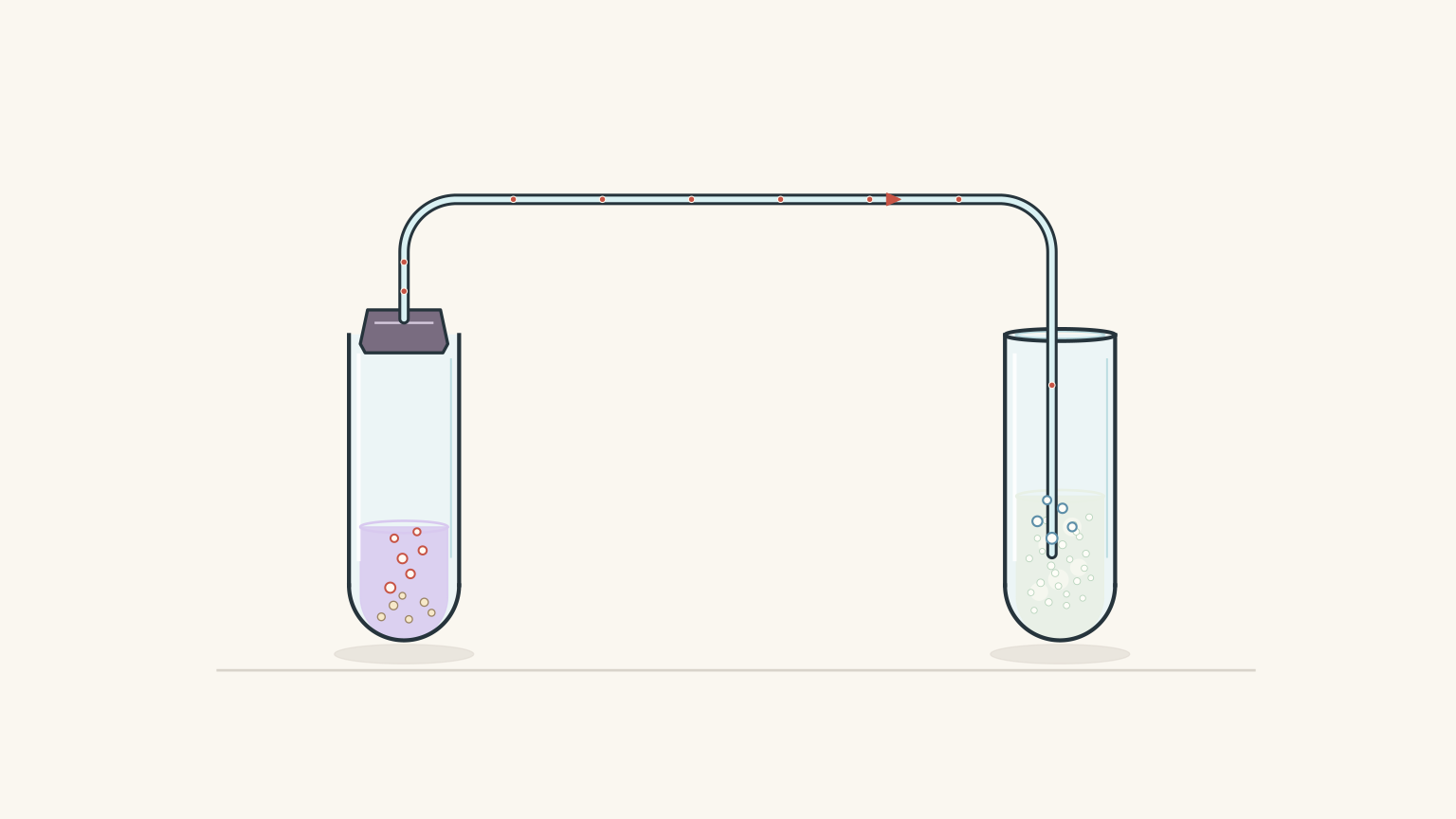
Due to technical limitations, this figure may display incorrectly or contain inaccuracies. Please check key details against your course materials.
Solution 3
(a) The gas is carbon dioxide, \(\ce{CO2}\).
The carbon dioxide is produced when sodium carbonate reacts with an acidic substance.
Its passage into limewater produces insoluble calcium carbonate, making the solution cloudy.
(b) The observation does not prove that esterification has failed because an ester can coexist with unreacted acid.
There are two possible sources of acid in the crude reaction mixture:
- Unreacted ethanoic acid, because esterification is reversible.
- Residual sulfuric acid, which was added as the catalyst.
Both can react with sodium carbonate and produce carbon dioxide.
Therefore, the presence of bubbles does not establish that the ester is absent.
The reaction may have produced ethyl ethanoate while leaving some acidic substances behind.
(c) The two possible reactions are:
Ethanoic acid reacting with sodium carbonate:
\[ \ce{2CH3COOH + Na2CO3} \]
\[ \ce{-> 2CH3COONa + H2O + CO2} \]
Sulfuric acid reacting with sodium carbonate:
\[ \ce{H2SO4 + Na2CO3} \]
\[ \ce{-> Na2SO4 + H2O + CO2} \]
Both reactions produce carbon dioxide.
The cloudy limewater confirms that carbon dioxide was present, but it does not identify which acid produced it.
(d) The ester must be separated from acidic impurities before its identity can be assessed reliably.
A suitable supervised purification procedure can remove residual acid, separate the organic product, and remove water.
The purified sample can then be analysed using infrared spectroscopy and, where appropriate, other instrumental techniques such as NMR.
For an ester, the expected carbonyl and C-O absorptions provide evidence of its functional group. Other analytical evidence can help confirm the molecular structure.
A pleasant smell and a positive carbonate test are not sufficient to establish product identity.
Question 4
Two identical esterification mixtures are prepared using the same amounts of ethanol and ethanoic acid.
Both mixtures are maintained at the same temperature and heated under reflux.
- Flask A contains a small amount of concentrated sulfuric acid as a catalyst.
- Flask B contains no catalyst.
After three minutes, a stronger fruity odour is incidentally noticed around Flask A.
A student makes two claims:
- The sulfuric acid catalyst increases the equilibrium constant, producing a greater equilibrium yield of ester.
- Reflux shifts the equilibrium towards ester formation because vapours condense and return to the reaction flask.
Evaluate both claims.
Assume that sulfuric acid is present only as a catalyst and does not remove a measurable amount of water in this comparison.
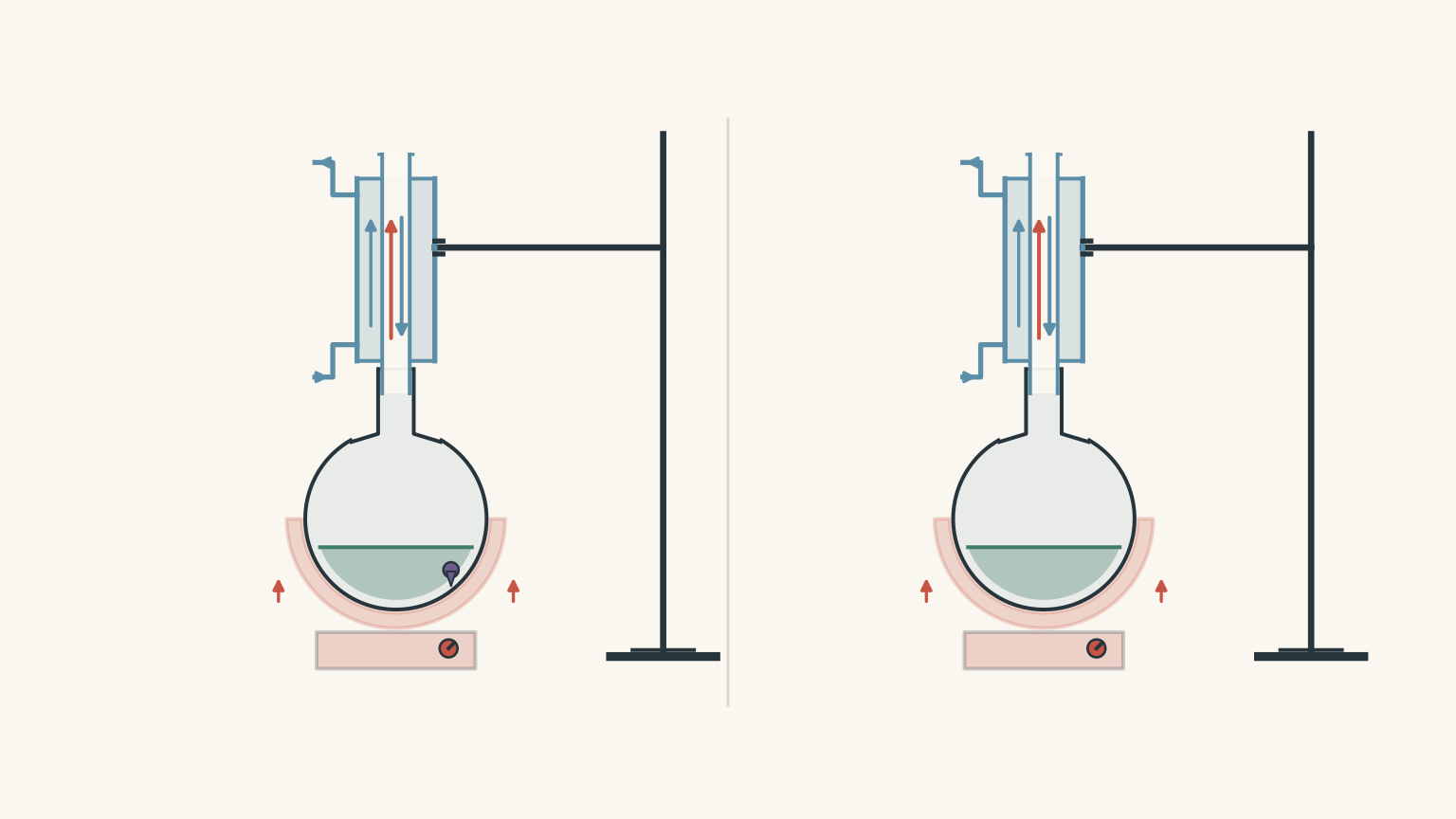
Due to technical limitations, this figure may display incorrectly or contain inaccuracies. Please check key details against your course materials.
Solution 4
Both claims are incorrect. The catalyst increases reaction rate, while reflux prevents the loss of volatile substances. Neither independently changes the equilibrium position under the stated assumptions.
Claim 1: The catalyst increases the equilibrium constant.
This is incorrect.
Concentrated sulfuric acid increases the rates of both the forward and reverse reactions by providing an alternative reaction pathway with lower activation energy.
As a result, Flask A approaches equilibrium faster than Flask B.
However, the equilibrium constant depends on temperature, not on whether a catalyst is present.
If both mixtures eventually reach equilibrium at the same temperature and have the same initial composition, their equilibrium compositions will be the same under the stated assumptions.
The stronger odour around Flask A after three minutes could be consistent with faster ester formation at that stage, but it does not establish the ester concentration or equilibrium yield.
Claim 2: Reflux shifts equilibrium towards ester formation.
This is also incorrect.
Reflux allows the mixture to be heated without losing significant amounts of volatile reactants and products.
Vapour rises into the condenser, cools, and returns to the flask.
The reflux condenser does not selectively remove water or ester. It retains condensed vapours within the reaction system.
Therefore, reflux helps maintain the reaction mixture while heating increases reaction rates.
A fair comparison would require both mixtures to reach equilibrium before their compositions are compared.
The ester concentrations should then be measured using an appropriate analytical technique, rather than estimated from odour intensity.
This distinguishes the effect of a catalyst on reaction rate from its lack of effect on equilibrium position.
Question 5
A homogeneous equilibrium mixture contains butanoic acid, methanol, methyl butanoate, and water.
The reaction is:
\[ \ce{CH3CH2CH2COOH + CH3OH} \]
\[ \ce{<=> CH3CH2CH2COOCH3 + H2O} \]
At a fixed temperature, the equilibrium concentrations are:
| Substance | Equilibrium concentration (mol L⁻¹) |
|---|---|
| Butanoic acid | 0.25 |
| Methanol | 0.25 |
| Methyl butanoate | 0.20 |
| Water | 0.20 |
The mixture is divided into two identical portions.
Portion A: An inert, non-volatile solvent is added, doubling the total volume. Assume that all four reacting species have their concentrations immediately halved.
Portion B: An ideal selective separation removes exactly half of the methyl butanoate. The total volume and concentrations of the other three substances remain unchanged.
Assume ideal solution behaviour, constant temperature, and that the solvent in Portion A does not participate in the reaction.
(a) Calculate the original equilibrium constant, \(K_c\).
(b) Calculate the reaction quotient, \(Q_c\), immediately after the change to Portion A. Predict whether the reaction shifts.
(c) Calculate \(Q_c\) immediately after the change to Portion B. Predict the direction of the reaction.
(d) Both portions initially produce a weaker ester odour than the original mixture. Explain why this observation cannot distinguish whether equilibrium has shifted.
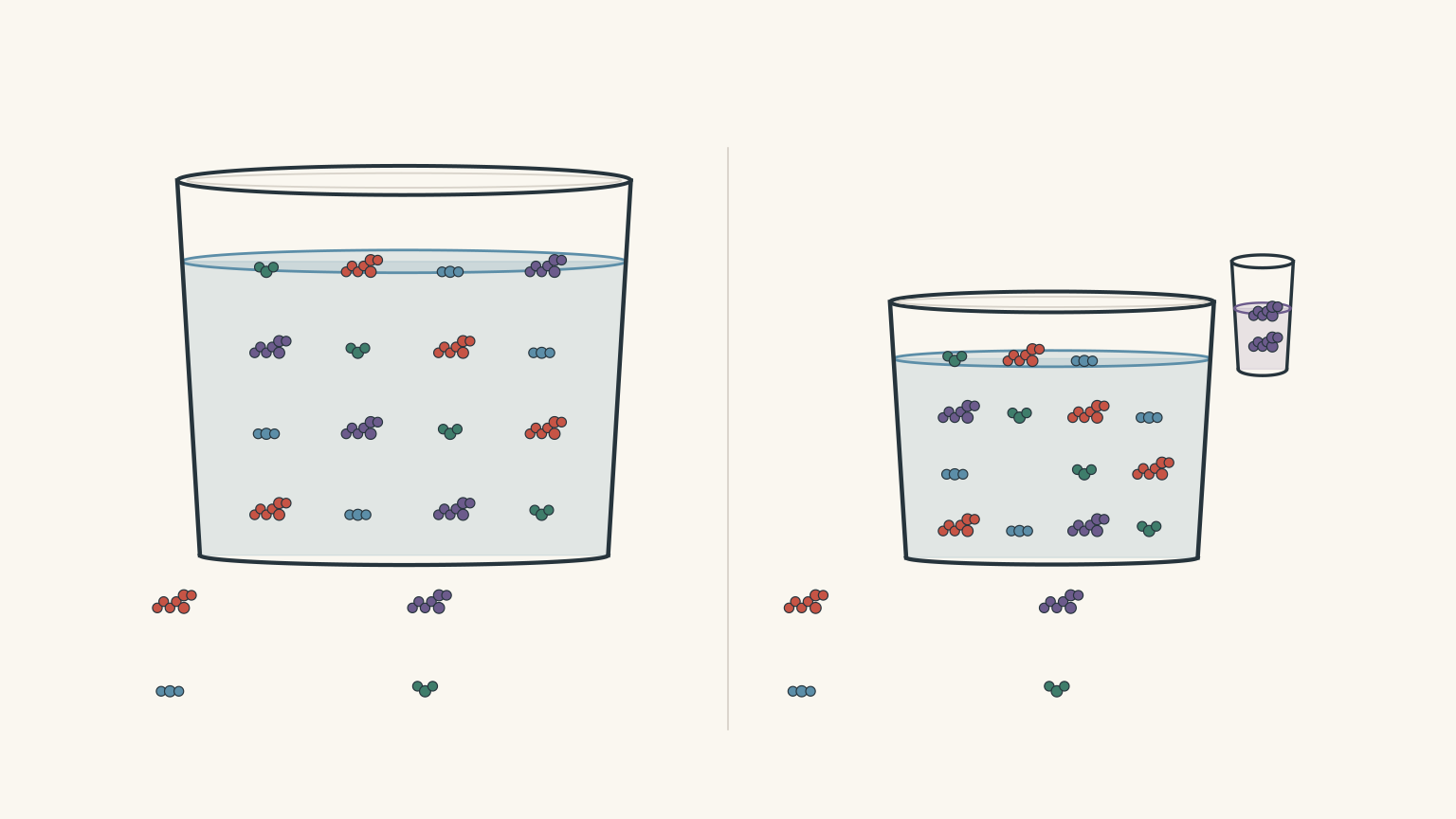
Due to technical limitations, this figure may display incorrectly or contain inaccuracies. Please check key details against your course materials.
Solution 5
(a) The original equilibrium constant is \(K_c=0.64\).
Step 1: Write the equilibrium expression.
\[ K_c= \frac{[\text{ester}][\text{water}]} {[\text{acid}][\text{methanol}]} \]
Step 2: Substitute the equilibrium concentrations.
\[ K_c= \frac{0.20\times0.20} {0.25\times0.25} \]
\[ K_c=\frac{0.040}{0.0625} \]
\[ K_c=0.64 \]
This is the equilibrium constant at the specified temperature.
(b) Portion A has \(Q_c=0.64\), so there is no shift in equilibrium.
Immediately after doubling the volume, all four concentrations are halved.
The new concentrations are:
| Substance | New concentration (mol L⁻¹) |
|---|---|
| Butanoic acid | 0.125 |
| Methanol | 0.125 |
| Methyl butanoate | 0.100 |
| Water | 0.100 |
The reaction quotient is:
\[ Q_c= \frac{0.100\times0.100} {0.125\times0.125} \]
\[ Q_c=\frac{0.0100}{0.015625} \]
\[ Q_c=0.64 \]
Since:
\[ Q_c=K_c \]
the mixture remains at equilibrium.
This is the important conceptual hinge.
You might predict that dilution shifts the equilibrium towards the side with more dissolved particles. However, this reaction has two reacting species on each side of the equation.
When all four concentrations are halved, the numerator and denominator of the equilibrium expression are both multiplied by the same factor.
The reaction quotient therefore remains unchanged.
There is no net shift.
(c) Portion B has \(Q_c=0.32\), so the reaction shifts forwards towards ester formation.
Half of the methyl butanoate is removed.
Its new concentration is:
\[ [\text{ester}]=0.100\text{ mol L}^{-1} \]
The other three concentrations remain unchanged.
Therefore:
\[ Q_c= \frac{0.100\times0.20} {0.25\times0.25} \]
\[ Q_c=\frac{0.020}{0.0625} \]
\[ Q_c=0.32 \]
Comparing the reaction quotient with the equilibrium constant:
\[ Q_c=0.32<K_c=0.64 \]
The forward reaction is favoured.
The system responds by consuming some butanoic acid and methanol and producing more methyl butanoate and water.
This is an application of Le Chatelier’s principle: removing a product disturbs equilibrium, and the system responds in the direction that partially opposes that change.
(d) Both portions initially have weaker odours because both have a lower methyl butanoate concentration. However, only Portion B experiences an equilibrium shift.
In Portion A, the number of moles of ester has not changed. Its concentration has simply decreased because the volume increased.
The reaction quotient remains equal to the equilibrium constant, so there is no net reaction.
In Portion B, some ester has actually been removed. This changes the reaction quotient, making it smaller than the equilibrium constant.
The forward reaction therefore produces additional ester as the mixture approaches its new equilibrium.
Under the assumption that the ester concentration in the surrounding air is proportional to its liquid concentration at constant temperature, both portions initially produce weaker odours.
However, their chemical behaviour is different:
- Portion A is diluted without shifting equilibrium.
- Portion B has lost product and responds by producing more ester.
The tempting conclusion is that a weaker smell means less ester has formed through a reverse reaction. Portion A demonstrates why that conclusion fails: the concentration can decrease without any net chemical reaction.
This is a much stronger way to interpret experimental evidence than treating smell as a direct measure of reaction progress.
08Where to go next
The important distinction is between observing a substance and identifying it.
A pleasant odour may be consistent with ester formation, but it cannot establish molecular connectivity, reaction completion, product purity, or safety.
For HSC Chemistry, the next useful connection is between esterification and the analytical techniques used to identify organic compounds. Combining structural formulae, chemical tests, infrared spectroscopy, and NMR provides a much stronger basis for identifying an unknown substance.
Syllabus context: For students studying the HSC in 2026 and 2027, the Chemistry Stage 6 Syllabus (2017) remains in use. NESA’s Chemistry 11-12 Syllabus (2025) is scheduled for implementation from 2028. This explanation draws on esterification, equilibrium, and organic chemical analysis; it does not present smelling a product as a formal chemical identification test. See NESA’s syllabus implementation information.