
How to Prepare a Dilute Solution from Stock in a Volumetric Flask
Learn how to calculate the required stock volume, transfer it accurately using a volumetric pipette, and dilute to the calibration mark. Includes worked examples explaining solute conservation, mixing solutions, and how chemical reactions affect final concentrations.
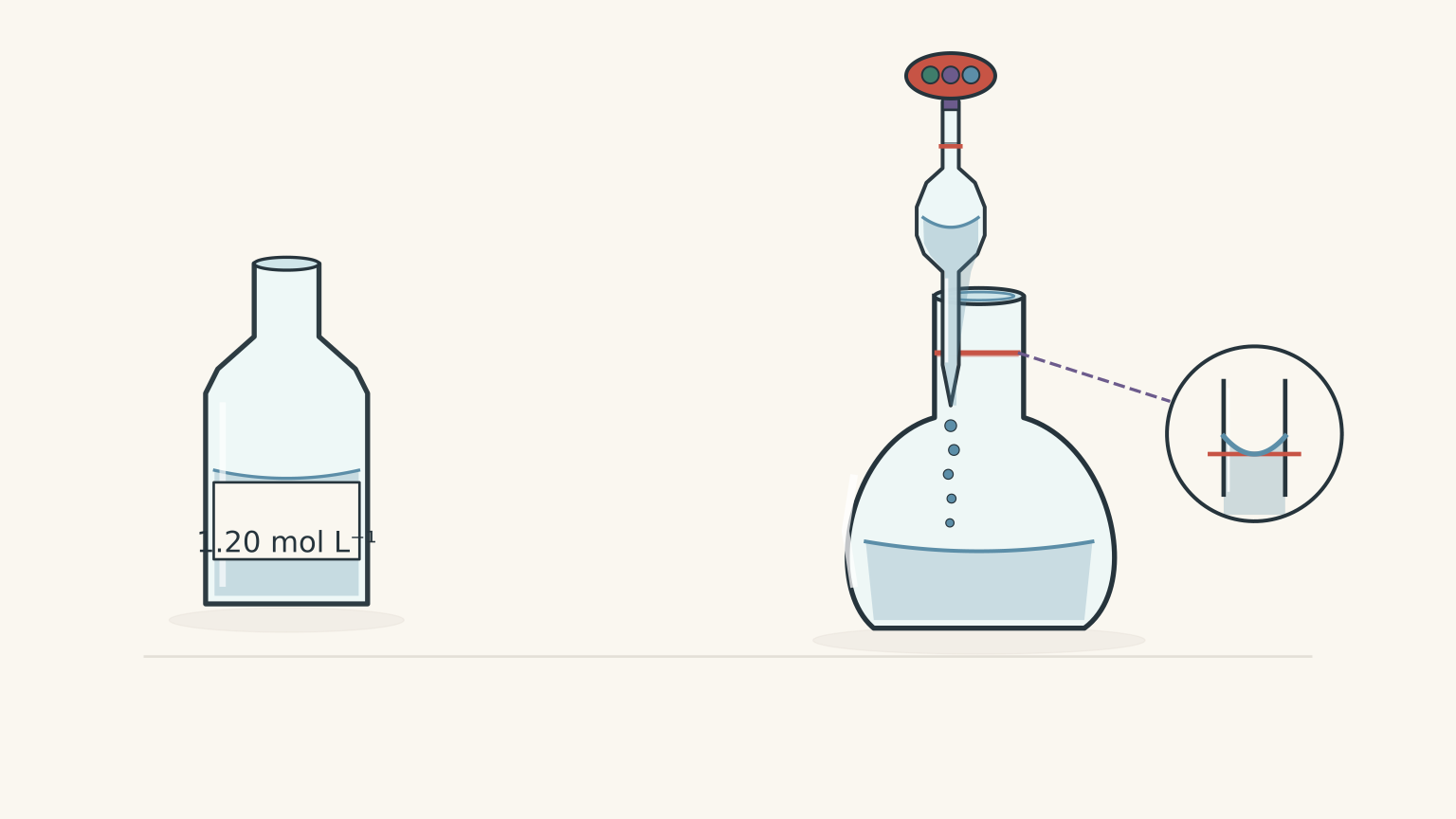
Suppose you have a \(1.20\ \mathrm{mol\,L^{-1}}\) potassium nitrate stock solution and need \(250.0\ \mathrm{mL}\) of a more dilute solution with a concentration of \(0.120\ \mathrm{mol\,L^{-1}}\).
You don’t measure out \(250.0\ \mathrm{mL}\) of water and pour the stock into it. Instead, you calculate the volume of stock needed, transfer that measured volume into a \(250.0\ \mathrm{mL}\) volumetric flask, and add water until the bottom of the meniscus reaches the calibration mark.
For this example, you need \(25.0\ \mathrm{mL}\) of stock solution.
One practical detail is worth predicting before you start: if the volumetric flask already contains a little distilled water, does it need to be dried? No. The final volume will still be \(250.0\ \mathrm{mL}\). However, if your pipette contains water before you measure the stock, you can deliver less solute than intended.
Understanding that difference is central to preparing an accurate solution.
Due to technical limitations, this figure may display incorrectly or contain inaccuracies. Please check key details against your course materials.
01The calculation: how much stock solution do you need?
A stock solution is a relatively concentrated solution used to prepare solutions of lower concentration.
The measured portion transferred from the stock bottle is called an aliquot.
The aim is to transfer enough dissolved solute to produce the required concentration when the aliquot is diluted to the final volume.
Start with the definition of molar concentration:
\[ c=\frac{n}{V} \]
where:
- \(c\) is molar concentration in \(\mathrm{mol\,L^{-1}}\)
- \(n\) is the amount of dissolved solute in moles
- \(V\) is the total solution volume in litres
Rearranging gives:
\[ n=cV \]
This tells us how many moles of solute are present in a particular volume of solution.
Why can we use the same number of moles before and after dilution?
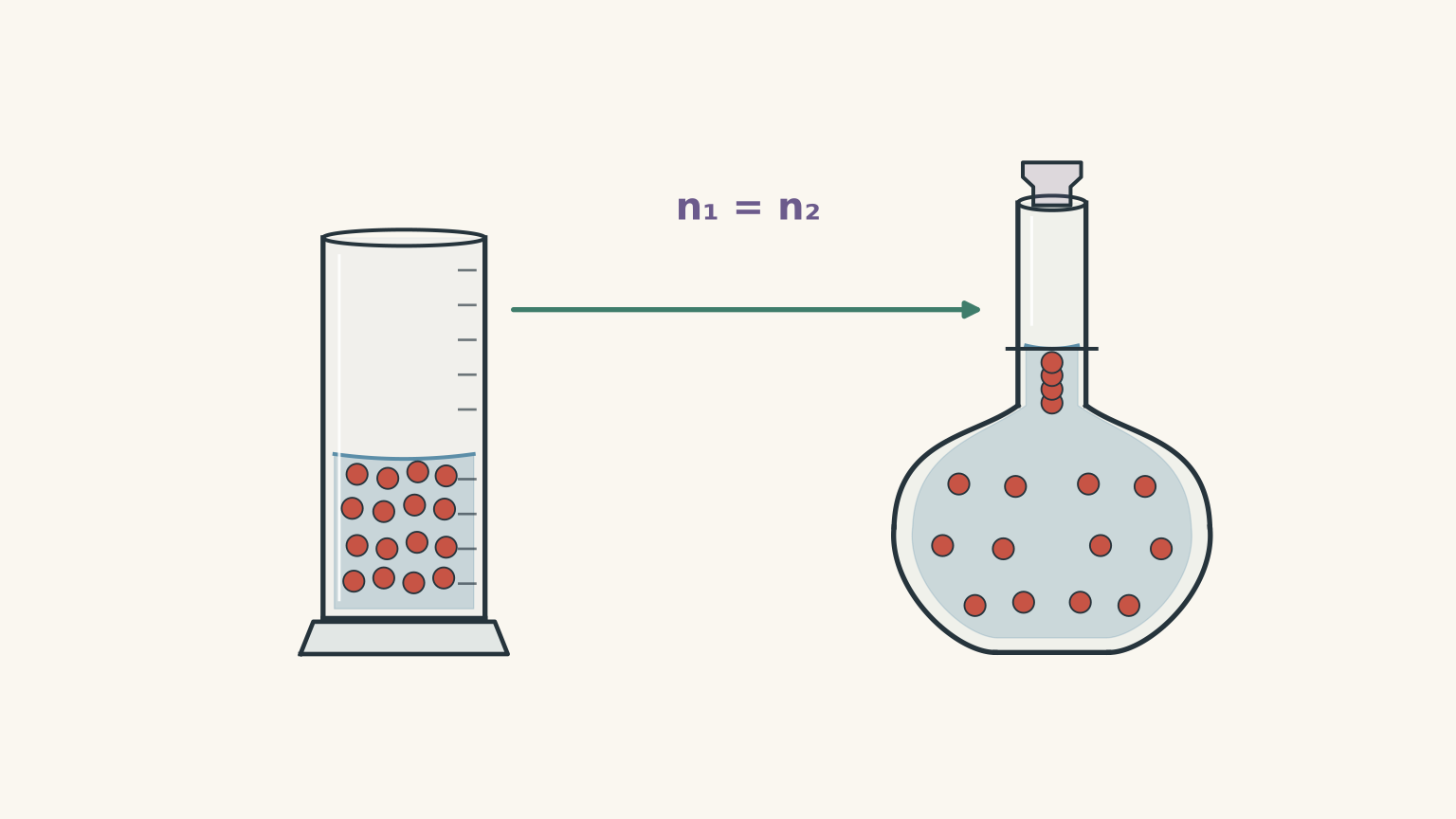
Imagine taking a measured amount of cordial concentrate and adding water. You haven’t removed any cordial concentrate. You’ve simply spread the same amount through a larger volume.
The same basic idea applies to a chemical solution.
If you transfer an aliquot of stock solution into a volumetric flask and add pure water, the amount of the original solute stays constant, provided that:
- No chemical reaction occurs.
- No solute is lost during transfer.
- No solute precipitates or is otherwise removed.
- The added water contains none of the solute being tracked.
The concentration changes because the final solution occupies a larger volume, not because the original solute disappears.
Due to technical limitations, this figure may display incorrectly or contain inaccuracies. Please check key details against your course materials.
We can therefore write:
\[ n_1=n_2 \]
Using \(n=cV\):
\[ c_1V_1=c_2V_2 \]
This is the dilution equation.
| Symbol | Meaning |
|---|---|
| \(c_1\) | Concentration of the original stock solution |
| \(V_1\) | Volume of stock solution transferred |
| \(c_2\) | Required final concentration |
| \(V_2\) | Required final solution volume |
The subscripts 1 and 2 represent the conditions before and after dilution, respectively.
Rearranging to find the required stock volume:
\[ \boxed{V_1=\frac{c_2V_2}{c_1}} \]
This is the equation you will use most often when preparing a dilute solution from a concentrated stock.
Watch your volume units. When using \(n=cV\) with concentration in \(\mathrm{mol\,L^{-1}}\), convert the volume into litres. When using the dilution equation directly, both volumes can be in millilitres, provided they use the same units.
A useful check is that the stock solution should be more concentrated than the target solution. Therefore, the volume of stock transferred should normally be smaller than the final solution volume.
For more practice rearranging the dilution equation, see Solution dilution calculations for HSC Chemistry.
02What does each piece of glassware actually do?
Two pieces of glassware are particularly important.
| Equipment | Its job | What it controls |
|---|---|---|
| Volumetric pipette | Transfers a measured amount of stock solution | \(V_1\) |
| Volumetric flask | Holds the prepared solution at its calibrated volume | \(V_2\) |
The distinction is important.
The pipette determines how much stock solution enters the flask. The volumetric flask determines the total volume of the finished solution.
A volumetric flask is not filled with a measured volume of water. It is filled with the solution until the liquid reaches its calibration mark.
For example, a \(100.0\ \mathrm{mL}\) volumetric flask is designed to contain \(100.0\ \mathrm{mL}\) of solution when filled correctly.
The stock solution already occupies some of that volume.
Worked example: Preparing a potassium nitrate solution
A laboratory has a \(1.50\ \mathrm{mol\,L^{-1}}\) potassium nitrate, \(\ce{KNO3}\), stock solution. Calculate the volume required to prepare \(100.0\ \mathrm{mL}\) of a \(0.150\ \mathrm{mol\,L^{-1}}\) solution.
Step 1
The stock concentration is:
\[ c_1=1.50\ \mathrm{mol\,L^{-1}} \]
The required final concentration is:
\[ c_2=0.150\ \mathrm{mol\,L^{-1}} \]
The required final volume is:
\[ V_2=100.0\ \mathrm{mL} \]
We need to calculate \(V_1\), the volume of stock solution to transfer.
Step 2
\[ c_1V_1=c_2V_2 \]
Rearrange to make \(V_1\) the subject:
\[ V_1=\frac{c_2V_2}{c_1} \]
Step 3
\[ V_1= \frac{(0.150)(100.0)}{1.50} \]
\[ V_1=10.0\ \mathrm{mL} \]
Step 4
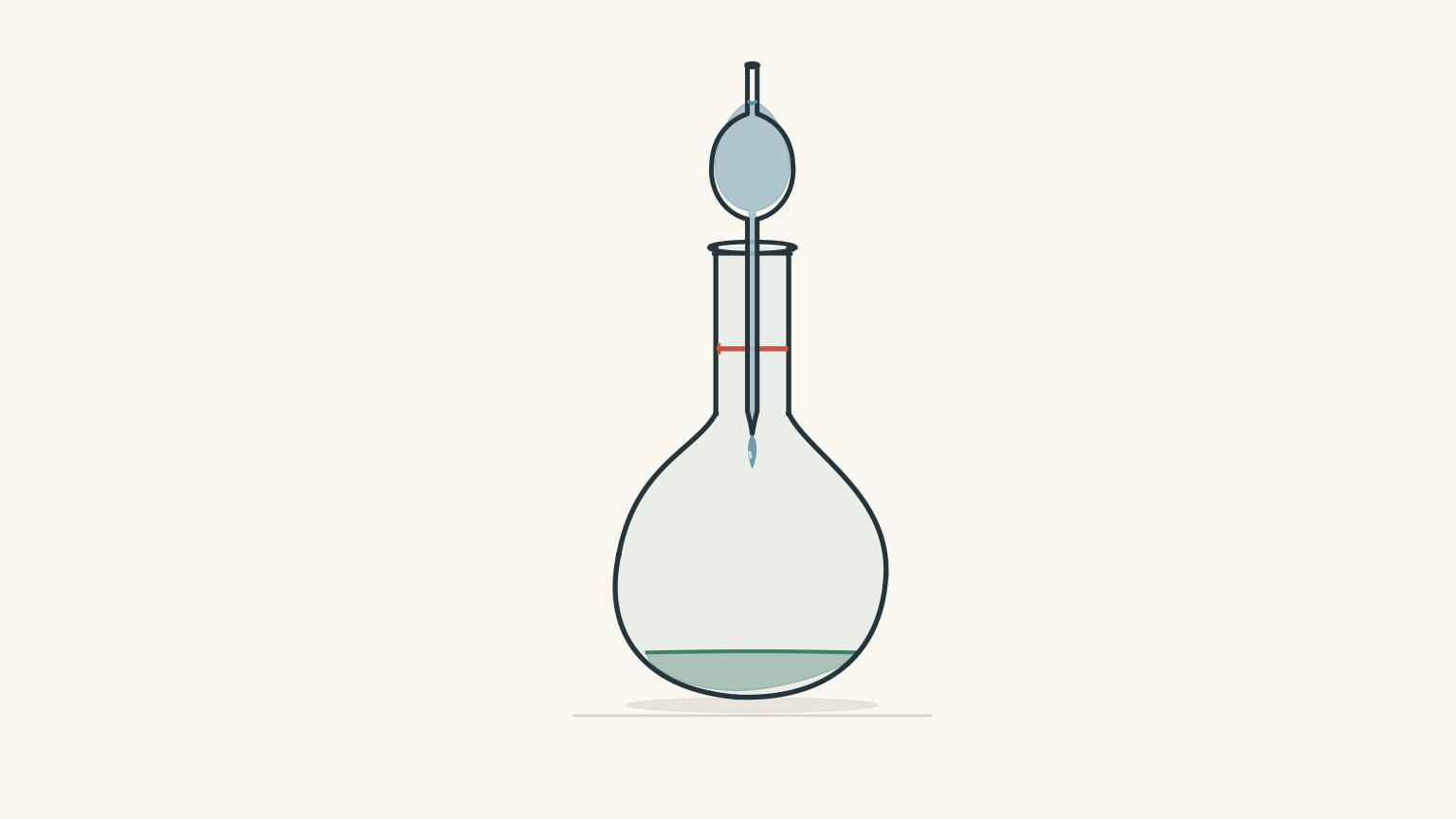
Use a \(10.00\ \mathrm{mL}\) volumetric pipette to transfer the stock solution into a \(100.0\ \mathrm{mL}\) volumetric flask.
Add distilled or deionised water until the bottom of the meniscus reaches the calibration mark.
Stopper the flask and invert it several times to mix thoroughly.
The required stock volume is \(10.0\ \mathrm{mL}\). This makes sense because the stock is ten times as concentrated as the target solution, so its volume must increase tenfold to reach the required final concentration.
Due to technical limitations, this figure may display incorrectly or contain inaccuracies. Please check key details against your course materials.
03Preparing the solution accurately in the laboratory
The calculation tells you how much stock to transfer. Your laboratory technique determines whether that amount actually reaches the flask.
Follow this sequence.
Step 1: Calculate the required stock volume
Calculate \(V_1\) using:
\[ V_1=\frac{c_2V_2}{c_1} \]
Check that the calculated volume is suitable for the available pipette.
For accurate preparation, use a volumetric pipette where possible. If the required volume cannot be delivered with the available pipette, an appropriate graduated pipette or burette may be used.
Step 2: Prepare the volumetric flask
Make sure the flask is clean.
It does not need to be completely dry. A small amount of distilled water remaining inside a clean flask will not affect the final concentration, provided the final volume is adjusted correctly and no reaction occurs.
If you are diluting an acid stock, place some water in the flask first and carefully transfer the measured acid into the water. Never pour water into concentrated acid.
Follow the appropriate laboratory safety instructions, wear suitable protective equipment, and use a pipette filler rather than pipetting by mouth.
Step 3: Condition the volumetric pipette
This is one of the most important practical steps.
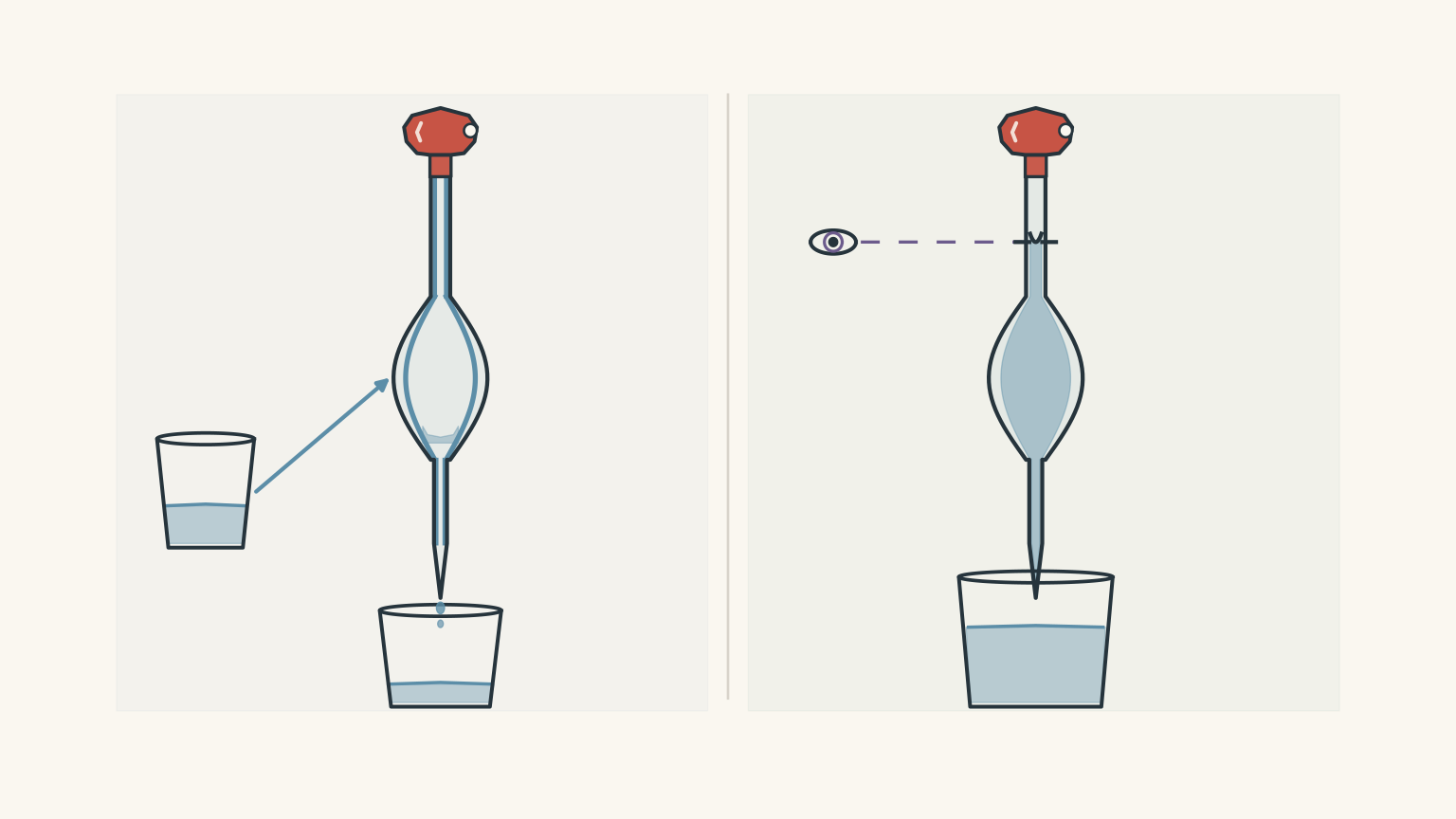
Rinse the inside of the pipette with a small amount of the stock solution before measuring the required aliquot. This is called conditioning the pipette.
Why?
Imagine that the pipette contains a thin film of distilled water. If you draw stock solution into it without conditioning, that water can dilute the stock inside the pipette.
You may still deliver the correct total volume, but that volume will contain fewer moles of solute than expected.
Rinse the pipette with small portions of stock solution and discard the rinsings appropriately.
Due to technical limitations, this figure may display incorrectly or contain inaccuracies. Please check key details against your course materials.
Step 4: Measure and transfer the stock solution
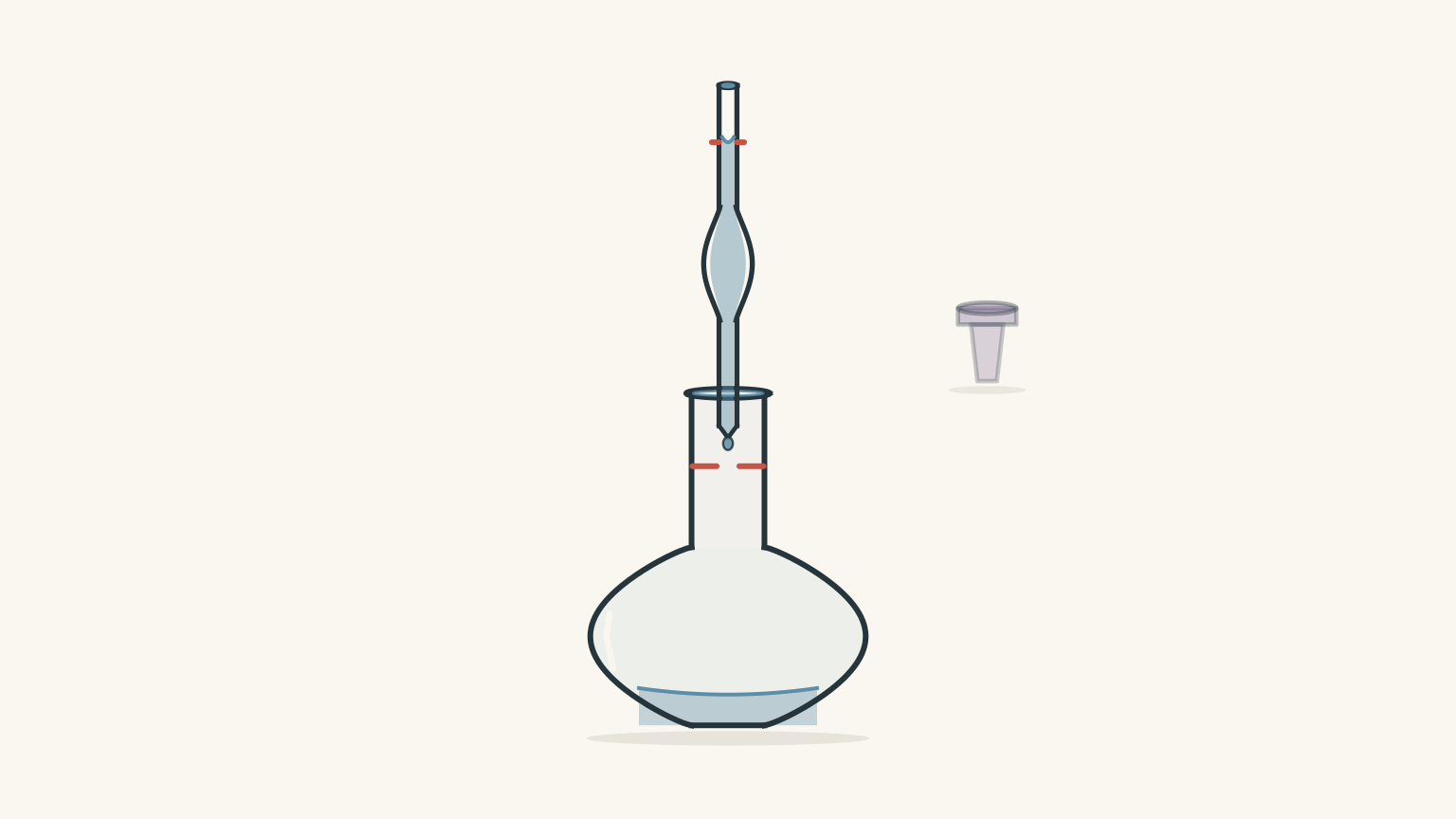
Use a pipette filler to draw the stock solution into the pipette.
Adjust the liquid level so that the bottom of the meniscus aligns with the calibration mark at eye level.
Transfer the measured aliquot into the volumetric flask.
For a standard volumetric pipette calibrated to deliver its stated volume, allow the liquid to drain naturally. Touch the tip against the inside wall of the receiving flask.
Do not blow out the final drop unless the pipette is specifically designed as a blow-out pipette. The small amount remaining in a standard volumetric pipette tip is accounted for in its calibration.
Step 5: Add water until close to the calibration mark
Add distilled or deionised water to the volumetric flask.
Initially, you can add water relatively quickly. As the liquid approaches the calibration mark, slow down.
Use a dropper to add the final few drops.
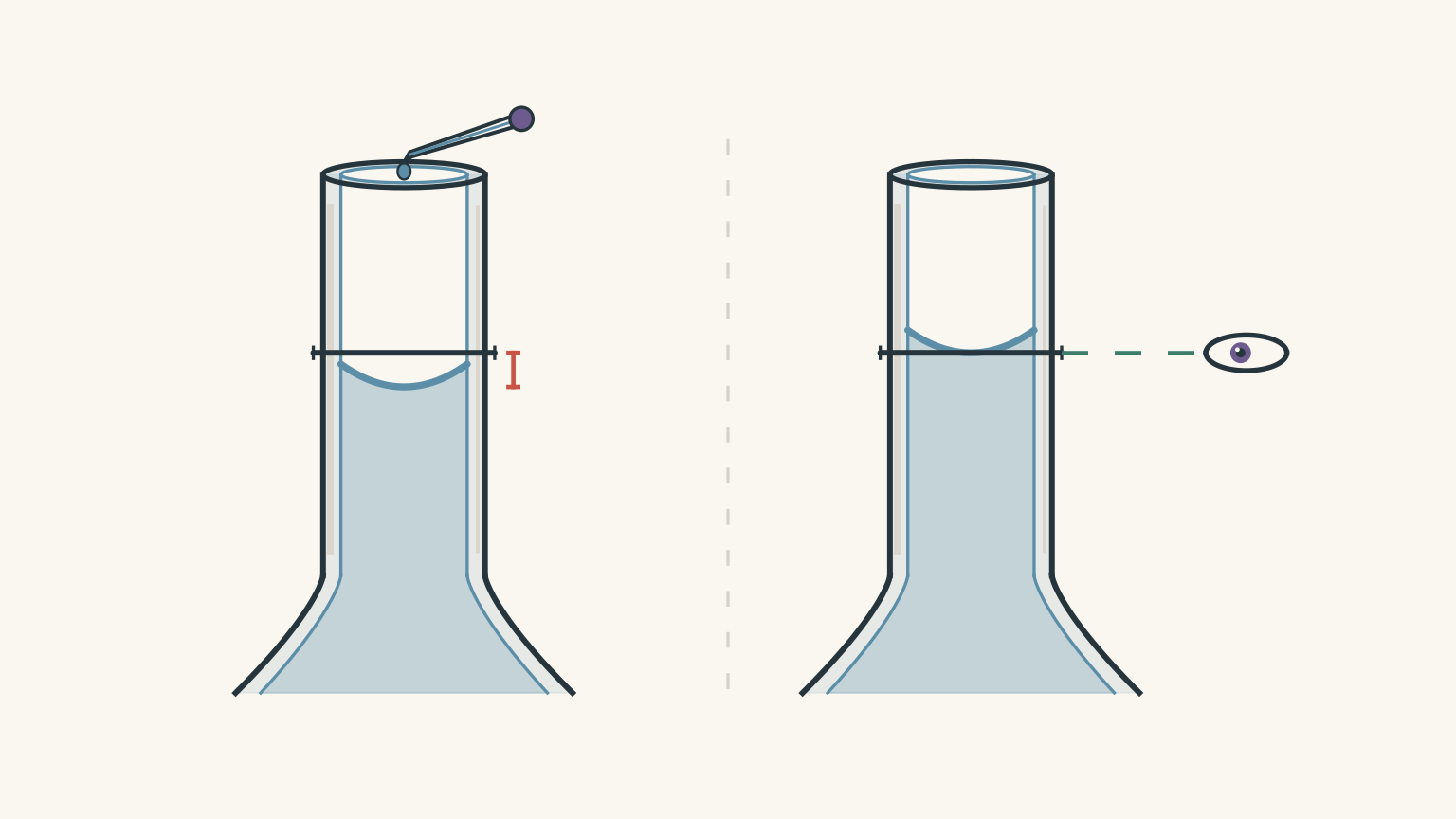
Due to technical limitations, this figure may display incorrectly or contain inaccuracies. Please check key details against your course materials.
Step 6: Set the final volume accurately
Place the flask on a flat surface.
Bring your eye level with the calibration mark and align the bottom of the concave meniscus with the line.
Reading from above or below introduces parallax error, which can cause the final volume to be incorrect.
If the dilution process produces significant heat, allow the solution to return to the flask’s calibration temperature before making the final volume adjustment. Temperature affects liquid volume.
Step 7: Stopper and mix thoroughly
Once the meniscus is correctly aligned, insert the stopper securely.
Invert the flask several times to distribute the solute evenly throughout the solution.
This step matters because the concentration may not initially be uniform immediately after adding the final water.
The solution is now ready to be labelled with its identity and concentration.
A common practical mistake: confusing a wet flask with a wet pipette
These two situations look similar, but they have different effects.
| Situation | Effect on the final concentration |
|---|---|
| Volumetric flask contains distilled water before stock is added | No effect, provided the final volume is correct |
| Pipette contains distilled water before stock is measured | Can decrease the amount of solute delivered |
| Flask contains a residue of another chemical | May contaminate the solution or cause a reaction |
| Flask is filled above the calibration mark | Final concentration becomes too low |
| Some stock solution is spilled before entering the flask | Less solute reaches the final solution |
The important distinction is that the flask controls the final volume, whereas the pipette controls the amount of stock transferred.
If you accidentally fill above the calibration mark, removing some of the mixed solution does not restore the intended concentration. You remove dissolved solute along with the liquid. For a significant overshoot, prepare the solution again.
04When is conservation of solute valid?
The dilution equation is based on a particular assumption: the amount of the solute being tracked remains unchanged.
That assumption is valid when one stock solution is diluted using pure water and no reaction occurs.
However, mixing two solutions is not necessarily the same process.
Consider these three situations:
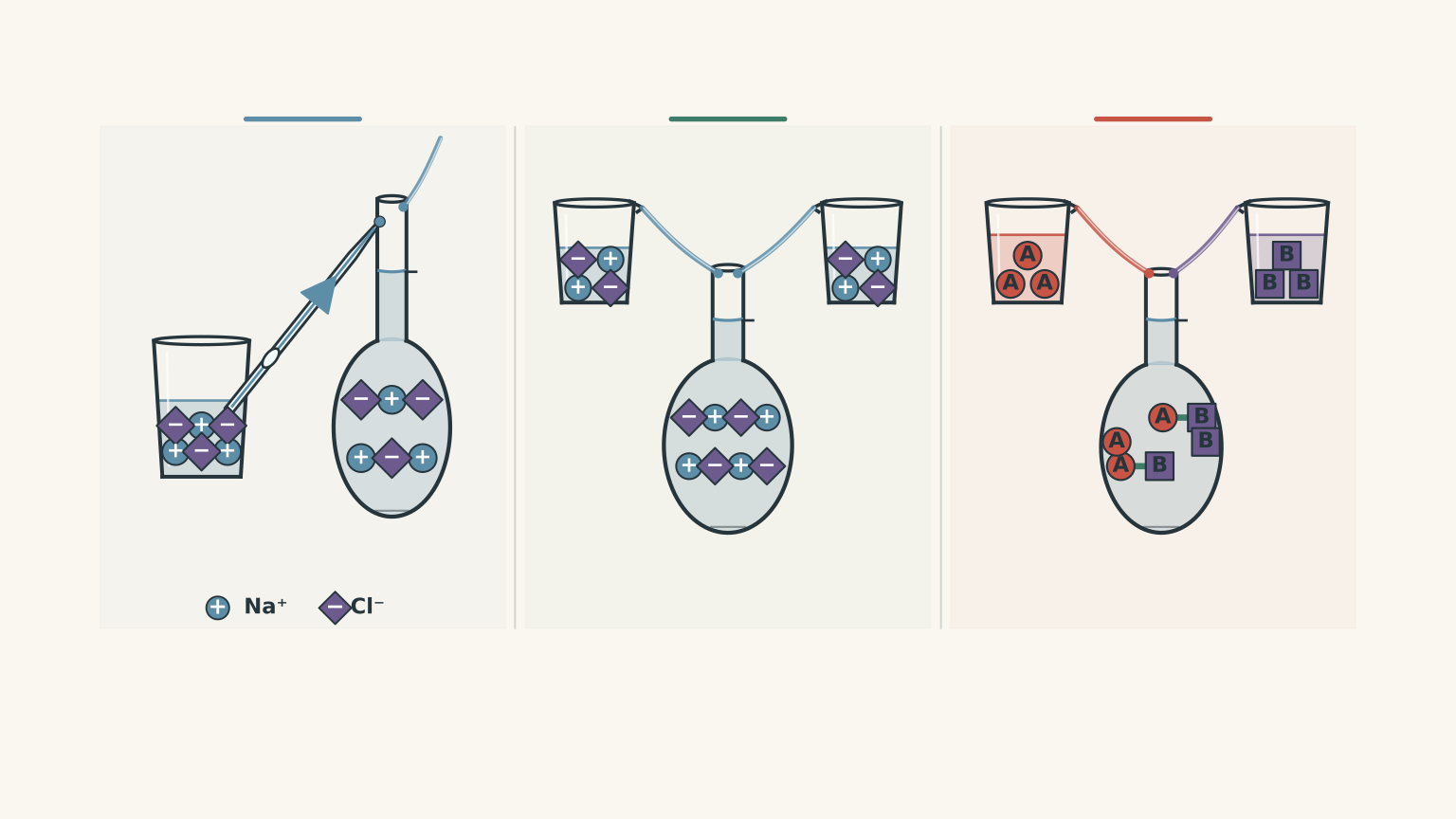
Due to technical limitations, this figure may display incorrectly or contain inaccuracies. Please check key details against your course materials.
Case 1: One stock solution diluted with water
This is the situation covered by the dilution equation.
The original amount of solute is conserved:
\[ c_1V_1=c_2V_2 \]
Case 2: Two solutions containing the same solute are mixed
Suppose you mix two sodium chloride solutions.
Both solutions contribute sodium chloride to the final mixture. You cannot simply track the amount in the first solution and ignore the second.
Instead:
\[ n_{\text{total}}=c_AV_A+c_BV_B \]
where:
- \(c_A\) and \(c_B\) are the initial concentrations
- \(V_A\) and \(V_B\) are their respective volumes
The final concentration is:
\[ c_{\text{final}}= \frac{n_{\text{total}}}{V_{\text{final}}} \]
Use the actual final solution volume. Do not automatically assume that the volumes of two solutions add exactly unless the question permits that approximation.
Case 3: Two solutions that react are mixed
This is where simply conserving the amount of each original solute fails.
For example, hydrochloric acid reacts with sodium hydroxide:
\[ \ce{HCl + NaOH -> NaCl + H2O} \]
The acid and base are consumed during neutralisation.
You must first use the balanced chemical equation to determine how much of each reactant remains. Only then can you calculate the final concentration.
Worked comparison: Why the dilution equation fails for reacting solutions
A student mixes \(20.0\ \mathrm{mL}\) of \(0.100\ \mathrm{mol\,L^{-1}}\) hydrochloric acid with \(10.0\ \mathrm{mL}\) of \(0.100\ \mathrm{mol\,L^{-1}}\) sodium hydroxide.
Assume the volumes are additive and the reaction goes to completion. Calculate the final hydrogen ion concentration.
Step 1: Calculate the initial amount of acid.
\[ n(\mathrm{H}^{+})=cV \]
\[ =(0.100)(0.0200) \]
\[ =0.00200\ \mathrm{mol} \]
Step 2: Calculate the initial amount of hydroxide ions.
\[ n(\ce{OH-})=(0.100)(0.0100) \]
\[ =0.00100\ \mathrm{mol} \]
Step 3: Apply the reaction stoichiometry.
The net ionic equation is:
\[ \ce{H+ + OH- -> H2O} \]
The reaction occurs in a \(1:1\) mole ratio.
Therefore, \(0.00100\ \mathrm{mol}\) of hydrogen ions are consumed.
The amount remaining is:
\[ n(\mathrm{H}^{+})=0.00200-0.00100 \]
\[ =0.00100\ \mathrm{mol} \]
Step 4: Calculate the final concentration.
The total volume is:
\[ V_{\text{final}}=20.0+10.0 \]
\[ =30.0\ \mathrm{mL}=0.0300\ \mathrm{L} \]
Therefore:
\[ [\mathrm{H}^{+}]=\frac{0.00100}{0.0300} \]
\[ \boxed{[\mathrm{H}^{+}]=0.0333\ \mathrm{mol\,L^{-1}}} \]
A tempting approach would be to use the dilution equation and calculate:
\[ [\mathrm{H}^{+}]=\frac{(0.100)(20.0)}{30.0} \]
\[ =0.0667\ \mathrm{mol\,L^{-1}} \]
But this is incorrect.
It assumes that all the original hydrogen ions remain in the mixture. Half have actually reacted with hydroxide ions.
The lesson is simple: before conserving an amount of solute, check whether a chemical reaction changes that amount.
05Questions and solutions
All numerical data in the following questions are illustrative.
Assume that the stock solutions have their stated concentrations, the volumetric flasks are correctly calibrated, and any reaction or volume-additivity assumptions are stated in the question.
Question 1
A student needs to prepare \(250.0\ \mathrm{mL}\) of \(0.120\ \mathrm{mol\,L^{-1}}\) potassium nitrate, \(\ce{KNO3}\), using a stock solution with a concentration of \(1.20\ \mathrm{mol\,L^{-1}}\).
Calculate the volume of stock solution required and describe how the student should prepare the solution using a volumetric pipette and volumetric flask.
Due to technical limitations, this figure may display incorrectly or contain inaccuracies. Please check key details against your course materials.
Solution 1
The student needs to transfer \(25.0\ \mathrm{mL}\) of stock solution into the \(250.0\ \mathrm{mL}\) volumetric flask, then dilute to the calibration mark.
Step 1: Identify the known values.
\[ c_1=1.20\ \mathrm{mol\,L^{-1}} \]
\[ c_2=0.120\ \mathrm{mol\,L^{-1}} \]
\[ V_2=250.0\ \mathrm{mL} \]
Step 2: Apply the dilution equation.
\[ c_1V_1=c_2V_2 \]
Rearrange:
\[ V_1=\frac{c_2V_2}{c_1} \]
Step 3: Substitute the values.
\[ V_1=\frac{(0.120)(250.0)}{1.20} \]
\[ \boxed{V_1=25.0\ \mathrm{mL}} \]
Step 4: Describe the practical procedure.
- Condition a \(25.00\ \mathrm{mL}\) volumetric pipette with the stock solution.
- Use the pipette to transfer the measured stock into a clean \(250.0\ \mathrm{mL}\) volumetric flask containing some distilled water.
- Add distilled water until the bottom of the meniscus reaches the calibration mark.
- Stopper and invert the flask several times.
The final concentration is one-tenth of the original concentration because the \(25.0\ \mathrm{mL}\) aliquot is diluted to ten times its original volume.
Question 2
A student wants to prepare \(100.0\ \mathrm{mL}\) of \(0.160\ \mathrm{mol\,L^{-1}}\) copper sulfate, \(\ce{CuSO4}\), using a \(0.800\ \mathrm{mol\,L^{-1}}\) stock solution.
The student uses a \(20.00\ \mathrm{mL}\) volumetric pipette.
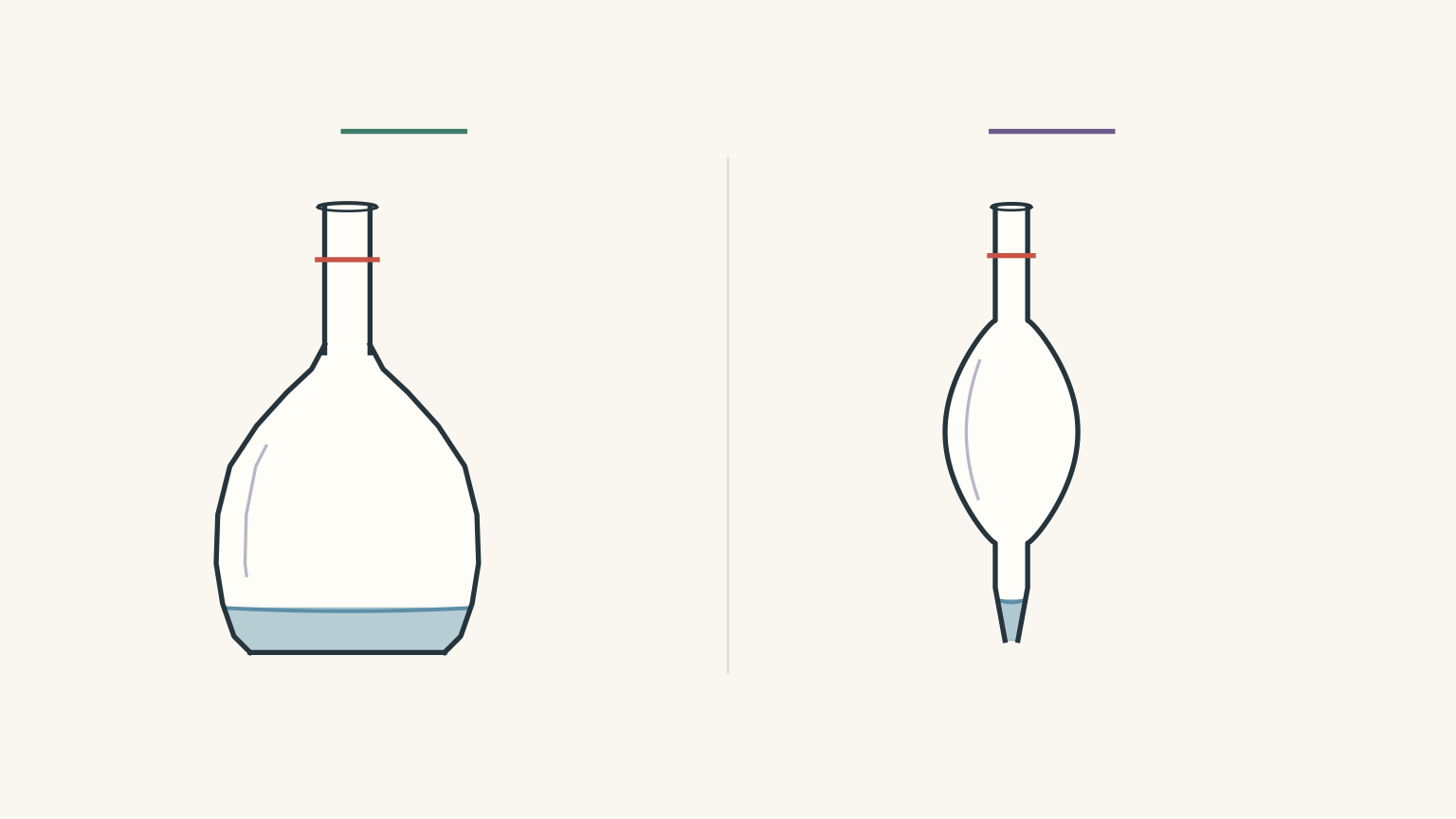
However, the pipette accidentally contains \(0.50\ \mathrm{mL}\) of distilled water before the stock solution is drawn into it. Assume the final \(20.00\ \mathrm{mL}\) delivered contains \(19.50\ \mathrm{mL}\) of stock solution and \(0.50\ \mathrm{mL}\) of water.
The volumetric flask also contains \(5.0\ \mathrm{mL}\) of distilled water before the stock solution is transferred.
Calculate the actual final concentration and explain which of these two sources of water affects the result.
Due to technical limitations, this figure may display incorrectly or contain inaccuracies. Please check key details against your course materials.
Solution 2
The actual final concentration is \(0.156\ \mathrm{mol\,L^{-1}}\). The water in the pipette reduces the amount of copper sulfate transferred, whereas the water already in the volumetric flask does not affect the final concentration.
Step 1: Determine the actual volume of stock solution delivered.
The pipette delivers \(20.00\ \mathrm{mL}\) in total, but \(0.50\ \mathrm{mL}\) of that volume is water.
Therefore:
\[ V_{\text{stock}}=20.00-0.50 \]
\[ =19.50\ \mathrm{mL} \]
Convert to litres:
\[ V_{\text{stock}}=0.01950\ \mathrm{L} \]
Step 2: Calculate the actual amount of copper sulfate transferred.
\[ n=cV \]
\[ =(0.800)(0.01950) \]
\[ =0.01560\ \mathrm{mol} \]
Step 3: Calculate the actual final concentration.
The final solution volume is still \(100.0\ \mathrm{mL}\), or \(0.1000\ \mathrm{L}\).
\[ c=\frac{n}{V} \]
\[ =\frac{0.01560}{0.1000} \]
\[ \boxed{c=0.156\ \mathrm{mol\,L^{-1}}} \]
Step 4: Explain the effect of the two water residues.
The \(5.0\ \mathrm{mL}\) of water in the volumetric flask does not matter because the final solution is still adjusted to \(100.0\ \mathrm{mL}\).
The \(0.50\ \mathrm{mL}\) of water in the pipette matters because it reduces the amount of stock solution in the measured aliquot.
The student therefore transfers fewer moles of copper sulfate than intended.
This is why conditioning the pipette with the stock solution is important.
Question 3
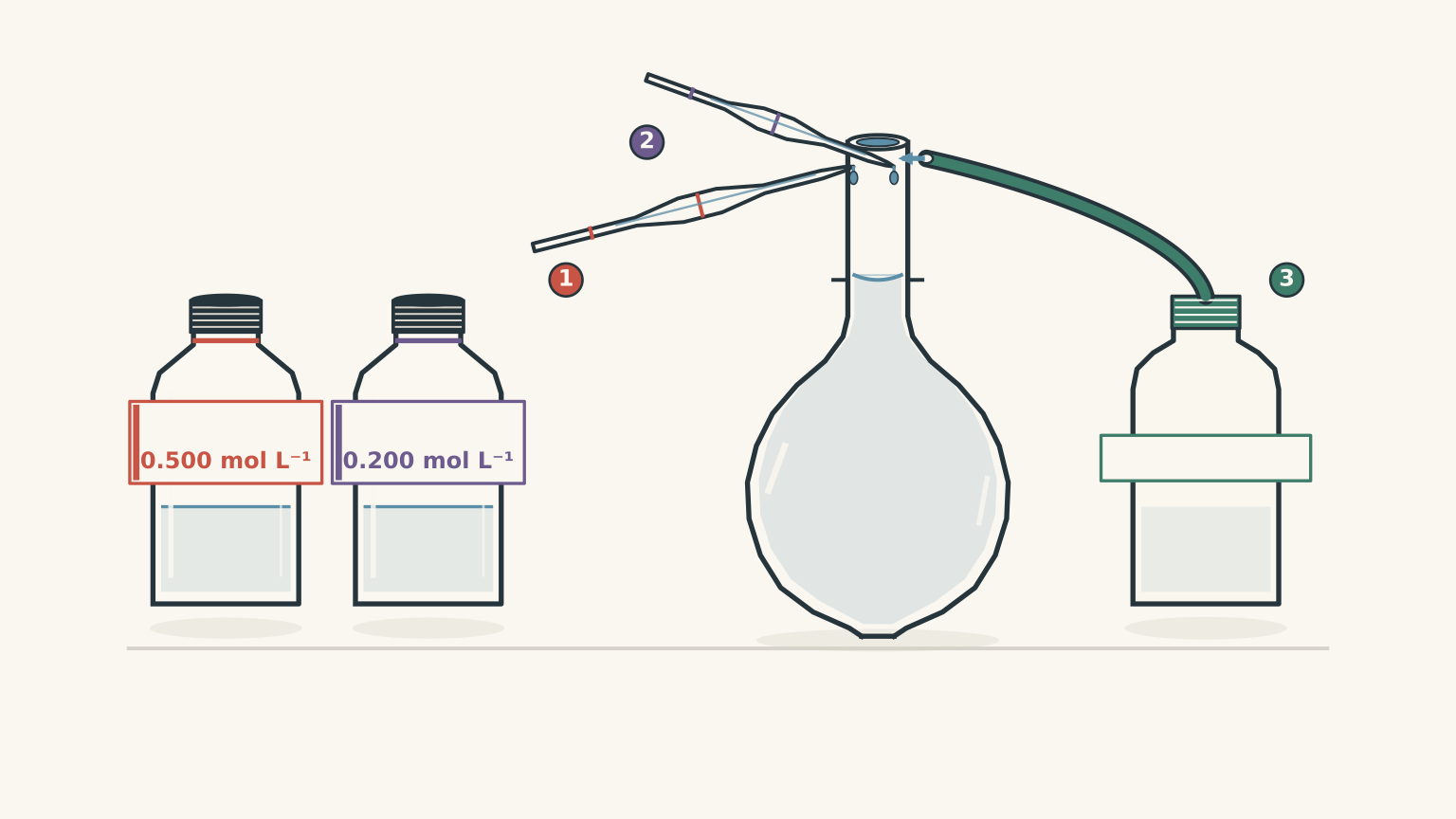
A student is preparing \(100.0\ \mathrm{mL}\) of sodium chloride solution using a \(0.500\ \mathrm{mol\,L^{-1}}\) stock solution.
The student transfers \(20.00\ \mathrm{mL}\) of this stock into a volumetric flask.
Before filling the flask to the calibration mark, the student accidentally adds \(10.00\ \mathrm{mL}\) of a second sodium chloride solution with a concentration of \(0.200\ \mathrm{mol\,L^{-1}}\).
The flask is then filled with distilled water to a final volume of \(100.0\ \mathrm{mL}\).
Assume no chemical reaction occurs.
Calculate the final sodium chloride concentration and explain why treating the second solution as pure water would produce an incorrect result.
Due to technical limitations, this figure may display incorrectly or contain inaccuracies. Please check key details against your course materials.
Solution 3
The final sodium chloride concentration is \(0.120\ \mathrm{mol\,L^{-1}}\), not \(0.100\ \mathrm{mol\,L^{-1}}\).
The second solution contributes additional sodium chloride, so its solute amount must also be included.
Step 1: Calculate the amount of sodium chloride from the first solution.
\[ n_1=c_1V_1 \]
\[ =(0.500)(0.02000) \]
\[ =0.0100\ \mathrm{mol} \]
Step 2: Calculate the amount of sodium chloride from the second solution.
\[ n_2=c_2V_2 \]
\[ =(0.200)(0.01000) \]
\[ =0.00200\ \mathrm{mol} \]
Step 3: Calculate the total amount of sodium chloride.
Both solutions contain the same solute, and no reaction occurs.
Therefore, their amounts of sodium chloride add:
\[ n_{\text{total}}=0.0100+0.00200 \]
\[ =0.0120\ \mathrm{mol} \]
Step 4: Calculate the final concentration.
The final solution volume is:
\[ 100.0\ \mathrm{mL}=0.1000\ \mathrm{L} \]
Therefore:
\[ c_{\text{final}}=\frac{0.0120}{0.1000} \]
\[ \boxed{c_{\text{final}}=0.120\ \mathrm{mol\,L^{-1}}} \]
The tempting mistake is to treat the second solution as if it were pure water.
If it were pure water, the original \(0.0100\ \mathrm{mol}\) would remain unchanged, giving \(0.100\ \mathrm{mol\,L^{-1}}\).
But the second solution contributes another \(0.00200\ \mathrm{mol}\) of sodium chloride.
This is a mixture of two solutions containing the same solute, not a simple dilution of one solution.
Question 4
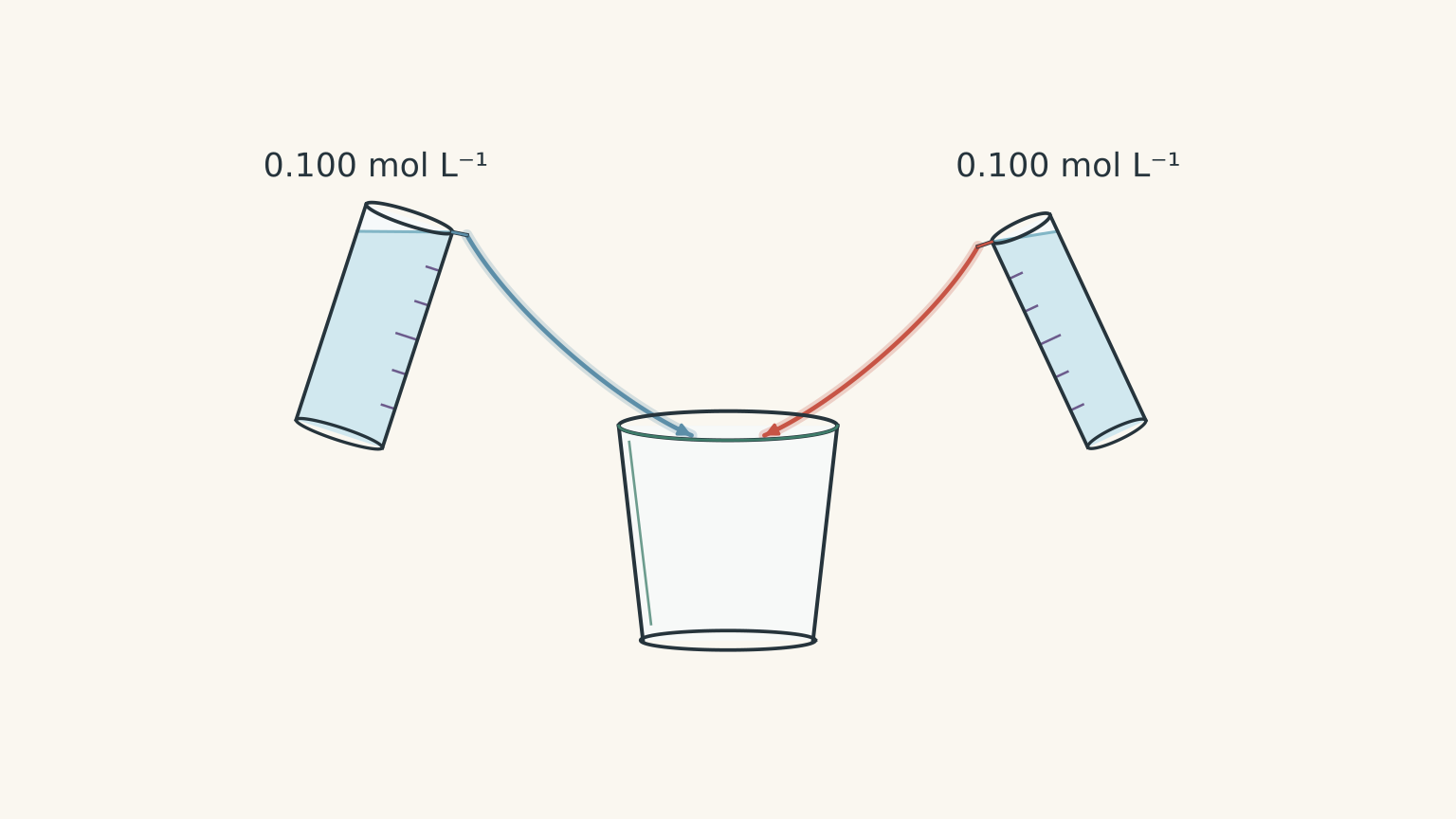
A student mixes:
- \(20.0\ \mathrm{mL}\) of \(0.100\ \mathrm{mol\,L^{-1}}\) hydrochloric acid
- \(10.0\ \mathrm{mL}\) of \(0.100\ \mathrm{mol\,L^{-1}}\) sodium hydroxide
The reaction proceeds to completion, and the final volume is \(30.0\ \mathrm{mL}\).
Calculate the final hydrogen ion concentration.
Explain why using the dilution equation directly on the hydrochloric acid solution would give an incorrect answer.
Due to technical limitations, this figure may display incorrectly or contain inaccuracies. Please check key details against your course materials.
Solution 4
The final hydrogen ion concentration is \(0.0333\ \mathrm{mol\,L^{-1}}\).
The hydrochloric acid reacts with the sodium hydroxide, so some of the original hydrogen ions are consumed.
Step 1: Calculate the initial amount of hydrogen ions.
Hydrochloric acid is a strong acid and dissociates completely in water.
\[ n(\mathrm{H}^{+})=cV \]
\[ =(0.100)(0.0200) \]
\[ =0.00200\ \mathrm{mol} \]
Step 2: Calculate the amount of hydroxide ions.
\[ n(\ce{OH-})=cV \]
\[ =(0.100)(0.0100) \]
\[ =0.00100\ \mathrm{mol} \]
Step 3: Determine the amount of hydrogen ions remaining.
The balanced net ionic equation is:
\[ \ce{H+ + OH- -> H2O} \]
The mole ratio is \(1:1\).
Therefore, \(0.00100\ \mathrm{mol}\) of hydrogen ions react with the hydroxide ions.
The remaining amount is:
\[ n(\mathrm{H}^{+})=0.00200-0.00100 \]
\[ =0.00100\ \mathrm{mol} \]
Step 4: Calculate the final concentration.
\[ V_{\text{final}}=30.0\ \mathrm{mL} \]
\[ =0.0300\ \mathrm{L} \]
Therefore:
\[ [\mathrm{H}^{+}]=\frac{0.00100}{0.0300} \]
\[ \boxed{[\mathrm{H}^{+}]=0.0333\ \mathrm{mol\,L^{-1}}} \]
The incorrect dilution approach would assume that all \(0.00200\ \mathrm{mol}\) of hydrogen ions remain after mixing.
It would therefore calculate:
\[ [\mathrm{H}^{+}]=\frac{0.00200}{0.0300} \]
\[ =0.0667\ \mathrm{mol\,L^{-1}} \]
This is twice the actual concentration.
The problem is not the dilution equation itself. The problem is assuming that the amount of hydrogen ions is conserved when a reaction is taking place.
Question 5
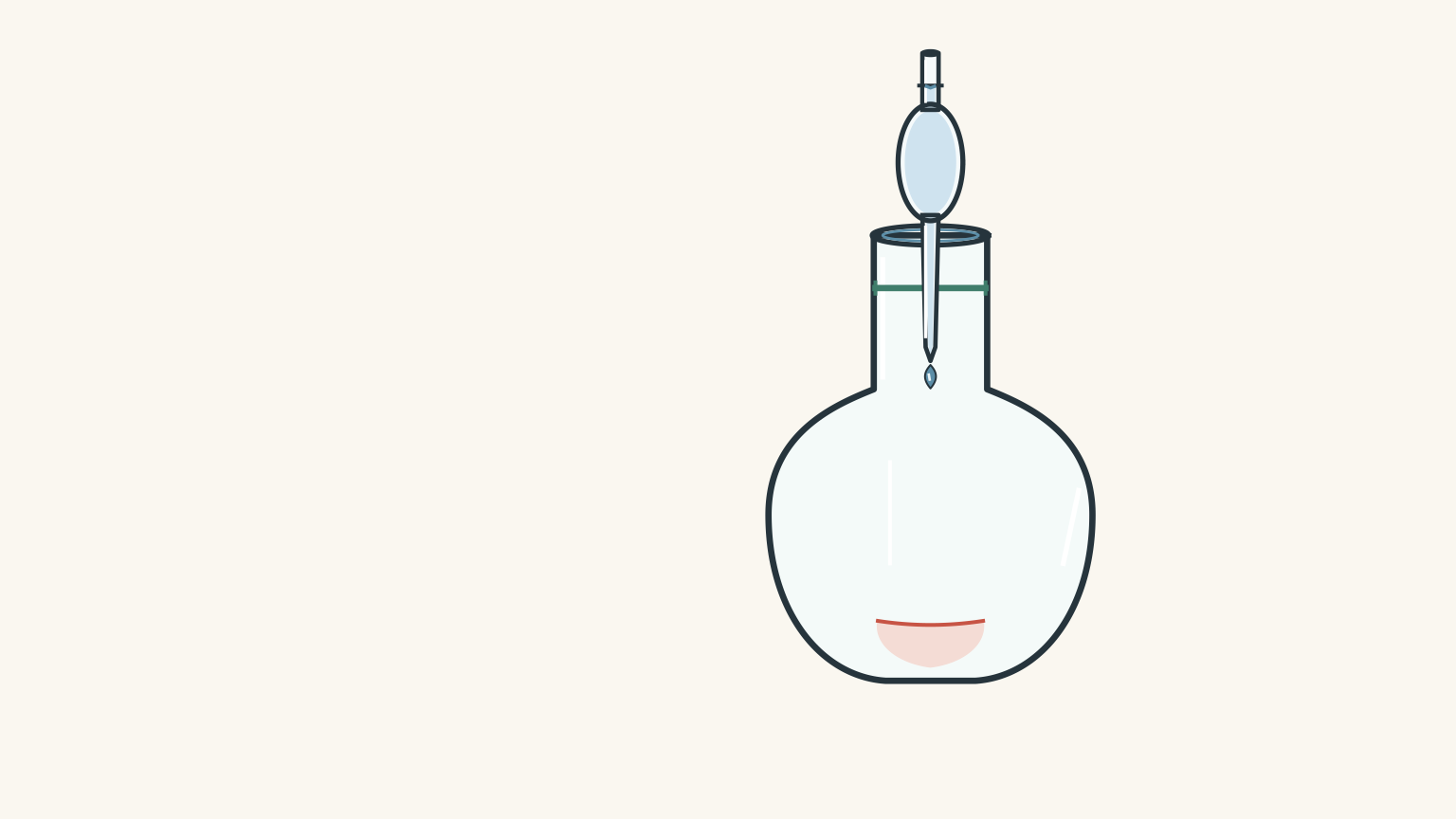
A student needs to prepare \(100.0\ \mathrm{mL}\) of \(0.100\ \mathrm{mol\,L^{-1}}\) silver nitrate, \(\ce{AgNO3}\), using a \(0.200\ \mathrm{mol\,L^{-1}}\) stock solution.
The student correctly calculates that \(50.00\ \mathrm{mL}\) of stock solution is required.
However, the volumetric flask has not been properly cleaned after a previous experiment. It contains \(5.00\ \mathrm{mL}\) of \(0.100\ \mathrm{mol\,L^{-1}}\) sodium chloride solution, \(\ce{NaCl}\).
The student adds the silver nitrate stock and then fills the flask with distilled water to the \(100.0\ \mathrm{mL}\) calibration mark.
Assume:
- The final solution volume is exactly \(100.0\ \mathrm{mL}\).
- The precipitation reaction proceeds to completion.
- Silver chloride is treated as insoluble, and its small solubility is ignored.
- No other reactions occur.
Calculate:
(a) The amount of silver chloride precipitated.
(b) The final concentration of dissolved silver ions, \(\mathrm{Ag}^{+}\).
(c) The final concentrations of nitrate ions, \(\ce{NO3-}\), and sodium ions, \(\mathrm{Na}^{+}\).
(d) Whether the final solution is equivalent to a correctly prepared \(0.100\ \mathrm{mol\,L^{-1}}\) silver nitrate solution.
Due to technical limitations, this figure may display incorrectly or contain inaccuracies. Please check key details against your course materials.
Solution 5
The final solution contains:
- \(0.0950\ \mathrm{mol\,L^{-1}}\) dissolved \(\mathrm{Ag}^{+}\)
- \(0.100\ \mathrm{mol\,L^{-1}}\) \(\ce{NO3-}\)
- \(0.00500\ \mathrm{mol\,L^{-1}}\) \(\mathrm{Na}^{+}\)
- \(0.000500\ \mathrm{mol}\) of precipitated \(\ce{AgCl}\)
The final solution is not equivalent to a correctly prepared silver nitrate solution because the residual sodium chloride reacts with some of the silver ions.
Step 1: Calculate the initial amount of silver ions.
The silver nitrate stock contributes:
\[ n(\mathrm{Ag}^{+})=cV \]
\[ =(0.200)(0.05000) \]
\[ =0.0100\ \mathrm{mol} \]
Because silver nitrate dissociates into silver and nitrate ions, the initial amount of nitrate ions is also:
\[ n(\ce{NO3-})=0.0100\ \mathrm{mol} \]
Step 2: Calculate the initial amount of chloride ions.
The sodium chloride residue has a volume of:
\[ 5.00\ \mathrm{mL}=0.00500\ \mathrm{L} \]
Therefore:
\[ n(\mathrm{Cl}^{-})=(0.100)(0.00500) \]
\[ =0.000500\ \mathrm{mol} \]
The initial amount of sodium ions is also:
\[ n(\mathrm{Na}^{+})=0.000500\ \mathrm{mol} \]
Step 3: Identify the reaction.
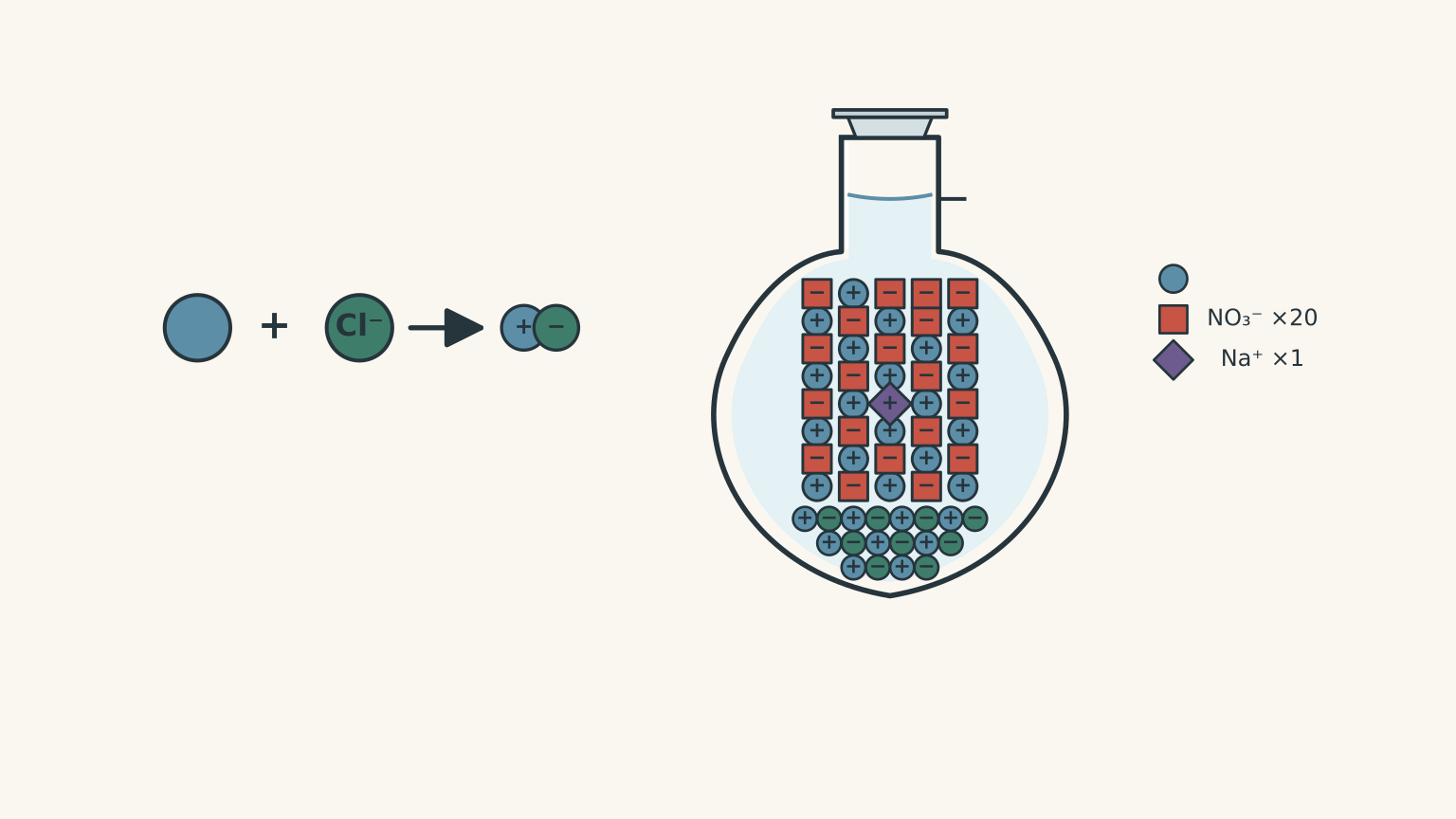
Silver ions react with chloride ions to form solid silver chloride.
The net ionic equation is:
\[ \ce{Ag+ + Cl- -> AgCl(s)} \]
The mole ratio is \(1:1\).
There are \(0.0100\ \mathrm{mol}\) of silver ions but only \(0.000500\ \mathrm{mol}\) of chloride ions.
Therefore, chloride ions are the limiting reactant.
The amount of silver chloride precipitated is:
\[ n(\ce{AgCl})=0.000500\ \mathrm{mol} \]
This answers part (a).
Due to technical limitations, this figure may display incorrectly or contain inaccuracies. Please check key details against your course materials.
Step 4: Calculate the remaining amount of silver ions.
The reaction consumes \(0.000500\ \mathrm{mol}\) of silver ions.
Therefore:
\[ n(\mathrm{Ag}^{+})_{\text{remaining}} =0.0100-0.000500 \]
\[ =0.00950\ \mathrm{mol} \]
The final solution volume is:
\[ 100.0\ \mathrm{mL}=0.1000\ \mathrm{L} \]
Therefore:
\[ [\mathrm{Ag}^{+}]=\frac{0.00950}{0.1000} \]
\[ \boxed{[\mathrm{Ag}^{+}]=0.0950\ \mathrm{mol\,L^{-1}}} \]
This answers part (b).
Step 5: Calculate the nitrate ion concentration.
Nitrate ions do not participate in the precipitation reaction.
Their amount remains:
\[ n(\ce{NO3-})=0.0100\ \mathrm{mol} \]
Therefore:
\[ [\ce{NO3-}]=\frac{0.0100}{0.1000} \]
\[ \boxed{[\ce{NO3-}]=0.100\ \mathrm{mol\,L^{-1}}} \]
Step 6: Calculate the sodium ion concentration.
Sodium ions also remain in solution because they do not participate in the precipitation reaction.
Their amount is:
\[ n(\mathrm{Na}^{+})=0.000500\ \mathrm{mol} \]
Therefore:
\[ [\mathrm{Na}^{+}]=\frac{0.000500}{0.1000} \]
\[ \boxed{[\mathrm{Na}^{+}]=0.00500\ \mathrm{mol\,L^{-1}}} \]
This answers part (c).
Step 7: Compare the final solution with the intended solution.
If the volumetric flask had contained only distilled water, the silver nitrate would have been diluted without reacting.
Its final silver ion concentration would have been:
\[ [\mathrm{Ag}^{+}]=\frac{0.0100}{0.1000} \]
\[ =0.100\ \mathrm{mol\,L^{-1}} \]
However, the residual sodium chloride consumes some of the silver ions, reducing their final concentration to \(0.0950\ \mathrm{mol\,L^{-1}}\).
The nitrate concentration remains \(0.100\ \mathrm{mol\,L^{-1}}\), and additional sodium ions remain in the solution.
Therefore, the final mixture is not equivalent to a correctly prepared \(0.100\ \mathrm{mol\,L^{-1}}\) silver nitrate solution.
This is the important distinction: a volumetric flask containing pure water is harmless for dilution, but a flask containing another chemical may introduce a new solute or cause a reaction.
The reliable decision is to identify what enters the flask and whether any chemical reaction occurs. If you transfer one stock solution and add only pure water, conserve its amount of solute using the dilution equation. If you mix solutions containing other substances, account for every solute and use reaction stoichiometry wherever necessary before calculating the final concentrations.