
How to Calculate Water Needed for a Dilution | HSC Chemistry
Learn how to calculate the volume of water needed to dilute a solution using the HSC Chemistry dilution equation. Includes step-by-step worked examples and explains how dilution differs from mixing solutions and chemical reactions.
You have 20.0 mL of a 0.500 mol L\(^{-1}\) sodium chloride solution. You need to make it less concentrated, so that its final concentration is 0.100 mol L\(^{-1}\). How much water should you add?
Before calculating, predict whether you need 80.0 mL or 100.0 mL of water.
The answer is approximately 80.0 mL of water. The finished solution must have a total volume of 100.0 mL, but the original 20.0 mL of solution is already in the flask.
This is the key to calculating the water needed for a dilution:
\[ \boxed{V_{\text{water}}\approx V_{\text{final}}-V_{\text{initial}}} \]
If the final volume isn’t given, you first calculate it using the initial and target concentrations.
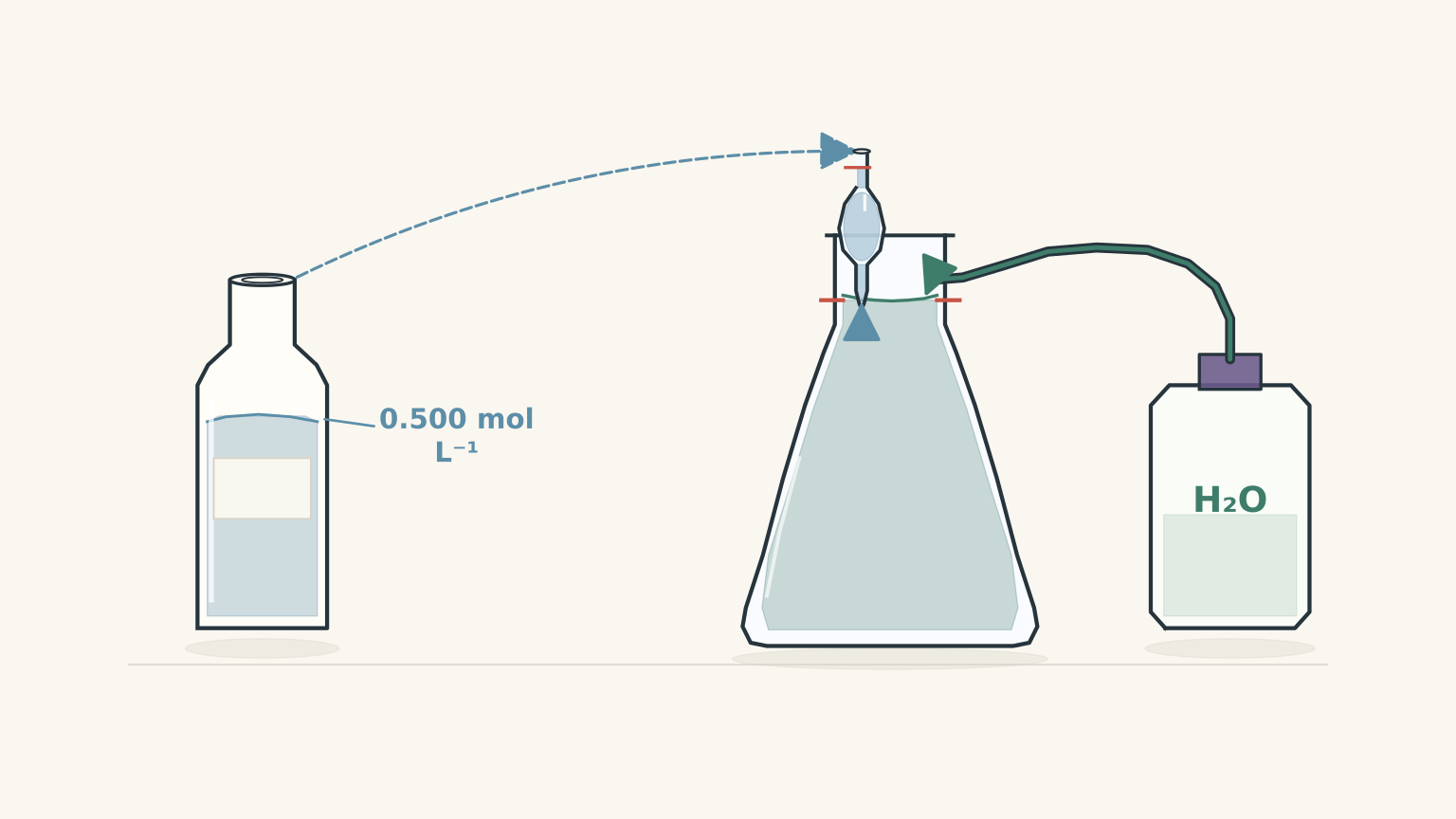
Due to technical limitations, this figure may display incorrectly or contain inaccuracies. Please check key details against your course materials.
01Why does dilution require adding water?
Imagine making a glass of cordial. You pour in some cordial concentrate, then add water. The amount of cordial concentrate hasn’t disappeared. It is simply spread throughout a larger volume of drink.
The same basic idea applies to a chemical solution.
A solution contains:
- A solute, which is the substance dissolved.
- A solvent, which is the substance doing the dissolving.
For an aqueous solution, water is the solvent.
When you add pure water to a solution, the amount of dissolved solute stays the same, provided no chemical reaction or loss occurs. However, the total solution volume increases.
This means the concentration decreases.
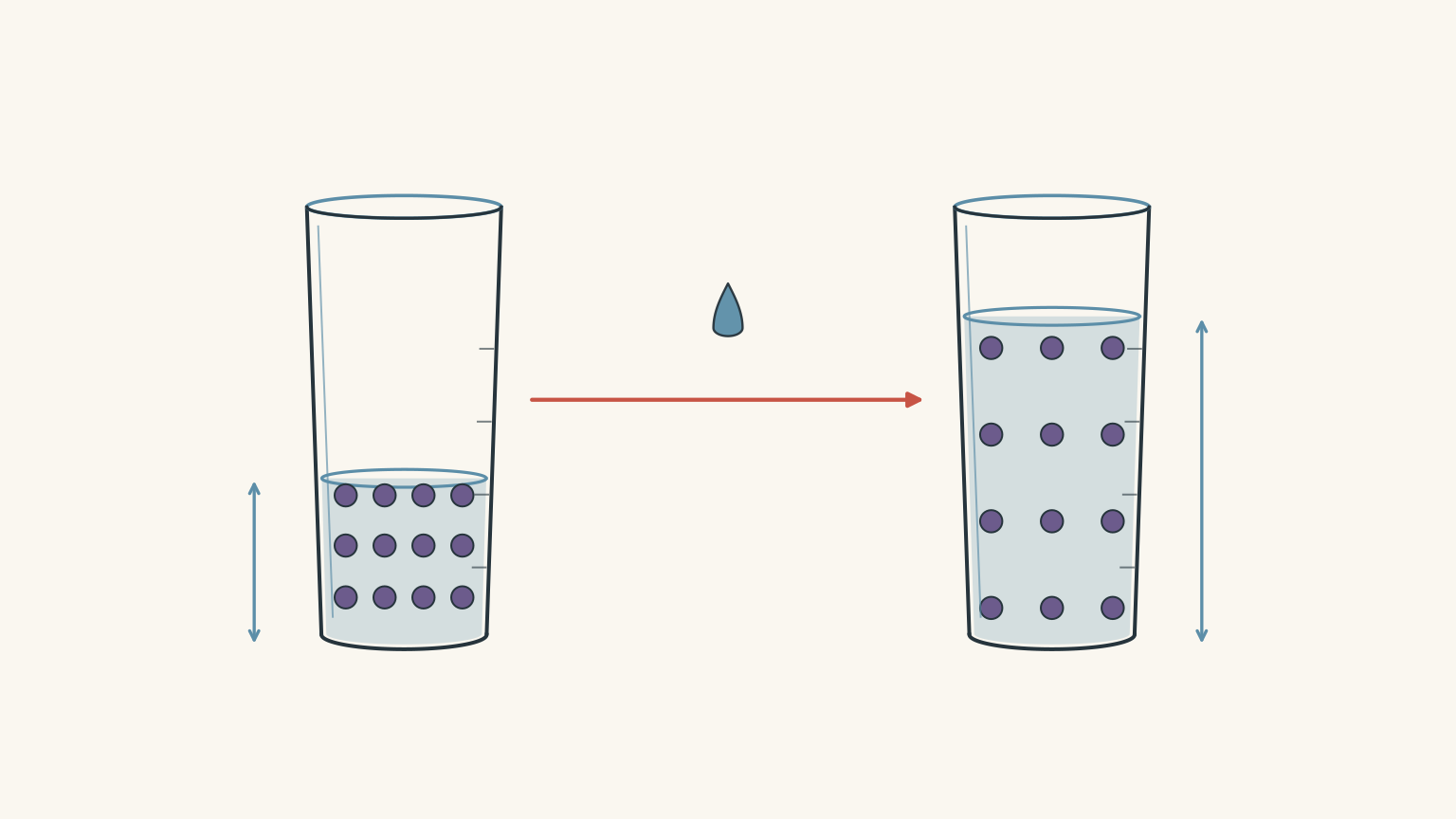
Due to technical limitations, this figure may display incorrectly or contain inaccuracies. Please check key details against your course materials.
The cordial analogy helps explain why the concentration changes, but it has a limitation: actual solution volumes do not always add together perfectly. For accurate laboratory preparation, we use a volumetric flask and its calibration mark rather than relying on an exact measured volume of added water.
The chemistry behind the calculation
Concentration tells us how much solute is present in a particular volume of solution.
Molar concentration is calculated using:
\[ c=\frac{n}{V} \]
Where:
- \(c\) is the concentration, in \(\mathrm{mol\,L^{-1}}\).
- \(n\) is the amount of solute, in mol.
- \(V\) is the total solution volume, in L.
Rearranging:
\[ n=cV \]
During a simple dilution, the amount of solute in the transferred sample remains constant.
Therefore:
\[ n_1=n_2 \]
Substituting \(n=cV\):
\[ \boxed{c_1V_1=c_2V_2} \]
This is the dilution equation.
The subscripts describe the solution before and after dilution:
| Symbol | Meaning |
|---|---|
| \(c_1\) | Initial concentration |
| \(V_1\) | Initial volume transferred (the aliquot) |
| \(c_2\) | Final concentration |
| \(V_2\) | Final total solution volume |
An aliquot is simply a measured portion taken from a larger solution.
Notice that \(V_1\) is the volume actually transferred, not the total volume of the original stock bottle.
The equation assumes:
- Pure water is added.
- No chemical reaction occurs.
- No solute is lost during transfer.
- The solute remains dissolved.
These conditions are important. We’ll return to what happens when solutions are mixed or react.
02How to calculate the volume of water needed
There are two common types of dilution questions.
Situation A: The final solution volume is given
Suppose you transfer 25.0 mL of a solution into a volumetric flask and need the finished solution to have a total volume of 100.0 mL.
You already know the final volume.
Therefore:
\[ V_{\text{water}}\approx V_2-V_1 \]
\[ =100.0-25.0 \]
\[ \boxed{V_{\text{water}}\approx75.0\text{ mL}} \]
You need approximately 75.0 mL of water.
Situation B: The final concentration is given
This requires an extra calculation.
Suppose you have 30.0 mL of a 0.600 mol L\(^{-1}\) solution and need to dilute it to 0.150 mol L\(^{-1}\).
You know the starting concentration, starting volume, and target concentration.
However, you don’t know the final volume.
Rearrange the dilution equation:
\[ c_1V_1=c_2V_2 \]
\[ V_2=\frac{c_1V_1}{c_2} \]
Substitute:
\[ V_2= \frac{0.600\times30.0}{0.150} \]
\[ V_2=120\text{ mL} \]
Now calculate the water required:
\[ V_{\text{water}}\approx120-30.0 \]
\[ \boxed{V_{\text{water}}\approx90.0\text{ mL}} \]
The important distinction is that you calculate the final solution volume first, then subtract the original solution volume.
A useful comparison: Read the instruction carefully
Consider a 20.0 mL sample of 0.500 mol L\(^{-1}\) sodium chloride.
Two laboratory instructions might look almost identical:
| Instruction | Final solution volume | Approximate water added |
|---|---|---|
| Dilute to 100.0 mL | 100.0 mL | 80.0 mL |
| Add 100.0 mL of water | 120.0 mL | 100.0 mL |
These instructions produce different concentrations.
For the first instruction:
\[ c_2=\frac{0.500\times20.0}{100.0} \]
\[ c_2=0.100\text{ mol L}^{-1} \]
For the second instruction, assuming additive volumes:
\[ c_2=\frac{0.500\times20.0}{120.0} \]
\[ c_2=0.0833\text{ mol L}^{-1} \]
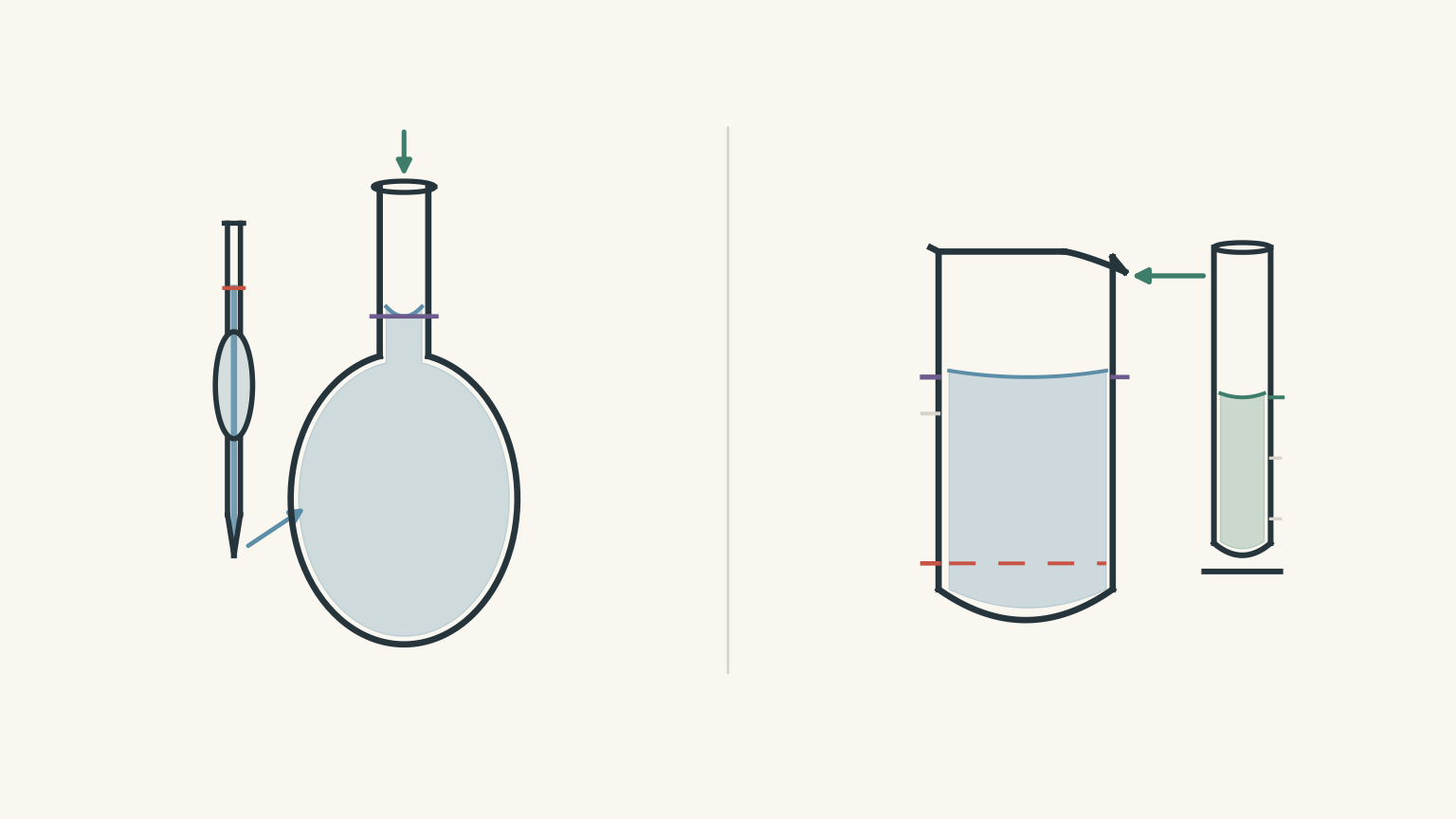
Due to technical limitations, this figure may display incorrectly or contain inaccuracies. Please check key details against your course materials.
The first produces the intended 0.100 mol L\(^{-1}\) solution. The second is more dilute because more water has been added.
Exam tip: Whenever a question says “dilute to 100 mL”, the 100 mL refers to the final solution volume, not the volume of water added.
03Worked examples
Worked example: Calculate the water needed from a target concentration
A student has 30.0 mL of a 0.600 mol L\(^{-1}\) glucose solution. They want to prepare a solution with a final concentration of 0.120 mol L\(^{-1}\).
Calculate the approximate volume of water required.
Step 1
Initial concentration:
\[ c_1=0.600\text{ mol L}^{-1} \]
Initial solution volume:
\[ V_1=30.0\text{ mL} \]
Target concentration:
\[ c_2=0.120\text{ mol L}^{-1} \]
We need to calculate \(V_2\), the final solution volume.
Step 2
\[ c_1V_1=c_2V_2 \]
Rearrange:
\[ V_2=\frac{c_1V_1}{c_2} \]
Substitute:
\[ V_2= \frac{0.600\times30.0}{0.120} \]
\[ V_2=150\text{ mL} \]
The final solution must have a total volume of 150 mL.
Step 3
Subtract the original solution volume:
\[ V_{\text{water}}\approx V_2-V_1 \]
\[ =150-30.0 \]
\[ \boxed{V_{\text{water}}\approx120\text{ mL}} \]
Step 4
Approximately 120 mL of water is required under the additive-volume assumption.
For an accurate laboratory preparation, transfer the 30.0 mL aliquot into an appropriately sized volumetric flask and add water until the final volume reaches 150 mL.
The final solution contains the same amount of glucose as the original aliquot, but its concentration is now one-fifth of the starting concentration.
Worked example: Calculate both the stock volume and water required
A chemistry student needs to prepare 250.0 mL of a 0.0500 mol L\(^{-1}\) potassium nitrate solution, \(\ce{KNO3}\).
The available stock solution has a concentration of 0.500 mol L\(^{-1}\).
Calculate:
a) The volume of stock solution required.
b) The approximate volume of water needed.
Step 1
\[ c_1=0.500\text{ mol L}^{-1} \]
\[ c_2=0.0500\text{ mol L}^{-1} \]
\[ V_2=250.0\text{ mL} \]
This time, the final volume is known, but the initial volume transferred is unknown.
Step 2
\[ c_1V_1=c_2V_2 \]
\[ V_1=\frac{c_2V_2}{c_1} \]
Substitute:
\[ V_1= \frac{0.0500\times250.0}{0.500} \]
\[ \boxed{V_1=25.0\text{ mL}} \]
The student needs 25.0 mL of the stock solution.
Step 3
\[ V_{\text{water}}\approx V_2-V_1 \]
\[ =250.0-25.0 \]
\[ \boxed{V_{\text{water}}\approx225.0\text{ mL}} \]
Step 4
The student should:
- Measure 25.0 mL of the stock solution.
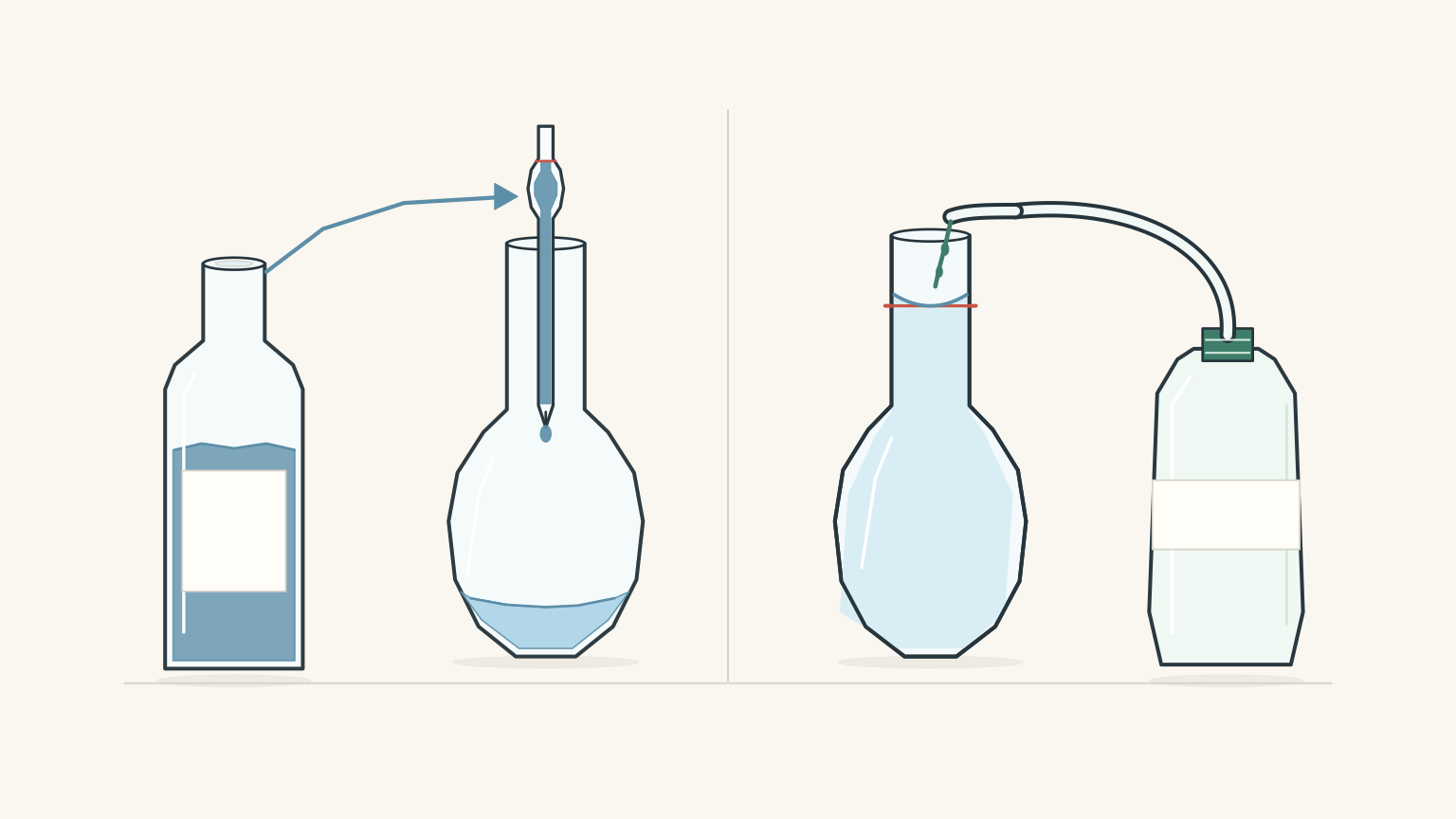
- Transfer it into a 250.0 mL volumetric flask.
- Add distilled water until close to the calibration mark.
- Carefully add the final drops until the bottom of the meniscus reaches the mark.
- Stopper and mix thoroughly.
The calculated 225.0 mL is an approximate water volume. In an accurate preparation, the final calibration mark determines the total solution volume.
One more check: A normal dilution with water must produce a lower concentration than the original stock solution. If your calculation requires a final concentration greater than the initial concentration, adding water cannot achieve the target.
For more practice with rearranging the dilution equation and following an aliquot through a calculation, see Solution dilution calculations for HSC Chemistry.
Due to technical limitations, this figure may display incorrectly or contain inaccuracies. Please check key details against your course materials.
04What changes when you mix two solutions?
So far, we’ve considered one solution being diluted with pure water.
But what if you pour one chemical solution into another?
This is where students sometimes apply the dilution equation incorrectly.
The key difference is that the second solution may contain additional solute.
When you add pure water, you increase the volume without adding more solute. When you mix two solutions containing the same solute, both solutions contribute to the total amount of solute.
Mixing two solutions containing the same solute
Consider two potassium chloride solutions:
- Solution A: 35.0 mL of 0.200 mol L\(^{-1}\) KCl.
- Solution B: 65.0 mL of 0.100 mol L\(^{-1}\) KCl.
Assume no reaction occurs and the volumes are additive.
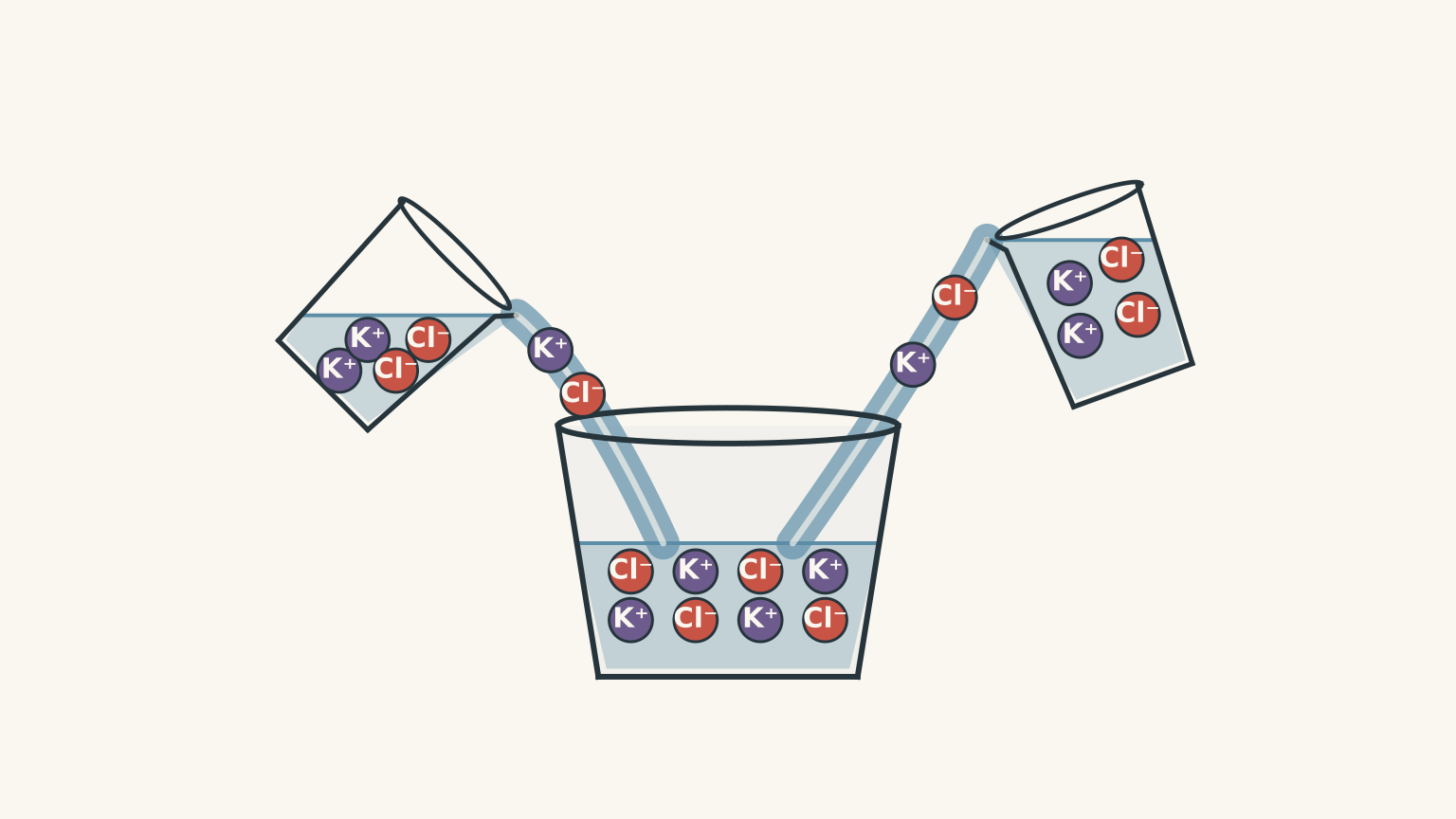
Due to technical limitations, this figure may display incorrectly or contain inaccuracies. Please check key details against your course materials.
Can we treat Solution B as though it were pure water?
No. It contains potassium chloride, so it contributes additional solute.
We must calculate the amount of solute supplied by each solution.
Step 1: Calculate the moles of KCl in Solution A.
\[ n_A=c_AV_A \]
Convert the volume into litres:
\[ 35.0\text{ mL}=0.0350\text{ L} \]
\[ n_A=0.200\times0.0350 \]
\[ n_A=0.00700\text{ mol} \]
Step 2: Calculate the moles of KCl in Solution B.
\[ n_B=c_BV_B \]
\[ n_B=0.100\times0.0650 \]
\[ n_B=0.00650\text{ mol} \]
Step 3: Add the total amount of solute.
\[ n_{\text{total}}=n_A+n_B \]
\[ =0.00700+0.00650 \]
\[ n_{\text{total}}=0.01350\text{ mol} \]
Step 4: Calculate the final concentration.
The total volume is:
\[ V_{\text{total}}=35.0+65.0 \]
\[ =100.0\text{ mL}=0.1000\text{ L} \]
Therefore:
\[ c_{\text{final}}=\frac{n_{\text{total}}}{V_{\text{total}}} \]
\[ =\frac{0.01350}{0.1000} \]
\[ \boxed{c_{\text{final}}=0.135\text{ mol L}^{-1}} \]
Notice that the final concentration is 0.135 mol L\(^{-1}\), not 0.0700 mol L\(^{-1}\).
The incorrect answer comes from treating the second KCl solution as pure water. That would ignore the additional 0.00650 mol of KCl it contributes.
The general method for mixing nonreacting solutions is to calculate the moles supplied by each solution, add the relevant amounts, and divide by the final total volume.
For different salts, you may need to track each ion separately. The relevant method is explained in How to Calculate Final Ion Concentrations When Mixing Salts.
What if a chemical reaction occurs?
There is another important condition.
The amount of a particular dissolved chemical species is only conserved if that species is not consumed or produced in a chemical reaction.
Consider hydrochloric acid reacting with sodium hydroxide:
\[ \ce{HCl(aq) + NaOH(aq) -> NaCl(aq) + H2O(l)} \]
The hydrogen ions from the acid react with hydroxide ions from the base:
\[ \ce{H+(aq) + OH-(aq) -> H2O(l)} \]
The amount of dissolved \(\mathrm{H^+}\) decreases because some of it has reacted.
You cannot simply take the original moles of hydrochloric acid and divide by the final volume to find the remaining hydrogen ion concentration.
You must first use the balanced chemical equation and calculate how much acid and base react.
The distinction is:
| Situation | What happens to the solute? | Appropriate method |
|---|---|---|
| One solution diluted with pure water | Amount of solute in the aliquot stays constant | \(c_1V_1=c_2V_2\) |
| Two nonreacting solutions mixed | Amounts from both solutions contribute to the mixture | Calculate and add moles |
| Two solutions mixed and a reaction occurs | Amounts of reacting species change | Use stoichiometry first |
The conservation idea is not that chemical matter disappears during a reaction. Atoms are still accounted for in the products. What changes is the amount of each particular chemical species.
This distinction becomes especially important when working with precipitation reactions, neutralisation, and metals reacting with acids.
05Questions and solutions
The following questions move from straightforward water-volume calculations to situations where you must decide whether the dilution equation is appropriate.
Question 1
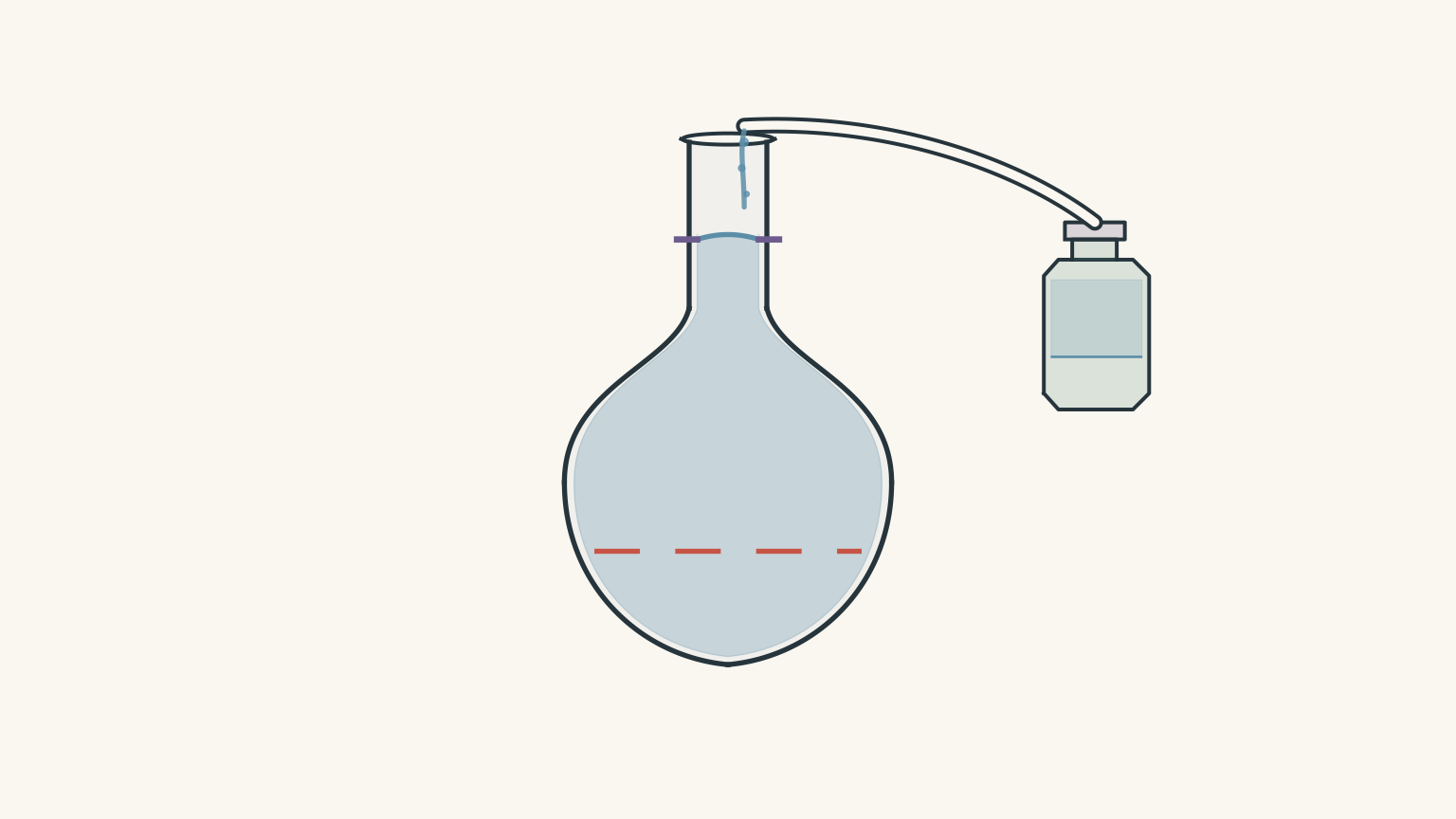
A student transfers 15.0 mL of a 0.400 mol L\(^{-1}\) potassium nitrate solution into a volumetric flask.
They add distilled water until the total solution volume reaches 60.0 mL.
Assuming additive volumes for the purpose of estimating the water added, calculate:
a) The approximate volume of water added.
b) The final concentration of potassium nitrate.
Due to technical limitations, this figure may display incorrectly or contain inaccuracies. Please check key details against your course materials.
Solution 1
The student adds approximately 45.0 mL of water, producing a final potassium nitrate concentration of 0.100 mol L\(^{-1}\).
Part a: Calculate the water volume.
The final volume is 60.0 mL, and the initial aliquot is 15.0 mL.
\[ V_{\text{water}}\approx V_2-V_1 \]
\[ =60.0-15.0 \]
\[ \boxed{V_{\text{water}}\approx45.0\text{ mL}} \]
Part b: Calculate the final concentration.
Use the dilution equation:
\[ c_1V_1=c_2V_2 \]
Rearrange:
\[ c_2=\frac{c_1V_1}{V_2} \]
Substitute:
\[ c_2=\frac{0.400\times15.0}{60.0} \]
\[ \boxed{c_2=0.100\text{ mol L}^{-1}} \]
The final concentration is one-quarter of the original concentration because the same amount of solute is distributed throughout four times the original volume.
Question 2
A laboratory technician needs to prepare 200.0 mL of a 0.0750 mol L\(^{-1}\) potassium nitrate solution.
The available stock solution has a concentration of 0.600 mol L\(^{-1}\).
Calculate:
a) The volume of stock solution required.
b) The approximate volume of water required.
c) How the technician should prepare the solution accurately using laboratory equipment.
Solution 2
The technician needs 25.0 mL of stock solution and approximately 175.0 mL of water. For an accurate preparation, the stock solution should be transferred into a 200.0 mL volumetric flask and diluted to the calibration mark.
Part a: Calculate the stock volume.
Known quantities:
\[ c_1=0.600\text{ mol L}^{-1} \]
\[ c_2=0.0750\text{ mol L}^{-1} \]
\[ V_2=200.0\text{ mL} \]
Rearrange the dilution equation:
\[ V_1=\frac{c_2V_2}{c_1} \]
Substitute:
\[ V_1=\frac{0.0750\times200.0}{0.600} \]
\[ \boxed{V_1=25.0\text{ mL}} \]
Part b: Calculate the water volume.
\[ V_{\text{water}}\approx V_2-V_1 \]
\[ =200.0-25.0 \]
\[ \boxed{V_{\text{water}}\approx175.0\text{ mL}} \]
Part c: Describe the preparation.
The technician should:
- Measure 25.0 mL of the stock solution using suitable volumetric equipment.
- Transfer it into a 200.0 mL volumetric flask.
- Add distilled water until close to the calibration mark.
- Adjust the meniscus carefully until it reaches the mark.
- Stopper and invert the flask several times to mix thoroughly.
The distinction between the calculated water volume and the laboratory preparation matters. The final volume is measured directly, rather than assuming that the volumes of stock solution and water combine perfectly.
Question 3
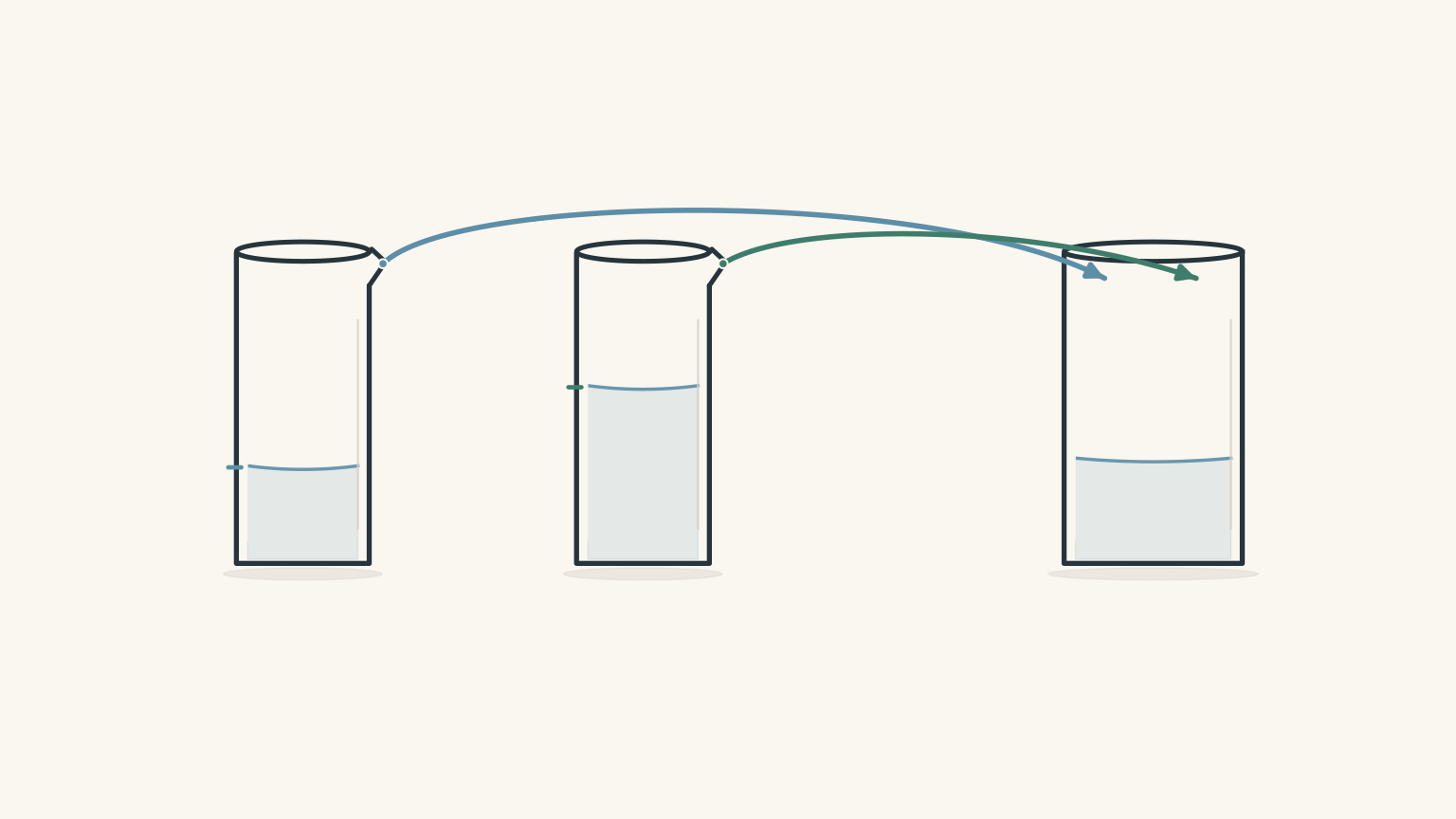
Two potassium chloride solutions are mixed in a single container.
- Solution A: 35.0 mL of 0.200 mol L\(^{-1}\) KCl.
- Solution B: 65.0 mL of 0.100 mol L\(^{-1}\) KCl.
Assume that no reaction occurs and the solution volumes are additive.
Calculate the final potassium chloride concentration.
A student argues that this is simply a dilution of Solution A because the total volume increases. Explain why this reasoning is incorrect.
Due to technical limitations, this figure may display incorrectly or contain inaccuracies. Please check key details against your course materials.
Solution 3
The final potassium chloride concentration is 0.135 mol L\(^{-1}\). The second solution cannot be treated as pure water because it supplies additional potassium chloride.
Step 1: Calculate the moles of KCl in Solution A.
Convert the volume:
\[ 35.0\text{ mL}=0.0350\text{ L} \]
Calculate:
\[ n_A=c_AV_A \]
\[ =0.200\times0.0350 \]
\[ n_A=0.00700\text{ mol} \]
Step 2: Calculate the moles of KCl in Solution B.
\[ 65.0\text{ mL}=0.0650\text{ L} \]
\[ n_B=c_BV_B \]
\[ =0.100\times0.0650 \]
\[ n_B=0.00650\text{ mol} \]
Step 3: Calculate the total moles of KCl.
\[ n_{\text{total}}=0.00700+0.00650 \]
\[ n_{\text{total}}=0.01350\text{ mol} \]
Step 4: Calculate the final concentration.
The total volume is:
\[ V_{\text{total}}=0.0350+0.0650 \]
\[ =0.1000\text{ L} \]
Therefore:
\[ c_{\text{final}}=\frac{0.01350}{0.1000} \]
\[ \boxed{c_{\text{final}}=0.135\text{ mol L}^{-1}} \]
The student’s mistake is assuming that the second solution contributes only volume.
It actually contributes both volume and solute. The dilution equation cannot be applied to Solution A alone because the amount of KCl in the final mixture is greater than the amount initially present in Solution A.
Question 4
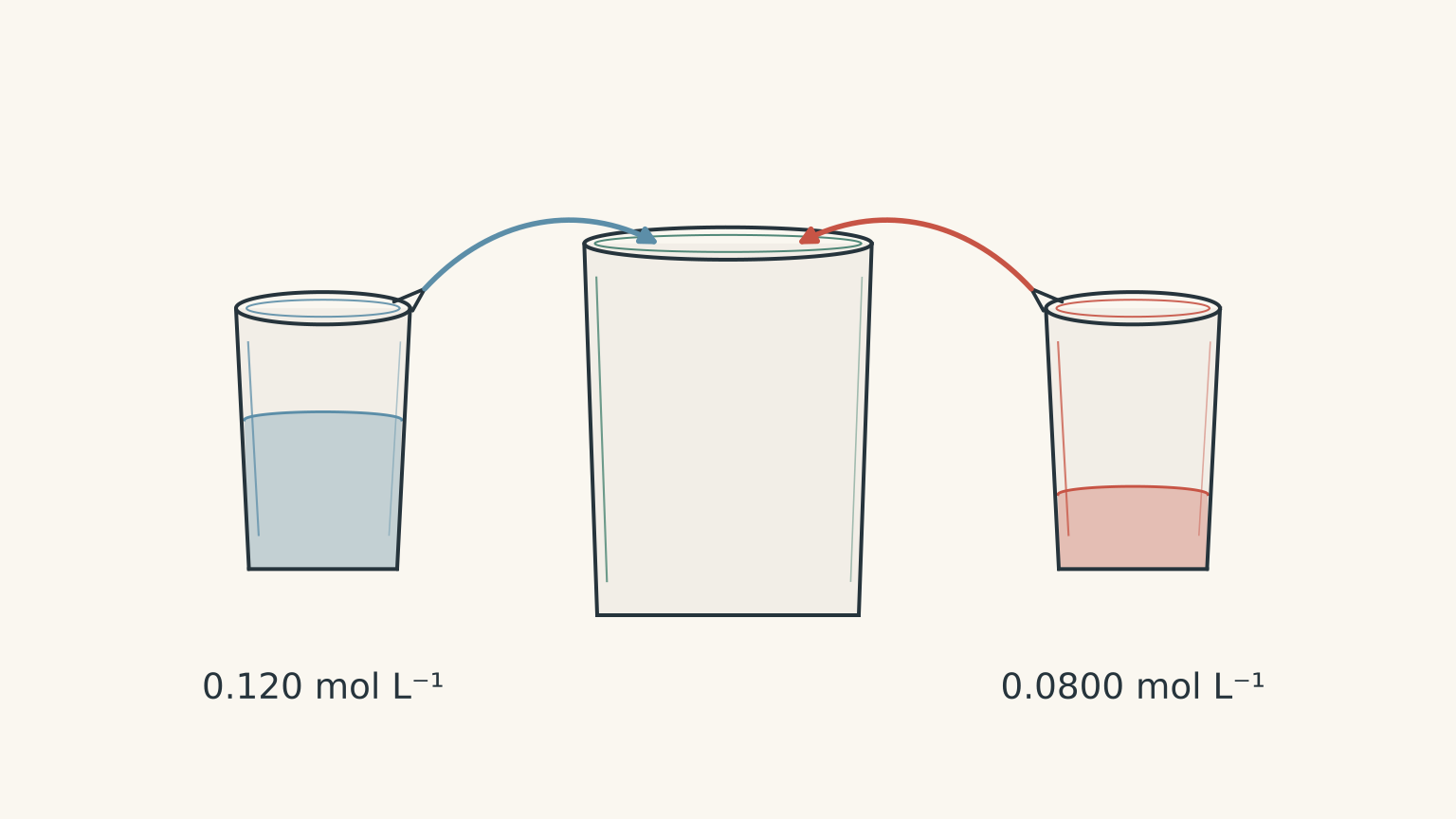
A student mixes:
- 100.0 mL of 0.120 mol L\(^{-1}\) hydrochloric acid.
- 50.0 mL of 0.0800 mol L\(^{-1}\) sodium hydroxide.
The solutions react completely according to the neutralisation reaction:
\[ \ce{HCl(aq) + NaOH(aq) -> NaCl(aq) + H2O(l)} \]
Assume complete dissociation, complete neutralisation, and additive solution volumes.
Calculate the final concentrations of:
a) Hydrogen ions, \(\mathrm{H^+}\).
b) Chloride ions, \(\mathrm{Cl^-}\).
c) Sodium ions, \(\mathrm{Na^+}\).
Explain why using the ordinary dilution equation on the original hydrochloric acid would produce an incorrect hydrogen ion concentration.
Due to technical limitations, this figure may display incorrectly or contain inaccuracies. Please check key details against your course materials.
Solution 4
The final concentrations are:
- \([\mathrm{H^+}]=0.0533\text{ mol L}^{-1}\)
- \([\mathrm{Cl^-}]=0.0800\text{ mol L}^{-1}\)
- \([\mathrm{Na^+}]=0.0267\text{ mol L}^{-1}\)
The key is to calculate the neutralisation reaction before calculating the final concentrations.
Step 1: Calculate the initial moles of hydrogen ions.
Hydrochloric acid dissociates completely:
\[ \ce{HCl -> H+ + Cl-} \]
The mole ratio of HCl to H\(^+\) is 1:1.
Convert the acid volume:
\[ 100.0\text{ mL}=0.1000\text{ L} \]
Calculate:
\[ n(\mathrm{H^+})=cV \]
\[ =0.120\times0.1000 \]
\[ n(\mathrm{H^+})=0.0120\text{ mol} \]
Step 2: Calculate the initial moles of hydroxide ions.
Sodium hydroxide dissociates as:
\[ \ce{NaOH -> Na+ + OH-} \]
Convert the volume:
\[ 50.0\text{ mL}=0.0500\text{ L} \]
Calculate:
\[ n(\mathrm{OH^-})=0.0800\times0.0500 \]
\[ n(\mathrm{OH^-})=0.00400\text{ mol} \]
Step 3: Determine how much hydrogen ion remains.
The net ionic equation is:
\[ \ce{H+ + OH- -> H2O} \]
The mole ratio is 1:1.
Therefore, 0.00400 mol of hydrogen ions react with 0.00400 mol of hydroxide ions.
The remaining hydrogen ions are:
\[ n(\mathrm{H^+})_{\text{remaining}} =0.0120-0.00400 \]
\[ =0.00800\text{ mol} \]
Step 4: Calculate the final hydrogen ion concentration.
The total volume is:
\[ V_{\text{total}}=0.1000+0.0500 \]
\[ =0.1500\text{ L} \]
Therefore:
\[ [\mathrm{H^+}] =\frac{0.00800}{0.1500} \]
\[ \boxed{[\mathrm{H^+}]=0.0533\text{ mol L}^{-1}} \]
Step 5: Calculate the spectator ion concentrations.
Chloride ions do not participate in the neutralisation reaction.
Their original amount remains:
\[ n(\mathrm{Cl^-})=0.0120\text{ mol} \]
Therefore:
\[ [\mathrm{Cl^-}]=\frac{0.0120}{0.1500} \]
\[ \boxed{[\mathrm{Cl^-}]=0.0800\text{ mol L}^{-1}} \]
Sodium ions also remain in solution:
\[ n(\mathrm{Na^+})=0.00400\text{ mol} \]
Therefore:
\[ [\mathrm{Na^+}]=\frac{0.00400}{0.1500} \]
\[ \boxed{[\mathrm{Na^+}]=0.0267\text{ mol L}^{-1}} \]
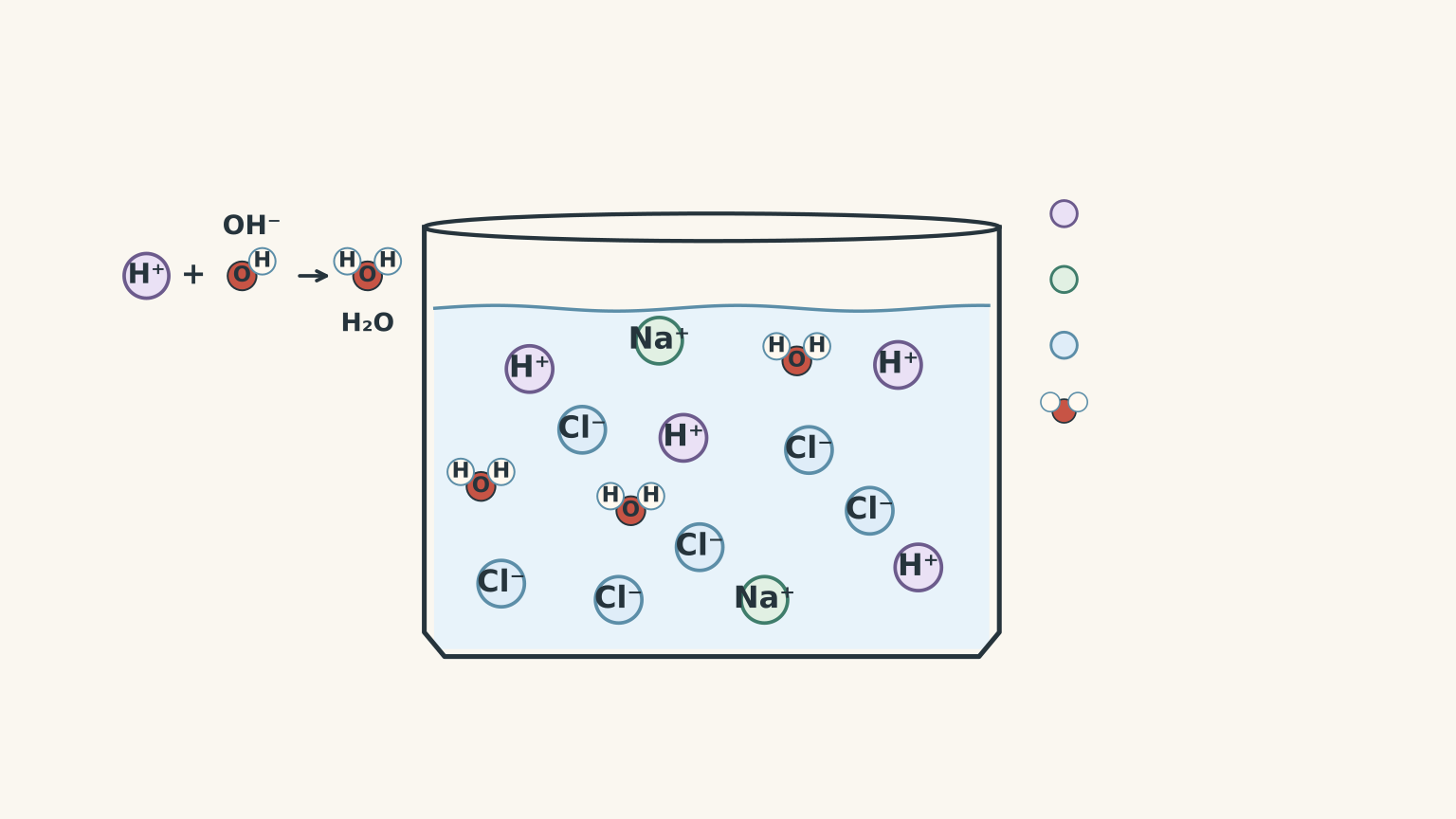
Due to technical limitations, this figure may display incorrectly or contain inaccuracies. Please check key details against your course materials.
Why does the simple dilution equation fail here?
A tempting calculation would be:
\[ [\mathrm{H^+}]= \frac{0.120\times100.0}{150.0} \]
\[ =0.0800\text{ mol L}^{-1} \]
This would be correct if the second solution were pure water.
However, the sodium hydroxide supplies hydroxide ions that react with hydrogen ions. The original amount of dissolved hydrogen ions is therefore no longer present after mixing.
The calculation must account for the chemical reaction before dividing by the final volume.
Question 5
This final problem combines dilution, mixing, and precipitation. The important challenge is deciding exactly when conservation of dissolved solute stops applying.
A student begins with 100.0 mL of 0.200 mol L\(^{-1}\) barium chloride, \(\ce{BaCl2}\).
They add distilled water until the solution reaches a total volume of 250.0 mL.
Next, they mix this diluted solution with 100.0 mL of 0.150 mol L\(^{-1}\) sodium sulfate, \(\ce{Na2SO4}\).
Barium sulfate, \(\ce{BaSO4}\), forms as a precipitate.
Assume:
- No solute is lost during the initial dilution.
- Solution volumes are additive.
- Barium sulfate precipitates quantitatively.
- The precipitation reaction is complete, and its small equilibrium solubility is ignored.
Calculate:
a) The initial amount of barium ions and chloride ions.
b) The amount of barium ions remaining in solution after precipitation.
c) The final concentrations of dissolved \(\mathrm{Ba^{2+}}\), \(\mathrm{Cl^-}\), and \(\mathrm{Na^+}\).
d) Explain why a student who calculates the final barium ion concentration by dividing the original moles of barium ions by the final volume obtains an incorrect result.
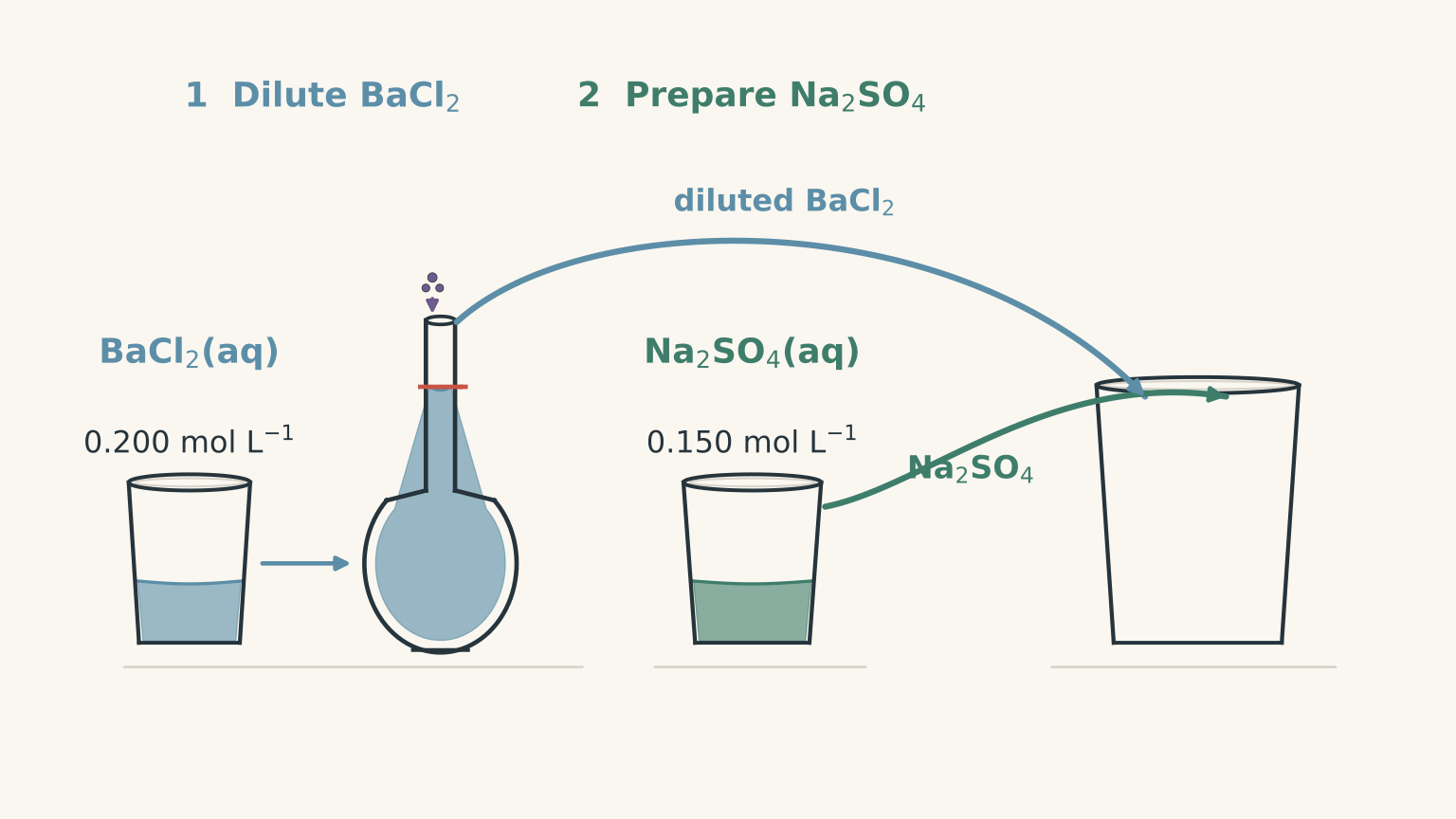
Due to technical limitations, this figure may display incorrectly or contain inaccuracies. Please check key details against your course materials.
Solution 5
The final concentrations are:
\[ \boxed{[\mathrm{Ba^{2+}}]=0.0143\text{ mol L}^{-1}} \]
\[ \boxed{[\mathrm{Cl^-}]=0.114\text{ mol L}^{-1}} \]
\[ \boxed{[\mathrm{Na^+}]=0.0857\text{ mol L}^{-1}} \]
The crucial point is that the amount of barium ions stays constant during the first dilution, but decreases when the barium ions react with sulfate ions.
Part a: Calculate the initial amounts of barium and chloride ions.
First, convert the original barium chloride solution volume:
\[ 100.0\text{ mL}=0.1000\text{ L} \]
Calculate the moles of barium chloride:
\[ n(\ce{BaCl2})=cV \]
\[ =0.200\times0.1000 \]
\[ =0.0200\text{ mol} \]
Barium chloride dissociates according to:
\[ \ce{BaCl2 -> Ba^2+ + 2Cl-} \]
Therefore, one mole of barium chloride produces one mole of barium ions and two moles of chloride ions.
The initial amount of barium ions is:
\[ \boxed{n(\mathrm{Ba^{2+}})=0.0200\text{ mol}} \]
The initial amount of chloride ions is:
\[ n(\mathrm{Cl^-})=2\times0.0200 \]
\[ \boxed{n(\mathrm{Cl^-})=0.0400\text{ mol}} \]
During the initial dilution to 250.0 mL, both amounts remain unchanged.
Part b: Calculate the amount of barium ions remaining after precipitation.
Now consider the sodium sulfate solution.
Convert its volume:
\[ 100.0\text{ mL}=0.1000\text{ L} \]
Calculate its amount:
\[ n(\ce{Na2SO4})=cV \]
\[ =0.150\times0.1000 \]
\[ =0.0150\text{ mol} \]
Sodium sulfate dissociates as:
\[ \ce{Na2SO4 -> 2Na+ + SO4^2-} \]
Therefore:
\[ n(\mathrm{SO_4^{2-}})=0.0150\text{ mol} \]
The precipitation reaction is:
\[ \ce{Ba^2+ + SO4^2- -> BaSO4(s)} \]
The mole ratio is 1:1.
We initially have:
| Ion | Initial amount |
|---|---|
| \(\mathrm{Ba^{2+}}\) | 0.0200 mol |
| \(\mathrm{SO_4^{2-}}\) | 0.0150 mol |
There are fewer moles of sulfate ions, so sulfate is the limiting reactant.
It reacts with 0.0150 mol of barium ions.
The amount of barium ions remaining is:
\[ n(\mathrm{Ba^{2+}})_{\text{remaining}} =0.0200-0.0150 \]
\[ \boxed{n(\mathrm{Ba^{2+}})_{\text{remaining}}=0.00500\text{ mol}} \]
The amount of barium sulfate precipitated is:
\[ \boxed{n(\ce{BaSO4})=0.0150\text{ mol}} \]
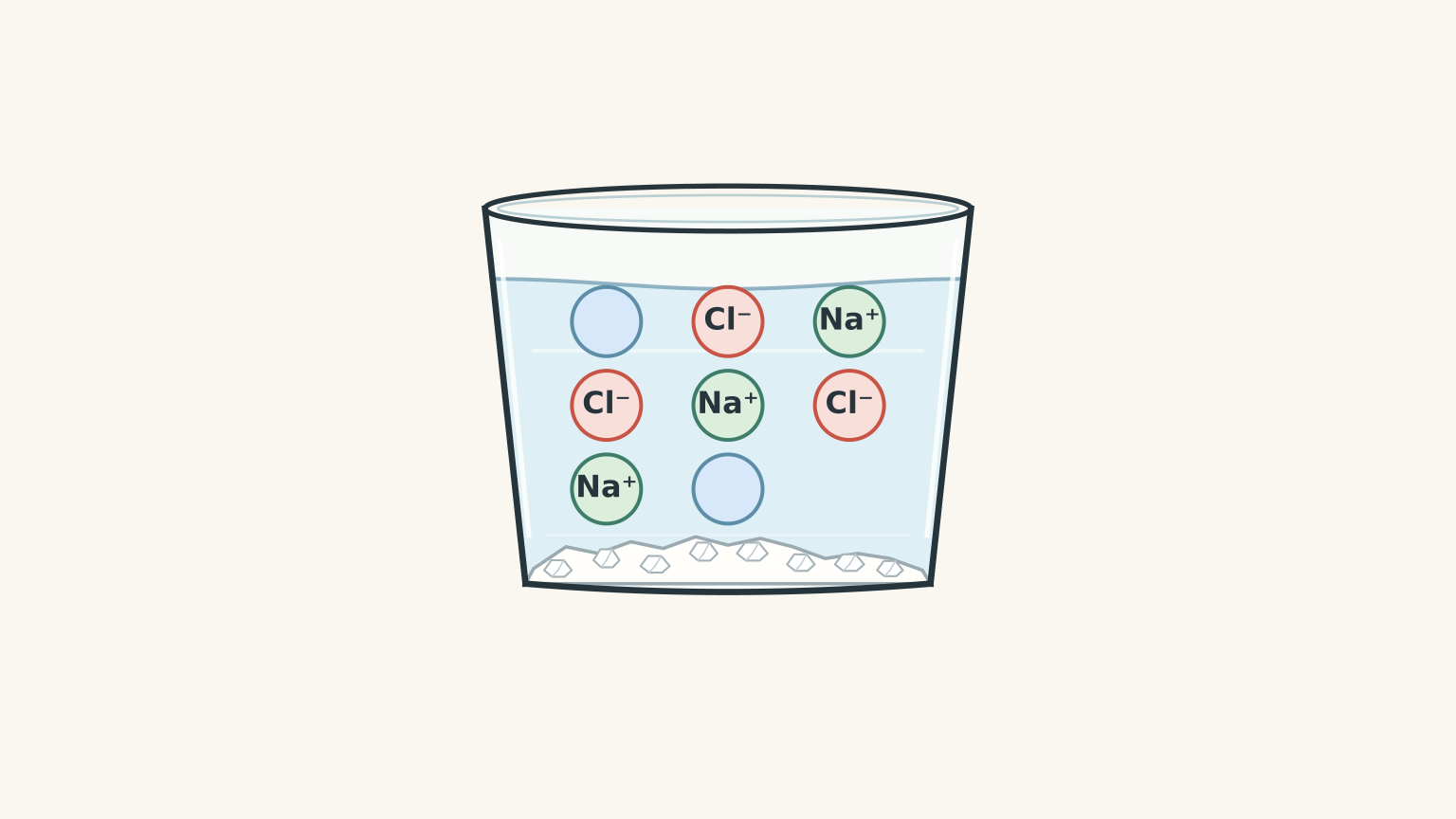
Due to technical limitations, this figure may display incorrectly or contain inaccuracies. Please check key details against your course materials.
Part c: Calculate the final concentrations.
First, calculate the final total solution volume.
The diluted barium chloride solution has a volume of 250.0 mL.
The sodium sulfate solution contributes another 100.0 mL.
Therefore:
\[ V_{\text{total}}=250.0+100.0 \]
\[ =350.0\text{ mL} \]
Convert to litres:
\[ V_{\text{total}}=0.3500\text{ L} \]
Now calculate each concentration.
For barium ions:
\[ [\mathrm{Ba^{2+}}] =\frac{0.00500}{0.3500} \]
\[ \boxed{[\mathrm{Ba^{2+}}]=0.0143\text{ mol L}^{-1}} \]
For chloride ions, no reaction has consumed them. Their amount remains 0.0400 mol.
\[ [\mathrm{Cl^-}] =\frac{0.0400}{0.3500} \]
\[ \boxed{[\mathrm{Cl^-}]=0.114\text{ mol L}^{-1}} \]
For sodium ions, the amount supplied by sodium sulfate is:
\[ n(\mathrm{Na^+})=2\times0.0150 \]
\[ =0.0300\text{ mol} \]
Sodium ions are spectator ions in this precipitation reaction, so they remain dissolved.
Therefore:
\[ [\mathrm{Na^+}] =\frac{0.0300}{0.3500} \]
\[ \boxed{[\mathrm{Na^+}]=0.0857\text{ mol L}^{-1}} \]
Part d: Explain the incorrect calculation.
The student calculates:
\[ [\mathrm{Ba^{2+}}]=\frac{0.0200}{0.3500} \]
\[ =0.0571\text{ mol L}^{-1} \]
This is incorrect because they have carried the conservation assumption from the dilution stage into the precipitation stage.
During dilution, the amount of dissolved barium ions stays at 0.0200 mol.
However, when sodium sulfate is added, 0.0150 mol of barium ions react to form solid barium sulfate.
Only 0.00500 mol of barium ions remain dissolved.
There is an important distinction here: the total amount of barium atoms is conserved, but some of those atoms are now part of solid \(\ce{BaSO4}\), rather than dissolved \(\mathrm{Ba^{2+}}\) ions.
A useful independent check is electrical charge balance.
The total positive charge concentration is:
\[ 2(0.0143)+0.0857 \]
\[ \approx0.114\text{ mol of charge equivalents L}^{-1} \]
The negative charge concentration is:
\[ 0.114\text{ mol of charge equivalents L}^{-1} \]
The two agree within rounding, supporting the calculated ion concentrations.
This question demonstrates why you must track the chemical species throughout every stage of a problem, rather than assuming that the original amount of dissolved solute always remains unchanged.
06Where to go next
When calculating water needed for a dilution, the main decision is whether you’re adding pure water to one solution, mixing two solutions, or combining substances that react.
For a simple dilution, conserve the amount of dissolved solute in the transferred aliquot.
For a nonreacting mixture, calculate the contributions from every solution.
For a reacting mixture, use the balanced equation and stoichiometry before calculating the final concentrations.
Once you can distinguish these three situations, you’re ready to tackle more complex HSC Chemistry questions involving multiple dissolved ions, precipitation, and reactions between solutions.