
How to Find Final Concentration After Two Successive Dilutions
Learn how to calculate final concentration after two successive dilutions using step-by-step worked examples. Understand dilution factors, mixing solutions, and when chemical reactions change the calculation.
Take 10.0 mL of a 0.200 mol L\(^{-1}\) solution and dilute it to 100.0 mL. Then take 20.0 mL of that first diluted solution and dilute it to 50.0 mL. What is the final concentration?
Is it \(0.0200\ \mathrm{mol\,L^{-1}}\), because that’s the concentration after the first dilution, or do you need to account for both steps?
The final concentration is \(0.00800\ \mathrm{mol\,L^{-1}}\). The first dilution reduces the concentration to \(0.0200\ \mathrm{mol\,L^{-1}}\), and the second reduces it again to \(0.00800\ \mathrm{mol\,L^{-1}}\).
The key is to calculate each dilution in sequence. The second dilution starts with the concentration produced by the first, not the original stock concentration.
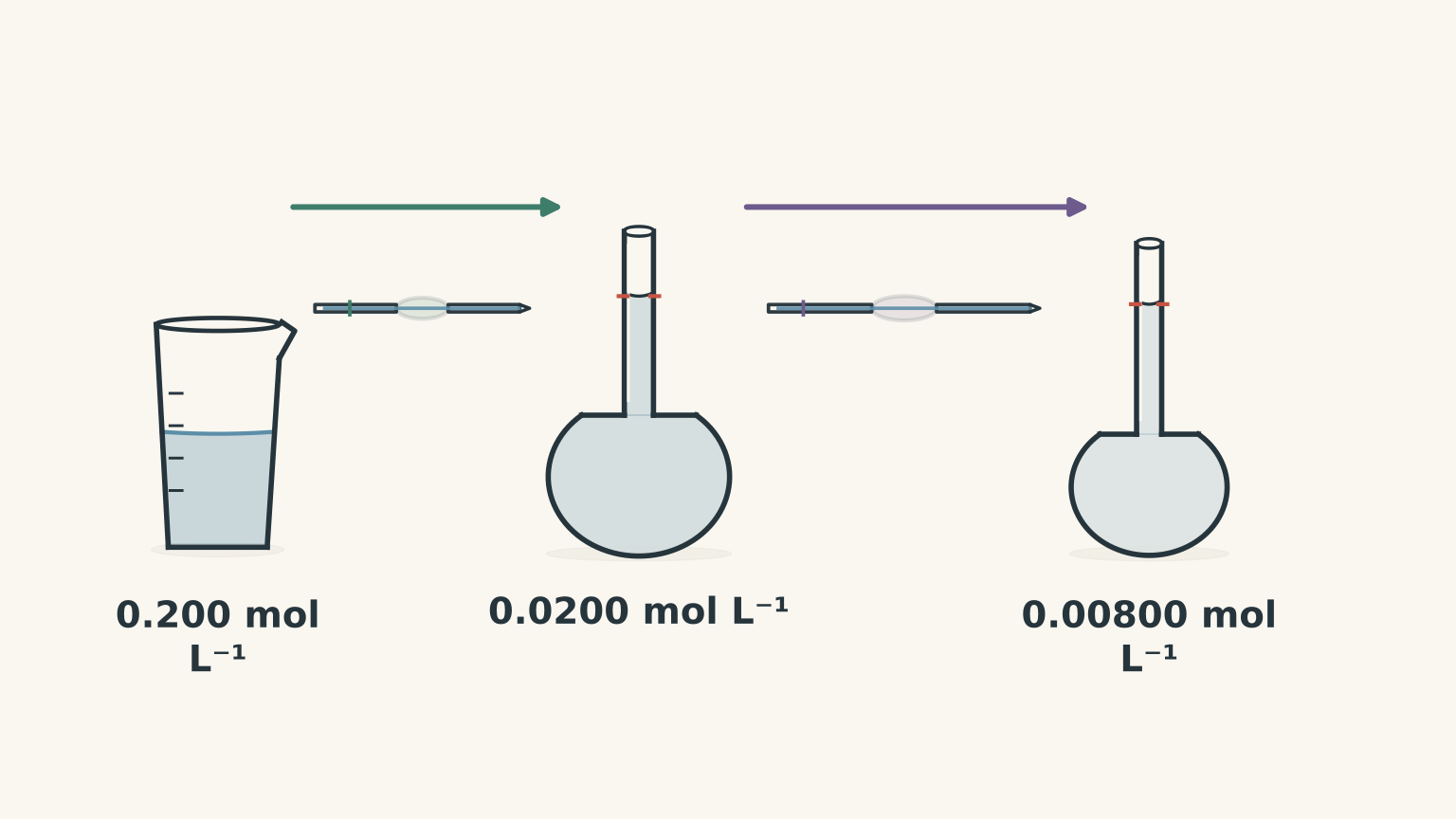
Due to technical limitations, this figure may display incorrectly or contain inaccuracies. Please check key details against your course materials.
01Understand what happens during two successive dilutions
A dilution occurs when you take a measured amount of a solution and add more solvent, usually water, to increase its total volume.
The amount of solute in the portion being diluted stays constant, provided no chemical reaction or physical loss occurs.
What changes is the volume occupied by that solute. The same amount is spread through more solution, so its concentration decreases.
Consider a solution containing dissolved potassium nitrate, \(\ce{KNO3}\).
- Initially, a measured portion contains a certain number of moles of \(\ce{KNO3}\).
- You transfer that portion into a volumetric flask.
- You add water until the solution reaches the flask’s calibration mark.
- The amount of \(\ce{KNO3}\) remains unchanged, but its concentration decreases.
Now comes the important part.
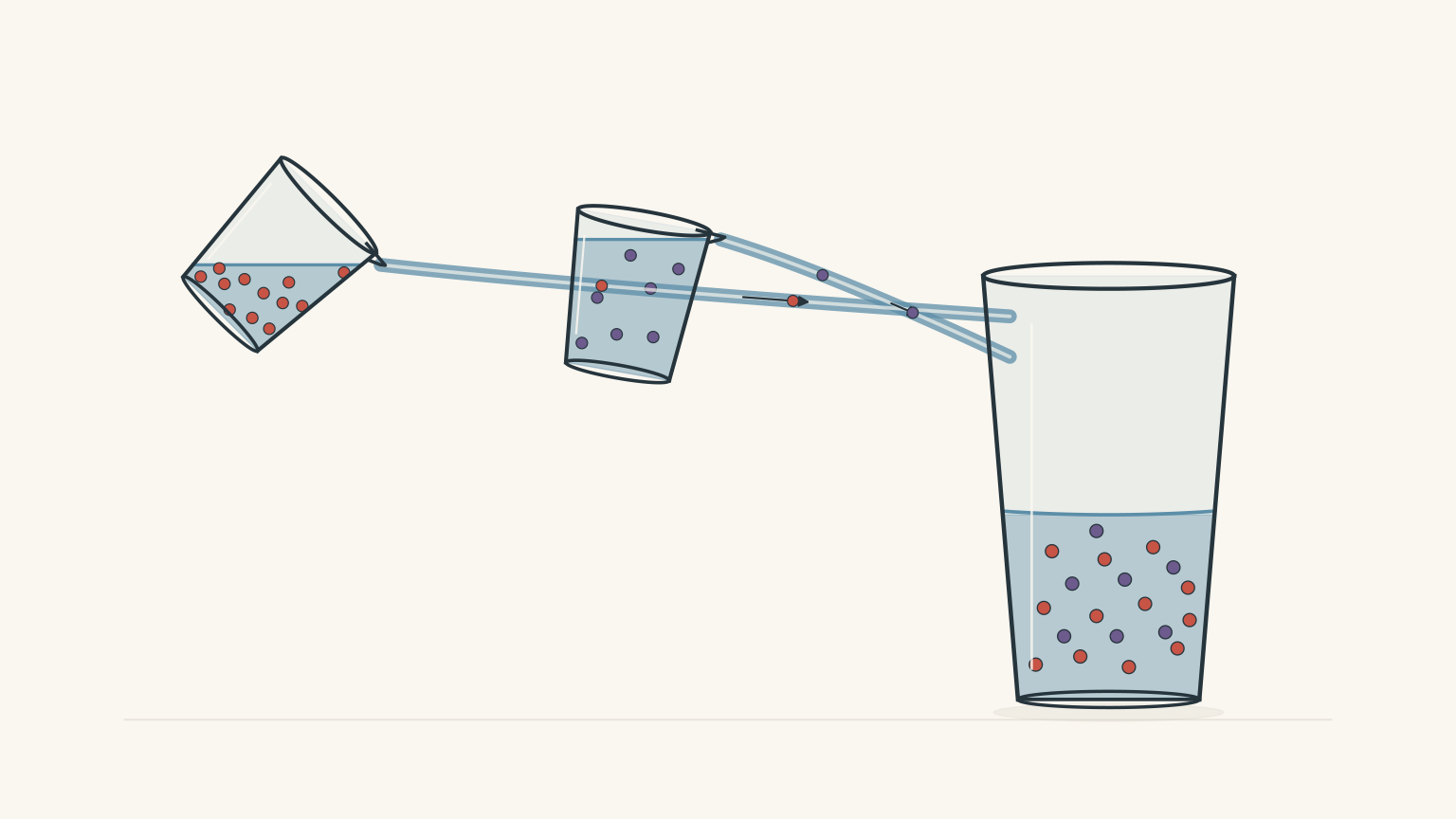
For a second dilution, you don’t transfer the entire first solution. You take another measured aliquot from it.
An aliquot is simply a measured portion of a solution.
Think of taking a ladle of well-stirred soup from a pot. The ladle contains the same proportions of ingredients as the soup in the pot, but only the ingredients in the ladle move into the next container.
The same principle applies to a well-mixed solution. The second aliquot has the same concentration as the first diluted solution, but it contains only a fraction of the total solute in that flask.
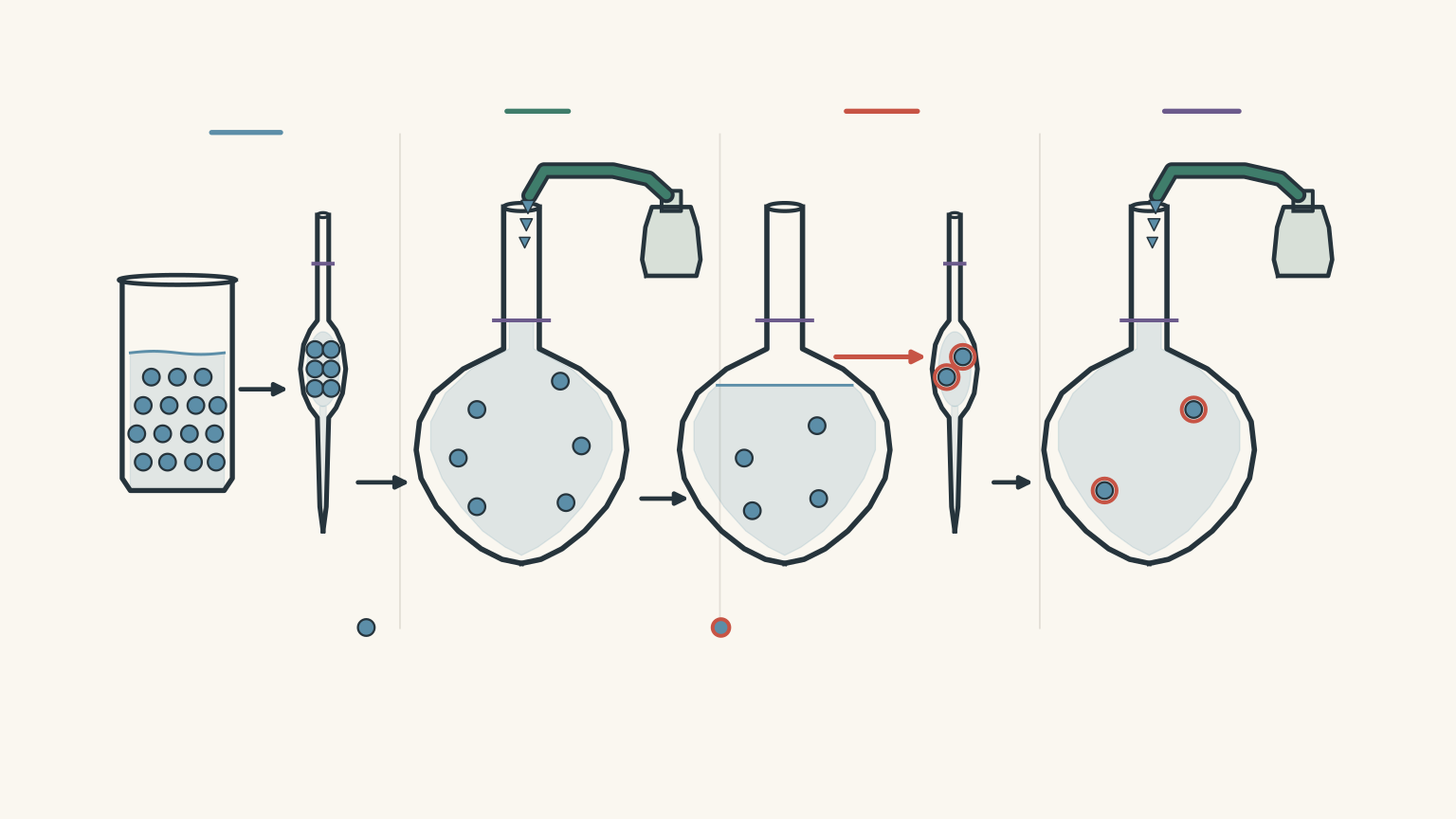
Due to technical limitations, this figure may display incorrectly or contain inaccuracies. Please check key details against your course materials.
This gives us two separate conservation steps:
- First dilution: the solute amount in the first aliquot is unchanged when water is added.
- Second dilution: the solute amount in the second aliquot is unchanged when water is added.
You must account for both steps to find the final concentration.
02The formula for two successive dilutions
The starting point is the concentration relationship:
\[ c=\frac{n}{V} \]
Where:
- \(c\) is concentration in \(\mathrm{mol\,L^{-1}}\).
- \(n\) is the amount of solute in moles, \(\mathrm{mol}\).
- \(V\) is the solution volume in litres, \(\mathrm{L}\).
Rearranging:
\[ n=cV \]
During an ordinary dilution, the amount of solute in the transferred portion remains constant.
Therefore:
\[ c_{\mathrm{initial}}V_{\mathrm{initial}} = c_{\mathrm{final}}V_{\mathrm{final}} \]
This is commonly written as:
\[ c_1V_1=c_2V_2 \]
You can apply this relationship twice.
First dilution
Let:
- \(c_0\) = original stock concentration.
- \(V_{a1}\) = volume transferred from the stock solution.
- \(c_1\) = concentration after the first dilution.
- \(V_{f1}\) = total volume after the first dilution.
Then:
\[ c_0V_{a1}=c_1V_{f1} \]
Rearranging:
\[ c_1=c_0\frac{V_{a1}}{V_{f1}} \]
Second dilution
Now take an aliquot from the first diluted solution.
Let:
- \(V_{a2}\) = volume transferred from the first diluted solution.
- \(c_2\) = final concentration after the second dilution.
- \(V_{f2}\) = total volume after the second dilution.
The concentration before this second dilution is \(c_1\).
Therefore:
\[ c_1V_{a2}=c_2V_{f2} \]
Rearranging:
\[ c_2=c_1\frac{V_{a2}}{V_{f2}} \]
Combine both steps
Substitute the first dilution equation into the second:
\[ c_2= c_0 \frac{V_{a1}}{V_{f1}} \frac{V_{a2}}{V_{f2}} \]
This is the main formula for finding the final concentration after two successive dilutions:
\[ \boxed{ c_{\mathrm{final}}= c_{\mathrm{stock}} \frac{V_{a1}}{V_{f1}} \frac{V_{a2}}{V_{f2}} } \]
Each volume ratio represents one dilution.
You can also calculate the overall dilution factor:
\[ DF_1=\frac{V_{f1}}{V_{a1}} \]
\[ DF_2=\frac{V_{f2}}{V_{a2}} \]
Then:
\[ DF_{\mathrm{overall}}=DF_1\times DF_2 \]
And:
\[ c_{\mathrm{final}}= \frac{c_{\mathrm{stock}}}{DF_{\mathrm{overall}}} \]
Notice that the dilution factors multiply, rather than add.
For more detail on calculating individual and overall dilution factors, see How to Calculate a Serial-Dilution Factor in HSC Chemistry.
A quick method to remember
| Stage | What you use | What you calculate |
|---|---|---|
| First dilution | Original stock concentration | First diluted concentration |
| Second dilution | First diluted concentration | Final concentration |
| Overall check | Both dilution factors | Final concentration relative to stock |
Three details are particularly important:
- Use the total final volume of each flask, not the volume of water added.
- Use the first diluted concentration as the starting concentration for the second dilution.
- Use consistent volume units within each volume ratio. Millilitres are perfectly acceptable because the units cancel.
03Worked example: Calculate the final concentration after two dilutions
A student starts with a \(0.500\ \mathrm{mol\,L^{-1}}\) potassium nitrate solution, \(\ce{KNO3}\).
They perform two successive dilutions:
- First, they transfer 8.00 mL of the original solution into a volumetric flask and dilute it to 80.0 mL.
- Next, they transfer 15.0 mL of the first diluted solution into another volumetric flask and dilute it to 60.0 mL.
Calculate the final concentration of potassium nitrate.
Step 1
We know:
- Original concentration = \(0.500\ \mathrm{mol\,L^{-1}}\)
- Original aliquot = 8.00 mL
- Final volume = 80.0 mL
Apply the dilution equation:
\[ c_0V_{a1}=c_1V_{f1} \]
Rearrange:
\[ c_1=\frac{c_0V_{a1}}{V_{f1}} \]
Substitute:
\[ c_1=0.500\times\frac{8.00}{80.0} \]
\[ \boxed{c_1=0.0500\ \mathrm{mol\,L^{-1}}} \]
The first dilution has reduced the concentration by a factor of 10.
Step 2
This is where students sometimes make a mistake.
The second dilution starts with the \(0.0500\ \mathrm{mol\,L^{-1}}\) solution, not the original \(0.500\ \mathrm{mol\,L^{-1}}\) solution.
We know:
- First diluted concentration = \(0.0500\ \mathrm{mol\,L^{-1}}\)
- Second aliquot = 15.0 mL
- Final volume = 60.0 mL
Apply:
\[ c_1V_{a2}=c_2V_{f2} \]
Rearrange:
\[ c_2=c_1\frac{V_{a2}}{V_{f2}} \]
Substitute:
\[ c_2=0.0500\times\frac{15.0}{60.0} \]
\[ \boxed{c_2=0.0125\ \mathrm{mol\,L^{-1}}} \]
Step 3
The first dilution factor is:
\[ DF_1=\frac{80.0}{8.00}=10.0 \]
The second dilution factor is:
\[ DF_2=\frac{60.0}{15.0}=4.00 \]
Therefore:
\[ DF_{\mathrm{overall}}=10.0\times4.00=40.0 \]
Check the final concentration:
\[ c_{\mathrm{final}}=\frac{0.500}{40.0} \]
\[ \boxed{c_{\mathrm{final}}=0.0125\ \mathrm{mol\,L^{-1}}} \]
Both methods give the same answer.
The final solution is 40 times less concentrated than the original stock solution.
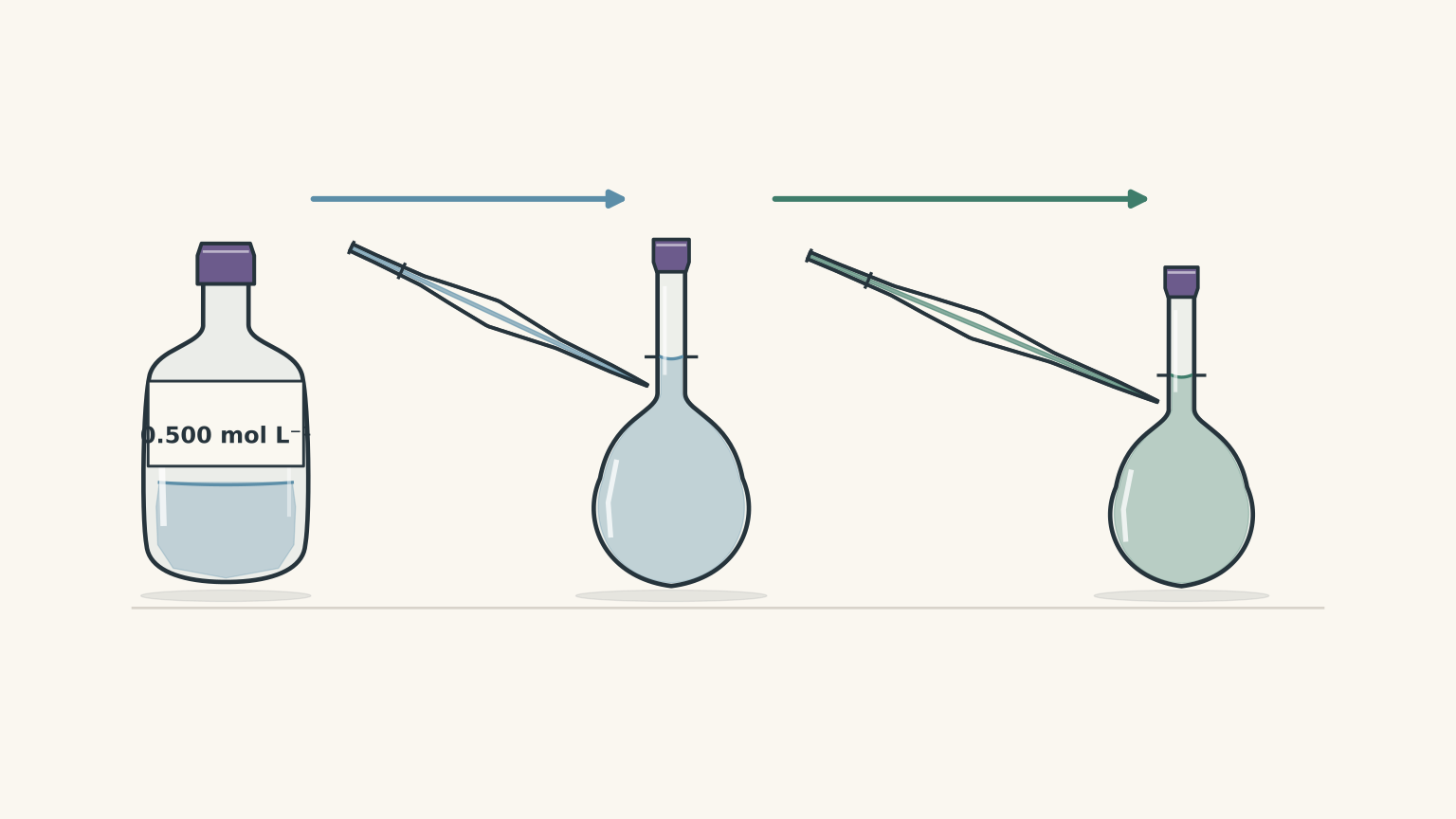
Due to technical limitations, this figure may display incorrectly or contain inaccuracies. Please check key details against your course materials.
04Worked example: Work backwards to find the original concentration
Sometimes an HSC question gives you the final concentration and asks you to determine the original stock concentration.
The same equations apply. You simply rearrange them in the opposite direction.
A glucose solution undergoes two successive dilutions:
- First, 25.0 mL of the original stock solution is diluted to 250.0 mL.
- Next, 10.0 mL of the first diluted solution is diluted to 50.0 mL.
The final glucose concentration is measured to be \(0.00400\ \mathrm{mol\,L^{-1}}\).
Calculate the original stock concentration.
Step 1
The second dilution takes 10.0 mL of the first solution and makes it up to 50.0 mL.
Its dilution factor is:
\[ DF_2=\frac{50.0}{10.0}=5.00 \]
The final concentration is one-fifth of the concentration before this dilution.
Therefore:
\[ c_1=c_2\times DF_2 \]
Substitute:
\[ c_1=0.00400\times5.00 \]
\[ \boxed{c_1=0.0200\ \mathrm{mol\,L^{-1}}} \]
Step 2
The first dilution takes 25.0 mL of the original stock and makes it up to 250.0 mL.
Its dilution factor is:
\[ DF_1=\frac{250.0}{25.0}=10.0 \]
Therefore, the original stock concentration is:
\[ c_0=c_1\times DF_1 \]
Substitute:
\[ c_0=0.0200\times10.0 \]
\[ \boxed{c_0=0.200\ \mathrm{mol\,L^{-1}}} \]
Step 3
The overall dilution factor is:
\[ DF_{\mathrm{overall}}=10.0\times5.00=50.0 \]
The predicted final concentration is:
\[ c_{\mathrm{final}}=\frac{0.200}{50.0} \]
\[ =0.00400\ \mathrm{mol\,L^{-1}} \]
This matches the measured concentration.
The original glucose stock concentration was therefore \(0.200\ \mathrm{mol\,L^{-1}}\).
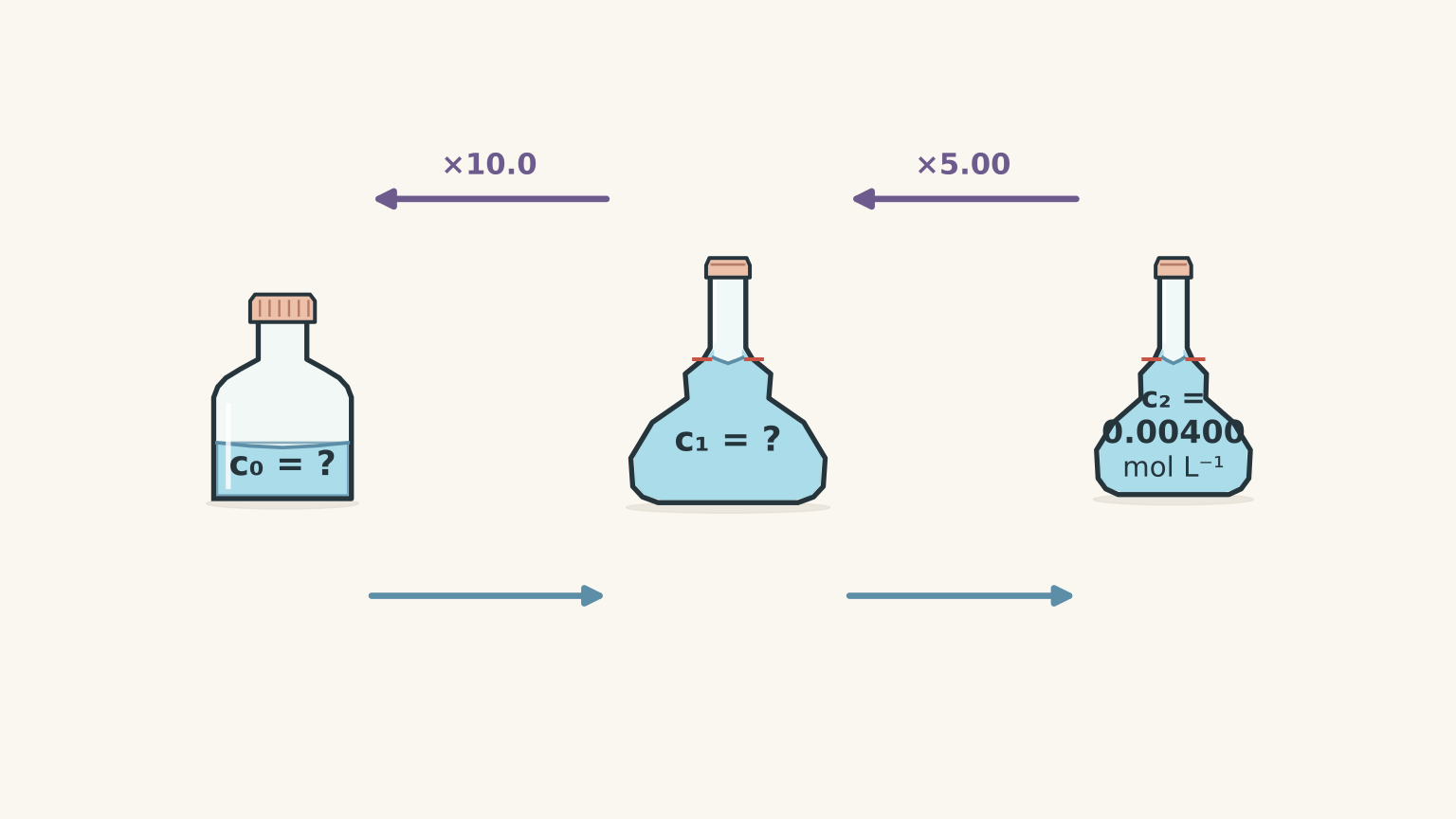
Due to technical limitations, this figure may display incorrectly or contain inaccuracies. Please check key details against your course materials.
05Important distinction: Diluting one solution versus mixing two solutions
This distinction is essential.
So far, we have considered a single solution being diluted with additional water.
But what happens if you add another solution containing the same solute?
You can no longer use the ordinary single-solution dilution equation without accounting for the extra solute.
Consider two beakers containing glucose solutions:
- Beaker A contains 25.0 mL of \(0.100\ \mathrm{mol\,L^{-1}}\) glucose.
- Beaker B contains 75.0 mL of \(0.0200\ \mathrm{mol\,L^{-1}}\) glucose.
You pour both solutions into a larger beaker.
Due to technical limitations, this figure may display incorrectly or contain inaccuracies. Please check key details against your course materials.
Both solutions contribute glucose.
The total amount of glucose is therefore:
\[ n_{\mathrm{total}}=n_A+n_B \]
Using \(n=cV\):
\[ n_{\mathrm{total}}=c_AV_A+c_BV_B \]
Assuming the volumes are additive, the final volume is:
\[ V_{\mathrm{final}}=V_A+V_B \]
Therefore:
\[ \boxed{ c_{\mathrm{final}}= \frac{c_AV_A+c_BV_B}{V_A+V_B} } \]
Substituting the illustrative values:
\[ n_A=0.100\times0.0250 =0.00250\ \mathrm{mol} \]
\[ n_B=0.0200\times0.0750 =0.00150\ \mathrm{mol} \]
Total glucose:
\[ n_{\mathrm{total}}=0.00400\ \mathrm{mol} \]
Total volume:
\[ V_{\mathrm{final}}=0.1000\ \mathrm{L} \]
Final concentration:
\[ c_{\mathrm{final}}= \frac{0.00400}{0.1000} \]
\[ \boxed{c_{\mathrm{final}}=0.0400\ \mathrm{mol\,L^{-1}}} \]
Notice that simply averaging the two starting concentrations would give \(0.0600\ \mathrm{mol\,L^{-1}}\), which is incorrect.
The volumes are different, so each solution contributes a different amount of glucose.
What if a chemical reaction occurs?
There is one more important limitation.
The dilution equation assumes that the solute being tracked does not react or get physically lost during the process.
If a chemical reaction occurs, the original reactant species may be consumed.
For example, mixing silver nitrate and sodium chloride produces a silver chloride precipitate:
\[ \ce{Ag+(aq) + Cl-(aq) -> AgCl(s)} \]
The silver and chloride ions are no longer all present as dissolved ions. Some have become solid silver chloride.
You cannot simply assume that the original dissolved amounts of \(\mathrm{Ag}^{+}\) and \(\mathrm{Cl}^{-}\) remain unchanged.
Instead, you must:
- Calculate the initial moles of each reactant.
- Use the balanced chemical equation to determine the mole ratio.
- Identify the limiting reactant.
- Calculate the amount of each species remaining.
- Divide the remaining amount by the final solution volume if a concentration is required.
The same principle applies to acid-base neutralisation.
| Situation | Correct approach |
|---|---|
| One solution diluted with water | Apply \(c_1V_1=c_2V_2\) |
| Two successive dilutions | Apply the dilution equation twice |
| Two nonreacting solutions containing the same solute | Add their moles, then divide by total volume |
| Different nonreacting salt solutions | Calculate each ion separately |
| Solutions that react when mixed | Calculate the reaction using mole ratios first |
For more practice with the different ions contributed by mixed salt solutions, see How to Calculate Final Ion Concentrations When Mixing Salts.
06Questions and solutions
The following questions move from a standard two-step dilution towards situations where you need to distinguish dilution, mixing, and chemical reaction.
All numerical values are illustrative.
Question 1
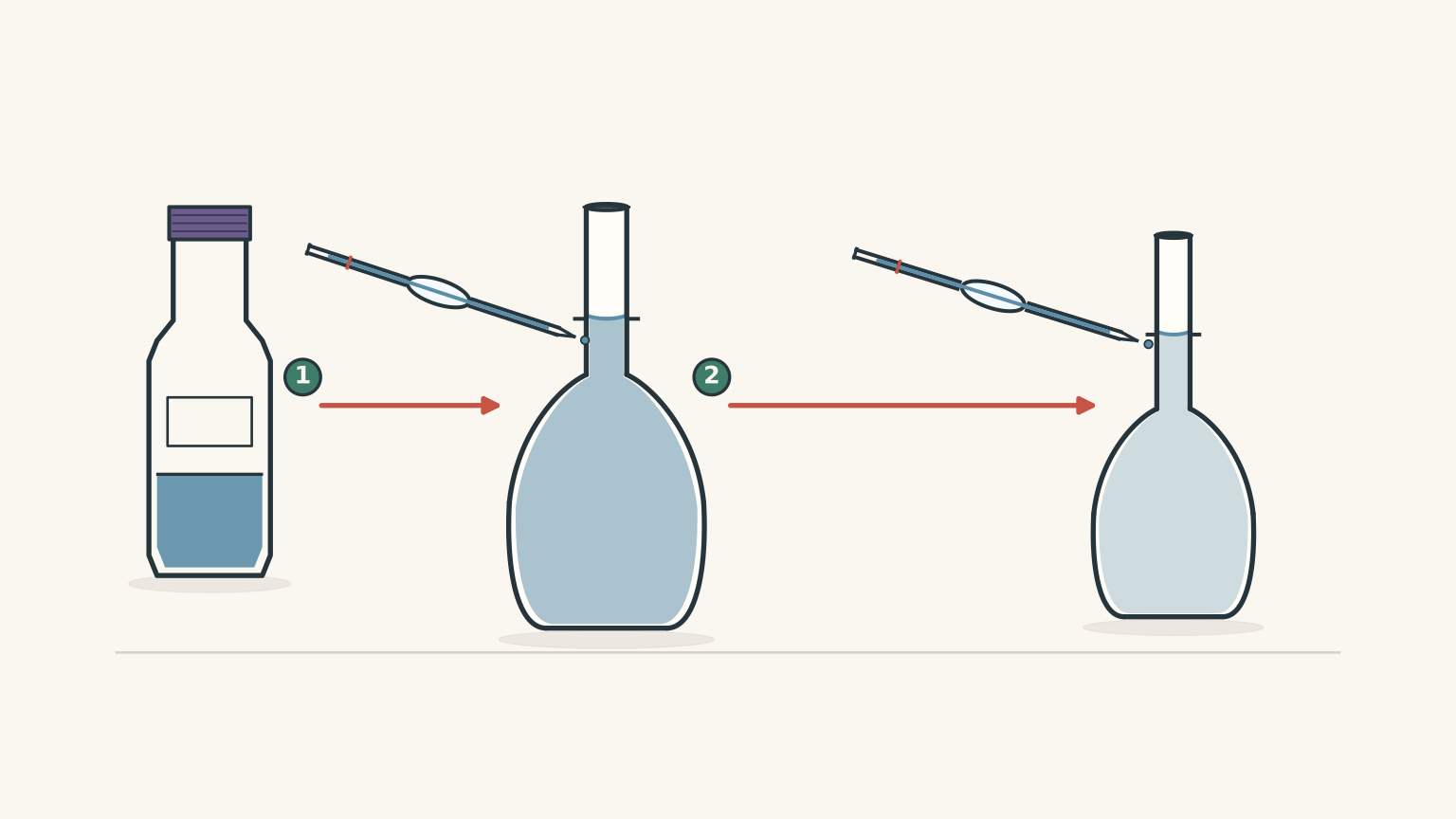
A student starts with a \(0.300\ \mathrm{mol\,L^{-1}}\) copper sulfate solution, \(\ce{CuSO4}\).
They perform two successive dilutions:
- 10.0 mL of the original solution is diluted to 100.0 mL.
- 20.0 mL of the first diluted solution is diluted to 50.0 mL.
Calculate the final concentration of \(\ce{CuSO4}\).
Due to technical limitations, this figure may display incorrectly or contain inaccuracies. Please check key details against your course materials.
Solution 1
The final concentration is \(0.0120\ \mathrm{mol\,L^{-1}}\).
Calculate each dilution separately.
Step 1: Find the concentration after the first dilution.
\[ c_1=0.300\times\frac{10.0}{100.0} \]
\[ c_1=0.0300\ \mathrm{mol\,L^{-1}} \]
Step 2: Calculate the concentration after the second dilution.
The second dilution starts with \(0.0300\ \mathrm{mol\,L^{-1}}\).
\[ c_2=0.0300\times\frac{20.0}{50.0} \]
\[ c_2=0.0120\ \mathrm{mol\,L^{-1}} \]
Step 3: Check using the overall dilution factor.
\[ DF_{\mathrm{overall}}= \frac{100.0}{10.0} \times \frac{50.0}{20.0} \]
\[ =10.0\times2.50=25.0 \]
Therefore:
\[ c_{\mathrm{final}}=\frac{0.300}{25.0} \]
\[ \boxed{c_{\mathrm{final}}=0.0120\ \mathrm{mol\,L^{-1}}} \]
The final solution is 25 times less concentrated than the original stock.
Question 2
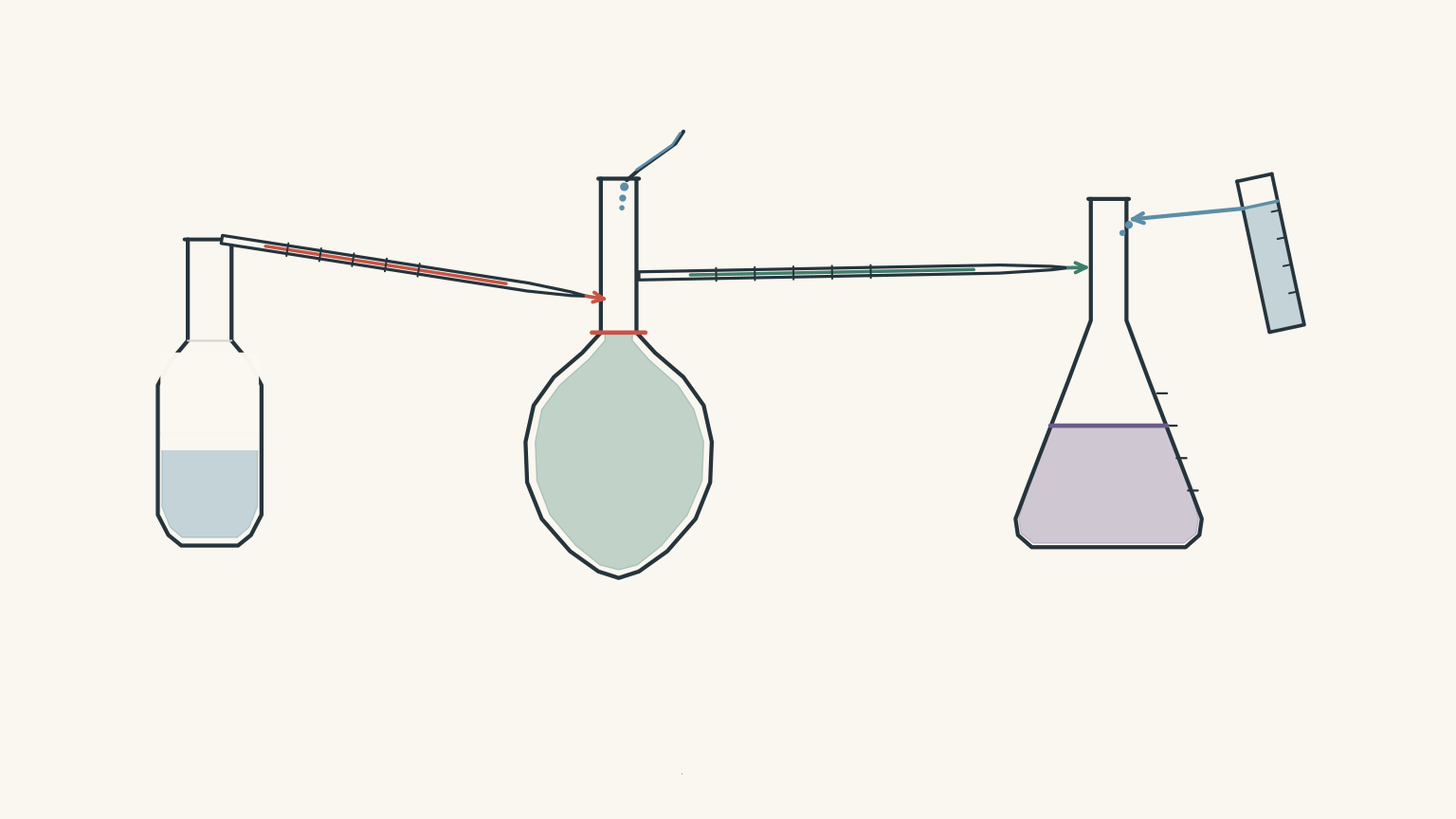
A student prepares two successive dilutions from a \(0.600\ \mathrm{mol\,L^{-1}}\) glucose solution.
For the first dilution, they transfer 12.0 mL of the stock solution into a volumetric flask and add water until the total volume reaches 120.0 mL.
For the second dilution, they transfer 15.0 mL of the first diluted solution into another flask and add 45.0 mL of water.
Calculate the final glucose concentration.
A student uses 45.0 mL as the final volume of the second dilution. Explain why this is incorrect and calculate the result they should have obtained.
Due to technical limitations, this figure may display incorrectly or contain inaccuracies. Please check key details against your course materials.
Solution 2
The correct final concentration is \(0.0150\ \mathrm{mol\,L^{-1}}\). The student’s mistake is using the volume of water added instead of the total final solution volume.
Step 1: Calculate the first diluted concentration.
\[ c_1=0.600\times\frac{12.0}{120.0} \]
\[ c_1=0.0600\ \mathrm{mol\,L^{-1}} \]
Step 2: Calculate the total volume after the second dilution.
The student transfers 15.0 mL of solution and adds 45.0 mL of water.
Therefore:
\[ V_{f2}=15.0+45.0 \]
\[ V_{f2}=60.0\ \mathrm{mL} \]
The final volume is 60.0 mL, not 45.0 mL.
Step 3: Calculate the final concentration.
\[ c_2=0.0600\times\frac{15.0}{60.0} \]
\[ \boxed{c_2=0.0150\ \mathrm{mol\,L^{-1}}} \]
Step 4: Explain the incorrect method.
If the student uses 45.0 mL as the final volume:
\[ c_2=0.0600\times\frac{15.0}{45.0} \]
\[ =0.0200\ \mathrm{mol\,L^{-1}} \]
This answer is too high because it assumes the final solution occupies a smaller volume than it actually does.
Always use the total final solution volume, not just the amount of water added.
Question 3
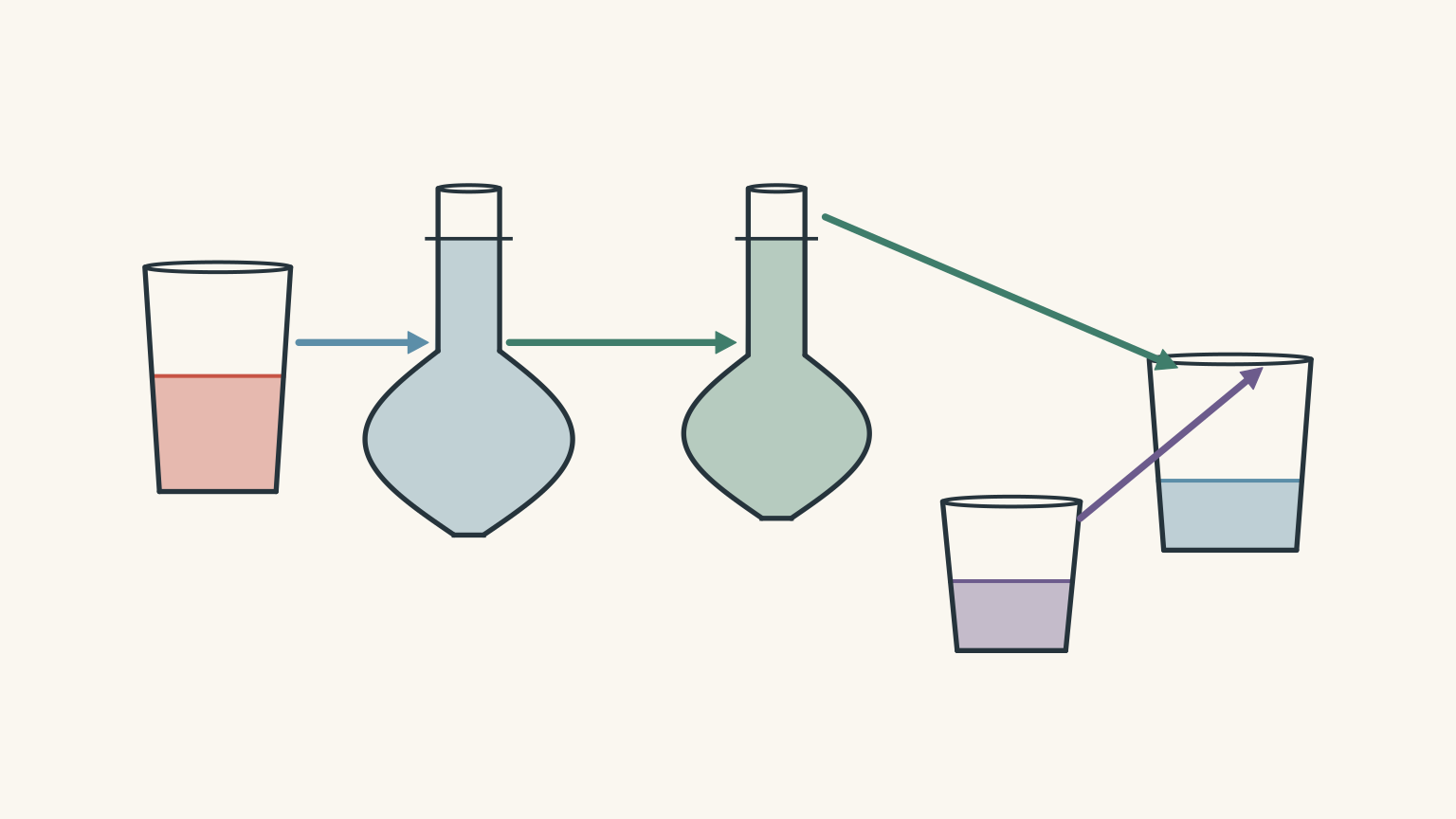
A student starts with a \(0.400\ \mathrm{mol\,L^{-1}}\) glucose solution.
They perform two successive dilutions:
- 10.0 mL of the stock solution is diluted to 100.0 mL.
- 20.0 mL of the first diluted solution is diluted to 80.0 mL.
The student then transfers 25.0 mL of the final diluted solution into a beaker containing 75.0 mL of a separate \(0.0200\ \mathrm{mol\,L^{-1}}\) glucose solution.
No chemical reaction occurs, and the volumes are additive.
Calculate the final glucose concentration after mixing.
Due to technical limitations, this figure may display incorrectly or contain inaccuracies. Please check key details against your course materials.
Solution 3
The final glucose concentration is \(0.0175\ \mathrm{mol\,L^{-1}}\).
The important distinction is that the final beaker contains glucose from two separate solutions. You must calculate the amount contributed by each one.
Step 1: Calculate the concentration after the first dilution.
\[ c_1=0.400\times\frac{10.0}{100.0} \]
\[ c_1=0.0400\ \mathrm{mol\,L^{-1}} \]
Step 2: Calculate the concentration after the second dilution.
\[ c_2=0.0400\times\frac{20.0}{80.0} \]
\[ c_2=0.0100\ \mathrm{mol\,L^{-1}} \]
The first solution contributing glucose to the final mixture therefore has a concentration of \(0.0100\ \mathrm{mol\,L^{-1}}\).
Step 3: Calculate the moles of glucose from the first solution.
Convert 25.0 mL into litres:
\[ 25.0\ \mathrm{mL}=0.0250\ \mathrm{L} \]
Using \(n=cV\):
\[ n_1=0.0100\times0.0250 \]
\[ n_1=0.000250\ \mathrm{mol} \]
Step 4: Calculate the moles of glucose from the second solution.
Convert 75.0 mL into litres:
\[ 75.0\ \mathrm{mL}=0.0750\ \mathrm{L} \]
\[ n_2=0.0200\times0.0750 \]
\[ n_2=0.00150\ \mathrm{mol} \]
Step 5: Add the moles and calculate the final concentration.
\[ n_{\mathrm{total}}=0.000250+0.00150 \]
\[ n_{\mathrm{total}}=0.00175\ \mathrm{mol} \]
The total volume is:
\[ V_{\mathrm{total}}=25.0+75.0 \]
\[ =100.0\ \mathrm{mL}=0.1000\ \mathrm{L} \]
Therefore:
\[ c_{\mathrm{final}}= \frac{0.00175}{0.1000} \]
\[ \boxed{c_{\mathrm{final}}=0.0175\ \mathrm{mol\,L^{-1}}} \]
The tempting mistake is to treat the second glucose solution as though it were water.
It isn’t. It contributes additional glucose, so its moles must be included.
Question 4
A student starts with a \(0.200\ \mathrm{mol\,L^{-1}}\) silver nitrate solution, \(\ce{AgNO3}\).
They perform two successive dilutions:
- 20.0 mL of the stock solution is diluted to 100.0 mL.
- 25.0 mL of the first diluted solution is diluted to 50.0 mL.
The student then mixes 40.0 mL of the final diluted solution with 30.0 mL of a \(0.0200\ \mathrm{mol\,L^{-1}}\) sodium chloride solution, \(\ce{NaCl}\).
Silver chloride precipitates according to:
\[ \ce{Ag+(aq) + Cl-(aq) -> AgCl(s)} \]
Assume the precipitation reaction is effectively complete, the volumes are additive, and the solubility of silver chloride can be ignored.
Calculate:
a) The concentration of silver nitrate after the two dilutions.
b) The limiting reactant when the two solutions are mixed.
c) The number of moles of silver ions remaining after the reaction.
d) The final concentration of silver ions in the mixture.
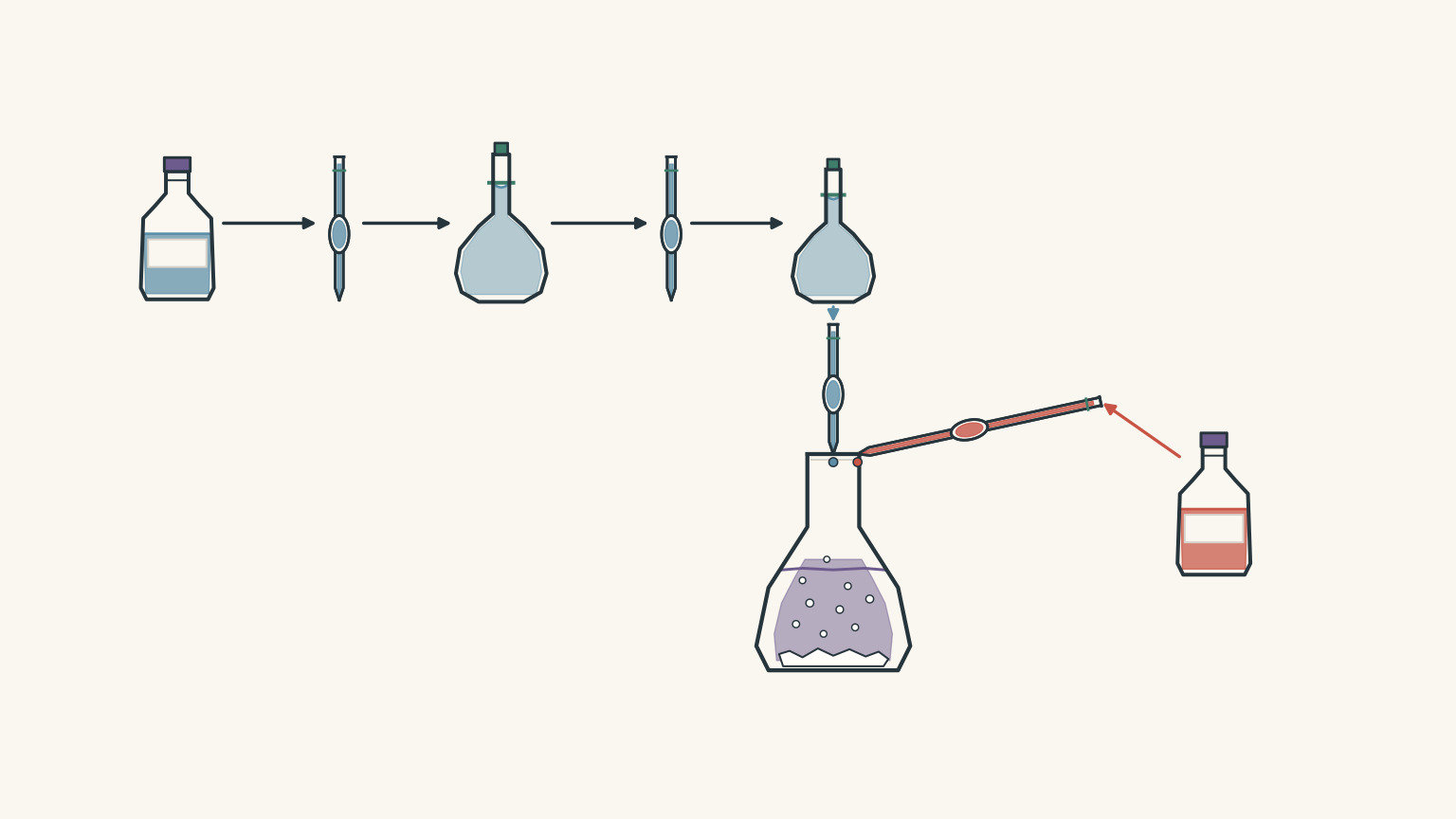
Due to technical limitations, this figure may display incorrectly or contain inaccuracies. Please check key details against your course materials.
Solution 4
Chloride ions are the limiting reactant, and the final silver ion concentration is \(0.00286\ \mathrm{mol\,L^{-1}}\).
This question is different from the previous ones because a chemical reaction occurs after the two dilutions.
You must calculate the concentration after dilution first, then account for the reaction.
Step 1: Calculate the concentration after the first dilution.
\[ c_1=0.200\times\frac{20.0}{100.0} \]
\[ c_1=0.0400\ \mathrm{mol\,L^{-1}} \]
Step 2: Calculate the concentration after the second dilution.
\[ c_2=0.0400\times\frac{25.0}{50.0} \]
\[ \boxed{c_2=0.0200\ \mathrm{mol\,L^{-1}}} \]
This is the concentration of the silver nitrate solution before mixing.
Step 3: Calculate the initial moles of silver ions.
Silver nitrate dissociates according to:
\[ \ce{AgNO3(aq) -> Ag+(aq) + NO3-(aq)} \]
One mole of silver nitrate produces one mole of silver ions.
The volume transferred is:
\[ 40.0\ \mathrm{mL}=0.0400\ \mathrm{L} \]
Therefore:
\[ n(\mathrm{Ag}^{+})=0.0200\times0.0400 \]
\[ n(\mathrm{Ag}^{+})=0.000800\ \mathrm{mol} \]
Step 4: Calculate the initial moles of chloride ions.
Sodium chloride dissociates according to:
\[ \ce{NaCl(aq) -> Na+(aq) + Cl-(aq)} \]
One mole of sodium chloride produces one mole of chloride ions.
The volume is:
\[ 30.0\ \mathrm{mL}=0.0300\ \mathrm{L} \]
Therefore:
\[ n(\mathrm{Cl}^{-})=0.0200\times0.0300 \]
\[ n(\mathrm{Cl}^{-})=0.000600\ \mathrm{mol} \]
Step 5: Identify the limiting reactant.
The balanced equation is:
\[ \ce{Ag+ + Cl- -> AgCl} \]
The mole ratio is 1:1.
We have:
- \(0.000800\) mol of \(\mathrm{Ag}^{+}\).
- \(0.000600\) mol of \(\mathrm{Cl}^{-}\).
Chloride ions are present in the smaller amount, so they are completely consumed.
Silver ions remain in excess.
Step 6: Calculate the moles of silver ions remaining.
\[ n(\mathrm{Ag}^{+})_{\mathrm{remaining}} = 0.000800-0.000600 \]
\[ \boxed{n(\mathrm{Ag}^{+})_{\mathrm{remaining}} =0.000200\ \mathrm{mol}} \]
Step 7: Calculate the final silver ion concentration.
The total volume is:
\[ V_{\mathrm{final}}=40.0+30.0 \]
\[ =70.0\ \mathrm{mL}=0.0700\ \mathrm{L} \]
Therefore:
\[ [\mathrm{Ag}^{+}]= \frac{0.000200}{0.0700} \]
\[ \boxed{[\mathrm{Ag}^{+}]=0.00286\ \mathrm{mol\,L^{-1}}} \]
The crucial point is that the original silver ions have not all remained as dissolved silver ions. Some have reacted to form solid silver chloride.
You can conserve the total amount of silver atoms, but you cannot assume that the original amount of dissolved \(\mathrm{Ag}^{+}\) remains unchanged after the reaction.
Question 5
A chemistry student prepares two separate branches of sodium chloride solution from the same \(0.800\ \mathrm{mol\,L^{-1}}\) stock.
Both branches undergo two successive dilutions.
Branch A
- Transfer 5.00 mL of the stock solution and dilute it to 50.0 mL.
- Transfer 10.0 mL of the first diluted solution and dilute it to 100.0 mL.
Branch B
- Transfer 20.0 mL of the original stock solution and dilute it to 100.0 mL.
- Transfer 25.0 mL of the first diluted solution and dilute it to 50.0 mL.
The student then:
- Transfers 80.0 mL of the final Branch A solution into a beaker.
- Transfers 20.0 mL of the final Branch B solution into the same beaker.
- Adds 50.0 mL of pure water.
Assume there is no reaction, no physical loss of solute, and the volumes are additive.
Calculate the final sodium chloride concentration.
A student makes the following claim:
“All four dilution factors should be multiplied together because both branches started with the same stock solution.”
Explain why this reasoning is incorrect.
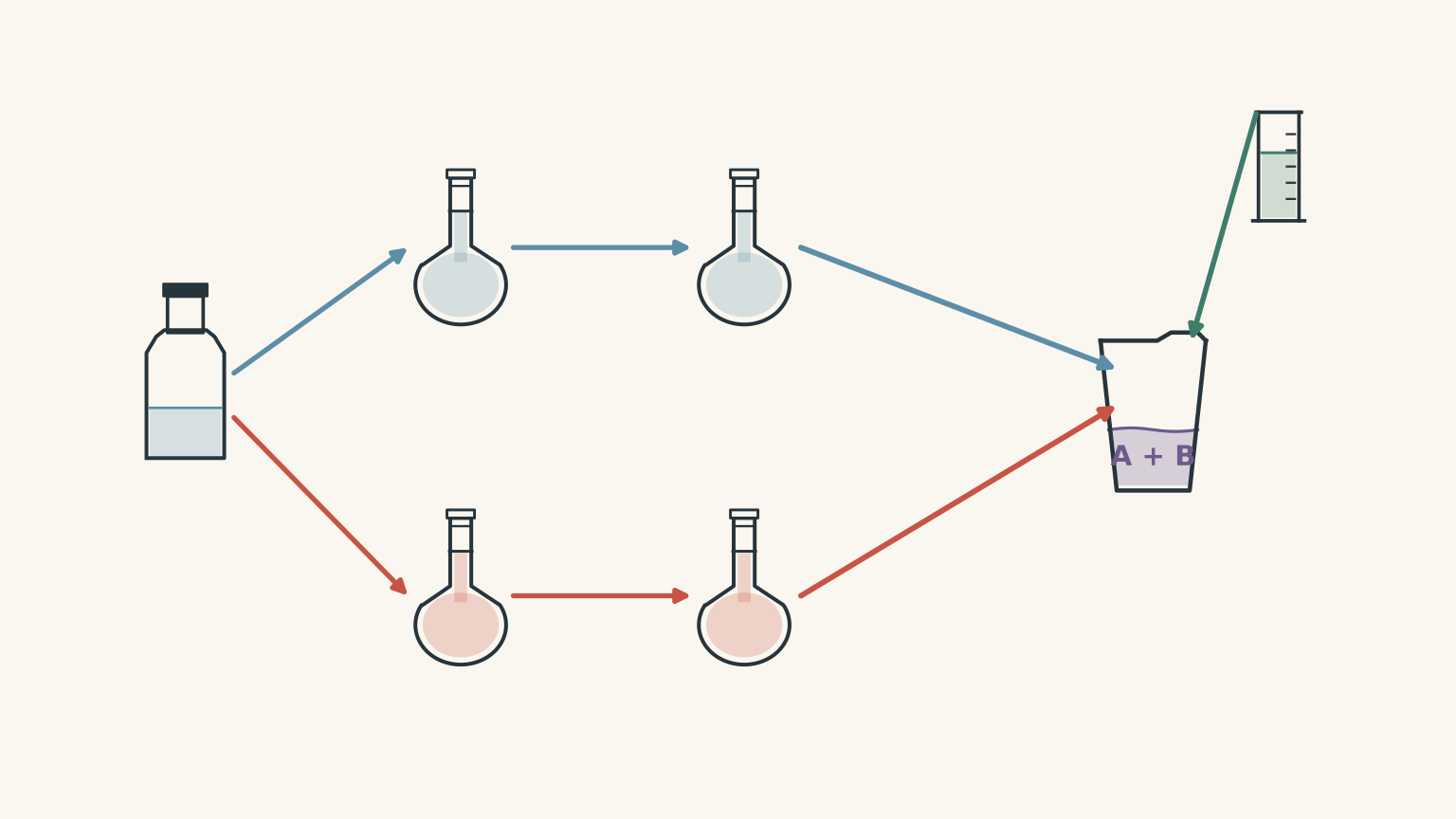
Due to technical limitations, this figure may display incorrectly or contain inaccuracies. Please check key details against your course materials.
Solution 5
The final sodium chloride concentration is \(0.0149\ \mathrm{mol\,L^{-1}}\). Branch B contributes more sodium chloride than Branch A, despite contributing a much smaller volume.
The student’s claim is incorrect because the two branches are separate dilution pathways. No portion of the solution passes through all four dilution stages.
You must calculate the concentration in each branch, then add the moles contributed by the portions being mixed.
Step 1: Calculate the final concentration of Branch A.
The first dilution factor is:
\[ DF_{A1}=\frac{50.0}{5.00}=10.0 \]
The second dilution factor is:
\[ DF_{A2}=\frac{100.0}{10.0}=10.0 \]
The overall dilution factor for Branch A is:
\[ DF_A=10.0\times10.0=100 \]
Therefore:
\[ c_A=\frac{0.800}{100} \]
\[ \boxed{c_A=0.00800\ \mathrm{mol\,L^{-1}}} \]
Step 2: Calculate the final concentration of Branch B.
The first dilution factor is:
\[ DF_{B1}=\frac{100.0}{20.0}=5.00 \]
The second dilution factor is:
\[ DF_{B2}=\frac{50.0}{25.0}=2.00 \]
The overall dilution factor for Branch B is:
\[ DF_B=5.00\times2.00=10.0 \]
Therefore:
\[ c_B=\frac{0.800}{10.0} \]
\[ \boxed{c_B=0.0800\ \mathrm{mol\,L^{-1}}} \]
Notice that Branch B is ten times more concentrated than Branch A.
Step 3: Calculate the moles of sodium chloride contributed by Branch A.
The transferred volume is:
\[ 80.0\ \mathrm{mL}=0.0800\ \mathrm{L} \]
Using \(n=cV\):
\[ n_A=0.00800\times0.0800 \]
\[ \boxed{n_A=0.000640\ \mathrm{mol}} \]
Step 4: Calculate the moles of sodium chloride contributed by Branch B.
The transferred volume is:
\[ 20.0\ \mathrm{mL}=0.0200\ \mathrm{L} \]
Therefore:
\[ n_B=0.0800\times0.0200 \]
\[ \boxed{n_B=0.00160\ \mathrm{mol}} \]
This is the interesting part.
Branch B contributes more than twice as many moles of sodium chloride as Branch A, even though its transferred volume is only one-quarter as large.
The concentration of a solution matters just as much as the volume transferred.
Step 5: Calculate the total moles of sodium chloride.
\[ n_{\mathrm{total}}=n_A+n_B \]
\[ =0.000640+0.00160 \]
\[ \boxed{n_{\mathrm{total}}=0.00224\ \mathrm{mol}} \]
The added water contributes no sodium chloride, so it does not increase the total number of moles.
Step 6: Calculate the final total volume.
The final mixture contains:
- 80.0 mL from Branch A.
- 20.0 mL from Branch B.
- 50.0 mL of added water.
Therefore:
\[ V_{\mathrm{final}}=80.0+20.0+50.0 \]
\[ =150.0\ \mathrm{mL} \]
Convert to litres:
\[ V_{\mathrm{final}}=0.1500\ \mathrm{L} \]
Step 7: Calculate the final concentration.
\[ c_{\mathrm{final}}= \frac{n_{\mathrm{total}}}{V_{\mathrm{final}}} \]
Substitute:
\[ c_{\mathrm{final}}= \frac{0.00224}{0.1500} \]
\[ \boxed{c_{\mathrm{final}}=0.0149\ \mathrm{mol\,L^{-1}}} \]
Step 8: Explain why multiplying all four dilution factors is wrong.
The dilution factors for the two branches describe separate pathways:
\[ DF_A=100 \]
\[ DF_B=10.0 \]
Multiplying them together would incorrectly assume that the same portion of stock solution passes through both pathways.
It doesn’t.
Instead, the final beaker receives one portion from Branch A and another portion from Branch B. Each portion carries its own amount of sodium chloride.
The correct approach is to calculate the moles contributed by each portion, add them, and divide by the final volume.
There is another useful check.
Before adding water, the 100.0 mL mixture has a concentration of:
\[ c=\frac{0.00224}{0.1000} \]
\[ =0.0224\ \mathrm{mol\,L^{-1}} \]
Adding 50.0 mL of pure water increases the volume to 150.0 mL without changing the amount of sodium chloride.
The concentration must therefore decrease:
\[ 0.0224\times\frac{100.0}{150.0} =0.0149\ \mathrm{mol\,L^{-1}} \]
This agrees with our answer.
The important lesson is that two separate dilution pathways do not become one serial dilution simply because they started with the same stock solution.
07Where to go next
When calculating a final concentration, your first decision should be to identify exactly what happens to the solution.
If one solution is diluted twice with water, apply the dilution equation twice.
If two solutions are combined, calculate the moles contributed by each one.
If a chemical reaction occurs, use the balanced equation and mole ratios before calculating the remaining concentrations.
Getting that decision right makes the mathematics much more straightforward, particularly in longer HSC Chemistry questions involving serial dilutions followed by mixing or reaction.