
How to Find a Hydrocarbon Formula from Combustion Data
Learn how to calculate a hydrocarbon's empirical and molecular formulae using carbon dioxide and water masses. Includes step-by-step worked examples, mole ratio rounding, experimental limitations, and challenging HSC Chemistry practice questions with solutions.
An unknown hydrocarbon burns completely. The products contain 1.320 g of carbon dioxide and 0.540 g of water. Can you use those two measurements to find the hydrocarbon’s formula?
Yes, but there’s a catch. Combustion data gives you the simplest carbon-to-hydrogen ratio first, not necessarily the molecular formula.
The method is to convert the mass of \(\ce{CO2}\) into moles of carbon atoms, convert the mass of \(\ce{H2O}\) into moles of hydrogen atoms, and reduce those amounts to the smallest whole-number ratio.
For these illustrative measurements, the result is \(\ce{CH2}\). That could correspond to \(\ce{C2H4}\), \(\ce{C3H6}\), or another hydrocarbon with the same ratio. To identify the molecular formula, we need more information.
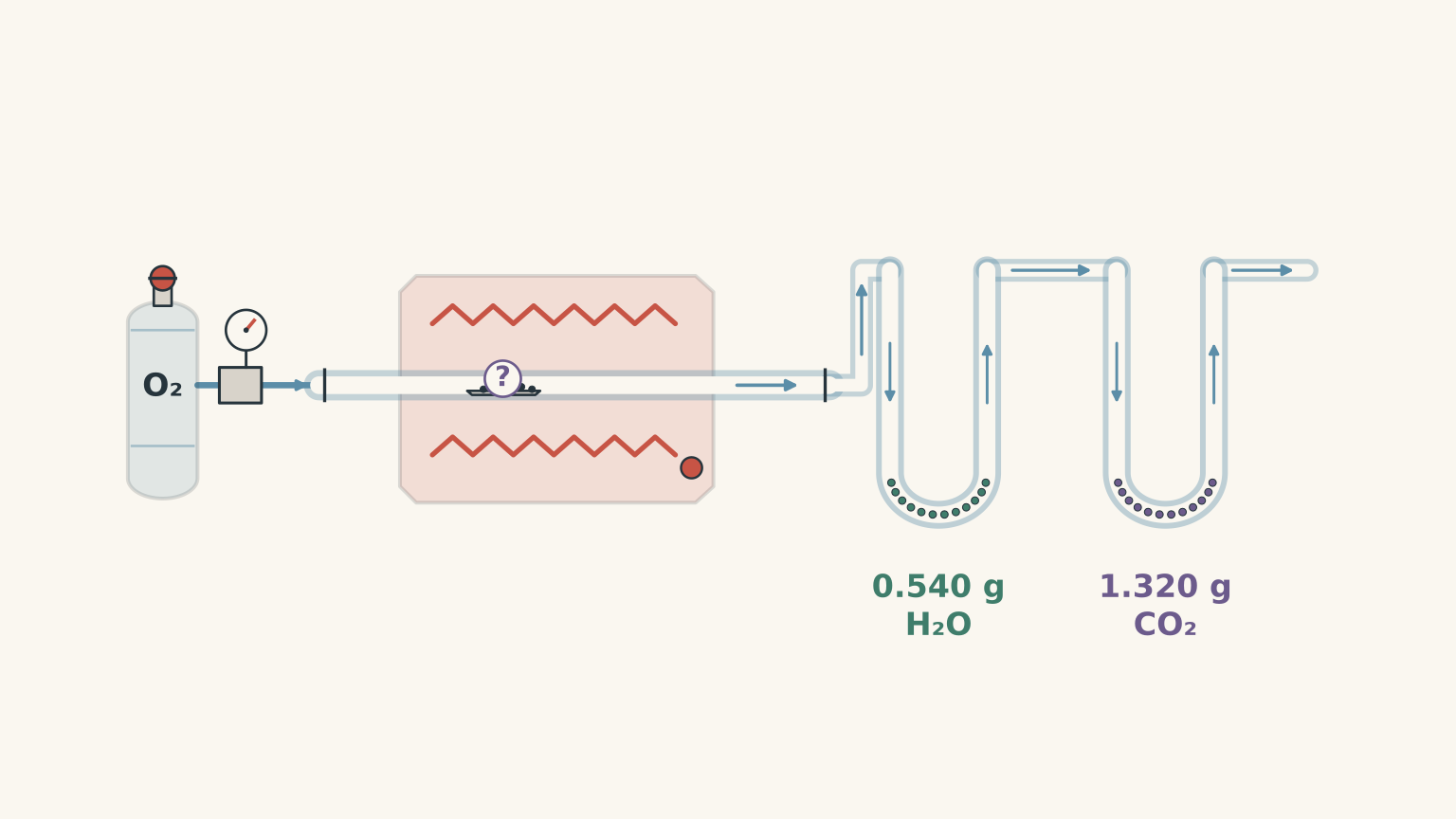
Due to technical limitations, this figure may display incorrectly or contain inaccuracies. Please check key details against your course materials.
01How combustion reveals the atoms in a hydrocarbon
Imagine burning a hydrocarbon and trying to work out what it’s made of.
You already know that a hydrocarbon contains only carbon and hydrogen. The difficulty is that both elements disappear into gases when the fuel burns.
How can you count atoms you can no longer see?
The useful idea is to collect the substances those atoms become.
During complete combustion:
- Every carbon atom from the hydrocarbon ends up in \(\ce{CO2}\).
- Every two hydrogen atoms from the hydrocarbon end up in one \(\ce{H2O}\) molecule.
- Oxygen comes from the supplied \(\ce{O2}\).
For example, propane burns according to:
\[ \ce{C3H8 + 5O2 -> 3CO2 + 4H2O} \]
The three carbon atoms in propane become three molecules of carbon dioxide. Its eight hydrogen atoms become four molecules of water.
Nothing mysterious happens to the atoms. They’re rearranged into new substances.
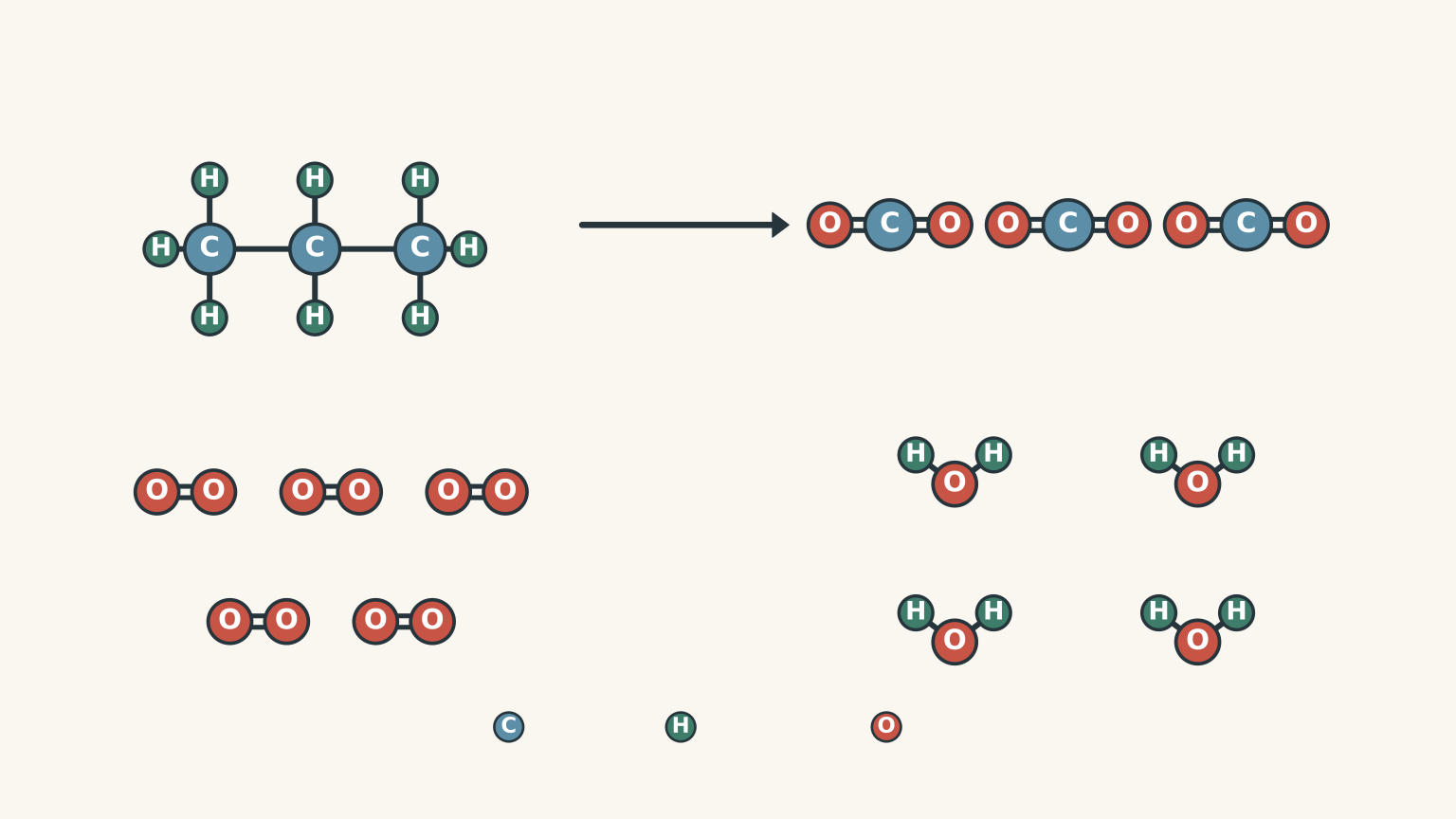
Due to technical limitations, this figure may display incorrectly or contain inaccuracies. Please check key details against your course materials.
That gives us two relationships:
\[ n(\mathrm{C})=n(\ce{CO2}) \]
\[ n(\mathrm{H})=2n(\ce{H2O}) \]
Here, \(n\) means amount in moles, with units of mol.
The factor of 2 for hydrogen is essential. Each water molecule contains two hydrogen atoms.
These equations work only if all the fuel’s carbon becomes \(\ce{CO2}\), all its hydrogen becomes \(\ce{H2O}\), and both products are measured accurately.
We’ll return to what happens when those assumptions fail.
02How chemists collect the combustion products
The challenge in combustion analysis is not getting a hydrocarbon to burn. It’s collecting and weighing its products without losing them or mixing them with substances already in the air.
An ordinary flame is a poor starting design. Carbon dioxide disperses, water escapes as vapour, and atmospheric moisture makes it difficult to tell how much water the fuel produced.
Nineteenth-century chemists, including Justus von Liebig, developed combustion-analysis apparatus that collected the products separately. The important advance was turning invisible gaseous products into measurable changes in mass.
Following the gases through the apparatus
In a typical combustion-analysis arrangement, the components are connected in this order:
- Dry oxygen supply: Oxygen enters the apparatus. It is dried first so water entering with the gas cannot be mistaken for water produced by combustion.
- Heated combustion tube: A known mass of hydrocarbon is heated and burned in excess oxygen. The gas stream carries the combustion products out of the tube.
- Water-absorption tube: The gases pass through a substance such as anhydrous calcium chloride, which absorbs water. The increase in the tube’s mass measures the water collected.
- Carbon dioxide-absorption tube: The remaining gases pass through a suitable carbon dioxide absorbent, such as soda lime. The mass increase measures the carbon dioxide absorbed.
- Gas outlet: Excess oxygen and any gases not collected leave the apparatus.
Both absorption tubes are weighed before and after the experiment.
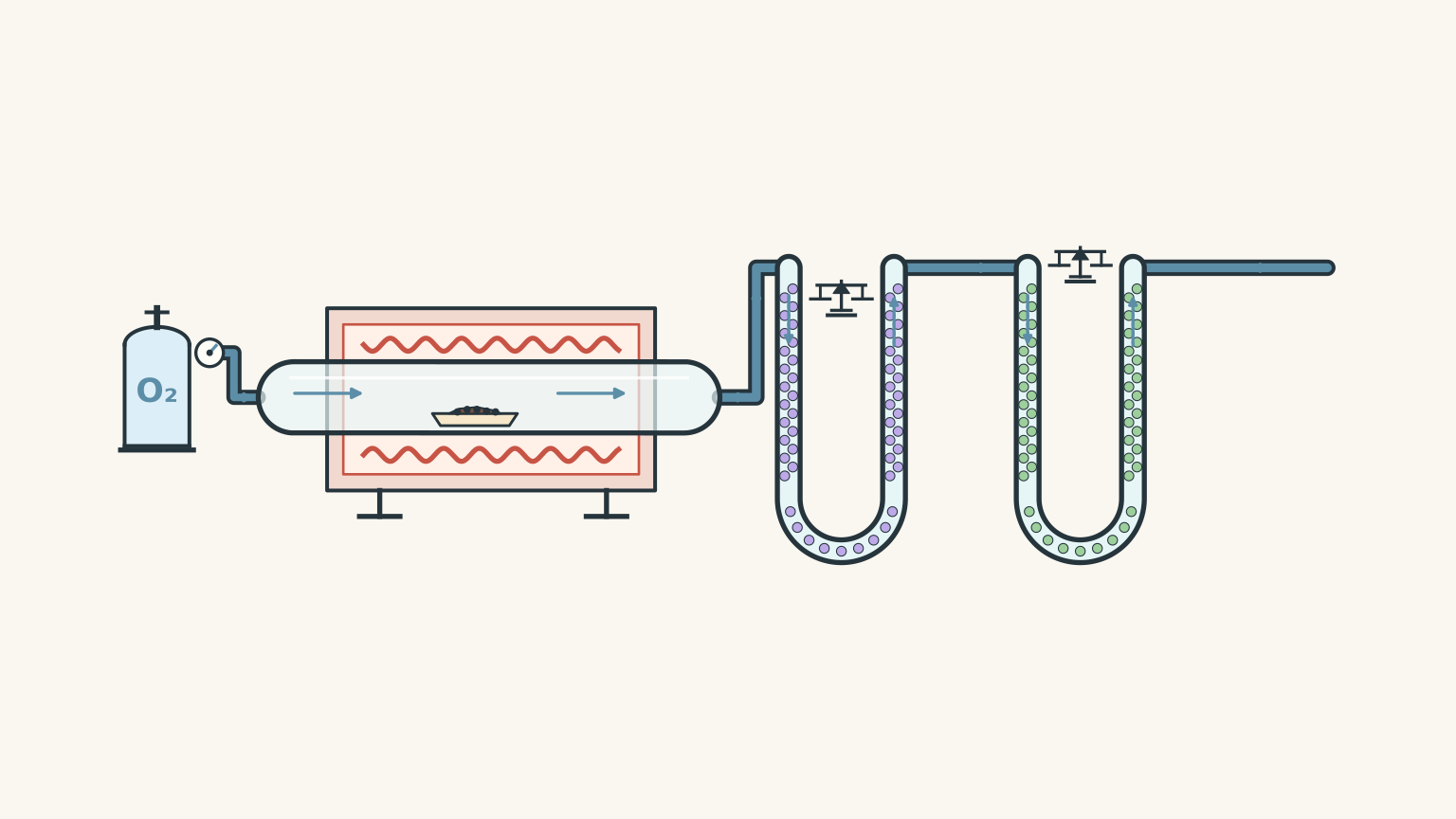
Due to technical limitations, this figure may display incorrectly or contain inaccuracies. Please check key details against your course materials.
Why collect water before carbon dioxide?
Some carbon dioxide absorbents also absorb water. If the gas reached one of those absorbents while still wet, its mass gain could include both products.
Removing the water first lets the next absorber measure carbon dioxide more selectively.
There are still limitations. Incomplete combustion may produce \(\ce{CO}\) or soot, a leak can allow products to escape, and contaminated oxygen can introduce extra mass. A reliable analysis therefore needs appropriate drying, combustion, and collection controls.
What the measured masses actually represent
Consider this illustrative set of experimental readings.
| Measurement | Mass |
|---|---|
| Hydrocarbon sample burned | 0.420 g |
| Increase in water-absorption tube mass | 0.540 g |
| Increase in carbon dioxide-absorption tube mass | 1.320 g |
The absorption tubes measure the mass of collected products, not the mass of carbon or hydrogen alone.
Notice something strange: the products weigh 1.860 g altogether, even though the original fuel weighed only 0.420 g.
Where did the extra mass come from?
It came from oxygen supplied during combustion.
\[ \begin{aligned} m(\text{products})&=1.320+0.540\\ &=1.860\ \mathrm{g} \end{aligned} \]
The oxygen incorporated into the products therefore has a mass of:
\[ 1.860-0.420=1.440\ \mathrm{g} \]
This is consistent with conservation of mass. The fuel wasn’t the only reactant.
It also explains why we cannot simply treat the measured masses of carbon dioxide and water as the masses of carbon and hydrogen.
03The calculation: from product masses to a hydrocarbon formula
The whole method depends on one equation:
\[ n=\frac{m}{M} \]
where:
- \(n\) is amount in moles (mol).
- \(m\) is mass (g).
- \(M\) is molar mass (\(\mathrm{g\,mol^{-1}}\)).
For the illustrative calculations in this article, use these rounded molar masses:
| Substance or element | Molar mass |
|---|---|
| Carbon, C | 12.0 g mol\(^{-1}\) |
| Hydrogen, H | 1.0 g mol\(^{-1}\) |
| Carbon dioxide, \(\ce{CO2}\) | 44.0 g mol\(^{-1}\) |
| Water, \(\ce{H2O}\) | 18.0 g mol\(^{-1}\) |
The reasoning has four moves.
First, calculate moles of carbon dioxide. Every mole of \(\ce{CO2}\) contains one mole of carbon atoms.
Second, calculate moles of water. Every mole of \(\ce{H2O}\) contains two moles of hydrogen atoms, so multiply the water amount by 2.
Third, divide both atom amounts by the smaller amount. This reveals their relative numbers.
Fourth, convert the ratio into the smallest whole numbers. Those numbers become the empirical formula subscripts.
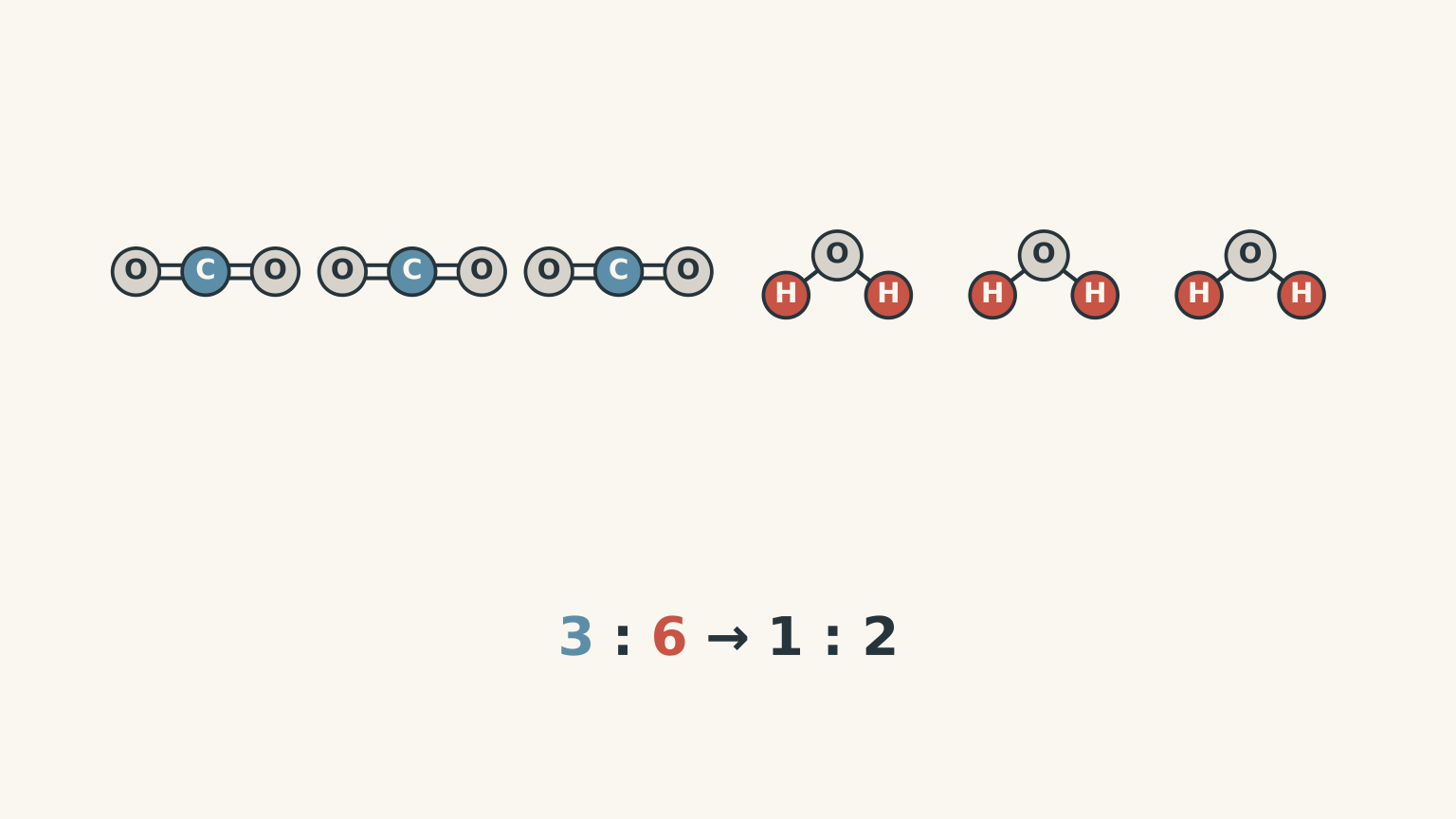
Due to technical limitations, this figure may display incorrectly or contain inaccuracies. Please check key details against your course materials.
Worked example: Finding the empirical formula from combustion products
A 0.580 g sample of an unknown pure hydrocarbon undergoes complete combustion.
The apparatus collects 1.760 g of \(\ce{CO2}\) and 0.900 g of \(\ce{H2O}\).
Determine the empirical formula of the hydrocarbon.
Step 1
The molar mass of carbon dioxide is \(44.0\ \mathrm{g\,mol^{-1}}\).
\[ \begin{aligned} n(\ce{CO2})&=\frac{1.760}{44.0}\\ &=0.0400\ \mathrm{mol} \end{aligned} \]
Each carbon dioxide molecule contains one carbon atom, so:
\[ n(\mathrm{C})=0.0400\ \mathrm{mol} \]
Step 2
The molar mass of water is \(18.0\ \mathrm{g\,mol^{-1}}\).
\[ \begin{aligned} n(\ce{H2O})&=\frac{0.900}{18.0}\\ &=0.0500\ \mathrm{mol} \end{aligned} \]
There are two hydrogen atoms in each water molecule:
\[ \begin{aligned} n(\mathrm{H})&=2(0.0500)\\ &=0.1000\ \mathrm{mol} \end{aligned} \]
Step 3
\[ \begin{aligned} \mathrm{C:H}&=0.0400:0.1000\\ &=1:2.5 \end{aligned} \]
Can we write \(\ce{CH2.5}\) as the empirical formula?
No. A chemical formula needs whole-number atom counts.
Multiply both parts of the ratio by 2:
\[ 1:2.5=2:5 \]
So the empirical formula is:
\[ \ce{C2H5} \]
Step 4
The carbon mass is:
\[ m(\mathrm{C})=(0.0400)(12.0) =0.480\ \mathrm{g} \]
The hydrogen mass is:
\[ m(\mathrm{H})=(0.1000)(1.0) =0.100\ \mathrm{g} \]
Together:
\[ 0.480+0.100=0.580\ \mathrm{g} \]
This matches the mass of the original sample.
The empirical formula is \(\ce{C2H5}\). It expresses the carbon-to-hydrogen ratio; it does not mean the original fuel necessarily contained separate \(\ce{C2H5}\) molecules.
For example, butane has the molecular formula \(\ce{C4H10}\), which reduces to the same empirical formula.
04How to round mole ratios without inventing a formula
Suppose your calculator gives a carbon-to-hydrogen ratio of:
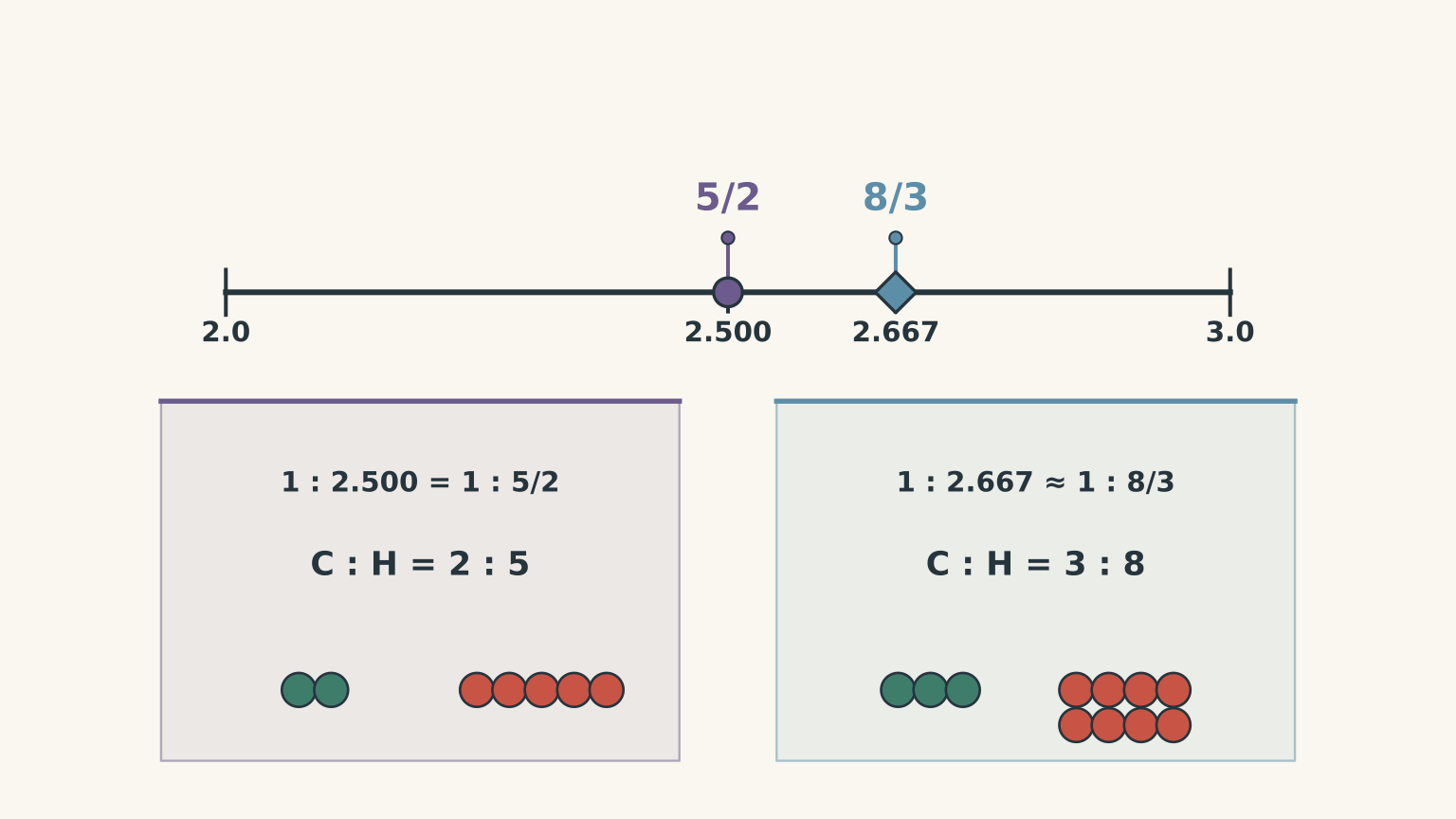
\[ 1:2.667 \]
A tempting move is to round 2.667 to 3 and report \(\ce{CH3}\).
But 2.667 is much closer to \(8/3\) than to a whole number. That suggests multiplying the ratio by 3 instead.
\[ 1:\frac{8}{3}=3:8 \]
The resulting empirical formula is \(\ce{C3H8}\), not \(\ce{CH3}\).
A useful ratio guide
| Calculated ratio | Interpretation | Simplest ratio |
|---|---|---|
| \(1:2.002\) | Very close to 2 | \(1:2\) |
| \(1:2.500\) | Exact half-integer | \(2:5\) |
| \(1:2.667\) | Close to \(8/3\) | \(3:8\) |
| \(1:2.300\) | Not close to a simple small ratio | Investigate further |
The last result should not automatically become \(1:2\).
Real measurements have uncertainty. A ratio slightly different from a simple fraction may be caused by experimental error, but there’s no universal decimal threshold that makes rounding justified.
Use these decisions:
- Keep several significant figures while calculating moles.
- Look for simple whole-number or fractional ratios.
- Multiply every ratio term by the same number when needed.
- Check whether the resulting formula is chemically plausible.
- If the ratio still looks unreasonable, revisit the data and experimental assumptions.
Due to technical limitations, this figure may display incorrectly or contain inaccuracies. Please check key details against your course materials.
A final chemical check is especially useful for hydrocarbons.
An ordinary neutral, saturated, open-chain hydrocarbon has the general formula:
\[ \ce{C_nH_{2n+2}} \]
This gives the maximum hydrogen count for a conventional neutral hydrocarbon containing \(n\) carbon atoms. Rings and double or triple bonds reduce the hydrogen count.
For example, \(\ce{C5H16}\) cannot be an ordinary neutral hydrocarbon: five carbons can support at most twelve hydrogens in the usual saturated open-chain structure.
An apparently precise numerical ratio is not automatically a valid chemical formula.
05Empirical formula versus molecular formula
The combustion experiment tells us the relative numbers of carbon and hydrogen atoms.
To find the actual number of each atom in one molecule, we need another measurement, usually the compound’s molar mass.
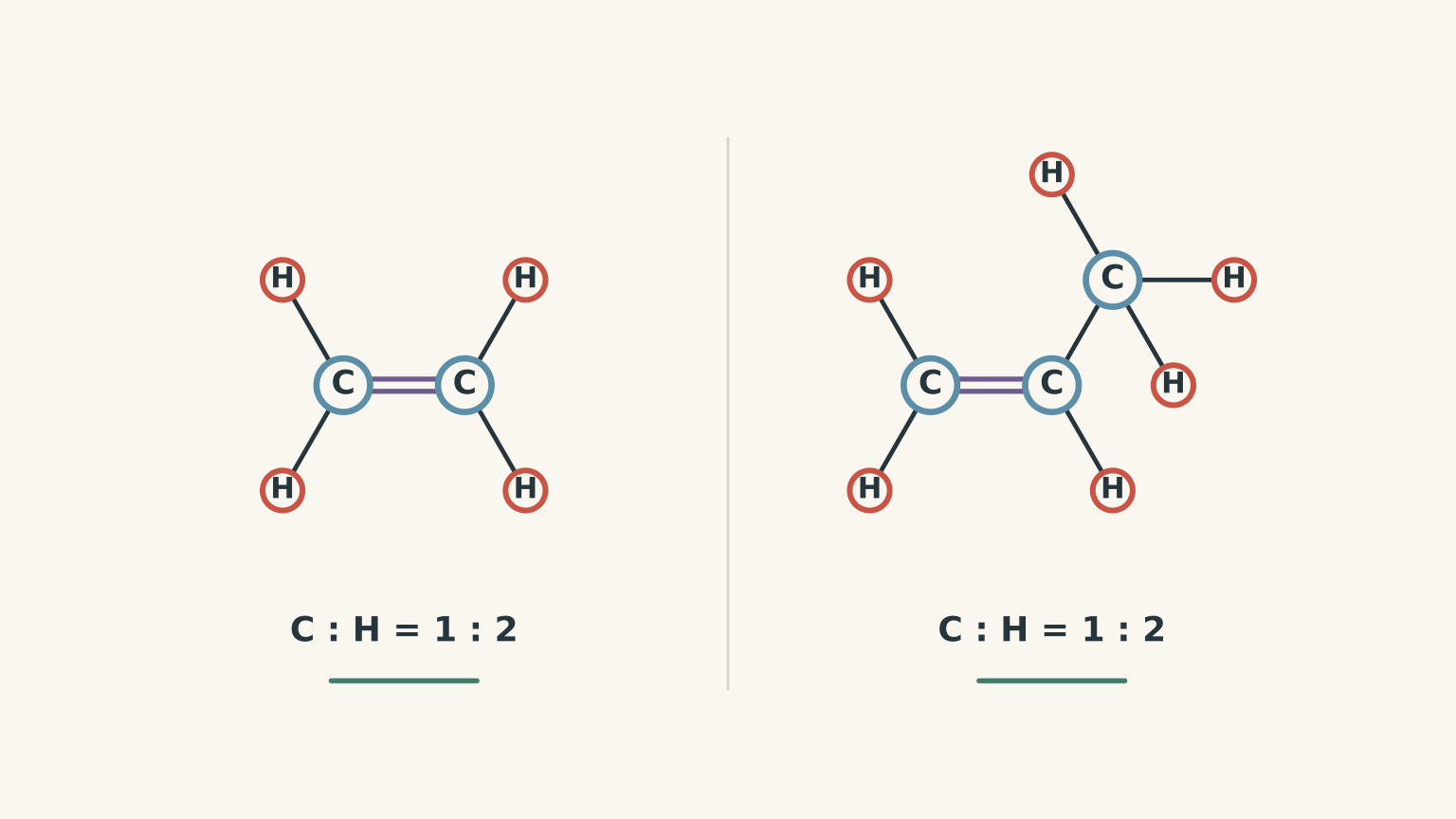
Consider two possible hydrocarbons:
Due to technical limitations, this figure may display incorrectly or contain inaccuracies. Please check key details against your course materials.
Both \(\ce{C2H4}\) and \(\ce{C3H6}\) have the empirical formula \(\ce{CH2}\).
Combustion analysis of either pure substance produces the same carbon-to-hydrogen mole ratio. Their molecular masses are different, however.
If the independently measured molar mass is known, calculate:
\[ k=\frac{M_{\text{molecule}}}{M_{\text{empirical}}} \]
Here, \(k\) is the number of empirical-formula units in one molecule. It should be a positive whole number, within experimental uncertainty.
Multiply every empirical-formula subscript by \(k\).
Worked example: Finding the molecular formula as well
A 0.440 g sample of a pure gaseous hydrocarbon is burned completely.
It produces 1.320 g of \(\ce{CO2}\) and 0.720 g of \(\ce{H2O}\).
An independent measurement gives the hydrocarbon a molar mass of \(44.0\ \mathrm{g\,mol^{-1}}\).
Determine its empirical and molecular formulae.
Step 1
Carbon dioxide contains one carbon atom per molecule:
\[ \begin{aligned} n(\mathrm{C})&=\frac{1.320}{44.0}\\ &=0.0300\ \mathrm{mol} \end{aligned} \]
Water contains two hydrogen atoms per molecule:
\[ \begin{aligned} n(\mathrm{H})&=2\left(\frac{0.720}{18.0}\right)\\ &=0.0800\ \mathrm{mol} \end{aligned} \]
Step 2
\[ \begin{aligned} \mathrm{C:H}&=0.0300:0.0800\\ &=1:2.6667 \end{aligned} \]
Multiply both numbers by 3:
\[ 3:8 \]
The empirical formula is:
\[ \ce{C3H8} \]
Notice why ordinary rounding would have failed. Rounding 2.6667 to 3 would give the wrong atom ratio.
Step 3
\[ \begin{aligned} M(\ce{C3H8})&=3(12.0)+8(1.0)\\ &=44.0\ \mathrm{g\,mol^{-1}} \end{aligned} \]
Step 4
\[ k=\frac{44.0}{44.0}=1 \]
So the molecular formula is also:
\[ \ce{C3H8} \]
The compound has three carbon atoms and eight hydrogen atoms per molecule. This is the molecular formula of propane.
In this case, the empirical and molecular formulae are identical because the subscripts cannot be reduced further.
06What if the combustion experiment gives misleading results?
The calculation works because we trust the relationship between the fuel’s atoms and the products we collect.
But experiments can break that relationship.
Problem 1: Incomplete combustion
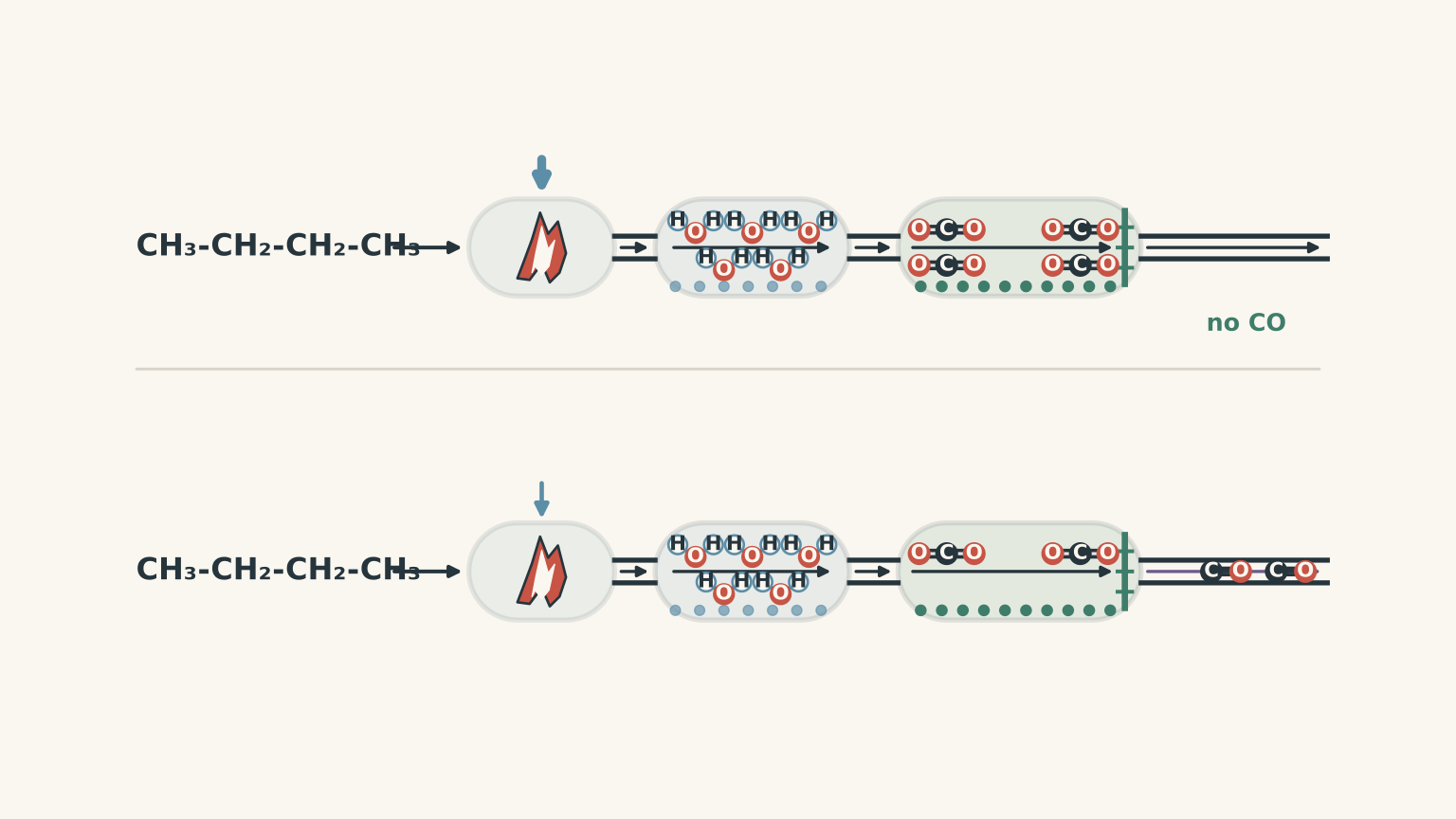
If oxygen is insufficient, some carbon may form carbon monoxide rather than carbon dioxide:
\[ \ce{2C + O2 -> 2CO} \]
If we measure only \(\ce{CO2}\), we miss the carbon in \(\ce{CO}\).
We would underestimate the amount of carbon in the original sample, making the calculated hydrogen-to-carbon ratio too large.
Due to technical limitations, this figure may display incorrectly or contain inaccuracies. Please check key details against your course materials.
Problem 2: Water enters from outside the sample
Suppose the oxygen entering the apparatus is humid.
The water-absorption tube will collect water produced by the fuel and water already present in the incoming gas.
This makes the calculated hydrogen amount too high.
A blank run, performed with no fuel but otherwise comparable conditions, can measure this background contribution so it can be subtracted.
Problem 3: The sample isn’t actually a pure hydrocarbon
If the original sample contains oxygen or a non-combustible impurity, its mass may not equal the combined masses of carbon and hydrogen recovered from the products.
For an ideal combustion analysis of a pure hydrocarbon:
\[ m_{\text{sample}}=m(\mathrm{C})+m(\mathrm{H}) \]
This is a powerful consistency check.
But don’t use it mechanically. If the equation fails, the result could indicate another element in the sample, an impurity, incomplete combustion, or inaccurate product collection.
The data alone may not identify which explanation is correct.
A quick diagnostic table
| What you observe | What to investigate |
|---|---|
| Calculated hydrogen amount is too high | Moisture entering with the gas or another source of water |
| Calculated carbon amount is too low | Incomplete combustion, carbon remaining as CO or soot, or lost CO2 |
| Recovered carbon and hydrogen weigh less than the sample | Other elements, impurities, incomplete collection, or incomplete combustion |
| Product masses exceed the fuel mass | Usually expected: oxygen from the supply enters the products |
| Empirical formula doesn’t match measured molar mass | Rounding, measurement errors, sample purity, or an incorrect assumed formula |
| Same empirical formula for multiple possible fuels | More information is needed to identify the molecular formula |
These checks matter because a combustion-analysis question is not always just a calculator exercise. Sometimes the correct response is that the evidence does not justify the proposed formula.
07Questions and solutions
All numerical data below are illustrative. Unless a question states otherwise, use C = \(12.0\), H = \(1.0\), and O = \(16.0\ \mathrm{g\,mol^{-1}}\).
Question 1
A 0.280 g sample of an unknown pure hydrocarbon undergoes complete combustion.
The products contain:
- 0.880 g of \(\ce{CO2}\)
- 0.360 g of \(\ce{H2O}\)
Determine the empirical formula of the hydrocarbon.
Explain why the total mass of the combustion products exceeds the mass of the original sample.
Solution 1
The empirical formula is \(\ce{CH2}\). The products are heavier because oxygen from the supplied gas becomes part of the carbon dioxide and water.
Calculate the carbon amount:
\[ \begin{aligned} n(\mathrm{C})&=\frac{0.880}{44.0}\\ &=0.0200\ \mathrm{mol} \end{aligned} \]
Calculate the hydrogen amount:
\[ \begin{aligned} n(\mathrm{H})&=2\left(\frac{0.360}{18.0}\right)\\ &=0.0400\ \mathrm{mol} \end{aligned} \]
The mole ratio is:
\[ \begin{aligned} \mathrm{C:H}&=0.0200:0.0400\\ &=1:2 \end{aligned} \]
Therefore, the empirical formula is \(\ce{CH2}\).
Now check the mass of carbon and hydrogen:
\[ \begin{aligned} m(\mathrm{C})&=(0.0200)(12.0)\\ &=0.240\ \mathrm{g}\\ m(\mathrm{H})&=(0.0400)(1.0)\\ &=0.0400\ \mathrm{g} \end{aligned} \]
Their total is \(0.280\ \mathrm{g}\), matching the fuel sample.
The combustion products weigh:
\[ 0.880+0.360=1.240\ \mathrm{g} \]
The difference is:
\[ 1.240-0.280=0.960\ \mathrm{g} \]
That additional mass is oxygen incorporated from the oxygen supply.
The tempting mistake is to compare the product mass directly with the fuel mass and claim conservation of mass has failed. It hasn’t. Oxygen is a reactant too.
Question 2
A combustion-analysis apparatus is being tested using two samples of the same pure hydrocarbon.
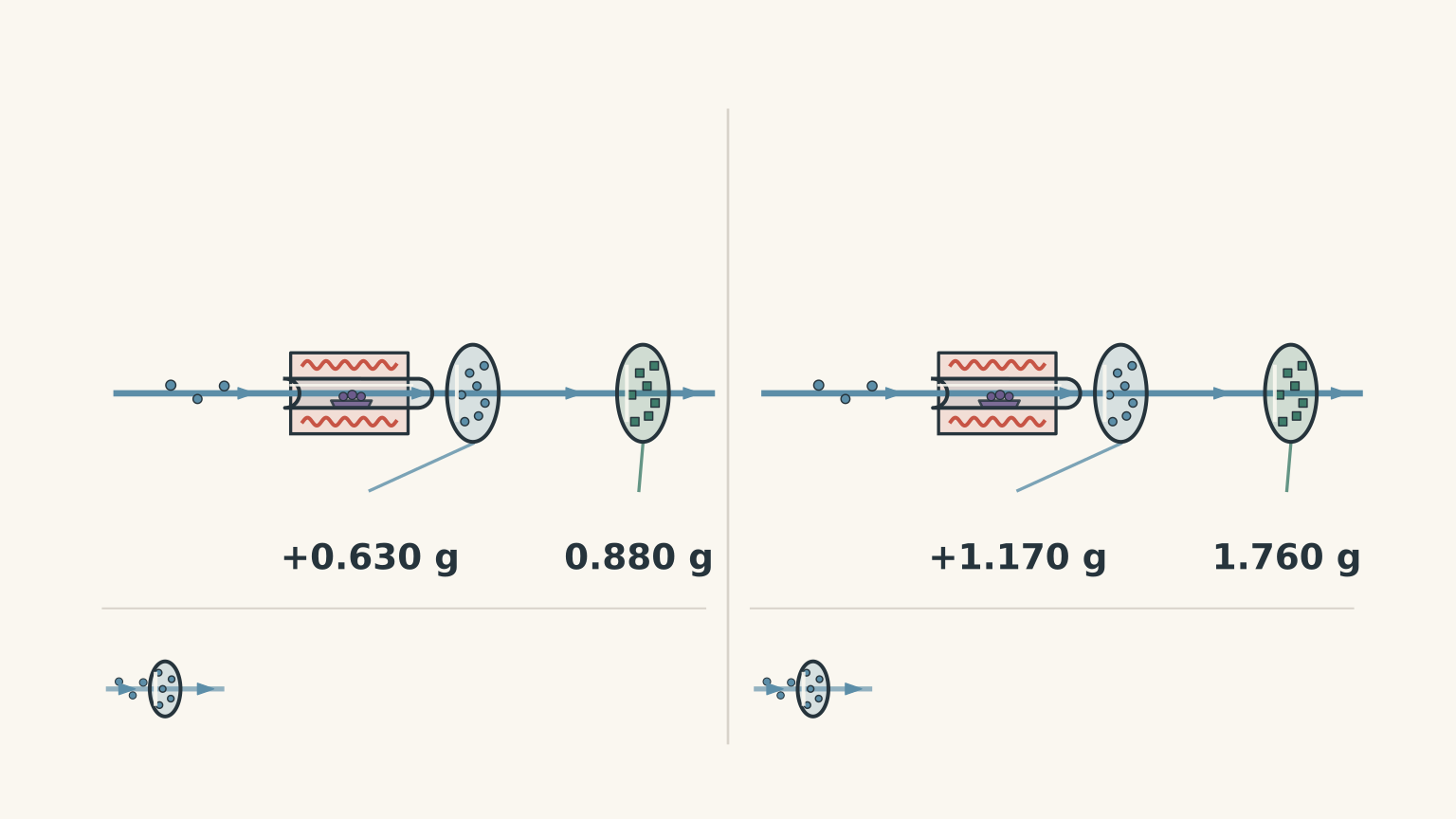
The oxygen supply accidentally contains a small, consistent amount of water vapour. A blank run shows that this adds 0.090 g to the measured water-absorption tube mass in each experiment.
The measurements are:
| Measurement | Experiment A | Experiment B |
|---|---|---|
| Hydrocarbon burned | 0.300 g | 0.600 g |
| CO2 collected | 0.880 g | 1.760 g |
| Measured water-trap mass gain | 0.630 g | 1.170 g |
The hydrocarbon has an independently measured molar mass of \(30.0\ \mathrm{g\,mol^{-1}}\).
Assume complete combustion, quantitative collection of products, and no other experimental errors.
a. Determine the corrected mass of water produced by the hydrocarbon in each experiment.
b. Find the empirical and molecular formulae.
c. Explain why using the uncorrected water mass from Experiment A produces an impossible result.
d. Explain why doubling the mass of fuel does not double the unwanted water contribution.
Due to technical limitations, this figure may display incorrectly or contain inaccuracies. Please check key details against your course materials.
Solution 2
The corrected water masses are 0.540 g and 1.080 g. The hydrocarbon has empirical formula \(\ce{CH3}\) and molecular formula \(\ce{C2H6}\), ethane.
First subtract the blank contribution from each run.
For Experiment A:
\[ 0.630-0.090=0.540\ \mathrm{g} \]
For Experiment B:
\[ 1.170-0.090=1.080\ \mathrm{g} \]
Both corrected product masses double when the fuel mass doubles, which is consistent with the same composition in both samples.
Use Experiment A to find the atom ratio.
\[ \begin{aligned} n(\mathrm{C})&=\frac{0.880}{44.0}\\ &=0.0200\ \mathrm{mol}\\ n(\mathrm{H})&=2\left(\frac{0.540}{18.0}\right)\\ &=0.0600\ \mathrm{mol} \end{aligned} \]
Therefore:
\[ \mathrm{C:H}=1:3 \]
The empirical formula is \(\ce{CH3}\).
Its empirical-formula mass is:
\[ 12.0+3(1.0)=15.0\ \mathrm{g\,mol^{-1}} \]
The molecular multiplier is:
\[ k=\frac{30.0}{15.0}=2 \]
So the molecular formula is \(\ce{C2H6}\).
Now consider the uncorrected reading from Experiment A.
It would suggest:
\[ \begin{aligned} n(\mathrm{H})&=2\left(\frac{0.630}{18.0}\right)\\ &=0.0700\ \mathrm{mol} \end{aligned} \]
The inferred hydrogen mass would be 0.0700 g, while the carbon mass would be:
\[ (0.0200)(12.0)=0.240\ \mathrm{g} \]
Their sum would be:
\[ 0.240+0.0700=0.310\ \mathrm{g} \]
That exceeds the original 0.300 g sample, which is impossible for a pure hydrocarbon under the stated assumptions.
The raw atom ratio also suggests \(\ce{C2H7}\), which is not a valid ordinary neutral hydrocarbon.
The issue is not a rounding error. Extra water has entered the collection system.
Finally, the blank contribution stays at 0.090 g because the question specifies a fixed amount of incoming moisture per experiment. It is not proportional to the mass of fuel burned.
Simply doubling every reading from Experiment A would incorrectly double that background contribution.
Question 3
A 0.460 g sample of an unknown combustible material produces 0.880 g of \(\ce{CO2}\) and 0.540 g of \(\ce{H2O}\) on complete combustion.
Assume both products are collected quantitatively and the sample contains no nitrogen, sulfur, or halogens.
Two explanations are proposed:
- Model A: The sample is a single pure compound containing carbon, hydrogen, and possibly oxygen.
- Model B: The sample contains a hydrocarbon mixed with an inert solid that produces no carbon dioxide or water.
a. Calculate the masses of carbon and hydrogen represented by the combustion products.
b. Under Model A, determine the empirical formula of the pure compound.
c. Under Model B, show how a mixture of ethane and an inert solid could reproduce the same results.
d. Explain why the combustion data cannot, by itself, establish which model is correct.
Solution 3
The products contain 0.240 g of carbon and 0.060 g of hydrogen. Model A gives the empirical formula \(\ce{C2H6O}\), while Model B can be satisfied by 0.300 g of ethane mixed with 0.160 g of inert material.
First calculate the atom amounts:
\[ \begin{aligned} n(\mathrm{C})&=\frac{0.880}{44.0}\\ &=0.0200\ \mathrm{mol}\\ n(\mathrm{H})&=2\left(\frac{0.540}{18.0}\right)\\ &=0.0600\ \mathrm{mol} \end{aligned} \]
Their masses are:
\[ \begin{aligned} m(\mathrm{C})&=(0.0200)(12.0)\\ &=0.240\ \mathrm{g}\\ m(\mathrm{H})&=(0.0600)(1.0)\\ &=0.0600\ \mathrm{g} \end{aligned} \]
Only 0.300 g of the original 0.460 g is accounted for as carbon and hydrogen.
Under Model A, the remaining mass must be oxygen:
\[ m(\mathrm{O})=0.460-0.300=0.160\ \mathrm{g} \]
The oxygen amount is:
\[ n(\mathrm{O})=\frac{0.160}{16.0} =0.0100\ \mathrm{mol} \]
The atom ratio is:
\[ \begin{aligned} \mathrm{C:H:O} &=0.0200:0.0600:0.0100\\ &=2:6:1 \end{aligned} \]
So the empirical formula is \(\ce{C2H6O}\).
The compound is not a hydrocarbon because it contains oxygen.
Now consider Model B.
The product amounts are exactly consistent with 0.0100 mol of ethane:
\[ \ce{C2H6 + 7/2O2 -> 2CO2 + 3H2O} \]
That amount of ethane has a mass of:
\[ \begin{aligned} M(\ce{C2H6})&=30.0\ \mathrm{g\,mol^{-1}}\\ m&=(0.0100)(30.0)\\ &=0.300\ \mathrm{g} \end{aligned} \]
If the remainder is inert:
\[ m_{\text{inert}}=0.460-0.300 =0.160\ \mathrm{g} \]
Both models therefore reproduce the observed product masses.
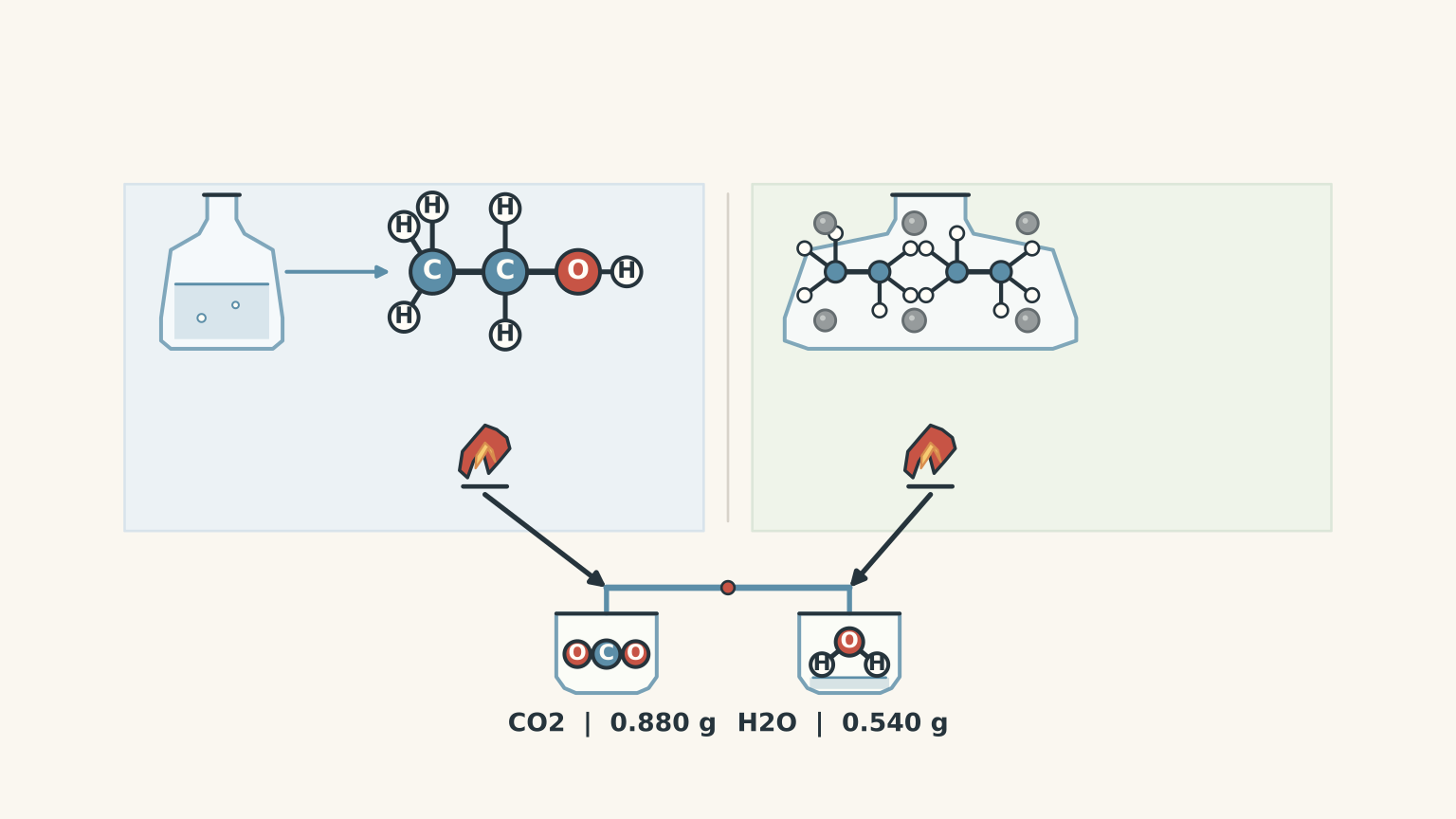
Due to technical limitations, this figure may display incorrectly or contain inaccuracies. Please check key details against your course materials.
The tempting conclusion is that a mass difference automatically reveals oxygen in the molecule. That works only after establishing the sample is pure, contains only the proposed elements, and was analysed quantitatively.
Combustion data establishes elemental amounts under its assumptions. It does not automatically establish sample purity or molecular identity.
Question 4
An unknown pure hydrocarbon has a mass of 0.440 g.
It is burned in an oxygen supply, and all the hydrocarbon is consumed. The water collector gains 0.720 g, while the carbon dioxide collector gains 1.100 g.
A gas detector shows that carbon monoxide is also present, but it does not measure how much.
Assume:
- All the original hydrogen ends up in the collected water.
- All the original carbon ends up in either the collected \(\ce{CO2}\) or the escaping \(\ce{CO}\).
- No soot or other carbon-containing products form.
- There are no collection losses.
a. Determine the amount, in moles, of carbon monoxide produced.
b. Determine the empirical formula of the hydrocarbon.
c. Explain what goes wrong if the student assumes the carbon dioxide collector contains all the original carbon.
d. Describe one experimental change that would allow the original carbon amount to be measured correctly using the carbon dioxide collector.
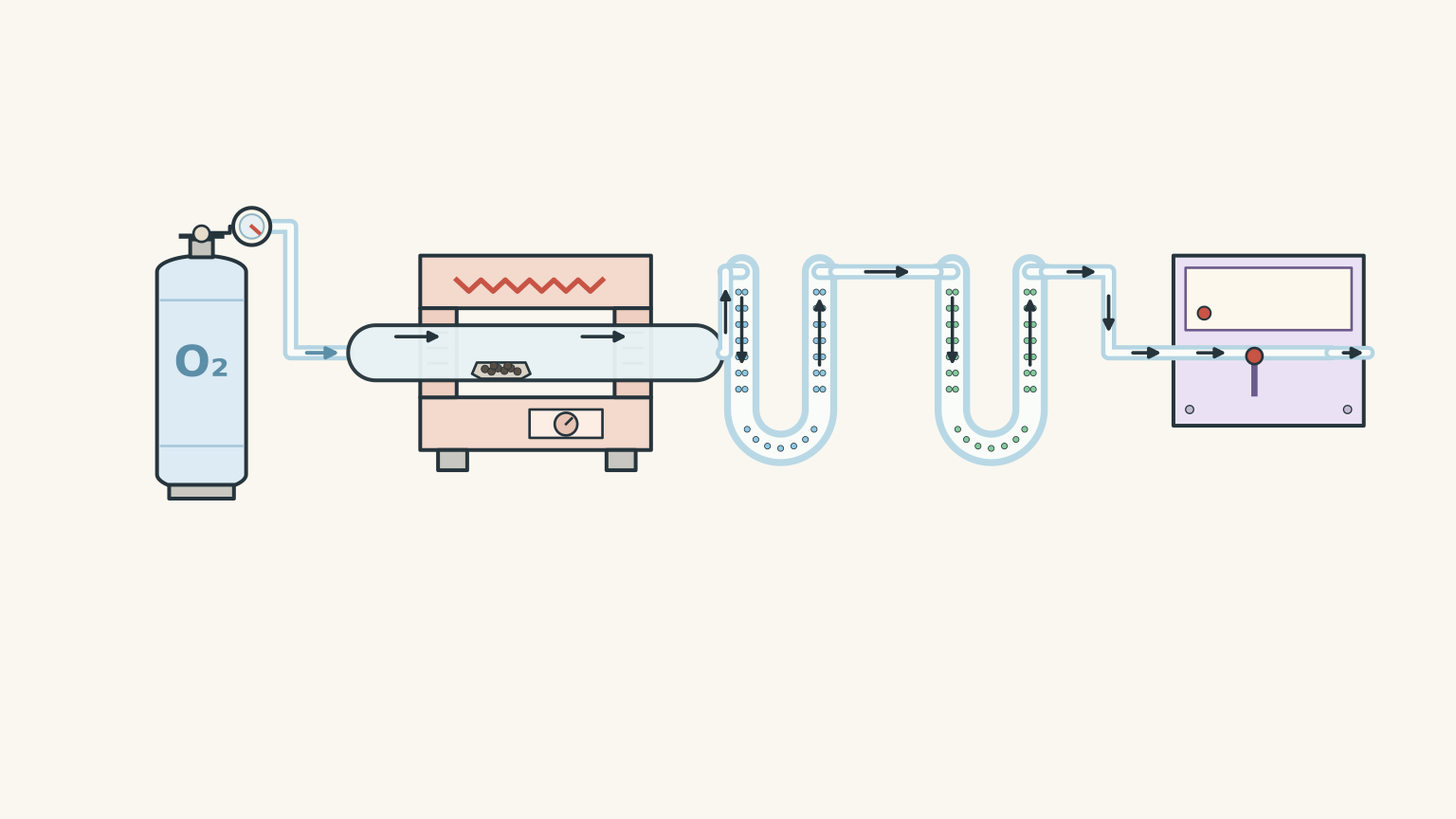
Due to technical limitations, this figure may display incorrectly or contain inaccuracies. Please check key details against your course materials.
Solution 4
The experiment produced 0.00500 mol of \(\ce{CO}\), and the hydrocarbon’s empirical formula is \(\ce{C3H8}\). Ignoring the carbon monoxide would underestimate the original carbon amount and produce an impossible atom ratio.
Start with the measured carbon dioxide:
\[ \begin{aligned} n(\ce{CO2})&=\frac{1.100}{44.0}\\ &=0.0250\ \mathrm{mol} \end{aligned} \]
So the carbon collected as carbon dioxide weighs:
\[ \begin{aligned} m(\mathrm{C\ in\ CO2}) &=(0.0250)(12.0)\\ &=0.300\ \mathrm{g} \end{aligned} \]
Now calculate the hydrogen amount:
\[ \begin{aligned} n(\mathrm{H})&=2\left(\frac{0.720}{18.0}\right)\\ &=0.0800\ \mathrm{mol} \end{aligned} \]
The hydrogen mass is therefore 0.0800 g.
Together, the measured carbon and hydrogen account for:
\[ 0.300+0.0800=0.380\ \mathrm{g} \]
But the original hydrocarbon weighed 0.440 g.
The difference is:
\[ 0.440-0.380=0.0600\ \mathrm{g} \]
Under the question’s assumptions, this missing mass must be carbon carried in the carbon monoxide.
Each \(\ce{CO}\) molecule contains one carbon atom, so:
\[ \begin{aligned} n(\ce{CO})&=\frac{0.0600}{12.0}\\ &=0.00500\ \mathrm{mol} \end{aligned} \]
Now calculate the total original carbon amount:
\[ \begin{aligned} n(\mathrm{C})&=0.0250+0.00500\\ &=0.0300\ \mathrm{mol} \end{aligned} \]
The corrected ratio is:
\[ \begin{aligned} \mathrm{C:H}&=0.0300:0.0800\\ &=3:8 \end{aligned} \]
The empirical formula is \(\ce{C3H8}\).
If the student ignored carbon monoxide, they would instead obtain:
\[ \mathrm{C:H}=0.0250:0.0800=5:16 \]
That would suggest \(\ce{C5H16}\), an impossible ordinary neutral hydrocarbon.
The misleading result arises because carbon monoxide has carried some carbon past the carbon dioxide absorber. No amount of ordinary ratio rounding fixes that missing-carbon problem.
One way to improve the apparatus would be to provide sufficient oxygen and suitable conditions to ensure complete combustion. Alternatively, a downstream oxidation stage could convert residual \(\ce{CO}\) into \(\ce{CO2}\) before a final carbon dioxide collector.
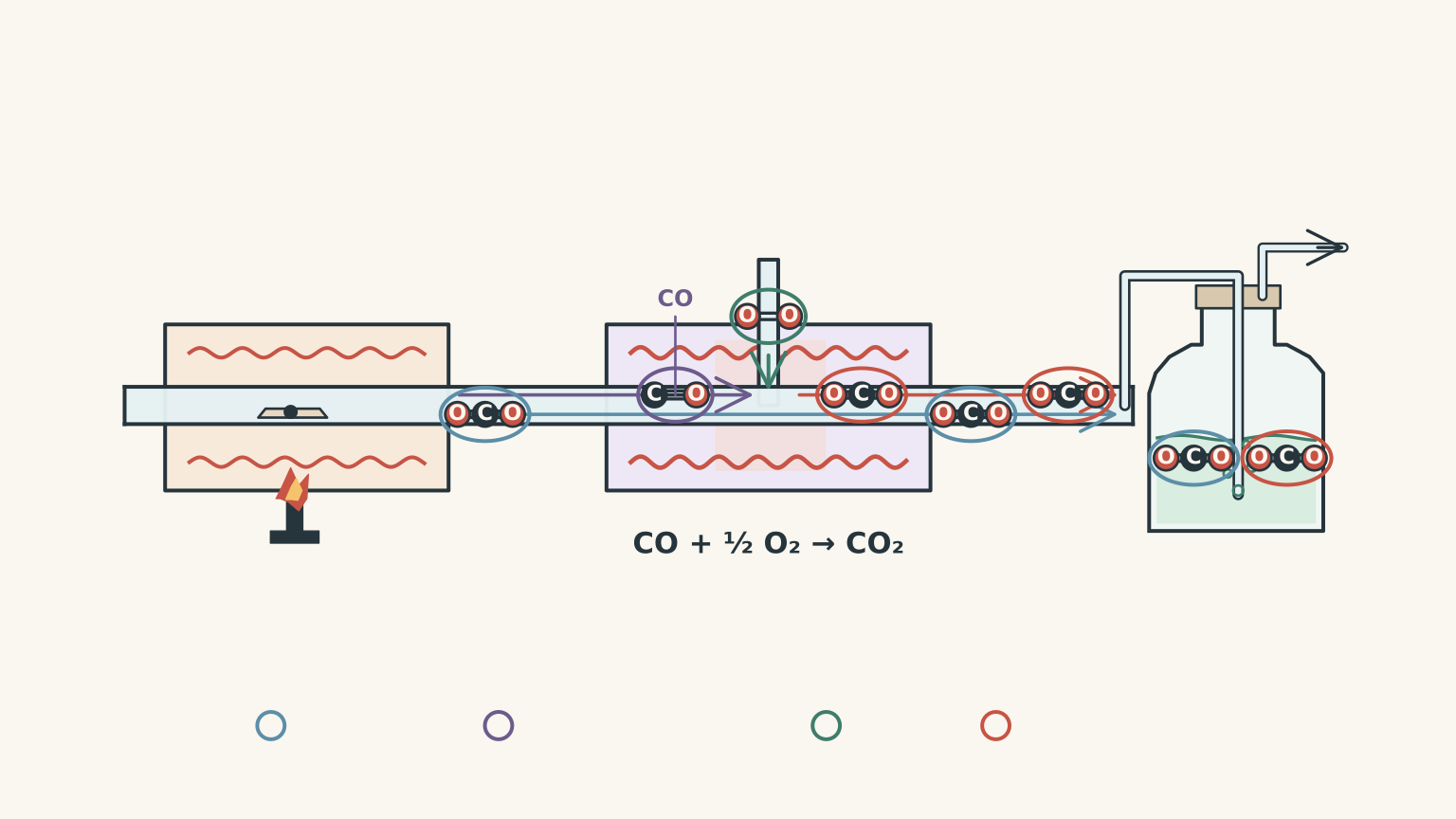
Due to technical limitations, this figure may display incorrectly or contain inaccuracies. Please check key details against your course materials.
The key is to measure all the carbon, not just the fraction that happens to reach carbon dioxide in the first combustion stage.
Question 5
A gas sample is known to contain only one or more of these three alkanes:
- Methane, \(\ce{CH4}\)
- Ethane, \(\ce{C2H6}\)
- Propane, \(\ce{C3H8}\)
An independent gas measurement establishes that the sample contains a total of 0.0200 mol of gas molecules.
The entire sample undergoes complete combustion, producing:
- 1.760 g of \(\ce{CO2}\)
- 1.080 g of \(\ce{H2O}\)
A student calculates the molecular formula \(\ce{C2H6}\) and concludes that the original sample must have been pure ethane.
Later, a separation analysis reveals that the original sample contained exactly two different hydrocarbons, but the instrument does not identify them.
Assume the combustion measurements are exact for the stated precision, all gases behave ideally, and the sample contains no substances other than the three listed alkanes.
a. Explain why the original combustion results appear to support the student’s conclusion.
b. Construct a mixture containing methane and propane that produces exactly the same combustion results, total gas amount, and sample mass as pure ethane.
c. Using the new evidence that exactly two hydrocarbons are present, determine which two they are and how many moles of each were in the sample. Explain why no ethane can be present.
d. For a mixture of alkanes, let \(N\) be the total moles of hydrocarbon molecules, \(n_C\) the total moles of carbon atoms, and \(n_H\) the total moles of hydrogen atoms. Show why:
\[ n_H=2n_C+2N \]
Then explain why measuring both combustion products, the total gas amount, and the total sample mass still cannot establish purity.
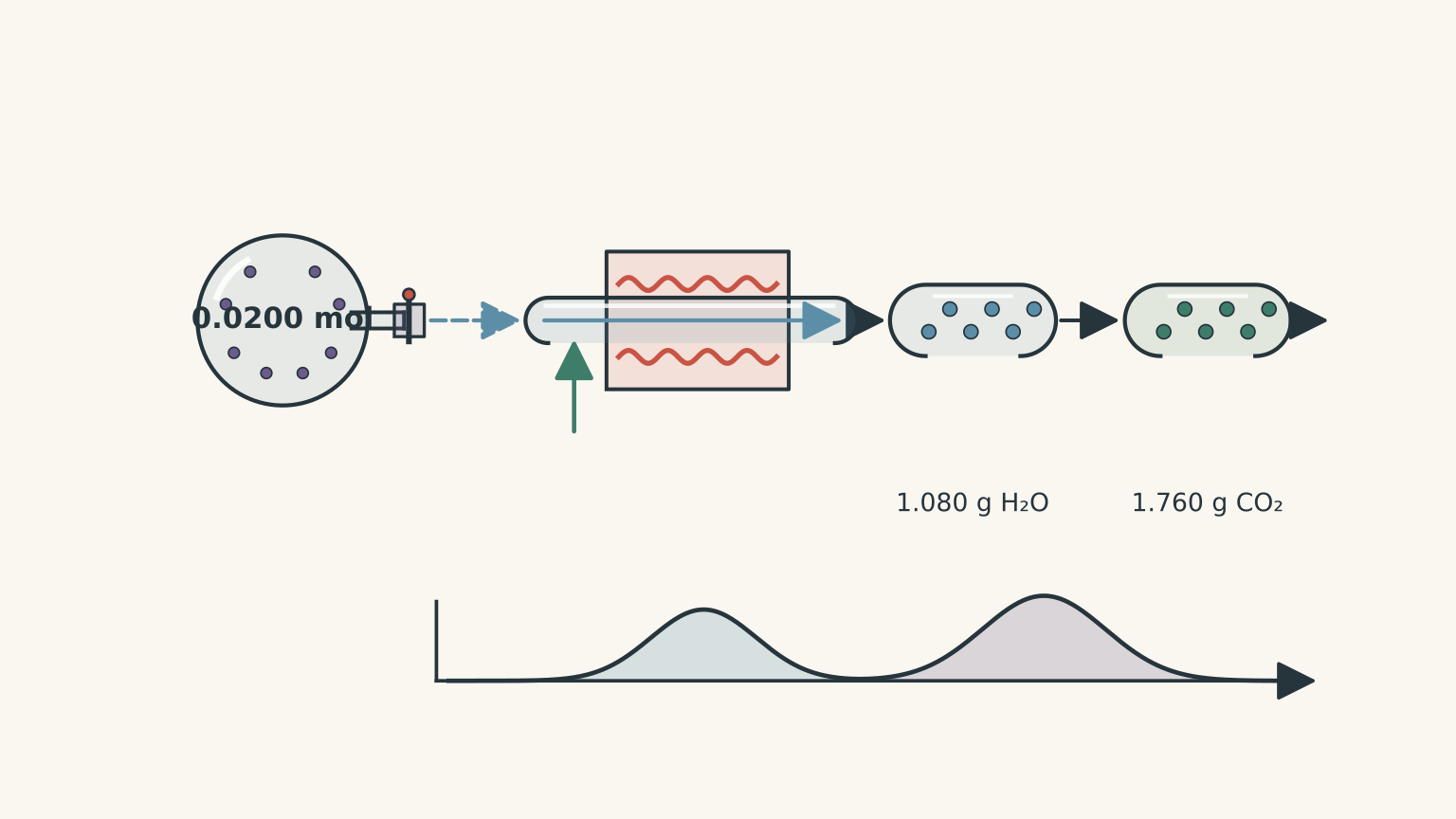
Due to technical limitations, this figure may display incorrectly or contain inaccuracies. Please check key details against your course materials.
Solution 5
The original combustion results are consistent with pure ethane, but they do not prove purity. They are also consistent with an equal-mole mixture of methane and propane. Once the sample is known to contain exactly two of the three listed alkanes, it must contain 0.0100 mol of methane and 0.0100 mol of propane.
This works because combustion analysis measures totals across the sample, not which molecules carried the atoms.
Part a: Why pure ethane appears correct
Calculate the carbon amount:
\[ \begin{aligned} n_C&=\frac{1.760}{44.0}\\ &=0.0400\ \mathrm{mol} \end{aligned} \]
Calculate the hydrogen amount:
\[ \begin{aligned} n_H&=2\left(\frac{1.080}{18.0}\right)\\ &=0.1200\ \mathrm{mol} \end{aligned} \]
The ratio is:
\[ \mathrm{C:H}=0.0400:0.1200=1:3 \]
So the empirical formula is \(\ce{CH3}\).
There are 0.0200 mol of gas molecules. If all those molecules are identical, the average numbers of carbon and hydrogen atoms per molecule are:
\[ \frac{0.0400}{0.0200}=2 \]
and
\[ \frac{0.1200}{0.0200}=6 \]
That gives \(\ce{C2H6}\), ethane.
The conclusion is correct only under the added assumption that the sample contains one pure molecular species.
Part b: Construct a different sample
Suppose the 0.0200 mol sample consists of:
\[ \begin{aligned} n(\ce{CH4})&=0.0100\ \mathrm{mol}\\ n(\ce{C3H8})&=0.0100\ \mathrm{mol} \end{aligned} \]
The total amount is still 0.0200 mol of gas molecules.
Complete combustion is described by:
\[ \ce{CH4 + 2O2 -> CO2 + 2H2O} \]
and:
\[ \ce{C3H8 + 5O2 -> 3CO2 + 4H2O} \]
Calculate the carbon dioxide produced.
Methane contributes 0.0100 mol of \(\ce{CO2}\).
Propane contributes:
\[ 3(0.0100)=0.0300\ \mathrm{mol} \]
Total:
\[ 0.0100+0.0300=0.0400\ \mathrm{mol} \]
Mass:
\[ (0.0400)(44.0)=1.760\ \mathrm{g} \]
Now calculate the water.
Methane produces:
\[ 2(0.0100)=0.0200\ \mathrm{mol} \]
Propane produces:
\[ 4(0.0100)=0.0400\ \mathrm{mol} \]
Total:
\[ 0.0200+0.0400=0.0600\ \mathrm{mol} \]
Mass:
\[ (0.0600)(18.0)=1.080\ \mathrm{g} \]
Both combustion products match perfectly.
Now compare the original sample masses.
Pure ethane:
\[ (0.0200)(30.0)=0.600\ \mathrm{g} \]
Methane-propane mixture:
\[ \begin{aligned} m&=(0.0100)(16.0)\\ &\quad +(0.0100)(44.0)\\ &=0.600\ \mathrm{g} \end{aligned} \]
Even the total sample mass is identical.
So an independent measurement of average molar mass would not distinguish these two samples.
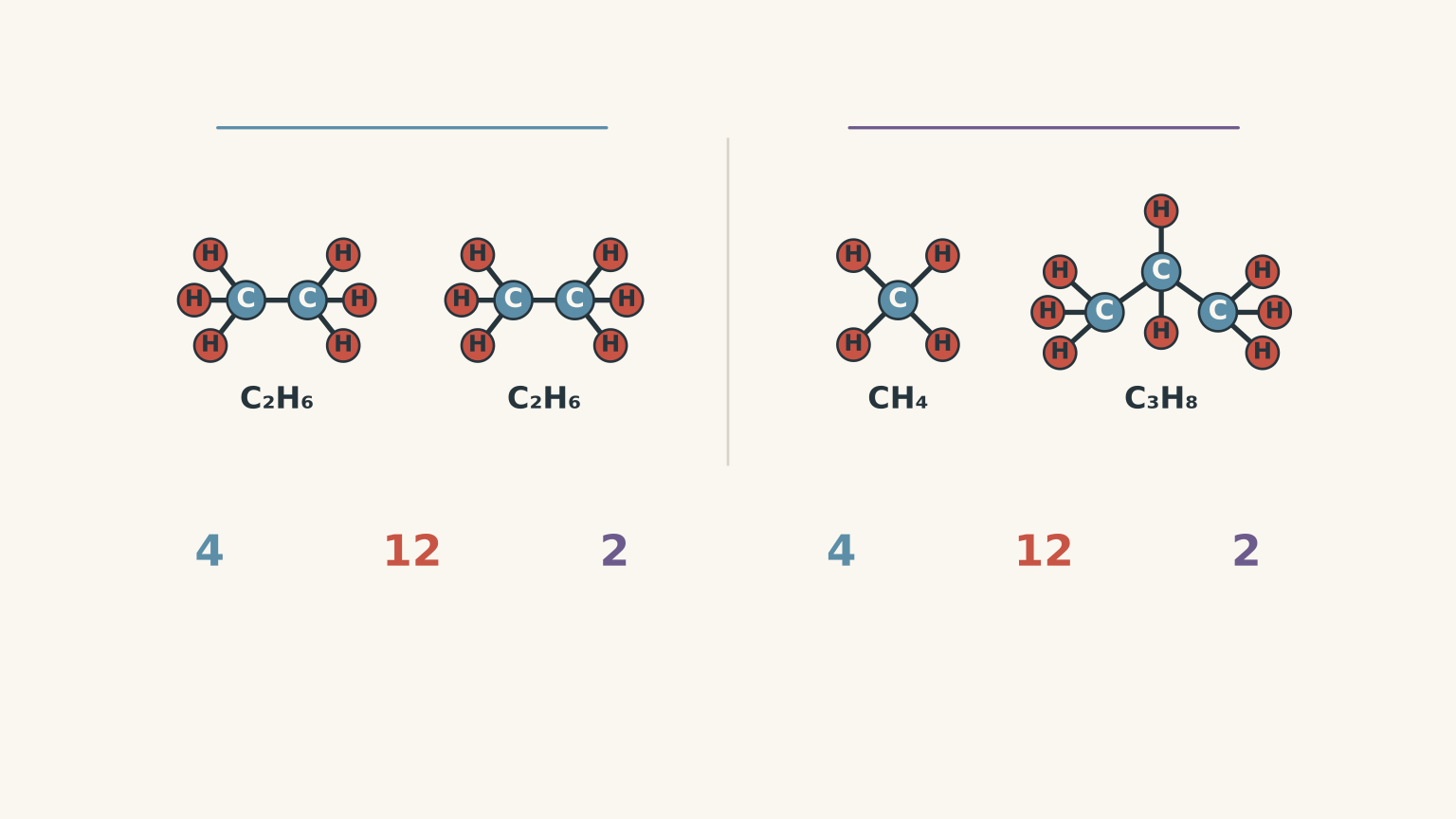
Due to technical limitations, this figure may display incorrectly or contain inaccuracies. Please check key details against your course materials.
Part c: Use the new evidence to identify the mixture
Let:
- \(x\) be the moles of methane.
- \(y\) be the moles of ethane.
- \(z\) be the moles of propane.
The total gas amount gives:
\[ x+y+z=0.0200 \]
The total carbon amount gives:
\[ x+2y+3z=0.0400 \]
Double the first equation:
\[ 2x+2y+2z=0.0400 \]
Subtract it from the carbon equation:
\[ -x+z=0 \]
Therefore:
\[ x=z \]
This is the important constraint: the methane and propane amounts must be equal.
If both \(x\) and \(z\) are positive and \(y\) is also positive, the sample contains three hydrocarbons. But the separation analysis establishes exactly two.
If \(x=z=0\), the sample contains only ethane. That gives just one hydrocarbon, also contradicting the separation result.
So the only possibility consistent with exactly two components is:
\[ y=0 \]
and:
\[ x=z \]
Using the total gas amount:
\[ x+z=0.0200 \]
Therefore:
\[ x=z=0.0100\ \mathrm{mol} \]
The sample contains:
- 0.0100 mol methane
- 0.0100 mol propane
- No ethane
The new separation evidence resolves an ambiguity that combustion measurements alone could not.
Part d: Why the water measurement cannot reveal purity
Every alkane has the general formula:
\[ \ce{C_nH_{2n+2}} \]
For each alkane molecule, the number of hydrogen atoms is twice the number of carbon atoms, plus two.
For a mixture, the same relationship holds when we total the atoms over all the molecules.
If the mixture contains \(N\) moles of alkane molecules and \(n_C\) moles of carbon atoms, then:
\[ n_H=2n_C+2N \]
Substitute the measured values:
\[ \begin{aligned} n_H&=2(0.0400)+2(0.0200)\\ &=0.1200\ \mathrm{mol} \end{aligned} \]
This is exactly the hydrogen amount found from the water measurement.
Here’s the surprising part: once we know the total carbon amount and total number of alkane molecules, the total hydrogen amount is already determined.
The water measurement can confirm consistency with the alkane model, but it cannot reveal how those atoms are distributed among different alkane molecules.
The sample mass provides no independent way around the problem either, because it is determined by the same total amounts of carbon and hydrogen.
Even repeating the combustion with another well-mixed portion and obtaining identical results would not establish purity. A homogeneous mixture can reproduce the same average composition every time.
The tempting assumption is that enough precise measurements must eventually identify a unique substance. But precision cannot recover information the method fundamentally does not measure.
Combustion analysis counts elements. It does not label the molecules those elements came from.
08What combustion analysis can tell you – and what comes next
When you need to find a hydrocarbon formula from combustion data, use this sequence:
- Calculate moles of \(\ce{CO2}\) to determine moles of carbon.
- Calculate moles of \(\ce{H2O}\) and multiply by 2 to determine moles of hydrogen.
- Divide both atom amounts by the smaller amount.
- Convert the ratio into justified whole numbers.
- Report the empirical formula.
- Use an independently determined molar mass to find the molecular formula, provided the sample is pure.
- Check the formula against the sample mass, chemical plausibility, and experimental assumptions.
The most useful habit is to ask exactly what has been measured. Combustion products tell you how much carbon and hydrogen were present. They do not necessarily reveal how those atoms were arranged, or whether every molecule in the original sample was the same.
If you need to calculate elemental mass fractions from a known formula rather than infer a formula from combustion products, use How to Calculate Element Percentages from Chemical Formulas.
If the experiment measures the energy released by burning a fuel instead of collecting and weighing its products, that is a different problem. The relevant method is covered in Heat of Combustion: Calculations for HSC Chemistry.
The next useful step after determining a molecular formula is structural identification. Two compounds can have the same molecular formula but different structures. Combustion analysis alone cannot distinguish structural isomers, which is why chemists combine composition measurements with techniques that reveal molecular structure.