
How to Write a Balanced Equation from a Word Equation
Learn how to translate word equations into chemical formulae and balance them correctly using coefficients. Includes worked examples, experimental evidence, and progressively challenging HSC Chemistry practice questions.
Heat a green sample of copper(II) carbonate. It turns black, and a gas released from the test tube makes limewater cloudy. What should you write on the product side of the chemical equation?
Writing black solid + gas might describe what you observed, but it doesn’t identify the substances that formed. To write a balanced equation from a word equation, you need to do three things:
- Identify the reactants and products.
- Convert the name of each substance into its correct chemical formula.
- Add coefficients until the number of atoms of every element is equal on both sides.
The important rule is that you balance an equation by changing coefficients, never subscripts.
For example, if independent evidence confirms that the black solid is copper(II) oxide and the gas is carbon dioxide, the word equation becomes:
Word equation:
Copper(II) carbonate → copper(II) oxide + carbon dioxide
Formula equation:
\[ \ce{CuCO3 -> CuO + CO2} \]
Count the atoms:
| Element | Left side | Right side |
|---|---|---|
| Copper (Cu) | 1 | 1 |
| Carbon (C) | 1 | 1 |
| Oxygen (O) | 3 | 1 + 2 = 3 |
The equation is already balanced. No coefficients are needed.
This example introduces an important distinction: identifying the substances is a separate job from balancing their equation. Getting the formulas wrong cannot be fixed by adding coefficients.
01Start with the evidence: what substances actually formed?
Before writing an equation from an experiment, separate what you observe from what you infer.
An observation is something you can directly see or measure. An inference is a conclusion about what is happening chemically.
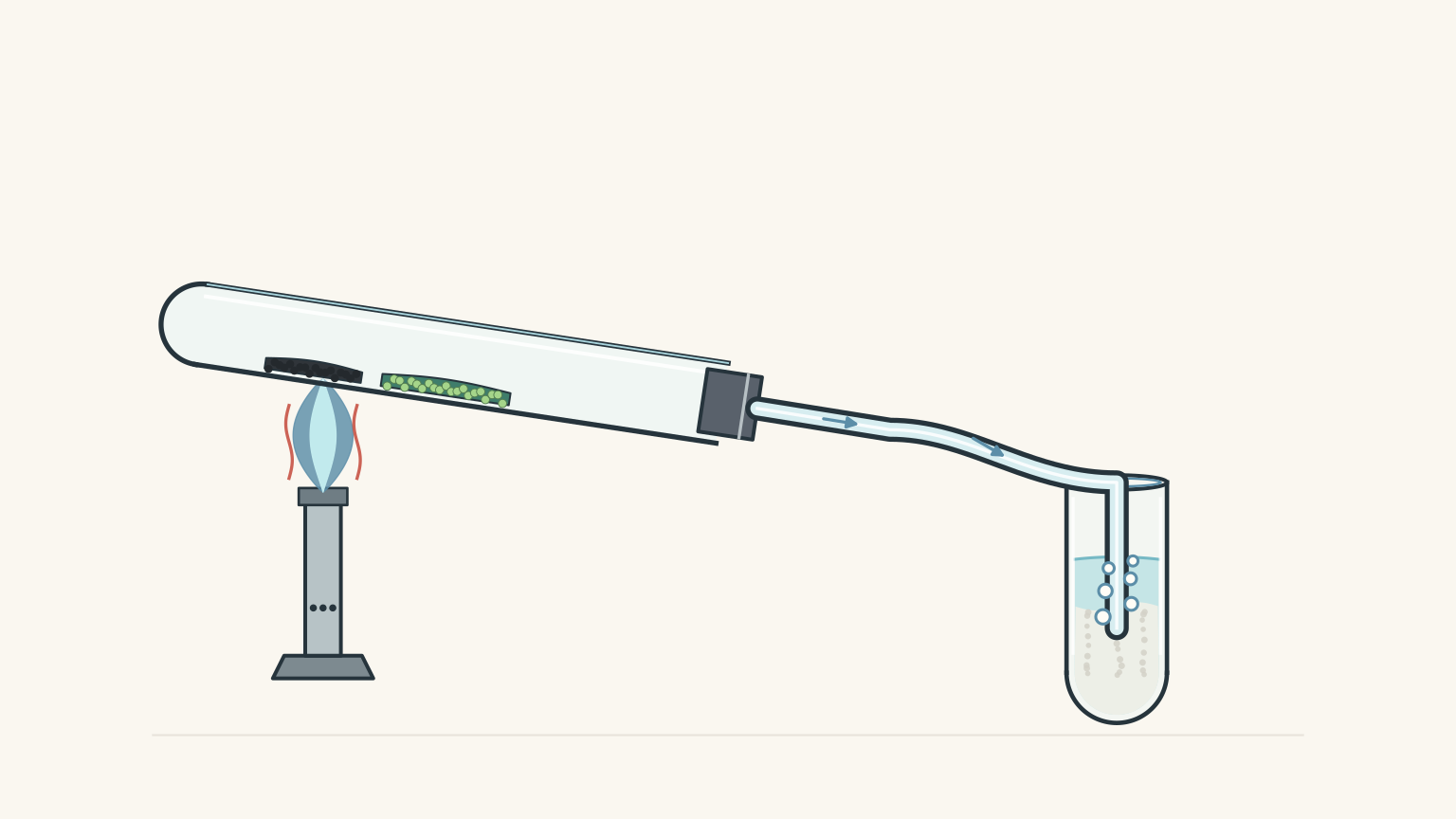
Consider the copper carbonate example. For this simplified investigation, assume the starting material is pure copper(II) carbonate, \(\ce{CuCO3}\).
Due to technical limitations, this figure may display incorrectly or contain inaccuracies. Please check key details against your course materials.
What does the apparatus actually tell us?
Imagine the investigation in two stages.
Stage 1: Observe the heated solid.
The copper carbonate is heated in a test tube. A black solid remains, and a gas is released.
The observations are:
- The original green solid changes colour.
- A black solid remains.
- A gas is produced.
These observations suggest that a chemical change has occurred. However, they don’t establish the chemical formula of either product.
A black solid is not automatically copper oxide. Colour is evidence, not a chemical identification.
Stage 2: Test the gas.
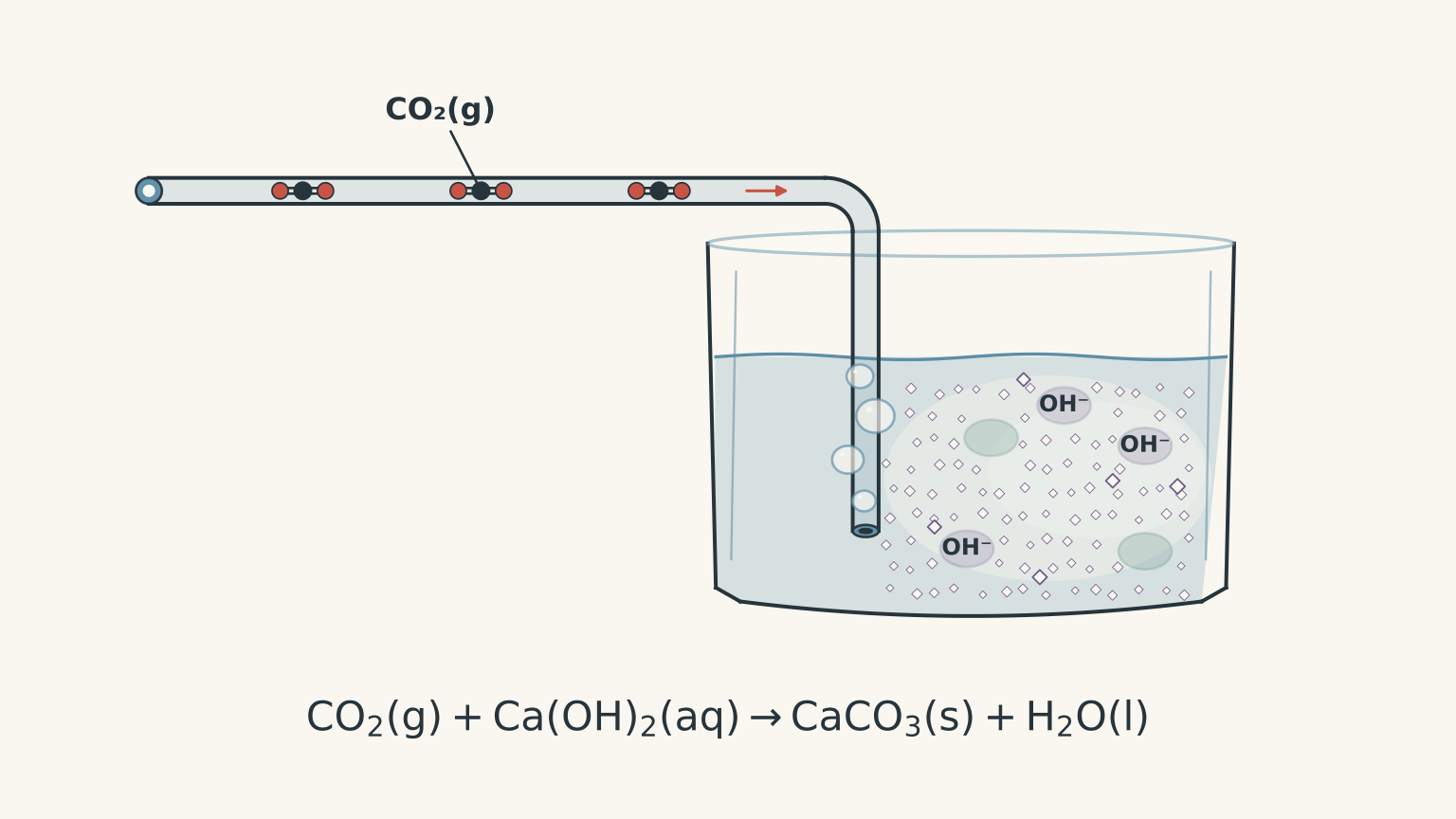
The gas travels through a delivery tube and bubbles through limewater, an aqueous solution of calcium hydroxide.
If the gas contains carbon dioxide, it reacts with the calcium hydroxide to form insoluble calcium carbonate. The suspended solid makes the limewater appear cloudy.
The reaction is:
\[ \ce{CO2(g) + Ca(OH)2(aq) -> CaCO3(s) + H2O(l)} \]
Due to technical limitations, this figure may display incorrectly or contain inaccuracies. Please check key details against your course materials.
The cloudiness supports the conclusion that carbon dioxide is present.
However, it doesn’t identify the black solid left behind. That requires separate evidence.
| Observation | Reasonable inference | What remains uncertain |
|---|---|---|
| Green solid becomes black | A new solid has formed | Its chemical identity |
| Gas is released | A gaseous product has formed | Its chemical identity |
| Limewater becomes cloudy | Carbon dioxide is present | Whether other gases are also present |
| Independent analysis identifies the residue as copper(II) oxide | The solid product is CuO | Nothing further is needed for this simplified equation |
This is why the experimental design matters.
The original arrangement, with only a heated test tube, reveals a colour change and gas production. Adding the delivery tube and limewater provides a way to identify carbon dioxide. The solid still needs separate identification.
The lesson for equation writing is simple: don’t turn an observation directly into a chemical formula. First establish which substance the observation supports.
02The three-pass method: words to formulae to a balanced equation
Once you know the substances involved, use the following method.
Pass 1: Identify the reactants and products
A word equation tells you which substances react and which substances form.
For example:
Magnesium + oxygen → magnesium oxide
The substances on the left are the reactants. The substance on the right is the product.
The arrow means that the reactants undergo a chemical reaction to form the products.
A useful way to translate the wording is:
| Words in the question | What to write |
|---|---|
| Reacts with | Separate reactants using a plus sign |
| And | Usually separates two substances using a plus sign |
| Produces, forms or yields | An arrow pointing towards the products |
| Is heated | A reaction condition, not a reactant |
| In the presence of a catalyst | A reaction condition, usually written above the arrow |
Don’t worry about balancing yet. First, establish which substances belong on each side.
Pass 2: Convert every substance name into its chemical formula
This is often the part that causes the most trouble.
You cannot balance an equation reliably until every formula is correct. Different substances can contain the same elements in different proportions, so the subscripts matter.
There are three common situations to recognise.
1. Elements written as substances
Some elements naturally exist as molecules containing two atoms when they are in their elemental gaseous form.
You need to recognise these seven diatomic elements:
| Element | Formula |
|---|---|
| Hydrogen | \(\ce{H2}\) |
| Nitrogen | \(\ce{N2}\) |
| Oxygen | \(\ce{O2}\) |
| Fluorine | \(\ce{F2}\) |
| Chlorine | \(\ce{Cl2}\) |
| Bromine | \(\ce{Br2}\) |
| Iodine | \(\ce{I2}\) |
For example, the word equation:
Magnesium + oxygen → magnesium oxide
becomes:
\[ \ce{Mg + O2 -> MgO} \]
Notice that magnesium is written as \(\ce{Mg}\), while oxygen gas is written as \(\ce{O2}\).
This is because magnesium is an elemental metal, whereas oxygen gas exists as diatomic molecules.
Be careful not to carry the diatomic subscript into a compound. Magnesium oxide is \(\ce{MgO}\), not \(\ce{MgO2}\).
2. Ionic compounds
Ionic compounds are made from positively charged ions (cations) and negatively charged ions (anions).
Their formulae must have an overall charge of zero.
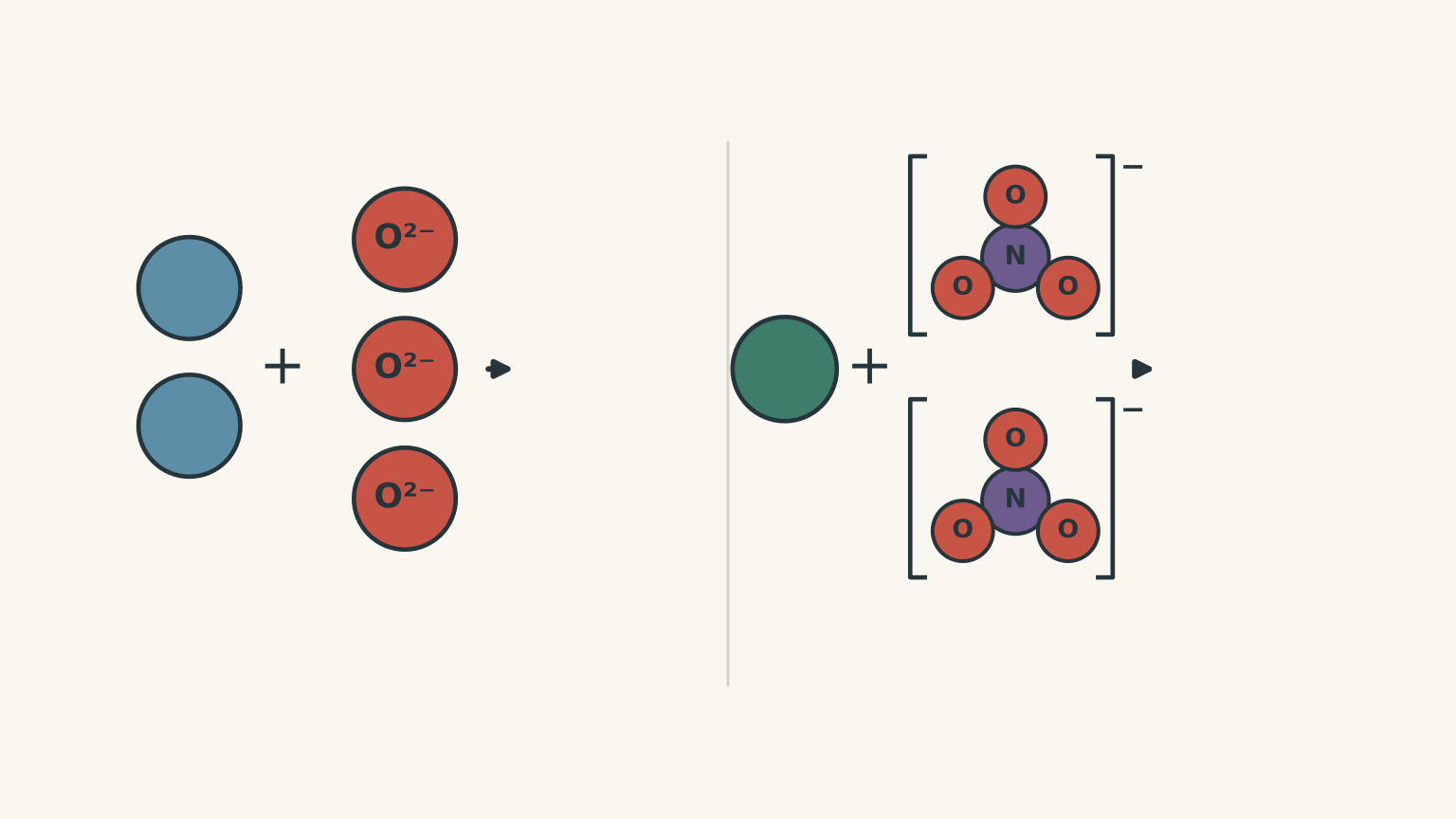
For example, consider aluminium oxide.
Aluminium forms \(\mathrm{Al^{3+}}\) ions, while oxygen forms \(\mathrm{O^{2-}}\) ions.
How many of each ion do you need to make a neutral compound?
- Two aluminium ions give a total charge of \(+6\).
- Three oxide ions give a total charge of \(-6\).
The charges cancel, giving:
\[ \ce{Al2O3} \]
The formula is aluminium oxide.
Due to technical limitations, this figure may display incorrectly or contain inaccuracies. Please check key details against your course materials.
Here are some other useful examples:
| Compound name | Formula | Reason |
|---|---|---|
| Sodium chloride | \(\ce{NaCl}\) | \(+1\) and \(-1\) |
| Magnesium oxide | \(\ce{MgO}\) | \(+2\) and \(-2\) |
| Calcium chloride | \(\ce{CaCl2}\) | \(+2\) and two \(-1\) ions |
| Aluminium oxide | \(\ce{Al2O3}\) | Two \(+3\) and three \(-2\) ions |
| Iron(III) oxide | \(\ce{Fe2O3}\) | Two \(+3\) and three \(-2\) ions |
The Roman numeral in a compound name tells you the charge of the metal ion.
For example:
- Iron(II) means \(\mathrm{Fe^{2+}}\).
- Iron(III) means \(\mathrm{Fe^{3+}}\).
- Copper(II) means \(\mathrm{Cu^{2+}}\).
This distinction changes the formula. Iron(II) oxide is \(\ce{FeO}\), whereas iron(III) oxide is \(\ce{Fe2O3}\).
Watch out for polyatomic ions.
Some ions contain several atoms bonded together but carry an overall charge. These are called polyatomic ions.
You should learn the common ones:
| Ion name | Formula |
|---|---|
| Hydroxide | \(\mathrm{OH}^{-}\) |
| Nitrate | \(\mathrm{NO_{3}}^{-}\) |
| Sulfate | \(\mathrm{SO_{4}}^{2-}\) |
| Carbonate | \(\mathrm{CO_{3}}^{2-}\) |
| Ammonium | \(\mathrm{NH_{4}}^{+}\) |
For example, calcium nitrate contains:
- One calcium ion, \(\mathrm{Ca^{2+}}\).
- Two nitrate ions, \(\mathrm{NO_3^-}\).
Its formula is:
\[ \ce{Ca(NO3)2} \]
The brackets show that there are two complete nitrate ions.
Don’t write \(\ce{CaNO32}\). That would represent a different arrangement of atoms.
3. Molecular compounds
Molecular compounds are formed when non-metal atoms bond together.
Their names often contain prefixes that tell you how many atoms of each element are present.
| Prefix | Number |
|---|---|
| Mono | 1 |
| Di | 2 |
| Tri | 3 |
| Tetra | 4 |
| Penta | 5 |
| Hexa | 6 |
For example:
- Carbon monoxide: \(\ce{CO}\).
- Carbon dioxide: \(\ce{CO2}\).
- Sulfur dioxide: \(\ce{SO2}\).
- Dinitrogen monoxide: \(\ce{N2O}\).
Notice the difference between carbon monoxide and carbon dioxide.
Carbon monoxide contains one carbon atom and one oxygen atom. Carbon dioxide contains one carbon atom and two oxygen atoms.
Their formulae are different because they are different substances.
Some common molecular compounds have names that you simply need to recognise:
| Compound | Formula |
|---|---|
| Water | \(\ce{H2O}\) |
| Ammonia | \(\ce{NH3}\) |
| Methane | \(\ce{CH4}\) |
| Ethane | \(\ce{C2H6}\) |
| Propane | \(\ce{C3H8}\) |
If a question gives you a hydrocarbon as a skeletal drawing rather than a name, you first need to count its carbon and hydrogen atoms correctly. See How to Read Skeletal Formulas and Write Condensed Formulas.
Pass 3: Balance the equation using coefficients
Now you have the correct formula for every substance.
The remaining job is to make sure that the number of atoms of each element is equal on both sides.
This follows the law of conservation of mass: atoms are rearranged during a chemical reaction, not created or destroyed.
Consider:
\[ \ce{Mg + O2 -> MgO} \]
Count the oxygen atoms.
- Left side: 2 oxygen atoms.
- Right side: 1 oxygen atom.
We need two magnesium oxide units on the right:
\[ \ce{Mg + O2 -> 2MgO} \]
Now count magnesium.
- Left side: 1 magnesium atom.
- Right side: 2 magnesium atoms.
Place a coefficient of 2 before magnesium:
\[ \ce{2Mg + O2 -> 2MgO} \]
Now both sides contain two magnesium atoms and two oxygen atoms.
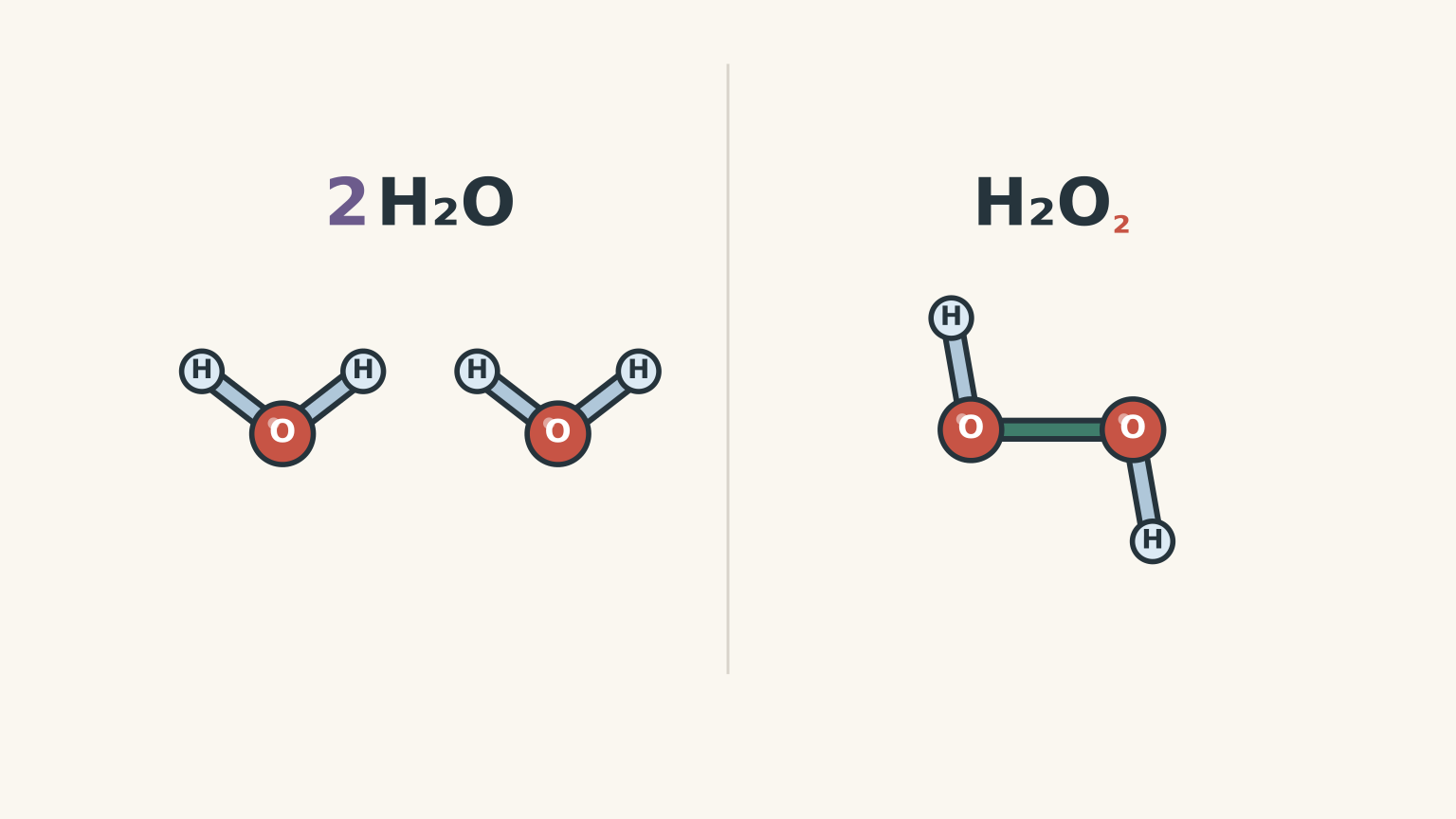
The distinction between a coefficient and a subscript is essential.
- A coefficient changes how many units of a substance are present.
- A subscript changes the number of atoms within each formula unit or molecule.
For example, \(\ce{2H2O}\) represents two water molecules. Each contains two hydrogen atoms and one oxygen atom.
By contrast, \(\ce{H2O2}\) is hydrogen peroxide, a different substance.
Due to technical limitations, this figure may display incorrectly or contain inaccuracies. Please check key details against your course materials.
Changing a subscript to balance an equation changes the identity of the substance. It is never a valid balancing method.
For more practice with this distinction, see How to Balance Chemical Equations Without Changing Chemical Subscripts.
A reliable balancing routine is:
- Write the correct formula for every reactant and product.
- Count the atoms of each element on both sides.
- Add coefficients to balance one element at a time.
- Recount all atoms after each adjustment.
- Check that the final coefficients are in the smallest whole-number ratio.
For hydrocarbon combustion, balancing carbon first, hydrogen second, and oxygen last is usually the easiest approach.
03Worked examples
Worked example: Magnesium reacts with oxygen
Question: Magnesium burns in oxygen gas to produce magnesium oxide. Write the balanced chemical equation, including state symbols.
Step 1
- Reactant: magnesium.
- Reactant: oxygen gas.
- Product: magnesium oxide.
Step 2
Magnesium is \(\ce{Mg}\), oxygen gas is \(\ce{O2}\), and magnesium oxide is \(\ce{MgO}\).
The unbalanced equation is:
\[ \ce{Mg(s) + O2(g) -> MgO(s)} \]
Step 3
There are two oxygen atoms on the left and one on the right.
Place a coefficient of 2 before magnesium oxide:
\[ \ce{Mg(s) + O2(g) -> 2MgO(s)} \]
Step 4
There are now two magnesium atoms on the right, so place a coefficient of 2 before magnesium on the left:
\[ \ce{2Mg(s) + O2(g) -> 2MgO(s)} \]
Step 5
| Element | Left side | Right side |
|---|---|---|
| Mg | 2 | 2 |
| O | 2 | 2 |
The balanced equation is:
\[ \boxed{\ce{2Mg(s) + O2(g) -> 2MgO(s)}} \]
The equation shows that two magnesium atoms react with one oxygen molecule to form two formula units of magnesium oxide.
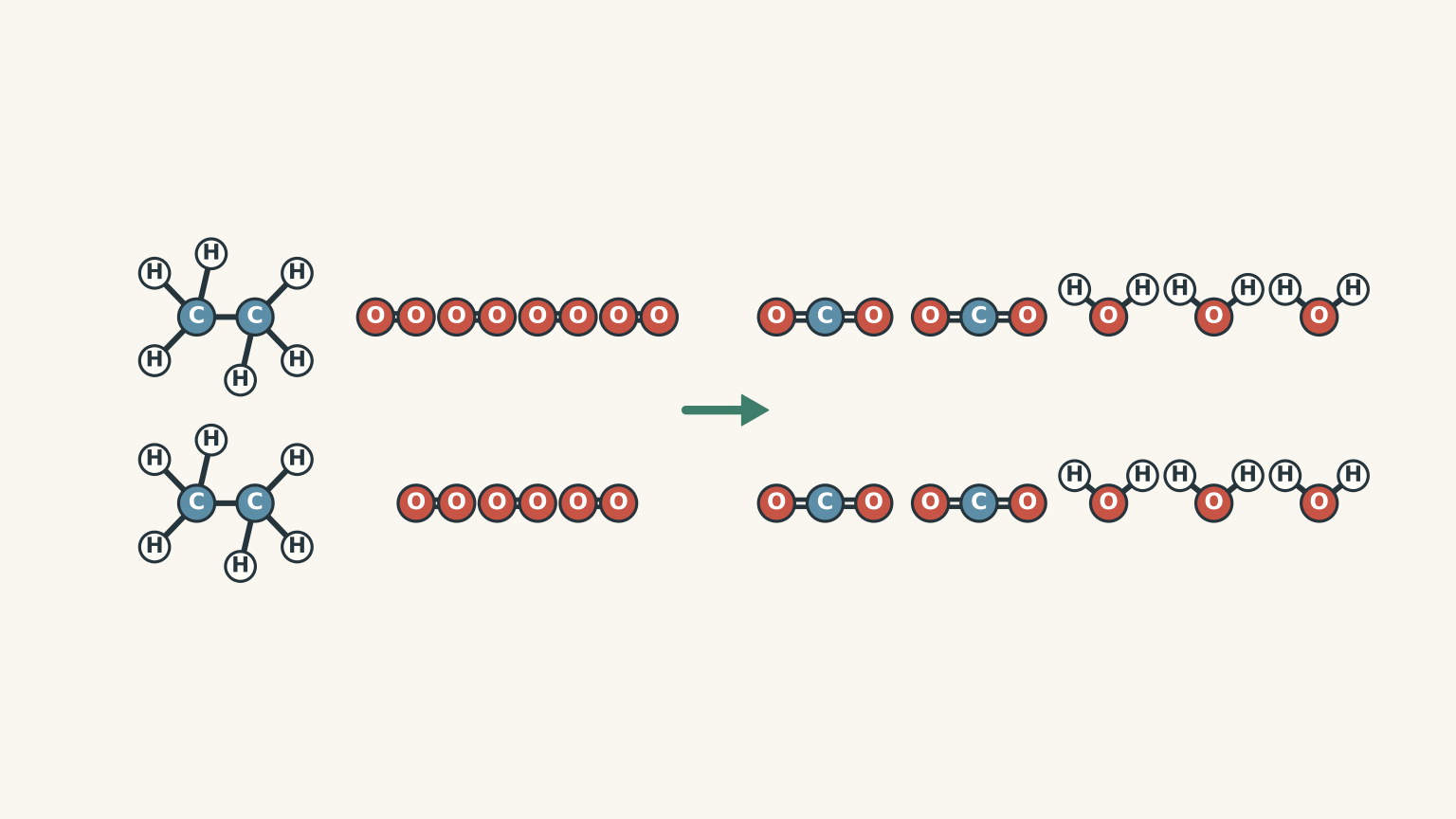
Worked example: Complete combustion of ethane
Question: Ethane burns completely in oxygen to produce carbon dioxide and water vapour. Write the balanced chemical equation.
This example is more challenging because oxygen appears in two different products.
Step 1
- Reactants: ethane and oxygen.
- Products: carbon dioxide and water.
Step 2
Ethane is \(\ce{C2H6}\), oxygen is \(\ce{O2}\), carbon dioxide is \(\ce{CO2}\), and water is \(\ce{H2O}\).
Our unbalanced equation is:
\[ \ce{C2H6 + O2 -> CO2 + H2O} \]
Step 3
There are two carbon atoms in ethane, so we need two carbon dioxide molecules:
\[ \ce{C2H6 + O2 -> 2CO2 + H2O} \]
Step 4
Ethane contains six hydrogen atoms.
Each water molecule contains two hydrogen atoms, so we need three water molecules:
\[ \ce{C2H6 + O2 -> 2CO2 + 3H2O} \]
Step 5
Count the oxygen atoms on the right:
- Two carbon dioxide molecules contain four oxygen atoms.
- Three water molecules contain three oxygen atoms.
There are seven oxygen atoms altogether.
Oxygen gas contains two oxygen atoms per molecule, so we need:
\[ \frac{7}{2}\ce{O2} \]
This gives:
\[ \ce{C2H6 + 7/2 O2 -> 2CO2 + 3H2O} \]
Step 6
Multiply every coefficient by 2:
\[ \ce{2C2H6 + 7O2 -> 4CO2 + 6H2O} \]
Step 7
| Element | Left side | Right side |
|---|---|---|
| Carbon | 4 | 4 |
| Hydrogen | 12 | 12 |
| Oxygen | 14 | 14 |
The final balanced equation is:
\[ \boxed{\ce{2C2H6(g) + 7O2(g) -> 4CO2(g) + 6H2O(g)}} \]
The equation is balanced because every element has the same number of atoms on both sides.
Notice that we didn’t change the formula of ethane, oxygen, carbon dioxide, or water at any point. We only changed the coefficients.
Due to technical limitations, this figure may display incorrectly or contain inaccuracies. Please check key details against your course materials.
04Questions and solutions
Try these questions without looking back at the worked examples. They progress from straightforward formula conversion to more demanding problems involving experimental evidence and quantitative reasoning.
Question 1
Hydrogen gas reacts with chlorine gas to produce hydrogen chloride gas.
Write the balanced chemical equation, including state symbols.
Solution 1
The balanced equation is:
\[ \boxed{\ce{H2(g) + Cl2(g) -> 2HCl(g)}} \]
Hydrogen and chlorine are both diatomic elements, so their formulae are \(\ce{H2}\) and \(\ce{Cl2}\).
Hydrogen chloride has the formula \(\ce{HCl}\).
The unbalanced equation is:
\[ \ce{H2 + Cl2 -> HCl} \]
There are two hydrogen atoms and two chlorine atoms on the left, but only one of each on the right.
Adding a coefficient of 2 before hydrogen chloride balances both elements simultaneously.
The final equation contains two hydrogen atoms and two chlorine atoms on each side.
Question 2
Aqueous aluminium sulfate reacts with aqueous sodium hydroxide to produce solid aluminium hydroxide and aqueous sodium sulfate.
(a) Write the correct chemical formula for each of the four substances.
(b) Construct the balanced chemical equation, including state symbols.
(c) Explain why brackets are required in the formulae of aluminium sulfate and aluminium hydroxide.
Solution 2
The balanced equation is:
\[ \boxed{ \ce{Al2(SO4)3(aq) + 6NaOH(aq) -> 2Al(OH)3(s) + 3Na2SO4(aq)} } \]
First, establish the correct formulae.
- Aluminium sulfate: \(\ce{Al2(SO4)3}\).
- Sodium hydroxide: \(\ce{NaOH}\).
- Aluminium hydroxide: \(\ce{Al(OH)3}\).
- Sodium sulfate: \(\ce{Na2SO4}\).
For aluminium sulfate, aluminium has a \(+3\) charge and sulfate has a \(-2\) charge. Two aluminium ions and three sulfate ions are needed to produce a neutral compound.
For aluminium hydroxide, one aluminium ion requires three hydroxide ions to balance its charge.
The brackets indicate that the entire polyatomic ion is repeated.
Now balance the equation.
Step 1: Balance aluminium.
There are two aluminium atoms in \(\ce{Al2(SO4)3}\), so place a coefficient of 2 before aluminium hydroxide.
Step 2: Balance sulfate.
There are three sulfate groups on the left, so place a coefficient of 3 before sodium sulfate.
Step 3: Balance sodium.
Three sodium sulfate units contain six sodium atoms. Place a coefficient of 6 before sodium hydroxide.
Step 4: Check hydroxide.
Six sodium hydroxide units provide six hydroxide groups. Two aluminium hydroxide units also contain six hydroxide groups.
All elements and polyatomic groups are balanced.
The final atom and group counts are:
| Element or group | Left side | Right side |
|---|---|---|
| Aluminium | 2 | 2 |
| Sulfate groups | 3 | 3 |
| Sodium | 6 | 6 |
| Hydroxide groups | 6 | 6 |
This is a useful example of balancing polyatomic ions as intact groups when they appear unchanged on both sides.
Question 3
When solid sodium hydrogen carbonate is heated, it decomposes to produce solid sodium carbonate, carbon dioxide gas, and water vapour.
(a) Write the balanced chemical equation, including state symbols.
(b) Explain why a coefficient is required before sodium hydrogen carbonate.
(c) Explain why water vapour is written as \(\ce{H2O(g)}\), rather than using a different chemical formula for steam.
Solution 3
The balanced equation is:
\[ \boxed{ \ce{2NaHCO3(s) -> Na2CO3(s) + CO2(g) + H2O(g)} } \]
The formulae are:
- Sodium hydrogen carbonate: \(\ce{NaHCO3}\).
- Sodium carbonate: \(\ce{Na2CO3}\).
- Carbon dioxide: \(\ce{CO2}\).
- Water: \(\ce{H2O}\).
Step 1: Write the unbalanced equation.
\[ \ce{NaHCO3 -> Na2CO3 + CO2 + H2O} \]
Step 2: Balance sodium.
The product contains two sodium atoms in \(\ce{Na2CO3}\), but the reactant contains only one sodium atom per formula unit.
Place a coefficient of 2 before sodium hydrogen carbonate.
\[ \ce{2NaHCO3 -> Na2CO3 + CO2 + H2O} \]
Step 3: Check the remaining elements.
| Element | Left side | Right side |
|---|---|---|
| Na | 2 | 2 |
| H | 2 | 2 |
| C | 2 | 1 + 1 = 2 |
| O | 6 | 3 + 2 + 1 = 6 |
The equation is balanced.
Water vapour and liquid water have the same chemical formula, \(\ce{H2O}\). The state symbol changes because the physical state is different, not because the substance has a different composition.
The coefficient of 2 is necessary because the products contain two sodium atoms, and each sodium hydrogen carbonate formula unit contains only one.
Question 4
At high temperatures, iron(III) oxide reacts with carbon monoxide to produce iron metal and carbon dioxide.
A student writes the following equation:
\[ \ce{Fe2O3 + CO -> Fe + CO2} \]
The student argues that the equation is correct because all four chemical formulae match the substance names.
(a) Write the balanced chemical equation.
(b) Explain why the student’s equation is not balanced.
(c) Explain why changing \(\ce{Fe2O3}\) to \(\ce{FeO}\) would not be a valid way to fix the equation.
Solution 4
The correct balanced equation is:
\[ \boxed{\ce{Fe2O3(s) + 3CO(g) -> 2Fe(s) + 3CO2(g)}} \]
The student’s formulae are correct, but the equation is not balanced.
Step 1: Check the compound formulae.
Iron(III) means that iron has a \(+3\) charge.
Oxygen has a \(-2\) charge.
Two iron ions and three oxide ions give the neutral formula:
\[ \ce{Fe2O3} \]
Carbon monoxide is \(\ce{CO}\), while carbon dioxide is \(\ce{CO2}\).
These are different substances, so their formulae cannot be interchanged.
Step 2: Balance iron.
There are two iron atoms on the left, so place a coefficient of 2 before iron on the right.
\[ \ce{Fe2O3 + CO -> 2Fe + CO2} \]
Step 3: Balance carbon and oxygen.
There is one carbon atom in each carbon monoxide and carbon dioxide molecule.
Placing a coefficient of 3 before carbon monoxide and carbon dioxide balances carbon:
\[ \ce{Fe2O3 + 3CO -> 2Fe + 3CO2} \]
Step 4: Check every element.
| Element | Left side | Right side |
|---|---|---|
| Iron | 2 | 2 |
| Carbon | 3 | 3 |
| Oxygen | 3 + 3 = 6 | 6 |
The equation is balanced.
The tempting mistake is to change \(\ce{Fe2O3}\) into \(\ce{FeO}\) to reduce the number of oxygen atoms. However, \(\ce{FeO}\) is iron(II) oxide, not iron(III) oxide.
Changing the subscript would change the identity of the reactant. The correct solution is to adjust coefficients while keeping all four chemical formulae unchanged.
Question 5
A student is investigating the thermal decomposition of an unknown metal carbonate.
The carbonate is known to be either magnesium carbonate or calcium carbonate. Both possible reactions produce a white metal oxide and carbon dioxide gas.
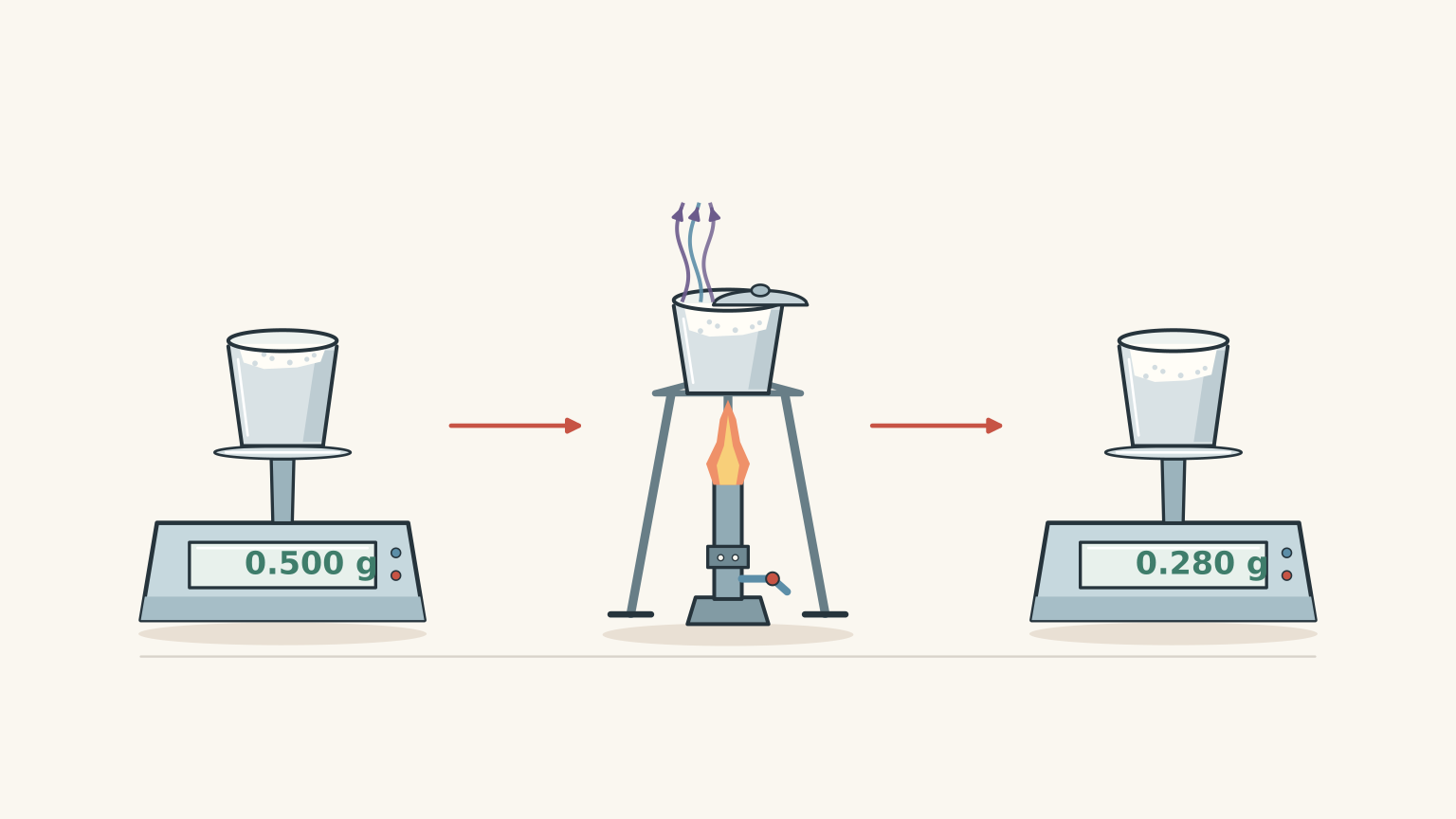
The student records the following illustrative experimental data:
- Initial mass of pure carbonate: 0.500 g.
- Final mass of solid residue: 0.280 g.
- The gas released turns limewater cloudy.
- Decomposition is complete.
- No solid is lost during heating, and carbon dioxide is the only substance that escapes.
The possible reactions are:
\[ \ce{MgCO3 -> MgO + CO2} \]
or
\[ \ce{CaCO3 -> CaO + CO2} \]
(a) Explain why the observations of a white residue and cloudy limewater cannot distinguish between the two carbonates.
(b) Use the mass data to identify the original carbonate.
(c) Write the balanced chemical equation for the decomposition reaction.
(d) Explain why the mass measurement provides stronger evidence than the visual observations alone.
Due to technical limitations, this figure may display incorrectly or contain inaccuracies. Please check key details against your course materials.
Solution 5
The original carbonate is calcium carbonate, and its balanced decomposition equation is:
\[ \boxed{\ce{CaCO3(s) -> CaO(s) + CO2(g)}} \]
The key is to use the mass lost during heating to calculate the molar mass of the original carbonate.
Part (a): Why the observations are insufficient
Both magnesium carbonate and calcium carbonate produce carbon dioxide when they decompose.
Both also leave a white metal oxide:
- Magnesium carbonate produces magnesium oxide.
- Calcium carbonate produces calcium oxide.
Therefore, the cloudy limewater confirms the presence of carbon dioxide, but it does not identify the metal.
Likewise, the white residue does not distinguish between magnesium oxide and calcium oxide.
The two proposed reactions are both consistent with the qualitative observations.
Part (b): Identify the carbonate using the mass data
Step 1: Calculate the mass of carbon dioxide released.
The initial sample has a mass of 0.500 g, and the remaining solid has a mass of 0.280 g.
Because carbon dioxide is the only substance that escapes:
\[ m(\ce{CO2})=0.500-0.280 \]
\[ m(\ce{CO2})=0.220\text{ g} \]
Step 2: Calculate the number of moles of carbon dioxide.
The molar mass of carbon dioxide is:
\[ M(\ce{CO2})=12.0+2(16.0) \]
\[ M(\ce{CO2})=44.0\text{ g mol}^{-1} \]
Using \(n=m/M\):
\[ n(\ce{CO2})= \frac{0.220}{44.0} \]
\[ n(\ce{CO2})=0.00500\text{ mol} \]
Step 3: Calculate the moles of the original carbonate.
Both possible decomposition reactions have a 1:1 mole ratio between the metal carbonate and carbon dioxide.
Therefore:
\[ n(\text{carbonate})=0.00500\text{ mol} \]
Step 4: Calculate the molar mass of the original carbonate.
\[ M(\text{carbonate})= \frac{m}{n} \]
Substituting:
\[ M(\text{carbonate})= \frac{0.500}{0.00500} \]
\[ M(\text{carbonate})=100\text{ g mol}^{-1} \]
Step 5: Identify the metal.
Both possible carbonates contain the carbonate ion, \(\mathrm{CO_{3}}^{2-}\).
Its molar mass is:
\[ M(\ce{CO3})=12.0+3(16.0) \]
\[ M(\ce{CO3})=60.0\text{ g mol}^{-1} \]
The metal must therefore contribute approximately:
\[ 100-60=40\text{ g mol}^{-1} \]
Compare the two possibilities:
| Metal | Approximate molar mass |
|---|---|
| Magnesium (Mg) | 24.3 g mol⁻¹ |
| Calcium (Ca) | 40.1 g mol⁻¹ |
The metal is calcium.
The original compound must therefore be calcium carbonate, \(\ce{CaCO3}\).
Part (c): Write the balanced equation
The word equation is:
Calcium carbonate → calcium oxide + carbon dioxide
Converting to formulae gives:
\[ \ce{CaCO3 -> CaO + CO2} \]
Check the atoms:
| Element | Left side | Right side |
|---|---|---|
| Calcium | 1 | 1 |
| Carbon | 1 | 1 |
| Oxygen | 3 | 1 + 2 = 3 |
The equation is already balanced.
Part (d): Why the mass measurement matters
The tempting approach is to identify calcium carbonate from the cloudy limewater and white residue.
But magnesium carbonate produces the same qualitative observations. Visual evidence alone cannot distinguish the two possibilities.
The mass measurement provides an additional constraint.
For magnesium carbonate, the molar mass would be approximately 84.3 g mol⁻¹. A 0.500 g sample would release approximately:
\[ 0.500\times\frac{44.0}{84.3} =0.261\text{ g CO2} \]
The measured mass loss is only 0.220 g.
That result is consistent with calcium carbonate, not magnesium carbonate.
The conclusion depends on the stated assumptions: the sample is pure, decomposition is complete, and carbon dioxide is the only substance lost. If another gas escaped or some solid was lost, the calculation would no longer establish the identity reliably.
This is the important distinction between qualitative and quantitative evidence. An observation can support a chemical explanation, while a measurement can help distinguish between competing explanations.
05What to do next
When you receive a word equation, keep two questions separate:
- Do I know the identity of every reactant and product?
- Have I written the correct formula for each substance?
Only once both answers are yes should you start balancing.
If the products are not identified, you need to predict or establish them first. No amount of balancing can fix an incorrect product formula.
Once you can confidently translate word equations into formula equations, the next useful skill is predicting products from the reactants, then using balanced equations to calculate mole ratios and reacting quantities.