
Further Calculus Skills: Year 12 Maths Extension 1 Guide
A comprehensive guide to Further calculus skills in the NSW 2024 Mathematics Extension 1 syllabus. Learn parametric differentiation, inverse functions, inverse trigonometric derivatives, integration by substitution, and trigonometric integrals through worked examples and challenging HSC-style questions.
A particle moves along a curved path. Its horizontal position is \(x=t^2+1\), and its vertical position is \(y=t^3-3t\). At \(t=2\), how steep is the path?
You could try to eliminate \(t\), rearrange the equations, and find an ordinary function \(y=f(x)\). But that is unnecessary. You can calculate the gradient directly from how quickly the horizontal and vertical coordinates are changing.
This is one of the central ideas behind Further calculus skills: familiar differentiation and integration techniques become much more powerful when you connect them to inverse functions, parametric equations, and more complicated combinations of functions.
The focus area also introduces some important connections. Differentiating an inverse function involves taking the reciprocal of a derivative. Integrating certain expressions produces inverse trigonometric functions. And a simple double-angle identity turns an awkward squared trigonometric integral into something straightforward.
Each technique makes more sense when you understand where it comes from.
01Differentiating functions defined parametrically
Why use a parameter?
Usually, you describe a curve using an equation such as
\[ y=x^2+3x-1. \]
Here, \(y\) is expressed directly in terms of \(x\), so differentiation is straightforward.
But not every curve is naturally described this way.
Suppose the coordinates of a moving particle depend on time \(t\):
\[ x=f(t),\qquad y=g(t). \]
These are called parametric equations. The variable \(t\) is the parameter, and each value of \(t\) determines a point \((x,y)\).
This is particularly useful when describing motion, because both coordinates can change independently as time passes.
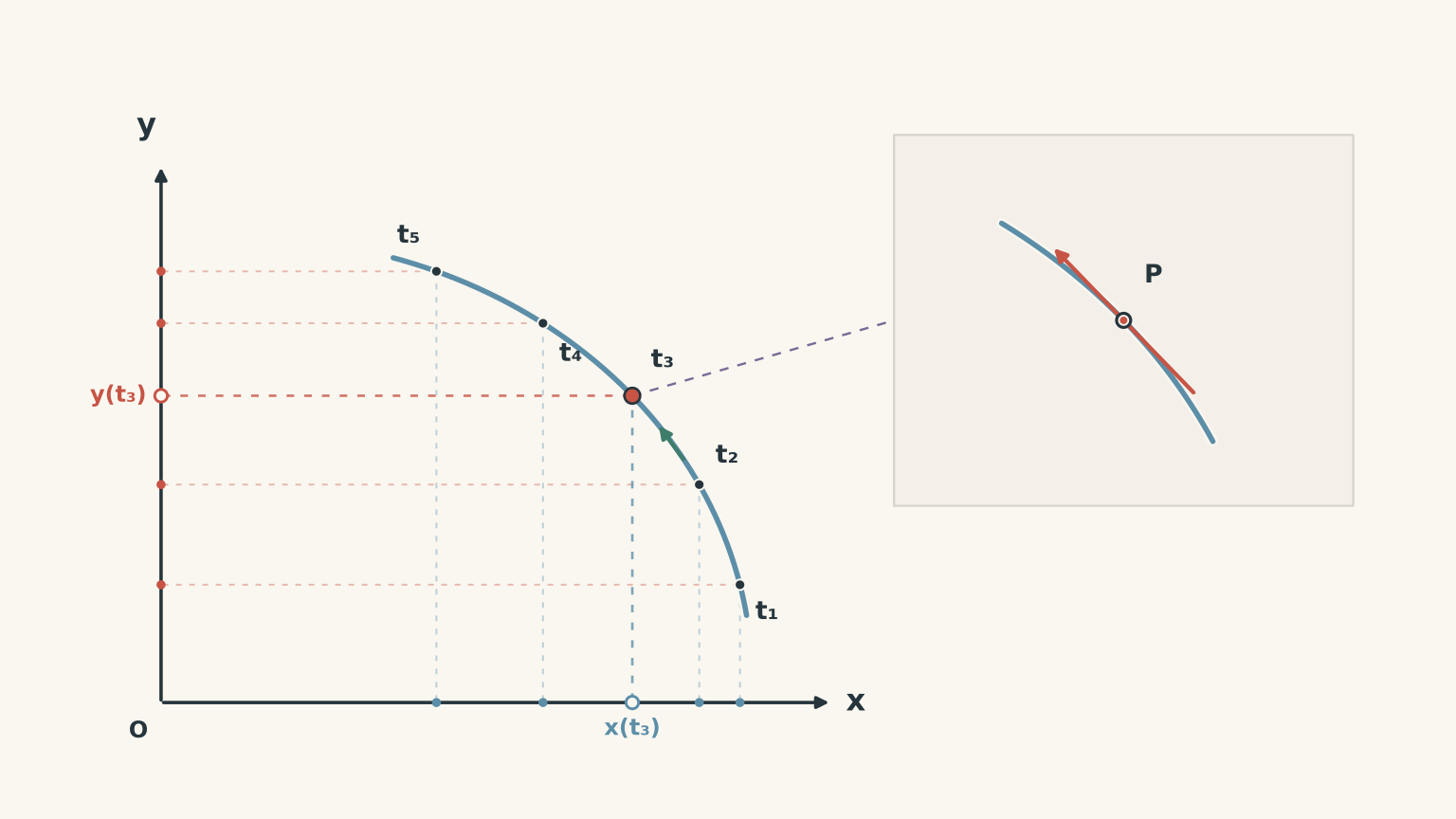
Due to technical limitations, this figure may display incorrectly or contain inaccuracies. Please check key details against your course materials.
Deriving the parametric differentiation formula
Think about the gradient of the curve.
It measures the change in \(y\) divided by the change in \(x\):
\[ \frac{dy}{dx}=\frac{\text{change in }y}{\text{change in }x}. \]
However, both coordinates are changing with respect to \(t\).
The chain rule tells us that
\[ \frac{dy}{dt} = \frac{dy}{dx}\frac{dx}{dt}. \]
Rearranging gives
\[ \boxed{\frac{dy}{dx} = \frac{\frac{dy}{dt}}{\frac{dx}{dt}}} \]
provided that \(\frac{dx}{dt}\neq 0\).
In words:
Differentiate both parametric equations with respect to the parameter, then divide the derivative of \(y\) by the derivative of \(x\).
This is the key formula for parametric differentiation.
Worked example: Find the gradient of a parametric curve
A curve is defined by
\[ x=t^2+1,\qquad y=t^3-3t. \]
Find the gradient and equation of the tangent when \(t=2\).
Step 1
For the horizontal coordinate,
\[ \frac{dx}{dt}=2t. \]
For the vertical coordinate,
\[ \frac{dy}{dt}=3t^2-3. \]
Step 2
\[ \begin{aligned} \frac{dy}{dx} &=\frac{3t^2-3}{2t}\\ &=\frac{3(t^2-1)}{2t}. \end{aligned} \]
Step 3
\[ \begin{aligned} \frac{dy}{dx} &=\frac{3(2^2-1)}{2(2)}\\ &=\frac{9}{4}. \end{aligned} \]
The gradient is \(\frac94\).
Step 4
When \(t=2\),
\[ x=2^2+1=5 \]
and
\[ y=2^3-3(2)=2. \]
The point is \((5,2)\).
Step 5
Using \(y-y_1=m(x-x_1)\),
\[ \boxed{y-2=\frac94(x-5)}. \]
The tangent has gradient \(\frac94\) at the point \((5,2)\).
Notice that we never needed to eliminate \(t\). That is the main advantage of parametric differentiation.
What if the derivative of \(x\) is zero?
There is an important condition hidden in the formula:
\[ \frac{dy}{dx}=\frac{dy/dt}{dx/dt}. \]
We cannot divide by zero.
Consider three possibilities:
| Condition | Geometrical interpretation |
|---|---|
| \(\frac{dy}{dt}=0\), \(\frac{dx}{dt}\neq0\) | Horizontal tangent |
| \(\frac{dx}{dt}=0\), \(\frac{dy}{dt}\neq0\) | Vertical tangent, provided the curve is regular |
| Both derivatives equal zero | The formula is inconclusive; further investigation is needed |
If both derivatives are zero, you cannot simply conclude that the curve has no tangent. You may need to examine a limit or simplify the parametric equations.
The second derivative of a parametric curve
You can also differentiate again to find the second derivative.
Start with
\[ \frac{dy}{dx}= \frac{dy/dt}{dx/dt}. \]
Because this expression is a function of \(t\), differentiate it with respect to \(t\), then divide by \(dx/dt\):
\[ \boxed{ \frac{d^2y}{dx^2} = \frac{\frac{d}{dt}\left(\frac{dy}{dx}\right)} {\frac{dx}{dt}} } \]
This is useful when investigating concavity and points of inflection on parametric curves.
The important detail is that the second differentiation is still with respect to \(x\), not \(t\). You must account for that using the chain rule.
02Differentiating inverse functions
Imagine a function that takes an input, multiplies it by 3, and adds 2:
\[ f(x)=3x+2. \]
Its inverse reverses those operations:
\[ f^{-1}(x)=\frac{x-2}{3}. \]
The original function has gradient 3. Its inverse has gradient \(\frac13\).
This is not a coincidence.
Why are inverse gradients reciprocals?
A function and its inverse undo each other’s operations.
If
\[ y=f(x), \]
then
\[ x=f^{-1}(y). \]
Geometrically, the graph of an inverse function is the reflection of the original graph in the line \(y=x\).
Reflection across this line swaps the horizontal and vertical changes. Consequently, a gradient \(m\) becomes \(\frac1m\), provided \(m\neq0\).
Proving the inverse derivative formula
Let
\[ y=f^{-1}(x). \]
By the definition of an inverse function,
\[ f(y)=x. \]
Differentiate both sides with respect to \(x\).
The right-hand side becomes 1.
The left-hand side requires the chain rule:
\[ f'(y)\frac{dy}{dx}=1. \]
Rearranging,
\[ \frac{dy}{dx}=\frac{1}{f'(y)}. \]
Since \(y=f^{-1}(x)\), substitute back:
\[ \boxed{ (f^{-1})'(x) = \frac{1}{f'(f^{-1}(x))} } \]
This is the derivative of an inverse function.
The formula is valid at points where the inverse exists and is differentiable, with
\[ f'(f^{-1}(x))\neq0. \]
The derivative of the original function must therefore be non-zero at the corresponding input.
Worked example: Find the gradient of an inverse function
A function is defined by
\[ f(x)=x^3+2x+1. \]
Find the gradient of its inverse function when \(x=4\).
Step 1
We need to find the value of \(f^{-1}(4)\).
In other words, solve
\[ f(a)=4. \]
Trying \(a=1\),
\[ f(1)=1^3+2(1)+1=4. \]
Therefore,
\[ f^{-1}(4)=1. \]
Step 2
\[ f'(x)=3x^2+2. \]
Step 3
\[ \begin{aligned} (f^{-1})'(4) &=\frac{1}{f'(f^{-1}(4))}\\ &=\frac{1}{f'(1)}\\ &=\frac{1}{3(1)^2+2}\\ &=\frac15. \end{aligned} \]
Therefore,
\[ \boxed{(f^{-1})'(4)=\frac15} \]
The gradient of the inverse is \(\frac15\).
A common trap: Taking the reciprocal of the wrong number
The formula is not simply
\[ (f^{-1})'(x)=\frac{1}{f'(x)}. \]
You must first find \(f^{-1}(x)\), then evaluate the original derivative at that value.
For example, when finding \((f^{-1})'(4)\), you evaluate \(f'(1)\), not \(f'(4)\).
The input to the original function and the input to its inverse are generally different.
03Derivatives of inverse trigonometric functions
Inverse trigonometric functions are especially important in this focus area because their derivatives appear repeatedly in both differentiation and integration.
You already know the basic trigonometric functions:
\[ y=\sin x,\qquad y=\cos x,\qquad y=\tan x. \]
Their inverses reverse these relationships.
For example,
\[ y=\sin^{-1}x \]
means that \(y\) is the angle whose sine is \(x\).
One notation warning: \(\sin^{-1}x\) means inverse sine, not \(\frac1{\sin x}\). The reciprocal of sine is \(\csc x\).
Principal domains and ranges
Trigonometric functions are not one-to-one over their entire domains. For an inverse function to exist, we restrict the original function to a suitable interval.
The resulting inverse functions have the following domains and ranges.
| Function | Domain | Range |
|---|---|---|
| \(\sin^{-1}x\) | \([-1,1]\) | \([-\frac\pi2,\frac\pi2]\) |
| \(\cos^{-1}x\) | \([-1,1]\) | \([0,\pi]\) |
| \(\tan^{-1}x\) | \(\mathbb R\) | \((-\frac\pi2,\frac\pi2)\) |
These restrictions are not just technical details. They determine the signs of the derivatives.
Proving the derivative of inverse sine
Start with
\[ y=\sin^{-1}x. \]
By the definition of inverse sine,
\[ x=\sin y. \]
Differentiate both sides with respect to \(x\).
\[ 1=\cos y\frac{dy}{dx}. \]
Rearrange:
\[ \frac{dy}{dx}=\frac1{\cos y}. \]
We need to express this entirely in terms of \(x\).
Using the Pythagorean identity,
\[ \sin^2y+\cos^2y=1, \]
we obtain
\[ \cos y=\sqrt{1-\sin^2y}. \]
Why the positive square root?
Because the principal range of inverse sine is
\[ -\frac\pi2\leq y\leq\frac\pi2, \]
where cosine is non-negative.
Since \(\sin y=x\),
\[ \cos y=\sqrt{1-x^2}. \]
Therefore,
\[ \boxed{ \frac{d}{dx}(\sin^{-1}x) = \frac1{\sqrt{1-x^2}} } \]
for \(-1<x<1\).
The derivative is not finite at \(x=\pm1\).
Proving the derivative of inverse cosine
Start with
\[ y=\cos^{-1}x. \]
Rearrange:
\[ x=\cos y. \]
Differentiate:
\[ 1=-\sin y\frac{dy}{dx}. \]
Therefore,
\[ \frac{dy}{dx}=-\frac1{\sin y}. \]
Using
\[ \sin^2y+\cos^2y=1, \]
we have
\[ \sin y=\sqrt{1-\cos^2y}. \]
The positive square root is required because the principal range of inverse cosine is
\[ 0\leq y\leq\pi, \]
where sine is non-negative.
Since \(\cos y=x\),
\[ \sin y=\sqrt{1-x^2}. \]
Hence,
\[ \boxed{ \frac{d}{dx}(\cos^{-1}x) = -\frac1{\sqrt{1-x^2}} } \]
for \(-1<x<1\).
Notice the negative sign. Inverse cosine is a decreasing function, so its gradient is negative.
Proving the derivative of inverse tangent
Start with
\[ y=\tan^{-1}x. \]
Rearrange:
\[ x=\tan y. \]
Differentiate:
\[ 1=\sec^2y\frac{dy}{dx}. \]
Therefore,
\[ \frac{dy}{dx}=\frac1{\sec^2y}. \]
Using the identity
\[ \sec^2y=1+\tan^2y, \]
we obtain
\[ \frac{dy}{dx} = \frac1{1+\tan^2y}. \]
Since \(\tan y=x\),
\[ \boxed{ \frac{d}{dx}(\tan^{-1}x) = \frac1{1+x^2} } \]
This derivative exists for every real value of \(x\).
Comparing the three derivatives
These are worth knowing without hesitation.
\[ \boxed{ \begin{aligned} \frac{d}{dx}(\sin^{-1}x) &=\frac1{\sqrt{1-x^2}}\\[6pt] \frac{d}{dx}(\cos^{-1}x) &=-\frac1{\sqrt{1-x^2}}\\[6pt] \frac{d}{dx}(\tan^{-1}x) &=\frac1{1+x^2} \end{aligned} } \]
A useful observation is that inverse sine and inverse cosine have derivatives that are negatives of each other.
This makes sense because, over their principal ranges, their outputs are complementary angles:
\[ \sin^{-1}x+\cos^{-1}x=\frac\pi2. \]
Differentiating both sides gives the same relationship.
Applying the chain rule to inverse trigonometric functions
So far, we have differentiated expressions such as
\[ \sin^{-1}x. \]
But what happens when the input is a more complicated function?
Consider
\[ y=\sin^{-1}(3x). \]
This is a composite function. The outside function is inverse sine, and the inside function is \(3x\).
We use the chain rule.
For a general function \(f(x)\),
\[ \boxed{ \frac{d}{dx}\left[\sin^{-1}f(x)\right] = \frac{f'(x)}{\sqrt{1-[f(x)]^2}} } \]
Similarly,
\[ \boxed{ \frac{d}{dx}\left[\cos^{-1}f(x)\right] = -\frac{f'(x)}{\sqrt{1-[f(x)]^2}} } \]
and
\[ \boxed{ \frac{d}{dx}\left[\tan^{-1}f(x)\right] = \frac{f'(x)}{1+[f(x)]^2} } \]
The first two formulas require \(|f(x)|<1\) for a finite derivative. The inverse tangent formula has no such restriction.
Worked example: Differentiate an inverse cosine composite
Differentiate
\[ y=\cos^{-1}(1-2x^2) \]
for \(0<x<1\).
Step 1
Let
\[ f(x)=1-2x^2. \]
Then
\[ f'(x)=-4x. \]
Step 2
\[ \frac{dy}{dx} = -\frac{f'(x)}{\sqrt{1-[f(x)]^2}}. \]
Substitute:
\[ \frac{dy}{dx} = \frac{4x}{\sqrt{1-(1-2x^2)^2}}. \]
Step 3
Expand the square:
\[ (1-2x^2)^2=1-4x^2+4x^4. \]
Therefore,
\[ \begin{aligned} \frac{dy}{dx} &=\frac{4x}{\sqrt{4x^2-4x^4}}\\ &=\frac{4x}{\sqrt{4x^2(1-x^2)}}. \end{aligned} \]
Since \(0<x<1\), we know that \(\sqrt{x^2}=x\).
Thus,
\[ \frac{dy}{dx} = \frac{4x}{2x\sqrt{1-x^2}}. \]
The final answer is
\[ \boxed{ \frac{dy}{dx} = \frac2{\sqrt{1-x^2}} } \]
The restriction \(x>0\) matters when simplifying \(\sqrt{x^2}\). Replacing \(\sqrt{x^2}\) with \(x\) without checking the sign can produce an incorrect result.
Common mistakes with inverse trigonometric derivatives
- Forgetting the negative sign when differentiating inverse cosine.
- Forgetting to differentiate the inner function.
- Using \(1-f(x)^2\) without the square root for inverse sine or inverse cosine.
- Treating \(\sin^{-1}x\) as the reciprocal of sine.
- Ignoring the domain restrictions when simplifying square roots.
04Combining the product, quotient, and chain rules
The next skill is combining everything.
In Mathematics Advanced, you have already studied functions such as polynomials, exponentials, logarithms, and trigonometric functions.
The Mathematics Extension 1 syllabus expects you to combine these with inverse trigonometric functions using the familiar differentiation rules.
You do not need a separate rule for every possible combination.
You need three main rules.
The product rule
Suppose
\[ y=f(x)g(x). \]
Differentiate using
\[ \boxed{ \frac{dy}{dx}=f'(x)g(x)+f(x)g'(x) } \]
Both functions must be differentiated, one at a time.
A useful way to remember this is:
Differentiate the first, keep the second, then keep the first, differentiate the second.
The quotient rule
Suppose
\[ y=\frac{f(x)}{g(x)}. \]
Then
\[ \boxed{ \frac{dy}{dx} = \frac{g(x)f'(x)-f(x)g'(x)} {[g(x)]^2} } \]
Remember the order:
Bottom times derivative of top, minus top times derivative of bottom, all over bottom squared.
The denominator must be non-zero.
The chain rule
For a composite function,
\[ y=f(g(x)), \]
the derivative is
\[ \boxed{ \frac{dy}{dx}=f'(g(x))g'(x) } \]
Differentiate the outside function while leaving the inside unchanged, then multiply by the derivative of the inside.
Worked example: Product rule with inverse sine
Differentiate
\[ y=e^x\sin^{-1}(2x). \]
Step 1
Let
\[ f(x)=e^x,\qquad g(x)=\sin^{-1}(2x). \]
Step 2
\[ f'(x)=e^x. \]
For the second function, use the inverse sine chain rule:
\[ g'(x)=\frac{2}{\sqrt{1-4x^2}}. \]
Step 3
\[ \frac{dy}{dx}=f'(x)g(x)+f(x)g'(x). \]
Substituting,
\[ \boxed{ \frac{dy}{dx} = e^x\sin^{-1}(2x) + \frac{2e^x}{\sqrt{1-4x^2}} } \]
The derivative is valid for \(-\frac12<x<\frac12\).
The important point is that the product rule and chain rule are working together. Applying only one of them would leave the derivative incomplete.
Worked example: Quotient rule with inverse tangent
Differentiate
\[ y=\frac{\ln(1+x^2)}{\tan^{-1}(2x)} \]
for \(x>0\).
Step 1
Let
\[ f(x)=\ln(1+x^2) \]
and
\[ g(x)=\tan^{-1}(2x). \]
Step 2
Using the chain rule,
\[ f'(x)=\frac{2x}{1+x^2}. \]
Step 3
Using the inverse tangent derivative,
\[ g'(x)=\frac{2}{1+4x^2}. \]
Step 4
\[ \frac{dy}{dx} = \frac{gf'-fg'}{g^2}. \]
Substituting all the expressions gives
\[ \boxed{ \frac{dy}{dx} = \frac{ \frac{2x\tan^{-1}(2x)}{1+x^2} - \frac{2\ln(1+x^2)}{1+4x^2} } {[\tan^{-1}(2x)]^2} } \]
The derivative is valid for \(x>0\).
How to approach a complicated differentiation question
When you see a long expression, do not immediately start expanding everything.
Instead:
- Identify the outermost operation. Is it a product, quotient, or composite function?
- Apply the corresponding rule.
- Differentiate the smaller functions using the appropriate rules.
- Substitute your derivatives carefully.
- Simplify only when it makes the answer clearer.
A complicated expression often requires several rules, but each individual step should be familiar.
05Integrating expressions that produce inverse trigonometric functions
Here is an interesting connection.
You have just learned that differentiating inverse sine produces a square-root denominator:
\[ \frac{d}{dx}(\sin^{-1}x) = \frac1{\sqrt{1-x^2}}. \]
What happens if you reverse this process?
You obtain an integral involving the same expression.
This means that some integration questions can be solved by recognising a derivative you already know.
First standard integral
We know that
\[ \frac{d}{dx}(\sin^{-1}x) = \frac1{\sqrt{1-x^2}}. \]
Now consider a constant \(a>0\).
Using the chain rule,
\[ \frac{d}{dx} \left[ \sin^{-1}\left(\frac xa\right) \right] = \frac{\frac1a}{\sqrt{1-\frac{x^2}{a^2}}}. \]
Simplifying,
\[ \frac{d}{dx} \left[ \sin^{-1}\left(\frac xa\right) \right] = \frac1{\sqrt{a^2-x^2}}. \]
Therefore,
\[ \boxed{ \int\frac{1}{\sqrt{a^2-x^2}}\,dx = \sin^{-1}\left(\frac xa\right)+C } \]
where \(C\) is the constant of integration.
For the real-valued derivative, \(-a<x<a\).
Second standard integral
Recall that
\[ \frac{d}{dx}(\tan^{-1}x) = \frac1{1+x^2}. \]
Again, introduce a positive constant \(a\).
Using the chain rule,
\[ \frac{d}{dx} \left[ \tan^{-1}\left(\frac xa\right) \right] = \frac{\frac1a}{1+\frac{x^2}{a^2}}. \]
Simplifying,
\[ \frac{d}{dx} \left[ \tan^{-1}\left(\frac xa\right) \right] = \frac{a}{a^2+x^2}. \]
Therefore,
\[ \boxed{ \int\frac{a}{a^2+x^2}\,dx = \tan^{-1}\left(\frac xa\right)+C } \]
This integral is valid for all real \(x\).
Worked example: Evaluate two definite integrals
Evaluate
\[ I=\int_0^{5/2}\frac1{\sqrt{25-x^2}}\,dx. \]
Step 1
Here,
\[ a=5. \]
Therefore,
\[ I= \left[ \sin^{-1}\left(\frac x5\right) \right]_0^{5/2}. \]
Step 2
\[ I= \sin^{-1}\left(\frac12\right) - \sin^{-1}(0). \]
Since
\[ \sin^{-1}\left(\frac12\right)=\frac\pi6, \]
we obtain
\[ \boxed{I=\frac\pi6}. \]
Now consider
\[ J=\int_0^{5\sqrt3}\frac5{25+x^2}\,dx. \]
Step 1
Again, \(a=5\).
\[ J= \left[ \tan^{-1}\left(\frac x5\right) \right]_0^{5\sqrt3}. \]
Step 2
\[ \begin{aligned} J &=\tan^{-1}(\sqrt3)-\tan^{-1}(0)\\ &=\frac\pi3-0. \end{aligned} \]
Therefore,
\[ \boxed{J=\frac\pi3}. \]
Both integrals produce angles measured in radians.
Recognising the correct integral
These two expressions look similar, but they lead to different inverse trigonometric functions.
| Integrand | Antiderivative |
|---|---|
| \(\frac1{\sqrt{a^2-x^2}}\) | \(\sin^{-1}(x/a)+C\) |
| \(\frac{a}{a^2+x^2}\) | \(\tan^{-1}(x/a)+C\) |
A common mistake is to confuse the two denominators.
The square root is the giveaway for inverse sine. The quadratic sum is the giveaway for inverse tangent.
06Integration by substitution
Integration by substitution is essentially the reverse of the chain rule.
Think about differentiating
\[ y=(x^2+3)^5. \]
The chain rule tells you to differentiate the outside power and multiply by the derivative of the inside expression.
Integration by substitution works in the opposite direction. You identify an inner expression and replace it with a simpler variable.
The goal is to make the integral easier to evaluate.
Case 1: The substitution is given as a function of \(x\)
Suppose the question gives
\[ u=g(x). \]
Differentiate both sides:
\[ \frac{du}{dx}=g'(x). \]
Rearranging,
\[ du=g'(x)\,dx. \]
You can now replace the appropriate parts of the original integral with expressions involving \(u\).
The important requirement is that every part of the integral must be expressed in terms of the new variable.
Worked example: Indefinite integration using substitution
Evaluate
\[ \int(2x+1)\sqrt{x^2+x+4}\,dx \]
using the substitution
\[ u=x^2+x+4. \]
Step 1
\[ \frac{du}{dx}=2x+1. \]
Therefore,
\[ du=(2x+1)\,dx. \]
Step 2
The expression \(x^2+x+4\) becomes \(u\), and the remaining factor becomes \(du\).
\[ \int(2x+1)\sqrt{x^2+x+4}\,dx = \int u^{1/2}\,du. \]
Step 3
\[ \int u^{1/2}\,du = \frac{u^{3/2}}{3/2}+C. \]
Hence,
\[ =\frac23u^{3/2}+C. \]
Step 4
\[ \boxed{ \int(2x+1)\sqrt{x^2+x+4}\,dx = \frac23(x^2+x+4)^{3/2}+C } \]
Always return to the original variable when giving an indefinite integral unless the question requests an answer in terms of \(u\).
Case 2: The variable of integration is the subject
Sometimes the substitution is given in the opposite form:
\[ x=h(u). \]
In this case, differentiate with respect to \(u\):
\[ \frac{dx}{du}=h'(u). \]
Therefore,
\[ dx=h'(u)\,du. \]
You must also rewrite every occurrence of \(x\) in terms of \(u\).
This is particularly important when the substitution is not simply a rearrangement of the previous type.
Worked example: Substitution where \(x\) is the subject
Evaluate
\[ I=\int_2^5\frac{x}{\sqrt{x-1}}\,dx \]
using
\[ x=u^2+1. \]
Step 1
\[ \frac{dx}{du}=2u. \]
Therefore,
\[ dx=2u\,du. \]
Step 2
Since
\[ x=u^2+1, \]
we also have
\[ \sqrt{x-1}=\sqrt{u^2}=u. \]
We use the positive branch because the original interval has \(x\geq2\), so \(u\geq1\).
Step 3
When \(x=2\),
\[ 2=u^2+1 \]
so
\[ u=1. \]
When \(x=5\),
\[ 5=u^2+1 \]
so
\[ u=2. \]
The new limits are 1 and 2.
Step 4
\[ \begin{aligned} I &=\int_1^2 \frac{u^2+1}{u}(2u)\,du\\ &=\int_1^2 2(u^2+1)\,du. \end{aligned} \]
Step 5
\[ \begin{aligned} I &=2\left[\frac{u^3}{3}+u\right]_1^2\\ &=2\left[ \left(\frac83+2\right) - \left(\frac13+1\right) \right]\\ &=2\left(\frac{10}{3}\right). \end{aligned} \]
Therefore,
\[ \boxed{I=\frac{20}{3}}. \]
Changing limits in definite integrals
There are two valid approaches when using substitution in a definite integral:
- Change the integration limits into the new variable and complete the integration entirely in that variable.
- Keep the original limits, integrate in the new variable, substitute back into the original variable, and then evaluate.
Both approaches work.
What you must not do is change the integrand into \(u\) but leave the limits in \(x\). That mixes two different variables and produces an invalid calculation.
Common substitution mistakes
- Forgetting to differentiate the substitution.
- Forgetting to replace \(dx\) with the correct expression.
- Leaving an \(x\) in the integral after changing to \(u\).
- Forgetting to change the limits in a definite integral.
- Forgetting the constant of integration in an indefinite integral.
The last step is worth checking every time.
07Integrating squared trigonometric functions
Consider the integral
\[ \int\sin^2x\,dx. \]
You might be tempted to apply the power rule:
\[ \frac{\sin^3x}{3}. \]
Unfortunately, that is incorrect.
The power rule applies to powers of \(x\), not directly to powers of trigonometric functions.
Instead, we need an identity that transforms the squared expression into something easier to integrate.
Proving the squared sine identity
Recall the double-angle identity:
\[ \cos 2\theta=1-2\sin^2\theta. \]
Rearrange:
\[ 2\sin^2\theta=1-\cos2\theta. \]
Divide both sides by 2:
\[ \boxed{ \sin^2\theta = \frac12(1-\cos2\theta) } \]
Now let \(\theta=nx\).
We obtain
\[ \boxed{ \sin^2(nx) = \frac12(1-\cos2nx) } \]
This is the required squared sine identity.
Proving the squared cosine identity
Start with another double-angle identity:
\[ \cos2\theta=2\cos^2\theta-1. \]
Rearrange:
\[ 2\cos^2\theta=1+\cos2\theta. \]
Divide by 2:
\[ \boxed{ \cos^2\theta = \frac12(1+\cos2\theta) } \]
Substituting \(\theta=nx\),
\[ \boxed{ \cos^2(nx) = \frac12(1+\cos2nx) } \]
Notice the difference between the two identities:
- Squared sine has a minus sign.
- Squared cosine has a plus sign.
Integrating squared sine
We want to evaluate
\[ \int\sin^2(nx)\,dx. \]
Use the identity:
\[ \sin^2(nx)=\frac12(1-\cos2nx). \]
Substitute into the integral:
\[ \begin{aligned} \int\sin^2(nx)\,dx &=\frac12\int(1-\cos2nx)\,dx\\ &=\frac12\left(x-\frac{\sin2nx}{2n}\right)+C. \end{aligned} \]
Therefore,
\[ \boxed{ \int\sin^2(nx)\,dx = \frac x2-\frac{\sin2nx}{4n}+C } \]
Integrating squared cosine
Similarly,
\[ \int\cos^2(nx)\,dx \]
becomes
\[ \frac12\int(1+\cos2nx)\,dx. \]
Integrating,
\[ \boxed{ \int\cos^2(nx)\,dx = \frac x2+\frac{\sin2nx}{4n}+C } \]
Both formulas assume \(n\neq0\).
If \(n=0\), the integrals can be evaluated directly.
Worked example: Integrate a squared trigonometric function
Evaluate
\[ \int\sin^2(3x)\,dx. \]
Step 1
Here,
\[ n=3. \]
Step 2
\[ \sin^2(3x)=\frac12(1-\cos6x). \]
Step 3
\[ \begin{aligned} \int\sin^2(3x)\,dx &=\frac12\int(1-\cos6x)\,dx\\ &=\frac12\left(x-\frac{\sin6x}{6}\right)+C. \end{aligned} \]
Therefore,
\[ \boxed{ \int\sin^2(3x)\,dx = \frac x2-\frac{\sin6x}{12}+C } \]
Worked example: Evaluate a definite integral
Evaluate
\[ \int_0^{\pi/2}\cos^2(3x)\,dx. \]
Step 1
\[ \cos^2(3x)=\frac12(1+\cos6x). \]
Step 2
\[ \int_0^{\pi/2}\cos^2(3x)\,dx = \left[ \frac x2+\frac{\sin6x}{12} \right]_0^{\pi/2}. \]
Step 3
\[ \begin{aligned} I &=\frac{\pi}{4}+\frac{\sin3\pi}{12} -\left(0+\frac{\sin0}{12}\right)\\ &=\frac\pi4. \end{aligned} \]
Hence,
\[ \boxed{I=\frac\pi4}. \]
The integral is the accumulated area under the squared cosine curve over the specified interval.
A useful connection between the two identities
Notice that
\[ \sin^2(nx)+\cos^2(nx)=1. \]
Integrating both sides gives
\[ \int\sin^2(nx)\,dx + \int\cos^2(nx)\,dx = x+C. \]
The two antiderivatives must therefore add to \(x\), apart from a constant.
You can verify this using the formulas:
\[ \left(\frac x2-\frac{\sin2nx}{4n}\right) + \left(\frac x2+\frac{\sin2nx}{4n}\right) =x. \]
This is a useful way to check your integration.
08Questions and solutions
The following questions combine the techniques from this focus area. They progress from a standard parametric differentiation problem to more demanding questions involving inverse functions, composite differentiation, substitution, and the restrictions on inverse trigonometric functions.
Question 1
A curve is defined parametrically by
\[ x=3t-1,\qquad y=t^2+2t. \]
Find:
(a) The gradient of the curve when \(t=1\).
(b) The equation of the tangent to the curve at this point.
Solution 1
The gradient is \(\frac43\), and the tangent equation is
\[ \boxed{y-3=\frac43(x-2)}. \]
Step 1: Differentiate both parametric equations.
\[ \frac{dx}{dt}=3 \]
and
\[ \frac{dy}{dt}=2t+2. \]
Step 2: Calculate the gradient using the parametric formula.
\[ \frac{dy}{dx} = \frac{2t+2}{3}. \]
At \(t=1\),
\[ \frac{dy}{dx} = \frac{2(1)+2}{3} = \frac43. \]
Step 3: Find the coordinates of the point.
When \(t=1\),
\[ x=3(1)-1=2 \]
and
\[ y=1^2+2(1)=3. \]
The point is \((2,3)\).
Step 4: Find the tangent equation.
Using the point-gradient form,
\[ y-y_1=m(x-x_1), \]
we obtain
\[ \boxed{y-3=\frac43(x-2)}. \]
The key is to calculate the gradient using derivatives with respect to the parameter, rather than treating \(dy/dt\) as the gradient directly.
Question 2
A function is defined by
\[ f(x)=x^3+2x+1. \]
(a) Show that \(f\) has an inverse function.
(b) Find \((f^{-1})'(4)\).
(c) Find the equation of the tangent to the graph of \(y=f^{-1}(x)\) at \(x=4\).
Solution 2
The inverse exists, its derivative at \(x=4\) is
\[ \boxed{(f^{-1})'(4)=\frac15}, \]
and the tangent equation is
\[ \boxed{y-1=\frac15(x-4)}. \]
Step 1: Show that the original function is one-to-one.
Differentiate:
\[ f'(x)=3x^2+2. \]
Since
\[ 3x^2+2>0 \]
for every real \(x\), the function is strictly increasing.
Therefore, it is one-to-one and has an inverse.
Step 2: Find the corresponding input to the original function.
We need to calculate
\[ f^{-1}(4). \]
Try \(x=1\):
\[ f(1)=1+2+1=4. \]
Therefore,
\[ f^{-1}(4)=1. \]
The inverse graph passes through \((4,1)\).
Step 3: Apply the inverse derivative formula.
\[ (f^{-1})'(x) = \frac1{f'(f^{-1}(x))}. \]
At \(x=4\),
\[ (f^{-1})'(4)=\frac1{f'(1)}. \]
Since
\[ f'(1)=3(1)^2+2=5, \]
we obtain
\[ \boxed{(f^{-1})'(4)=\frac15}. \]
Step 4: Find the tangent equation.
The tangent has gradient \(\frac15\) and passes through \((4,1)\).
Therefore,
\[ y-1=\frac15(x-4). \]
The important distinction is that we evaluate the original derivative at \(f^{-1}(4)=1\), not at 4.
Question 3
Consider the function
\[ y=\frac{e^x\sin^{-1}(x/2)}{\ln(1+x)} \]
for \(0<x<2\).
Find \(\frac{dy}{dx}\), expressing your answer in terms of \(x\).
Solution 3
The derivative is
\[ \boxed{ \frac{dy}{dx} = \frac{ e^x\left( \ln(1+x) \left[ \sin^{-1}(x/2) + \frac{1}{2\sqrt{1-x^2/4}} \right] - \frac{\sin^{-1}(x/2)}{1+x} \right) } {[\ln(1+x)]^2} } \]
This question requires the product, quotient, and chain rules.
Step 1: Identify the numerator and denominator.
Let
\[ u=e^x\sin^{-1}(x/2) \]
and
\[ v=\ln(1+x). \]
We will use the quotient rule:
\[ \frac{dy}{dx} = \frac{vu'-uv'}{v^2}. \]
Step 2: Differentiate the numerator using the product rule.
For
\[ u=e^x\sin^{-1}(x/2), \]
we have
\[ u' = e^x\sin^{-1}(x/2) + e^x\frac{d}{dx}\left[\sin^{-1}(x/2)\right]. \]
Using the inverse sine chain rule,
\[ \frac{d}{dx}\left[\sin^{-1}(x/2)\right] = \frac{1/2}{\sqrt{1-x^2/4}}. \]
Therefore,
\[ u' = e^x\left[ \sin^{-1}(x/2) + \frac1{2\sqrt{1-x^2/4}} \right]. \]
Step 3: Differentiate the denominator.
\[ v=\ln(1+x). \]
Using the chain rule,
\[ v'=\frac1{1+x}. \]
Step 4: Substitute into the quotient rule.
\[ \frac{dy}{dx} = \frac{ \ln(1+x)u' - e^x\sin^{-1}(x/2)\frac1{1+x} } {[\ln(1+x)]^2}. \]
Step 5: Substitute the expression for \(u'\) and simplify.
\[ \frac{dy}{dx} = \frac{ e^x\left( \ln(1+x) \left[ \sin^{-1}(x/2) + \frac1{2\sqrt{1-x^2/4}} \right] - \frac{\sin^{-1}(x/2)}{1+x} \right) } {[\ln(1+x)]^2}. \]
This is the required derivative.
The main trap is differentiating the numerator as though it were a single function. It is a product, so the product rule must be completed before applying the quotient rule.
Question 4
Evaluate the definite integral
\[ I= \int_0^1 \frac{ (2x+1)\sin^{-1}\left(\frac{x^2+x}{3}\right) } {\sqrt{9-(x^2+x)^2}} \,dx. \]
Use the substitution
\[ u=x^2+x. \]
Solution 4
The exact value is
\[ \boxed{ I=\frac12 \left[ \sin^{-1}\left(\frac23\right) \right]^2 }. \]
The important observation is that the first substitution reveals another expression that is itself a derivative of inverse sine.
Step 1: Apply the given substitution.
Let
\[ u=x^2+x. \]
Differentiate:
\[ du=(2x+1)\,dx. \]
Step 2: Change the integration limits.
When \(x=0\),
\[ u=0. \]
When \(x=1\),
\[ u=1+1=2. \]
The new limits are 0 and 2.
Step 3: Rewrite the integral.
\[ I= \int_0^2 \frac{\sin^{-1}(u/3)} {\sqrt{9-u^2}}\,du. \]
Step 4: Recognise the derivative of inverse sine.
Recall that
\[ \frac{d}{du} \left[ \sin^{-1}\left(\frac u3\right) \right] = \frac1{\sqrt{9-u^2}}. \]
This suggests a second substitution:
\[ v=\sin^{-1}\left(\frac u3\right). \]
Therefore,
\[ dv=\frac1{\sqrt{9-u^2}}\,du. \]
Step 5: Change the limits again.
When \(u=0\),
\[ v=\sin^{-1}(0)=0. \]
When \(u=2\),
\[ v=\sin^{-1}\left(\frac23\right). \]
Thus,
\[ I= \int_0^{\sin^{-1}(2/3)}v\,dv. \]
Step 6: Integrate.
\[ I= \left[ \frac{v^2}{2} \right]_0^{\sin^{-1}(2/3)}. \]
Therefore,
\[ \boxed{ I=\frac12 \left[ \sin^{-1}\left(\frac23\right) \right]^2 }. \]
This problem combines two substitutions with the inverse sine integration formula. The first substitution simplifies the polynomial expression, while the second recognises the derivative of inverse sine.
Question 5
Consider the function
\[ F(x)=\sin^{-1}\left(\frac{2x}{1+x^2}\right), \qquad x\geq0. \]
A student differentiates the function using the chain rule and claims that
\[ F'(x)=\frac2{1+x^2} \]
for every \(x\geq0\).
However, this result is not correct everywhere.
(a) Find \(F'(x)\) wherever the derivative exists.
(b) Determine whether \(F\) is differentiable at \(x=1\). Explain your reasoning.
(c) Find the maximum value of \(F(x)\).
(d) Evaluate
\[ \int_0^2 F'(x)\,dx. \]
Explain why the integral can be evaluated even though \(F\) is not differentiable at one point in the interval.
Solution 5
The correct derivative is
\[ \boxed{ F'(x)= \begin{cases} \frac2{1+x^2},&0<x<1,\\[6pt] -\frac2{1+x^2},&x>1. \end{cases} } \]
The function is continuous at \(x=1\), but it is not differentiable there. Its maximum value is
\[ \boxed{\frac\pi2}, \]
and the definite integral is
\[ \boxed{ \int_0^2F'(x)\,dx = \pi-2\tan^{-1}(2) }. \]
The student’s mistake is assuming that inverse sine always reverses sine without accounting for its restricted principal range.
Step 1: Recognise a useful trigonometric identity.
Recall the double-angle identity:
\[ \sin2\theta=2\sin\theta\cos\theta. \]
Using
\[ \tan\theta=x, \]
we can express sine and cosine as
\[ \sin\theta=\frac{x}{\sqrt{1+x^2}}, \]
and
\[ \cos\theta=\frac1{\sqrt{1+x^2}}. \]
Therefore,
\[ \sin2\theta = \frac{2x}{1+x^2}. \]
If we choose
\[ \theta=\tan^{-1}x, \]
then
\[ \boxed{ F(x)=\sin^{-1}(\sin(2\tan^{-1}x)) }. \]
Step 2: Examine the principal range of inverse sine.
The range of inverse sine is
\[ -\frac\pi2\leq y\leq\frac\pi2. \]
But
\[ 0\leq2\tan^{-1}x<\pi \]
for \(x\geq0\).
This creates two cases.
If
\[ 0\leq2\tan^{-1}x\leq\frac\pi2, \]
then inverse sine reverses sine directly.
If
\[ \frac\pi2\leq2\tan^{-1}x<\pi, \]
the angle must be reflected into the principal range.
The boundary occurs when
\[ 2\tan^{-1}x=\frac\pi2. \]
Therefore,
\[ \tan^{-1}x=\frac\pi4 \]
and
\[ x=1. \]
Step 3: Express the original function piecewise.
For \(0\leq x\leq1\),
\[ F(x)=2\tan^{-1}x. \]
For \(x\geq1\), the principal angle is the supplement of the original angle:
\[ F(x)=\pi-2\tan^{-1}x. \]
Hence,
\[ \boxed{ F(x)= \begin{cases} 2\tan^{-1}x,&0\leq x\leq1,\\[4pt] \pi-2\tan^{-1}x,&x\geq1. \end{cases} } \]
Step 4: Differentiate each part.
For \(0<x<1\),
\[ F'(x)=\frac2{1+x^2}. \]
For \(x>1\),
\[ F'(x)=-\frac2{1+x^2}. \]
Therefore,
\[ \boxed{ F'(x)= \begin{cases} \frac2{1+x^2},&0<x<1,\\[6pt] -\frac2{1+x^2},&x>1. \end{cases} } \]
At the endpoint \(x=0\), the right-hand derivative is 2.
Step 5: Investigate differentiability at \(x=1\).
First, evaluate the function:
\[ F(1)=2\tan^{-1}(1)=\frac\pi2. \]
The function is continuous at \(x=1\), because both pieces give the same value.
Now consider the left-hand derivative:
\[ F'_-(1)=\frac2{1+1^2}=1. \]
The right-hand derivative is
\[ F'_+(1)=-\frac2{1+1^2}=-1. \]
Since the left-hand and right-hand derivatives are different,
\[ \boxed{F'(1)\text{ does not exist}.} \]
The graph has a sharp turning point at \(x=1\).
Step 6: Find the maximum value.
For \(0\leq x\leq1\), the function is increasing.
For \(x>1\), it is decreasing.
Therefore, its maximum occurs at \(x=1\).
Hence,
\[ \boxed{F_{\max}=\frac\pi2}. \]
Step 7: Evaluate the definite integral.
We must split the integral at \(x=1\), where the derivative changes.
\[ \begin{aligned} \int_0^2F'(x)\,dx &= \int_0^1\frac2{1+x^2}\,dx\\ &\quad- \int_1^2\frac2{1+x^2}\,dx. \end{aligned} \]
Using the inverse tangent antiderivative,
\[ \begin{aligned} &= \left[2\tan^{-1}x\right]_0^1\\ &\quad- \left[2\tan^{-1}x\right]_1^2. \end{aligned} \]
Evaluate the first integral:
\[ 2\tan^{-1}(1)-2\tan^{-1}(0) = \frac\pi2. \]
Evaluate the second:
\[ 2\tan^{-1}(2)-2\tan^{-1}(1) = 2\tan^{-1}(2)-\frac\pi2. \]
Subtracting,
\[ \begin{aligned} \int_0^2F'(x)\,dx &=\frac\pi2- \left(2\tan^{-1}(2)-\frac\pi2\right)\\ &=\boxed{\pi-2\tan^{-1}(2)}. \end{aligned} \]
The integral exists because the derivative is continuous on each side of \(x=1\) and has only a finite jump at that point. We can apply the Fundamental Theorem of Calculus separately on the two intervals.
The key lesson is that the chain rule formula for inverse sine cannot be used at a point where its derivative is not finite. Here, the inner derivative becomes zero at \(x=1\), while the inverse sine derivative becomes unbounded. Cancelling terms and pretending the result is valid at that point hides the sharp turning point.
This is exactly why domain restrictions, principal ranges, and differentiability conditions matter.
The techniques in Further calculus skills are closely connected. Parametric differentiation uses the chain rule to describe curves, inverse functions reverse the relationship between gradients, and inverse trigonometric functions provide both new derivatives and useful antiderivatives.
The integration techniques extend those connections further. Substitution reverses the chain rule, while double-angle identities make otherwise awkward trigonometric integrals manageable.
The next step is to use these tools in Further applications of calculus: modelling rates of change, finding areas and volumes, and solving problems involving differential equations. The emphasis shifts from finding derivatives and integrals to deciding which calculus technique best describes a particular mathematical situation.