
Capillary Condensation: Why Vapour Fills Small Pores
An accessible extension of Year 12 equilibrium chemistry explaining why water vapour condenses inside small, wetting pores below the bulk saturation pressure. Explore the Kelvin equation, worked calculations, pore-filling mechanisms, and adsorption hysteresis.
A porous ceramic can take up liquid water even when the surrounding air is below 100% relative humidity. At 80% relative humidity, a flat puddle will not grow by condensation, yet a sufficiently narrow, water-wet pore can fill with liquid. The difference is the shape of the liquid surface inside the pore. Its curvature changes the vapour pressure at which liquid and vapour can coexist.
This phenomenon is called capillary condensation. It explains how vapours condense inside small pores at pressures below the saturation vapour pressure of the bulk liquid.
Scope: Capillary condensation is an extension beyond the required NSW Chemistry syllabus. This guide uses the Year 12 Equilibrium focus area of the Chemistry 11-12 (2025) syllabus as its prerequisite, particularly the treatment of gaseous equilibrium and collision theory. The 2025 syllabus is scheduled for implementation from 2028. Capillary condensation itself is not an HSC assessment requirement.
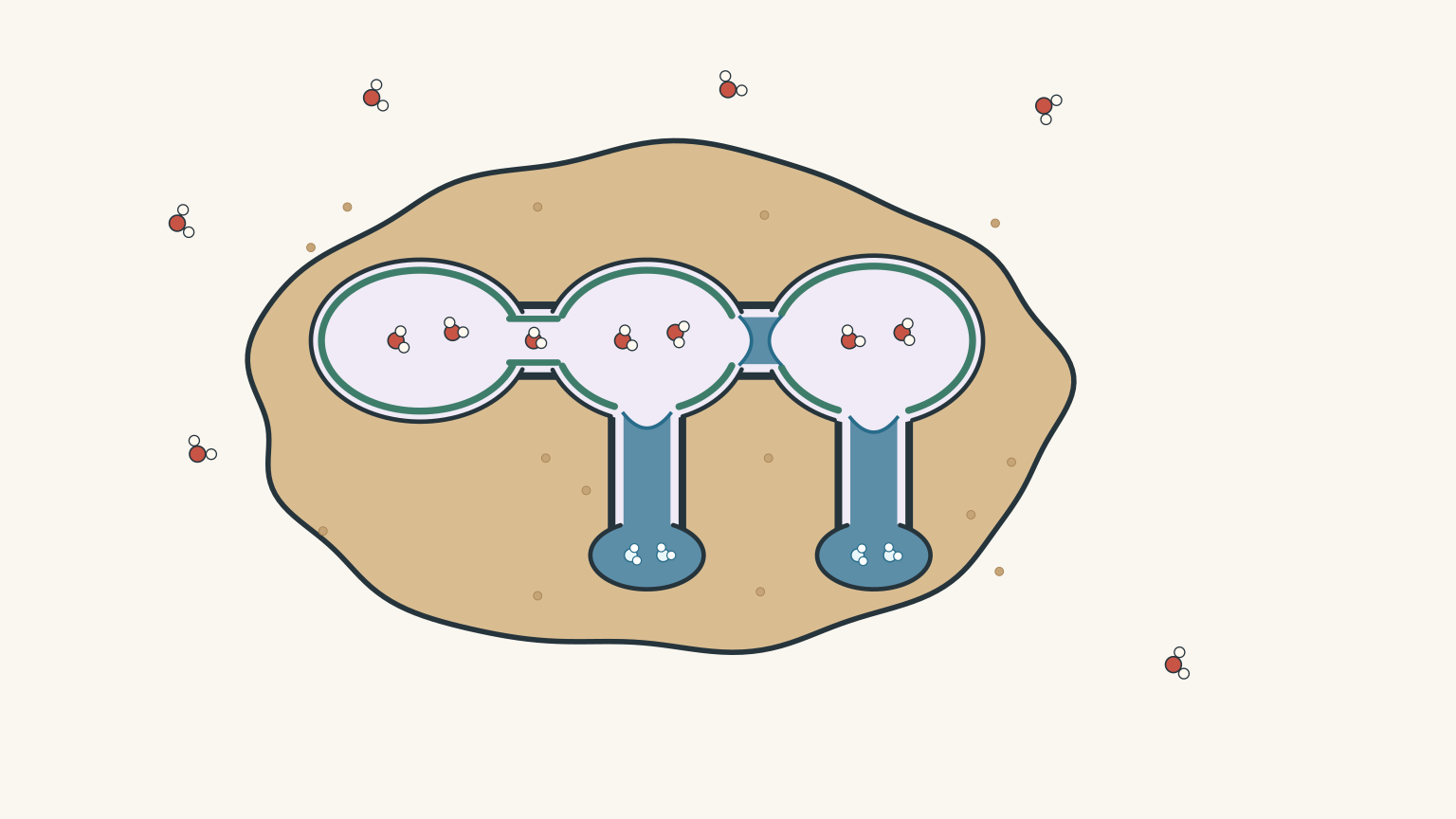
Due to technical limitations, this figure may display incorrectly or contain inaccuracies. Please check key details against your course materials.
01Start with the equilibrium model you already know
Before looking at pores, recall what happens when pressure changes in a gaseous chemical equilibrium.
Consider the equilibrium:
\[ \ce{N2O4(g) <=> 2NO2(g)} \]
Suppose the volume of a sealed container is reduced while temperature remains constant.
The gas molecules become more concentrated. They are closer together, so collisions become more frequent.
Both forward and reverse reaction rates increase initially. However, the reverse reaction involves two \(\ce{NO2}\) molecules colliding to form one \(\ce{N2O4}\) molecule. Its collision frequency responds more strongly to the increase in concentration than the unimolecular forward dissociation.
The reverse reaction is therefore favoured initially. The system shifts towards the side containing fewer gaseous particles until the forward and reverse rates become equal again.
This is the qualitative collision-theory model used to explain pressure changes in gaseous equilibrium systems.
Capillary condensation involves a different kind of equilibrium.
The relevant physical change is:
\[ \ce{H2O(g) <=> H2O(l)} \]
Water molecules are not being converted into a different chemical substance. They are changing phase.
Collision theory still helps explain how quickly vapour molecules reach and leave a surface. However, counting gaseous particles on each side of a chemical equation does not explain why condensation can occur below the bulk saturation pressure.
For that, we need to consider the curvature of the liquid surface.
02Why does a small pore change the condensation pressure?
Imagine a narrow channel through a solid material. Water molecules are attracted to the walls of the channel.
As water vapour comes into contact with the surface, some molecules accumulate there. This process is called adsorption.
The adsorbed water forms a thin film along the pore walls. As more water accumulates, the liquid film can develop a curved boundary with the remaining vapour.
This boundary is called a meniscus.
In a water-wet pore, the meniscus is concave towards the vapour. Its shape is important because a curved liquid surface has a different equilibrium vapour pressure from a flat liquid surface.
Flat surfaces versus curved surfaces
The saturation vapour pressure, \(p_{\mathrm{sat}}\), is the equilibrium vapour pressure above a flat surface of the pure liquid at a particular temperature.
For example, at 25°C, water has a particular saturation vapour pressure. If the water vapour pressure is below this value, a flat water surface experiences net evaporation rather than condensation.
However, a curved meniscus behaves differently.
Surface tension causes a pressure difference across a curved liquid surface. For a hemispherical meniscus, the magnitude of this pressure difference is:
\[ \Delta P=\frac{2\gamma}{r_m} \]
Here:
- \(\Delta P\) is the pressure difference across the interface.
- \(\gamma\) is the liquid-vapour surface tension.
- \(r_m\) is the radius of curvature of the meniscus.
For a wetting pore, the liquid pressure is lower than the surrounding gas pressure.
This changes the chemical potential of the confined liquid. Consequently, the vapour pressure needed to maintain equilibrium with that liquid is lower than the saturation vapour pressure above a flat surface.
The result is important:
A concave meniscus can be in equilibrium with water vapour at a pressure below the bulk saturation vapour pressure.
Now consider two pores containing the same liquid at the same temperature.
Which pore should condense water at the lower vapour pressure: the wider pore or the narrower one?
The narrower pore.
Its meniscus has a smaller radius of curvature. This produces a larger curvature effect and lowers the equilibrium vapour pressure further.
This is the central reason capillary condensation occurs preferentially in smaller wetting pores.
03The Kelvin equation
The relationship between vapour pressure and the curvature of a liquid surface is described by the Kelvin equation.
For a concave liquid-vapour interface:
\[ \ln\left(\frac{p}{p_{\mathrm{sat}}}\right) = -\frac{\gamma V_m}{RT} \left( \frac{1}{r_1}+\frac{1}{r_2} \right) \]
The symbols represent:
| Symbol | Meaning | SI unit |
|---|---|---|
| \(p\) | Equilibrium vapour partial pressure | Pa |
| \(p_{\mathrm{sat}}\) | Bulk saturation vapour pressure | Pa |
| \(\gamma\) | Liquid-vapour surface tension | N m\(^{-1}\) |
| \(V_m\) | Molar volume of the liquid | m\(^3\) mol\(^{-1}\) |
| \(R\) | Universal gas constant, 8.314 | J mol\(^{-1}\) K\(^{-1}\) |
| \(T\) | Absolute temperature | K |
| \(r_1,r_2\) | Principal radii of meniscus curvature | m |
The negative sign describes a concave meniscus in a wetting pore. It means:
\[ \ln\left(\frac{p}{p_{\mathrm{sat}}}\right)<0 \]
Therefore:
\[ \frac{p}{p_{\mathrm{sat}}}<1 \]
The equilibrium vapour pressure is below the bulk saturation vapour pressure.
The hemispherical meniscus model
For a hemispherical meniscus, the two principal radii of curvature are equal:
\[ r_1=r_2=r_m \]
The Kelvin equation becomes:
\[ \boxed{ \ln\left(\frac{p}{p_{\mathrm{sat}}}\right) = -\frac{2\gamma V_m}{r_mRT} } \]
This is the form we will use in the worked examples.
Notice that the coefficient of 2 comes from the two equal principal curvatures.
A cylindrical meniscus has only one finite principal radius of curvature. Its other radius is effectively infinite, so the corresponding equation contains a factor of 1 rather than 2.
Always check the assumed meniscus geometry before substituting values.
Relative pressure and humidity
The ratio
\[ \frac{p}{p_{\mathrm{sat}}} \]
is called the relative pressure.
It is dimensionless because both pressures have the same units.
For water vapour in air, this ratio is also the fractional relative humidity.
For example:
| Relative pressure | Relative humidity |
|---|---|
| 0.60 | 60% |
| 0.80 | 80% |
| 0.95 | 95% |
| 1.00 | 100% |
A pore that condenses water at a relative pressure of 0.80 can therefore fill at approximately 80% relative humidity, even though the surrounding air is not saturated.
What about contact angle?
So far, we have assumed that water completely wets the pore walls.
This is an important assumption.
The contact angle, \(\theta\), describes the angle at which the liquid-vapour interface meets the solid surface, measured through the liquid.
- At \(\theta=0^\circ\), the surface is completely wetting.
- At \(\theta<90^\circ\), the surface is wetting.
- At \(\theta>90^\circ\), the surface is non-wetting.
For an ideal cylindrical pore with a hemispherical meniscus, a useful form of the Kelvin equation is:
\[ \ln\left(\frac{p}{p_{\mathrm{sat}}}\right) \approx -\frac{2\gamma V_m\cos\theta} {(r_p-t)RT} \]
Here, \(r_p\) is the pore radius and \(t\) is the thickness of the adsorbed liquid film.
The effective radius available to the meniscus is approximately \(r_p-t\).
When \(\theta=0^\circ\), \(\cos\theta=1\), giving the fully wetting model.
As the contact angle increases towards \(90^\circ\), the curvature effect becomes weaker. The condensation threshold moves closer to the bulk saturation pressure.
For a non-wetting surface, this simple model does not predict condensation below bulk saturation pressure.
This means pore size is not the only factor controlling capillary condensation. The interaction between the liquid and the solid matters as well.
04How does a pore actually fill?
Capillary condensation does not normally begin with an entirely empty pore suddenly becoming full.
There is a sequence of events.
Stage 1: Adsorption
At relatively low vapour pressures, water molecules accumulate on the pore walls through intermolecular attractions.
This is physical adsorption, or physisorption. The water molecules are not forming a new chemical compound with the solid.
Stage 2: Film growth
As the relative pressure increases, additional water molecules adsorb.
The film becomes thicker, reducing the amount of space available for the vapour.
Stage 3: Capillary condensation
Eventually, the pressure reaches the equilibrium condition for a curved liquid-vapour interface in that pore.
A liquid-like phase fills the remaining pore space.
This can produce a substantial increase in the amount of liquid held by the material over a relatively small increase in vapour pressure.
Stage 4: Further pore filling
As pressure increases, progressively larger pores can fill.
Eventually, the vapour pressure approaches the bulk saturation pressure, and bulk condensation becomes possible.
Where collision theory fits
The pressure dependence can still be understood qualitatively through molecular collisions.
At constant temperature, increasing the vapour partial pressure increases the number of vapour molecules per unit volume. More molecules strike the pore walls and liquid interface per second.
However, the rate of evaporation also matters.
At a particular pore-specific equilibrium pressure, the rates of condensation and evaporation are equal.
- Below that pressure, evaporation exceeds condensation.
- Above that pressure, condensation exceeds evaporation.
- At equilibrium, the two rates are equal.
The Kelvin equation explains why this balance occurs at a lower pressure in a small wetting pore than above a flat liquid surface.
This distinction is worth remembering: collision theory helps explain the rates, while the curvature-dependent equilibrium condition explains the unusual condensation pressure.
Capillary condensation is also different from ordinary capillary rise. Capillary rise involves liquid moving into a narrow space from an existing liquid reservoir. Capillary condensation involves vapour becoming liquid inside a pore.
05Worked example: Calculate the condensation pressure in a small pore
An ideal cylindrical pore has a diameter of 10.0 nm. Water completely wets its walls, and the liquid-vapour interface is assumed to be hemispherical.
At 25°C, calculate the relative vapour pressure at which capillary condensation occurs.
Use the following values:
- Surface tension of water: \(\gamma=0.072\ \mathrm{N\,m^{-1}}\)
- Molar volume of water: \(V_m=18.0\times10^{-6}\ \mathrm{m^3\,mol^{-1}}\)
- Gas constant: \(R=8.314\ \mathrm{J\,mol^{-1}\,K^{-1}}\)
- Temperature: \(T=298\ \mathrm{K}\)
Assume the adsorbed film thickness is negligible.
Step 1
The pore diameter is 10.0 nm.
For the assumed hemispherical meniscus and complete wetting, the radius of curvature is approximately the pore radius:
\[ r_m=\frac{10.0}{2}=5.0\ \mathrm{nm} \]
Convert to metres:
\[ r_m=5.0\times10^{-9}\ \mathrm{m} \]
Step 2
Because the meniscus is hemispherical:
\[ \ln\left(\frac{p}{p_{\mathrm{sat}}}\right) = -\frac{2\gamma V_m}{r_mRT} \]
Step 3
\[ \ln\left(\frac{p}{p_{\mathrm{sat}}}\right) = -\frac{2(0.072)(18.0\times10^{-6})} {(5.0\times10^{-9})(8.314)(298)} \]
Therefore:
\[ \ln\left(\frac{p}{p_{\mathrm{sat}}}\right) =-0.209 \]
Step 4
Take the exponential of both sides:
\[ \frac{p}{p_{\mathrm{sat}}}=e^{-0.209} \]
\[ \boxed{\frac{p}{p_{\mathrm{sat}}}=0.811} \]
The pore undergoes capillary condensation at approximately 81.1% relative pressure.
For water vapour, this corresponds to approximately 81.1% relative humidity.
The result demonstrates that liquid water can form inside this idealised pore well below the 100% relative humidity required for bulk condensation.
06Worked example: Estimate pore size from condensation pressure
A porous material contains cylindrical pores with completely wetting walls.
At 25°C, capillary condensation begins in one pore population when the water vapour relative pressure reaches 0.85.
Assume a hemispherical meniscus and an adsorbed film thickness of 0.50 nm.
Estimate the diameter of the pores.
Use:
\[ \gamma=0.072\ \mathrm{N\,m^{-1}} \]
\[ V_m=18.0\times10^{-6}\ \mathrm{m^3\,mol^{-1}} \]
\[ R=8.314\ \mathrm{J\,mol^{-1}\,K^{-1}} \]
\[ T=298\ \mathrm{K} \]
Step 1
Start with:
\[ \ln\left(\frac{p}{p_{\mathrm{sat}}}\right) = -\frac{2\gamma V_m}{r_mRT} \]
Rearranging:
\[ r_m= -\frac{2\gamma V_m} {RT\ln(p/p_{\mathrm{sat}})} \]
Step 2
\[ r_m= \frac{2(0.072)(18.0\times10^{-6})} {(8.314)(298)[-\ln(0.85)]} \]
Since:
\[ -\ln(0.85)=0.1625 \]
We obtain:
\[ r_m=6.44\times10^{-9}\ \mathrm{m} \]
Therefore:
\[ r_m=6.44\ \mathrm{nm} \]
Step 3
The meniscus forms inside the adsorbed film, so the pore radius is larger than the meniscus radius.
\[ r_p=r_m+t \]
\[ r_p=6.44+0.50 \]
\[ r_p=6.94\ \mathrm{nm} \]
Step 4
\[ d=2r_p \]
\[ d=2(6.94) \]
\[ \boxed{d=13.9\ \mathrm{nm}} \]
The estimated pore diameter is approximately 13.9 nm.
This is a mesopore, consistent with the use of a capillary-condensation model.
The calculation also demonstrates why the adsorbed film cannot always be ignored. The meniscus does not occupy the entire original pore radius.
07When is the Kelvin equation reliable?
The Kelvin equation is a useful model, but it is not an exact description of every pore.
Its main assumptions are:
- The liquid has bulk-like surface tension and molar volume.
- The pore has a reasonably well-defined geometry.
- A recognisable liquid-vapour interface exists.
- The system is sufficiently close to equilibrium.
- The contact angle and adsorbed film thickness can be estimated.
These assumptions become increasingly problematic as pores become extremely small.
Mesopores versus micropores
The International Union of Pure and Applied Chemistry (IUPAC) classifies pores approximately as follows:
| Pore classification | Pore width |
|---|---|
| Micropores | Less than 2 nm |
| Mesopores | 2-50 nm |
| Macropores | Greater than 50 nm |
Capillary condensation is particularly relevant to mesoporous materials.
In micropores, the distance between opposing walls becomes so small that their attractive potentials overlap. Molecules can fill the pore without forming a conventional, bulk-like curved meniscus.
This process is generally called micropore filling rather than capillary condensation.
Applying the Kelvin equation to such pores can produce misleading pore-size estimates.
More advanced approaches, including molecular simulation and density functional theory, are used to describe these smaller structures.
Why adsorption and desorption can behave differently
There is another interesting complication.
Imagine gradually increasing the vapour pressure until a pore fills with liquid. Now gradually reduce the pressure.
You might expect the pore to empty at exactly the same pressure at which it filled.
That is not necessarily what happens.
The adsorption and desorption pathways can have different meniscus geometries. In a classic model of an open cylindrical pore, condensation can occur through a cylindrical meniscus, while evaporation occurs through a hemispherical meniscus.
These interfaces have different curvatures, so their equilibrium pressures differ.
The resulting difference between the adsorption and desorption pathways is called adsorption hysteresis.
Hysteresis can also arise from pore-network effects, metastable liquid states, and differences between pore bodies and their connecting necks.
This is why the pore structure matters, not just the average pore diameter.
The IUPAC technical report by Thommes and colleagues (2015) discusses these complications in detail. A useful modern review by Schlumberger and Thommes (2021) also compares classical Kelvin-based methods with more advanced approaches to pore characterisation.
For related foundations, see Adsorption Isotherms: Surface Coverage and Equilibrium and Chemical Potential.
Scientific sources
- Thommes, M. et al. (2015). Physisorption of gases, with special reference to the evaluation of surface area and pore size distribution (IUPAC Technical Report). Pure and Applied Chemistry, 87, 1051-1069. DOI: 10.1515/pac-2014-1117.
- Schlumberger, C. and Thommes, M. (2021). Characterization of Hierarchically Ordered Porous Materials by Physisorption and Mercury Porosimetry-A Tutorial Review. Advanced Materials Interfaces. DOI: 10.1002/admi.202002181.
- Cohan, L. H. (1944). Hysteresis and the Capillary Theory of Adsorption of Vapors. Journal of the American Chemical Society, 66, 98-105. DOI: 10.1021/ja01229a028.
- Evans, R., Marini Bettolo Marconi, U. and Tarazona, P. (1986). Capillary condensation and adsorption in cylindrical and slit-like pores. Journal of the Chemical Society, Faraday Transactions 2, 82, 1763-1787. DOI: 10.1039/F29868201763.
08Questions and solutions
The following questions use idealised models. Unless otherwise stated, assume water at 298 K, complete wetting, and:
\[ \gamma=0.072\ \mathrm{N\,m^{-1}} \]
\[ V_m=18.0\times10^{-6}\ \mathrm{m^3\,mol^{-1}} \]
\[ R=8.314\ \mathrm{J\,mol^{-1}\,K^{-1}} \]
For convenience:
\[ \frac{\gamma V_m}{RT}=0.523\ \mathrm{nm} \]
Question 1
Two independent cylindrical pores contain water vapour at the same temperature.
- Pore A has a diameter of 6.0 nm.
- Pore B has a diameter of 18.0 nm.
Both pores have completely wetting walls and identical hemispherical meniscus geometries. Ignore adsorbed film thickness.
Which pore undergoes capillary condensation at the lower relative vapour pressure? Explain using the Kelvin equation.
Solution 1
Pore A, the 6.0 nm pore, undergoes capillary condensation at the lower relative vapour pressure.
The Kelvin equation for a hemispherical meniscus is:
\[ \ln\left(\frac{p}{p_{\mathrm{sat}}}\right) = -\frac{2\gamma V_m}{r_mRT} \]
Pore A has a smaller radius of curvature than pore B.
Since the radius appears in the denominator, a smaller radius produces a larger negative value of the logarithm.
Consequently, the equilibrium relative pressure is lower.
We can verify this numerically.
For pore A:
\[ r_A=3.0\ \mathrm{nm} \]
\[ \frac{p_A}{p_{\mathrm{sat}}} = e^{-2(0.523)/3.0} \]
\[ \frac{p_A}{p_{\mathrm{sat}}} \approx0.705 \]
For pore B:
\[ r_B=9.0\ \mathrm{nm} \]
\[ \frac{p_B}{p_{\mathrm{sat}}} = e^{-2(0.523)/9.0} \]
\[ \frac{p_B}{p_{\mathrm{sat}}} \approx0.890 \]
Pore A therefore condenses at approximately 70.5% relative pressure, compared with 89.0% for pore B.
The important principle is that smaller wetting pores can retain condensed liquid at lower vapour pressures because their menisci have greater curvature.
Question 2
A cylindrical pore has a radius of 7.0 nm. An adsorbed water film of thickness 0.50 nm coats its walls.
Assume complete wetting and a hemispherical meniscus.
- Calculate the relative vapour pressure at which capillary condensation occurs.
- Determine whether condensation occurs at 80% relative humidity.
- Determine whether condensation occurs at 90% relative humidity.
Solution 2
The condensation threshold is approximately 85.1% relative pressure. The pore does not undergo capillary condensation at 80% relative humidity, but it does at 90%.
Step 1: Calculate the effective meniscus radius.
The adsorbed film reduces the space available to the meniscus.
\[ r_m=r_p-t \]
\[ r_m=7.0-0.50 \]
\[ r_m=6.50\ \mathrm{nm} \]
Step 2: Apply the Kelvin equation.
\[ \ln\left(\frac{p}{p_{\mathrm{sat}}}\right) = -\frac{2(0.523)}{6.50} \]
\[ \ln\left(\frac{p}{p_{\mathrm{sat}}}\right) =-0.161 \]
Step 3: Calculate the relative pressure.
\[ \frac{p}{p_{\mathrm{sat}}}=e^{-0.161} \]
\[ \boxed{\frac{p}{p_{\mathrm{sat}}}=0.851} \]
Step 4: Compare the two humidity conditions.
At 80% relative humidity:
\[ 0.80<0.851 \]
The vapour pressure is below the pore-specific condensation threshold. Net pore filling is not favoured.
At 90% relative humidity:
\[ 0.90>0.851 \]
The vapour pressure exceeds the pore-specific threshold. Net condensation is favoured.
The distinction is that the pore can contain an adsorbed film even below the capillary-condensation threshold. Not all adsorption means the pore has completely filled.
Question 3
Two cylindrical pores have identical radii of 6.0 nm.
However, their surface properties differ:
- Pore A has a contact angle of \(0^\circ\).
- Pore B has a contact angle of \(60^\circ\).
Assume hemispherical menisci and negligible adsorbed film thickness.
- Calculate the relative condensation pressure for each pore.
- At a relative humidity of 88%, determine which pore undergoes capillary condensation.
- Explain why pore size alone is insufficient to predict the condensation pressure.
Solution 3
Pore A condenses at a lower relative pressure and is the only pore that fills at 88% relative humidity.
The relevant equation is:
\[ \ln\left(\frac{p}{p_{\mathrm{sat}}}\right) = -\frac{2\ell_K\cos\theta}{r_p} \]
where \(\ell_K=0.523\ \mathrm{nm}\) is the Kelvin length for water at 298 K.
Step 1: Calculate the threshold for pore A.
For pore A:
\[ \theta=0^\circ \]
\[ \cos0^\circ=1 \]
Therefore:
\[ \ln\left(\frac{p_A}{p_{\mathrm{sat}}}\right) = -\frac{2(0.523)(1)}{6.0} \]
\[ =-0.174 \]
Taking the exponential:
\[ \boxed{\frac{p_A}{p_{\mathrm{sat}}}=0.840} \]
Step 2: Calculate the threshold for pore B.
For pore B:
\[ \theta=60^\circ \]
\[ \cos60^\circ=0.5 \]
Therefore:
\[ \ln\left(\frac{p_B}{p_{\mathrm{sat}}}\right) = -\frac{2(0.523)(0.5)}{6.0} \]
\[ =-0.0872 \]
Taking the exponential:
\[ \boxed{\frac{p_B}{p_{\mathrm{sat}}}=0.916} \]
Step 3: Compare the thresholds with 88% relative humidity.
For pore A:
\[ 0.88>0.840 \]
Condensation is favoured.
For pore B:
\[ 0.88<0.916 \]
Capillary condensation is not yet favoured.
Pore A fills while pore B remains below its condensation threshold.
The tempting assumption is that identical pore sizes must produce identical condensation pressures.
However, the contact angle changes the meniscus curvature. Pore B is less wetting, so its condensation threshold is closer to bulk saturation.
This demonstrates why both pore geometry and surface chemistry must be considered.
Question 4
A sealed chamber contains air, water vapour, a flat water surface, and a porous hydrophilic material.
At constant temperature, the water vapour partial pressure increases from:
\[ 0.75p_{\mathrm{sat}} \]
to:
\[ 0.85p_{\mathrm{sat}} \]
A Kelvin model predicts that one population of pores in the material has a capillary-condensation threshold of:
\[ 0.81p_{\mathrm{sat}} \]
Explain why:
- The flat water surface experiences net evaporation.
- The porous material experiences net condensation.
- A student cannot correctly explain both observations simply by applying the HSC rule that increased pressure favours the side with fewer gaseous particles.
Your answer should include collision theory and the difference between chemical and phase equilibrium.
Solution 4
The flat surface experiences net evaporation, while the porous material experiences net condensation. The difference arises because the two surfaces have different equilibrium vapour pressures.
Part 1: The flat water surface
The saturation vapour pressure above a flat water surface is:
\[ p_{\mathrm{sat}} \]
The final vapour pressure is:
\[ p=0.85p_{\mathrm{sat}} \]
Therefore:
\[ p<p_{\mathrm{sat}} \]
The surrounding vapour pressure is below the equilibrium pressure for a flat water surface.
More water molecules leave the liquid than return from the vapour, so there is net evaporation.
Part 2: The porous material
The pore-specific condensation threshold is:
\[ p_{\mathrm{eq,pore}}=0.81p_{\mathrm{sat}} \]
The final vapour pressure is:
\[ p=0.85p_{\mathrm{sat}} \]
Therefore:
\[ p>p_{\mathrm{eq,pore}} \]
The vapour pressure exceeds the equilibrium pressure associated with the curved meniscus.
More water molecules condense than evaporate, so there is net pore filling.
Part 3: Why the ordinary gaseous equilibrium rule is insufficient
The student’s reasoning confuses two different equilibrium systems.
In a homogeneous gaseous chemical equilibrium, changing pressure affects the concentrations and collision frequencies of the gaseous reactants and products. The resulting change in forward and reverse reaction rates can shift the chemical equilibrium.
In capillary condensation, water vapour and liquid water are the same chemical substance in different physical states.
There is no change in the number of gaseous particles through a chemical reaction.
Collision theory still provides useful information. Increasing the vapour pressure increases the frequency of water molecules striking the liquid surfaces. However, the direction of net transfer also depends on the evaporation rate and the equilibrium condition of the interface.
The flat surface has an equilibrium pressure of \(p_{\mathrm{sat}}\), while the curved meniscus has a lower equilibrium pressure.
That is why the two surfaces can experience opposite net changes under the same vapour conditions.
Question 5
A porous material contains an idealised ink-bottle-shaped pore.
The pore consists of:
- A wide cylindrical body with a radius of 12 nm.
- A narrow connecting neck with a radius of 4 nm.
Water completely wets both surfaces. Assume hemispherical menisci, negligible adsorbed film thickness, and water at 298 K.
For this idealised model, assume that vapour can reach the empty pore body through the neck. Once the body fills, a continuous liquid column remains connected through the neck. Evaporation can then occur only through a meniscus in the narrow neck.
Ignore independent filling of the neck, cavitation, and other pore-network effects.
The pore initially contains vapour.
A pressure cycle is applied:
- The relative vapour pressure increases from 0.70 to 0.93.
- It then decreases to 0.85.
- It decreases further to 0.75.
- Finally, it increases again to 0.85.
Determine:
a. The relative pressure at which the pore body initially fills.
b. The relative pressure at which the liquid can escape through the neck.
c. Whether the pore is liquid-filled or empty at the two occasions when the relative pressure is 0.85.
d. Why the same vapour pressure can correspond to two different pore states.
Solution 5
The pore fills when the relative pressure reaches approximately 0.917 and empties when it falls below approximately 0.770. At 0.85, the pore can be either liquid-filled or empty, depending on the pressure history.
This is an example of pore-network hysteresis.
The crucial detail is that the body and neck control different stages of the process.
Part a: Determine the body-filling pressure
Initially, the pore is dry, and vapour can reach the wide body through the neck.
Under the stated ideal ink-bottle assumptions, condensation in the body is governed by its radius.
For a hemispherical meniscus:
\[ \ln\left(\frac{p_{\mathrm{body}}}{p_{\mathrm{sat}}}\right) = -\frac{2\ell_K}{r_{\mathrm{body}}} \]
Substitute:
\[ = -\frac{2(0.523)}{12} \]
\[ =-0.0872 \]
Taking the exponential:
\[ \boxed{ \frac{p_{\mathrm{body}}}{p_{\mathrm{sat}}} =0.9165 } \]
The pore body therefore fills when the relative pressure reaches approximately 0.917.
Part b: Determine the emptying pressure
Once the body is filled, the liquid remains connected through the narrow neck.
For evaporation, the meniscus is now controlled by the neck radius.
\[ \ln\left(\frac{p_{\mathrm{neck}}}{p_{\mathrm{sat}}}\right) = -\frac{2\ell_K}{r_{\mathrm{neck}}} \]
Substitute:
\[ = -\frac{2(0.523)}{4} \]
\[ =-0.2615 \]
Taking the exponential:
\[ \boxed{ \frac{p_{\mathrm{neck}}}{p_{\mathrm{sat}}} =0.770 } \]
The liquid can escape when the pressure falls below approximately 0.770.
Part c: Follow the pressure cycle
The pore begins empty at 0.70.
| Stage | Relative pressure | Pore state |
|---|---|---|
| Initial | 0.70 | Empty |
| Pressure increases | 0.93 | Fills |
| Pressure decreases | 0.85 | Remains filled |
| Pressure decreases further | 0.75 | Empties |
| Pressure increases again | 0.85 | Remains empty |
At 0.93, the pressure exceeds the body-filling threshold of 0.917, so the pore fills.
When pressure falls to 0.85, it is still above the neck-emptying threshold of 0.770. The liquid therefore remains trapped in the pore.
When pressure reaches 0.75, it falls below the neck threshold. Evaporation can proceed, and the pore empties.
On the final increase to 0.85, the pore remains empty because this pressure is still below the body-filling threshold.
Part d: Explain the different states at the same pressure
The pore can be liquid-filled or empty at 0.85 because the pressure at which it fills differs from the pressure at which it empties.
The tempting approach is to assume that one pore radius must control both processes.
However, the relevant interface changes as the pore changes state.
While the pore is dry, vapour can reach the wide body, and the body radius determines the filling threshold.
After the body fills, the continuous liquid column cannot simply evaporate from the wide cavity. Its escape is controlled by the narrow neck.
The narrow neck therefore delays evaporation until the vapour pressure becomes sufficiently low.
This produces a history-dependent state, known as hysteresis. It does not mean that the Kelvin equation has stopped working. It means that the system can remain in a metastable state because the pathway for filling differs from the pathway for emptying.
This is an idealised ink-bottle model. Real porous materials can have additional complications, including interconnected pores, pore blocking, and cavitation.
09What this lets you understand next
Capillary condensation connects equilibrium chemistry to the behaviour of real porous materials.
The key idea is that equilibrium vapour pressure is not always determined by temperature alone. The curvature of the liquid surface, the pore geometry, and the interaction between the liquid and solid can all affect the pressure at which condensation occurs.
The next useful concept is adsorption isotherms. They show how the amount of vapour adsorbed changes with relative pressure. Once you understand capillary condensation, the steep rises and hysteresis loops in these graphs become evidence about the size and connectivity of pores, rather than just unexplained features of an experimental curve.