
Detailed Balance: How Molecular Reactions Behave at Equilibrium
Explore how individual molecular reaction pathways balance at equilibrium, why constant concentrations do not always indicate equilibrium, and how catalysts and reaction mechanisms fit into the picture.
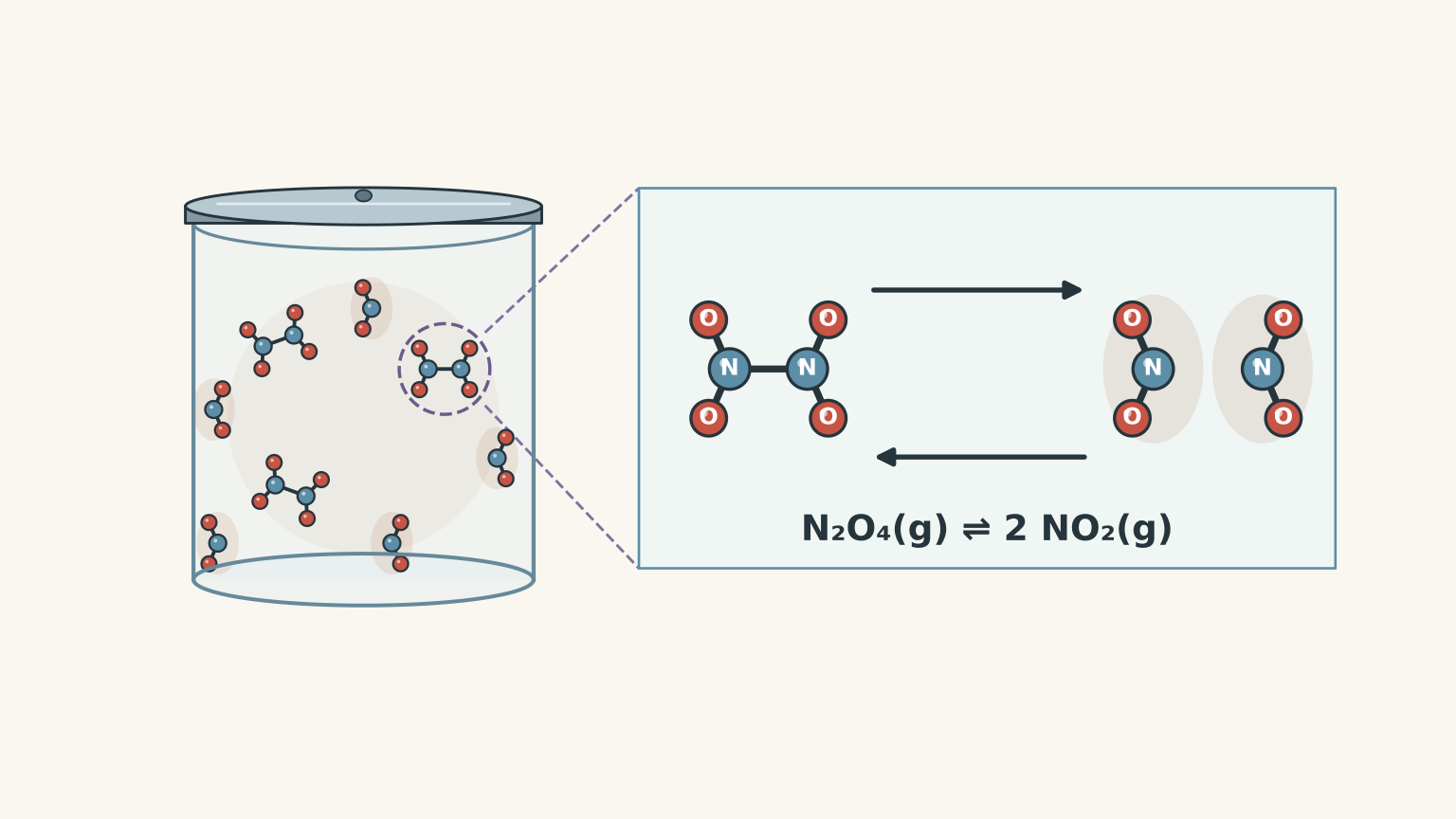
A sealed vessel containing dinitrogen tetroxide, \(\ce{N2O4}\), gradually turns brown as some of the colourless molecules dissociate into brown nitrogen dioxide, \(\ce{NO2}\). Eventually, the colour stops changing.
Does that mean the reaction has stopped?
Not at all. Molecules are still dissociating and recombining. The number of molecules of each type simply stops changing on a macroscopic scale.
Now consider a more difficult question. If the overall concentrations remain constant, must every individual reaction pathway also be balanced? Or could one pathway be moving forward while another moves backwards, with the overall system appearing unchanged?
This is where detailed balance becomes important. It explains what equilibrium means at the level of individual molecular processes, rather than just observable concentrations.
Extension note: Detailed balance goes beyond the required HSC Chemistry equilibrium content. This article builds on the Year 12 dynamic-equilibrium model in the NSW Chemistry 11-12 Syllabus (2025), but detailed balance is additional enrichment, not an HSC assessment requirement. The 2025 syllabus is scheduled for implementation from 2028. NESA syllabus information.
01The equilibrium model you already know
In Year 12 Chemistry, you learn that a reversible reaction can reach dynamic equilibrium in a closed system.
Consider:
\[ \ce{N2O4(g) <=> 2NO2(g)} \]
Initially, if the vessel contains only \(\ce{N2O4}\), the forward reaction proceeds while the reverse reaction has essentially no opportunity to occur.
As \(\ce{NO2}\) forms, however, its concentration increases. More \(\ce{NO2}\) molecules become available to recombine, increasing the reverse reaction rate.
Meanwhile, the decreasing concentration of \(\ce{N2O4}\) causes the forward reaction rate to decrease.
Eventually, the two rates become equal.
Due to technical limitations, this figure may display incorrectly or contain inaccuracies. Please check key details against your course materials.
At this point, the forward and reverse reactions continue, but there is no net change in the concentrations.
This explains why macroscopic properties, such as colour and pressure, remain constant.
The distinction is between what individual molecules are doing and what we observe when considering the entire sample.
Notice something important: the concentrations of reactants and products do not have to be equal at equilibrium.
Only their forward and reverse reaction rates must be equal.
NESA’s 2025 syllabus defines dynamic equilibrium in terms of equal forward and reverse rates and the absence of macroscopic changes. This is the foundation we are extending here. NESA Chemistry glossary.【turn943832view0】
02What does detailed balance add?
The Year 12 model describes the overall behaviour of a reversible reaction.
Detailed balance asks us to look more closely at the individual molecular processes responsible for that behaviour.
To understand this, we first need to distinguish an elementary reaction from an overall reaction.
Elementary reactions and their reverse processes
An elementary reaction is a single molecular event. It occurs through one elementary process rather than through several consecutive reaction steps.
Consider the simple reversible process:
\[ \ce{A <=> B} \]
For this elementary reaction, we can describe the forward and reverse rates using:
\[ v_f=k_f[A] \]
\[ v_r=k_r[B] \]
Here:
- \(v_f\) is the forward reaction rate.
- \(v_r\) is the reverse reaction rate.
- \(k_f\) is the forward rate constant.
- \(k_r\) is the reverse rate constant.
- \([A]\) and \([B]\) are the molar concentrations of the two species.
Both rates are measured in \(\mathrm{mol\,L^{-1}\,s^{-1}}\), while the rate constants have units of \(\mathrm{s^{-1}}\).
The net reaction rate is:
\[ v_{\mathrm{net}}=v_f-v_r \]
At equilibrium:
\[ v_f=v_r \]
Therefore:
\[ v_{\mathrm{net}}=0 \]
But detailed balance makes a stronger statement.
Every elementary molecular process at equilibrium is balanced by its exact reverse process.
It is not enough for the total number of molecules entering and leaving a particular group of chemical species to balance. Each individual elementary transition must be matched by its reverse, when the system is at genuine equilibrium.
This is closely related to the principle of microscopic reversibility. IUPAC describes it as the average rate of a molecular process matching that of its reverse at equilibrium.【turn929816search5】
A useful way to picture it
Imagine two rooms connected by two separate corridors.
People can travel from Room A to Room B through either corridor, and they can also travel in the opposite direction.
Suppose ten people per minute travel from A to B through the first corridor, while ten people per minute return through the second corridor.
The number of people in each room can remain constant. However, neither corridor is balanced. There is a continuous circulation of people around the two routes.
At equilibrium, detailed balance requires each corridor’s forward traffic to match its own reverse traffic.
The analogy is not a literal description of molecular behaviour. Molecules do not choose corridors or deliberately select reaction pathways. Instead, the different routes represent different sequences of molecular events.
The important distinction is that balanced totals do not necessarily mean balanced individual pathways.
03Worked example: Are the forward and reverse molecular rates equal?
Consider the elementary reaction:
\[ \ce{N2O4(g) <=> 2NO2(g)} \]
At a particular temperature, a sealed vessel contains:
- \([\ce{N2O4}]=0.040\ \mathrm{mol\,L^{-1}}\)
- \([\ce{NO2}]=0.020\ \mathrm{mol\,L^{-1}}\)
The forward rate constant is \(0.30\ \mathrm{s^{-1}}\), and the reverse rate constant is \(30\ \mathrm{L\,mol^{-1}\,s^{-1}}\).
Determine whether the reaction satisfies detailed balance at this composition.
Step 1
For the forward dissociation:
\[ v_f=k_f[\ce{N2O4}] \]
For the reverse association:
\[ v_r=k_r[\ce{NO2}]^2 \]
The squared concentration in the reverse expression comes from the assumed elementary bimolecular association of two \(\ce{NO2}\) molecules.
Step 2
\[ \begin{aligned} v_f&=0.30\times0.040\\ &=0.012\ \mathrm{mol\,L^{-1}\,s^{-1}} \end{aligned} \]
Step 3
\[ \begin{aligned} v_r&=30\times(0.020)^2\\ &=30\times0.0004\\ &=0.012\ \mathrm{mol\,L^{-1}\,s^{-1}} \end{aligned} \]
Step 4
\[ v_f=v_r=0.012\ \mathrm{mol\,L^{-1}\,s^{-1}} \]
The forward and reverse rates are equal, so the elementary reaction satisfies detailed balance at this composition.
Molecules continue to dissociate and recombine, but the two processes balance each other exactly on average.
Notice that both rates are non-zero. Equilibrium does not mean that molecular activity has stopped.
Connecting detailed balance to the equilibrium constant
There is another useful consequence.
For an elementary reversible reaction:
\[ \ce{aA + bB <=> cC + dD} \]
the elementary forward and reverse rate expressions are:
\[ v_f=k_f[A]^a[B]^b \]
\[ v_r=k_r[C]^c[D]^d \]
At equilibrium:
\[ k_f[A]^a[B]^b = k_r[C]^c[D]^d \]
Rearranging gives:
\[ \frac{k_f}{k_r} = \frac{[C]^c[D]^d} {[A]^a[B]^b} \]
Therefore, in the ideal concentration-based model:
\[ \boxed{K_c=\frac{k_f}{k_r}} \]
This relationship applies to the reversible elementary reaction being considered. It should not automatically be applied to an overall reaction that occurs through several elementary steps.
For the \(\ce{N2O4}\) example:
\[ K_c=\frac{(0.020)^2}{0.040} \]
\[ K_c=0.010\ \mathrm{mol\,L^{-1}} \]
The ratio of the rate constants gives the same result:
\[ \frac{k_f}{k_r}=\frac{0.30}{30}=0.010 \]
The concentration-form equilibrium constant has units here because of the stoichiometry of the reaction. Thermodynamic equilibrium constants expressed using dimensionless activities do not have units.
04Why the reaction mechanism matters
So far, we have considered individual elementary reactions.
Real chemical reactions can involve several elementary steps. The overall chemical equation may hide intermediates and alternative pathways.
Consider a reaction that proceeds through an intermediate, \(I\):
\[ \ce{A <=> I <=> B} \]
The intermediate \(I\) is produced in the first step and consumed in the second. It does not appear in the overall reaction:
\[ \ce{A <=> B} \]
At equilibrium, detailed balance applies to both elementary steps:
\[ v_{1,f}=v_{1,r} \]
\[ v_{2,f}=v_{2,r} \]
This is stronger than simply saying that the overall concentrations of A and B remain constant.
Each step must balance its own reverse process.
Worked example: Finding an equilibrium concentration from a reaction mechanism
A reaction proceeds through the following two elementary steps:
\[ \ce{A <=> I} \]
\[ \ce{I <=> B} \]
Both steps are first order in each direction.
At a fixed temperature, the rate constants are:
| Rate constant | Value |
|---|---|
| \(k_1\) | \(0.50\ \mathrm{s^{-1}}\) |
| \(k_{-1}\) | \(0.25\ \mathrm{s^{-1}}\) |
| \(k_2\) | \(0.20\ \mathrm{s^{-1}}\) |
| \(k_{-2}\) | \(0.40\ \mathrm{s^{-1}}\) |
At equilibrium, \([A]=0.080\ \mathrm{mol\,L^{-1}}\) and \([I]=0.160\ \mathrm{mol\,L^{-1}}\).
Determine the equilibrium concentration of B and the overall equilibrium constant for the reaction \(\ce{A <=> B}\).
Step 1
For \(\ce{A <=> I}\):
\[ v_{1,f}=k_1[A] \]
\[ v_{1,r}=k_{-1}[I] \]
Substituting:
\[ \begin{aligned} v_{1,f}&=0.50\times0.080\\ &=0.040\ \mathrm{mol\,L^{-1}\,s^{-1}} \end{aligned} \]
\[ \begin{aligned} v_{1,r}&=0.25\times0.160\\ &=0.040\ \mathrm{mol\,L^{-1}\,s^{-1}} \end{aligned} \]
The first elementary step satisfies detailed balance.
Step 2
For \(\ce{I <=> B}\):
\[ v_{2,f}=k_2[I] \]
\[ v_{2,r}=k_{-2}[B] \]
At equilibrium:
\[ k_2[I]=k_{-2}[B] \]
Rearranging:
\[ [B]=\frac{k_2[I]}{k_{-2}} \]
Substituting:
\[ [B]=\frac{0.20\times0.160}{0.40} \]
\[ \boxed{[B]=0.080\ \mathrm{mol\,L^{-1}}} \]
The second elementary step is now balanced as well.
Step 3
For the overall reaction:
\[ \ce{A <=> B} \]
the concentration-form equilibrium constant is:
\[ K_c=\frac{[B]}{[A]} \]
Therefore:
\[ K_c=\frac{0.080}{0.080} \]
\[ \boxed{K_c=1.0} \]
We can check this result using the two elementary equilibrium constants.
For the first step:
\[ K_1=\frac{k_1}{k_{-1}}=2.0 \]
For the second step:
\[ K_2=\frac{k_2}{k_{-2}}=0.50 \]
Adding the two reaction steps gives the overall reaction, so their equilibrium constants multiply:
\[ K_c=K_1K_2 \]
\[ K_c=2.0\times0.50=1.0 \]
Both approaches give the same result.
The important point is that the overall equilibrium constant can be obtained from the elementary steps without pretending that the overall reaction occurs in a single molecular event.
A common mistake: Assuming that the stoichiometric coefficients in an overall equation automatically give its rate law. They do not. The rate law follows from the mechanism, and detailed balance applies to the elementary steps in that mechanism.
05A steady state is not necessarily equilibrium
Here is where the distinction becomes particularly important.
You might reason that if every concentration remains constant, the system must be at equilibrium.
That conclusion is incorrect.
A system is in a steady state when the quantities being observed do not change with time. This does not necessarily mean that every individual reaction pathway is balanced by its reverse.
Equilibrium is a special type of steady state. It requires the stronger condition of detailed balance.
A simple continuous-flow example
Imagine a continuously stirred reactor containing a reversible reaction:
\[ \ce{A <=> B} \]
Fresh A enters the reactor, while a mixture containing A and B leaves.
Suppose the forward reaction converts A into B faster than the reverse reaction converts B back into A.
The concentration of B can still remain constant if B is removed at exactly the rate at which it is produced.
Likewise, the concentration of A can remain constant if the incoming supply compensates for its removal and consumption.
The reactor can maintain constant concentrations while chemical conversion continues.
This is a steady state, but it is not chemical equilibrium.
A useful analogy is a bathtub with its tap running and its drain open. The water level can remain unchanged even though water continuously enters and leaves.
The analogy captures the balance of incoming and outgoing quantities, but the chemistry involves reaction events as well as material flows.
Three conditions worth distinguishing
| Property | Equilibrium | Non-equilibrium steady state |
|---|---|---|
| Concentrations remain constant | Yes | Can be yes |
| Forward and reverse rates for each elementary pair are equal | Yes | Not necessarily |
| Persistent net reaction pathways | No | Possible |
| External energy or material supply maintaining the state | Not required | Often required |
The distinction is important in chemistry, particularly when studying reaction mechanisms and systems that consume energy.
A reaction intermediate can also reach a steady-state concentration while the overall reaction continues. This is the basis of the steady-state approximation used in chemical kinetics.
The UCLA Department of Chemistry and Biochemistry explicitly distinguishes steady states from equilibrium and discusses detailed balance at the elementary-reaction level.【turn943832view3】
06What happens when a catalyst is added?
Detailed balance also helps explain why a catalyst does not change the equilibrium composition.
A catalyst provides an alternative reaction pathway with a lower activation energy.
It allows the forward and reverse reactions to occur more quickly, but it does not change the energy difference between the reactants and products.
For a simple reversible elementary reaction, consider:
\[ \ce{A <=> B} \]
Suppose a catalyst increases both effective rate constants by the same factor.
The forward reaction becomes faster, but the reverse reaction also becomes faster.
At equilibrium, their rates remain equal.
This means the system reaches equilibrium more quickly, but its equilibrium constant and final equilibrium composition do not change.
More complicated catalytic mechanisms may introduce several new elementary steps. Detailed balance still applies to the individual forward and reverse processes at equilibrium.
A catalyst cannot create a persistent one-way reaction current in a system that is genuinely at equilibrium.
07When does this model need refining?
The examples so far use simplified concentration-based rate expressions.
They rely on several assumptions:
- The temperature is constant.
- The system is at equilibrium in a closed vessel, unless an open system is explicitly being considered.
- The elementary reaction steps and their reverse processes have been correctly identified.
- Concentration-based expressions are an appropriate approximation for the chemical system.
- No external energy source is maintaining a directional reaction cycle.
The last assumption is particularly important. A system supplied with energy from outside can maintain a non-equilibrium steady state, even when its measured concentrations remain constant.
There is also a refinement for solutions.
In non-ideal solutions, concentration alone does not fully describe the thermodynamic behaviour of a species. Its activity accounts for the effects of interactions with surrounding particles.
The equilibrium expressions should then be written using activities rather than simply substituting concentrations.
This does not invalidate detailed balance. It makes the thermodynamic description more accurate.
For the next step, see tutorgum’s guide to Activities and Activity Coefficients in Non-Ideal Solutions.
The related concept of chemical potential provides a deeper explanation of why equilibrium has no net chemical driving force. See Chemical Potential.
08Questions and solutions
These questions move from straightforward rate calculations towards situations where constant concentrations can conceal very different microscopic behaviour.
Question 1
Consider the reversible elementary reaction:
\[ \ce{X <=> Y} \]
At a fixed temperature, the forward and reverse rate constants are:
\[ k_f=0.80\ \mathrm{s^{-1}} \]
\[ k_r=0.20\ \mathrm{s^{-1}} \]
A closed vessel contains:
\[ [X]=0.015\ \mathrm{mol\,L^{-1}} \]
\[ [Y]=0.060\ \mathrm{mol\,L^{-1}} \]
Calculate the forward and reverse reaction rates. Determine whether the system satisfies detailed balance.
Solution 1
The system satisfies detailed balance because the forward and reverse rates are both \(0.012\ \mathrm{mol\,L^{-1}\,s^{-1}}\).
For the forward reaction:
\[ v_f=k_f[X] \]
Substituting:
\[ v_f=0.80\times0.015 \]
\[ v_f=0.012\ \mathrm{mol\,L^{-1}\,s^{-1}} \]
For the reverse reaction:
\[ v_r=k_r[Y] \]
Substituting:
\[ v_r=0.20\times0.060 \]
\[ v_r=0.012\ \mathrm{mol\,L^{-1}\,s^{-1}} \]
Therefore:
\[ v_f=v_r \]
We can also check the equilibrium constant:
\[ K_c=\frac{k_f}{k_r} =\frac{0.80}{0.20}=4.0 \]
Using the concentrations:
\[ K_c=\frac{[Y]}{[X]} =\frac{0.060}{0.015}=4.0 \]
Both methods agree.
The system has no net conversion of X into Y or Y into X, even though individual molecules continue to interconvert.
Question 2
A reaction follows the mechanism:
\[ \ce{X <=> I} \]
\[ \ce{I <=> Y} \]
Both elementary steps are first order in each direction.
The rate constants are:
\[ \begin{aligned} k_1&=0.60\ \mathrm{s^{-1}}\\ k_{-1}&=0.30\ \mathrm{s^{-1}}\\ k_2&=0.40\ \mathrm{s^{-1}}\\ k_{-2}&=0.20\ \mathrm{s^{-1}} \end{aligned} \]
At a particular instant, the concentrations are:
\[ [X]=0.050\ \mathrm{mol\,L^{-1}} \]
\[ [I]=0.100\ \mathrm{mol\,L^{-1}} \]
\[ [Y]=0.180\ \mathrm{mol\,L^{-1}} \]
Determine:
(a) Whether the first elementary step satisfies detailed balance.
(b) Whether the second elementary step satisfies detailed balance.
(c) The net rate and direction of the second step.
(d) The concentration of Y required for the entire system to satisfy detailed balance.
Solution 2
The first step satisfies detailed balance, but the second does not. The second step has a net forward rate of \(0.004\ \mathrm{mol\,L^{-1}\,s^{-1}}\), and equilibrium requires \([Y]=0.200\ \mathrm{mol\,L^{-1}}\).
(a) First elementary step
For \(\ce{X <=> I}\):
\[ v_{1,f}=k_1[X] \]
\[ v_{1,r}=k_{-1}[I] \]
Substituting:
\[ v_{1,f}=0.60\times0.050=0.030 \]
\[ v_{1,r}=0.30\times0.100=0.030 \]
Both rates are:
\[ 0.030\ \mathrm{mol\,L^{-1}\,s^{-1}} \]
Therefore, the first step satisfies detailed balance.
(b) Second elementary step
For \(\ce{I <=> Y}\):
\[ v_{2,f}=k_2[I] \]
\[ v_{2,r}=k_{-2}[Y] \]
Substituting:
\[ v_{2,f}=0.40\times0.100=0.040 \]
\[ v_{2,r}=0.20\times0.180=0.036 \]
The rates are not equal.
Therefore, the second step does not satisfy detailed balance.
(c) Net reaction rate and direction
The net rate is:
\[ v_{\mathrm{net}}=v_{2,f}-v_{2,r} \]
\[ v_{\mathrm{net}}=0.040-0.036 \]
\[ \boxed{v_{\mathrm{net}}=0.004\ \mathrm{mol\,L^{-1}\,s^{-1}}} \]
The net reaction proceeds towards Y.
(d) Equilibrium concentration of Y
For the second elementary step, detailed balance requires:
\[ k_2[I]=k_{-2}[Y] \]
Rearranging:
\[ [Y]=\frac{k_2[I]}{k_{-2}} \]
Substituting:
\[ [Y]=\frac{0.40\times0.100}{0.20} \]
\[ \boxed{[Y]=0.200\ \mathrm{mol\,L^{-1}}} \]
This is the concentration needed to balance the second step.
The overall equilibrium constant provides an independent check:
\[ K_1=\frac{0.60}{0.30}=2 \]
\[ K_2=\frac{0.40}{0.20}=2 \]
Therefore:
\[ K_c=K_1K_2=4 \]
At equilibrium:
\[ [Y]=K_c[X]=4\times0.050 \]
\[ [Y]=0.200\ \mathrm{mol\,L^{-1}} \]
The tempting mistake here is to see that the first step is balanced and assume the whole mechanism must therefore be at equilibrium.
It is not. Every elementary step must satisfy detailed balance.
Question 3
A reversible elementary reaction follows:
\[ \ce{A <=> B} \]
At equilibrium, the following conditions apply:
\[ k_f=0.50\ \mathrm{s^{-1}} \]
\[ k_r=0.25\ \mathrm{s^{-1}} \]
\[ [A]=0.20\ \mathrm{mol\,L^{-1}} \]
\[ [B]=0.40\ \mathrm{mol\,L^{-1}} \]
A catalyst is introduced. In this simplified model, it doubles both effective rate constants without changing the temperature.
(a) Calculate the forward and reverse rates immediately after the catalyst is introduced.
(b) Does the catalyst change the equilibrium composition?
(c) A student argues that doubling only the forward rate constant would also be an acceptable description of the catalyst’s effect. Explain why this is inconsistent with detailed balance at the original equilibrium composition.
Solution 3
The catalyst doubles both reaction rates, but the equilibrium composition remains unchanged.
(a) Calculate the new reaction rates.
The original forward rate is:
\[ v_f=0.50\times0.20=0.10 \]
The original reverse rate is:
\[ v_r=0.25\times0.40=0.10 \]
Both rates are initially:
\[ 0.10\ \mathrm{mol\,L^{-1}\,s^{-1}} \]
After the catalyst is added:
\[ k_f=1.00\ \mathrm{s^{-1}} \]
\[ k_r=0.50\ \mathrm{s^{-1}} \]
The new forward rate is:
\[ v_f=1.00\times0.20 \]
\[ v_f=0.20\ \mathrm{mol\,L^{-1}\,s^{-1}} \]
The new reverse rate is:
\[ v_r=0.50\times0.40 \]
\[ v_r=0.20\ \mathrm{mol\,L^{-1}\,s^{-1}} \]
The rates have doubled, but they remain equal.
(b) Determine whether equilibrium composition changes.
The equilibrium constant before adding the catalyst is:
\[ K_c=\frac{k_f}{k_r} \]
\[ K_c=\frac{0.50}{0.25}=2.0 \]
After adding the catalyst:
\[ K_c=\frac{1.00}{0.50}=2.0 \]
The equilibrium constant is unchanged.
Therefore, the equilibrium concentration ratio remains:
\[ \frac{[B]}{[A]}=2.0 \]
The catalyst changes how quickly equilibrium can be reached, not the equilibrium composition.
(c) Evaluate the student’s claim.
Suppose the catalyst doubled only the forward rate constant.
The new constants would be:
\[ k_f=1.00,\qquad k_r=0.25 \]
At the original equilibrium concentrations:
\[ v_f=1.00\times0.20=0.20 \]
\[ v_r=0.25\times0.40=0.10 \]
The forward and reverse rates would no longer be equal.
This would create a net forward reaction at a composition that was previously at equilibrium.
The mistake is treating the two directions as independent processes that a catalyst can selectively accelerate without accounting for the reverse pathway.
A catalyst changes the reaction mechanism and lowers activation barriers. The reverse of a catalysed elementary pathway is also available, and detailed balance must still hold at equilibrium.
Question 4
A continuously stirred, constant-volume reactor contains the elementary reversible reaction:
\[ \ce{A <=> B} \]
At a particular operating condition:
\[ [A]=0.20\ \mathrm{mol\,L^{-1}} \]
\[ [B]=0.050\ \mathrm{mol\,L^{-1}} \]
The rate constants are:
\[ k_f=0.075\ \mathrm{s^{-1}} \]
\[ k_r=0.20\ \mathrm{s^{-1}} \]
The reactor receives pure A at a rate of \(0.025\ \mathrm{mol\,L^{-1}\,s^{-1}}\).
The mixed outlet removes A at \(0.020\ \mathrm{mol\,L^{-1}\,s^{-1}}\) and B at \(0.005\ \mathrm{mol\,L^{-1}\,s^{-1}}\).
All flow rates are expressed per unit reactor volume.
(a) Calculate the forward and reverse reaction rates.
(b) Verify that both concentrations can remain constant.
(c) Determine whether the reactor is at chemical equilibrium. Justify your answer using detailed balance.
Solution 4
The reactor is in a non-equilibrium steady state, not chemical equilibrium. Its concentrations remain constant because external material flows compensate for the net forward reaction.
(a) Calculate the forward and reverse rates.
The forward reaction rate is:
\[ v_f=k_f[A] \]
\[ v_f=0.075\times0.20 \]
\[ v_f=0.015\ \mathrm{mol\,L^{-1}\,s^{-1}} \]
The reverse reaction rate is:
\[ v_r=k_r[B] \]
\[ v_r=0.20\times0.050 \]
\[ v_r=0.010\ \mathrm{mol\,L^{-1}\,s^{-1}} \]
Therefore:
\[ v_{\mathrm{net}}=0.015-0.010 \]
\[ \boxed{v_{\mathrm{net}}=0.005\ \mathrm{mol\,L^{-1}\,s^{-1}}} \]
The reaction has a net forward direction, converting A into B.
(b) Verify the concentration balances.
For A, the rate of change is determined by its feed, outlet removal, and consumption through reaction:
\[ \frac{d[A]}{dt} = 0.025-0.020-0.005 \]
\[ \boxed{\frac{d[A]}{dt}=0} \]
For B, the reaction produces B, while the outlet removes it:
\[ \frac{d[B]}{dt}=0.005-0.005 \]
\[ \boxed{\frac{d[B]}{dt}=0} \]
Both concentrations remain constant.
(c) Determine whether detailed balance is satisfied.
Detailed balance requires:
\[ v_f=v_r \]
However:
\[ 0.015\neq0.010 \]
Therefore, detailed balance is not satisfied.
We can also compare the reaction quotient with the equilibrium constant.
The equilibrium constant is:
\[ K_c=\frac{k_f}{k_r} \]
\[ K_c=\frac{0.075}{0.20}=0.375 \]
The actual concentration ratio is:
\[ Q_c=\frac{[B]}{[A]} \]
\[ Q_c=\frac{0.050}{0.20}=0.250 \]
Since:
\[ Q_c\neq K_c \]
the reactor composition is not at equilibrium.
The key distinction is that the reactor’s external flows maintain constant concentrations despite a net chemical reaction.
This is a steady state, but not an equilibrium state.
Question 5
Consider a molecular reaction network with four states:
\[ \ce{A <=> B <=> C <=> D <=> A} \]
Each arrow pair represents a reversible elementary transition.
The system is maintained by an external energy source. The energy-coupled steps consume a fuel supplied from a reservoir whose concentration is held constant. The fuel and waste products are omitted from the simplified network above.
At a particular operating condition, the measured one-way reaction fluxes are:
| Elementary transition | Clockwise flux | Reverse flux |
|---|---|---|
| A ⇌ B | 9 | 4 |
| B ⇌ C | 9 | 4 |
| C ⇌ D | 9 | 4 |
| D ⇌ A | 9 | 4 |
All values are in \(\mathrm{\mu mol\,L^{-1}\,s^{-1}}\).
The concentrations of A, B, C, and D are measured and found to remain constant.
A student concludes:
“The system must be at equilibrium. Every species has a constant concentration, so its forward and reverse reaction rates must be equal overall. Detailed balance is satisfied.”
Evaluate this conclusion.
Your response should:
(a) Verify that the total production and consumption rates of each species are balanced.
(b) Calculate the net flux through each elementary transition.
(c) Determine whether the system satisfies detailed balance.
(d) Explain how the system can maintain constant concentrations while continuing to undergo net chemical transformations.
Solution 5
The student’s conclusion is incorrect. The system is in a non-equilibrium steady state with a persistent clockwise cycle flux of \(5\ \mathrm{\mu mol\,L^{-1}\,s^{-1}}\). Its concentrations remain constant, but detailed balance is violated.
This question tests the difference between balancing the total production and consumption of each species and balancing every individual elementary reaction.
(a) Verify the species balances.
Consider species A.
It is produced by:
- The reverse reaction B to A, at \(4\ \mathrm{\mu mol\,L^{-1}\,s^{-1}}\).
- The forward reaction D to A, at \(9\ \mathrm{\mu mol\,L^{-1}\,s^{-1}}\).
Its total production rate is:
\[ R_{\mathrm{production}}=4+9=13 \]
A is consumed by:
- The forward reaction A to B, at \(9\ \mathrm{\mu mol\,L^{-1}\,s^{-1}}\).
- The reverse reaction A to D, at \(4\ \mathrm{\mu mol\,L^{-1}\,s^{-1}}\).
Its total consumption rate is:
\[ R_{\mathrm{consumption}}=9+4=13 \]
Therefore:
\[ R_{\mathrm{production}}=R_{\mathrm{consumption}} \]
The concentration of A remains constant.
The same calculation applies to the other three species.
For B, C, and D, each species also has a total production rate of 13 and a total consumption rate of 13 in the stated units.
Therefore, all four concentrations remain constant.
(b) Calculate the net flux through each transition.
The net flux is the clockwise flux minus the reverse flux.
For A to B:
\[ J_{AB}=9-4=5 \]
For B to C:
\[ J_{BC}=9-4=5 \]
For C to D:
\[ J_{CD}=9-4=5 \]
For D to A:
\[ J_{DA}=9-4=5 \]
Therefore:
\[ \boxed{J_{\mathrm{cycle}}=5\ \mathrm{\mu mol\,L^{-1}\,s^{-1}}} \]
There is a persistent net clockwise flow through the entire reaction network.
(c) Determine whether detailed balance is satisfied.
Detailed balance requires the forward and reverse rates of each elementary transition to be equal.
However, every transition has:
\[ v_f=9 \]
and:
\[ v_r=4 \]
Therefore:
\[ v_f\neq v_r \]
Detailed balance is not satisfied.
The system is not at equilibrium.
(d) Explain why the concentrations remain constant.
The important distinction is between two different levels of balance.
At the species level, total production equals total consumption. This explains why the measured concentrations remain constant.
At the elementary-reaction level, however, the forward and reverse fluxes are unequal. This creates a persistent clockwise cycle.
The external fuel supplies the energy required to maintain this directional flow. In the complete chemical mechanism, the fuel is consumed and its products are formed. The simplified four-state network leaves those fuel-related reactions out of the displayed equations.
Without this external energy supply, the system could not maintain the same persistent cycle at equilibrium.
The tempting argument is that constant concentrations prove equilibrium. The missing constraint is that equilibrium requires every elementary process to balance its exact reverse, not merely that the total number of particles in each state remains unchanged.
This is the central insight of detailed balance.
09Where to take the idea next
Detailed balance gives you a more precise way to distinguish equilibrium from other apparently stable chemical systems.
You now have three levels of reasoning:
- Macroscopic equilibrium: Observable properties and concentrations remain constant.
- Dynamic equilibrium: Forward and reverse reaction rates are equal.
- Detailed balance: Every elementary molecular process is balanced by its exact reverse.
The third level becomes especially useful when studying complicated reaction mechanisms, catalytic cycles, and systems that consume energy while maintaining constant concentrations.
The natural next connection is chemical potential: it explains why an equilibrium system has no net thermodynamic driving force, and why an externally fuelled system can maintain a persistent reaction cycle instead.
10Scientific sources
The extension material is grounded in the following authoritative references:
- NESA – Chemistry 11-12 Syllabus (2025), Glossary. Dynamic equilibrium and its macroscopic characteristics.
- IUPAC Gold Book – Microscopic reversibility at equilibrium. Definition of microscopic reversibility and its relationship to detailed balance.
- OpenStax – Chemistry 2e, Chemical Equilibria. Dynamic equilibrium and the \(\ce{N2O4}/\ce{NO2}\) reaction example.
- Louis Bouchard, UCLA Department of Chemistry and Biochemistry – Chemical Energetics and Change. Sections on detailed balance, elementary reaction mechanisms, and the distinction between steady states and equilibrium.